

The first thing I heard after the crash was metal screaming.
The second was my mother telling me that pickleball mattered more than my children.
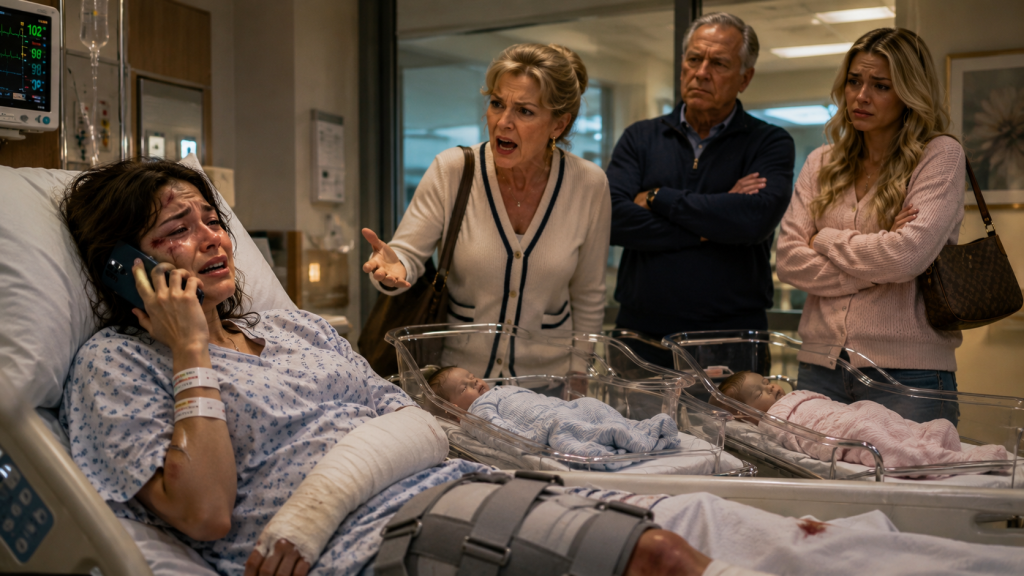
I woke beneath white hospital lights with a fractured pelvis, two shattered ribs, a broken wrist, and a surgeon warning me that walking again would take months.
My one-year-old twins, Noah and Lily, had survived because their rear-facing car seats held firm. They had bruises from the straps and were frightened by every loud sound, but the pediatrician assured me they would recover.
My husband, Ethan, had died from a sudden heart condition eleven months earlier. Since then, I had managed our home, my financial consulting company, and two babies while trying to grieve quietly enough that no one became uncomfortable.
That morning, however, I could not sit up without assistance.
I could not lift either child.
I could not even reach for the cup of water beside my bed without sending pain through my ribs.
A hospital social worker had arranged an emergency sitter for Noah and Lily, but the woman could remain for only twenty-four hours. After that, I needed family, a temporary caregiver, or an approved placement.
My parents were my last call.
“Mom,” I whispered when she answered.
There was laughter in the background and the hollow pop of a plastic ball striking a paddle.
“Mara?” she said impatiently. “I’m about to start a match.”
“I was in a crash.”
“I know. Claire texted us.”
Her flat response made me wonder whether she understood how serious it had been.
“The doctors say I won’t walk normally for several months. I need you and Dad to take Noah and Lily until I can manage at home. Just a few weeks. I’ll pay for everything.”
She sighed as if I had asked her to donate a kidney.
“I still need time for pickleball! Your sister never bothers us the way you do.”
For a moment, I thought the medication had distorted her words.
“Mom, I was almost killed.”
“And we are not built-in babysitters, Mara. Your father has his golf league, and I have commitments. You made choices. You need to figure it out.”
“They’re your grandchildren.”
“They are your responsibility.”
Outside my room, Lily began crying.
I could see her through the glass wall, standing unsteadily inside a borrowed crib and reaching toward me.
My body reacted before my mind did. I tried to rise.
Pain tore through my pelvis, and I collapsed against the pillows with a cry.
“Mom, please,” I said. “I can’t even hold my daughter.”
She lowered her voice.
“You always make everything dramatic. Claire never does this to us.”
Then she hung up.
I stared at the ceiling while every payment I had made for my family marched through my mind.
My parents’ house.
Their SUV.
Their medical premiums.
Their country club dues.
Their vacations to Italy, Hawaii, and the Bahamas.
My sister Claire’s failed clothing boutique.
My father’s dental implants.
My mother’s kitchen renovation.
The new roof my father had laughingly called “an early inheritance in reverse.”
For eight years, I had been the family bank.
Claire had been the family princess.
I had told myself that supporting them was an expression of love. My company had done well, and I had more than enough money. When my father’s business failed, I bought the house they wanted because they could not qualify for a mortgage.
When my mother worried about retirement, I covered their health insurance and deposited five thousand dollars into their account every month.
When Claire’s boutique collapsed, leaving her with unpaid vendors and credit-card debt, I hired her as a “brand consultant” even though she rarely answered emails and never attended meetings.
Ethan had warned me.
“They don’t appreciate you,” he once said. “They appreciate access to you.”
I had defended them.
“They’re family.”
“So are you,” he replied. “When do they take care of you?”
I had no answer then.
Now, listening to Lily cry while I lay helpless in a hospital bed, I finally did.
A nurse named Elena found me crying silently. She picked up my phone before it slipped from my bandaged hand.
“Who can I call?” she asked gently.
I looked through the glass wall at my babies.
Noah was sitting in the second crib, clutching the stuffed elephant Ethan had bought him before he died. Lily had stopped crying and was watching the doorway, waiting for someone familiar to appear.
Something inside me became very still.
“Daniel Cho,” I said. “My attorney.”
Daniel answered on the first ring.
He had handled my company’s legal affairs for six years and had helped Ethan organize our estate shortly before his death.
“Mara, I heard about the crash,” he said. “Are you all right?”
“No.”
There was a brief silence.
“What do you need?”
“I want every family payment stopped tonight. Cards, insurance, club fees, allowances, leases, payroll transfers—everything. No exceptions.”
Daniel did not ask whether I was sure.
He knew me well enough to understand that I did not make impulsive financial decisions.
“Including the residence?” he asked.
“Yes.”
My parents called it their home, but the deed belonged to a holding company I controlled. They had never qualified for financing. I had purchased the property and allowed them to live there rent-free through a renewable occupancy agreement.
The current agreement had six weeks remaining.
Daniel’s voice sharpened.
“They will panic.”
“They should have thought of that before abandoning two babies.”
“What about Claire?”
“Terminate her consulting contract according to the nonperformance clause. Freeze her company card. Stop the monthly transfer.”
“I’ll take care of it.”
“Daniel?”
“Yes?”
“I need help for Noah and Lily.”
His tone softened.
“My wife’s cousin runs a licensed temporary-care agency. I’ll call her tonight. We’ll find someone qualified to stay with you and the children.”
I closed my eyes.
“Thank you.”
At midnight, the automated transfers vanished.
The authorized cards froze.
My parents’ SUV lease was flagged for return because I had guaranteed it through my company.
Their country club membership went unpaid.
Their premium health plan shifted into its final covered month.
Claire’s monthly consulting payment disappeared from payroll.
At 12:07 a.m., my mother called six times.
I turned the phone facedown.
At 12:19, my father called.
At 12:26, Claire sent a message.
WHAT DID YOU DO?
Then another.
MY CARD WAS DECLINED IN FRONT OF EVERYONE.
Then a third.
FIX IT NOW.
I did not respond.
For the first time in eight years, I let them solve their own emergency.
The next morning, Daniel arrived with coffee, legal documents, and a calm woman in her late fifties named Ruth Bennett.
Ruth had worked as a neonatal nurse before opening a home-care agency. She spoke softly, moved confidently, and seemed to understand what Noah and Lily needed before they cried.
She lifted Lily from the crib and brought her close enough for me to kiss her forehead.
Then she placed Noah beside me, supporting his weight so he could curl against my uninjured side.
“We’ll make this work,” Ruth said. “You focus on healing. I’ll help with the rest.”
I had known her for less than ten minutes, yet she offered more kindness than my mother had shown during our entire conversation.
At noon, Daniel updated me.
“Your parents contacted the bank, the club, the leasing company, and my office,” he said. “They claim there has been a mistake.”
“There wasn’t.”
“Claire threatened to sue.”
“On what grounds?”
“She hasn’t decided yet.”
Despite the pain in my ribs, I laughed.
Claire had never once asked whether the twins were safe.
She had not visited the hospital.
She had not even sent a message about the crash.
Her concern began only when her card stopped working.
An hour later, my father called again.
This time, I answered.
“Mara,” he said, forcing warmth into his voice. “Thank God. We’ve been trying to reach you.”
“I noticed.”
“Your mother’s cards stopped working. The bank says the account connected to them has been closed. The country club called too. There must be some technical problem.”
“There is no technical problem.”
Silence followed.
“What does that mean?”
“It means I stopped paying.”
His breathing changed.
“Mara, your mother couldn’t buy groceries this morning.”
“Yesterday, you expected a woman who couldn’t sit up to somehow care for two babies alone.”
“That is different.”
“How?”
“We raised our children. We’ve done our part.”
“And I’ve paid your bills for eight years. I’ve done mine.”
“Families help each other.”
I looked toward Ruth, who was feeding Lily while Elena checked Noah’s temperature.
“Families help each other,” I repeated. “That’s exactly the problem. In this family, help has only traveled in one direction.”
His voice became harder.
“You’re upset because your mother said no.”
“I’m awake because a surgeon rebuilt part of my pelvis. My children almost lost their only living parent. Mom said pickleball was more important than keeping them safe.”
“She was caught off guard.”
“She had enough time to compare me to Claire.”
“We can discuss this when you’re calmer.”
“I am calm.”
That seemed to frighten him more than anger would have.
“The occupancy agreement ends in six weeks,” I continued. “Daniel will send written notice today. You and Mom can sign a market-rate lease or find another place to live.”
“You’re evicting your own parents?”
“No. I’m ending a gift.”
“Mara, we have nowhere to go.”
“You have savings.”
“Not enough for that neighborhood.”
“Then choose a neighborhood you can afford.”
He whispered my name as if I had become unrecognizable.
I ended the call.
By evening, my mother and Claire had arrived at the hospital.
They did not come with flowers.
They did not ask to see the twins.
They marched into my room as though they were entering a board meeting.
My mother still wore her pickleball skirt and white athletic shoes. Claire wore a cream designer coat I had paid for the previous Christmas.
“This has gone far enough,” Mom announced.
Ruth stood between them and the twins’ cribs.
“Visiting hours are limited,” she said. “Please keep your voices down.”
My mother looked her up and down.
“Who are you?”
“The caregiver Mara hired because her family refused to help.”
Mom’s face tightened.
Claire stepped closer to my bed.
“Turn my card back on.”
“No.”
“My rent is due.”
“Then pay it.”
“You know I don’t have that kind of cash available.”
“You received eight thousand dollars a month from my company.”
“I had expenses.”
“You had no job duties.”
Her cheeks reddened.
“That was our arrangement.”
“No. Our arrangement required you to provide consulting services. You missed every quarterly review, ignored client requests, and submitted work copied from websites. The contract has been terminated.”
“You can’t do that to me.”
“I already did.”
Mom raised both hands.
“Enough. You’re punishing the whole family because I couldn’t drop everything without warning.”
“You were playing pickleball.”
“It was a tournament.”
“My children needed somewhere safe to sleep.”
“Why couldn’t one of Ethan’s relatives help?”
“Ethan’s parents are dead. You know that.”
“Well, you have money. Clearly you found someone.”
The words struck me with such force that for a moment I could not speak.
To my mother, the fact that I could pay a stranger erased her abandonment.
“I did find someone,” I said. “That’s why I no longer need to purchase help from you.”
Mom recoiled.
“We never asked you to purchase our love.”
“You asked me to cover the house, the car, the club, the insurance, the vacations, and Claire’s lifestyle. What exactly did you think you were selling?”
Claire stared at me.
“You think you’re better than us because Ethan left you money?”
I felt the room become quiet.
My husband’s death had nearly destroyed me.
He had not “left me money” as some lucky accident. We had built our company together from a rented office above a bakery. We had worked nights, weekends, and holidays. After his death, I had kept it running while raising our twins and waking every morning to the empty side of our bed.
“Leave,” I said.
“Mara—” Mom began.
“Leave now, or I’ll ask security to remove you.”
Claire’s expression changed.
For the first time, she seemed to realize that I meant it.
Mom leaned closer.
“You will regret humiliating your family.”
“No,” I replied. “I regret financing people who abandoned me.”
Ruth opened the door.
Neither of them moved until Elena appeared with a security officer.
As my mother walked out, she glanced at the twins for the first time.
She did not kiss them.
She did not ask whether they were injured.
She only said, “Look what your mother is doing to us.”
That sentence ended any doubt I had left.
The hospital kept me for eleven days.
During that time, Ruth arranged a rotating team of caregivers, Daniel coordinated modifications to my house, and my employees covered my most urgent work.
My parents and Claire launched a campaign.
They called relatives I had not heard from in years.
They told them I had suffered a “mental breakdown” after the crash.
They claimed I was throwing my elderly parents into the street.
They described Claire as a devoted sister whose income I had cruelly taken away without notice.
No one mentioned the twins.
My aunt Susan called first.
“Your mother is devastated,” she said.
“Did she tell you why I stopped paying?”
“She said you asked her to babysit while you recovered.”
“I asked her to care for two one-year-old children after I nearly died.”
“She said she already had commitments.”
“She was playing pickleball.”
Aunt Susan paused.
“Well, everyone needs boundaries.”
“I agree. That’s why I created mine.”
“But the house—”
“Belongs to me.”
“Family shouldn’t use money as a weapon.”
“I’m no longer using money at all. That’s what they’re angry about.”
The calls eventually stopped.
Some relatives believed my parents.
Others quietly admitted they had watched my family take advantage of me for years.
One cousin sent a message that stayed with me.
They are not upset because you changed. They are upset because their access changed.
Three weeks after the crash, I returned home in a wheelchair.
Daniel had installed ramps, widened the nursery doorway, arranged a hospital bed in the downstairs study, and hired overnight support.
The first evening, Ruth placed both twins on a padded mat beside me.
Noah crawled into my lap carefully.
Lily rested her head against my shoulder.
I could not hold them the way I wanted, but I could touch their hair, sing their bedtime song, and feel their small hands wrapped around my fingers.
For the first time since the crash, I believed we would be all right.
My parents were not doing as well.
Without my monthly support, they discovered that their retirement income barely covered groceries, utilities, and basic insurance.
The leased SUV was returned.
My mother lost her country club membership.
Their planned cruise was canceled.
Claire moved into their guest room after missing two rent payments on her apartment.
Within a month, the three people who had complained that my babies would interfere with their freedom were living together and blaming one another for every inconvenience.
Daniel showed me the emails.
My father requested a reduced rent.
My mother demanded that I restore their medical coverage.
Claire insisted that her termination was unlawful.
I responded to each through counsel.
The rent would be based on market value.
Their medical insurance would remain active through the end of the already-paid period, giving them time to purchase another policy.
Claire’s termination stood.
Then Daniel discovered something that changed the situation completely.
Claire had used her company card for more than personal meals and clothing.
Over eighteen months, she had charged nearly seventy thousand dollars in travel, furniture, cosmetic procedures, and inventory for a new online boutique she had never disclosed.
Several expenses had been labeled as client development.
Two signatures on reimbursement forms had been forged.
Daniel brought the evidence to my house.
“You could pursue criminal charges,” he said.
I looked at the documents for a long time.
Ethan’s photograph sat on the desk beside me.
He had always believed Claire would eventually cross a line too large for me to ignore.
“What happens if I don’t?” I asked.
“We can demand repayment, file a civil claim, and include a confidentiality provision in any settlement. But the forged signatures create significant exposure.”
I thought about Noah and Lily.
I did not want years of public family warfare. I wanted safety, recovery, and peace.
“Offer her one chance,” I said. “She signs an acknowledgment, agrees to a repayment plan, gives up any claim against the company, and attends the meeting with her own attorney. If she refuses, we proceed.”
Claire refused.
At first.
Then Daniel sent her lawyer the documentation.
Two days later, she requested the meeting.
It took place in my home because I still could not travel easily.
Claire arrived with an attorney and none of her usual confidence.
My parents came with her even though they had no legal role.
My father looked older without his expensive haircut and tailored golf clothes. My mother wore ordinary slacks and a sweater I recognized from years earlier.
They sat across from me at the dining table Ethan had built from reclaimed oak.
Claire’s attorney reviewed the agreement quietly.
The repayment amount had been reduced in exchange for her cooperation and a strict payment schedule.
“You should sign,” he told her.
Claire glared at me.
“You’re taking everything.”
“No,” I said. “I’m asking you to repay part of what you stole.”
“I didn’t steal. You never cared what I spent before.”
“I cared. I simply trusted you.”
Mom leaned forward.
“She made mistakes. She’s your sister.”
“Being my sister gave her access. It did not give her permission.”
My father rubbed his face.
“Mara, can’t we go back to how things were?”
I looked at him.
“How things were?”
He lowered his hand.
“You helped us. We supported you emotionally.”
“When?”
The question hung between us.
“After Ethan died, you went to Hawaii because the trip was nonrefundable. Mom visited for two days, complained that the twins cried at night, and left early. Claire came to the funeral, asked about Ethan’s life-insurance policy, and never returned.”
“That is unfair,” Mom said.
“It is accurate.”
“We loved Ethan.”
“You loved the vacations he paid for.”
My father looked toward the floor.
For a moment, I saw shame in his face.
My mother only looked angry.
“You’ve always kept score,” she said.
“No. That was my mistake. I never kept score at all.”
Claire’s attorney placed a pen in front of her.
She signed.
My parents’ occupancy agreement became the next issue.
They could not afford market rent, and no bank would finance the property for them. Daniel offered a six-month transition period at a reduced rate, followed by a move-out date.
My father accepted.
My mother did not.
“This is my home,” she said.
“It is the house I allowed you to use.”
“I designed that kitchen.”
“I paid for it.”
“I chose every tile.”
“I paid for those too.”
She stood abruptly.
“One day Noah and Lily will see what kind of daughter you are.”
I felt a cold clarity settle over me.
“They will see a mother who survived.”
My mother left without signing.
My father remained behind.
After Claire and the attorneys departed, he sat silently at the table.
“I should have come to the hospital,” he said.
“Yes.”
“I wanted to.”
“But you didn’t.”
“Your mother said we shouldn’t encourage you to depend on us.”
I almost smiled at the absurdity.
“I paid nearly every major expense you had.”
“I know.”
“You already depended on me.”
“I know.”
His eyes filled with tears.
It was the first time I had seen him cry since Ethan’s funeral.
“I failed you,” he said.
I wanted those words to repair something.
They did not.
But they mattered.
“Why was Claire always treated differently?” I asked.
He took a long time to answer.
“She needed more help.”
“So you gave her more love?”
“No. We thought you were strong.”
“Strong children still need parents.”
He nodded.
“I understand that now.”
“No, Dad. You understand that now because the money stopped.”
He flinched, but he did not argue.
Before he left, he signed the transition agreement.
My recovery was slow.
At first, physical therapy meant sitting upright for thirty seconds without fainting.
Then it meant transferring from the bed to the wheelchair.
Then standing between parallel bars while two therapists supported my weight.
Every movement hurt.
Every step felt impossible.
But Noah and Lily became my reason to continue.
Ruth brought them to the therapy room at home.
They clapped whenever I stood.
Noah shouted, “Mama!” as if I had crossed a finish line.
Lily tried to imitate me by holding the side of my walker and taking exaggerated steps.
Three months after the crash, I crossed the living room using a walker.
I cried before I reached the other side.
Not because of the pain.
Because Ethan should have been there.
That night, after the babies were asleep, Ruth found me sitting beside his photograph.
“He would be proud of you,” she said.
“I’m tired of being strong.”
“Then don’t be strong tonight.”
She sat beside me while I cried.
She did not tell me to calm down.
She did not remind me that others had bigger problems.
She simply stayed.
That was when I began understanding the difference between people who loved me and people who benefited from me.
Six months after the crash, my parents moved into a modest two-bedroom condominium thirty minutes away.
My father found part-time work at a hardware store.
My mother sold jewelry and furniture to cover moving expenses.
Claire rented a room from a friend and began working at a department store while making monthly repayments to my company.
I heard about their struggles through other relatives.
For the first time, I did not rush to rescue them.
My father called occasionally.
At first, every conversation contained an indirect request.
Could I help with the moving truck?
Could I cover the condominium deposit?
Could I make one final insurance payment?
Each time, I said no.
Eventually, the requests stopped.
Then our conversations became shorter but more honest.
He asked about therapy.
He remembered the twins’ birthdays.
He mailed Noah a small wooden truck and Lily a picture book purchased with his own money.
The gifts were inexpensive.
They meant more than the luxury items he had once bought using my card.
My mother did not call for nearly five months.
When she finally did, I was walking with a cane.
“I heard you’re better,” she said.
“I’m improving.”
“That’s good.”
Neither of us spoke for several seconds.
Then she said, “Your father thinks we should apologize.”
“What do you think?”
“I think you overreacted.”
There it was.
Not regret.
Not accountability.
Only resentment that her choices had consequences.
“I asked you to keep your grandchildren safe,” I said.
“You asked me to give up my life.”
“For a few weeks.”
“It would never have been a few weeks. You always need something.”
I gripped the phone more tightly.
“I paid your expenses for eight years.”
“That was your choice.”
“Yes,” I said. “And stopping was my choice too.”
She inhaled sharply.
“You’ve changed.”
“The crash changed what I was willing to ignore.”
“You turned your father against me.”
“No. Reality did that.”
She hung up.
This time, I did not cry.
One year after the crash, I walked into Noah and Lily’s second birthday party without a cane.
The celebration was held in our backyard beneath strings of yellow and blue paper lanterns.
My employees came with their families.
Elena attended with her husband.
Daniel and his wife brought a wagon for the twins.
Ruth arrived early and cried when she saw me walking across the grass.
“You did it,” she said.
“We did it.”
My father came alone.
He stood near the gate holding two wrapped gifts and looking uncertain.
I had invited him after months of consistent effort. He had never demanded forgiveness. He had never asked me to restore financial support. He simply called, listened, and accepted my boundaries.
When Noah saw him, he ran forward.
My father knelt and opened his arms.
The sight hurt, but not in the old way.
It felt like watching something broken being rebuilt carefully, without pretending the cracks had never existed.
“Happy birthday,” he whispered to the twins.
He stayed for two hours.
He helped clean spilled juice.
He carried folding chairs.
Before leaving, he approached me.
“Your mother wanted me to ask whether she could come.”
“Did she apologize?”
“No.”
“Then you know the answer.”
He nodded.
“I do.”
A week later, a letter arrived from her.
It was six pages long.
The first four described everything she had lost: the house, the club, her social circle, her vacations, her reputation.
The fifth page blamed my father for failing to stop me.
Only on the final page did she mention the twins.
She wrote that she hoped they would one day understand that grandparents deserved freedom too.
I placed the letter in a drawer and did not answer.
Two months later, Claire asked to meet me.
We chose a coffee shop near my office.
She looked different without designer clothes, extensions, and expensive makeup. She wore a simple navy dress and carried a worn leather bag.
“I got promoted,” she said after we sat down.
“That’s good.”
“I manage the department now.”
“Congratulations.”
She stared into her coffee.
“I used to think normal work was beneath me.”
“I know.”
“I thought because you had so much, taking from you didn’t count.”
“It counted.”
“I know that now.”
She reached into her bag and placed an envelope on the table.
Inside was an extra payment toward the money she owed.
“I sold some inventory from the boutique,” she explained.
“You could have kept this under the agreement.”
“I didn’t want to.”
I studied her face.
“Why are you here, Claire?”
Her eyes filled.
“To say I’m sorry.”
I waited.
Not because I wanted her to suffer, but because apologies in my family had always been followed by requests.
She did not ask for anything.
“I was jealous of you,” she continued. “Mom said you thought you were better than us. Every time you helped, I told myself you were showing off. It was easier than admitting I was using you.”
I looked out the window.
People hurried along the sidewalk carrying bags, pushing strollers, living ordinary lives.
“When I was in the hospital,” I said, “you never asked whether Noah and Lily were alive.”
She covered her mouth.
“I know.”
“That is the part I can’t forget.”
“I don’t expect you to.”
We did not reconcile that day.
But we began something smaller and more honest.
A month later, she mailed birthday cards to the twins.
At Christmas, she sent each child a book and nothing expensive.
I allowed her to visit for one hour while Ruth remained nearby.
Trust did not return simply because she apologized.
It returned in tiny pieces, earned through consistent behavior.
My mother remained outside our lives.
Occasionally, she sent messages through relatives.
She complained that I had “chosen strangers over family.”
In one sense, she was right.
I chose Ruth, who held my babies when I could not.
I chose Elena, who wiped my tears without making me feel weak.
I chose Daniel, who protected my children’s future.
I chose employees who brought meals, covered meetings, and never once asked what they would receive in return.
I chose people whose love was visible in their actions.
Blood had made my parents relatives.
Behavior determined whether they remained family.
Two years after the crash, I stood on a stage at my company’s annual meeting.
My pelvis still ached when the weather changed, and I could no longer run, but I could walk.
Noah and Lily sat in the front row with Ruth.
They were three years old, restless, curious, and completely unaware that their lives had once depended on a hospital’s twenty-four-hour emergency-care limit.
I announced a new employee emergency fund named after Ethan.
It would help workers facing accidents, illnesses, bereavement, or temporary childcare crises.
“No one should have to choose between healing and keeping their children safe,” I told the room.
After the applause, Lily climbed onto the stage.
She wrapped both arms around my leg and announced loudly, “My mommy can walk.”
Everyone laughed.
I lifted her carefully.
My body was not what it had been before the crash.
My family was not what it had been either.
Both had been broken.
But not everything broken needed to be restored to its previous shape.
Some things could be rebuilt stronger, with better boundaries and truer foundations.
That evening, after the twins were asleep, I sat alone on the porch.
My father had sent a photograph of the wooden shelves he had built for his condominium. Claire had made another repayment. Ruth had left a container of soup in my refrigerator even though I had told her I could cook.
My mother had sent nothing.
For once, her silence did not feel like rejection.
It felt like peace.
I thought about the woman I had been before the crash—the woman who believed generosity could transform neglect into love.
She had paid every bill, solved every crisis, and swallowed every disappointment.
She had mistaken being needed for being cherished.
The crash had taken my ability to walk.
For a while.
My family’s abandonment had taken something else: the illusion that I could buy a place in their hearts.
That loss had been permanent.
And it had saved me.
I turned off the porch light and walked inside without a cane.
Noah stirred when I checked his room.
Lily had kicked off her blanket.
I covered her gently and stood between their beds, listening to them breathe.
They would grow up knowing that love was not measured by money, obedience, or sacrifice without limits.
They would know that asking for help was not weakness.
They would know that family was supposed to appear when life became unbearable—not only when the credit card worked.
My mother had once told me to figure it out.
So I did.
I found caregivers.
I rebuilt my body.
I protected my company.
I learned to say no.
I stopped every cent that had been purchasing the appearance of love.
And in the silence that followed, I finally heard the truth.
I had never needed to earn a family.
I only needed the courage to recognize one.
THE END! THANK YOU FOR READING!