

At midnight, my husband’s daughter appeared at our front door with her husband and two oversized suitcases.
“Dad said we’re moving in,” Madison announced.
She did not ask whether it was a convenient time.
She did not apologize for waking us.
She simply stepped across the threshold, rolled her suitcase over the hardwood floor, and looked around my home as though she were inspecting a hotel suite that had failed to meet her standards.
Her husband, Evan, followed with the second suitcase.
He was wearing an expensive camel-colored coat and white sneakers that were already leaving damp marks on the floor.
“Careful,” I said. “The rain made your shoes wet.”
Evan glanced down but did not remove them.
Madison gave me a tight smile.
“I’m sure it’ll dry.”
Behind them, my husband, Robert, stood near the staircase in his robe.
He would not meet my eyes.
That told me everything.
This had not been a sudden emergency.
He had known they were coming.
Perhaps not for long, but long enough to warn me.
Long enough to prepare a guest room.
Long enough to speak to his wife before inviting two adults to move into the house we shared.
Instead, he had remained silent until they were standing in our foyer at midnight.
Madison handed me a folded sheet of paper.
“This will make things easier,” she said.
I opened it.
It was a chore schedule.
Not for her.
Not for Evan.
For me.
Breakfast at seven.
Coffee prepared before they came downstairs.
Laundry on Tuesdays and Fridays.
Fresh towels every other day.
Vacuuming outside their room before noon.
No loud television after eight because Evan was “sensitive to overstimulation.”
Organic groceries only.
Oat milk, unsweetened.
No onions in shared meals.
No scented cleaning products.
Madison had even added a section titled “Emotional Boundaries.”
Underneath it, she had written:
No criticism.
No negative energy.
No discussion of rent.
I read the entire page without changing my expression.
Madison mistook my silence for surrender.
“We’ve had a stressful month,” she explained. “We need stability, and Dad said this is our home too.”
I looked at Robert.
His face tightened.
“Laura,” he said quietly, “they just need a little time.”
“How much time?”
“We’ll discuss it tomorrow.”
Madison walked toward the stairs.
“We’ll take the room beside Dad’s office.”
“That is my office,” I said.
She paused.
“The one with the blue walls?”
“Yes.”
“It’s much bigger than the guest room.”
“Because I work there.”
She laughed as if I had made a joke.
“You can use the guest room. I need the natural light for meditation and content creation.”
“Content creation?”
“I’m building a mindfulness brand.”
Evan lifted his phone.
“We’re documenting our healing journey.”
I stared at them.
They had arrived at midnight with suitcases, demands, and a printed schedule for my labor, yet somehow they considered themselves victims in need of healing.
Robert rubbed his forehead.
“Can we please not argue tonight?”
I folded the chore list carefully.
Then I smiled.
“All right,” I said.
Robert looked relieved.
Madison looked victorious.
Neither of them understood that my smile was not agreement.
It was the smile I used when a client revealed more than they intended during a negotiation.
I worked as an independent financial compliance consultant.
For twenty-eight years, I had helped small companies identify internal theft, fraudulent accounting, and hidden liabilities before those problems destroyed them.
I had learned never to interrupt someone who was confidently making a mistake.
People told you everything when they believed you were powerless.
“Wonderful,” Madison said. “I knew you’d understand.”
She kissed Robert’s cheek.
“Thank you, Daddy.”
Then she turned to Evan.
“Come on. Let’s clear out the office before we sleep.”
My smile disappeared.
“No.”
Madison blinked.
“No?”
“You will sleep in the guest room tonight. My office remains untouched.”
She crossed her arms.
“Dad already said we could use it.”
Robert finally looked at me.
Only for a second.
That second was enough.
He had promised her my office.
The room where I kept confidential client files.
The room containing locked cabinets, backup drives, and equipment purchased with my business income.
The one space in the house that was entirely mine.
“Robert,” I said, “did you give Madison permission to dismantle my office?”
He sighed.
“I said we could rearrange things temporarily.”
“Without asking me?”
“They’re family.”
“So am I.”
Madison made an impatient sound.
“This is exactly the kind of negative energy I was talking about.”
I turned to her.
“You arrived at midnight and handed me instructions for serving you. Do not lecture me about energy.”
Her cheeks reddened.
“This is Dad’s house.”
“No,” I said. “This is our house.”
Robert stepped forward.
“Laura, enough.”
There it was.
Not Madison, enough.
Not Evan, take off your wet shoes.
Not I’m sorry I made a decision without you.
Laura, enough.
I looked at the man I had been married to for eight years and felt something inside me become very still.
“All right,” I repeated.
I went upstairs.
But I did not go to bed.
At one in the morning, I heard furniture scraping across the floor.
At one fifteen, something heavy struck the hallway wall.
At one twenty, a drawer slammed.
Robert lay beside me, pretending to sleep.
I sat up.
“Your daughter is inside my office.”
He kept his eyes closed.
“We’ll sort it out tomorrow.”
I turned on the bedside lamp.
“Robert.”
He finally looked at me.
“They’ve been through a difficult situation.”
“What situation?”
“Problems with their apartment.”
“What kind of problems?”
“The landlord was harassing them.”
“Why?”
“I don’t know all the details.”
“You invited them into our home without knowing the details?”
“They’re my children.”
“Madison is thirty-two.”
“She’s still my daughter.”
“And I’m still your wife.”
He stared at the ceiling.
“They need me right now.”
“What do you think I need?”
He had no answer.
I put on my robe and walked down the hall.
The door to my office was open.
My desk had been shoved against the wall.
Two framed certificates lay facedown on the floor.
My printer sat in the hallway.
Boxes of confidential files had been stacked beside the stairs.
Madison was spreading a cream-colored rug across the center of the room.
Evan was attaching a circular light to a tripod.
“What are you doing?” I asked.
Madison did not even look embarrassed.
“Creating a peaceful environment.”
“You removed my files.”
“They were cluttering the room.”
“Those files are confidential.”
“We didn’t open them.”
“You were told not to touch anything.”
Evan shrugged.
“We thought Dad had explained.”
Robert had followed me into the hallway.
I turned toward him.
“Tell them to put everything back.”
He hesitated.
That hesitation ended our marriage, although neither of us knew it yet.
“Laura,” he said, “it’s already late.”
Madison smiled faintly.
I looked at the overturned photographs, the cables stretched across the carpet, and the boxes containing years of work.
Then I nodded.
“Leave it,” I said.
Robert frowned.
“What?”
“Leave everything exactly as it is.”
Madison seemed pleased.
“Thank you.”
I picked up my laptop, the locked portable drive from the bottom cabinet, and the small fireproof document box I kept beneath my desk.
Then I walked downstairs.
For the rest of the night, I sat at the kitchen island.
I reviewed the deed to the house.
The mortgage documents.
Bank transfers.
Our prenuptial agreement.
My business insurance.
The home security records.
Robert had insisted on the prenuptial agreement before our wedding.
“At our age, everyone needs to protect themselves,” he had said.
I had agreed.
According to that agreement, any equity created by my premarital contribution remained traceable as my separate property.
Seventy percent of the down payment had come from the sale of my condo.
The rest had come from Robert’s savings.
We were both listed on the deed, but our financial interests were not equal.
More importantly, the agreement gave neither spouse the authority to grant permanent occupancy to adult relatives without written consent from the other.
Robert had forgotten that clause.
I had not.
At three thirty in the morning, I checked the security application on my laptop.
The front door log showed something strange.
The lock had been accessed remotely seven times during the previous week.
I had not opened it remotely.
Neither had Robert, according to his usual pattern.
Someone had attempted to create a new access code.
Twice, the system had rejected the request.
The third time, it had accepted a temporary code from Robert’s account.
I stared at the screen.
He had given Madison access before she arrived.
How long had this been planned?
At four, I called the non-emergency police number.
I explained that two unapproved occupants had entered my home using a code created without my consent, had interfered with confidential business materials, and might have tampered with the lock.
The dispatcher advised me not to confront them physically.
An officer could come in the morning to document the situation.
At four fifteen, I called a twenty-four-hour locksmith.
At four forty, I emailed my attorney.
At five, I photographed every item removed from my office.
At five thirty, I made breakfast.
Two boiled eggs.
Dry toast.
Black coffee.
No butter.
No jam.
No bacon.
No fried potatoes.
Nothing luxurious enough to encourage my new guests to feel comfortable.
At six, Madison entered the kitchen wearing silk pajamas and staring at her phone.
She stopped when she saw the table.
“What is this?”
“Breakfast.”
She looked at the plate as though I had insulted her.
“Dad told you I eat protein pancakes.”
I glanced toward Robert, who stood near the doorway tying his robe.
He avoided my eyes.
“Your instructions said you don’t eat greasy food,” I replied pleasantly. “This meal is not greasy.”
Evan wandered in behind her, yawning.
“Where’s the oat milk?”
“In the refrigerator.”
Madison looked sharply at me.
“You’re supposed to pour it for him.”
I smiled.
Then I placed a second sheet of paper on the kitchen island.
Madison frowned.
“What’s that?”
“My list.”
Robert looked directly at me for the first time that morning.
I tapped the document.
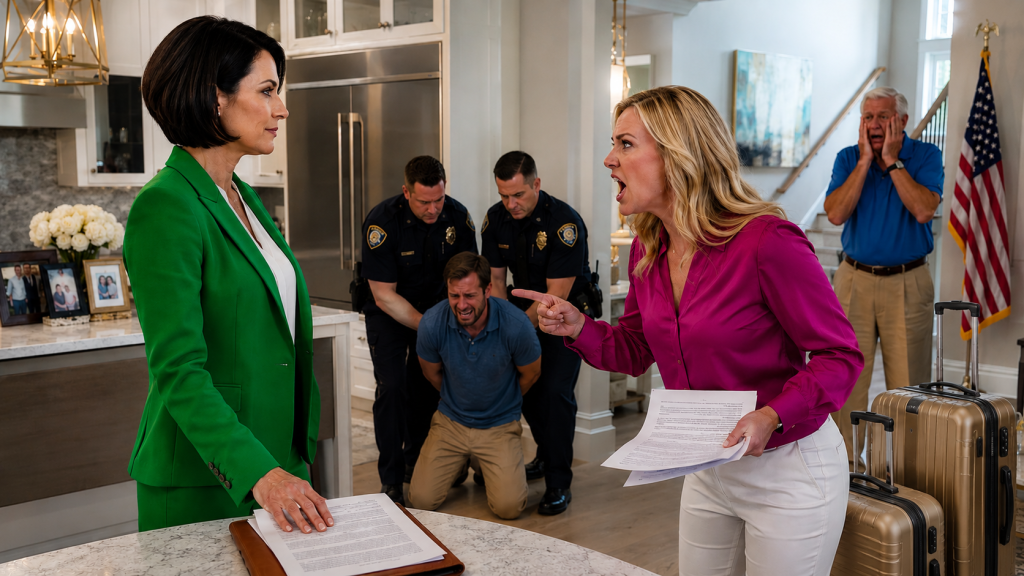
“These are the house rules. Rent is due every Friday. Two adults will pay a total of two thousand dollars each month. Utilities will be divided equally. The kitchen is off-limits after nine. You will clean your own room, wash your own clothes, and prepare your own meals. And if either of you touches my office equipment again, you will be required to leave immediately.”
Madison gave a mocking laugh.
“You can’t charge us rent. This is Dad’s house.”
“No,” I said. “This is our house. My name is on the deed, and seventy percent of the down payment came from the sale of my condo.”
Robert’s face lost its color.
Madison turned to him.
“Dad?”
He cleared his throat.
“Laura, don’t make this more difficult than it needs to be.”
I opened the drawer beside me and removed a folder.
“I am not making it difficult. I am making it clear.”
I spread copies of the deed and prenuptial agreement across the island.
Madison’s confidence slowly changed to confusion.
“You have until noon,” I said. “Sign the temporary occupancy agreement, pay the first week’s rent, restore my office, and follow the rules. Otherwise, take your suitcases and leave.”
Evan stared at me.
“You’re serious?”
Before I could answer, the doorbell rang.
Madison smirked.
“Good. Maybe someone reasonable finally showed up. Did you order breakfast, Dad?”
I opened the front door.
A uniformed police officer stood on the porch beside a locksmith holding a metal toolbox.
Behind me, Robert spoke in a low, uneasy voice.
“Laura, what did you do?”
I turned to him.
“What you should have done when they arrived last night.”
The officer introduced himself as Officer Daniel Ruiz.
“I’m here regarding a reported access dispute and possible tampering with the front-door lock.”
Madison stepped into the foyer.
“Tampering? That’s ridiculous. My father gave us permission to enter.”
Officer Ruiz looked at Robert.
“Did you authorize them to enter?”
Robert swallowed.
“I gave my daughter a temporary code.”
“Does the other homeowner agree that they may stay here?”
Robert glanced at me.
“No,” I said.
The officer nodded.
“This is partly a civil matter, but if there has been damage, unauthorized access to private business files, or tampering with security equipment, we need to document it.”
The locksmith set his toolbox down.
“I’ll inspect the lock first.”
His name was Mr. Harlan.
He was in his late fifties, with silver hair and the calm movements of someone who had spent decades opening doors without damaging them.
He removed the interior plate.
After several seconds, he frowned.
“That’s unusual.”
He used a thin tool to reach inside the housing.
Then he pulled out a tiny black object wrapped in clear tape.
Officer Ruiz stepped closer.
“What is it?”
Mr. Harlan placed it in his palm.
“Looks like a tracking device or a signal relay. It doesn’t belong inside a residential lock.”
The hallway went silent.
Madison’s face turned pale.
Evan stepped backward.
Officer Ruiz noticed.
“Either of you know what this is?”
“No,” Madison said too quickly.
Evan said nothing.
The officer held out a gloved hand.
“May I?”
The locksmith gave him the device.
Officer Ruiz examined it.
“It may be designed to capture access signals. I’m going to request another unit.”
Madison turned toward Evan.
The look between them lasted less than a second.
But I saw it.
So did the officer.
A second patrol car arrived moments later.
Two officers approached the house.
One carried a printed photograph.
When Officer Ruiz looked at it, his expression changed.
He turned the photograph toward Madison and Evan.
It showed a dark SUV parked outside an apartment building.
Beside it stood Evan, speaking to a broad-shouldered man in a leather jacket.
“Do you know this man?” Officer Ruiz asked.
Evan’s face hardened.
“No.”
Madison whispered, “Evan.”
He shot her a warning look.
The officer continued.
“This photograph was circulated after an incident at your apartment complex last night. Your landlord reported a break-in to the building’s management office. Several tenant files and master access devices were stolen.”
Robert stared at Evan.
“What is he talking about?”
Evan lifted both hands.
“This has nothing to do with us.”
“Then why did you leave your apartment in the middle of the night?” Officer Ruiz asked.
“Our landlord was harassing us.”
“What kind of harassment?”
“He was threatening eviction.”
“For what reason?”
Evan did not answer.
Madison wrapped her arms around herself.
Robert moved toward her.
“Sweetheart, tell me what happened.”
She looked at him with tears forming in her eyes.
“We fell behind on rent.”
“How far behind?”
“Three months.”
Robert looked shocked.
“But I gave you six thousand dollars in April.”
I turned toward him.
He had never told me that.
Madison looked down.
“We used some of it for the business.”
“What business?” I asked.
“My wellness platform.”
Evan stepped in.
“It was an investment.”
Officer Ruiz held up a hand.
“We’ll discuss the finances later. Right now, I need to know how this device ended up in the lock.”
No one spoke.
The locksmith examined the doorframe.
“There’s more,” he said.
He pointed toward the lower edge of the frame.
“Someone removed these screws recently. See the marks?”
Officer Ruiz crouched.
“When?”
Mr. Harlan shrugged.
“Within a few days, probably.”
I looked at Robert.
“When did you give Madison the door code?”
“Last week.”
Madison’s head snapped toward him.
Officer Ruiz heard the question.
“Why did she need a code last week if she moved in last night?”
Robert looked confused.
“She said she wanted to bring over a few boxes while we were at dinner.”
My stomach tightened.
“What dinner?”
“Thursday.”
Thursday night, Robert and I had attended his former colleague’s retirement party.
We had been gone for four hours.
I turned toward Madison.
“You were inside this house while we were away?”
She shook her head.
“No.”
The security system told a different story.
I opened the application on my phone.
“The temporary code was used Thursday at seven twelve.”
Madison’s eyes filled with panic.
“That must be wrong.”
Officer Ruiz held out his hand.
“May I see?”
I showed him the access history.
The door had opened at seven twelve.
It had closed at seven fourteen.
Opened again at eight forty-three.
Closed at nine eighteen.
More than two hours inside.
Robert stared at his daughter.
“You told me you were only dropping off boxes.”
“I was.”
“There were no boxes here when we came home.”
“I changed my mind.”
Evan stepped toward the door.
“This is getting out of control. Madison, get dressed. We’re leaving.”
Officer Ruiz blocked his path.
“Not yet.”
“I’m not under arrest.”
“No, but I need to identify everyone present and preserve the device found in the lock.”
“I’ve done nothing wrong.”
The officer remained calm.
“Then cooperating is the fastest way to clear this up.”
Evan’s jaw tightened.
Madison began crying.
Robert immediately put an arm around her.
That instinctive gesture infuriated me more than I expected.
He still wanted to protect her before knowing what she had done.
“Laura,” he said, “please stop this.”
“I did not hide a device in our door.”
“You called the police.”
“Because someone entered my home without my knowledge and interfered with my office.”
“They’re family.”
Officer Ruiz looked at him.
“Sir, being related does not give someone unrestricted access to another person’s property.”
Robert fell silent.
The second officer examined the device and spoke quietly into his radio.
Officer Ruiz asked me whether anything else seemed disturbed after Thursday.
I thought about it.
My office had looked normal Friday morning.
But one cabinet door had been slightly open.
I had assumed I had forgotten to close it.
The cabinet contained old financial records, insurance documents, and copies of our identities.
I went upstairs with Officer Ruiz.
Madison tried to follow.
He stopped her.
“Please remain downstairs.”
When we entered the office, the damage from the night before made it difficult to tell what had been moved earlier.
I pointed to the cabinet.
The lock showed a thin scratch beside the keyhole.
Officer Ruiz photographed it.
“Was this locked Thursday?”
“Yes.”
“Who has keys?”
“Only me.”
“Are you certain?”
“I keep the key on my personal key ring.”
He examined the cabinet.
“Has anything been removed?”
I opened it carefully.
The folders were disorganized.
I checked the labeled sections.
Property records.
Tax returns.
Insurance.
Business registration.
Robert’s retirement accounts.
My passport copy.
Then I reached the folder containing the original deed packet.
It was thinner than it should have been.
“The notarized ownership statement is missing,” I said.
“What does it establish?”
“My original contribution to the house.”
“Anything else?”
I searched again.
A copy of Robert’s driver’s license was missing.
So was an old utility bill.
Officer Ruiz’s expression became serious.
“Those documents could be used to impersonate a homeowner or support a fraudulent application.”
The blood drained from my face.
“What kind of application?”
“A loan. A property transfer. A new account. It depends on what other information they have.”
I thought of the device inside the lock.
“Could someone use that thing to get back into the house?”
“Possibly. Or to record access data.”
We returned downstairs.
Robert was questioning Madison.
She sat at the kitchen table with tears running down her cheeks.
“I didn’t steal anything,” she insisted.
Evan stood behind her with one hand on her shoulder.
The protective gesture looked rehearsed.
Officer Ruiz placed the photograph on the island.
“Who is the man with Evan?”
Madison stared at the floor.
Robert leaned closer.
“Tell him.”
She whispered, “His name is Cole.”
Evan removed his hand from her shoulder.
“Madison, stop.”
Officer Ruiz turned toward him.
“Cole what?”
“I don’t know his last name,” she said.
“How do you know him?”
“He helped us with financing.”
“For the wellness business?”
She nodded.
Evan interrupted.
“He was a private lender. That’s not illegal.”
“How much did you borrow?” I asked.
Evan glared at me.
“This doesn’t concern you.”
“It concerned me when a signal device appeared inside my front door.”
Robert looked between them.
“How much?”
Madison’s voice was barely audible.
“Forty thousand.”
Robert stumbled backward.
“Forty thousand dollars?”
“We were going to repay it after the launch.”
“What launch?” I demanded.
“The app,” she said. “The retreats. The membership subscriptions.”
“Do any of those exist?”
Her silence answered me.
Evan’s confidence began cracking.
“We had unexpected costs.”
Robert ran both hands through his hair.
“You borrowed forty thousand dollars from a stranger?”
“He wasn’t a stranger,” Madison said weakly.
Officer Ruiz asked, “What collateral did you offer?”
Evan answered immediately.
“None.”
Madison covered her face.
The officer watched her.
“What did you offer?”
She began sobbing harder.
“Madison,” Robert said, “tell us.”
She looked at her father.
“The house.”
For several seconds, no one moved.
Robert stared at her.
“What house?”
“This one.”
His face twisted in disbelief.
“You cannot use this house as collateral. You don’t own it.”
“Cole said we only needed proof that Dad had equity.”
My hands turned cold.
“What documents did you give him?”
She shook her head.
“Nothing official.”
Officer Ruiz spoke firmly.
“What documents?”
Madison’s breathing became shallow.
“A copy of Dad’s license.”
Robert gripped the back of a chair.
“You stole my identification?”
“I borrowed it.”
“From where?”
“Your desk.”
“Thursday night?” I asked.
She nodded.
“What else?”
“A utility bill.”
“The ownership statement?” I asked.
Her eyes lifted toward me.
Evan stepped forward.
“We’re done answering questions.”
Officer Ruiz faced him.
“You are free to stop speaking. But the evidence found inside this home and the reported burglary at your apartment building are separate matters. Investigators may obtain warrants if necessary.”
Evan looked toward the windows.
A black sedan had pulled up across the street.
Madison saw it too.
Her entire body stiffened.
“That’s him,” she whispered.
Officer Ruiz turned.
“Cole?”
The sedan remained parked.
The driver did not get out.
The officer radioed the plate number.
Within moments, the sedan pulled away.
The second patrol car followed.
Officer Ruiz ordered everyone to stay inside.
Madison clutched Robert’s arm.
“He found us.”
“What does that mean?” Robert asked.
She looked at Evan.
He said nothing.
Madison’s voice trembled.
“We missed a payment.”
“You said the landlord was harassing you,” Robert said.
“It wasn’t the landlord.”
The truth came out in fragments.
Cole had loaned them forty thousand dollars six months earlier.
The written agreement described the money as a business investment, but the real terms were different.
They owed weekly payments.
When they missed one, the amount increased.
When they missed three, Cole began appearing outside their apartment.
Evan had promised him access to Robert’s home equity.
He claimed Robert planned to refinance and give them part of the money.
Robert had never agreed to anything.
When Cole demanded proof, Madison stole documents from our house.
Then Evan discovered that their apartment manager kept copies of tenant identification and emergency contact information in the management office.
Among those files was Robert’s address.
Evan and Cole had entered the office after hours.
Evan insisted Cole had broken the lock.
He claimed he had only watched.
But the photograph showed him there.
The police had already recovered security footage.
Madison and Evan had fled their apartment because Cole believed they were trying to disappear.
They came to our house not because they needed family support.
They came because they had used our address in the fraudulent loan documents.
They expected Cole to come here.
The tracking device in the lock had been installed Thursday night.
Evan admitted Cole had given it to him.
He claimed he did not know exactly what it did.
He had hidden it while Madison searched my cabinet.
Robert looked twenty years older.
“You brought a criminal to our home?”
Evan’s eyes flashed.
“We made a mistake.”
“A mistake?” I said. “You stole our documents, tampered with our security, entered my office, and used our property in a fraudulent loan.”
Madison stood.
“We were desperate.”
“So you handed me a chore list?”
Her mouth opened.
No words came out.
“You arrived here knowing a dangerous man might follow you,” I continued. “You planned to hide in my house, take over my office, and order me to serve you while you waited to see what happened.”
“I was scared.”
“You were arrogant.”
Robert looked at me sharply.
“Laura.”
“No. You do not get to silence me again.”
He flinched.
I pointed toward the staircase.
“Your daughter moved into my office because she wanted access to my records. The mindfulness space was a lie.”
Madison shook her head.
“That wasn’t—”
“Then why choose the only locked room containing financial documents?”
She stopped.
I turned to Robert.
“And you helped her.”
“I didn’t know.”
“You gave her the security code. You promised her my office. You concealed the money you gave her. You invited her to live here without speaking to me.”
“I was trying to help my child.”
“You were trying to avoid disappointing her. There is a difference.”
Officer Ruiz received a message over his radio.
The black sedan had been stopped three streets away.
The driver was identified as Cole Mercer.
He had an outstanding warrant related to financial fraud and unlawful debt collection.
Inside the sedan, officers found copies of Robert’s identification, our address, photographs of the house, and a handwritten schedule of our movements.
They also found a second electronic device matching the one hidden in our lock.
Madison collapsed into a chair.
Robert covered his mouth.
Officer Ruiz asked Evan to turn around.
Evan’s face hardened.
“For what?”
“Suspicion of burglary, identity theft, conspiracy to commit fraud, and unlawful entry.”
Madison screamed.
Robert stepped forward.
“Wait. He didn’t—”
The officer looked at him.
“Sir, we have security footage placing him at the apartment management office during the break-in. We have the stolen homeowner documents, and we have his connection to the device installed in your lock.”
Evan backed away.
“This is Madison’s family. She got the documents.”
Madison stared at him.
“What?”
“You took them,” he said. “I never touched the cabinet.”
“You told me which files to find.”
“That’s not true.”
“You gave Cole our access code!”
“You wanted the money!”
Their marriage unraveled in less than a minute.
They shouted over each other.
Madison accused Evan of forging her signature.
Evan accused Madison of lying to Robert for years.
She admitted the wellness company had never earned a profit.
He admitted he had lost twelve thousand dollars gambling online.
She admitted the rent money Robert gave them had been used to make a payment to Cole.
He admitted he had promised Cole that Robert would refinance our house.
Robert stood in the middle of the kitchen, listening to the collapse of every illusion he had protected.
Officer Ruiz handcuffed Evan.
Madison sobbed as her husband was taken outside.
Then another officer approached her.
“Madison Bennett?”
She looked up.
“You need to come with us as well.”
Robert moved between them.
“She was manipulated.”
The officer remained professional.
“She will have an opportunity to provide a statement. But stolen documents were recovered, and she has admitted entering the home to obtain them.”
“She is my daughter.”
“That does not prevent an investigation.”
Madison reached for him.
“Daddy, please.”
The word seemed to break something inside him.
For years, that word had controlled him.
Daddy.
It transformed every demand into a need.
Every lie into a misunderstanding.
Every consequence into cruelty.
He had paid her credit cards.
Covered missed rent.
Financed failed businesses.
Replaced a car she had wrecked while texting.
Paid for a wedding more expensive than our first home.
Whenever I questioned the pattern, he accused me of lacking compassion.
Now the police were standing in our kitchen because his compassion had no boundaries.
Robert took Madison’s hand.
For one frightening moment, I thought he would ask me to lie.
Instead, he whispered, “Tell them the truth.”
Madison stared at him.
“What?”
“Tell them everything.”
“You’re supposed to protect me.”
“I did.”
His voice cracked.
“I protected you from every consequence until you became someone who thought consequences were for other people.”
She pulled her hand away.
The officers escorted her outside.
The front door closed.
The house became silent.
The boiled eggs remained untouched on the table.
Evan’s coffee had spilled across the chore list Madison had given me.
The ink ran down the page, blurring the words laundry, breakfast, towels, silence.
Robert sat heavily in a chair.
“I didn’t know,” he said.
I began gathering my documents.
“You did not want to know.”
“That’s not fair.”
“Isn’t it?”
“I thought she needed somewhere safe.”
“She did need somewhere safe. She also needed honesty, accountability, and professional help. Instead, you gave her my home without my permission.”
“Our home.”
“You stopped treating it as ours the moment you made decisions as though I were a guest.”
He rubbed his forehead.
“I made a mistake.”
“This was not one mistake.”
I listed them calmly.
The six thousand dollars.
The secret security code.
The promised office.
The midnight arrival.
The chore list he watched her hand me.
The silence while she dismantled my workspace.
The demand that I stop objecting.
Each decision had been a choice.
Each choice had told me where I stood.
Robert began crying.
I had seen him cry only twice before.
Once when his mother died.
Once when Madison walked down the aisle.
“I love you,” he said.
“I believe you.”
He looked up hopefully.
“But love without respect is not enough.”
His face collapsed.
“Are you leaving me?”
“I have not decided what happens next.”
It was true.
At that moment, I was too angry to make a permanent decision.
But I knew the marriage we had before midnight no longer existed.
The locksmith replaced the entire security system.
He changed the deadbolt, reinforced the frame, reset the electronic access panel, and inspected every exterior door.
The police collected the hidden device and copies of our security records.
My attorney called at nine thirty.
After hearing the details, she advised us to freeze our credit, notify the mortgage company, place fraud alerts on every account, and request an immediate title review.
The title review revealed the final shock.
Someone had already submitted preliminary paperwork for a home equity loan.
The application was incomplete.
It had not been funded.
But it contained Robert’s forged signature.
It also contained mine.
The signature looked convincing because it had been copied from a scanned business agreement stored in my office.
Had the lender not required an in-person verification, the fraud might have succeeded.
The requested amount was two hundred and fifty thousand dollars.
Robert read the number three times.
“Madison would never take that much.”
My attorney looked at him across the video call.
“Your daughter may claim she did not understand the full amount. But her identification appears in the supporting documents.”
Robert went silent.
I froze every joint account that could legally be restricted and moved my business funds to a new institution.
Robert did not object.
For the first time since the ordeal began, he seemed to understand that trust was no longer assumed.
It had to be earned.
That afternoon, I restored my office.
Robert carried the desk back into place.
He rehung my certificates.
He replaced the damaged frame around one of them.
He gathered every candle, cushion, camera light, and piece of “mindfulness” décor Madison had brought into the room.
When he found her printed vision board beneath the rug, he stopped.
At the center was a photograph of our house.
Above it, she had written:
FAMILY LEGACY HOME.
Underneath were the words:
Dad transfers equity.
Renovate studio wing.
Launch retreats.
Evan handles financing.
Robert sat on the floor.
“She planned all of this.”
“Yes.”
“She thought the house would become hers.”
“Yes.”
He looked at me.
“Did you know she hated you?”
“I don’t think she hated me. I think she viewed me as an obstacle.”
That was worse.
Hatred acknowledged another person’s power.
Madison had barely considered me a person at all.
To her, I was the woman occupying the house she believed belonged to her father and would eventually belong to her.
My money had purchased most of it.
My work maintained it.
My name was on the deed.
None of those facts mattered to her because Robert’s indulgence had taught her that his possessions existed for her benefit.
That evening, Robert packed a suitcase.
“I’ll stay at a hotel,” he said.
I nodded.
He seemed surprised that I did not stop him.
“At least until things settle down.”
“Things will not settle down by themselves.”
“I know.”
He placed his wedding ring on the dresser, then picked it up again.
“I don’t know what to do.”
“Start by telling the truth.”
“To you?”
“To yourself.”
He left without another word.
For the next two weeks, my house was quieter than it had been in years.
I changed the alarm codes again.
I installed cameras.
I met with investigators.
I gave a formal statement.
I reviewed every financial document connected to the attempted loan.
Madison was released pending further proceedings after agreeing to cooperate.
Evan remained in custody because the police connected him to the management-office break-in and to two similar fraud complaints in another county.
Cole Mercer faced multiple charges.
According to investigators, he had operated a predatory lending scheme targeting people with failing businesses and gambling debts.
He pressured them into providing information about relatives with property.
Then he used forged documents and intimidation to extract money.
Evan had not merely been trapped by Cole.
He had helped identify potential victims.
Robert was one of them.
So was I.
Madison called me eleven days after her arrest.
I almost did not answer.
“Laura,” she said softly, “I’m sorry.”
I waited.
“I know you hate me.”
“I don’t hate you.”
“You called the police.”
“I protected my home.”
“You could have handled it privately.”
“Your husband installed a device inside my lock and helped steal financial documents.”
“He was scared.”
“So were you. Fear does not erase responsibility.”
She began crying.
“Dad won’t give me money for a lawyer.”
“He found you a public defender.”
“That’s not the same.”
“No. It is what he can responsibly provide.”
“He says I have to sell my car.”
“You may have to.”
“It was a wedding gift.”
“It is also an asset.”
Her voice sharpened.
“You sound pleased.”
“I am not pleased. I am relieved that reality has finally entered the conversation.”
She fell silent.
Then she said, “I didn’t know Evan was planning to take so much.”
“How much did you think he was taking?”
“I thought Dad would borrow fifty thousand and help us.”
“Without asking him?”
“I thought he would understand.”
“That belief is the problem.”
She breathed shakily.
“I was going to pay it back.”
“With what income?”
“The business could have worked.”
“But it had not worked.”
“People invest in ideas all the time.”
“They invest their own money or money given with informed consent. They do not forge signatures.”
She was quiet for a long time.
Then she whispered, “I really did think of the house as Dad’s.”
“I know.”
“He always called it our family home.”
“It is a family home. That does not make it your property.”
“No one ever said no to me before.”
The confession was so simple that it almost hurt.
Not because it excused her.
Because it explained how thoroughly Robert had failed her.
Children needed affection.
They also needed boundaries.
A parent who removed every obstacle did not raise a secure adult.
He raised someone terrified of discomfort and enraged by limits.
“Someone is saying no now,” I told her.
“What happens to us?”
“That depends on what you do next.”
“Will you forgive me?”
“Forgiveness is not the first step.”
“What is?”
“Truth. Restitution. Accountability. Then time.”
She cried again.
But this time, I did not rush to comfort her.
A month later, Robert asked to meet me at a quiet café.
He looked tired.
He had lost weight.
He placed a folder on the table.
Inside were statements from every account he controlled.
A list of every payment he had secretly made to Madison during our marriage.
The total was seventy-eight thousand dollars.
I stared at the number.
He had taken much of it from his personal retirement income, which was legally his to spend.
But he had lied whenever I asked why our shared plans kept being delayed.
A kitchen renovation.
A trip to Italy.
Additional mortgage payments.
He had always claimed unexpected expenses.
Now I knew the unexpected expense had a name.
Madison.
“I thought if I told you,” he said, “you would make me stop.”
“I would have asked you to stop.”
“I know.”
“So you lied.”
“Yes.”
He did not defend himself.
That mattered.
But it did not repair the damage.
He continued.
“I started seeing a therapist.”
I said nothing.
“I learned something I should have understood years ago. I confused rescuing her with loving her.”
“Yes.”
“And I made you pay for it.”
“Yes.”
He swallowed.
“I want to come home.”
I looked through the café window.
A mother was walking with a little boy outside.
The child pulled against her hand because he wanted to run toward the street.
She held firmly.
He cried.
She did not release him.
Love was sometimes the hand that held on.
Sometimes it was the door that stayed closed.
“I’m not ready,” I said.
Robert nodded.
“I understand.”
“We need a legal separation.”
His eyes filled with tears, but he nodded again.
“I’ll sign whatever is fair.”
“I don’t want revenge.”
“I know.”
“I want clarity.”
“You deserve it.”
We agreed that I would remain in the house.
Because of my larger documented contribution, Robert transferred his share of the property to me in exchange for a fair settlement from other marital assets.
My attorney ensured every document was reviewed independently.
There would be no ambiguity.
No hidden promises.
No informal family understandings.
Just clear ownership.
Six months passed.
Evan eventually pleaded guilty to several charges connected to fraud and burglary.
Cole received a longer sentence after investigators uncovered multiple victims.
Madison accepted a plea agreement requiring probation, restitution, financial counseling, and community service.
She sold her luxury car.
She moved into a small studio apartment.
For the first time in her adult life, she worked a regular full-time job.
Not as a wellness founder.
Not as an influencer.
She became the receptionist at a physical therapy clinic.
Robert did not pay her rent.
He did not replace her car.
He did not call her employer when she complained about her schedule.
He listened.
He encouraged.
But he did not rescue.
Sometimes she hated him for it.
That was part of the process.
One Saturday morning, nearly a year after the midnight invasion, Madison appeared at my front door.
She did not have a suitcase.
She carried a cardboard box.
The new camera alerted me before she rang the bell.
I opened the door but did not invite her inside.
“I called first,” she said.
I checked my phone.
There was a missed call from an unknown number.
“I changed my number,” she explained.
“What’s in the box?”
“Your files.”
My body tightened.
“What files?”
“Copies Evan made.”
She held out the box.
“I found them in a storage unit under my name. The police released the things that weren’t evidence.”
I took the box but did not open it.
“Have the investigators seen these?”
“Yes. My lawyer gave them access.”
She looked different.
Her hair was shorter.
Her coat was inexpensive.
There were shadows under her eyes.
But the biggest difference was in the way she stood.
She no longer entered spaces as though she owned them.
“I also brought this.”
She handed me an envelope.
Inside was a check for five hundred dollars.
“What is this?”
“The first restitution payment to you.”
“The court did not order restitution directly to me.”
“I know. This is separate.”
“For what?”
“The damaged office furniture. The locksmith. The security system.”
“The costs were much higher than five hundred.”
“I know.”
She took a breath.
“I can pay five hundred now. Then one hundred every month.”
I studied her face.
“Why?”
“Because you were right.”
“About what?”
“I treated you like an obstacle. I told myself you had taken Dad away from me. But the truth is, I thought everything he had should eventually become mine.”
She wiped her eyes.
“When you said no, I thought you were cruel. Now I understand that I had built my whole life around people saying yes.”
I looked at the check again.
“You cannot purchase forgiveness.”
“I know.”
“This does not erase what happened.”
“I know.”
“And you will not be moving into this house.”
A small, sad smile touched her face.
“I know that too.”
For the first time, her answers did not contain an argument.
I opened the door wider.
“You may come in for coffee.”
She hesitated.
“Are you sure?”
“For coffee. Not for residence.”
She nodded.
“Understood.”
We sat at the same kitchen island where she had once declared the house belonged to her father.
I poured the coffee.
She poured her own oat milk.
Neither of us mentioned it.
Robert and I remained separated for fourteen months.
During that time, he did not pressure me.
He continued therapy.
He attended financial-boundary counseling.
He apologized without demanding forgiveness.
He accepted that reconciliation was not something he could earn through a checklist.
It had to become something I genuinely wanted.
Eventually, we began having dinner once a week.
Then twice.
He never used his daughter’s progress to excuse his betrayal.
He understood that Madison’s crimes and his choices were separate.
One evening, he stood outside my front door and waited.
The symbolism was not lost on either of us.
“This is your house,” he said. “May I come in?”
I looked at the new lock.
The reinforced frame.
The camera.
The door that had once concealed a tracking device and a web of lies.
Then I looked at Robert.
He was still my husband legally, though not yet again in practice.
He no longer assumed entry.
He asked.
That mattered.
“Yes,” I said. “You may come in.”
We did not return to the marriage we had before.
That marriage had depended on silence.
Instead, we built something more careful.
Robert moved back months later under a written financial agreement.
Some people found that unromantic.
I found it peaceful.
Love did not become weaker because expectations were clear.
It became safer.
Madison continued making restitution payments.
She eventually divorced Evan.
She completed probation.
Years later, she returned to school part-time to study occupational therapy.
Her new dream was smaller than the wellness empire she had once imagined.
It was also real.
On the second anniversary of that terrible midnight, she came to dinner.
She brought a loaf of bread she had baked herself.
Robert cooked.
I sat at the table.
No one handed me a chore list.
After dinner, Madison helped wash the dishes.
When she finished, she paused beside my office door.
The blue walls had been repainted.
My certificates were back in place.
The desk faced the window.
A new lock protected the file cabinet.
“I’m sorry about this room,” she said.
“I know.”
“I thought turning it into a mindfulness space would make me look like I belonged here.”
“You did belong here as a visitor and as Robert’s daughter.”
“But not as an owner.”
“No.”
She nodded.
“I understand now.”
Before leaving, she stopped on the porch.
“Laura?”
“Yes?”
“Thank you for calling the police.”
Robert looked startled.
Madison gave a small laugh.
“I hated you for it. But if you hadn’t, Evan and Cole would have kept going. Maybe they would have taken the house. Maybe someone would have gotten hurt. Maybe I would still be lying.”
I thought about the officer, the locksmith, and the tiny black device pulled from inside my door.
The discovery had felt like the destruction of our family.
In reality, it had exposed the damage already growing beneath the surface.
The locksmith had not merely found a tracking device.
He had uncovered years of secrecy.
Robert’s enabling.
Madison’s entitlement.
Evan’s deception.
My own habit of tolerating disrespect to preserve peace.
Every hidden weakness had been dragged into the light.
And once we could see it, we could finally choose whether to repair it.
“You’re welcome,” I told her.
She hugged her father.
Then, after a moment’s hesitation, she hugged me too.
It was not a perfect ending.
Perfect endings belonged to the kind of false image Madison once posted online—soft lighting, calming music, carefully cropped backgrounds that hid the mess outside the frame.
Our ending was better.
It was honest.
The house remained mine.
Robert lived there because I chose to share it with him, not because he assumed the right.
Madison visited because she respected the boundaries, not because she believed blood entitled her to ownership.
And the front door stayed locked.
Not out of fear.
Out of wisdom.
Sometimes protecting a family requires opening your home.
Sometimes it requires closing the door.
And sometimes, at six in the morning, it requires a police officer, a locksmith, and the courage to let the truth come inside.
THE END! THANK YOU FOR READING!