

The halls of Mercy General were filled with the smell of antiseptic, cold coffee, and quiet fear.
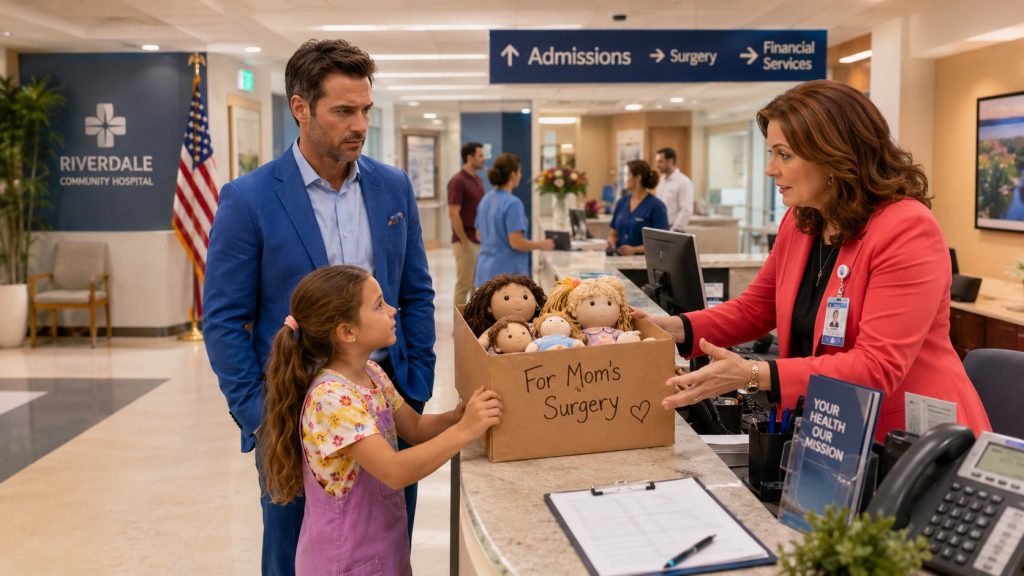
Under the bright fluorescent lights, five-year-old Sarah Miller stood alone beside the admissions desk, holding a worn cardboard box tightly against her chest.
She kept her head raised, just as her mother had taught her whenever unpaid bills appeared beneath the door of their small apartment.
Inside the box were the three dolls she treasured most.
Emma was the blonde doll she had received for her fifth birthday.
Penny was the tiny doll she held whenever thunder shook the windows.
And Luna was a soft cloth doll her mother had stitched from scraps of faded blue fabric during a freezing winter night when Sarah had been too frightened to sleep.
There was no money inside the box.
Sarah understood that.
But the dolls were the most valuable things she owned, and she believed that when someone you loved needed help, you offered everything you had.
“Please,” she said softly to the woman behind the desk. “My mommy is Anne Miller. A car hit her after she pushed me out of the way. You can have all my dolls.”
The clerk looked at the box, then at Sarah’s faded pink shirt and worn sneakers. One of the child’s shoelaces had snapped and been tied together with a small knot.
“Where is your father?” the woman asked.
Sarah tightened her arms around the box.
“I don’t have one.”
“Is there a grandparent, aunt, uncle, or another adult we can contact?”
Sarah slowly shook her head.
“It’s just Mommy and me.”
The clerk lowered her voice, but Sarah still heard every word.
“We need an adult who can provide insurance details or payment information. The hospital cannot accept toys.”
Sarah carefully lifted Luna from the box.
“She’s special,” she explained. “My mommy made her.”
A doctor passing through the corridor slowed when he noticed the little girl standing alone. Concern appeared on his face, but before he could say anything, the clerk pushed a clipboard forward.
“There is no insurance record, financial authorization, or emergency guardian listed.”
Sarah did not understand the complicated language.
She understood only one thing.
Her mother might not receive the care she desperately needed.
At that moment, the elevator doors opened, and several men in dark suits stepped into the hallway.
Among them was Matthew Sullivan, a billionaire whose name appeared on skyscrapers, charitable foundations, and the covers of business magazines.
He had come to visit an employee who had been injured at work. The hospital stop was meant to last only a few minutes before he left for an important meeting.
He had no reason to notice the small girl beside the admissions desk.
Then Sarah repeated the name.
“Anne Miller. Please help my mommy.”
Matthew stopped immediately.
His fingers tightened around his phone.
The ringing telephones, hurried footsteps, and low conversations around him seemed to disappear.
Anne Miller was not merely a name written on a hospital chart.
She was the girl with scraped knees and determined eyes who had shared her pencils with him in elementary school.
She was the child who cried when his family moved away.
She was the first person who had ever made a lonely boy feel as though he mattered.
The clerk pushed the cardboard box back toward Sarah.
“Bring the insurance documents by morning,” she said. “Your mother needs urgent treatment.”
Sarah did not cry.
She quietly returned Luna to the box and arranged the dolls carefully, as though they might also feel rejected.
Then she looked around the crowded corridor, searching for one person who understood that her entire world was lying unconscious somewhere upstairs.
Matthew stepped toward the counter.
“Tell me the patient’s name again.”
The clerk looked up and immediately noticed his tailored suit, expensive watch, and serious expression.
Sarah stared at him uncertainly.
“Anne Miller,” she repeated. “Do you know my mommy?”
For several seconds, Matthew could barely breathe.
A doctor returned carrying a folder and began explaining surgery, available treatment options, hospital rooms, financial guarantees, and authorization forms.
Matthew heard almost none of it.
His eyes remained fixed on the name printed at the top of the first page.
Anne Marie Miller.
Then he looked at the emergency-contact section.
It was completely empty.
His gaze moved back to Sarah, the damaged cardboard box, and the handmade doll sewn from faded blue cloth.
Suddenly, the hospital corridor seemed to shift beneath his feet.
Matthew carefully lifted Luna from the box.
His fingers trembled as he recognized the uneven stitches running along the doll’s left arm.
Years ago, Anne had sat beneath an old maple tree behind their elementary school, repairing a tear in Matthew’s backpack with blue thread.
She had been only nine, but she had worked with the concentration of a surgeon.
When she finished, the stitches were crooked, and one side of the bag was slightly shorter than the other.
Matthew had laughed.
Anne had crossed her arms and glared at him.
“It doesn’t have to look perfect,” she had said. “It only has to hold together.”
He had remembered those words for more than thirty years.
He looked down at Luna.
The stitching was the same.
“Your mother made this?” he asked.
Sarah nodded.
“She makes things when we can’t buy them.”
Matthew swallowed.
“Does she make your clothes too?”
“Sometimes. She fixed my winter coat with part of an old curtain.”
Sarah’s answer was simple and without embarrassment.
To her, Anne’s resourcefulness was not evidence of poverty.
It was proof that her mother could save anything.
Matthew turned toward the doctor.
“Begin whatever treatment she needs.”
The doctor hesitated.
“Sir, are you a relative?”
“No.”
“Then we still need authorization.”
“You have authorization to charge every expense to me.”
The admissions clerk stared.
Matthew removed a black card from his wallet and placed it on the counter.
“If there is paperwork, bring it. If there are specialists, call them. If there is equipment she needs, get it.”
The clerk finally recognized him.
“Mr. Sullivan?”
“Yes.”
Her expression changed instantly.
She reached for the telephone.
Within moments, nurses appeared, forms were printed, and a surgical coordinator hurried down the corridor.
The sudden activity frightened Sarah.
She clutched the box and stepped backward.
Matthew knelt so they were at eye level.
“Your mother once helped me when I had no one,” he said gently. “Now it’s my turn to help her.”
Sarah studied him carefully.
“Did you know her when she was little?”
“Yes.”
“Was she brave?”
Matthew almost smiled.
“She was the bravest person I knew.”
“She still is.”
A set of double doors opened at the end of the hallway.
A surgeon approached them, removing his glasses.
Anne had internal bleeding, two broken ribs, and a severe injury near her spine. Surgery could save her, but there were risks.
Matthew listened closely while Sarah held his sleeve.
When the surgeon finished, Matthew asked the question Sarah was too afraid to say aloud.
“Will she live?”
“We are going to do everything possible.”
The answer was not a promise.
Sarah’s small hand tightened around Matthew’s sleeve.
A nurse came to take her to the family waiting room.
Sarah refused to move.
“I need to stay where Mommy can find me.”
“She won’t be awake for several hours,” the nurse explained.
“But what if she wakes up early?”
Matthew glanced toward his assistants.
“Cancel everything.”
His chief of staff, Daniel, looked startled.
“You have the board vote at four.”
“Move it.”
“The investors flew in from three countries.”
“They can fly home.”
“Matthew, the merger—”
“Cancel everything.”
Daniel had worked for him for twelve years and had never heard him abandon a major negotiation.
But Matthew’s voice left no room for argument.
He walked beside Sarah to the waiting room.
There, beneath a television playing a muted cooking program, the little girl placed her dolls in a row.
Emma sat in the middle.
Penny leaned against the wall.
Luna remained in Sarah’s lap.
Matthew sat across from her.
For the first time in years, he did not check his phone.
He simply watched the operating-room clock move.
After several minutes, Sarah looked at him.
“Why did Mommy help you?”
Matthew leaned back and stared at the ceiling.
“My father was a difficult man. He believed children should be quiet, perfect, and useful. I was none of those things.”
Sarah frowned.
“You were a kid.”
“I know that now.”
“What did my mommy do?”
“She shared her lunch with me. She helped me with homework. Once, when older boys pushed me into the mud, she threw her shoes at them.”
Sarah smiled faintly.
“Mommy says throwing things is rude.”
“She made an exception.”
“Did you love her?”
The question was so direct that Matthew could not answer immediately.
“Yes,” he finally said.
“Then why did you leave?”
Matthew looked toward the dark window.
“My family moved away. I wrote letters, but none came back.”
“Maybe the mailman lost them.”
“Maybe.”
But Matthew had spent decades believing Anne had chosen to forget him.
That belief had shaped him more than he cared to admit.
He had built companies, bought buildings, and surrounded himself with people who needed something from him.
He had been engaged once, but the relationship ended after his fiancée accused him of never allowing anyone close enough to disappoint him.
He had told himself that he preferred being alone.
Now Anne was fighting for her life behind hospital doors, and her daughter was trying to pay for surgery with dolls.
The thought made him feel sick.
Three hours later, the surgeon returned.
The operation had stopped the bleeding, but Anne remained unconscious.
Her spine had not been severed, which meant she might walk again, but recovery would be long.
“The next twenty-four hours are critical,” the surgeon said.
Sarah stood.
“Can I see her?”
The doctor hesitated, then nodded.
A nurse helped Sarah wash her hands and put on a small yellow protective gown.
Matthew remained near the doorway of the intensive care room.
Anne looked smaller than he remembered.
Her dark hair was spread across the pillow. A bruise covered one side of her face, and machines surrounded the bed.
Sarah climbed onto a chair.
“Mommy,” she whispered. “I brought everybody.”
She held up each doll so Anne could see them.
“Emma is here. Penny is here. Luna is here.”
The machines continued beeping.
“And the man from when you were little is here too.”
Matthew closed his eyes.
Sarah leaned close to her mother.
“You can wake up now. The doctors said you’re fixed.”
A nurse turned away to hide her tears.
Matthew approached the bed.
He had imagined seeing Anne again many times, but never like this.
He gently touched the railing.
“It doesn’t have to look perfect,” he whispered. “It only has to hold together.”
Anne did not move.
That night, Matthew refused to leave.
He arranged for Sarah to sleep in a private family room next to the intensive care unit.
His assistants brought clean clothes, shoes, food, and several new dolls from an expensive toy store.
Sarah thanked them politely but left the new dolls in their boxes.
She kept Luna beside her.
“Don’t you like them?” Matthew asked.
“They’re pretty.”
“You can play with them.”
“I already have dolls.”
Matthew realized that Sarah had not offered her toys because they were replaceable.
She had offered them because they were irreplaceable.
Near midnight, a social worker arrived.
Her name was Evelyn Carter, and she explained that because Anne was unconscious and Sarah had no known guardian, child-protection procedures required a temporary placement.
Matthew stood immediately.
“She stays here.”
“I understand your concern, Mr. Sullivan, but you are not a relative.”
“I’ll sign responsibility for her.”
“It doesn’t work that way.”
“Then make it work.”
Evelyn remained calm.
“A child is not a corporation you can acquire with a signature.”
Sarah sat silently on the couch, listening.
Matthew lowered his voice.
“Her mother may die. You are not taking her to strangers tonight.”
Evelyn studied him.
“Why are you involved?”
Matthew looked at Sarah.
“Because I should have been involved years ago.”
Evelyn made several calls.
Eventually, she agreed that Sarah could remain at the hospital until morning under temporary supervision.
Matthew stayed beside the child all night.
At dawn, Anne’s condition worsened.
Her blood pressure dropped, alarms sounded, and medical staff rushed into the room.
Sarah woke to the commotion.
She ran into the hallway in her socks.
“What’s happening?”
Matthew blocked her from entering the intensive care room.
“The doctors are helping her.”
“She needs Luna.”
Sarah tried to push past him.
“She always needs Luna when she’s scared.”
Matthew knelt and held her shoulders.
“Let them work.”
Tears finally filled Sarah’s eyes.
“You said you would help.”
“I am.”
“You’re just standing here!”
Her accusation cut through him.
All his money, influence, and power meant nothing in that corridor.
He could purchase machines but not force Anne’s heart to keep beating.
He could hire specialists but not guarantee that Sarah would still have a mother by sunset.
Matthew held Sarah while she cried.
Inside the room, doctors stabilized Anne.
By late morning, her vital signs improved.
The surgeon explained that the crisis had passed, though Anne remained unconscious.
Sarah sat beside the bed again.
Matthew stepped into the corridor and called Daniel.
“I need you to find everything you can about Anne Miller.”
Daniel paused.
“Everything?”
“Where she has lived, where she worked, why she has no insurance, and whether she has relatives.”
“Isn’t that invasive?”
“Yes.”
Matthew hated the answer, but he needed to understand how Anne had ended up alone.
By afternoon, Daniel returned with a file.
Anne had worked for eleven years as a seamstress at a small costume shop. The shop had closed six months earlier.
Since then, she had cleaned offices at night and repaired clothing from home.
She and Sarah lived in a one-bedroom apartment in a deteriorating building owned by a company Matthew recognized immediately.
Sullivan Urban Properties.
One of his companies owned Anne’s building.
Matthew stared at the address.
Daniel continued carefully.
“The property-management division recently increased rent across the complex.”
“How much?”
“Thirty percent.”
Matthew’s jaw tightened.
“Were repairs completed?”
“There are several unresolved complaints. Heating failures, mold, electrical problems.”
“Who approved the increase?”
Daniel looked uncomfortable.
“The automated revenue system. The decision would not have required your direct approval.”
“But the company has my name.”
“Yes.”
Matthew looked through photographs from inspection reports.
One showed a bedroom wall stained by water.
Another showed a heater with a handwritten warning taped across it.
The report listed Anne Miller as one of the tenants who had repeatedly requested repairs.
Every request had been marked low priority.
Matthew felt ashamed.
He had not personally ignored her messages, but his fortune had grown through systems that treated people like numbers.
Anne had been sewing clothes and cleaning offices while paying increased rent to a company he owned.
Sarah had nearly lost her mother on a street where broken lights had been reported weeks earlier.
The accident happened at an intersection adjacent to the apartment complex.
A traffic camera had malfunctioned.
The streetlamp had not worked.
Both were the responsibility of contractors hired through Sullivan Urban Properties.
“What happened to the driver?” Matthew asked.
“Police found the vehicle abandoned. They are still investigating.”
Matthew closed the file.
“Fix every problem in that building today. No rent increases. Relocate tenants during repairs and cover all expenses.”
Daniel nodded.
“And Anne’s apartment?”
“Do not touch her belongings without permission.”
That evening, Matthew returned to Anne’s room.
Sarah was drawing a picture of three people holding hands.
One was small and wore a pink shirt.
One had long dark hair.
The third was tall and wore a black suit.
“Who is that?” Matthew asked.
“You.”
“Why am I in the picture?”
“Because you’re here.”
The answer seemed to Sarah as simple as the sunrise.
Matthew sat beside her.
“Do you and your mother ever talk about your father?”
Sarah’s crayon stopped.
“Mommy says he went away before I was born.”
“Do you know his name?”
Sarah shook her head.
“She said he didn’t know about me.”
Matthew felt an unexpected pressure in his chest.
“How old are you?”
“Five.”
“When is your birthday?”
“March fourteenth.”
Matthew calculated the dates without meaning to.
Six years earlier, he had attended a charity event in Chicago.
Anne had also lived in Chicago at the time, according to Daniel’s report.
Matthew looked at Sarah’s face.
Her gray-green eyes were unusual.
They were the same color as his mother’s.
He immediately rejected the thought.
It was impossible.
He had not seen Anne since childhood.
Had he?
A memory surfaced.
A winter gala.
A woman standing alone near a service entrance after an argument with an event organizer.
Matthew had offered her his coat before recognizing her.
Anne.
They had spoken for hours in a nearly empty hotel lounge.
They had laughed about childhood.
Anne had told him she was leaving Chicago the next morning.
Matthew had been drinking, but not enough to forget what happened after they went upstairs.
By morning, Anne was gone.
She left no number.
Matthew had searched briefly, but he had been preparing for a major acquisition and convinced himself that the night had meant more to him than to her.
Now Sarah’s birthday echoed in his mind.
He stood so quickly that the chair scraped the floor.
Sarah looked up.
“What’s wrong?”
“Nothing.”
He walked into the hallway and called Daniel.
“Find the exact date of the Chicago Children’s Foundation gala six years ago.”
Daniel answered minutes later.
The date was June eighteenth.
Sarah’s birthdate was almost exactly nine months later.
Matthew pressed his hand against the wall.
He returned to the room and looked at Sarah differently.
Not as Anne’s daughter.
As a possibility.
He did not ask for a test.
Not yet.
Anne had the right to speak first.
Two days passed.
Sarah stayed beside her mother.
Matthew became part of her routine.
He brought breakfast, helped her brush tangled hair, and listened while she invented stories about the hospital elevators.
He also began noticing things.
Sarah counted silently when she felt afraid.
Matthew had done the same as a child.
She disliked the crusts on sandwiches.
So did he.
She held pencils in her left hand.
He was left-handed too.
On the third morning, Anne opened her eyes.
Sarah was asleep with her head resting beside the bed.
Matthew stood by the window.
At first, Anne seemed confused.
Then she saw him.
Her expression changed from confusion to disbelief.
“Matthew?”
Her voice was weak.
He approached slowly.
“I’m here.”
Anne looked down at Sarah.
“What happened?”
“You were hit by a car. You saved her.”
Anne attempted to sit up, but pain stopped her.
“Is she hurt?”
“She has a few bruises. She’s safe.”
Anne closed her eyes with relief.
Then she looked around the private room.
“This isn’t covered.”
“It’s handled.”
Her gaze sharpened despite her exhaustion.
“What did you do?”
“What was necessary.”
“I didn’t ask you.”
“You were unconscious.”
Anne looked toward Sarah again.
“How did you find us?”
“She tried to pay for your surgery with her dolls.”
Anne’s face crumpled.
Matthew had expected anger.
He was unprepared for the sound she made as tears slipped down her cheeks.
“My baby.”
“She was brave.”
“She shouldn’t have needed to be.”
Matthew pulled a chair closer.
“Why didn’t you tell me?”
Anne became still.
“Tell you what?”
He glanced at Sarah.
Anne followed his gaze.
The silence answered him before she spoke.
“No,” Matthew whispered.
Anne looked away.
“You don’t understand.”
“She’s mine.”
It was not a question.
Anne’s eyes closed.
“Yes.”
Matthew stood and walked to the far side of the room.
For a moment, he could not speak.
Five years.
Sarah had taken her first steps, spoken her first words, suffered fevers, celebrated birthdays, and learned to draw.
He had missed all of it.
“You should have told me.”
Anne’s voice remained quiet.
“I tried.”
Matthew turned.
“What?”
“I wrote to you after I learned I was pregnant.”
“I never received anything.”
“I sent three letters to your office. One was returned. Two disappeared.”
“You could have called.”
“I did. Your assistant told me not to contact you again.”
Matthew thought of his former chief of staff, Richard Caldwell, a man hired by his father.
Richard had controlled access to Matthew during the company’s most aggressive expansion.
“What exactly did he say?”
“That you remembered our night in Chicago as a mistake. He said you were preparing to announce your engagement and that any claim involving a child would be handled by lawyers.”
“I wasn’t engaged.”
“I saw photographs of you with Victoria Lang three weeks later.”
“We attended a business event.”
Anne looked at him.
“I was pregnant, unemployed, and terrified. Your assistant knew my address. The next week, an envelope arrived containing a confidentiality agreement and a check.”
Matthew’s face hardened.
“How much?”
“Fifty thousand dollars.”
“You took it?”
“No.”
Anne’s answer came immediately.
“I tore up the check and sent everything back.”
Matthew believed her.
Not because he wanted to, but because the Anne he remembered would have rather gone hungry than accept money meant to silence her.
“Why didn’t you try again?”
“I did, after Sarah was born. I came to your headquarters. Security removed me from the lobby.”
“I never knew.”
“I finally decided that maybe not knowing was easier for you.”
“It wasn’t your decision to make.”
Anne’s eyes flashed.
“And what decision did I have? Keep bringing my baby to doors that slammed in my face? Let your lawyers call her a financial threat? I had no proof that you wanted us.”
“You knew me.”
“I knew the boy beneath the maple tree. I didn’t know the billionaire whose employees treated my daughter like a scandal.”
Matthew had no response.
Sarah stirred.
Both adults fell silent.
She opened her eyes and looked at Anne.
“Mommy?”
Anne smiled through tears.
“Hello, sweetheart.”
Sarah climbed carefully onto the side of the bed.
“You woke up.”
“I told you I would always try to come back.”
Sarah hugged her without touching the injured ribs.
Matthew stepped away, overwhelmed by the intimacy of a reunion he had almost missed forever.
Sarah noticed him near the door.
“Mr. Matthew, Mommy woke up!”
“I see that.”
“You can come closer. She knows you.”
Anne and Matthew exchanged a complicated look.
Sarah held out one hand to each of them.
For a few seconds, neither adult moved.
Then Anne allowed Sarah to take her hand.
Matthew offered his.
Sarah joined them across the hospital bed.
It was the picture she had drawn.
Over the following week, Anne began physical therapy.
Doctors were optimistic that she would walk again, although she faced months of rehabilitation.
Matthew visited every day.
He did not announce to the media that Sarah was his daughter.
He did not bring lawyers demanding custody.
Instead, he sat beside Anne and listened.
She told him about Sarah’s first word, “moon.”
She showed him photographs stored on an old phone.
Sarah as a baby wrapped in a yellow blanket.
Sarah taking her first steps toward a laundry basket.
Sarah on her third birthday wearing a paper crown.
Each image was both a gift and a punishment.
Matthew had not known.
But now that he knew, he could never reclaim the lost years.
A private DNA test confirmed what all three of them already understood.
Sarah was his daughter.
When Matthew received the result, he sat alone in his car for nearly an hour.
Then he returned to the hospital with no gifts and no prepared speech.
Sarah was coloring at a small table.
He knelt beside her.
“I need to tell you something important.”
She looked at him.
“Is Mommy sick again?”
“No. It’s about me.”
He struggled to find words a five-year-old could understand.
“You asked why your father went away.”
Sarah put down her crayon.
“He didn’t know about me.”
“That’s right.”
Matthew’s voice shook.
“I’m your father, Sarah.”
She stared at him without moving.
He waited for surprise, joy, anger, or confusion.
Instead, she asked, “Did you find out today?”
“Yes.”
“Are you going away tomorrow?”
“No.”
“Do you promise?”
Matthew looked toward Anne, who watched from the bed.
“I promise I will never choose to leave you.”
Sarah considered this.
Then she reached for Luna.
“You can hold her.”
Matthew accepted the doll.
Sarah wrapped her arms around his neck.
He held her carefully, afraid that the slightest movement might break the moment.
Anne turned toward the window as tears filled her eyes.
The reunion was not simple.
After Anne’s release from the hospital, Matthew offered to move them into his mansion.
Anne refused.
“We are not becoming guests in your life.”
“You’re not guests.”
“You learned about Sarah two weeks ago. She needs stability, not marble hallways and staff members.”
“The apartment is unsafe.”
“Then help make it safe for everyone, not only us.”
Matthew did.
He ordered a complete renovation of the complex and provided temporary housing for every tenant.
He dismissed three executives who had ignored repair complaints and created a tenant council with real authority over safety decisions.
He also established a fund to help uninsured families receive emergency medical care without facing delays.
When reporters asked why Sullivan Industries had suddenly changed its housing and healthcare policies, Matthew answered honestly.
“Because I spent years looking at numbers instead of people.”
He did not mention Sarah or Anne.
Their privacy mattered more than publicity.
Anne and Sarah moved temporarily into a modest furnished townhouse near the rehabilitation clinic.
Matthew visited after work.
At first, he arrived with expensive gifts.
Sarah liked the giant stuffed bear but became more excited when Matthew repaired Penny’s broken arm with tape.
Anne watched from the kitchen.
“You’re terrible at that,” she said.
“The tape is holding.”
“It looks awful.”
Matthew smiled.
“It doesn’t have to look perfect.”
Anne finished the sentence.
“It only has to hold together.”
For the first time since the accident, they laughed together.
Building a family proved harder than paying a hospital bill.
Matthew did not know how to braid hair.
He packed lunches Sarah refused to eat.
He once bought a child-sized designer coat that cost more than Anne’s monthly rent.
Sarah wore it for ten minutes, then returned to the coat Anne had repaired with curtain fabric.
Matthew learned.
He attended pediatric appointments.
He sat through preschool meetings.
He listened when Sarah explained that purple and yellow crayons could not share the same box because they argued at night.
He also began repairing his relationship with Anne.
They spoke about the past without pretending the lost years could be erased.
Matthew investigated Richard Caldwell.
Records revealed that Richard had intercepted Anne’s letters and sent the confidentiality agreement without Matthew’s knowledge.
Richard claimed he had been protecting the company from potential scandal.
Matthew filed legal action against him.
But punishment did not restore what had been stolen.
One evening, after Sarah fell asleep, Matthew sat with Anne on the townhouse porch.
“I keep imagining what would have happened if I had opened one letter,” he said.
“You would have come?”
“Yes.”
“You don’t know that.”
“I do.”
Anne looked at him.
“You were different then. You were consumed by the company.”
“I still would have come.”
“Maybe.”
Matthew accepted that he could not demand her faith.
“Do you hate me?”
“No.”
“That would be easier.”
Anne folded her hands.
“I hated you for a while. Then Sarah was born, and I didn’t have enough energy to hate anyone. I had to feed her, protect her, and become both parents.”
“You shouldn’t have had to.”
“No, but I did.”
Matthew stared into the quiet street.
“I don’t want to take your place.”
“You couldn’t.”
“I want to find mine.”
Anne nodded slowly.
“That will take time.”
“I have time.”
Months passed.
Anne progressed from a wheelchair to crutches, then from crutches to a cane.
On the day she took her first unassisted steps, Sarah stood at one end of the therapy room and Matthew stood at the other.
Anne walked toward her daughter.
Everyone applauded.
Sarah ran forward, but stopped herself before crashing into Anne.
“You’re fixed now,” she whispered.
Anne kissed her forehead.
“I’m healing.”
Matthew understood the difference.
Healing did not mean returning to the person you had been.
It meant learning how to live with what had changed.
The driver who struck Anne was eventually arrested.
He had been speeding through the dark intersection while looking at his phone.
He pleaded guilty.
Matthew attended the hearing but did not use his influence to demand a harsher sentence.
Anne asked only that the man acknowledge what he had done.
In court, he apologized directly to Sarah.
Sarah held Luna and asked, “Will you look at the road next time?”
The man broke down.
“Yes.”
Sarah nodded.
“Good.”
Her forgiveness was not permission to escape consequences.
It was simply the refusal to carry hatred.
A year after the accident, Anne returned to work.
Not as a cleaner or seamstress struggling from one payment to the next.
Matthew offered her positions throughout his company, but she rejected every role that felt like charity.
Instead, she created a nonprofit workshop teaching sewing, repair, and job skills to single parents.
Matthew provided the initial funding only after Anne insisted on a formal business plan and independent board.
The workshop was called Luna House.
Its symbol was a blue cloth doll with crooked stitching.
Families came there to learn that broken things did not always need to be thrown away.
Some could be repaired.
Some could be transformed.
Some became more valuable because they had survived.
Sarah started kindergarten.
On the first day, Matthew arrived wearing a suit because he had a board meeting afterward.
Anne looked at him.
“You’re going to frighten the other parents.”
“I always dress like this.”
“That is the problem.”
Sarah appeared wearing her repaired pink backpack.
Matthew had offered to buy a new one, but she refused.
Luna’s face peeked from the front pocket.
At school, the teacher asked every child to introduce the people who brought them.
Sarah stood between Anne and Matthew.
“This is my mommy,” she announced. “She can fix anything.”
Then she pointed at Matthew.
“This is my daddy. He’s learning.”
Several parents laughed.
Matthew did too.
He had spent his life being introduced as a founder, chairman, billionaire, and industry leader.
Nothing had ever meant as much as being called Sarah’s father.
His relationship with Anne changed gradually.
There was no dramatic proposal beside a hospital bed.
No instant reunion erased the years between them.
They rebuilt trust through ordinary things.
Grocery shopping.
Therapy appointments.
School projects.
Arguments over bedtime.
Quiet conversations after Sarah slept.
One rainy evening, almost two years after the accident, the three of them returned to Mercy General.
Luna House was opening a family-support center inside the hospital.
The center would provide emergency childcare, patient advocates, temporary housing assistance, and financial counseling.
No child would stand alone at an admissions desk believing toys were the only payment she could offer.
During the ceremony, Sarah carried the original cardboard box.
Emma, Penny, and Luna sat inside.
The admissions clerk who had pushed the box back was no longer working at the front desk.
An investigation found that she had ignored hospital policy, which required emergency treatment regardless of payment status.
She had not acted alone; poor training and a culture of financial fear had contributed to the moment.
Anne asked that she not be publicly humiliated.
Instead, the hospital retrained its entire admissions staff and created strict procedures to protect unaccompanied children.
Before the ribbon cutting, Sarah placed the cardboard box inside a glass display.
A plaque beneath it read:
“Everything you have may look small to the world, but love makes it priceless.”
Matthew stood beside Anne.
She no longer needed a cane.
“You did this,” he told her.
“We did this.”
“No. I wrote checks. You created the purpose.”
Anne smiled.
“You finally learned the difference.”
Sarah ran toward them.
“Come on! They’re taking pictures.”
Matthew looked uncomfortable.
Anne noticed.
“The man who appears on magazine covers is afraid of a kindergarten photographer?”
“I’m afraid Sarah will make me wear the blue hat.”
Sarah returned carrying three paper crowns made by children from the new family center.
She placed one on Anne’s head.
Then one on Matthew’s.
The third went onto her own head.
A photographer raised his camera.
Sarah stood between her parents and held their hands.
This time, the picture was real.
Later that evening, they walked through the hospital garden.
Sarah ran ahead to examine a fountain.
Matthew and Anne stopped beneath a maple tree planted near the path.
Matthew looked up at the branches.
“Do you remember the tree behind our school?”
“You cried when they cut it down.”
“I did not cry.”
“You absolutely cried.”
“I had allergies.”
“In November?”
Matthew smiled.
Then his expression became serious.
“I bought something.”
Anne raised an eyebrow.
“If it’s another house, I’m leaving.”
“It isn’t.”
“If it’s jewelry worth more than my workshop, I’m throwing it in the fountain.”
“It isn’t jewelry.”
Matthew handed her a small envelope.
Inside was a photograph of an empty piece of land beside Luna House.
Anne looked at him.
“What is this?”
“A community garden. In your name.”
“You bought land?”
“The nonprofit owns it.”
Anne studied the documents.
“There are no conditions?”
“One.”
She narrowed her eyes.
“What?”
“You let me help plant a maple tree.”
Anne looked toward Sarah, who was trying to touch the water without getting her sleeves wet.
“You’re asking permission now?”
“I’m learning.”
Anne slipped her hand into his.
They planted the tree the following spring.
The ceremony was small.
There were no reporters.
Sarah dug the first hole with a plastic shovel.
Matthew ruined an expensive pair of shoes in the mud.
Anne laughed until she had tears in her eyes.
Afterward, they sat beneath the thin young branches and ate sandwiches.
Sarah removed the crust from hers.
Matthew removed the crust from his.
Anne noticed and shook her head.
“I should have known years ago.”
Matthew leaned closer.
“Known what?”
“That she was yours.”
Sarah looked between them.
“Everybody knows now.”
“Yes,” Anne said.
“Are we a family forever?”
Anne and Matthew exchanged a glance.
Families could not promise that nothing bad would happen.
They could not guarantee there would be no arguments, fear, illness, or loss.
But they could promise to remain honest.
They could promise to keep trying.
Matthew reached for Anne’s hand.
“We’re a family for as long as we keep choosing each other.”
Sarah considered the answer.
“That means forever.”
Anne smiled.
“Yes, sweetheart. That means forever.”
Years later, the maple tree grew tall enough to shade the entrance of Luna House.
Children tied blue ribbons to its branches.
Parents found work in the sewing studio.
Families received help before desperation became disaster.
Inside the main room, the original Luna doll sat safely behind glass, though Sarah sometimes removed her for special occasions.
Sarah grew into a determined young woman who wanted to become a doctor.
When people asked why, she told them about the day her mother saved her life and strangers in a hospital saved her mother.
She also told them about the cardboard box.
“I thought my dolls were valuable enough to pay for surgery,” she would say. “I was wrong about the payment, but I was right about their value.”
Matthew eventually stepped back from daily leadership of his company.
He devoted most of his time to housing reform, emergency medical funding, and afternoons with his family.
Anne continued leading Luna House.
She never became comfortable with luxury, but she learned to accept help without mistaking it for pity.
Matthew learned that providing money was not the same as providing love.
Love required time.
It required patience.
It required showing up after the crisis ended.
On the tenth anniversary of the accident, the family returned to Mercy General.
The hospital’s support center had helped more than twenty thousand families.
A new sign stood near the admissions desk:
“No child waits alone.”
Sarah, now fifteen, carried the same battered cardboard box.
The edges were reinforced with tape, and her childhood handwriting remained visible on the side.
Anne walked beside her.
Matthew followed, holding Luna.
They placed the doll in the display one final time.
Sarah looked at her parents.
“Do you ever think about what would have happened if Dad hadn’t heard your name?”
Anne touched the faint scar near her temple.
“Sometimes.”
Matthew looked around the corridor where his life had changed.
He could have walked past.
He could have remained focused on meetings, profit, and schedules.
Instead, one name had stopped him.
But Anne shook her head.
“I don’t like thinking about what almost happened. I prefer thinking about what we chose afterward.”
Sarah smiled.
Matthew reached for both of their hands.
Around them, hospital staff hurried between patients.
Telephones rang.
Elevators opened and closed.
Somewhere, a child laughed.
Somewhere else, a family received difficult news.
Life continued with all its fear, uncertainty, and hope.
The three of them stood together beneath the bright fluorescent lights.
Once, Sarah had believed she had to surrender everything she loved to save her mother.
Instead, her small box had uncovered a truth hidden for years.
It had reunited a father with the daughter he never knew existed.
It had forced a powerful man to confront the human cost of his success.
It had transformed an old childhood promise into a family.
The cardboard box had contained no money.
Only three dolls, faded fabric, crooked stitches, and the complete devotion of a five-year-old girl.
To the world, it had looked worthless.
To Matthew Sullivan, it was the most valuable thing he had ever seen.
Because it had brought him back to Anne.
It had led him to Sarah.
And it had taught all of them that a family did not need to begin perfectly.
It only needed enough love to hold together.
THE END! THANK YOU FOR READING!