

The ballroom fell so silent that I could hear the soft hum of the air-conditioning above us.
Brett stared at me as though his mind refused to accept what his eyes were seeing.
His gaze dropped from my face to the sleeping baby in the stroller.
For one second, he looked almost human.
Almost.
Then his eyes darted toward the cameras.
That was when I knew nothing had changed.
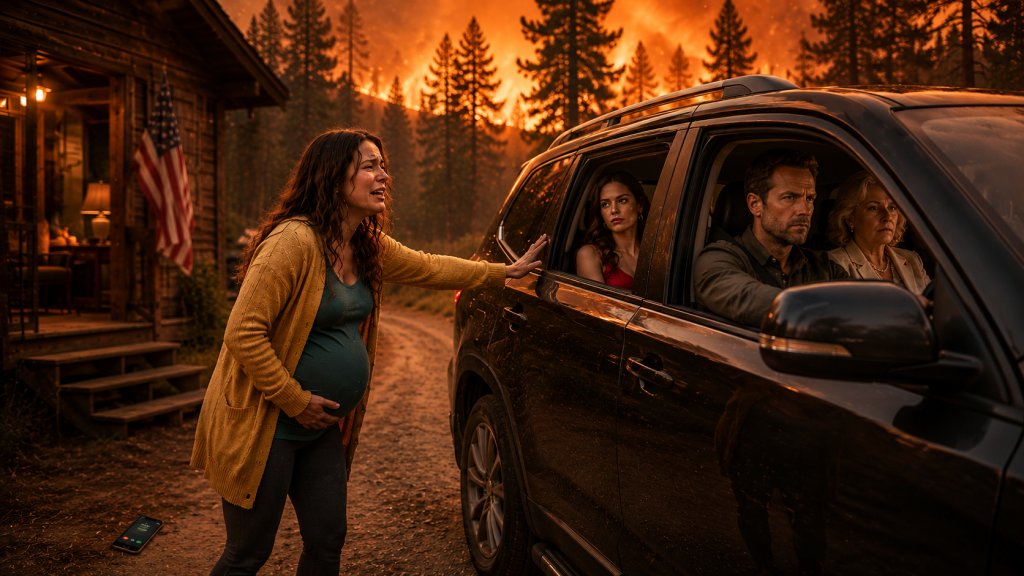
Three months ago, Brett Keene had watched his six-month-pregnant wife stand in smoke and ash while he drove away with his mother and his mistress.
Now, surrounded by reporters, donors, politicians, and wealthy business owners, his first concern was still how the moment would look.
“Natalie,” he whispered.
The microphone clipped to his jacket carried his voice through the speakers.
Everyone heard the fear in it.
“You’re alive.”
I kept my hand on the stroller.
“You sound disappointed.”
A nervous murmur traveled through the ballroom.
Tessa Vale stood near the stage curtains in a fitted black dress, the same woman who had sat in the back seat while I begged Brett not to leave me.
She took one small step away from him.
Eleanor Keene remained seated at the front table, frozen with a white tissue between her fingers.
The tissue trembled.
Brett descended from the stage.
He moved carefully, wearing the sympathetic expression he had perfected for interviews.
“Please,” he said quietly. “Not here.”
I looked around at the enormous banner above the stage.
PINE RIDGE WILDFIRE RELIEF FUND.
Beneath those words was a photograph of Brett standing beside the ruins of our cabin.
The picture had been taken two days after the fire.
He wore a soot-stained jacket and stared solemnly into the distance.
The caption beneath it read:
A HUSBAND’S LOSS BECOMES A COMMUNITY’S HOPE.
I pointed toward the banner.
“This is exactly where it needs to happen.”
“Natalie, you’ve been through something terrible. You’re emotional.”
A bitter laugh escaped me.
There it was.
The same calm, patronizing tone he had used during our marriage whenever I questioned him.
Whenever I noticed money missing.
Whenever he came home smelling like perfume.
Whenever I asked why Tessa called him after midnight.
He would lower his voice and make me feel as though my pain was embarrassing.
“You’re tired.”
“You’re imagining things.”
“You’re making everything worse.”
But the woman standing in that ballroom was no longer the woman he had left on Pine Ridge Road.
I had crawled through smoke.
I had woken in a hospital without my husband.
I had learned to sleep through nightmares while listening to my daughter’s heartbeat on a monitor.
I had given birth without Brett holding my hand.
I had survived the part of my life that he had expected to kill me.
“You told these people you lost me,” I said.
Brett glanced at the reporters.
“I believed you were missing.”
“You knew exactly where you left me.”
“I went back for you.”
“No, you didn’t.”
His expression hardened for half a second.
Only I noticed it.
Then he softened it again.
“The road was blocked. The fire department wouldn’t let anyone through.”
“That was hours later.”
“I did everything I could.”
A voice came from the back of the ballroom.
“No, you didn’t.”
Every head turned.
A woman in a dark blue suit walked slowly down the center aisle.
Her name was Marissa Cole.
She had been the emergency dispatcher who answered my 911 call.
Beside her walked Captain Daniel Ruiz of the Pine Ridge Fire Department.
Behind them came my attorney, Rebecca Sloan, carrying a leather folder.
Brett’s face drained of color.
Marissa stopped beside me and rested a hand on my shoulder.
She had visited me twice in the hospital.
The first time, she cried.
She told me she had listened to my call again and again after learning that firefighters had found me unconscious inside the cabin.
She had remained on the line even after I stopped responding, directing the rescue team toward the house through failing cell towers and emergency radio interference.
That woman had fought harder to save my daughter and me than my own husband had.
Captain Ruiz looked toward the audience.
“My crew reached Mrs. Keene twenty-seven minutes after her husband drove away,” he said.
Brett raised both hands.
“This is becoming a spectacle.”
Rebecca stepped forward.
“No, Mr. Keene. It’s becoming evidence.”
The room erupted with whispers.
Brett looked at me.
“What have you done?”
I leaned closer.
“I survived.”
June stirred beneath her white blanket.
Her tiny mouth opened, and she made a sleepy sound.
Brett stared at her.
“How old is she?”
“You know how old she is.”
His jaw tightened.
“Is she mine?”
The cruelty of the question traveled through the room like a cold wind.
Several people gasped.
I felt Marissa’s hand tense on my shoulder.
But I did not give Brett the satisfaction of seeing me break.
“Yes,” I said. “She is yours biologically.”
He blinked.
“Biologically?”
“You stopped being her father the moment you drove away.”
Eleanor finally stood.
“That is enough.”
She walked toward us, gathering her coat around her shoulders as if dignity were something she could button into place.
“This event is meant to help families,” she announced. “Natalie has clearly suffered a breakdown.”
My eyes met hers.
Three months earlier, she had sat in the SUV and stared straight ahead while I begged for my life.
Now she approached me wearing diamonds and concern.
“Natalie,” she said, lowering her voice, “you should take the baby somewhere quiet.”
“Her name is June.”
Eleanor glanced at the stroller without warmth.
“You disappeared. Brett had no idea whether you were alive.”
“You heard me begging him.”
“The situation was chaotic.”
“You told him to leave me.”
Her lips pressed together.
“I told him to save his mother.”
“And his mistress?”
Tessa flinched.
All eyes shifted toward her.
She shook her head.
“I wasn’t his mistress.”
I looked at the overnight bag near the cabin door in my memory.
I remembered her red sweater hanging over the guest-room chair.
I remembered the messages I had seen flash across Brett’s phone.
Can’t wait until she’s gone.
Soon we won’t have to hide.
“You were sleeping with my husband,” I said.
Tessa looked down.
Brett moved toward her.
“Don’t answer that.”
Rebecca opened her leather folder.
“She won’t need to.”
She removed several pages.
“We have hotel records, text messages, bank transfers, and photographs establishing a relationship between Mr. Keene and Ms. Vale going back at least fourteen months.”
Brett’s mask finally cracked.
“You searched my private accounts?”
“They were marital accounts,” I said. “You used our money to pay for hotel rooms.”
Eleanor turned sharply toward him.
“You said those expenses were for the foundation.”
Brett looked at his mother.
“Not now.”
Something passed across Eleanor’s face.
Not guilt.
Not yet.
Fear.
Rebecca continued.
“The affair is not the most serious issue.”
Captain Ruiz stepped closer to the stage.
“The wildfire evacuation order for Pine Ridge Road was issued at 8:14 p.m.,” he said. “Mr. Keene’s SUV passed the lower emergency checkpoint at approximately 8:31.”
Brett folded his arms.
“That proves I evacuated.”
“It proves you left the property.”
“I told you the road was closing.”
Captain Ruiz nodded.
“It was restricted at 8:40. However, according to traffic cameras, you remained at a gas station less than four miles from the checkpoint for nearly fifty minutes.”
The ballroom became silent again.
I watched Brett’s lips part.
He had not expected that.
Captain Ruiz went on.
“You made no attempt to report your wife missing at the checkpoint. You did not tell officers she remained at the cabin. You did not request assistance.”
“That isn’t true.”
“It is documented.”
“I was in shock.”
“You purchased fuel, bottled water, cigarettes, and three coffees.”
Tessa closed her eyes.
Eleanor sank back into her chair.
Brett looked at me with hatred now.
The pleasant public face was gone.
“You planned this.”
“No,” I said. “You did.”
He pointed at the stroller.
“You kept my child from me.”
“You never asked whether the baby survived.”
“I thought you were dead.”
“You hoped I was.”
“That’s insane.”
Marissa removed her phone from her pocket.
“I have the recording.”
Brett turned toward her.
“What recording?”
“The emergency call.”
His expression changed.
I had seen Brett afraid before.
I had seen him nervous about business deals and angry about money.
But I had never seen him truly terrified until that moment.
Marissa looked at the event organizer near the sound system.
The organizer hesitated, then nodded.
A technician connected Marissa’s phone to the ballroom speakers.
Static filled the room.
Then my voice came through.
Thin.
Coughing.
Terrified.
“My name is Natalie Keene. I’m at the Keene cabin off Pine Ridge Road. My husband took the only car. I’m six months pregnant, and the smoke is already inside.”
Someone in the audience began to cry.
On the recording, Marissa asked me to repeat the address.
I tried.
My breathing grew weaker.
Then she asked who had taken the vehicle.
“My husband, Brett Keene. His mother is with him. Tessa Vale is with him.”
Brett stepped toward the sound technician.
“Turn this off.”
Captain Ruiz blocked his path.
The recording continued.
Marissa’s voice remained steady.
“Natalie, stay low. Put something wet over your mouth. Help is coming.”
“I can’t breathe.”
“You’re doing well. Stay with me.”
“My baby.”
“We’re coming for both of you.”
Then, faintly, I said something I had not remembered until I heard the recording in the hospital.
“Please tell my baby I tried.”
A wave of horror moved through the ballroom.
Tessa covered her mouth.
Eleanor stared at the floor.
Brett stood completely still.
My voice on the recording weakened.
“I asked him not to leave.”
Marissa asked, “Did he know you had no transportation?”
“Yes.”
“Did he know the road was closing?”
“Yes.”
“Did he know you were pregnant?”
A long burst of static filled the speakers.
Then my answer came.
“He looked at my stomach before he drove away.”
The recording ended.
For several seconds, no one moved.
Then a chair scraped against the floor.
An elderly donor stood.
His name was Walter Pierce, the retired owner of a regional grocery chain.
He had donated one hundred thousand dollars to Brett’s fund.
“I want my contribution frozen,” he said.
A woman at the next table rose.
“Mine too.”
Another voice followed.
“And mine.”
Within seconds, people were standing throughout the ballroom.
The fundraiser director hurried toward the stage, pale and shaking.
“Mr. Keene,” she said, “we need to suspend tonight’s event pending an immediate financial review.”
Brett turned on her.
“This foundation exists because of me.”
“No,” I said. “It exists because you used my supposed death to build it.”
“I raised money for victims.”
Rebecca handed a document to the fundraiser director.
“Our forensic accountant found that almost forty percent of the donations collected through Brett’s private relief organization were transferred to consulting companies connected to him and Ms. Vale.”
Tessa’s head snapped up.
“What?”
Brett stared at Rebecca.
“That is a lie.”
Rebecca removed another page.
“Keene Community Strategies received two hundred and eighty thousand dollars. Vale Outreach Consulting received ninety-six thousand.”
Every face turned toward Tessa.
She shook her head violently.
“No. Brett told me the money was payment for legitimate campaign work.”
“You signed the invoices,” Rebecca said.
“He prepared them.”
Brett grabbed Tessa’s arm.
“Stop talking.”
She pulled away.
It was the first time I had ever seen her resist him.
“You said Natalie was going to divorce you,” Tessa whispered. “You said the cabin was already empty when we left.”
My stomach tightened.
The room seemed to tilt.
“What did you say?” I asked.
Tessa looked at me.
Tears gathered in her eyes.
“At the gas station, I asked him why you weren’t in the car. He said you had decided to stay with a neighbor.”
I remembered her sitting in the back seat.
I remembered her refusing to meet my eyes through the window.
“You saw me standing on the porch.”
“I thought you were getting into another car.”
“There was no other car.”
“I didn’t know.”
“You heard me say I was pregnant.”
Tessa began to cry.
“I knew that. But Brett said emergency crews were already coming up the road.”
Captain Ruiz shook his head.
“No crews had reached Pine Ridge Road at that time.”
Tessa turned toward Brett.
“You told me she was safe.”
Brett’s voice became low and dangerous.
“Be quiet.”
“No.”
The word surprised everyone, including Tessa.
She took another step away from him.
“No, Brett. I stayed quiet for three months.”
Eleanor stood again.
“Tessa, think carefully before you destroy people’s lives.”
Tessa looked at her.
“You knew too.”
Eleanor’s face went white.
I felt my fingers curl around the stroller handle.
“What did Eleanor know?”
Tessa wiped her tears with the back of her hand.
“The night before the fire, Brett told us he was going to ask you to sign papers transferring ownership of the cabin.”
Rebecca looked at me.
“What papers?”
“I never saw any.”
Brett laughed sharply.
“This is ridiculous.”
Tessa continued.
“He said the property needed to be placed under the foundation for tax purposes. Eleanor said Natalie would never agree.”
Eleanor stepped toward her.
“You are confused.”
“I’m not confused.”
Tessa’s voice rose.
“You said if the cabin burned, the insurance money would solve everything.”
The ballroom exploded with voices.
Captain Ruiz immediately lifted a hand.
“Everyone remain calm.”
Brett moved toward the exit.
Two uniformed investigators who had been waiting near the doors stepped into his path.
He stopped.
His face had become gray.
I looked at Rebecca.
“Was the fire set?”
“We don’t know,” she said carefully. “The wildfire itself was natural. But investigators found evidence that someone disabled the cabin’s exterior sprinkler system earlier that day.”
My knees weakened.
Marissa caught my elbow.
The sprinkler system.
Brett had insisted we install it after buying the cabin.
It drew water from an underground tank and sprayed the roof and surrounding trees during fire emergencies.
That afternoon, Brett told me the control panel was malfunctioning.
He said he would repair it.
I had believed him.
Captain Ruiz faced Brett.
“Mr. Keene, did you access the sprinkler controls on the day of the evacuation?”
Brett said nothing.
“Your phone location places you beside the utility shed at 3:46 p.m.”
“I was checking the generator.”
“The generator was inside the garage.”
“I want an attorney.”
Rebecca gave a small nod.
“That may be the wisest thing you’ve said tonight.”
The investigators escorted Brett toward a side room.
As he passed me, he stopped.
For a second, we were close enough that I could smell his cologne.
The same expensive scent he had worn on our wedding day.
“You think you’ve won?” he whispered.
I looked at June.
“No,” I said. “I think she survived.”
His eyes dropped to the stroller.
Something possessive entered his expression.
“I’m her father.”
“You are the man who left her in a fire.”
“I can take her from you.”
Rebecca stepped between us.
“No, Mr. Keene. You cannot.”
One of the investigators ordered him to keep moving.
Brett walked away without looking back.
It should have felt like victory.
Instead, I felt empty.
For three months, I had imagined exposing him.
I had pictured the shock on his face and the moment his supporters realized who he truly was.
But standing in that ballroom, I understood that revenge did not heal smoke-damaged lungs.
It did not erase the memory of tires disappearing down a gravel road.
It did not give June a father who loved her.
It only opened the door to the truth.
I still had to walk through it.
The fundraiser ended immediately.
Guests were asked to leave while financial investigators collected documents from the event offices.
Reporters crowded around me, shouting questions.
“Mrs. Keene, did your husband intentionally abandon you?”
“Are you filing for divorce?”
“Do you believe the relief fund was fraudulent?”
“Will you seek criminal charges?”
Marissa and Captain Ruiz created a path through the crowd.
Rebecca pushed June’s stroller while I kept my head down.
Outside, cold night air touched my face.
For one panicked moment, the smell of smoke from a hotel guest’s cigarette carried me back to Pine Ridge Road.
My heart began racing.
The pavement seemed to move beneath my feet.
Then June cried.
That small sound brought me back.
I leaned over the stroller and lifted her into my arms.
“I’m here,” I whispered.
Her tiny fingers curled around the collar of my dress.
“I’m right here.”
Across the street, camera flashes burst through the darkness.
But I no longer cared what story the cameras told.
My daughter knew the truth.
When she cried, her mother stayed.
The next morning, Brett’s face appeared on every local news station.
The Pine Ridge Wildfire Relief Fund froze all accounts.
The hotel released a statement saying it had been unaware of the allegations.
Major donors demanded audits.
Board members resigned.
Tessa agreed to cooperate with investigators.
Eleanor hired a public-relations firm and released a statement calling the ballroom confrontation “a painful family misunderstanding amplified by trauma.”
No one believed her.
The 911 recording had changed everything.
People could argue about intentions.
They could not argue with my voice begging for rescue while Brett bought coffee four miles away.
Rebecca filed for divorce that afternoon.
She also requested emergency sole custody of June.
The judge granted it within hours.
Brett was prohibited from contacting me directly.
Any request to see June had to pass through attorneys and the court.
His first official message was not an apology.
It was a demand for a paternity test.
I agreed.
Not because I owed Brett proof.
Because I wanted the result entered into the court record beside the evidence of what he had done.
The test confirmed that Brett was June’s biological father.
He responded by requesting supervised visitation.
Rebecca looked across her desk at me.
“You do not have to agree before the custody hearing.”
“Will refusing make me look unreasonable?”
“The court’s priority is June’s safety. Brett is under investigation for abandonment, financial fraud, and possible interference with emergency fire protections. No judge will expect you to hand him a baby.”
I stared at the paperwork.
“What if he convinces everyone he made one terrible decision in a moment of panic?”
Rebecca’s expression softened.
“Natalie, one terrible decision would have been driving away and immediately reporting you to authorities. He did not do that.”
“He came back later.”
“After the cabin was destroyed.”
“He called hospitals.”
“After reporters began asking where you were.”
I looked out her office window.
For years, Brett had trained me to doubt my own understanding of events.
Even with evidence in front of me, part of my mind still searched for excuses for him.
Maybe he had panicked.
Maybe Eleanor had pressured him.
Maybe he believed I could escape with a neighbor.
Then I remembered his eyes dropping to my belly.
I remembered him saying, “You have your phone. Call someone.”
He had made a choice.
Then he had made another choice at the gas station.
Another at the checkpoint.
Another when he returned without telling firefighters where I had been.
Another when he began calling himself a grieving husband.
Cruelty was rarely one decision.
It was a staircase.
Brett had walked down every step willingly.
“No visitation,” I said.
Rebecca nodded.
“I agree.”
Tessa asked to meet me two weeks later.
My first answer was no.
Then she sent a message through Rebecca.
There is something about the fire you deserve to know.
We met in a private room at Rebecca’s office.
Tessa arrived without makeup, wearing jeans and a plain gray sweater.
She looked younger than she had in the ballroom.
Not innocent.
Just ordinary.
That surprised me.
For more than a year, I had imagined her as someone powerful enough to steal my husband.
Now I saw the truth.
Brett had not been stolen.
He had gone willingly.
And Tessa was not more beautiful, more intelligent, or more worthy than I was.
She was simply someone willing to believe his lies until those lies nearly killed another woman.
“I’m not asking you to forgive me,” she said.
“Good.”
She lowered her eyes.
“I knew he was married.”
“I know.”
“He told me the marriage was over.”
“It wasn’t.”
“I understand that now.”
“You understood it when you stood in my house with an overnight bag.”
Tessa’s face tightened.
“Yes.”
June slept in a carrier against my chest.
I kept one hand protectively over her back.
“What do you know about the sprinkler system?”
Tessa inhaled slowly.
“Brett was in debt.”
I said nothing.
“He invested money from the foundation into a property development company. The project failed. He owed private lenders almost six hundred thousand dollars.”
My chest tightened.
“Our savings?”
“Mostly gone.”
I had suspected financial problems, but not that much.
Tessa continued.
“The cabin was insured for more than it was worth because of renovations. Brett said if it was destroyed during wildfire conditions, the insurance company would never question it.”
“He planned to let it burn?”
“He told me he only wanted to make sure the sprinklers didn’t activate.”
“And me?”
Tessa’s eyes filled with tears.
“He said you were supposed to spend the evacuation week with your sister.”
My sister lived three states away.
I had canceled that trip because my doctor advised against flying.
Brett knew that.
“When did he realize I was still at the cabin?”
“When we arrived that afternoon.”
“And he still disabled the sprinklers?”
“I didn’t see him do it. But he went outside near the utility shed. When he came back, Eleanor asked whether it was handled. He said yes.”
My hand trembled against June’s blanket.
“What happened when the evacuation alert came?”
“Brett told me to pack.”
“You were already packed.”
She looked ashamed.
“I was planning to leave with him after he told you about us.”
A laugh escaped me.
It sounded hollow.
“So the wildfire was also when he intended to end our marriage?”
“He said once the cabin was gone, he would tell you everything.”
“After destroying our home.”
Tessa nodded.
“Why didn’t you help me?”
She began crying.
“I was scared.”
“So was I.”
“I know.”
“No, you don’t.”
My voice remained quiet, but she flinched.
“You were scared of losing Brett. I was scared my baby and I were going to die.”
She covered her face.
“I should have gotten out of the car.”
“Yes.”
“I should have called 911.”
“Yes.”
“I should have told the officers at the checkpoint.”
“Yes.”
She looked at me.
“I am sorry.”
I had imagined hearing those words.
They brought no relief.
“Sorry is what people say when they cannot repair what they broke.”
“I’ll testify.”
“That isn’t an apology. That’s the beginning of taking responsibility.”
She nodded.
“I’ll tell them everything.”
Before leaving, Tessa placed a small digital recorder on the table.
“What is this?”
“Brett gave it to me for work. It automatically saved some of our planning meetings.”
Rebecca picked it up carefully.
“Does it contain conversations about the cabin?”
“One.”
Tessa looked at me.
“Eleanor is on it too.”
The recording was made three days before the fire.
Brett’s voice sounded relaxed.
He spoke about insurance values, foundation debts, and how wildfire destruction could be classified as unavoidable.
Then Eleanor asked, “What about Natalie?”
Brett answered, “She won’t be there.”
Eleanor said, “Make sure of it. We cannot afford another complication.”
Then Tessa asked, “What if she doesn’t go to her sister’s?”
There was a long pause.
Brett finally said, “Then I’ll handle it.”
Those words became the center of the criminal investigation.
Brett was arrested one month later.
The official charges included fraud, reckless endangerment, abandonment of a vulnerable person during an emergency, and tampering with fire-safety equipment.
Additional financial charges followed after investigators traced donor money through his consulting companies.
Eleanor was charged with conspiracy and financial fraud.
Tessa received reduced charges in exchange for cooperation and testimony.
When the news broke, reporters camped outside the small rental house where June and I were staying.
I closed the curtains and turned off my phone.
I did not celebrate.
Brett was still June’s father.
Someday, she would be old enough to search his name.
She would read headlines describing the night she almost died before she was born.
I wondered how I would explain it.
Would I tell her that her father was evil?
The word felt too simple.
Brett had once brought me soup when I was sick.
He had cried at our wedding.
He had painted the nursery pale yellow because I said gray felt too cold.
He had also taken the only car and driven away.
Human beings were not divided into monsters and good people as cleanly as stories pretended.
Sometimes the monster remembered your birthday.
Sometimes he kissed your forehead.
Sometimes he assembled a crib while planning to steal the insurance money from the house around it.
The hardest truth was not that Brett had never loved me.
It was that whatever he called love had always been weaker than his hunger for control.
The custody hearing took place six months after the fire.
Brett appeared by video from the county detention center.
He wore a plain uniform instead of a navy suit.
Without the stage lights and expensive clothes, he looked smaller.
His attorney argued that Brett had panicked during an unprecedented natural disaster.
He claimed Brett believed I would evacuate with neighbors.
He said Brett’s later fundraising proved his commitment to the community.
Rebecca played the 911 recording.
Then she displayed traffic-camera footage of Brett’s SUV at the gas station.
She presented messages he sent Tessa while I was still trapped.
One message read:
Once this is over, we start fresh.
Another read:
Do not mention Natalie at the checkpoint.
The judge removed her glasses.
“Mr. Keene,” she said, “is there any explanation for these messages?”
Brett leaned toward the video camera.
“My wife and I had a complicated marriage.”
The judge’s expression became cold.
“Your unborn child did not have a complicated marriage.”
Brett said nothing.
The judge granted me full legal and physical custody.
Brett would have no visitation while criminal proceedings were pending.
Any future contact would require psychological evaluation, proof of rehabilitation, and a separate court review.
Then Brett asked to speak.
His lawyer tried to stop him.
He insisted.
The judge allowed it.
Brett looked directly into the camera.
“Natalie, I made mistakes.”
I felt my body become still.
“But you kept June from me. You humiliated me publicly. You destroyed my career and turned my mother against—”
The judge interrupted.
“Mr. Keene, stop.”
He kept talking.
“You wanted revenge.”
“No,” I said.
Everyone turned toward me.
The judge gave me permission to continue.
I stood.
For years, I had imagined what I would say if Brett ever admitted even part of what he had done.
Now the words were simple.
“You destroyed your career when you stole from wildfire victims.”
He stared at me through the screen.
“You destroyed your reputation when you used my disappearance to make yourself a hero.”
His mouth tightened.
“You destroyed our marriage when you left your pregnant wife in a burning evacuation zone.”
“Natalie—”
“I did not do those things to you.”
My voice shook, but I continued.
“I simply survived long enough for people to see them.”
The judge ended the hearing.
Brett’s image vanished from the screen.
For the first time since the fire, I felt something inside me loosen.
Not disappear.
Just loosen.
The criminal trial began the following spring.
By then, June was crawling.
She had Brett’s dark hair and my stubborn chin.
She laughed whenever sunlight moved across the living-room floor.
I did not attend every day of the trial.
I refused to let Brett consume another season of my daughter’s life.
But I testified.
I described the orange sky.
The ash falling like dirty snow.
The keys in my hand.
Brett’s fingers closing around my wrist.
The SUV door shutting.
The tires disappearing down the road.
The defense attorney asked why I had not walked to a neighbor’s house.
“Because the nearest occupied house was nearly a mile away, visibility was low, and I was six months pregnant.”
He asked whether Brett might have believed emergency crews were nearby.
“He did not report me to them.”
He suggested I had exaggerated my medical condition.
The prosecutor displayed hospital records showing smoke inhalation, dehydration, early contractions, and fetal distress.
Then Marissa testified.
Captain Ruiz testified.
Tessa testified.
Finally, prosecutors played the digital recording.
Then they presented security footage from a hardware store showing Brett buying a tool used to disconnect the sprinkler control valve.
The jury deliberated for less than six hours.
Brett was convicted on nearly every count.
Eleanor was convicted of conspiracy and fraud.
Tessa received probation, community service, and an order to repay misused foundation funds.
At sentencing, several wildfire victims spoke.
A retired teacher named Helen Morris described losing the home where she had raised four children.
She had donated five thousand dollars to Brett’s fund after he promised it would help families replace medication, clothing, and temporary housing.
Instead, part of her donation paid for a luxury hotel where Brett met Tessa.
“You did not only steal money,” Helen told him. “You stole our belief that someone understood.”
Walter Pierce spoke next.
Then Captain Ruiz.
Then the prosecutor asked whether I wished to address the court.
I carried June to the front.
She was almost one year old.
She wore a yellow dress and held a stuffed rabbit by one ear.
Brett stared at her from the defense table.
It was the first time he had seen her in person.
His face crumpled.
For one dangerous second, my heart remembered the man I had once loved.
Then I remembered that love without safety was not love I could give my daughter.
I faced the judge.
“The night of the fire, I begged Brett to take me with him,” I said. “For months afterward, I was ashamed that I begged.”
The courtroom was silent.
“I thought begging made me weak. But I understand now that there was no shame in asking my husband to protect our child.”
June rested her head against my shoulder.
“The shame belongs to the person who heard that request and drove away.”
Brett lowered his head.
“I do not ask the court to punish him because I hate him. I ask the court to recognize that what he did was not panic. It was a series of choices.”
I looked at him.
“He disabled the system meant to protect our home. He took the emergency supplies. He left without reporting me. He sat at a gas station while I called 911. Then he used my presumed death to raise money.”
My voice broke.
I paused and kissed June’s hair.
“This child is alive because strangers refused to abandon her.”
Marissa wiped tears from her face.
Captain Ruiz looked down.
“I hope she grows up knowing that family is not only blood. Family is the person who answers when you call. Family is the person who enters the smoke. Family is the person who stays.”
The judge sentenced Brett to prison.
Eleanor received a shorter sentence due to her age, but she was ordered to surrender assets purchased with stolen funds.
The remaining foundation money was transferred to a legitimate wildfire recovery organization.
The hotel ballroom fundraiser that had been built around Brett’s lie eventually raised more money than he ever had.
But this time, every dollar was independently audited.
The fund was renamed the Pine Ridge Survivor and Rescue Fund.
Marissa became one of its board members.
Captain Ruiz oversaw emergency-preparedness grants.
I initially refused to participate.
Then Helen Morris visited my rental home.
She sat at my kitchen table and held June while I made tea.
“You don’t have to become a symbol,” she said. “But your voice could help people understand why evacuation plans matter.”
“I don’t want my whole life to be about what Brett did.”
“It shouldn’t be.”
She smiled at June.
“Make it about what you did next.”
Those words stayed with me.
I joined the fund as an advisor.
We provided emergency transportation for pregnant women, older residents, people with disabilities, and families without vehicles.
We placed charging stations and emergency phones along remote mountain roads.
We distributed evacuation bags containing water, masks, infant supplies, medication containers, flashlights, and portable chargers.
No one should ever stand in smoke holding a dead phone while the person who promised to love them drives away.
A year after the fire, I returned to Pine Ridge Road.
The cabin was gone.
Only part of the stone chimney remained.
Wild grass had begun growing through the blackened ground.
Small green shoots pushed between burned tree roots.
June stood beside me, gripping both of my fingers.
She had recently learned to walk.
Each step looked uncertain, but determined.
Marissa and Captain Ruiz came with us.
So did my sister, Claire, who had flown in after the fire and stayed through June’s birth.
We planted a young maple tree near where the porch had once been.
Not as a memorial to the marriage.
Not as a monument to suffering.
As proof that the ground did not belong forever to the fire.
When we finished, I carried June toward the ridge.
The sky was clear and blue.
She pointed at a bird circling above the trees.
“Look,” Claire said. “She sees everything.”
I smiled.
“She always did.”
June pressed one hand against my cheek.
I thought of the kick I had felt after Brett drove away.
That tiny movement had called me back to myself.
I had believed I was saving her when I crawled inside and called 911.
But in many ways, she had saved me first.
My divorce became final two weeks later.
Brett signed the papers from prison.
He sent a letter with them.
Rebecca asked whether I wanted to read it.
I carried the sealed envelope home.
For three days, it remained on my kitchen counter.
I imagined every possible version of the words inside.
An apology.
An accusation.
A request for forgiveness.
A promise that he had changed.
Finally, after putting June to bed, I opened it.
Natalie,
I think about that night constantly. I know you believe I wanted you to die. I didn’t. Everything happened too fast. My mother was screaming. Tessa was panicking. I believed you would call someone.
I made the wrong decision, but you made sure the entire world saw me at my worst. I hope someday you understand that people are more than one moment.
Tell June I love her.
Brett
I read the letter twice.
Then I laughed quietly.
Even after prison, he still described abandonment as one moment.
He did not mention disabling the sprinklers.
He did not mention the gas station.
He did not mention the lies, the money, or the fundraiser.
He still wanted forgiveness without confession.
I placed the letter in a folder with the court records.
I would not destroy it.
Someday, when June was old enough, she might ask to see it.
I would never lie to her about her father.
But I would also never allow his version of love to become her definition.
Years passed.
The maple tree grew.
So did June.
She became a fearless child with scraped knees, endless questions, and a habit of rescuing insects from sidewalks.
Every year on the anniversary of the fire, we visited Station Seven with cupcakes.
June called Captain Ruiz “Uncle Daniel.”
She called Marissa “Aunt Rissa.”
At school, when asked to draw her family, she drew me, Claire, Marissa, Daniel, Helen, and herself beneath a huge yellow sun.
One afternoon, when she was six, she came home carrying the picture.
“Mom,” she asked, “do I have a dad?”
I had prepared for that question for years.
Still, my heart tightened.
“Yes.”
“Where is he?”
I sat beside her on the couch.
“He is in prison because he made dangerous choices that hurt many people.”
“Did he hurt me?”
I looked into her dark eyes.
“He left us somewhere unsafe before you were born.”
She thought for a moment.
“Did you leave me?”
“Never.”
“Did the firefighters leave me?”
“No.”
“Did Aunt Rissa leave me?”
“No.”
June nodded as if she had solved something important.
“Then they’re my family.”
I pulled her into my arms.
“Yes,” I whispered. “They are.”
When June was nine, Brett became eligible to request limited correspondence.
A court-appointed specialist contacted me.
Brett wanted permission to send birthday cards.
I asked June whether she wanted them.
She knew more by then.
Not every detail, but enough.
She considered the question seriously.
“Will he say sorry?”
“I don’t know.”
“Has he said sorry to you?”
“Not in a way that took responsibility.”
She shook her head.
“Then I don’t want cards.”
I respected her decision.
Two years later, Brett sent another letter through his attorney.
This one was different.
There were no excuses.
He admitted disabling the sprinkler system.
He admitted leaving me because returning would expose the insurance plan.
He admitted telling himself firefighters would arrive so he would not have to think of himself as a murderer.
He wrote that hearing the 911 recording in court had destroyed every lie he used to protect himself.
He did not ask me to forgive him.
He asked me to tell June that he was sorry she had entered the world carrying consequences she did not create.
I showed the letter to Rebecca.
“Do you believe him?” I asked.
She read it carefully.
“I believe he finally understands what accountability sounds like.”
“That isn’t the same as change.”
“No.”
“Should June read it?”
“That is her choice when she is ready.”
I stored the letter beside the first one.
One showed the man Brett had been when he still believed words could control reality.
The other showed the beginning of a man facing what he had done.
Whether he truly changed was no longer my responsibility.
Forgiveness was not a door I owed him.
It was not a prize for eventually telling the truth.
My life had stopped being a courtroom built around Brett Keene.
My life was June laughing in the kitchen.
It was emergency drills at community centers.
It was watching families drive away from wildfire zones in vehicles provided by the fund.
It was the maple tree becoming tall enough to cast shade.
On the tenth anniversary of the fire, the Pine Ridge Survivor and Rescue Fund opened a permanent evacuation center.
The building contained medical rooms, sleeping spaces, infant supplies, oxygen equipment, backup generators, and transportation for residents without cars.
A plaque near the entrance honored the firefighters, dispatchers, medical workers, and volunteers who had saved lives during the Pine Ridge wildfire.
My name was not on it.
I had requested that.
Instead, another sentence was engraved beneath the list:
NO ONE IS LEFT BEHIND.
June stood beside me during the opening ceremony.
She was ten years old, tall for her age, with a yellow ribbon in her hair.
Reporters gathered near the entrance.
Some of them had been in the ballroom the night I returned.
One asked whether I considered the center my final victory over Brett.
I looked at the buses lined along the parking lot.
I looked at the families touring the medical wing.
I looked at Marissa laughing with Captain Ruiz.
Then I looked at my daughter.
“This was never about defeating Brett,” I said.
“It was about making sure his choice would never become someone else’s fate.”
That evening, June and I drove up Pine Ridge Road.
The maple tree stood where the cabin porch had once been.
Its leaves moved softly in the wind.
There had been rain that week, and the air smelled clean.
June sat beneath the tree and opened a notebook.
She had recently decided she wanted to become a writer.
“What are you writing?” I asked.
“Our story.”
I sat beside her.
“Where does it begin?”
“With the fire.”
I felt a familiar ache.
Then she smiled.
“But that isn’t what it’s about.”
“What is it about?”
She looked toward the valley.
“It’s about the people who came back for us.”
My eyes filled with tears.
For years, I had believed the defining image of my life would always be Brett’s SUV disappearing through the smoke.
But memory changes when healing gives it somewhere else to go.
Now, when I thought about that night, I still saw the orange sky.
I still heard the tires on gravel.
But I also heard Marissa’s voice through the static.
Stay with me.
I saw firefighters breaking through the cabin door.
I felt June’s kick beneath my ribs.
I remembered waking to the words that mattered most.
Your baby still has a heartbeat.
Brett had driven away believing he had taken everything.
The car.
The emergency supplies.
The future he had promised me.
But he had not taken my voice.
He had not taken my daughter.
He had not taken the strangers who became family.
Most importantly, he had not taken the part of me that could stand in a ballroom, place one hand on a stroller, and tell the truth without trembling.
The sun began setting behind the mountains.
For a moment, the sky turned orange.
My body reacted before my mind could stop it.
My breath caught.
My hands became cold.
June noticed.
She slipped her hand into mine.
“It’s only the sunset, Mom.”
I looked at her.
“Yes,” I said.
The orange light touched her face.
There was no smoke.
No ash.
No evacuation alert.
Only evening settling over land that had burned and grown green again.
June leaned against my shoulder.
“Are you okay?”
I kissed the top of her head.
“I am now.”
Down in the valley, the lights of the new evacuation center began turning on one by one.
Bright windows against the approaching night.
A place with buses ready.
Phones charged.
Doors open.
People waiting to answer.
I watched those lights and thought of the woman I had been ten years earlier, standing barefoot on a porch, begging a man not to leave her.
I wished I could reach through time and take her hand.
I would tell her that the road ahead would hurt.
That survival would not feel heroic.
That there would be hospital rooms, courtrooms, nightmares, and mornings when getting out of bed felt impossible.
But I would also tell her that her daughter would live.
That strangers would become family.
That the truth would find its way into the light.
And that one day, she would stand on the same ridge without fear controlling her.
Brett Keene had left me in the smoke.
But I did not remain there.
I walked out carrying my daughter.
And together, we built a life no fire could take from us.
THE END! THANK YOU FOR READING!