

I sent a message to our family group chat:
“My flight lands at five. Can anyone come get me?”
I had just returned from another country after burying my husband.
My brother answered first.
“We’re busy. Take an Uber.”
Then my mother added:
“You should have planned this better.”
I stared at the screen for several seconds before replying with only two words:
“No problem.”
But less than twenty-four hours later, when my family saw my house on the evening news, none of them knew what to say.
My name is Amelia Hart.
I am thirty-five years old, and that morning I had stood beside my husband James’s grave in a country that had never truly felt like home to either of us.
James and I had traveled to Portugal because he was overseeing the final stage of a restoration project in a small coastal town. He was an architect who loved old buildings, forgotten histories, and the idea that something damaged could be made beautiful again without erasing what it had survived.
We had planned to stay for three weeks.
On the ninth morning, James collapsed in our hotel bathroom.
One moment he was standing at the sink, teasing me because I had used his toothbrush by mistake.
The next moment, the glass in his hand shattered against the floor.
He looked at me with confusion, tried to say my name, and fell.
The doctors told me it was a sudden brain aneurysm.
They performed emergency surgery, but there was too much bleeding.
James died before sunrise the following day.
He was thirty-eight years old.
I spent the next week moving through a blur of hospital corridors, government offices, funeral arrangements, and conversations conducted partly through translators.
Every decision felt impossible.
Which suit should he wear?
Did I want his wedding ring returned to me?
Would I bury him there or transport his body home?
James had once told me that if anything happened while we were abroad, he wanted to be buried near the ocean.
At the time, I had laughed and told him nothing was going to happen.
But standing outside the hospital with his ring clenched in my hand, I remembered every word.
I buried him on a hillside overlooking the Atlantic.
The morning of the funeral, the sky was pale gray and the wind carried salt from the water.
A few of James’s colleagues attended.
The hotel manager came.
So did an elderly couple who had met us only once at a café and remembered how James had helped carry the woman’s wheelchair down a flight of steps.
My family did not come.
My mother said international tickets were too expensive on short notice.
My father said he could not leave work during the quarterly inventory.
My brother Troy said traveling that far would be complicated because his daughter had a school performance.
I did not beg.
I told them I understood.
But when the coffin was lowered into the ground and the priest stepped aside, I looked at the empty place beside me and realized I had never felt more alone.
Afterward, I returned to the hotel room and packed James’s clothes into two black suitcases.
His shirts still smelled faintly of cedar and the cologne I had bought him for Christmas.
I folded each one carefully because it was the only thing I could still do for him.
The following morning, I boarded the flight home.
When the plane touched down at Portland International Airport, the tires struck the runway with a sharp screech.
Before we even reached the gate, I switched on my phone.
My hands were trembling.
It was not because of the cold.
A small, foolish part of me still hoped someone from my family might be waiting for me.
I opened the group chat and typed:
“My flight arrives at 5:00 p.m. Could someone please pick me up?”
The typing bubbles appeared almost immediately.
For one brief moment, I felt relieved.
Then my brother’s response appeared.
“Troy: Today is really busy. Just order an Uber.”
A few seconds later, my mother replied.
“Mom: Why didn’t you arrange transportation earlier? You know Tuesdays are difficult for everyone.”
I stared at her message until the words became blurry.
Arrange it earlier.
As though I had scheduled the moment James suffered a sudden brain aneurysm.
As though his death had been a family appointment I should have added to everyone’s calendar in advance.
I did not argue.
I did not remind them that I had spent the previous days identifying my husband’s body, signing unfamiliar documents, arranging a funeral overseas, and standing beside his grave without a single relative there to support me.
I simply typed:
“No problem.”
At the time, I had no idea those messages would appear on local television before the next day was over.
By the time I reached baggage claim, my phone vibrated again.
My father had joined the conversation.
“Dad: They’re predicting heavy rain tonight. Be careful getting home.”
Then my mother sent another message.
“Mom: Your father and I are having dinner with the Hendersons. We agreed to it weeks ago.”
I read the message twice.
Their dinner plans mattered more than meeting their daughter after she had buried her husband alone.
I locked the phone and pushed it deep into my coat pocket.
Eventually, two large black suitcases appeared on the carousel.
They contained nearly everything I had left of James.
His shirts.
His shoes.
His shaving kit.
The navy tie he had worn to our anniversary dinner.
I struggled to lift both cases onto a luggage cart and began pushing them toward the exit.
Then one of the wheels jammed.
The cart stopped abruptly.
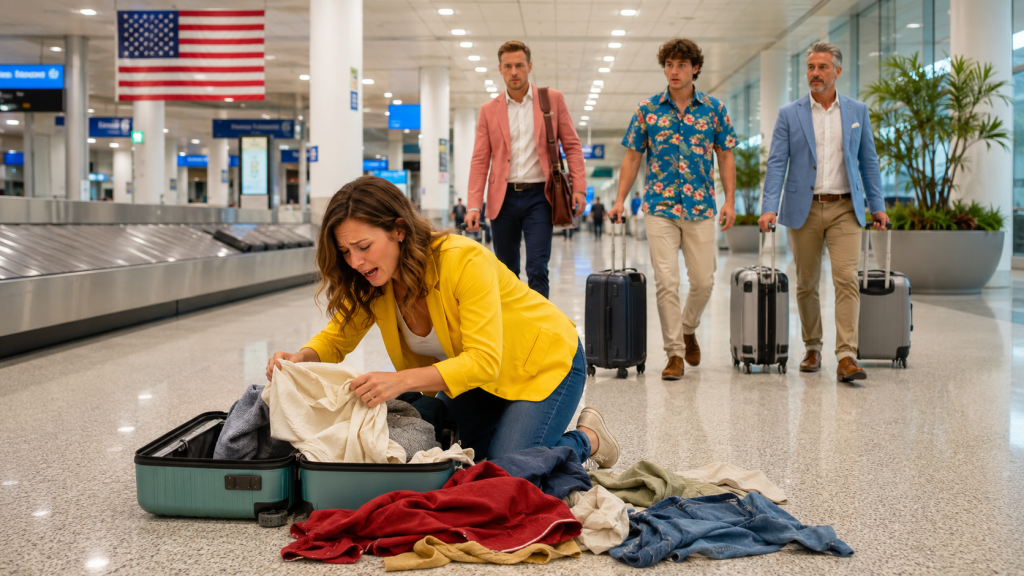
The suitcase on top fell to the floor and burst open.
James’s belongings scattered across the polished terminal tiles.
Socks.
Ties.
Neatly folded shirts that still carried the faint trace of his cologne.
Pieces of a life that had ended without warning.
Travelers stepped around me as I dropped to my knees and tried desperately to gather everything.
Tears filled my eyes.
My chest tightened so badly that breathing became difficult.
Finally, an airport employee knelt beside me.
She was a woman in her late fifties with silver threaded through her dark hair.
She did not ask what had happened.
She simply began folding James’s clothes.
When she picked up his shaving kit, she saw the hospital identification bracelet tucked inside.
Her expression softened.
“I’m sorry,” she whispered.
Those two words nearly broke me.
Not because they were unusual.
Because they were the first genuinely kind words anyone had spoken to me since I landed.
“My husband,” I managed to say. “He died.”
The woman placed one hand over mine.
“Is someone meeting you?”
I looked away.
“No.”
She helped close the suitcase and found a strip of airport tape to secure it.
Before I left, she wrote her name on the back of a receipt.
“Marianne,” she said. “I work here most evenings. If you need help getting to the rideshare area, I’ll walk with you.”
I thanked her, but my voice barely came out.
My family lived less than an hour away.
Not one of them was coming.
I ordered a rideshare and sat silently in the back seat while rain struck the windows.
The driver tried to start a conversation twice.
Both times, I pretended not to hear.
When we reached the house James and I had shared, every window was dark.
The driver carried my suitcases to the porch.
“You sure someone’s inside?” he asked.
I nodded even though I knew no one was there.
The moment I opened the front door, icy air wrapped around me.
The house smelled stale, like it had been closed for years instead of ten days.
I left the suitcases near the entrance and did not turn on a single light.
Instead, I curled into the armchair where James used to sit on Sunday mornings with a cup of coffee and the newspaper.
The silence inside the house was unbearable.
It seemed to close around me from every direction.
Every object reminded me of him.
His reading glasses rested on the side table.
A coffee mug sat upside down beside the sink.
His work boots were lined neatly against the wall.
On the mantel stood a photograph from our wedding.
James was laughing because the wind had blown my veil across his face.
I stared at the photograph until I could no longer see it clearly.
At some point, exhaustion pulled me into sleep.
I dreamed that James was calling me from another room.
At first his voice sounded normal.
Then it became distant.
Urgent.
“Amelia, wake up.”
I opened my eyes.
For several seconds, I did not know where I was.
Then I heard a clicking sound above me.
Click.
Click.
Click.
A sharp electronic chirp followed.
The smoke detector.
I sat upright.
The room was dark, but something faint and gray drifted near the ceiling.
Smoke.
I stood too quickly and nearly fell.
The smell hit me a moment later.
Burning plastic.
I followed it down the hallway toward the laundry room.
When I opened the door, sparks flashed behind the dryer.
A thin line of flame climbed the wall.
I screamed and stumbled backward.
James had always insisted on keeping a fire extinguisher beside the utility sink.
I grabbed it, pulled the pin, and aimed.
A weak cloud sprayed from the nozzle.
Then nothing.
I squeezed again.
The extinguisher sputtered and died.
The flame spread upward, catching the shelf above the dryer.
A bottle of cleaning solution fell and burst against the floor.
Fire raced across the spilled liquid.
Within seconds, the entire corner of the laundry room was burning.
I ran for my phone.
The smoke detector began shrieking.
I dialed 911 while trying to drag the suitcases toward the door.
The dispatcher answered.
“Emergency services. What is your location?”
“My house is on fire,” I said. “Please hurry.”
I gave her the address.
“Are you outside?”
“Not yet.”
“Leave everything. Get out immediately.”
I looked at the two suitcases.
James’s clothes.
His documents.
His wedding ring was inside the smaller case.
For one irrational moment, I thought I could save them.
Then something exploded in the laundry room.
The lights flickered.
A wave of black smoke rolled into the hallway.
I dropped the suitcase handles and ran.
Outside, cold rain struck my face.
I stood barefoot on the porch, coughing so hard that I could barely breathe.
My neighbor, Mr. Alvarez, opened his front door.
He was seventy-two and walked with a cane, but the moment he saw the smoke, he hurried across the street.
“Amelia!”
“Call the fire department!”
“They’re coming,” I said.
Flames appeared in the rear window.
Mr. Alvarez pulled off his coat and wrapped it around my shoulders.
His wife, Elena, came running behind him with a blanket and slippers.
Other neighbors emerged from their houses.
A young couple from two doors down dragged a garden hose across the lawn.
Someone moved a car away from our driveway.
Someone else shouted that the fire was reaching the attic.
Sirens screamed in the distance.
I stood in the rain, watching orange light pulse behind the windows of the home James and I had spent eleven years building together.
The first fire engine turned onto our street.
Then another.
Firefighters rushed toward the house carrying hoses and equipment.
One of them guided me toward an ambulance.
“Was anyone else inside?”
“My husband,” I said automatically.
The firefighter froze.
I closed my eyes.
“No. I’m sorry. He died last week. I was alone.”
A paramedic placed an oxygen mask over my face.
Through the rain, I watched firefighters break the laundry-room window.
Water blasted into the house.
Steam and smoke poured into the night.
Elena sat beside me inside the ambulance.
She held my hand although we had spoken only a few times before that night.
“You’re safe,” she kept saying. “That’s what matters.”
But I did not feel safe.
I felt as though James had died again.
First I had lost him.
Now I was watching our home disappear.
A reporter arrived before midnight.
The fire had spread through the attic, and strong wind was carrying sparks toward the neighboring houses. Emergency crews evacuated the homes on both sides of mine.
The reporter stood near the end of the street beneath a large umbrella.
A cameraman pointed his lens toward the flames.
I did not know they were filming me until a woman approached the ambulance.
“Mrs. Hart?”
I looked up.
“I’m Vanessa Cole from Channel Eight News. We understand you arrived home from overseas tonight. Would you be willing to speak with us?”
“No.”
She nodded immediately.
“Of course. I’m very sorry.”
Then Mr. Alvarez stepped forward.
“She buried her husband yesterday,” he told the reporter. “Her family wouldn’t even pick her up from the airport.”
I lowered the oxygen mask.
“Please,” I whispered.
Mr. Alvarez looked ashamed.
“I’m sorry, Amelia. I’m angry for you.”
Vanessa crouched beside the ambulance.
“Your family didn’t know you were here alone?”
“They knew.”
I should have stopped there.
But grief, exhaustion, smoke, and the sight of the burning house stripped away the careful silence I had maintained for years.
I unlocked my phone.
The family group chat was still open.
Vanessa did not touch the phone.
She only looked at the screen as I held it.
My request for a ride.
Troy’s response.
My mother’s criticism.
The message about dinner with the Hendersons.
Then my two-word reply.
No problem.
Vanessa’s face changed.
“May we mention these messages in the report?”
I hesitated.
I had spent my entire life protecting my family from the consequences of their own behavior.
I covered for Troy when he forgot birthdays.
I apologized for my mother when she made cruel remarks.
I invented excuses for my father’s emotional distance.
Even after James died, I had told his colleagues that my family could not attend the funeral because of unavoidable circumstances.
The truth was simpler.
They had not come because supporting me was inconvenient.
I looked at the burning roof.
“Yes,” I said. “You may mention them.”
Vanessa asked whether my name could be used.
“Yes.”
“Are you certain?”
“For once, I am.”
The firefighters worked for nearly four hours.
They prevented the fire from destroying the neighboring houses, but ours was severely damaged.
The laundry room and kitchen were gone.
The roof had partially collapsed.
Smoke and water had ruined most of the second floor.
When the fire chief finally spoke to me, the sky was beginning to lighten.
“The electrical wiring behind your dryer overheated,” he explained. “It looks like the breaker failed to trip.”
“Could it have happened earlier?”
He nodded.
“It may have been smoldering inside the wall for hours, possibly longer. You were fortunate the detector worked.”
Fortunate.
The word felt impossible.
But he was right.
If I had taken sleeping pills on the flight, I might not have awakened.
If the detector’s battery had failed, I might never have reached the porch.
If the neighbors had not acted quickly, several homes could have burned.
The Red Cross arranged a hotel room for me.
Elena packed a small bag of clothing from her own closet.
Mr. Alvarez drove me to the hotel after sunrise.
Before leaving, he wrote his phone number on the hotel notepad.
“You call us,” he said. “Day or night.”
I looked at him.
“Why are you doing this?”
He seemed surprised by the question.
“Because you’re our neighbor.”
That simple answer followed me upstairs.
Because you’re our neighbor.
Not because I had earned it.
Not because it was convenient.
Not because I had asked correctly or planned earlier.
Because I was a human being who needed help.
I slept for several hours and woke to my phone vibrating across the bedside table.
Twenty-three missed calls.
Most were from my family.
The Channel Eight report had aired during the morning news.
I opened the first voicemail.
My mother’s voice was high and frantic.
“Amelia, call me immediately. They’re showing your house on television. Why didn’t you tell us there was a fire?”
I deleted it.
The next voicemail was from Troy.
“What were you thinking showing private family messages to a reporter? People are posting screenshots everywhere. Call me before this gets worse.”
I deleted that one too.
My father’s message was quieter.
“Amelia, I’m glad you’re alive. Please call when you can.”
For a moment, my thumb hovered over his number.
Then another notification appeared.
Channel Eight had posted the report online.
The headline read:
“GRIEVING WIDOW ESCAPES HOUSE FIRE HOURS AFTER FAMILY REFUSES AIRPORT RIDE.”
I pressed play.
The video opened with footage of my house engulfed in flames.
Then Vanessa appeared on-screen.
“Thirty-five-year-old Amelia Hart returned to Portland Tuesday evening after burying her husband overseas. She says she asked relatives for transportation from the airport but was told to arrange a rideshare.”
The screen displayed the messages with names partially obscured.
“My flight arrives at 5:00 p.m. Could someone please pick me up?”
“Today is really busy. Just order an Uber.”
“Why didn’t you arrange transportation earlier?”
“Your father and I are having dinner with the Hendersons.”
Then my reply filled the screen.
“No problem.”
The report showed Mr. Alvarez speaking near the fire truck.
“That woman had just buried her husband,” he said. “She came home alone. When her house started burning, strangers helped her because her own people weren’t there.”
The final footage showed me wrapped in a blanket, barefoot in the rain, staring at the flames.
I barely recognized myself.
The story spread quickly.
Local radio stations discussed it.
A national morning program requested an interview.
Thousands of strangers left comments.
Some criticized my family harshly.
Others shared stories about being abandoned during grief, illness, or emergencies.
Several people offered clothing, temporary housing, food, and financial assistance.
I did not want money.
I did not want fame.
I only wanted James back.
A knock sounded at the hotel door.
When I looked through the peephole, my mother stood in the hallway.
My father was beside her.
Troy stood behind them holding a paper bag from a coffee shop.
I remained silent.
My mother knocked again.
“Amelia, we know you’re inside.”
I opened the door but did not invite them in.
My mother looked me over as though she expected visible burns.
“You’re all right,” she said.
It sounded more like an accusation than relief.
“I’m alive.”
She glanced down the hallway.
“Can we come in? People are looking.”
“That has always mattered to you.”
Her face tightened.
Troy stepped forward.
“This has gotten completely out of control.”
I looked at the coffee bag in his hand.
“You brought breakfast?”
“We didn’t know whether you had eaten.”
“I hadn’t eaten at the airport either.”
He looked away.
My father finally spoke.
“We made a terrible mistake.”
My mother turned toward him.
“Richard, we did not know her house was going to catch fire.”
“No,” I said. “You only knew my husband had died.”
The hallway became silent.
My mother folded her arms.
“That is not fair. We supported you by phone.”
“You sent three messages.”
“We asked whether you were managing.”
“You asked whether I had completed the paperwork because you wanted to know when I would return.”
Troy sighed.
“Amelia, nobody is saying we handled everything perfectly.”
“Perfectly?”
My voice rose despite my effort to remain calm.
“I stood beside my husband’s coffin alone.”
“We couldn’t fly across the world with no notice,” Troy said.
“You took your family to Hawaii last spring with two days’ notice because a resort offered you a discounted room.”
“That was different.”
“Of course it was. You wanted to go.”
My mother stepped closer.
“This public humiliation is unnecessary. You gave a television reporter access to private messages while you were emotional.”
“They asked what happened.”
“You could have protected us.”
I stared at her.
There it was.
Not “We should have protected you.”
Not “We failed you.”
“You could have protected us.”
My father closed his eyes.
My mother continued.
“People from church have called. The Hendersons saw the report. Troy’s employer has received messages. Your aunt has been sharing the video online.”
“And James is still dead.”
My mother stopped.
The anger drained from my voice.
“My house is destroyed. I have no clothes except what Elena Alvarez gave me. I woke up today and reached for James before remembering he is buried thousands of miles away. And you came here because people from church called you.”
My father moved toward me.
“I came because you are my daughter.”
“Then where were you yesterday?”
He had no answer.
Troy placed the coffee bag on the carpet.
“I should have picked you up,” he said quietly.
My mother shot him a look.
He ignored her.
“I saw your suitcase fall in the airport footage.”
I frowned.
“There was footage?”
“A traveler recorded it. It was posted after the news story.”
I had not known anyone was filming.
Troy’s eyes were wet.
“You were on the floor picking up James’s clothes. People were walking around you.”
He swallowed.
“I was thirty-five minutes away.”
“Yes.”
“I told you I was busy.”
“Yes.”
“I was at home watching a basketball game.”
My mother stared at him.
“Troy.”
“No, Mom. She deserves the truth.”
He looked back at me.
“The school performance was next week. I forgot the date. I didn’t want to drive through traffic.”
The confession should have shocked me.
It did not.
It only confirmed what I had already understood.
“I’m sorry,” he said.
I nodded once.
But I did not tell him it was all right.
Because it was not.
My father cleared his throat.
“I was not doing inventory.”
My mother turned toward him now.
“What are you doing?”
“What I should have done before.”
He looked at me.
“I could have left work. I told myself your mother or Troy would collect you. Then when neither of them agreed, I stayed quiet because I did not want an argument.”
“You sent me a warning about the rain.”
“I know.”
“You knew I was coming home alone in heavy rain after burying James.”
“I know.”
“And you stayed at work.”
His shoulders lowered.
“Yes.”
My mother’s expression hardened.
“Well, I did have dinner plans. The Hendersons made the reservation weeks ago. We could not cancel at the last moment without explanation.”
I almost laughed.
“You could have said, ‘Our daughter’s husband died.’”
“That would have created an awkward situation.”
My father looked at her with disbelief.
Troy muttered, “Mom, stop.”
But she did not.
“I am trying to explain that everyone has responsibilities. Grief does not mean the entire world stops.”
“No,” I said. “It only meant my world stopped.”
She opened her mouth, but I raised my hand.
“I need you to leave.”
My father nodded.
Troy looked as though he wanted to speak again.
My mother did not move.
“You cannot shut your family out because of one bad day.”
“One bad day?”
“Amelia—”
“This is not one day.”
Memories I had buried for years rose to the surface.
“When I graduated from college, you left before my name was called because Troy had a baseball banquet.”
“He was receiving an award.”
“When James and I got married, you complained during my entire reception because the hotel room did not have the view you requested.”
“That hotel was expensive.”
“When I miscarried, you told me not to tell anyone because it would make Thanksgiving uncomfortable.”
Her face went pale.
Troy looked at me sharply.
“You had a miscarriage?”
I stared at him.
Three years earlier, I had lost a pregnancy at fourteen weeks.
James and I had named the baby Grace.
My mother had known.
My father had known.
They had never told Troy because my mother believed discussing pregnancy loss would upset his wife, who was expecting their second child.
“Yes,” I said. “I did.”
Troy looked at our parents.
“No one told me.”
My mother’s voice became defensive.
“It was a private medical matter.”
“It was my sister.”
“And you were preparing for the baby.”
He stepped away from her.
I looked at all three of them.
“This family has spent years asking me to make my pain smaller so no one else feels uncomfortable.”
My father’s eyes filled with tears.
“You’re right.”
My mother shook her head.
“No. Families make compromises.”
“I made the compromises. You made the demands.”
She drew herself upright.
“You are emotional and exhausted. We will discuss this when you are thinking clearly.”
“I am thinking clearly for the first time in my life.”
I closed the door.
My knees weakened the moment the lock clicked.
I sat on the carpet and cried until there was nothing left.
Later that afternoon, Vanessa called.
She apologized for disturbing me but said the fire department had released more information.
The smoke detector that saved my life had been part of a safety upgrade James designed for the neighborhood association six months earlier.
He had encouraged residents to install interconnected alarms that used sealed ten-year batteries.
Many neighbors had followed his recommendation.
The detector in our hallway had activated because the laundry-room alarm sensed smoke inside the wall.
James had saved me.
Even after death, he had saved me.
Vanessa asked whether I wanted that detail included in the evening follow-up.
I agreed.
She also told me the city planned to inspect similar homes because our electrical failure might not be isolated.
By six o’clock, the second report aired.
This time, I agreed to speak on camera.
I stood outside the damaged house wearing Elena’s blue sweater and a borrowed coat.
The roof behind me was blackened and partially collapsed.
Vanessa asked what I wanted people to understand.
I looked directly into the camera.
“Grief is not an inconvenience,” I said. “When someone you love loses a spouse, a child, a parent, or anyone important, do not wait for them to ask perfectly. Do not tell them to plan better. Show up. Sit beside them. Carry one suitcase. Drive through traffic. Make one phone call. You may think there will be another opportunity, but sometimes there is not.”
Vanessa asked how the community had responded.
“My neighbors saved my life in more ways than one,” I said. “They came outside when they heard the alarm. They gave me clothing, a place to sit, and kindness without asking what they would receive in return.”
Then she asked about James.
I looked toward the damaged house.
“My husband believed broken things could be restored without hiding the damage. I hope I can learn to believe that too.”
The segment ended with a photograph of James standing beside one of his restoration projects.
He was smiling at the camera, his sleeves rolled to his elbows.
For the first time since his death, seeing his face brought something besides pain.
It brought pride.
The story changed after that report.
Instead of focusing only on my family’s messages, people began discussing how to support grieving friends.
A local organization created a volunteer program offering airport pickups and meal deliveries for bereaved residents.
They named it James’s Ride Home.
The airport employee who had helped me, Marianne, contacted the station.
She became one of the first volunteers.
So did Mr. and Mrs. Alvarez.
I donated every dollar strangers had raised for me to the program after my insurance company confirmed the house would be covered.
I kept only enough clothing and household items to survive the next several weeks.
The following morning, Troy returned to the hotel alone.
He did not bring coffee or excuses.
He stood in the hallway with James’s navy jacket folded over his arms.
“I went to the house,” he said. “The fire chief let me collect a few things from the front room.”
The jacket smelled like smoke, but it was intact.
I pressed it against my face.
For a moment, neither of us spoke.
Then Troy said, “I resigned from the family group chat.”
Despite everything, a small laugh escaped me.
“You cannot resign from a group chat.”
“I left it.”
“That you can do.”
He sat in the chair beside the window.
“I have been a terrible brother.”
“You have been an absent brother.”
“That sounds worse.”
“It is more accurate.”
He accepted the correction.
“I don’t expect forgiveness today.”
“Good.”
“But I want to do better.”
I studied him.
“Why?”
“Because the whole world saw what I did.”
I appreciated his honesty.
He continued.
“At first, I was embarrassed. Then I saw the airport video. And I realized the worst part was not that people knew. The worst part was that I had left you there.”
His voice broke.
“I kept thinking about what I would want someone to do for my daughters if they were alone.”
I looked down at James’s jacket.
“Apologies are easy after public consequences.”
“I know.”
“Change is harder.”
“I know that too.”
I did not forgive him that morning.
But I allowed him to stay.
He helped me call the insurance company.
He drove me to buy basic clothing.
He went to the damaged house and spent hours cleaning smoke from the few belongings firefighters recovered.
He did not post any of it online.
He did not ask me to tell people he was helping.
For the next month, he showed up every day.
My father came too.
Unlike Troy, he apologized only once.
Then he began doing the work.
He contacted James’s architectural firm and helped organize the legal documents I had been unable to face.
He drove me to grief counseling.
He sat in the waiting room without asking questions.
One afternoon, he brought me a wooden box containing every photograph he had of James.
“I should have attended the funeral,” he said.
“Yes.”
“I was afraid.”
“Of what?”
“Of seeing your pain and knowing I could not fix it.”
“You could have stood beside me.”
“I understand that now.”
He looked older than I remembered.
“I spent my life confusing silence with strength.”
I touched the lid of the box.
“Silence is sometimes just abandonment.”
He nodded.
“I know.”
My mother did not come.
For two weeks, she sent messages explaining herself.
She said the news report had been unfair.
She said strangers did not understand the family’s history.
She said I had always been independent, so she assumed I preferred handling things alone.
Finally, she sent a message asking me to publicly clarify that she was not a bad mother.
I did not answer.
Instead, I wrote her a letter.
I told her I loved her.
I also told her love did not require me to accept cruelty.
I explained that I would not speak with her again until she could apologize without defending herself, blaming me, or asking me to protect her reputation.
Three days later, the letter came back unopened.
She had written “RETURN TO SENDER” across the front.
That hurt more than I expected.
But pain was no longer enough to make me chase her.
James and I had spent years trying to earn my mother’s approval.
Every holiday dinner, every invitation, every gift was another attempt to prove we deserved warmth.
After his death, I finally understood something James had tried gently to teach me.
Love that must be constantly earned is not safety.
It is a test with rules that keep changing.
Six months after the fire, reconstruction began.
The insurance company offered to rebuild the house exactly as it had been.
I declined.
James had left several unfinished sketches in his home office.
One showed a redesigned ground floor with larger windows, a reading alcove, and a wide kitchen table.
At the bottom, he had written:
“For the life we haven’t lived yet.”
I gave the drawing to his firm.
They completed the design without charging me.
The new house kept part of the original brick chimney.
The fire had blackened it, but the structure remained solid.
At first, I wanted it covered.
Then I remembered James’s belief that restoration should not erase survival.
We cleaned the bricks but left the faint smoke marks visible.
I placed his armchair beside the new windows.
The rebuilt laundry room received updated wiring, fire-resistant walls, and three interconnected alarms.
The city inspections prompted by our fire discovered faulty electrical panels in nineteen other homes.
Repairs were completed before another fire occurred.
James had saved more people than he would ever know.
James’s Ride Home also grew.
Within a year, more than two hundred volunteers had joined.
They collected people from airports, hospitals, funeral homes, and train stations.
Sometimes they delivered meals.
Sometimes they simply sat with someone who did not want to enter an empty house alone.
Marianne became the volunteer coordinator.
Mr. Alvarez handled transportation schedules even though he still preferred paper calendars to computers.
Troy volunteered twice a month.
He never missed a shift.
On the first anniversary of James’s death, the organization held a small gathering at the airport.
A plaque was installed near the arrivals hall.
It read:
NO ONE SHOULD COME HOME TO GRIEF ALONE.
Beneath it was James’s name.
My father stood beside me during the ceremony.
Troy and his daughters were there.
My mother was not.
I had received one message from her that morning.
“I hope you are satisfied with what your publicity has done to this family.”
I deleted it.
Then I watched Marianne welcome a young man whose mother had died overseas.
He stepped through the security doors carrying a single suitcase.
When he saw the volunteers holding a sign with his name, his face crumpled.
Troy walked forward and took the suitcase from his hand.
“You don’t have to carry this alone,” my brother said.
The words reached somewhere deep inside me.
James should have been there.
I felt his absence every day.
Grief had not become smaller.
I had simply grown around it.
After the ceremony, I drove home.
The reconstructed house glowed warmly against the evening sky.
As I approached the porch, I saw someone sitting on the front steps.
My mother.
She looked thinner.
Older.
There was no audience.
No camera.
No one from church.
Just the two of us.
I stopped several feet away.
“What are you doing here?”
She stood.
“I opened your letter.”
“You returned it.”
“I bought another envelope from the post office trash after they stamped it.”
Despite myself, I almost smiled.
She twisted her hands together.
“I have read it many times.”
I waited.
She looked toward the dark marks on the chimney.
“I spent most of this year telling myself that you embarrassed me. That you exaggerated. That everyone turned against me because of one misunderstood message.”
I said nothing.
“But it was not one message.”
Her voice shook.
“It was years.”
She took a breath.
“When you were hurting, I asked you to make your hurt easier for me. When you needed support, I gave you instructions. When James died, I thought sending a few messages was enough because I did not want to face something painful.”
Tears filled her eyes.
“I should have come to you. I should have canceled dinner. I should have been waiting at that airport before your plane landed.”
“Yes.”
“I am sorry.”
She did not add “but.”
She did not mention the news report.
She did not ask me to forgive her.
For the first time, her apology had no escape route.
“I don’t know whether I can trust you,” I said.
“I understand.”
“I’m not ready to pretend everything is repaired.”
“I understand that too.”
I looked at the house behind us.
“James believed damaged things could be restored. But he also believed you had to inspect the foundation first.”
My mother nodded.
“What does that mean for us?”
“It means you do not come back into my life because you apologized once.”
“All right.”
“It means therapy.”
She flinched but did not argue.
“It means respecting boundaries.”
“All right.”
“It means when I tell you something hurts, you do not explain why it should not.”
She wiped her eyes.
“All right.”
I opened the front door.
“I’m making tea.”
She looked at me uncertainly.
“May I come inside?”
“Only for tea.”
“Only for tea,” she agreed.
We sat at the kitchen table James had drawn.
For several minutes, neither of us spoke.
Then my mother looked toward the reading alcove.
“He would have loved this house.”
“He designed it.”
“I know.”
She wrapped both hands around her cup.
“I miss him.”
Part of me wanted to say she had no right.
Instead, I answered honestly.
“So do I.”
That evening did not fix our relationship.
Nothing that important is repaired in one conversation.
But it was a beginning.
A careful one.
A beginning with boundaries, grief counseling, uncomfortable truths, and no promises that forgiveness would come quickly.
Troy and I rebuilt our relationship slowly as well.
He stopped assuming I would always be available to solve his problems.
I stopped rescuing him whenever he forgot something.
My father learned to speak instead of disappearing into silence.
He began telling his granddaughters that showing emotion was not weakness.
My mother attended therapy.
Sometimes she returned to old habits.
When she did, I ended the conversation and tried again another day.
Not every broken relationship deserves restoration.
Some should be released.
But when people accept responsibility and change their behavior, something new can sometimes be built from what remains.
Two years after the fire, I traveled back to Portugal.
I carried only one suitcase.
Inside were James’s navy tie, a small piece of brick from the old chimney, and a photograph of the rebuilt house.
The cemetery overlooked the Atlantic exactly as I remembered.
I sat beside his grave and told him everything.
I told him about the fire.
The alarm.
The neighbors.
The news report.
James’s Ride Home.
The faulty panels discovered in other houses.
Troy carrying suitcases for grieving strangers.
My father attending counseling with me.
My mother sitting at the kitchen table asking permission before offering advice.
I placed the photograph against his headstone.
“You were right,” I whispered. “It could be restored.”
Wind moved through the grass.
Far below, waves struck the rocks.
For a moment, I imagined his voice.
Not as it had sounded in the hospital.
Not distant or frightened.
Warm.
Amused.
Proud.
When I returned to Portland, my flight landed at five in the evening.
As soon as the plane reached the gate, I turned on my phone.
There were several messages waiting.
“Troy: We’re parked near arrivals. No rush.”
“Dad: I brought your favorite coffee.”
“Mom: I made soup for later. I will leave it at your house unless you would like company.”
Then another message appeared from Marianne.
“Welcome home, Amelia. Your ride is waiting.”
I walked toward baggage claim.
This time, when my suitcase appeared, Troy lifted it before I could reach for the handle.
My father gave me the coffee.
My mother waited a few steps away, allowing me to decide whether I wanted an embrace.
I looked at them.
They were not the family I had once imagined.
They were imperfect, unfinished people who had caused pain and, in different ways, chosen whether to confront it.
I stepped toward my mother.
She opened her arms only after I nodded.
As we left the airport, we passed the plaque near the arrivals hall.
NO ONE SHOULD COME HOME TO GRIEF ALONE.
A volunteer stood nearby holding a sign for someone she had never met.
Beyond the glass doors, rain fell gently over Portland.
But this time, I was not afraid of the journey home.
This time, someone had come.
THE END! THANK YOU FOR READING!