

My fifteen-year-old daughter had been telling me for weeks that something was wrong.
At first, I tried to convince myself it was just a phase.
Teenagers changed. They became quieter. They slept more. They complained about school, stress, friendships, and their bodies going through changes.
That was what I told myself.
Because admitting something deeper was happening meant admitting that I had missed something.
And a mother never wants to believe she failed to see her own child hurting.
Hailey had always been the kind of girl who filled every room she entered.
She laughed loudly.
She sang while brushing her hair.
She took hundreds of pictures of ordinary things—clouds, flowers growing through cracks in sidewalks, the sunset behind our neighborhood houses.
She said every place had a story if you looked closely enough.
But over the last few months, my daughter slowly disappeared.
Not physically.
She was still there.
But the light inside her was fading.
She stopped playing soccer.
She stopped meeting friends after school.
She stopped arguing with me about cleaning her room, which honestly worried me more than the mess ever did.
Because Hailey loved being herself.
And suddenly, she was trying to become invisible.
“Mom, I’m just tired,” she would say whenever I asked.
But it wasn’t normal tired.
It was the kind of exhaustion that made her sit on the stairs halfway up because she needed a moment before reaching her bedroom.
Her stomach hurt constantly.
She felt dizzy when she stood up.
She barely ate.
Some mornings, I would find her breakfast untouched on the kitchen table.
I would ask, “Hailey, are you feeling sick again?”
And she would force a smile.
“I’m okay.”
Two words.
Always two words.
But her eyes told me something different.
I noticed.
I just didn’t understand.
My husband, Mark, noticed too.
But he saw something completely different.
“She’s fifteen,” he said one evening while watching television. “Everything is dramatic at that age.”
I looked at him from the kitchen.
“She’s been sick for weeks.”
“She says she’s sick.”
The way he said it made my stomach tighten.
Like our daughter’s pain was an inconvenience.
Like she was creating a problem instead of experiencing one.
“She’s losing weight, Mark.”
“She’s probably trying to get attention.”
I stared at him.
“Attention?”
He shrugged.
“You know how teenagers are.”
No.
I didn’t know.
Because I knew my daughter.
I knew the difference between a teenager wanting attention and a child silently begging for help.
But Mark had already returned his eyes to his phone.
The conversation was over.
At least for him.
Not for me.
That night, I sat beside Hailey’s bedroom door for almost twenty minutes after hearing her cry.
Quietly.
The way children cry when they don’t want anyone to know.
I almost knocked.
Almost opened the door.
But something stopped me.
A strange feeling.
Like she was protecting something.
The next morning, I found her standing in front of the bathroom mirror.
She looked pale.
Too pale.
“Hailey?”
She quickly turned around.
“I’m fine.”
Again.
Those words.
Always those words.
I walked closer.
“Sweetheart, you can tell me anything.”
For a second, I thought she would.
Her lips parted.
Her eyes filled with tears.
Then footsteps came from the hallway.
Mark.
Immediately, Hailey changed.
The tears disappeared.
Her shoulders tightened.
And she stepped away from me.
That small movement stayed in my mind.
Because it was not the movement of a daughter hiding embarrassment.
It was the movement of someone who was afraid.
I watched Mark walk into the room.
“Everything okay?”
Hailey looked down.
“Yeah.”
I looked between them.
And for the first time, a frightening thought entered my mind.
Something is happening that she cannot tell me.
I didn’t know what.
I didn’t know why.
But I knew one thing.
I was done waiting.
A few days later, Hailey collapsed in the kitchen.
Not dramatically.
Not like in movies.
She simply reached for the counter, missed it, and fell.
My heart stopped.
“Hailey!”
She opened her eyes slowly.
“Mom…”
Her voice was barely a whisper.
“My stomach hurts so bad.”
I called Mark immediately.
His response shocked me.
“She probably hasn’t eaten enough.”
“She just fainted!”
“Then give her something to eat.”
I stood there holding the phone, unable to believe what I was hearing.
My daughter was on the floor.
And her father sounded annoyed.
That night, after Mark went to bed, I made a decision.
I packed a small bag.
I woke Hailey gently.
“Get dressed.”
She looked confused.
“Where are we going?”
“The hospital.”
Her face changed instantly.
Not fear of the hospital.
Fear of something else.
“Mom, no.”
My heart broke.
“Why not?”
She looked away.
“I’m fine.”
I held her hand.
“No, you’re not.”
For a long moment, she said nothing.
Then she whispered:
“Please don’t tell Dad.”
That sentence changed everything.
Because children are not supposed to be afraid of being honest with their parents.
I waited until Mark was distracted the next morning.
I told him I was running errands.
Then I drove Hailey to St. Helena Medical Center.
The entire ride was silent.
Hailey stared out the window.
I wanted to ask a thousand questions.
But something told me not to push.
She had been silent for too long.
Maybe she needed to know I could sit beside her without demanding answers.
At the hospital, the nurses immediately noticed something was wrong.
They checked her blood pressure.
They asked questions.
They ordered tests.
Blood work.
Ultrasound.
More scans.
Every minute waiting felt heavier.
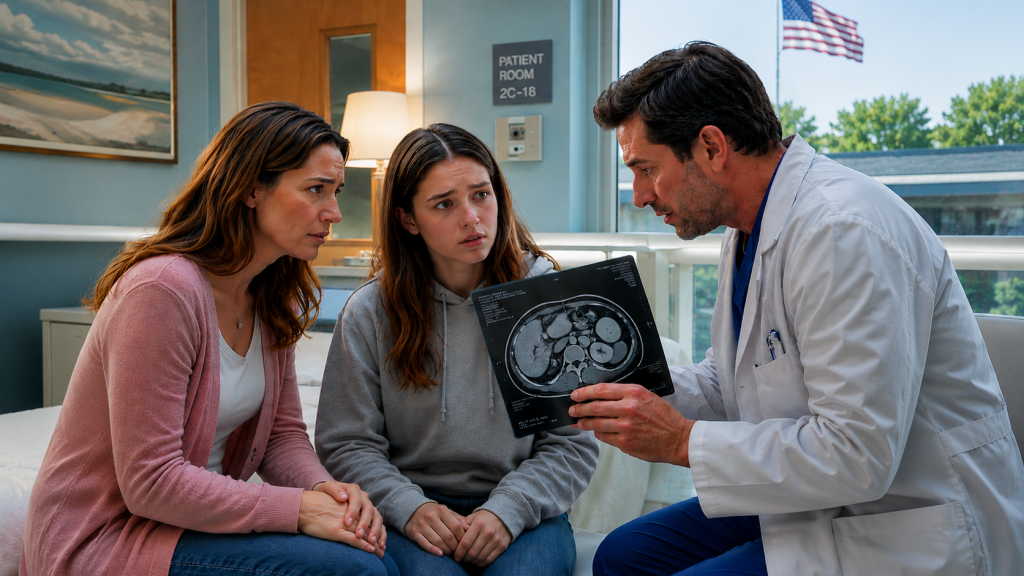
Then Dr. Adler walked back into the room.
He was holding the scan results.
But he wasn’t looking at the papers.
He was looking at Hailey.
Then at me.
His expression changed.
And my heart dropped.
“Mrs. Carter…”
I stood immediately.
“What is it?”
He closed the door behind him.
The sound was quiet.
But it felt terrifying.
“There is something inside your daughter.”
My entire body went cold.
I grabbed the edge of the chair.
“What do you mean?”
Dr. Adler looked at Hailey.
Then back at me.
“We need to talk about the results.”
My mind raced through every possibility.
Every nightmare.
Every disease I had ever heard of.
And then he said the words that changed our lives forever.
“Your daughter is pregnant.”
The room went silent.
Hailey covered her face.
And the sound that came from her was not anger.
Not embarrassment.
It was pain.
The kind of pain that comes from carrying a secret for too long.
I turned toward my daughter.
And in that moment, I realized something.
My little girl had been fighting a battle alone.
A battle she never should have had to fight.
For several seconds, I could not move.
I could not speak.
I could barely breathe.
The words kept repeating inside my head.
Your daughter is pregnant.
Pregnant.
My fifteen-year-old daughter.
I looked at Hailey sitting on the hospital bed, her hands covering her face, her shoulders shaking.
She looked so small.
Not fifteen.
Not old enough to carry the weight of what she had been carrying.
I moved toward her slowly.
“Hailey…”
She didn’t look up.
“I’m sorry, Mom.”
Those three words destroyed me.
Not because she had done something wrong.
But because she believed she had something to apologize for.
I sat beside her and wrapped my arms around her.
“No.”
My voice broke.
“No, sweetheart. You don’t say sorry to me.”
She cried harder.
“I didn’t know what to do.”
I held her tighter.
“You should have come to me.”
“I tried.”
That sentence made me freeze.
She pulled back slightly.
Her face was covered in tears.
“I tried so many times.”
My heart sank.
“What do you mean?”
She looked down.
“I wanted to tell you.”
The room suddenly felt smaller.
“But I was scared.”
“Scared of what?”
She didn’t answer immediately.
She stared at the floor.
Then she whispered:
“Scared nobody would believe me.”
Those words felt like a knife.
Because I realized this was not just a medical emergency.
This was something much deeper.
Something my daughter had been hiding because she thought the truth would destroy everything.
The hospital contacted a social worker named Lauren.
She arrived quietly.
No rushed movements.
No judgment.
Just a calm presence.
She explained that because Hailey was fifteen, they needed to make sure she was safe.
She asked if she could speak with Hailey privately.
I wanted to say no.
Every part of me wanted to protect my daughter and never let her out of my sight again.
But Hailey looked at me.
And in her eyes, I saw something I had never seen before.
A request.
Not for me to stay.
But for me to trust her.
So I nodded.
“I’ll be right outside.”
She squeezed my hand before letting go.
That small gesture almost broke me.
Because my daughter was still trying to comfort me while her own world was falling apart.
I sat outside that room for over an hour.
I watched doctors walk by.
I watched families laugh together in the hallway.
I watched a father carry flowers to his wife.
And all I could think was:
How did my daughter become someone who was afraid to tell me she was hurting?
When Lauren finally opened the door, her expression was serious.
But gentle.
She sat beside me.
“Mrs. Carter, Hailey has been through something traumatic.”
My hands immediately went cold.
“What happened?”
Lauren took a breath.
“She is not ready to tell you everything yet.”
“Is she safe?”
Lauren looked directly into my eyes.
“She is safe now.”
That word.
Now.
It stayed with me.
Because it meant there was a time when she wasn’t.
“Who hurt her?” I whispered.
Lauren’s face softened.
“We are working to understand that.”
I looked through the small window in the door.
Hailey was sitting alone on the bed.
My daughter.
My beautiful girl.
The child I had carried.
The child I had protected.
And somehow, she had been suffering right under my roof.
That thought haunted me.
The hospital recommended that Hailey not return home that night.
They wanted her somewhere she felt secure.
So I called my sister Amanda.
She answered immediately.
“Are you okay?”
I couldn’t speak.
The tears came before the words.
Amanda knew something was wrong.
“Where are you?”
I told her.
Twenty minutes later, she arrived.
She didn’t ask questions.
She didn’t demand explanations.
She walked straight to Hailey and hugged her.
“You’re safe with me.”
That was all she said.
And for the first time in days, I saw my daughter relax.
We brought her to Amanda’s house.
She slept in the guest room.
A room filled with soft blankets, family pictures, and the smell of lavender candles Amanda always used.
But I couldn’t sleep.
I sat downstairs in the dark.
And memories started coming back.
Small moments.
Moments I had ignored.
Hailey suddenly leaving the room when Mark walked in.
Hailey becoming quiet during family dinners.
Hailey refusing to be alone at home.
Hailey looking uncomfortable whenever Mark asked why she was acting different.
I pressed my hands against my face.
How did I miss it?
How did I not see my own child asking for help?
The next morning, Detective Morris came to speak with us.
He was assigned to Hailey’s case.
He spoke carefully.
He never rushed.
He never treated Hailey like she was a problem to solve.
He treated her like a person who had been hurt.
Hailey spoke with him in a private room at a child advocacy center.
I waited outside.
Every minute felt endless.
I wanted to go inside.
I wanted to hold her.
I wanted to tell her everything would be okay.
But I knew she needed the chance to tell her story in her own way.
When the door finally opened, Detective Morris stepped out.
His expression was serious.
“We have enough information to begin an investigation.”
My heart started pounding.
“Who was it?”
He looked at me.
Then looked away for a moment.
Like he was choosing his next words carefully.
“Mrs. Carter…”
I stood up.
“Please.”
He took a breath.
“The person Hailey identified…”
He paused.
And that pause terrified me more than anything.
“Was someone she knew.”
My stomach dropped.
Someone she knew.
Not a stranger.
Not someone from far away.
Someone close enough to earn her trust.
Someone close enough to be around our family.
I thought about every person who had entered our home.
Every person who had sat at our table.
Every person I had welcomed.
Then Detective Morris said:
“We believe we need to speak with your husband, Mark.”
The world stopped.
I stared at him.
“No.”
The word escaped before I even realized I had spoken.
Because my mind refused to accept it.
Not him.
Not Mark.
Not Hailey’s father.
Detective Morris didn’t say anything.
He didn’t need to.
His silence told me everything.
I drove back to Amanda’s house in a daze.
The streets looked different.
The houses looked different.
Everything I knew felt like it had been built on a lie.
When I walked into the guest room, Hailey was awake.
She looked at me.
And immediately started crying.
“Mom…”
I sat beside her.
She whispered:
“Are you angry at me?”
I felt my heart break all over again.
I held her face gently.
“Never.”
“But everything is ruined.”
“No.”
She looked at me.
“Listen to me, Hailey.”
I wiped away her tears.
“You are not ruined.”
She cried.
“I was scared you would hate me.”
I pulled her into my arms.
“My love, I could never hate you.”
Then she whispered the words that made me realize how much pain she had been hiding.
“Mom… I thought you would believe him before you believed me.”
And in that moment, I knew the hardest part of this nightmare was only beginning.
Because now I had to face the truth.
And the truth was waiting back at the house.
With Mark.
I sat beside Hailey on Amanda’s guest room floor long after she fell asleep.
I watched her breathing.
I watched her fingers slowly relax around the blanket she was holding.
For years, I had believed my job as a mother was to protect my daughter from the world outside our home.
From strangers.
From danger.
From things I could see coming.
But I never imagined I would have to protect her from something happening inside the place where she was supposed to feel safest.
Our home.
My marriage.
The man I had trusted.
The next morning, Detective Morris called.
He asked if I could come to the station.
Alone.
I kissed Hailey’s forehead before leaving.
She looked terrified.
“Mom, are you coming back?”
The question hurt more than anything.
Because she sounded like a little girl afraid of being abandoned.
I held her hand.
“I am always coming back for you.”
And I meant it.
No matter what happened.
No matter what I discovered.
No matter how painful the truth became.
I would choose my daughter.
Every single time.
At the station, Detective Morris sat across from me.
There were no dramatic accusations.
No raised voices.
Just facts.
And somehow, that made it worse.
“We need to talk about Mark’s behavior over the last several months,” he said.
I swallowed.
“What kind of behavior?”
Detective Morris opened a folder.
“Changes in Hailey’s behavior. Changes in her routine. Times she seemed afraid.”
I stared at the papers.
Every memory I had ignored suddenly became impossible to ignore.
“She was scared when he came home,” I whispered.
Detective Morris nodded.
“Did you notice anything else?”
I closed my eyes.
“Yes.”
The words came slowly.
“She stopped wanting to be alone with him.”
I remembered.
A family barbecue.
Mark offering to drive Hailey home from my mother’s house.
Hailey immediately saying she would rather wait for me.
I thought she was being moody.
I thought she was fifteen.
I thought she was changing.
I never thought she was trying to tell me something.
“She changed after last summer,” I said quietly.
Detective Morris looked up.
“What happened last summer?”
I shook my head.
“I don’t know.”
And that was the hardest sentence I had ever spoken.
Because I was her mother.
I was supposed to know.
When I returned to Amanda’s house, Hailey was sitting on the porch.
She looked exhausted.
But something was different.
Like she had finally stopped carrying the secret completely alone.
I sat beside her.
“Are you okay?”
She gave a small, sad smile.
“I don’t know.”
I took her hand.
“You don’t have to pretend with me anymore.”
She looked down.
“Mom?”
“Yes?”
“Do you hate him?”
The question surprised me.
Not because I didn’t understand who she meant.
But because I realized she was still worried about everyone else’s feelings.
I looked at my daughter.
“I hate what happened to you.”
A tear rolled down her cheek.
“I don’t know what I’m supposed to feel.”
“You are allowed to feel anything.”
“What if people blame me?”
My heart broke.
“People who blame you are wrong.”
She was quiet.
Then she whispered:
“He told me nobody would believe me.”
I froze.
Those words.
That sentence.
The same fear she had carried into the hospital.
Nobody would believe me.
I felt anger rise inside me.
Not the kind of anger that made me lose control.
The kind that made me stronger.
Because someone had spent months convincing my child that her voice didn’t matter.
And I needed her to know the truth.
Her voice mattered.
That afternoon, Detective Morris and a team of investigators went to our house.
Mark was still there.
Still living in the home where Hailey had felt unsafe.
Still acting like nothing had happened.
I stayed with Amanda and Hailey.
I didn’t want Hailey anywhere near that moment.
A few hours later, my phone rang.
It was Mark.
I stared at his name on the screen.
The name that had once meant home.
The name that had once meant family.
Now it only made me feel sick.
I answered.
“What?”
There was a pause.
Then his voice came.
“Where are you?”
I said nothing.
“Why did you take Hailey to the hospital without telling me?”
I closed my eyes.
“You know why.”
Silence.
Then he laughed softly.
A laugh that sounded unfamiliar.
“You’re being dramatic.”
The old me might have questioned myself.
The old me might have tried to keep peace.
But that woman was gone.
“Hailey told the truth.”
Another silence.
Longer this time.
Then Mark’s voice changed.
“You need to be careful what you believe.”
My hands tightened around the phone.
“Are you threatening me?”
“No.”
But he sounded nervous.
“I’m saying you don’t know everything.”
I looked through the window at Hailey sitting with Amanda.
My daughter.
My reason.
“Yes,” I said quietly.
“I know enough.”
I hung up.
That night, Hailey finally told me more.
Not everything.
Not all the details.
But enough.
Enough to understand how afraid she had been.
Enough to understand why she had changed.
Enough to understand why she had hidden her pain.
She cried.
“I thought if I said something, everyone would hate me.”
I held her.
“Never.”
“I thought Dad would leave.”
I felt my heart crack.
“Hailey…”
“I didn’t want our family to break.”
That was the moment I realized something.
My daughter had been protecting us.
While nobody was protecting her.
The next morning, Detective Morris arrived with an update.
The investigation had moved forward.
Evidence had been collected.
Statements had been taken.
And Mark was no longer able to pretend everything was normal.
But Detective Morris had one more thing to tell me.
“There is something else you need to know.”
I looked at him.
“What?”
He hesitated.
“We found evidence that suggests Mark had been hiding more than we originally knew.”
My stomach tightened.
“What do you mean?”
He looked serious.
“We believe this may not have started recently.”
The room went cold.
Because suddenly, the question was no longer only what happened to Hailey.
The question became:
How long had this been happening?
And how much had I failed to see?
I couldn’t speak after Detective Morris said those words.
How long had this been happening?
That question followed me everywhere.
It followed me when I looked at Hailey sleeping.
It followed me when I washed dishes.
It followed me when I walked through the house we had once called a home.
Because every corner held a memory.
And now I was forced to look at those memories differently.
The kitchen where Hailey used to bake cookies with me.
The hallway where she used to run toward the door when Mark came home.
The living room where we watched movies together as a family.
Places that once felt warm now felt heavy.
I wanted to go back in time.
I wanted to see the signs.
I wanted to protect her before she ever needed to ask.
But time does not move backward.
A mother can only stand in the present and decide what she will do next.
And I knew exactly what I had to do.
I had to stand beside my daughter.
Not just with words.
With action.
The next few days were filled with interviews, appointments, and conversations I never imagined having.
Hailey met with counselors who helped her understand that what happened was not her fault.
At first, she struggled to believe them.
She would sit quietly and say:
“But I should have told someone.”
Every time she said that, my heart broke.
Because she was carrying responsibility for someone else’s choices.
I held her hand.
“You were a child trying to survive something painful.”
She looked at me.
“But I was scared.”
“I know.”
“I thought nobody would believe me.”
I brushed her hair back.
“I believe you.”
Those four words became something she needed to hear again and again.
Because fear had taken her voice away.
And slowly, very slowly, she was finding it again.
Meanwhile, Mark continued trying to control the situation.
At first, he sent messages.
Long messages.
Messages saying he was confused.
Messages saying everyone was misunderstanding him.
Messages saying he loved Hailey.
I read every one.
But I didn’t answer.
Because I finally understood something.
Words were easy.
Actions revealed the truth.
Then one evening, he showed up at Amanda’s house.
I was in the kitchen making tea when the doorbell rang.
The moment I saw him through the window, my entire body went still.
Amanda noticed.
“Do you want me to call someone?”
I shook my head.
“No.”
Not because I wasn’t afraid.
But because I needed to stop being afraid of him.
I stepped outside.
Mark looked tired.
Not sorry.
Tired.
“There you are.”
I stared at him.
“What do you want?”
He looked past me toward the house.
“Can I see Hailey?”
“No.”
His expression changed.
“I’m her father.”
I felt something inside me break.
Because once upon a time, those words would have convinced me.
Not anymore.
“A father protects his daughter.”
He looked away.
“Things aren’t as simple as you think.”
I studied his face.
“You know what’s amazing?”
“What?”
“I spent years believing you were the person who would protect our family.”
He said nothing.
“And now I realize I was protecting everyone except the person who needed me most.”
His jaw tightened.
“You’re making a mistake.”
“No.”
I shook my head.
“I made a mistake.”
I stepped closer.
“I ignored my daughter when she was trying to tell me something was wrong.”
His eyes changed.
For a moment, I saw anger.
Then it disappeared.
Replaced by the same calm expression he always used.
But I saw it now.
The difference.
I finally saw through it.
“You need to leave,” I said.
He stood there for several seconds.
Then he walked away.
And for the first time in weeks, I felt like I could breathe.
Not because everything was fixed.
It wasn’t.
There were still court dates.
Still investigations.
Still painful conversations.
But something important had changed.
Hailey no longer felt alone.
One month later, we attended a meeting with the legal team handling the case.
I sat beside Hailey.
She was nervous.
Her hands trembled.
I squeezed them gently.
“You don’t have to be fearless.”
She looked at me.
“What if I cry?”
“Then cry.”
“What if I can’t speak?”
“Then I’ll sit beside you.”
She nodded.
That day, Hailey told her story.
Not because she was forced.
Because she chose to.
And watching my daughter find her voice was one of the hardest and most beautiful moments of my life.
She was still hurt.
Still healing.
But she was no longer hiding.
After the meeting, she hugged me.
“Mom?”
“Yes?”
“Thank you for believing me.”
I started crying.
Because those words should never have been something a child had to thank a parent for.
Believing your child should be the easiest thing in the world.
But for Hailey, it had been the thing she feared losing most.
Months passed.
Healing was not quick.
Some days were good.
Some days were difficult.
Some mornings Hailey woke up happy.
Other mornings, she woke up scared.
But slowly, she returned.
She started taking pictures again.
She started walking outside.
She started laughing.
Not the fake laugh she had used before.
A real one.
The kind I had missed.
One afternoon, she showed me a picture she had taken.
It was a sunset.
Orange and gold light spreading across the sky.
“It’s beautiful,” I said.
She smiled.
“I thought it looked like a new beginning.”
I looked at my daughter.
And I realized something.
The worst moment of her life had not destroyed her.
Because she had something stronger.
A voice.
A family member who believed her.
And a mother who finally understood that protecting a child sometimes means facing the truth you never wanted to see.
But there was still one final chapter left.
Because the truth about Mark was not finished coming out.
And the final piece of evidence would reveal something nobody expected.
The months after everything came to light changed our family forever.
Not in the way I once imagined.
I used to think families were protected by keeping problems hidden.
By avoiding difficult conversations.
By pretending everything was fine.
But I learned the opposite.
A family is not protected by silence.
A family is protected by truth.
The final investigation into Mark took longer than any of us wanted.
There were interviews.
There were records reviewed.
There were difficult conversations with people who had known our family for years.
And with every new piece of information, I felt the same mixture of anger and sadness.
Anger because my daughter had suffered.
Sadness because I kept remembering the girl she was before fear changed her.
But Hailey was changing too.
She was healing.
Slowly.
One day at a time.
Her counselor told me healing was not about forgetting what happened.
It was about learning that the pain did not define her.
And I saw that happening.
The girl who once avoided mirrors started taking pictures of herself again.
The girl who stopped talking started sharing her thoughts.
The girl who thought nobody would believe her started believing in herself.
One afternoon, we sat together on the porch at Amanda’s house.
The same porch where Hailey had sat quietly months earlier, afraid and broken.
Now she was holding a camera.
“What are you taking pictures of?” I asked.
She looked toward the trees.
“Everything.”
I smiled.
“Everything?”
She nodded.
“I think I forgot how much I liked noticing little things.”
I looked at her.
“No, sweetheart.”
She turned toward me.
“You never forgot.”
I paused.
“You were just trying to survive.”
Her eyes became emotional, but she didn’t look away.
That was something new.
Hailey was no longer hiding.
A few weeks later, Detective Morris called me with the final update.
The case had moved forward.
The evidence had confirmed what Hailey had bravely shared.
Mark was being held responsible for what he had done.
When I hung up the phone, I sat quietly for a long time.
I expected to feel relief.
But instead, I felt something complicated.
Relief.
Grief.
Anger.
And a strange sadness for the person I thought I knew.
Because sometimes losing someone is not about death.
Sometimes you lose the version of a person you believed existed.
The husband I married.
The father I thought Hailey had.
That person was gone.
And I had to accept that.
But my daughter was still here.
That was what mattered.
Months later, Hailey returned to school.
She was nervous the first day.
“What if people look at me differently?” she asked.
I held her backpack.
“Some people might.”
She looked worried.
“But the people who matter will see you.”
She nodded.
Then she smiled slightly.
It was the first morning in a long time where I saw confidence in her eyes.
Not completely.
Not perfectly.
But enough.
Enough to know she was coming back.
Years later, when I think about that night in the kitchen when Hailey collapsed, I still remember the fear.
The confusion.
The feeling that my entire world had fallen apart.
But I also remember something else.
The moment I decided to listen.
The moment I stopped accepting explanations that didn’t feel right.
The moment I chose my daughter over protecting a false image of my family.
Because a child’s silence is not always proof that nothing is wrong.
Sometimes silence is a cry for help that only someone who truly listens can hear.
Hailey is older now.
She still loves sunsets.
She still takes pictures of ordinary things.
She still believes every place has a story.
And she was right.
Every place does have a story.
Our house had one too.
A story about fear.
A story about pain.
But most importantly…
A story about a girl who found her voice.
And a mother who learned that love is not just comforting your child when life is easy.
Love is standing beside them when the truth is painful.
Love is believing them.
Love is fighting for them.
Love is choosing them.
Every single time.
THE END! THANK YOU FOR READING!