

“Mom, there are little fish swimming in my tummy… and they’re biting me.”
Nancy appeared in the doorway of my bedroom at two in the morning, drenched in sweat and doubled over in pain.
She was five years old.
Her blond hair was stuck to her forehead, and one hand pressed tightly against her stomach while the other gripped the frame of my bedroom door.
At first, I thought she had suffered a nightmare.
Nancy often dreamed about animals. Sometimes she woke up believing birds were trapped inside her closet or that butterflies were hiding beneath her blankets.
But the expression on her face that night was different.
It was not fear created by a dream.
It was real pain.
I jumped out of bed and lifted her into my arms.
“Where does it hurt, sweetheart?”
“Here,” she whispered, touching the lower part of her stomach. “The little fish keep moving.”
Her entire body trembled.
I placed my hand against her forehead.
She did not have a fever, but her skin felt cold and damp.
I carried her into the bathroom and turned on the light. Her face was pale, and dark circles had formed beneath her eyes.
“Did you eat something that made you sick?”
She shook her head.
“Did you take anything from the medicine cabinet?”
“No.”
“Did someone give you something?”
Her lips parted, but before she could answer, another wave of pain struck her.
She cried out and curled against my chest.
That sound ended every question.
My husband, Brandon, was supposedly in Phoenix attending a three-day business conference. I called him twice while wrapping Nancy in a blanket, but both calls went directly to voicemail.
I left a message.
“Brandon, Nancy is in severe pain. I’m taking her to the emergency room. Call me as soon as you hear this.”
Then I grabbed my keys, carried Nancy to the car, and drove toward the private children’s hospital in San Diego.
The roads were nearly empty.
Every red light felt endless.
Nancy lay curled in the back seat, crying softly and repeating that the fish were biting her.
“Stay awake for me, sweetheart,” I said, looking at her through the rearview mirror.
“I’m tired, Mommy.”
“I know, baby. We’re almost there.”
When I reached the emergency entrance, two nurses rushed outside with a wheelchair.
Nancy was examined immediately.
The pediatric doctor pressed gently around her abdomen. Nancy screamed when he touched the right side.
His expression became serious.
“How long has she been experiencing pain?”
“This is the first time she’s told me,” I answered. “She ate dinner normally and went to bed around eight.”
“Has she vomited?”
“No.”
“Any history of digestive problems?”
“None.”
He ordered blood tests, an ultrasound, and an abdominal X-ray.
A technician wheeled Nancy into the imaging room while I walked beside her holding her hand.
The ultrasound technician barely spoke.
She moved the probe slowly across Nancy’s stomach, pausing repeatedly to study the screen.
“What do you see?” I asked.
“I need the radiologist to review it.”
“Is something wrong?”
She did not answer.
She simply excused herself and left the room.
A few minutes later, a specialist entered and repeated the examination.
His eyes narrowed.
He asked the technician to prepare Nancy for an X-ray.
By then, my fear had become almost unbearable.
“What is happening?” I demanded. “Please tell me what you’re looking for.”
“We need clearer images.”
That was all he would say.
After the X-ray, Nancy and I were returned to a small examination room.
A nurse connected her to an IV and gave her medication for the pain.
I sat beside the bed, brushing the hair away from her forehead.
“You’re going to be all right,” I whispered.
She looked at me with heavy eyes.
“Are the fish going away?”
“Yes, sweetheart.”
I had no idea whether that was true.
The doctor entered carrying a tablet displaying Nancy’s X-ray.
The color had drained from his face.
He stared at me for several seconds before speaking.
“Mrs. Carter, we have found multiple foreign objects inside your daughter’s digestive tract.”
“What kind of objects?”
He enlarged the image.
Dozens of tiny white circles filled Nancy’s abdomen.
“They appear to be high-powered magnets.”
I stared at the screen, unable to understand what I was seeing.
“Magnets?”
“Yes.”
“That’s impossible. We don’t own anything like that.”
He looked toward the nurse.
Without explaining further, he stepped into the hallway and picked up the telephone at the nurses’ station.
“I need to report a possible case of child abuse,” he said quietly. “There are multiple foreign objects inside a minor’s abdomen.”
My knees weakened.
I gripped the edge of Nancy’s bed.
“Child abuse?”
The nurse gently guided me into a chair.
“Please remain calm.”
“How can I remain calm? He just said someone abused my daughter.”
The doctor returned.
“The magnets have attached to one another through several sections of intestinal tissue. They may have caused internal damage. A surgical team is being assembled.”
My vision blurred.
“Is she going to die?”
“We are moving quickly.”
That was not an answer.
Within minutes, the room filled with nurses, specialists, and hospital staff.
They asked me to sign surgical consent forms.
My hands shook so badly that I could barely hold the pen.
Nancy began crying when they prepared to take her away.
“Mommy, come with me.”
“I’ll be right here when you wake up.”
“Promise?”
“I promise.”
I kissed her forehead and watched the surgical team wheel my little girl through the double doors.
The doors closed behind her.
I stood in the hallway with my arms wrapped around myself, feeling as though half of my body had been taken away.
Less than ten minutes later, two municipal police officers arrived.
Officer Elliott entered first. He was a tall man in his early forties with a careful, unreadable expression.
Officer Peters followed him carrying a notebook.
“Mrs. Carter?”
“Yes.”
“We need to ask you a few questions.”
“My daughter is in surgery.”
“We understand. This is urgent.”
They led me into a private consultation room.
Officer Elliott placed a printed copy of the X-ray on the table.
“There are thirty-six high-powered magnetic beads inside your daughter,” he explained. “When multiple magnets are swallowed, they can attract each other through the intestinal walls. This can cut off blood flow, create holes, and cause life-threatening infections.”
I pressed my hand over my mouth.
“Thirty-six?”
“Yes.”
“That cannot be right.”
“The count has been confirmed.”
“We don’t have those magnets in our home.”
“Has your daughter visited anyone recently?”
“She goes to kindergarten. Yesterday was Saturday, so she stayed home.”
“Was anyone else in the house?”
“My mother-in-law visited in the afternoon.”
Officer Peters wrote something down.
“Anyone else?”
“No.”
“Where is your husband?”
“Phoenix. He left Friday morning for a business conference.”
“Who normally watches Nancy?”
“I do.”
“You don’t work outside the home?”
“No. I take online courses, but I’m home with her.”
The atmosphere in the room changed.
It was subtle, but I felt it.
Their questions became sharper.
“What time did your daughter wake up yesterday?”
“Around seven.”
“What did she eat?”
“Pancakes for breakfast, a turkey sandwich for lunch, and pasta for dinner.”
“Was she ever alone?”
“Maybe for a few minutes at a time. I was cleaning the house.”
“Do you take any medication?”
“No.”
“Have you ever suffered from depression?”
“What does that have to do with this?”
“We have to consider every possibility.”
Suddenly, being a stay-at-home mother made me look like the only person who could have harmed Nancy.
I understood why they needed to ask questions, but each one felt like an accusation.
My phone rang.
It was Brandon.
I answered immediately.
“Where are you?” I demanded.
“At the airport. I just heard your message. What happened?”
“Nancy swallowed magnets. She’s in surgery.”
There was a long silence.
“What are you talking about?”
“They found thirty-six magnets inside her.”
“How could that happen?”
“I don’t know.”
“I’m coming home.”
He ended the call without saying another word.
For the next two hours, I sat outside the operating room while the police continued questioning me.
I called my sister, but she was traveling in Europe and did not answer.
I had never felt so alone.
Shortly before sunrise, Brandon arrived.
His mother, Evelyn, walked beside him.
I had expected him to rush toward me.
I expected him to hold me and ask about our daughter.
Instead, he stopped several feet away and stared at me as if I were a stranger.
“What did you do, Samantha?”
I blinked.
“What?”
“How could you let her swallow thirty-six magnets?”
“I didn’t let her swallow anything.”
“You’re with her every day!”
Evelyn clutched her chest dramatically.
“My poor granddaughter,” she cried. “I knew something terrible would happen eventually.”
I turned toward her.
“What does that mean?”
“You spend hours on your phone taking those online courses. You’re distracted all the time.”
“I study after Nancy goes to bed.”
“That isn’t what I’ve seen.”
Brandon shook his head.
“How did you not notice her swallowing thirty-six objects?”
“I don’t know because I didn’t see it happen.”
Officer Elliott stepped between us.
“Mr. Carter, we need everyone to remain calm.”
Brandon pointed at me.
“She is the primary caregiver. I’m away working to support the family.”
His words were carefully chosen.
Not a frightened father asking whether his child would survive.
A man building a case against his wife.
Evelyn reached for Brandon’s arm.
“You did everything you could, son.”
Neither of them asked how Nancy was doing.
Neither asked how long she had been in surgery.
Neither asked whether I had eaten, slept, or spoken to the doctors.
They only spoke about me.
Three hours after the operation began, the surgeon entered the waiting room.
We all stood.
“The surgery is complete,” he said. “Nancy is stable.”
My knees nearly gave out with relief.
“Can I see her?”
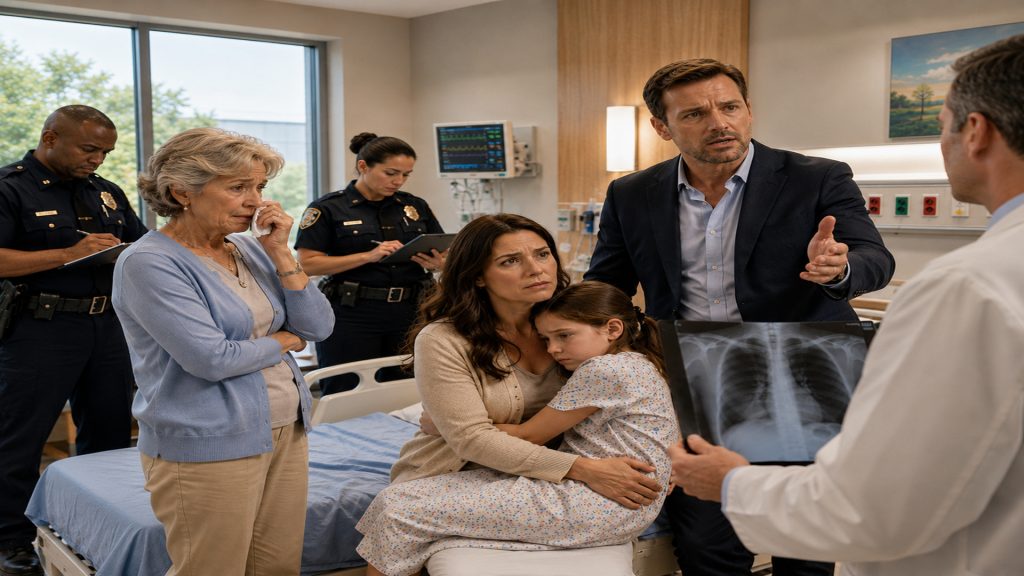
“Soon. There was significant damage. The magnets had attached across several loops of intestine. We had to remove a damaged section.”
Brandon stared at the doctor.
“How long were they inside her?”
“Based on the tissue damage, more than a day.”
He turned toward me.
“How did you not notice?”
I ignored him and asked the doctor the question that had been forming in my mind.
“Could a five-year-old swallow thirty-six magnets by herself?”
The surgeon hesitated.
“It would be extremely unlikely.”
“Why?”
“High-powered magnetic beads have a metallic taste. Swallowing that many would be unpleasant and difficult. A child might accidentally swallow one or two, but thirty-six suggests repeated ingestion.”
“Someone gave them to her?”
“That is one possibility. Someone may have convinced her they were candy.”
The waiting room became silent.
Brandon’s expression changed.
Evelyn lowered her eyes.
But not before I saw something in them.
Fear.
Not grief.
Not shock.
Fear.
A memory flashed through my mind.
Several months earlier, I had installed a small security camera in our dining room after money disappeared from my purse.
Brandon had laughed at me and said I was becoming paranoid.
I never found out who took the money, but I left the camera running.
It pointed directly toward the dining table.
I pulled out my phone.
Officer Elliott looked at me.
“Is something wrong?”
“We have a security camera in our dining room.”
Brandon frowned.
“What camera?”
“The one near the bookshelf.”
“You told me you removed it.”
“I said I stopped checking it.”
Evelyn’s face went pale.
Brandon glanced at her.
“Why waste time with a camera?” he asked. “Nancy probably found the magnets somewhere.”
“Children put everything in their mouths,” Evelyn added quickly.
Neither of them looked at me.
They looked at each other.
Officer Elliott noticed.
He stepped forward.
“Mrs. Carter, can you access the footage remotely?”
“I’m not sure. The recordings are stored on a device in the house.”
“We’ll send an officer to retrieve it.”
Brandon moved toward him.
“Do you need a warrant?”
Officer Elliott’s eyes narrowed.
“Your wife, who is also an owner of the property, has given us permission.”
“I’m just asking.”
“Then you have your answer.”
An officer was dispatched to our home.
While we waited, Nancy was moved into intensive care.
Only one parent was allowed to enter at first.
Brandon insisted he should go.
“She needs her mother,” the nurse replied.
For the first time that night, someone said what should have been obvious.
I entered Nancy’s room.
She looked impossibly small beneath the hospital blankets.
Machines surrounded her, and a tube ran from her arm.
Her eyes opened slightly when I touched her hand.
“Mommy?”
“I’m here.”
“Did the fish leave?”
“Yes, sweetheart. The doctors took them away.”
She closed her eyes.
“I didn’t like the candy.”
My breath stopped.
“What candy?”
“The shiny candy.”
“Who gave it to you?”
Her eyelids fluttered.
“Grandma said not to tell.”
I felt the room tilt.
“Nancy, which grandma?”
But she had already fallen asleep.
I remained beside her until Officer Elliott asked to speak with me.
The recording device had been brought to the hospital.
A technician connected it to a monitor inside a private conference room.
Officer Peters stood near the door.
Brandon and Evelyn were invited to watch because they had both insisted on being present.
The technician searched the footage from Saturday.
At first, nothing unusual appeared.
At 7:12 a.m., Nancy ate pancakes while I cleaned the kitchen.
At 9:30, she colored pictures at the dining table.
At noon, I served her lunch.
At 1:48 p.m., Evelyn arrived carrying a large leather purse and a white bakery box.
I remembered the visit clearly.
She had brought cupcakes and complained that I was raising Nancy without enough discipline.
At 2:15, the footage showed me walking through the back door with a basket of laundry.
I went outside to hang blankets on the drying rack.
Nancy remained at the table with Evelyn.
For several minutes, Evelyn sat beside her granddaughter, smiling and brushing Nancy’s hair.
Then she reached into her purse.
She removed a small plastic container.
My stomach tightened.
On the screen, Evelyn looked toward the kitchen and then toward the back door.
She opened the container and poured several tiny silver balls into her palm.
Nancy pointed at them.
Even without sound, I could see her asking a question.
Evelyn smiled.
She placed one of the silver beads onto a cupcake.
Then she pushed the cupcake toward Nancy.
The room went silent.
“No,” Evelyn whispered behind me.
On the recording, Nancy ate the cupcake.
Evelyn added another magnet.
Then another.
She gave them to Nancy one at a time, hiding each bead inside pieces of frosting.
My entire body became cold.
The footage continued for eleven minutes.
Thirty-six times, Evelyn placed a magnet into food and encouraged my daughter to swallow it.
At one point, Nancy shook her head.
Evelyn gripped her chin and pointed toward the back door where I was working.
Then she said something that made Nancy begin eating again.
The technician increased the audio.
The camera’s microphone was weak, but Evelyn’s voice could be heard.
“If you tell your mother, she’ll be taken away, and you’ll never see her again.”
I turned toward my mother-in-law.
She backed against the wall.
“It isn’t what it looks like.”
Officer Elliott stepped between her and the door.
“It looks like you intentionally fed thirty-six magnets to a five-year-old child.”
“No! I didn’t know they were dangerous.”
“You hid them inside cupcakes.”
“I thought they would pass naturally.”
Brandon stared at his mother.
“Mom?”
Evelyn began shaking.
“I was trying to help you.”
“Help me?”
“You said Samantha was going to take Nancy and leave.”
I looked at Brandon.
His face went blank.
“What is she talking about?”
He did not answer.
Officer Peters reached for Evelyn’s wrists.
“You are under arrest for aggravated child abuse and attempted murder.”
“Attempted murder?” she screamed. “I didn’t try to kill anyone!”
“You gave a child thirty-six high-powered magnets and threatened her into silence.”
As the officer placed handcuffs around Evelyn’s wrists, she turned toward Brandon.
“Tell them! Tell them this was your idea!”
The room became completely still.
Brandon’s mouth opened.
No sound came out.
I stared at him.
“What did she say?”
Evelyn began sobbing.
“He told me we needed proof that Samantha was an unfit mother. He said if something happened while she was home, he could get full custody.”
“That’s a lie!” Brandon shouted.
“You told me to scare Nancy. You told me to create an emergency.”
“I never told you to feed her magnets!”
“You bought them!”
Officer Elliott immediately turned to Brandon.
“Where were the magnets purchased?”
“I don’t know anything about them.”
Evelyn laughed bitterly through her tears.
“Check his office. Check his online account. He ordered them two weeks ago.”
Brandon lunged toward her, but Officer Peters blocked him.
“You stupid woman!”
The officers restrained him.
My hands went numb.
I could barely breathe.
“You planned this?” I whispered.
Brandon looked at me.
“No. Samantha, listen to me. My mother misunderstood.”
“You bought the magnets?”
“They were for a desk toy.”
“You don’t own a desk toy.”
“I was going to build one.”
“Why did your mother bring them into my home?”
“I didn’t know she would do that.”
Evelyn screamed from the doorway.
“He said Nancy needed to get sick while Samantha was watching her! He wanted hospital records. He wanted the police involved!”
The officers removed Evelyn from the room.
Brandon was detained for questioning.
I stood in front of the dark monitor, staring at the frozen image of my daughter eating the cupcake.
Officer Elliott spoke gently.
“Mrs. Carter, we need to ask whether you and your husband were having marital problems.”
I lowered myself into a chair.
“I thought we were going through a difficult period. He had become distant. He criticized everything I did. A month ago, I told him I wanted us to attend counseling.”
“Did you threaten to leave?”
“I said that if he refused counseling, I might take Nancy to stay with my sister for a while.”
“Did you discuss custody?”
“No.”
“Did he?”
“He said I would never take his daughter away from him.”
Officer Elliott wrote something down.
“Are there financial issues?”
“I don’t think so.”
“Would your husband benefit from gaining custody?”
The question seemed strange until I remembered something.
Brandon’s father had died two years earlier.
His will created a family trust for Brandon, but there was a condition.
The larger share of the trust would be released when Brandon became the primary guardian of a biological child.
At the time, Brandon had laughed about the wording.
His father had been old-fashioned and believed a man should provide the principal home for his children.
Because Nancy lived with both of us, the trust remained under the management of an attorney.
If Brandon became her sole custodial parent, he would receive nearly three million dollars.
I told Officer Elliott.
His expression hardened.
“That gives him a financial motive.”
“I never believed he cared about the money.”
But as I said the words, memories began rearranging themselves.
Brandon had recently complained that his salary was not enough.
He had mentioned starting a real estate company.
He had asked me whether I would ever consider letting Nancy attend boarding school.
He had encouraged me to post more of my life online, joking that people might think I spent all day on my phone.
He had begun documenting small household accidents.
A spilled glass.
A scraped knee.
A forgotten lunchbox.
Each time, he photographed the incident and sent the picture to Evelyn.
I had believed he was being controlling.
Now I realized he had been collecting evidence.
When Brandon returned from questioning, he was not wearing handcuffs.
The police said they did not yet have enough evidence to arrest him.
He admitted purchasing the magnets but claimed Evelyn had taken them without his permission.
He denied planning the poisoning.
His attorney arrived before noon.
Within an hour, Brandon stopped speaking to me.
He sat outside Nancy’s room sending messages and making calls while I remained beside our daughter.
That afternoon, a hospital social worker entered.
“Mrs. Carter, until the investigation is complete, we need to discuss a temporary safety plan.”
My heart tightened.
“Are you taking Nancy away from me?”
“No. Based on the video, you are no longer considered a suspect. But your husband and his mother cannot have unsupervised contact with Nancy.”
Relief and horror washed through me at the same time.
“My husband cannot see his own daughter?”
“Not without supervision.”
“Does he know?”
“Yes.”
Brandon exploded when security informed him.
“This is my child!” he shouted in the hallway. “You can’t keep me away from her because of something my mother did.”
The hospital removed him from the floor.
Before leaving, he looked at me with an expression I had never seen before.
Hatred.
Not sorrow.
Not regret.
Hatred because his plan had failed.
That evening, Nancy woke for several minutes.
She cried when she realized she was still in the hospital.
I climbed carefully onto the edge of the bed and held her hand.
“Mommy, is Grandma angry?”
“No, sweetheart.”
“She said Daddy needed me to eat the candy.”
My throat closed.
“What exactly did she say?”
Nancy stared at the blanket.
“She said Daddy wanted to know if I was brave. She said if I ate all the shiny candy, Daddy would come home and take me to Disneyland.”
“Did you see Daddy that day?”
Nancy shook her head.
“Did Grandma call him?”
“Yes.”
“What did she say?”
“She said, ‘It’s done.’”
I recorded Nancy’s words with permission from the social worker.
The next morning, detectives searched our house.
Inside Brandon’s home office, they found a hidden folder containing printed information about child custody.
There were articles about proving parental negligence.
There were screenshots of my social media accounts, photographs of Nancy’s scraped knee, and notes listing every occasion when I had left her with a babysitter.
They also found a draft email addressed to a family attorney.
It described me as emotionally unstable, addicted to social media, and incapable of protecting our daughter.
The email had been written three weeks before Nancy swallowed the magnets.
The detectives found something else.
A receipt for two containers of magnetic beads.
Only one container had been used.
The second remained hidden inside Brandon’s desk.
His fingerprints were on both.
There were text messages between Brandon and Evelyn.
Most had been deleted, but investigators recovered them from a cloud backup.
At first, the messages seemed vague.
Brandon wrote that he needed “an incident serious enough to create a record.”
Evelyn replied that she would “handle the distraction.”
Brandon warned her, “Nothing permanent.”
She responded, “I understand.”
The day before Nancy became sick, Brandon sent another message.
“The package is in my office. Use enough to make the hospital take it seriously.”
Evelyn answered, “And then you get custody?”
Brandon replied, “Once they see Samantha as negligent, everything changes.”
The final message was sent at 2:28 p.m., while I was hanging laundry outside.
Evelyn wrote, “It’s done.”
Brandon responded with a thumbs-up.
He was arrested at the airport while attempting to board a flight to Mexico.
The business conference in Phoenix had never existed.
Brandon had been staying at a hotel near the San Diego airport, creating the appearance that he was out of town while remaining close enough to control the situation.
Police found his passport, cash, and a second phone in his luggage.
He claimed he was traveling for work.
The detectives did not believe him.
When Officer Elliott told me about the arrest, I did not feel victorious.
I felt empty.
The man I had slept beside for eight years had planned to injure our child and blame me.
He had been willing to let Nancy suffer for money.
Worse, he had known that suspicion would fall on me because I was the parent who stayed home.
He understood how quickly people judged mothers.
He had counted on it.
Nancy spent twelve days in the hospital.
Her recovery was slow.
She developed a fever after surgery, and doctors feared an infection.
For two nights, I sat beside her bed listening to the monitors, terrified that they might suddenly begin alarming.
Every time she moved, I woke.
Every time a nurse entered, my heart raced.
On the fourth day, Nancy asked about Brandon.
“Where’s Daddy?”
I struggled to answer.
“He can’t visit right now.”
“Is he still at work?”
“Yes,” I whispered. “He has something important to take care of.”
I hated lying to her, but the child psychologist advised me not to explain the truth until Nancy was stronger.
Children often blamed themselves when adults committed terrible acts around them.
Nancy already believed she had done something wrong by eating the “candy.”
The psychologist helped her understand that she was not responsible.
“A grown-up gave you something dangerous,” she explained gently. “It was not your fault.”
Nancy looked at me.
“Mommy told me not to take candy from strangers.”
“That’s true,” the psychologist said. “But Grandma wasn’t a stranger. You trusted her.”
“Am I bad?”
“No,” I said immediately, kneeling beside her bed. “You are not bad. You are brave, and you told me when your stomach hurt. That helped the doctors save you.”
Nancy wrapped her arms around my neck.
For the first time since the surgery, I allowed myself to cry in front of her.
Not loudly.
Just enough for her to see that adults could be hurt and still remain strong.
While Nancy recovered, Brandon’s attorney began attacking me publicly.
Someone leaked the story to a local news website.
The first headline read:
“Grandmother Accused of Feeding Magnets to Child During Custody Dispute.”
By evening, strangers were discussing our family online.
Some accused me of inventing the story.
Others claimed I must have known what was happening.
People searched through my social media pages and reposted photographs of Nancy.
I deleted every account.
Brandon’s attorney released a statement claiming his client had been manipulated by an unstable mother.
The statement suggested Evelyn acted alone and that I had pressured Nancy into accusing Brandon.
I wanted to respond.
I wanted to tell the world what he had done.
Officer Elliott advised me to remain silent.
“The evidence is stronger than public opinion,” he said. “Let the investigation speak.”
So I stayed quiet.
I focused on Nancy.
My sister, Laura, returned from Europe and moved into the hospital room with us.
She brought clean clothes, food, and the kind of support I had once expected from my husband.
When I finally told her everything, she sat completely still.
Then she reached across the table and took my hands.
“You are never going back to that house alone.”
“I don’t know where else to go.”
“You and Nancy can stay with me.”
“I don’t want to uproot her.”
“Samantha, that house is a crime scene. It stopped being a home the moment they used your dining table to hurt your child.”
She was right.
The police allowed me to enter the house once to collect clothing and important documents.
Officer Peters accompanied me.
The dining room looked exactly as I had left it.
Nancy’s coloring book remained on the table.
A purple crayon lay beneath a chair.
The white bakery box was gone, taken into evidence.
I stood in the doorway unable to move.
The room that had held birthday dinners, Christmas breakfasts, and family celebrations now felt contaminated.
Officer Peters waited patiently.
“You don’t have to go inside.”
“I need her favorite blanket.”
“Tell me where it is.”
I directed him to Nancy’s bedroom.
While he collected the blanket, I entered Brandon’s office.
The desk drawers were open from the search.
On the floor lay one of the custody articles he had printed.
A sentence had been highlighted:
“A pattern of negligent supervision may influence the court’s determination of the child’s primary residence.”
He had not wanted to protect Nancy.
He had wanted to possess her.
There was a difference.
When Nancy was discharged, she moved into Laura’s house with me.
For several weeks, she could eat only soft foods.
She became afraid of cupcakes.
She refused anything with frosting and cried whenever she saw silver candy decorations.
At night, she woke screaming that fish were biting her again.
I slept beside her.
Sometimes she reached for my hand without opening her eyes.
I held on until morning.
The criminal proceedings began six weeks later.
Evelyn accepted a plea agreement after prosecutors presented the recovered messages and security footage.
In exchange for a reduced sentence, she agreed to testify against Brandon.
I attended the hearing.
Evelyn entered the courtroom wearing a plain gray uniform.
Without expensive clothes, jewelry, and carefully styled hair, she looked smaller than I remembered.
She avoided my eyes until the judge asked whether she wished to make a statement.
Then she turned toward me.
“I loved Nancy,” she said.
A sound escaped my throat.
It was not laughter, exactly.
It was disbelief.
Evelyn continued.
“I never intended for her to be permanently harmed. Brandon told me the magnets would pass through her body. He said she would have stomach pain and the hospital would blame Samantha.”
The prosecutor asked, “Why were you willing to cause pain to your granddaughter?”
Evelyn lowered her head.
“My son said Samantha was planning to destroy our family.”
“You were also aware that he would receive money from a trust if he gained primary custody, correct?”
“Yes.”
“And he promised to purchase you a home?”
“Yes.”
There it was.
The value Evelyn had placed on Nancy’s safety.
A house.
Not even a house she currently owned.
The promise of one.
The judge sentenced Evelyn to eighteen years in prison.
She began sobbing as the bailiff led her away.
I felt no satisfaction.
Only sadness that Nancy would someday understand what her grandmother had chosen.
Brandon refused every plea offer.
He insisted on going to trial.
His defense argued that the text messages were misunderstood.
They claimed he wanted Evelyn to create evidence of ordinary negligence, such as leaving a door unlocked or allowing Nancy to play unsupervised.
They said he never authorized the use of magnets.
Then the prosecution played the security footage.
The courtroom watched Evelyn hide silver beads inside frosting.
They listened to her threaten Nancy.
Afterward, the prosecutor displayed Brandon’s messages.
“Use enough to make the hospital take it seriously.”
The defense attorney argued that the message referred to ordinary household mess.
The prosecutor then presented Brandon’s internet history.
Three days before the incident, he had searched:
“What happens if a child swallows magnets?”
“How many magnets cause intestinal damage?”
“Can swallowed magnets be detected immediately?”
“Can a parent lose custody after accidental poisoning?”
Brandon stared at the table while each search appeared on the courtroom screen.
The final evidence came from his second phone.
Investigators recovered a voice recording made the night before Evelyn entered our home.
Brandon had apparently recorded the conversation by accident while testing the phone.
His voice filled the courtroom.
“It needs to happen while Samantha is home.”
Evelyn asked, “What if Nancy tells them?”
“She’s five. Tell her it’s a secret game.”
“What if she gets really sick?”
“That’s the point. A stomachache won’t create a case.”
“I don’t want her to die.”
“She won’t. The website says doctors can remove them.”
I closed my eyes.
Even after everything I had learned, hearing his voice destroyed the last part of me that still searched for another explanation.
He had known.
He had understood the danger.
He had decided the risk was acceptable.
The jury deliberated for less than four hours.
Brandon was convicted of attempted murder, aggravated child abuse, conspiracy, evidence tampering, and attempted custodial interference.
Before sentencing, the judge allowed me to speak.
I walked to the front of the courtroom carrying a photograph of Nancy taken before the incident.
She was standing on the beach wearing a yellow dress, holding a seashell against her ear.
“I used to believe betrayal happened in one moment,” I began. “I thought it was a door closing, a lie being discovered, or a promise being broken.”
Brandon stared at me from the defense table.
“But what my husband did was not one moment. It was hundreds of choices. He researched how magnets could hurt a child. He purchased them. He created a false business trip. He convinced his mother to enter our home. He chose a time when I would be blamed. Then, while our daughter was in surgery, he looked into my face and asked what I had done to her.”
My voice trembled, but I continued.
“He knew I would question myself. He knew the police would question me. He knew strangers would believe a mother must have seen what happened. He used every hour I had spent caring for Nancy as a weapon against me.”
Brandon looked down.
“Our daughter lost part of her intestine. She wakes at night believing animals are biting her from inside. She is afraid of food. She asks why her father does not visit.”
I placed the photograph on the podium.
“One day, she will learn the truth. She will learn that her father valued money more than her safety. But she will also learn that she survived. She will learn that the person he tried to blame never abandoned her.”
I turned toward Brandon.
“You wanted to prove I was an unfit mother. Instead, you proved that you were never worthy of being her father.”
The judge sentenced Brandon to thirty-eight years in prison.
As deputies led him away, he called my name.
“Samantha!”
I did not turn around.
The civil court granted me sole custody of Nancy.
Brandon’s parental rights were terminated.
The trust became the subject of another legal battle.
Brandon’s father’s will contained a clause disqualifying any beneficiary convicted of a felony against a family member.
As a result, Brandon lost his entire inheritance.
The money was redirected into a protected trust for Nancy, accessible only for her medical care, education, and future needs.
The fortune he had tried to obtain by hurting her would now be used to rebuild her life without him.
I filed for divorce.
There was nothing to negotiate.
Our house was sold after the criminal trial.
I could not imagine raising Nancy in the same rooms where the plan had unfolded.
With my share of the proceeds, I purchased a smaller home near Laura’s neighborhood.
It had a bright kitchen, a little garden, and a bedroom with windows overlooking a jacaranda tree.
Nancy chose pale blue walls.
“No fish,” she said when I showed her wallpaper samples.
“No fish,” I promised.
She selected stars instead.
For months, our life revolved around doctor appointments, counseling sessions, and gradual healing.
Nancy’s physical recovery progressed faster than her emotional recovery.
She returned to kindergarten but refused to eat lunch unless I packed every item in a sealed container.
Her teacher allowed her to sit near the classroom window when she felt anxious.
Sometimes I waited in the parking lot for hours because leaving felt impossible.
The first time Nancy completed a full school day, she ran into my arms.
“I ate my apples,” she announced proudly.
“That’s wonderful.”
“I checked them first.”
“That’s okay.”
Her trust in food returned slowly.
Her trust in people took longer.
One afternoon, nearly a year after the surgery, Laura baked cupcakes for her son’s birthday.
When Nancy saw them, she froze.
I knelt beside her.
“You don’t have to eat one.”
She stared at the pink frosting.
“Did Aunt Laura make them?”
“Yes.”
“Did you watch?”
“I helped.”
Nancy considered this.
Then she asked for a plain cupcake without decorations.
She broke it into tiny pieces and inspected each one.
Finally, she took a bite.
Everyone in the kitchen pretended not to watch.
When she finished half of it, she smiled.
“It tastes normal.”
Laura turned away to hide her tears.
I smiled back.
“It is normal.”
That small cupcake felt like a victory greater than any courtroom verdict.
I completed the online courses Evelyn had mocked.
They were part of a certification program in child advocacy.
After everything that happened, I understood how quickly innocent caregivers could be treated as suspects and how easily children could be silenced by adults they trusted.
I began volunteering with a local family safety organization.
Eventually, they offered me a paid position helping parents navigate hospital investigations and emergency custody cases.
On my first day, I met a mother sitting alone in a hallway while her son underwent surgery.
Police officers had questioned her for hours.
She looked at me with the same terror I once felt.
“They think I hurt him,” she whispered.
I sat beside her.
“Then we will help you tell the truth.”
I could not promise that every story would end fairly.
But I could make sure she did not face it alone.
Nancy grew stronger.
By the time she turned seven, the scar across her abdomen had faded from red to pale pink.
She called it her “brave line.”
For her birthday, she asked for a party in our garden.
There were balloons, music, sandwiches, and a cake decorated with stars.
No silver candy.
No hidden surprises.
Before blowing out the candles, Nancy closed her eyes and made a wish.
“What did you wish for?” I asked later.
She leaned close to my ear.
“I wished you would never leave me.”
I wrapped my arms around her.
“That wish already came true.”
Years passed.
We rarely spoke about Brandon, though his absence existed like a closed door at the end of a hallway.
When Nancy was old enough, I told her the truth with the help of her therapist.
I did not show her the security footage.
I did not describe every message.
I explained only what she needed to understand.
Her father and grandmother had made a plan to hurt her and blame me.
They did it because they wanted money and control.
The police discovered the truth.
They could never hurt her again.
Nancy cried quietly.
“Did Daddy love me?”
It was the hardest question she ever asked.
I refused to lie.
“I think he loved the idea of owning a family,” I said. “But real love protects people. Real love does not use them.”
“Do you hate him?”
“I hated what he did. For a long time, I hated him too. But carrying that hate made him feel present in our home, and I didn’t want him living with us anymore, even in our minds.”
Nancy thought about this.
“I don’t want him in my mind either.”
“You don’t have to decide how you feel today.”
She looked down at her brave line.
“I survived him.”
“Yes,” I said. “You did.”
On the tenth anniversary of the night Nancy entered my bedroom, we visited the hospital.
The surgeon who saved her had retired, but several nurses still remembered the case.
Nancy brought flowers for the pediatric intensive care unit.
She was fifteen by then, nearly as tall as I was, with a calm confidence that sometimes surprised me.
We stood outside the examination room where the magnets had first appeared on the X-ray.
“Do you remember being here?” I asked.
“Only pieces.”
“What pieces?”
“Your hand.”
“My hand?”
“I remember holding it. Everything else was bright and loud, but your hand was there.”
I looked away, overcome by emotion.
For years, I had feared that Nancy’s strongest memory would be pain, betrayal, or fear.
Instead, she remembered that I had stayed.
As we left the hospital, she slipped her hand into mine just as she had when she was five.
Outside, the afternoon sun reflected off the building’s windows.
Families walked through the entrance carrying flowers, overnight bags, and frightened hope.
Nancy looked back once.
Then she faced forward.
“Mom?”
“Yes?”
“I think I know what I want to do when I grow up.”
“What?”
“I want to become a surgeon.”
I smiled.
“You would be an excellent one.”
“I want to help children when something bad gets inside them.”
Her words carried more meaning than she realized.
Some dangerous things entered the body.
Others entered a family.
Both had to be found before they destroyed everything around them.
Nancy squeezed my hand.
“Do you think the little fish are finally gone?”
I remembered the child she had been, standing in my doorway at two in the morning, trying to describe pain she could not understand.
“Yes,” I said. “They’re gone.”
And this time, I knew it was true.
The magnets were gone.
The lies were gone.
The people who had tried to destroy us no longer controlled our lives.
What remained was not the family Brandon had pretended to protect.
It was something smaller, stronger, and honest.
It was Nancy laughing in our bright kitchen.
It was Laura arriving without knocking.
It was a bedroom painted blue with stars across the walls.
It was a mother who had once collapsed against a hospital wall but had learned to stand again.
And it was a daughter who carried a scar across her stomach, not as proof of what had been done to her, but as evidence that she had survived.
THE END! THANK YOU FOR READING!