

The first sound after my parents fell into the swimming pool was laughter.
It was not loud at first.
It moved through the terrace in scattered bursts—nervous, cruel, and cowardly—like people testing whether they were permitted to enjoy someone else’s humiliation.
My mother, Ruth Hayes, surfaced coughing, her navy dress heavy with water. Her gray hair had come loose from the careful twist she had spent an hour arranging in the hotel bathroom that morning. One of her shoes floated beside her like a dark little boat.
My father, Daniel, came up immediately after her. He wrapped one arm around her waist and guided her toward the shallow steps, although his own borrowed suit was soaked through and pulling against his shoulders.
At the edge of the pool stood my future mother-in-law, Victoria Blackwell.
Her diamonds glittered in the afternoon sunlight. One manicured hand still hovered in the air—the same hand she had used to shove my mother backward.
Hundreds of wedding guests watched from beneath white canopies and flowering arches.
Executives.
Politicians.
Donors.
Television personalities.
Old-money families whose names appeared on hospitals, libraries, museums, and private schools.
Victoria looked down at my parents and smiled.
“Perhaps the water will wash away the smell of poverty,” she said.
A few people laughed again.
This time, they were louder.
My mother’s face changed.
She had endured years of hard work without complaint. She had spent three decades serving lunches to children at an elementary school, memorizing which students needed extra food and quietly slipping fruit into backpacks when she knew their families were struggling.
My father had repaired engines since he was seventeen. His hands were permanently marked by oil, burns, and small scars earned from a lifetime of honest labor.
Neither of them had ever been ashamed of who they were.
But in that moment, standing waist-deep in a billionaire’s swimming pool while strangers laughed, I saw shame enter my mother’s eyes.
It was not shame for herself.
It was shame because she believed she had embarrassed me.
That hurt more than anything Victoria could have said.
I turned to Julian.
My fiancé stood beside me in a custom black tuxedo, frozen beneath the floral arch where we were supposed to exchange vows in less than twenty minutes.
He looked at his mother.
Then at the guests.
Then at me.
“Say something,” I whispered.
Julian’s jaw tightened.
“Natalie, not here.”
“Your mother pushed my parents into the pool.”
“She’s been drinking.”
“She insulted them in front of everyone.”
“I know, and I’ll speak to her later.”
“Later?”
His eyes darted toward the photographers.
“Please don’t make this worse.”
For a second, I thought I had misunderstood him.
“Don’t make this worse?” I repeated.
He stepped closer and lowered his voice.
“My mother lost control for one moment. Your parents are not injured. We can get them dry clothes, delay the ceremony, and handle this privately.”
My father had reached the pool steps by then. He helped my mother climb out while water poured from their clothing onto the pale marble.
No one rushed forward.
No one offered a towel.
People simply watched.
Some guests looked uncomfortable, but discomfort was not the same as courage.
Julian reached for my hand.
“Natalie, everyone is waiting. We have spent months preparing for today. Let’s not destroy our future because of one stupid mistake.”
I stared at him.
For two years, Victoria had insulted my family.
She had mocked my mother’s job during our engagement dinner.
She had asked my father whether he knew which fork to use at a charity banquet.
She had suggested that my parents enter the wedding through the service gate so they would not be photographed near important guests.
Each time, Julian apologized afterward.
Always privately.
Always gently.
Always after Victoria had already gotten what she wanted.
He promised things would improve after the wedding.
He promised marriage would give him the confidence to set boundaries.
He promised that once I officially became a Blackwell, his mother would respect me.
I had wanted to believe him.
Now my parents stood dripping on marble, and Julian was still protecting his mother’s comfort.
Something inside me went quiet.
Not broken.
Finished.
I slid the engagement ring from my finger.
Julian’s eyes widened.
“Natalie.”
I dropped the ring into his champagne glass.
It struck the crystal with a delicate chime.
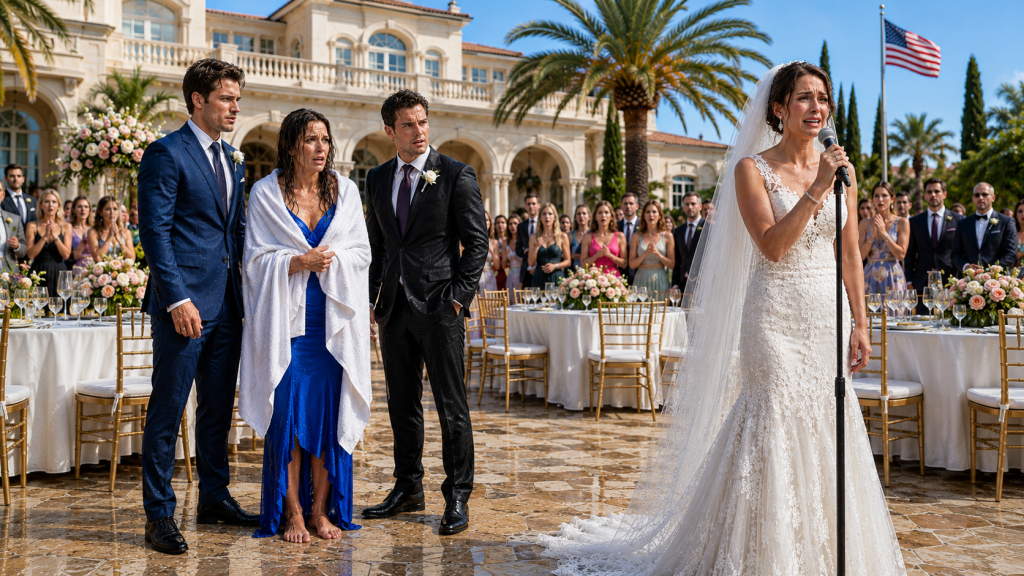
Then I turned and walked toward the bandstand.
“Natalie, stop.”
I did not.
The musicians fell silent as I approached.
The bandleader stared at me, then handed me the microphone.
My wet, humiliated parents stood near the pool.
Victoria smirked.
Julian followed me through the crowd, his face pale with panic.
I raised the microphone.
“This wedding is canceled.”
The words carried across the estate.
Conversations stopped.
“There will be no ceremony,” I continued. “There will be no reception, and there will be no marriage between me and Julian Blackwell.”
Gasps moved through the guests.
Victoria laughed.
It was a sharp, dismissive sound.
“You dramatic little fool,” she said. “Do you understand what you’re throwing away?”
I looked directly at her.
“Yes.”
“You’ll regret this before sunset.”
“No,” I said. “But by tomorrow morning, the Blackwell business empire will begin falling apart.”
She laughed again.
Several guests joined her.
They thought I was only Natalie Hayes, the owner of a modest design studio in downtown Boston.
They thought I was the daughter of a mechanic and a school cafeteria worker who had somehow convinced Julian Blackwell to marry beneath his social class.
They thought the small studio apartment I had lived in when Julian met me represented the full extent of my life.
They thought my last name was Hayes because that was the name printed on my business cards.
They did not know Hayes was my mother’s maiden name.
They did not know my legal surname was Fairchild.
And they certainly did not know what Fairchild meant.
I removed my phone from the pocket hidden inside my wedding dress and called Simon Cross, general counsel for Fairchild Capital.
He answered on the first ring.
“Ms. Fairchild.”
“Activate the Blackwell protocol.”
There was a pause.
“Are you certain?”
I looked at my parents.
My father had placed his jacket around my mother even though it was as wet as her dress.
“I’m certain.”
Simon’s voice became formal.
“Understood.”
“Freeze every pending transfer requiring our consent. Notify the board. Contact every lender in the file. Suspend the restructuring agreement and release the evidence package to federal investigators at midnight.”
Julian stopped walking.
His expression changed completely.
“Evidence package?” he whispered.
I continued speaking into the phone.
“Bring the legal team onto the estate. And send medical staff for my parents.”
“We are at the east gate,” Simon said. “We’ll be there in less than two minutes.”
I ended the call.
Victoria folded her arms.
“What a performance.”
Then the estate gates opened.
Five black sedans entered in a slow line.
The guests turned.
The cars crossed the long circular driveway and stopped beside the terrace. Men and women stepped out wearing dark suits, carrying locked briefcases, tablet computers, and document cases.
There were attorneys.
Auditors.
Security personnel.
Two private nurses.
And representatives from Fairchild Capital, the company my grandfather had founded.
The company Victoria believed had once hired me to design a few brochures.
The company I quietly controlled.
Simon Cross approached me without hesitation.
He was sixty-three, silver-haired, precise, and nearly impossible to intimidate.
He handed me a leather folder.
“Everything is ready, Ms. Fairchild.”
A murmur swept through the terrace.
Victoria’s smile disappeared.
“Ms. Fairchild?” someone repeated.
Julian stared at me.
“What is happening?”
I met his eyes without anger.
“You’re finally seeing the truth.”
The nurses hurried toward my parents with towels and blankets. My mother tried to protest, but one of them gently led her toward the house.
My father paused beside me.
“You all right, sweetheart?”
I almost laughed at the absurdity of the question.
He was soaking wet.
His face was red with humiliation.
And he was asking whether I was all right.
“I am now.”
He squeezed my shoulder.
“Then do what you need to do.”
Simon opened the leather folder.
“Victoria Blackwell,” he said, “Fairchild Capital has exercised its contractual right to suspend all financing and asset transfers connected to Blackwell Holdings.”
Victoria looked around as if waiting for someone to stop him.
No one moved.
“Our family does not borrow from Fairchild Capital,” she said.
Simon glanced down at the documents.
“Blackwell Holdings currently carries $1.8 billion in debt across eleven entities. Fairchild Capital controls or guarantees approximately sixty-two percent of that exposure.”
Several executives began checking their phones.
Julian’s uncle, Charles Blackwell, pushed through the crowd.
“What restructuring agreement?”
“The agreement your board has been negotiating for nine months,” Simon replied.
Charles looked at Julian.
“You told me Fairchild was committed.”
Julian’s face had gone white.
“They were.”
“Fairchild was committed,” I said, “because I approved the negotiations.”
Victoria stared at me.
“You?”
“My grandfather founded Fairchild Capital forty-eight years ago. When he died, controlling ownership passed into a trust. I became chair of that trust on my thirtieth birthday.”
“That’s impossible.”
“It isn’t.”
“You own that little design shop.”
“I do. I built it myself because I wanted one part of my life that wasn’t inherited.”
Victoria looked toward the arriving attorneys.
“You expect us to believe you secretly control one of the largest private investment companies in the country?”
“I never asked you to believe it.”
Phones began ringing across the terrace.
Charles answered his.
His expression darkened as he listened.
“What do you mean the credit facility is frozen?”
Another Blackwell executive received a call.
Then another.
The sound spread across the reception like an alarm.
Julian stepped toward me.
“Natalie, we need to talk privately.”
“No.”
“This concerns our family.”
“There is no ‘our family’ anymore.”
He looked toward my parents, then back at me.
“I’m sorry about what happened.”
“You’re sorry because the cars arrived.”
“That’s not fair.”
“Fair?” I repeated. “My mother was pushed into a pool while your guests laughed. You told me not to make it worse.”
“I panicked.”
“You chose.”
His face tightened.
“I chose to prevent a public scandal.”
“No. You chose the person you always choose.”
Victoria recovered enough to lift her chin.
“This is blackmail.”
Simon answered before I could.
“No, Mrs. Blackwell. Fairchild Capital is exercising rights written into contracts your attorneys reviewed and your board approved.”
“On what grounds?”
“Fraud, material misrepresentation, misuse of restricted funds, undisclosed related-party transactions, and potential obstruction of a federal inquiry.”
The terrace became silent again.
Victoria’s confidence faltered.
Julian looked at his mother.
“What inquiry?”
She did not answer.
Simon handed me another document.
Six months earlier, Fairchild auditors had discovered irregular payments hidden inside the Blackwell Foundation’s charitable accounts.
Millions of dollars had supposedly been used for housing projects, community clinics, and scholarships.
Instead, the funds had passed through shell companies connected to Victoria’s brother.
Some of the money had financed private aircraft, luxury renovations, overseas properties, and political gifts disguised as consulting payments.
When I first learned about the irregularities, I had wanted to tell Julian.
Simon advised me not to.
At the time, we did not know whether Julian was involved.
I had spent months hoping he was not.
Eventually, the evidence suggested he had not stolen money himself.
But he had approved documents he did not read.
He had ignored warnings from junior accountants.
He had signed whatever his mother placed in front of him.
His crime was not greed.
It was cowardice.
And cowardice had protected the people who were greedy.
Victoria pointed at me.
“You planned this.”
“I prepared for it.”
“You were going to marry my son while secretly investigating us?”
“I was going to marry Julian if he proved he was capable of choosing what was right.”
Julian flinched.
“So this was a test?”
“No. Life is not a test, Julian. Your mother created the crisis. You revealed yourself in it.”
Victoria stepped forward.
“You came into this family under false pretenses.”
I almost admired her ability to sound offended.
“I never lied to Julian about my identity.”
He looked at me sharply.
“Yes, you did.”
“I told you my legal name before our third date.”
“You said Natalie Fairchild Hayes.”
“That is my full name.”
“You never told me you controlled Fairchild Capital.”
“You never asked.”
“How could I possibly know to ask?”
“You could have asked about my life. My family. My work. My interests. Instead, you were proud that you loved a woman you believed had nothing. It made you feel generous.”
“That is not true.”
“Isn’t it?”
He opened his mouth, then stopped.
I remembered our first year together.
Julian had seemed different from his family.
He visited my father’s repair shop and listened while Dad explained engines.
He ate meatloaf in my parents’ small kitchen and told my mother it tasted better than anything served at the Blackwell estate.
He laughed easily.
He carried grocery bags.
He washed dishes.
I fell in love with that man.
But gradually, he began correcting my clothes before family dinners.
He asked me not to mention my father’s work around certain donors.
He suggested my parents might be happier seated farther from the head table at the wedding.
Each compromise seemed small.
Together, they formed a cage.
A dark SUV entered the driveway behind the sedans.
Two federal agents stepped out.
Victoria’s face lost all color.
Simon turned to me.
“They requested permission to enter once the evidence release was authorized.”
“Let them in.”
Julian grabbed my arm.
I looked down at his hand.
He released me immediately.
“You’re destroying everything,” he said.
“No. I’m refusing to hold it together.”
The agents approached Victoria and asked to speak with her inside.
She laughed, but the sound trembled.
“You cannot question me at my son’s wedding.”
“There is no wedding,” I said.
She glared at me.
“This is because your mother fell into a pool?”
“No. This is happening because you stole from charities, lied to lenders, and treated every decent person around you as though they existed for your convenience.”
“You have no idea what it takes to protect a family like ours.”
“I know exactly what it takes. Silence. Fear. Excuses. People like Julian saying, ‘Not here. Not now. Don’t make it worse.’”
The agents repeated their request.
Victoria turned to her son.
“Julian.”
He stood motionless.
For the first time in his life, he could not look to me to absorb his mother’s cruelty.
He could not look to his employees to fix the consequences.
He could not ask the photographers to turn away.
Everyone was watching.
“Tell them to leave,” Victoria ordered.
Julian looked at the agents.
Then at Simon.
Then at me.
“I can’t.”
Victoria stared at him as though he had struck her.
“You can’t?”
“I don’t have the authority.”
“You are a Blackwell.”
“And she controls the financing.”
The answer revealed more than he intended.
Even now, he was not refusing because his mother was wrong.
He was refusing because he lacked power.
I felt the final piece of my love for him disappear.
Victoria was escorted into the house.
The terrace erupted into whispers.
Guests began leaving in groups, eager to escape before reporters arrived. Some avoided my eyes. Others approached with awkward expressions and offered support they had not shown when my parents were in the pool.
A senator’s wife touched my arm.
“What Victoria did was appalling.”
“You laughed.”
Her face stiffened.
“I was shocked.”
“You laughed.”
She withdrew her hand and walked away.
I did not stop her.
My parents had been taken to a guest suite to change into dry clothing. I found them there twenty minutes later.
My mother wore a white robe, and my father had changed into spare clothes provided by one of Simon’s assistants.
Mom sat on the edge of the bed.
When she saw me, she began crying.
“I’m so sorry.”
I crossed the room quickly.
“You have nothing to apologize for.”
“I ruined your wedding.”
“No. You saved me from the marriage.”
She shook her head.
“I should have stayed home. I knew that woman didn’t want us there.”
“You are my mother. There was never going to be a wedding without you.”
Dad stood near the window, his arms crossed.
“I should’ve seen it coming.”
“How could you?”
“She kept circling us, making comments. I thought if I ignored her, she’d get bored.”
“That’s what we all thought.”
Mom touched my bare ring finger.
“You really ended it?”
“Yes.”
“Do you still love him?”
The question hurt because the answer was not simple.
“I love who he was when no one was watching.”
Dad looked at me.
“A person is also who they are when everyone is watching.”
I nodded.
“I know.”
He sat beside Mom.
“What happens now?”
“The investigation continues. Fairchild will protect the legitimate employees and projects, but the Blackwells will lose control.”
Mom looked worried.
“Will people lose their jobs?”
“Not if I can prevent it.”
That had been part of my preparation.
Blackwell Holdings employed nearly twelve thousand people across construction, logistics, energy, and real estate. Most had nothing to do with Victoria’s fraud.
I had instructed Simon to create a stabilization plan that would keep payroll funded while separating healthy divisions from corrupted leadership.
I did not want revenge on receptionists, drivers, engineers, warehouse workers, or accountants.
I wanted accountability for the people at the top.
Dad gave me a faint smile.
“Your grandfather would be proud.”
“I hope so.”
“He was always worried the money would change you.”
“It almost changed the people around me instead.”
A knock sounded at the door.
Julian stood in the hallway.
His tie was gone. His hair had fallen out of place, and for the first time since I had known him, he looked less like a Blackwell heir and more like a frightened man.
“Can I speak with Natalie?”
My father rose.
“No.”
I touched his arm.
“It’s all right.”
Dad studied me, then nodded.
“We’ll be downstairs.”
My parents left together.
Julian stepped inside but remained near the door.
“I didn’t know about the charity money.”
“I believe you.”
He looked surprised.
“You do?”
“Yes.”
“Then why are you treating me like I stole it?”
“Because you signed the documents.”
“My mother told me they were routine.”
“And you believed her because believing her was easier than checking.”
“I trusted my family.”
“You surrendered your judgment.”
He walked toward the window.
Outside, staff members were dismantling the floral arch.
“I know I failed you today.”
“You failed my parents.”
“I failed all of you.”
“Yes.”
He turned.
“I should have defended them.”
“Yes.”
“I should have stopped the wedding myself.”
“Yes.”
Anger flashed across his face.
“Can you say anything else?”
“What would you like me to say?”
“That you understand what this is like.”
“I understand perfectly.”
“My family’s company may collapse.”
“It will be restructured.”
“My mother could go to prison.”
“That depends on the evidence and the law.”
“My entire life is disappearing.”
“No, Julian. Your position is disappearing. Your life is what remains after the position is gone.”
He sank into a chair.
For a while, neither of us spoke.
Then he looked at me.
“Were you ever going to tell me about Fairchild?”
“Yes.”
“When?”
“Tonight.”
He stared.
“After the wedding?”
“After the reception. My grandfather’s portrait was waiting at the Fairchild townhouse. I planned to take you there and explain everything.”
“Why wait so long?”
“Because I needed to know whether you loved me or the name.”
“That doesn’t make sense. I didn’t know the name.”
“Exactly.”
His brow furrowed.
“I wanted someone who could respect my parents before discovering they were connected to wealth. I wanted someone who could see dignity without needing a bank statement.”
“I did respect them.”
“You liked them when it was convenient.”
“That’s not fair.”
“You keep using that word.”
He stood again.
“Give me one chance to fix this.”
“You had hundreds of chances.”
“One real chance.”
“The pool was your real chance.”
His eyes filled.
“I froze.”
“You spoke. You told me not to make things worse.”
“I was trying to protect us.”
“You were trying to protect the wedding photographs.”
He looked down.
I removed the small pearl earrings his mother had chosen for me and placed them on the table.
“Julian, I do not hate you.”
“That almost sounds worse.”
“I hope you become someone who can stand without your family’s approval. But I will not spend my life waiting to see whether that happens.”
He stepped closer.
“We could start over.”
“No.”
“You don’t mean that.”
“I do.”
His face crumpled.
For one moment, I almost reached for him.
Then I remembered my mother surfacing from the water while strangers laughed.
I stepped back.
Julian left without another word.
By midnight, the evidence package reached federal investigators, the Securities and Exchange Commission, and three state attorneys general.
By sunrise, Blackwell Holdings had lost access to two major credit lines.
At eight in the morning, the board scheduled an emergency meeting.
By noon, Victoria Blackwell had resigned as chairwoman.
She claimed health reasons.
No one believed her.
News helicopters circled the estate, broadcasting images of abandoned wedding decorations while reporters described the canceled marriage and the expanding financial scandal.
My phone filled with messages.
Some came from journalists.
Some came from guests apologizing for their silence.
Some came from women who had married into powerful families and recognized the pattern.
My parents and I left through a private gate.
Dad drove us away in the old blue truck he had insisted on bringing to the wedding despite Victoria’s complaints that it would look terrible in photographs.
Mom sat beside him.
I sat in the back seat wearing my wedding dress beneath one of Dad’s work jackets.
As we passed the reporters, Dad glanced at me in the mirror.
“Where to?”
“Home.”
My parents’ house was a small two-story place with faded shutters and a porch Dad had rebuilt twice.
Neighbors had already seen the news.
When we arrived, Mrs. Delgado from next door stood on her lawn holding a casserole.
Behind her were three more neighbors carrying food.
No one mentioned the soaked clothes or the canceled wedding.
They simply hugged us.
That evening, Mom reheated soup while Dad sat at the kitchen table reading financial news on his old tablet.
“They’re calling you the hidden heiress,” he said.
“I hate that.”
“They’re also calling you the runaway bride who brought down a dynasty.”
“I hate that more.”
Mom placed a bowl in front of me.
“You’ll survive.”
The next week was consumed by meetings.
Fairchild Capital moved quickly to stabilize Blackwell Holdings.
We replaced six senior executives, opened the company’s books to regulators, and established a protected fund to ensure employee salaries and pensions were paid.
Charles Blackwell attempted to rally the board against me.
He failed when Simon presented proof that Charles had approved consulting contracts benefiting his own son.
Two board members resigned.
Three agreed to cooperate with investigators.
Julian was removed as chief development officer, though the board allowed him to remain temporarily as a consultant because he possessed knowledge of several unfinished projects.
I did not participate in that decision.
I did not want every consequence in his life to come directly from me.
Victoria’s attorneys launched an aggressive public-relations campaign.
They described the pool incident as an accident.
They accused me of using a private family misunderstanding to seize control of a competitor.
Then a wedding guest released a video.
It showed Victoria approaching my mother from behind.
It showed her placing both hands against Mom’s shoulders.
It captured her words clearly.
Perhaps the water will wash away the smell of poverty.
The video spread across the country within hours.
Public sympathy shifted.
Charities removed Victoria’s name from gala committees.
A museum returned her donation.
Politicians began claiming they had barely known her.
The same people who once fought for invitations to her parties now competed to distance themselves from her.
Two months after the wedding, Victoria was indicted on charges including wire fraud, conspiracy, money laundering, and obstruction.
She was released pending trial.
As she left the courthouse, reporters shouted questions.
She said only one thing.
“This is Natalie Fairchild’s revenge.”
I watched the clip from my office.
Simon stood beside the window.
“Do you want to issue a response?”
“No.”
“She’s trying to make this personal.”
“It was personal to her long before it became legal.”
He nodded.
“There is another matter.”
He handed me a folder.
Inside was a letter from Julian.
It was not an apology.
At least, not in the usual sense.
He did not ask me to take him back.
He did not blame his mother.
He wrote that he had begun meeting with investigators and had turned over every document he could find.
He admitted signing reports without reading them.
He admitted dismissing employees who raised concerns because their warnings irritated Victoria.
He admitted that he had spent his life confusing obedience with loyalty.
The final paragraph was only three sentences.
You were right about me. I loved being the man who rescued someone I believed had less power than I did. When I discovered you had more power than all of us, I finally understood how little character I had built for myself.
I folded the letter.
Simon watched me.
“Will you answer?”
“Not yet.”
Six months passed.
Blackwell Holdings was divided into three independent companies. Healthy divisions continued operating under new leadership.
The Blackwell name was removed from the corporate headquarters.
Employees voted to rename the largest division Harbor Industrial Group.
Fairchild Capital recovered most of its exposure, though the restructuring cost hundreds of millions of dollars.
Some commentators called the decision too generous.
They argued I should have liquidated everything.
But liquidation would have punished thousands of workers for the crimes of a few executives.
My grandfather had taught me that money was not power unless it could protect people who had less of it.
I chose protection.
My design studio remained open.
I still met clients in the same brick building above a bakery, though reporters sometimes waited outside.
One rainy afternoon, nearly eight months after the wedding, Julian came through the door.
He looked different.
His expensive suit was gone.
He wore a plain blue shirt, dark trousers, and a coat damp from the rain.
My assistant asked whether I wanted security.
I shook my head.
Julian stood across from my desk.
“Thank you for seeing me.”
“I didn’t say I would.”
A faint smile touched his face.
“No. You didn’t.”
He placed a document on my desk.
It was a resignation letter.
“I’m leaving Harbor Industrial.”
“Why?”
“I was offered a permanent position. I declined.”
“That was your choice.”
“I know.”
He sat only after I gestured toward the chair.
“I’m moving to Ohio.”
“What’s in Ohio?”
“A nonprofit that renovates abandoned houses for low-income families. They needed someone who understands development permits and construction financing.”
I studied him.
“That sounds useful.”
“I hope so.”
There was no arrogance in his voice.
No expectation that I should praise him.
“I testified before the grand jury last week,” he continued. “My mother’s attorneys have stopped speaking to me.”
“I’m sorry.”
“I’m not.”
He looked around the studio.
“I used to think this place was small.”
“It is small.”
“No. I mean I thought it made you small.”
I said nothing.
He took a breath.
“I came to return something.”
He reached into his pocket and placed the engagement ring on the desk.
I had forgotten that he had taken it from the champagne glass.
“I didn’t know whether it belonged to you or the trust.”
“It belonged to me.”
“I thought so.”
The diamond caught the gray light from the window.
“I’m not asking for another chance,” he said.
“That’s good.”
“I know.”
He stood.
“I wanted you to know I’m trying to become someone who would have deserved one.”
I looked at him for a long moment.
“I hope you do.”
He nodded.
Then he left.
I never saw him again.
A year after the canceled wedding, Victoria’s trial began.
The courtroom was crowded every day.
Prosecutors presented bank records, internal emails, testimony from accountants, and evidence that Victoria had directed employees to destroy documents after learning of the Fairchild audit.
Julian testified for nearly six hours.
Victoria refused to look at him.
When asked why he had signed misleading statements, he answered honestly.
“Because my mother told me to, and because I was too weak to question her.”
The jury found Victoria guilty on most counts.
She was sentenced to eleven years in federal prison.
Her brother received seven.
Charles Blackwell avoided prison through a cooperation agreement but paid millions in penalties and accepted a lifetime ban from serving as an officer of a public company.
The Blackwell estate was sold.
A hotel group purchased it and announced plans to convert the property into a conference center.
The swimming pool was removed.
My mother seemed especially pleased about that.
On the first anniversary of the wedding, I invited my parents to the Fairchild townhouse.
It was a quiet brownstone overlooking a public garden.
My grandfather had lived there for most of his life.
I had avoided using it because I never wanted to become someone who needed marble floors and staff members to feel important.
But I no longer wanted secrecy to define me either.
In the dining room, my grandfather’s portrait hung above the fireplace.
Dad stood beneath it with his hands in his pockets.
“He looks grumpy,” he said.
“He was grumpy.”
Mom carried in a cake she had baked herself.
The frosting leaned slightly to one side.
Written across the top were the words: HAPPY NOT-WEDDING ANNIVERSARY.
I laughed so hard I cried.
We ate dinner at the long formal table, but Dad complained that we were too far apart to talk properly.
So we moved our plates into the kitchen.
That was where Simon found us when he arrived with papers for me to sign.
He looked at the crowded counter.
“I see the formal dining room remains unused.”
“Sit down,” Mom told him. “There’s cake.”
Simon obeyed immediately.
My mother had that effect on powerful men.
After dinner, I gave my parents an envelope.
Dad opened it carefully.
Inside were documents establishing the Ruth and Daniel Hayes Foundation.
The foundation would provide scholarships for children of school cafeteria workers, mechanics, custodians, bus drivers, and other hourly employees.
Mom covered her mouth.
“Natalie.”
“It’s not charity,” I said. “It’s recognition.”
Dad read the first page twice.
“How much money is in this?”
“Enough.”
“That is not a number.”
“It’s twenty-five million dollars to start.”
Mom nearly dropped her fork.
“We can’t manage that.”
“You won’t manage the investments. A professional team will do that. You’ll decide who the foundation helps.”
Dad looked worried.
“What if we make mistakes?”
“You will.”
“That doesn’t sound encouraging.”
“Everyone makes mistakes. The difference is whether we admit them and correct them.”
Mom looked toward my grandfather’s portrait.
“Would he approve?”
“He believed the people who built the country rarely got their names on the buildings. I think he would approve.”
She began to cry.
Dad pretended to study the papers so no one would notice his eyes were wet.
I walked onto the back terrace later that evening.
The city lights glowed beyond the garden.
For years, I had hidden the scale of my inheritance because I feared being valued for it.
Then I had nearly married a man who valued me partly because he believed I did not possess it.
Both fears had controlled me.
I finally understood that secrecy was not the same as humility.
Humility meant knowing wealth did not make me better than my parents.
Courage meant refusing to let anyone treat them as though they were less.
Mom joined me outside and wrapped a shawl around her shoulders.
“Cold?” she asked.
“A little.”
She stood beside me.
“Do you regret the wedding?”
“I regret that you were hurt.”
“That wasn’t the wedding.”
I looked at her.
“The wedding was supposed to be a beginning,” she said. “It was. Just not the beginning you expected.”
“What did it begin?”
“You stopped apologizing for being strong.”
I smiled.
“I was always strong.”
“I know. But you kept making yourself smaller so other people would feel comfortable.”
She touched my hand.
“Your father and I didn’t raise you for that.”
Inside, Dad called out that Simon had eaten the last piece of cake.
Simon denied it.
Mom hurried inside to investigate.
I remained on the terrace for another moment.
A year earlier, I had stood beside a swimming pool in a wedding dress while hundreds of people waited to see whether I would accept humiliation in exchange for privilege.
I had believed removing the ring meant losing my future.
Instead, it gave my future back to me.
The Blackwell empire did not fall because one angry bride made a telephone call.
It fell because it had been built on intimidation, silence, stolen money, and the assumption that decent people would always be too polite to fight back.
Victoria mistook my patience for weakness.
Julian mistook avoidance for peace.
The guests mistook wealth for dignity.
They were all wrong.
My parents had arrived at the wedding in borrowed formal clothes and an old blue truck.
They left with their dignity intact.
Victoria had arrived surrounded by diamonds, influence, and people eager to laugh at her jokes.
She left surrounded by investigators.
In the end, power was not the estate, the company, the politicians, or the billions of dollars controlled through private contracts.
Power was my mother climbing out of the pool with her head raised.
Power was my father asking whether I was all right while water poured from his sleeves.
Power was telling the truth into a microphone when silence would have been easier.
And power was knowing that I never needed the Blackwell name.
I already had one of my own.
THE END! THANK YOU FOR READING!