

Carol’s voice trembled, but she did not step back.
“Helen told me this day might come,” she whispered.
My heart pounded. “You knew my wife?”
She nodded and carefully set the groceries on the kitchen counter.
“For almost seven years.”
Every answer only created more questions.
“Why didn’t she ever tell me?”
Carol looked toward the hallway before meeting my eyes again.
“Because she was protecting something she believed would only be safe after she was gone.”
She reached into a weathered oak cabinet and removed a small locked wooden box with Helen’s handwriting across the lid.
For Eugene Only.
My breath caught.
“She made me promise I would never open it, no matter what your son said or did.”
The mention of Bradley sent a chill through me.
Carol continued quietly. “She believed he would eventually come looking for something hidden here, and she wanted you to know the truth first.”
She placed the box in my hands, along with a folded envelope sealed in dark blue wax.
“Read her letter before you ask me anything else,” she said.
I stared at Helen’s familiar handwriting, knowing that whatever waited inside would change everything I believed about my family forever.
My name was written across the envelope in the same careful script she had used on birthday cards, grocery lists, and the little notes she sometimes tucked into my lunch when we were younger.
Eugene.
Nothing more.
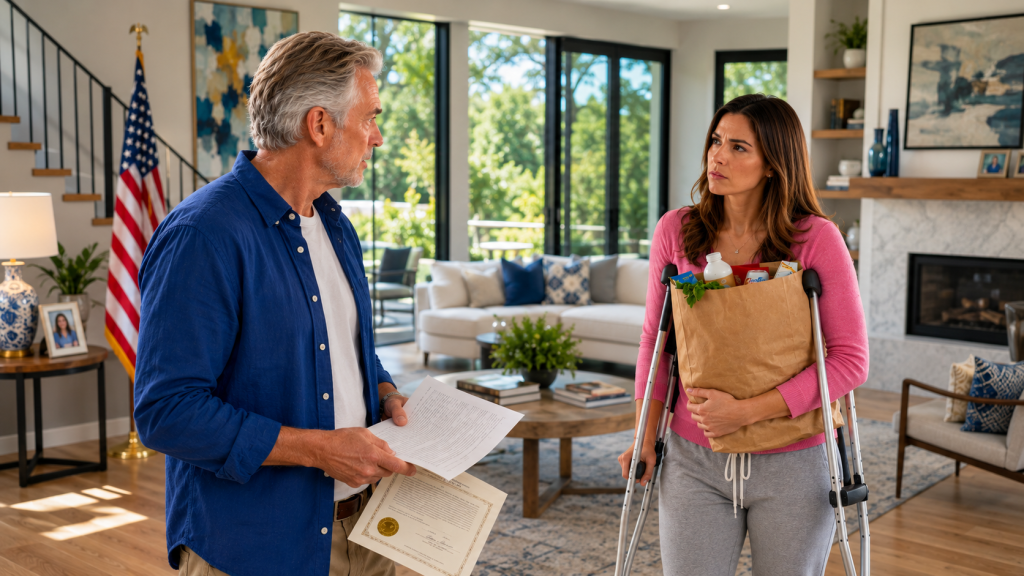
I sat on the blue couch because my knees no longer felt dependable. Carol lowered herself into a wooden chair across from me, resting her crutches beside the table.
The wax seal cracked beneath my thumb.
Inside were six pages.
The first began with the words I had heard Helen say countless times during our forty-two years together.
My dearest Eugene,
If you are reading this, then I am gone, and Bradley has probably already shown you the man he has chosen to become.
I stopped.
The words blurred.
Carol looked away, giving me what privacy she could in a room that suddenly felt full of Helen.
I wiped my eyes and continued.
I wish I had been brave enough to tell you everything while I was alive. I told myself that silence was protection. Perhaps it was cowardice. Perhaps it was both. You trusted me, and I kept a part of my life hidden from you. For that, I am deeply sorry.
But I need you to understand that nothing I did here was meant to replace our marriage. This cabin was not another life away from you. It was a promise I made long before I understood what keeping it would cost.
I glanced at Carol.
She sat very still, her hands folded in her lap.
The next paragraph contained a name I did not recognize.
Thirty-four years ago, before Bradley started school, my younger sister, Rebecca, came to us asking for help.
I read the sentence twice.
Helen had never told me she had a sister.
In all our years together, she had spoken of being an only child. Her parents had died before we married, and there had been no siblings at our wedding, no relatives arriving at holidays, no stories about childhood arguments or shared bedrooms.
Yet the letter continued.
Rebecca was eighteen when she became pregnant. Our father was a harsh man, as you know, though I never told you the worst of it. When he learned about the pregnancy, he threw her out. I was already married to you, and we had a baby of our own. Rebecca begged me not to tell anyone. She was terrified our father would find her.
I helped her move into this cabin. It belonged to our maternal grandmother then. No one in our family remembered it except me.
Rebecca gave birth to a daughter named Carolina.
My eyes moved from the page to the woman sitting across from me.
“Carolina,” I whispered.
Carol nodded.
“My full name.”
I returned to the letter.
Rebecca loved her daughter, but she was frightened and unwell. She struggled with addiction after Carolina was born. I paid for treatment several times. Sometimes she recovered. Sometimes she disappeared. During those years, I came to the cabin whenever I could. I brought groceries, medicine, clothes, and money. When Rebecca died, Carolina was twelve years old.
I lowered the pages.
“How did she die?”
Carol’s face tightened.
“An overdose.”
The ocean murmured beyond the windows, steady and indifferent.
I forced myself to continue.
I wanted to bring Carolina home with us. I wanted to tell you everything and ask you to help me raise her. But Bradley was thirteen then, and he had already discovered Rebecca’s existence.
A heaviness settled in my chest.
Bradley had known.
He had known something I had not.
One afternoon, he followed me when I drove to the cabin. He saw Carolina and demanded to know who she was. I explained that she was my niece and that she had lost her mother.
Bradley became angry. He believed I was spending money that should belong to him. He threatened to tell your company that you were misusing project funds to support a secret family.
My hands tightened around the paper.
“That’s impossible,” I said. “I never misused a cent.”
“Helen knew that,” Carol said. “But Bradley found copies of old financial documents in your home office. He didn’t understand them, but he knew how serious the accusation would sound.”
I thought back to Bradley at thirteen.
He had been clever, restless, and resentful whenever Helen’s attention shifted away from him. We had assumed it was adolescence. We had taken him to counseling after he stole money from Helen’s purse. He had cried, apologized, and promised to change.
I had believed him.
The letter continued.
I should have told you then. Instead, I panicked. You were leading the largest bridge project of your career, and a false accusation could have delayed construction, damaged your reputation, and cost hundreds of people their jobs.
I told Bradley I would keep Carolina away from our home if he kept silent.
It was the worst bargain I ever made.
My son had blackmailed his mother at thirteen years old.
And she had spent more than three decades honoring the bargain.
I looked at Carol again.
“You were a child.”
“So was he,” she said quietly. “At least then.”
There was no bitterness in her voice, which somehow made it worse.
I resumed reading.
After Rebecca’s death, Carolina lived with a trusted foster family nearby. I paid for her needs anonymously and visited as often as I could. She grew into a compassionate, intelligent woman. She became a physical therapist and devoted her life to helping people regain what illness and injury had taken from them.
Five years ago, Carolina was struck by a drunk driver while returning home from work.
The crash damaged her spine.
She can walk short distances, but she will likely need mobility support for the rest of her life.
I looked at the crutches beside Carol’s chair.
She gave me a small, sad smile.
“Helen came every week after the accident,” she said. “She took me to therapy, helped with insurance, and made sure the cabin was accessible.”
I studied the room again and noticed details I had missed.
The widened doorway.
The low kitchen shelves.
The support rail beside the hallway.
Nothing about the cabin was accidental.
Helen had transformed it quietly, piece by piece, into a safe home for the niece she had protected all her life.
I returned to the letter.
Eugene, I did not leave you a ruin.
The cabin, the land surrounding it, and the properties held under the Driftwood Coastal Trust are worth far more than Bradley understands.
I stopped breathing for a moment.
Properties.
Not property.
I turned the page.
Over the years, the coastline changed. Developers began buying every available parcel. Through the trust, I purchased the neighboring lots when they became available. I did this with money inherited from my grandmother and with profits from investments I made before our marriage. I never used our shared retirement funds.
The trust now owns seven acres of protected beachfront, three rental cottages, a small marina lease, and the commercial building at the corner of Harbor Avenue and Bay Street.
The estimated value at the time of my last appraisal was $18.7 million.
My hands began to shake.
Bradley had laughed because he thought I had inherited a collapsing shack.
He had walked away with a villa in Italy that he believed made him wealthy, while Helen had placed nearly nineteen million dollars and an entire hidden legacy into my hands.
But the letter was not finished.
Bradley’s villa is not the gift he thinks it is.
I closed my eyes.
Of course it wasn’t.
Helen had known our son better than I had.
The villa belonged to my father. Bradley has admired it since he saw photographs as a teenager. What he does not know is that the property cannot be sold separately from the family vineyard, and the vineyard carries substantial debt.
The estate taxes, restoration requirements, staffing obligations, and agricultural liens will become his responsibility once he formally accepts the inheritance.
Mr. Thompson has been instructed to explain everything before Bradley signs.
If Bradley listens carefully, he may refuse the property and learn humility.
If he does not, pride will make the decision for him.
I thought of Bradley tapping the line in the will.
The villa in Italy. That’s mine.
He had not asked about taxes.
He had not asked about debt.
He had not asked why his mother, who rarely discussed Italy, had chosen that particular inheritance for him.
He had seen marble balconies and vineyard views.
He had seen status.
Helen had seen a test.
The final page was harder to read.
I left the coastal trust to you because you know how to build things that endure. You understand land, water, storms, and responsibility. But ownership is not the same as purpose.
Carolina has a lifetime right to live in the cabin. She is also the director of the Helen Miller Coastal Foundation, which I established to provide temporary housing, rehabilitation services, and legal assistance to families displaced by hurricanes and medical crises.
The trust funds the foundation.
You control the trust, but I ask you to work with Carolina. I believe the two of you can finish what I began.
As for Bradley, I have left him what he always claimed to value most: the appearance of wealth.
Whether he learns to value anything deeper is now his choice.
Forgive me, Eugene.
Forgive me for the secrets.
Forgive me for not trusting you with the burden.
And please understand this one truth: I loved you every day of my life, even on the days when fear made me silent.
Always yours,
Helen
For several minutes, the only sound in the cabin was the low hum of the refrigerator and the distant crash of waves.
I pressed the letter against my chest.
Grief had already hollowed me out once.
Now it returned differently.
I was grieving the wife I knew, the sister she had hidden, the frightened girl she had once been, and the thirty-four years she had carried a threat inside our home.
“I would have helped her,” I said.
Carol nodded. “She knew that.”
“Then why didn’t she tell me later? When Bradley was grown? When my career was secure?”
“She tried.”
I looked up.
Carol reached toward the photo album and turned to a page near the back.
There was a picture of Helen sitting at the kitchen table, writing.
“Three years ago, she wrote you a letter,” Carol said. “She planned to tell you everything. Then Bradley came here.”
A cold pressure spread through my chest.
“He came to the cabin?”
“He had started watching her bank accounts. He noticed payments for repairs and medical equipment. One day, he followed her.”
“What did he do?”
“He waited until she was inside, then confronted her on the porch. I heard most of it through the window.”
Carol’s fingers tightened.
“He told her that if she brought you into this, he would accuse you both of hiding assets from the government. He said he would drag the family through court until there was nothing left.”
“He couldn’t have won.”
“No,” she said. “But Helen was sick by then.”
I stared at her.
“What do you mean?”
“She had already received the diagnosis.”
Helen’s cancer.
She had told me eighteen months ago that doctors had found it during a routine examination.
But Carol was saying she had known earlier.
“How long?”
“Almost four years.”
The room seemed to contract around me.
“She hid that too?”
“At first, the doctors believed treatment might work. She didn’t want to frighten you until she knew more. Then Bradley began pressuring her about the estate.”
The pieces came together in a shape I did not want to see.
Bradley’s sudden interest in our finances.
His frequent visits during Helen’s final year.
The way he always asked whether her attorney had updated the will.
I had mistaken attention for concern.
Carol spoke softly. “Helen worried that if Bradley learned about the trust, he would try to take control before she died. She was afraid he might challenge her mental competence.”
“She was competent until the end.”
“I know. So did Mr. Thompson. That’s why they documented everything carefully.”
I looked at the wooden box in my lap.
“What’s inside?”
“The deed, trust documents, account information, and recordings.”
“Recordings?”
“Helen began recording every conversation with Bradley after he threatened her here.”
My stomach tightened.
“She wanted you to hear the truth in his own voice.”
The box had a brass keyhole.
The second key from Mr. Thompson’s envelope fit perfectly.
Inside were neatly arranged folders, a portable audio recorder, several flash drives, a copy of the coastal trust deed, and another sealed envelope.
On top lay a photograph of Helen and me on our honeymoon.
We were standing beside a lake, both of us sunburned and laughing. I had one arm around her waist. She was holding her shoes in one hand.
On the back, she had written:
This is the Eugene I trust with everything, even though I sometimes forget how brave he is.
My vision blurred again.
Carol let me sit with the photograph until I could breathe.
Then the sound of a car approaching came through the open window.
Gravel shifted outside.
Carol’s expression changed instantly.
“Were you followed?”
“I don’t think so.”
She reached for her crutches and stood.
A black SUV stopped beside my truck.
Bradley stepped out.
He was still wearing the expensive navy coat he had worn at the attorney’s office. Sunglasses covered his eyes. He held a leather folder under one arm and walked toward the cabin as if he already owned the ground beneath his shoes.
Behind him came a woman in a cream-colored suit carrying a tablet.
“Who is she?” Carol asked.
“I’ve seen her at Bradley’s office. She handles property acquisitions.”
Bradley knocked once and entered without waiting.
His gaze moved from me to Carol, then to the open wooden box.
For half a second, surprise broke through his confidence.
Then he smiled.
“So it’s true.”
I stood.
“What are you doing here?”
“I could ask you the same thing, but I suppose Mom gave you the key.”
He looked around the cabin.
The woman behind him began photographing the room with her tablet.
“Stop that,” I said.
Bradley ignored me.
“I came to help. This place is clearly more than you can manage. Jenna has buyers interested in coastal land.”
Carol stepped forward. “This property is not for sale.”
Bradley looked at her as though she were furniture that had spoken.
“And you are?”
“Carol Martinez.”
Recognition flickered across his face.
Not surprise.
Recognition.
“So you’re still here,” he said.
The casual cruelty of it made my hands curl into fists.
“You knew exactly who she was,” I said.
Bradley removed his sunglasses.
“I knew Mom had a charity case.”
“She is your cousin.”
“She is not my responsibility.”
“No,” I said. “Apparently responsibility has never interested you.”
His expression hardened.
“Dad, you’re grieving. I’m trying to keep you from making emotional decisions.”
“You threw me out of my home the morning after the will was read.”
“The house belongs to me.”
“You had movers there before I had packed.”
“It was efficient.”
The word hung between us.
Efficient.
Like emptying his father’s life was a business transaction.
His eyes shifted toward Helen’s letter.
“What did she tell you?”
“Enough.”
“Did she mention the trust?”
Carol inhaled sharply.
Bradley smiled again.
“That’s what I thought.”
“You knew about it,” I said.
“I knew she had assets hidden out here. I didn’t know the structure.”
“Hidden from whom?”
“From the family.”
“From you.”
His jaw tightened.
Jenna, the woman with the tablet, lowered it slowly. She seemed less comfortable now.
Bradley walked closer.
“Let’s not pretend Mom was some saint. She diverted money for years. Money that should have stayed in our family.”
“It was her inheritance.”
“I’m her son.”
“And Carol was her niece.”
“A niece she barely knew.”
Carol’s face went pale.
I moved between them.
“She raised Carol after Rebecca died.”
Bradley laughed softly. “Is that what she wrote? She visited a few times a month and paid bills. Let’s not turn it into a heroic sacrifice.”
“You blackmailed her when you were thirteen.”
His eyes sharpened.
“So she included that.”
“Did you threaten to destroy my career?”
“I was a child.”
“You continued threatening her as an adult.”
“That is a very dramatic interpretation.”
I reached into the box and lifted the recorder.
Bradley’s confidence shifted.
Only slightly, but I saw it.
“Helen recorded you,” I said.
Jenna turned toward him.
“What recordings?”
“Nothing relevant,” Bradley said quickly.
“Your mother was a client connected to this transaction,” Jenna replied. “If there are undisclosed recordings involving coercion, I need to know.”
“You work for me.”
“I work under a professional license.”
Bradley’s face darkened.
I pressed the recorder’s power button.
A list of dated files appeared.
The most recent had been recorded six weeks before Helen’s death.
I selected it.
At first, there was only rustling.
Then Helen’s voice filled the cabin.
Weak, but clear.
“You cannot have the coastal trust, Bradley.”
His recorded voice answered.
“You’re not thinking clearly.”
“I am thinking more clearly than I ever have.”
“You’re giving nearly twenty million dollars to strangers.”
“To your father, to Carol, and to the foundation.”
“Carol is nothing.”
Across the room, Carol closed her eyes.
The recording continued.
“She is family,” Helen said.
“She is your mistake.”
“My mistake was allowing you to believe cruelty was strength.”
There was a pause.
Then Bradley’s voice became low.
“If you sign control over to Dad, I will have him declared incompetent before the funeral flowers wilt.”
My skin went cold.
Helen answered, “Your father is healthier than you are.”
“That won’t matter. I’ll say grief broke him. I’ll say he’s confused. I’ll show the court every foolish investment he ever made.”
“I have protected Eugene from you for thirty-four years.”
“And you’ll keep protecting him. Change the trust.”
“No.”
Another pause.
Then Bradley said, “You don’t have much time left. Think carefully about how comfortable you want those final weeks to be.”
The recording ended.
No one moved.
Jenna stared at Bradley.
“You threatened a terminally ill woman.”
He reached for the recorder.
I pulled it back.
“That was taken out of context.”
“You threatened your mother,” I said.
“She was manipulating me.”
“She was dying.”
“She was giving everything away!”
His voice exploded through the cabin.
The mask finally came off.
His face twisted with the anger he had hidden beneath polished suits and measured words.
“That land should have been mine. The marina should have been mine. The commercial building should have been mine. I spent years helping her manage appointments, medications, attorneys—”
“You visited twice a month,” Carol said.
Bradley turned on her.
“You don’t get to speak.”
“This is her home,” I said. “You are the one who doesn’t get to speak to her that way.”
He stepped closer until we were nearly face-to-face.
“You don’t even know what you own.”
“Then I’ll learn.”
“You’re seventy years old.”
“I built bridges that will be standing after both of us are gone.”
“This is different.”
“Yes,” I said. “This matters more.”
The words surprised even me.
For years, I had measured my worth by projects completed, deadlines met, and disasters prevented.
But Helen had left me something that could not be evaluated only in dollars.
She had left me unfinished work.
Bradley glanced at the trust documents.
“You won’t be able to manage it. The taxes, insurance, environmental restrictions, tenants—you’ll drown.”
“Then why are you so desperate to take it?”
His mouth closed.
Jenna slipped her tablet into her bag.
“I’m leaving,” she said.
Bradley stared at her. “We came here to secure a listing.”
“We came here because you represented that your father had inherited an abandoned cabin and wanted assistance selling it.”
“I said he would want assistance.”
“He clearly does not.”
She looked at me.
“Mr. Miller, I apologize. I will delete the photographs and provide written confirmation.”
Then she turned to Bradley.
“Do not contact me again without your attorney present.”
She left.
Bradley watched the SUV door close behind her.
When he looked back at me, something calculating had returned to his face.
“Fine,” he said. “Keep the cabin.”
I almost laughed.
“It isn’t only the cabin, is it?”
He slipped on his sunglasses.
“I don’t care what Mom told you. You’ll come to me when this becomes too much.”
“No.”
“You always do.”
I thought about all the times I had rescued him.
The credit card debt after college.
The business loan he failed to repay.
The divorce settlement I quietly covered so his daughter would not suffer.
Every time, Bradley had called me with the same urgent tone.
Dad, I need help.
And every time, I had mistaken dependence for love.
“I won’t come to you again,” I said.
He paused at the door.
“You’ll change your mind.”
“Leave the property.”
His face stiffened.
Then he walked out.
I followed him to the porch.
“Bradley.”
He turned.
“Mr. Thompson told you there were conditions attached to the villa, didn’t he?”
For the first time, real uncertainty appeared in his eyes.
“What conditions?”
“You didn’t stay long enough to hear them?”
He said nothing.
I understood.
He had left the office believing the summary was enough. He had probably instructed his own attorney to handle the details while he rushed home to sell my house.
I took Helen’s letter from my pocket.
“The villa carries debt.”
“How much?”
“You should ask Mr. Thompson.”
His face lost some of its color.
“What kind of debt?”
“Vineyard debt. Restoration obligations. Taxes. Staffing costs.”
“You’re lying.”
“Helen wrote it herself.”
He stared at me, then pulled out his phone.
I watched him call Mr. Thompson.
The attorney answered.
Bradley walked away from the porch, speaking sharply.
“What exactly did my mother leave me?”
His voice faded as he moved toward the SUV.
A minute later, he stopped walking.
Even from the porch, I saw the moment the truth reached him.
His shoulders stiffened.
He removed his sunglasses.
“How much?”
Silence.
Then louder, “How much?”
Carol came to stand beside me.
Bradley turned in our direction.
His face was white.
He ended the call and marched back toward the cabin.
“You knew.”
“I learned ten minutes before you arrived.”
“The villa is tied to four-point-six million dollars in debt.”
“Then refuse it.”
“I can’t.”
“Why not?”
His silence answered before he did.
“You already signed,” I said.
He looked away.
“When?”
“This morning.”
“You signed without reading?”
“My attorney reviewed the primary transfer documents.”
“Did your attorney know about the agricultural liens?”
Bradley’s mouth tightened.
“I used a local service. The Italian documentation was still being translated.”
Carol lowered her gaze, hiding what might have been disbelief.
I felt no satisfaction.
Only exhaustion.
Helen had given Bradley a choice.
He had chosen appearance before understanding the cost.
“Sell the villa,” I said.
“I can’t sell it separately from the vineyard.”
“Sell both.”
“The vineyard has preservation restrictions, and the regional authority has first refusal rights. The value barely covers the loans.”
“Then walk away.”
“I accepted the estate.”
“Talk to your lawyer.”
“I need liquidity.”
There it was.
Not an apology.
Not remorse.
Money.
His eyes moved toward the cabin.
“How quickly can you access the trust?”
“No.”
“Dad, listen to me. I can restructure the debt, improve the vineyard, and sell within five years. I just need bridge financing.”
“No.”
“You haven’t even heard the proposal.”
“I’ve heard thirty years of proposals.”
His expression turned wounded, but this time I recognized it as performance.
“I’m your son.”
“And Helen was your mother.”
He looked toward Carol.
“This is because of her.”
“No. This is because of you.”
He came closer and lowered his voice.
“You cannot let family wealth disappear into some foundation.”
“It is already in the foundation.”
“Change it.”
“I won’t.”
“You owe me.”
I stared at him.
“For what?”
The question stunned him.
I continued.
“What do I owe you, Bradley? I gave you a safe home. I paid for your education. I covered your debts. I rescued your businesses. I supported your daughter after you stopped paying child support. I gave you every opportunity to become a decent man.”
His face flushed.
“You always judged me.”
“I defended you. Even from your mother. Every time she warned me, I said you were under pressure. I said you needed time. I said you would mature.”
I looked through the cabin window at Helen’s letter resting on the table.
“She was not protecting me from scandal. She was protecting herself from admitting what our son had become.”
Bradley stepped backward.
“You’ll regret this.”
“I already regret more than you know.”
He returned to the SUV and drove away.
For the rest of the afternoon, Carol and I sat at the kitchen table going through Helen’s files.
The trust was organized with extraordinary care.
Every property had maintenance records, tax documents, photographs, insurance policies, and tenant information. Helen had created five-year budgets for the foundation and written notes explaining every decision.
She had prepared for storms, legal challenges, medical emergencies, and even my own confusion.
In one folder, I found a list titled Things Eugene Will Ask.
Carol smiled when she saw it.
“She knew you well.”
The first item read:
Why does the marina lease lose money every winter?
Below it, Helen had written:
Because the fishing cooperative pays reduced rates during storm season. Do not raise them. Their families depend on it.
The second item:
Why keep Cottage Three vacant from August through October?
Answer:
Emergency housing for hurricane evacuees.
The third:
Why is the commercial building rent below market?
Answer:
Because the ground floor houses the rehabilitation clinic. The second floor’s rent subsidizes it.
Helen had not simply accumulated property.
She had designed a system.
Each piece supported another.
The vacation cottages funded the clinic.
The marina supported local fishing families.
The commercial building provided legal services and physical therapy.
The protected beachfront prevented developers from destroying the dunes that shielded the neighborhood from storm surges.
It was engineering of another kind.
A human bridge.
At sunset, Carol heated soup.
We ate on the porch while the sky turned coral over the water.
For the first time since Helen’s funeral, I felt something besides grief and betrayal.
I felt close to her.
Not because she had hidden nothing.
Because I could finally see what she had been building in silence.
“I’m sorry she kept you from me,” I told Carol.
“She didn’t keep me from you because she was ashamed,” Carol said. “She was afraid Bradley would use me to hurt both of you.”
“She should have trusted me.”
“Yes.”
Her answer was gentle but honest.
“She knew that too.”
I looked toward the beach.
“Did you resent me?”
“When I was younger.”
I nodded.
“That’s fair.”
“I thought you knew about me and didn’t care. Helen never criticized you, but she also couldn’t explain the truth without admitting what Bradley had done.”
“What changed?”
“She showed me photographs. Your bridge openings. Your retirement ceremony. Pictures of you falling asleep with a newspaper on your chest.”
I smiled despite myself.
“She said you were the safest person she had ever known.”
“Yet she didn’t tell me.”
“Fear does not always follow logic.”
That sounded like something Helen might have said.
I stayed at the cabin that night.
Carol used the downstairs bedroom, and I slept in the small room upstairs.
Inside the closet, I found several of Helen’s dresses.
Not many.
Just enough to prove she had stayed overnight sometimes.
I pressed one sleeve between my fingers.
Lavender.
The entire cabin smelled like her because she had been woven into every corner of it.
On the bedside table rested another photograph.
Helen and Carol stood beside a sign reading Helen Miller Coastal Foundation.
Behind them, a group of families smiled in front of one of the cottages.
On the back, Helen had written:
Opened after Hurricane Isaias. Twelve families housed. No one turned away.
I placed the picture beside our wedding photograph.
Both belonged to the woman I loved.
The next morning, Mr. Thompson arrived with two accountants, a trust officer, and a folder thick enough to stop a door.
We met at the commercial building on Harbor Avenue.
The ground floor clinic was bright and busy. Patients worked with therapists between parallel bars. A little boy in leg braces laughed as he kicked a foam ball toward his father.
On the second floor, attorneys met with families facing insurance disputes, disability claims, and housing problems.
Helen’s name appeared nowhere except on a small brass plaque near the entrance.
She had not built it for recognition.
Mr. Thompson spent four hours explaining the trust.
By noon, my head ached.
By three, I understood enough to know that Bradley had been right about one thing.
Managing it would be difficult.
But difficulty had never frightened me.
At five, I signed the documents accepting my role as trustee.
Carol signed as foundation director.
When it was done, Mr. Thompson removed his glasses.
“Helen hoped you would say yes.”
“She should have asked me herself.”
“She wanted to.”
“Everyone keeps telling me that.”
The attorney looked down at his hands.
“She came to my office twice intending to revise the will and tell you everything immediately. Both times, she lost her nerve.”
“Because of Bradley?”
“Partly. And partly because she feared you would see the secrecy as a betrayal.”
“I do.”
He met my gaze.
“But I also see why she did it.”
Mr. Thompson nodded.
“That may be the forgiveness she hoped for.”
The following weeks were the busiest of my retirement.
I moved permanently into the cabin.
Not because Bradley had pushed me out, but because I chose it.
I repaired the sagging porch with help from a local carpenter. We replaced the boarded window, reinforced the foundation, and repainted the siding a deep coastal blue.
I did not make it luxurious.
I made it sound.
Storm shutters.
Accessible ramps.
Stronger roof connections.
Improved drainage.
Work that mattered.
Carol and I developed a rhythm.
She ran the foundation and taught me the history behind every program. I reviewed infrastructure, contracts, and long-term maintenance.
We argued sometimes.
She thought I was too cautious about expanding emergency housing.
I thought she underestimated construction costs.
Helen had predicted that too.
In another folder, I found a note:
Eugene will say the numbers do not work.
Carol will say people cannot wait for perfect numbers.
They are both right.
Make them drink coffee before continuing the argument.
We laughed so hard that Carol nearly spilled her cup.
For a while, Bradley stayed away.
Then the letters began.
First came a formal request from his attorney for a complete accounting of the coastal trust.
We provided it.
Then a claim that Helen had lacked capacity when she created the foundation.
Mr. Thompson responded with medical evaluations, witness statements, video recordings, and notarized documents proving otherwise.
Bradley withdrew the claim.
A month later, he filed a petition arguing that the trust assets were marital property and should have passed through the general estate.
The court rejected it.
Helen’s inherited funds had been kept separate and documented for decades.
Then Bradley attacked Carol.
He accused her of manipulating a vulnerable woman.
We answered with records showing that Helen had established the trust years before Carol’s accident and had retained independent attorneys, accountants, and medical experts.
The petition failed.
Each loss cost Bradley more money.
Meanwhile, the Italian villa consumed him.
A storm damaged part of the vineyard roof.
The regional authority required immediate repairs.
Two employees filed claims for unpaid benefits from the previous management company.
A tax assessment arrived.
Bradley mortgaged his house, then sold one of his cars.
He called me six times.
I did not answer.
On the seventh call, he left a message.
“Dad, this has gone far enough. I need to talk to you in person.”
I listened twice.
Not because I wanted to hear his voice.
Because for the first time, he sounded tired rather than angry.
I agreed to meet him at a diner halfway between the coast and the city.
He arrived twenty minutes late.
His suit was wrinkled. There were gray shadows beneath his eyes. He ordered coffee but did not drink it.
“You look well,” he said.
“I am.”
“The cabin suits you.”
“You haven’t seen it since you tried to sell it out from under me.”
He looked down.
“I handled that badly.”
It was the closest thing to an apology I had heard from him.
“Why are we here?”
He took a breath.
“I’m in trouble.”
“I know.”
“The vineyard debt is worse than expected. There was fraud by the former manager. Some of the equipment was leased through shell companies.”
“Report it.”
“I did. The investigation could take years.”
“What do you want from me?”
“A loan.”
“No.”
His face tightened, but he controlled himself.
“Please hear the amount.”
“The amount does not matter.”
“I need eight hundred thousand dollars to stabilize operations.”
“No.”
“The trust has liquid reserves.”
“For emergencies, maintenance, and foundation programs.”
“This is an emergency.”
“For you.”
“I am your family.”
“So are the people the foundation serves.”
“They are strangers.”
I leaned back.
“Helen was a stranger to every family she housed after a storm. Carol was a stranger to every patient she helped walk again. I spent my career building bridges for strangers. Society functions because decent people do not reserve responsibility only for those who share their blood.”
Bradley rubbed his forehead.
“You sound like Mom.”
“I’m beginning to understand her.”
His eyes lifted.
“She hated me.”
“No. She feared what you had become.”
“She set me up to fail.”
“She gave you a choice.”
“A debt-covered villa is not a choice.”
“You could have refused it.”
“I didn’t know.”
“You didn’t ask.”
He finally drank the coffee.
“I thought she wanted me to have it.”
“She wanted you to slow down long enough to understand what you were accepting.”
“That’s cruel.”
“Perhaps.”
He looked surprised.
I continued.
“Your mother was not perfect. She kept secrets. She made decisions for other people because she believed she knew what they could handle. She caused pain while trying to prevent it.”
For a moment, Bradley’s expression softened.
Then I said, “But none of that excuses what you did.”
He looked toward the window.
“I was thirteen.”
“And thirty-seven. And forty-two. And fifty.”
His eyes filled with something I could not identify.
Shame, perhaps.
Or self-pity.
“I never intended for her to be afraid.”
“You threatened to make her final weeks uncomfortable.”
“I was angry.”
“She was dying.”
He closed his eyes.
“I know.”
The words came out almost silently.
I waited.
He opened his eyes again.
“Did she say anything about me at the end?”
I had not expected the question.
“Yes.”
“What?”
“She said whether you learned to value anything deeper was your choice.”
He looked down at his coffee.
For several minutes, neither of us spoke.
Then he said, “I don’t know how to fix this.”
“Start by telling the truth.”
“To whom?”
“To yourself.”
He gave a bitter laugh.
“That doesn’t pay the debt.”
“No.”
“It doesn’t save the vineyard.”
“No.”
“Then what good does it do?”
“It may save whatever is left of you.”
Bradley stared at me.
I reached into my coat pocket and placed a business card on the table.
It belonged to a financial restructuring specialist recommended by the trust officer.
“This man works with distressed agricultural properties. He won’t rescue you. He will help you understand your options.”
Bradley picked up the card.
“You already contacted him?”
“I asked whether he would take your call.”
“Why?”
“Because refusing to give you money is not the same as wanting you destroyed.”
He looked at me for a long moment.
“Will you come to Italy?”
“No.”
His face fell.
“Not now,” I added. “Handle the first steps yourself. Provide every document. Sell what can be sold. Accept the losses that belong to you.”
“And then?”
“Then call me without asking for money.”
He turned the card over in his fingers.
When we left the diner, he did not hug me.
But he said, “I’m sorry about the house.”
I waited.
“And the movers,” he added. “And what I said at the attorney’s office.”
It was incomplete.
It did not include Helen.
It did not include Carol.
But it was a beginning.
“I hear you,” I said.
Three months passed.
Bradley sold the city house before foreclosure became a risk. He moved into a small apartment and began working directly with the vineyard staff.
He dismissed the management company, cooperated with investigators, and accepted a restructuring plan that would keep the vineyard operating under strict financial supervision.
For the first time in his adult life, he lived without someone else quietly paying for his mistakes.
He called every Sunday.
At first, the conversations lasted less than five minutes.
He talked about weather, repairs, and legal documents.
He never asked for money.
Gradually, he began telling me about the vineyard workers.
There was Luca, whose family had tended the vines for three generations.
Sofia, the bookkeeper who discovered the shell companies.
Matteo, an elderly groundskeeper who refused to retire because the villa gardens had been planted by his father.
Bradley had once spoken about employees only as expenses.
Now he knew their names.
That winter, a hurricane formed unexpectedly in the Gulf and moved toward our coast.
The foundation activated its emergency plan.
We opened all three cottages and converted the clinic’s second floor into temporary sleeping space. Volunteers stocked food, water, medical supplies, and generators.
The storm made landfall twenty miles south of us.
Wind tore roofs from homes.
Floodwater crossed the highway.
The reinforced cabin shook through the night but held.
At dawn, Carol and I walked outside.
Branches covered the yard, and one section of fencing had fallen.
But the dunes remained intact.
The protected beach absorbed much of the storm surge exactly as Helen’s environmental consultants had predicted.
By afternoon, families began arriving.
A mother carrying an infant.
An elderly couple whose trailer had flooded.
A restaurant worker with two children and nowhere to go.
For ten days, every room was full.
I repaired doors, checked generators, and organized volunteers.
Carol coordinated medical care and insurance assistance from her wheelchair when the long hours made crutches too painful.
On the sixth day, a truck pulled into the driveway.
Bradley stepped out.
I had not known he was back in the United States.
He wore jeans, work boots, and an old canvas jacket.
No suit.
No sunglasses.
He opened the back of the truck.
Inside were boxes of water filters, blankets, portable chargers, and medical supplies.
“What are you doing here?” I asked.
“I saw the storm coverage.”
“Who paid for this?”
“I did.”
“With what?”
“I sold my watch.”
The watch had cost more than my first car.
He looked embarrassed.
“I didn’t need it.”
Carol came down the ramp.
Bradley turned toward her.
For several seconds, he said nothing.
Then he walked over.
“I owe you an apology.”
Carol stopped.
He continued.
“What I said about you was cruel. What I did to my mother was worse. I treated you like you were taking something from me when she was trying to give you the family you had already lost.”
Carol’s face remained guarded.
“I don’t expect forgiveness,” he said. “I just wanted to say it without asking for anything.”
The wind moved through the beach grass.
Finally, Carol nodded.
“Thank you for saying it.”
Bradley spent the next week unloading supplies, clearing debris, and repairing damaged cottages.
He slept on a folding cot in the clinic hallway because every proper bed belonged to a displaced family.
No one treated him like Helen Miller’s son.
No one knew about the villa.
He was simply another volunteer carrying lumber and cleaning mud from floors.
One evening, I found him sitting alone on the cabin porch.
The sunset burned orange across the water.
He held one of Helen’s photographs.
She was standing beside the foundation sign with Carol.
“I didn’t know she smiled like this here,” he said.
“I didn’t either.”
“She stopped smiling around me.”
I sat beside him.
“She was very sick.”
“That isn’t the only reason.”
I did not answer.
He looked toward the families gathered around a temporary grill near the cottages.
“I spent my whole life thinking money was proof that someone valued me.”
“Why?”
He shrugged.
“Because Mom was always disappearing. Meetings, appointments, errands. I knew she came here. I knew there was someone else receiving her attention.”
“You were jealous of a twelve-year-old orphan.”
“I know how it sounds.”
“It sounds true.”
He looked down.
“When I followed her that first time, I thought she had another child. I thought maybe you weren’t my father, or she had some secret family she loved more.”
“You could have asked.”
“I did. She said Carol was her niece. But I was angry, and then I realized she was frightened of you finding out.”
“So you used it.”
“Yes.”
The word was barely audible.
“Why did you continue after you were old enough to understand?”
“Because it worked.”
I looked at him.
There was no excuse in his face now.
Only the terrible honesty I had demanded.
“Every time I threatened to expose the secret, she gave me something. Money. Help. Influence. Later, she stopped giving in, and I became more aggressive.”
“She loved you.”
“I know.”
“Do you?”
He swallowed.
“I think that’s what made me believe she would always forgive me.”
I looked toward the ocean.
“Love is not permission.”
“No.”
We sat quietly until the sun disappeared.
Then Bradley said, “The vineyard may survive.”
“That’s good.”
“I’ll probably never make much money from it.”
“That may be better.”
He almost smiled.
“Luca said the same thing.”
The foundation helped fifty-three families after the hurricane.
Every one of them returned home or moved into stable housing within four months.
The clinic expanded its rehabilitation program.
Carol hired two additional therapists.
We renovated the fourth cottage into a fully accessible residence for patients traveling from rural communities.
A year after Helen’s death, we held a small memorial ceremony on the beach.
No reporters.
No speeches from politicians.
Just foundation staff, local families, friends, and people Helen had helped.
We placed a bench on the dune path overlooking the water.
The plaque read:
Helen Miller
She made room for those who had nowhere to go.
Bradley came from Italy.
He looked older.
Not weaker.
More real.
He brought a bottle of wine from the vineyard’s first profitable harvest in six years.
The label carried a simple name.
Rebecca.
Carol stared at it.
“My mother?”
Bradley nodded.
“I thought the first successful vintage should belong to someone the family tried to forget.”
Carol held the bottle against her chest.
Then she embraced him.
It was not complete forgiveness.
Those things rarely happen in a single moment.
But it was the beginning of something neither of them had believed possible.
After the ceremony, the three of us sat on Helen’s bench.
Bradley told us the vineyard had entered a cooperative agreement with local workers. He had transferred partial ownership to the employees in exchange for debt restructuring and long-term management commitments.
“You gave up control?” I asked.
“I shared it.”
“That must have hurt.”
“It did.”
Carol smiled.
“Then it was probably healthy.”
Bradley laughed.
A real laugh this time.
Not sharp.
Not satisfied.
Just human.
Later, after everyone left, I walked alone to the water.
The cabin behind me glowed with warm light.
The same cabin I had once mistaken for punishment.
The same place Bradley had called forgotten.
It was not forgotten.
It held Rebecca’s story.
Carol’s survival.
Helen’s courage and fear.
Bradley’s worst choices.
My second chance to know my family honestly.
I carried Helen’s final letter in my coat pocket, its folds softened from being opened so many times.
For months, I had focused on her apology.
Forgive me for the secrets.
But standing beside the ocean, I understood that forgiveness was not one decision.
It was construction.
A foundation laid carefully.
A structure tested by storms.
Repairs made where weakness appeared.
Trust reinforced through action rather than promises.
I still wished Helen had told me.
I still felt anger when I imagined the years we had lost.
I still woke some nights and reached for her, only to find an empty pillow.
But I no longer believed the secret cabin represented a life from which I had been excluded.
It was a door she had left for me.
A door into unfinished work.
A door into a family larger and more complicated than I had known.
A door into the final lesson she wanted to teach us all.
Property could be inherited.
Money could be transferred.
Houses could be sold.
But a legacy was not what someone left in your name.
It was what you chose to do after the papers were signed.
I returned to the cabin as the first stars appeared.
Carol was in the kitchen arranging flowers in a mason jar.
Bradley was tightening a loose hinge on the screen door.
For a moment, I stood in the entryway exactly as I had on the day I arrived.
Back then, I had believed I was entering an abandoned place because my son had taken everything valuable.
Now I understood.
Nothing valuable had been taken from me.
The value had been waiting quietly by the water, hidden beneath peeling paint, old photographs, one deed, and a letter written by the woman who knew that even broken families could be rebuilt if someone was willing to begin.
Bradley looked up from the hinge.
“Dad, can you hand me the screwdriver?”
I reached into the toolbox.
“The flathead or Phillips?”
He examined the screw.
“Phillips.”
I handed it to him.
Carol placed three cups on the kitchen table.
Outside, the tide moved steadily toward the shore.
Inside, the cabin was no longer silent.
And for the first time since Helen left us, neither was my heart.
THE END! THANK YOU FOR READING!