

The knock came at 4:47 on a Tuesday afternoon.
I remember the time because I was kneeling in the entryway, helping my five-year-old son, Eli, fasten the Velcro strap on his sneaker. His red soccer ball waited beside the door, and July sunlight stretched across the hardwood floor in a warm golden stripe.
Two sharp knocks rattled the frame.
Then a woman called through the door.
“Ma’am, I’m with Child Protective Services. I need to speak with you about your son.”
Eli’s fingers stopped moving.
He looked up at me with the blue eyes he had inherited from his father.
“Are we still going to the park?”
The question nearly broke me.
I stood, smoothed my navy slacks, and opened the door.
A woman in her early forties stood on the porch in a gray blazer despite the Virginia heat. Damp curls clung to her temples. She held a thick manila folder and showed me her identification.
“My name is Dana Reyes. I’m an investigator with the Department of Social Services.”
I checked the agency seal and photograph.
“What can I do for you, Ms. Reyes?”
“We received a report alleging neglect, physical mistreatment, and unsafe supervision involving a minor child at this address.”
The words hit like freezing water.
My heart accelerated, but my face stayed still. Eleven years as a Navy attorney had taught me how to remain calm while witnesses lied, commanders shouted, and futures balanced on a single sentence.
“May I ask who made the report?”
“I’m not permitted to disclose that yet.”
She glanced past me.
Eli had moved closer, clutching the hem of my blouse with one hand and a plastic dinosaur with the other.
I did not need the name.
Two days earlier, my older sister, Monica, had stood in my kitchen and said, “A woman who spends her life pretending to be one of the boys has no business raising a little boy alone.”
I had asked her to leave.
Before walking out, she looked at Eli’s backpack and added, “He needs a real home, Rachel. Not a barracks with cartoons on the walls.”
Now an investigator stood on my porch.
I stepped aside.
“You may come in.”
Dana seemed to expect anger or panic.
Instead, I crouched beside Eli.
“This lady needs to ask us some questions,” I told him. “We’ll answer honestly, and we’ll go to the park another day.”
“Did I do something bad?”
“No. You did absolutely nothing wrong.”
Inside, the house smelled of lemon cleaner and peanut butter crackers. Toy trucks lined the coffee table. Clean laundry sat on the couch because I had planned to fold it after the park.
Dana began taking notes.
The report claimed Eli was frequently left alone, the home was poorly maintained, and he had unexplained bruises.
I answered each point calmly.
Eli was never left alone. He attended kindergarten and a licensed after-school program. My neighbor, Mrs. Crawford, watched him only on Thursday afternoons while I volunteered at a legal clinic on base. My current Navy assignment was a shore billet with regular hours.
Dana asked my position.
“Commander Rachel Bennett, United States Navy Judge Advocate General’s Corps,” I said. “I handle military justice cases at Naval Station Norfolk.”
Her pen paused.
Not because rank excused anything.
Because she recalculated.
“Your profession doesn’t exempt you from investigation.”
“Of course not. I expect you to follow every required procedure.”
And I meant it.
I would not bully a caseworker. Good systems failed when frightened people obstructed them.
But I also knew something Monica did not.
Every allegation created a record. Every photograph had metadata. Every witness statement could be tested. Every lie eventually showed a seam.
Dana opened the folder.
“The reporting party claims to have photographic evidence.”
My stomach tightened.
“What kind?”
“Images of injuries on your son.”
Across the room, Eli roared as two dinosaurs crashed together.
I thought of his scraped elbow from the playground, the bruise on his shin from falling off his bicycle, and the faded mark near his shoulder from bumping into the dining table while chasing our dog.
Ordinary marks.
But photographs could be cropped. Dates could be removed. Context could be manufactured.
Someone had not accused me in anger.
Someone had been collecting evidence.
And only one person had been close enough to do it without making me suspicious.
Dana asked permission to inspect Eli’s room, the kitchen, the bathrooms, and the backyard.
I agreed.
She checked the refrigerator, pantry, medicine cabinet, smoke detectors, electrical outlets, and bedroom windows. She photographed the childproof locks beneath the kitchen sink and the emergency contact sheet posted beside the refrigerator.
She noted the fresh fruit, milk, vegetables, and prepared meals labeled with dates.
She opened Eli’s closet and found clean clothes arranged by size. On his nightstand sat a framed photograph of his father, Lieutenant Daniel Bennett, wearing his dress whites.
Daniel had been killed in a training accident three years earlier.
Eli remembered very little about him beyond the sound of his laugh and the way he used to carry him around the living room on his shoulders.
Dana looked at the photograph.
“I’m sorry.”
“Thank you.”
She crouched beside Eli.
“Can I ask you some questions?”
He looked at me first.
I nodded.
Dana spoke gently.
“Who makes your breakfast?”
“Mommy. Sometimes I help.”
“What do you eat?”
“Eggs. Toast. Blueberries. But not bananas because bananas are squishy.”
Dana’s mouth twitched.
“Who takes you to school?”
“Mommy, unless she has Navy work early. Then Mrs. Crawford does.”
“Are you ever home alone?”
“No.”
“Does anyone hit you?”
Eli’s expression changed.
He glanced toward me, confused.
“No.”
“Does your mother ever hurt you?”
“No. She gives hugs when I’m hurt.”
“Where did you get the bruise on your leg?”
He lifted his shorts slightly and pointed to the fading purple mark on his shin.
“I fell off my bike because I tried to ride with one hand like Tyler.”
I closed my eyes for half a second.
We had discussed Tyler’s one-handed riding technique extensively.
Dana made another note.
“Do you feel safe here?”
“Yes.”
“Is there anywhere else you stay?”
“At Aunt Monica’s sometimes. But I don’t like sleeping there.”
My attention sharpened.
Dana noticed.
“Why don’t you like sleeping there?”
Eli pushed one dinosaur against the carpet.
“Her house makes noises.”
“What kind of noises?”
“Just noises.”
He had never told me that.
Monica had watched him overnight twice during the previous six months, once when I attended a mandatory training event in Washington and once when a storm grounded my return flight from Jacksonville.
Dana did not press him.
She finished the interview and stood.
“I’ll need copies of school attendance, medical records, childcare documentation, and any information related to your work schedule.”
“You’ll have them.”
She handed me her card.
“Commander Bennett, I recommend that you gather anything you believe may be relevant.”
Her tone was neutral, but the sentence carried weight.
She had seen something in the allegations that did not align with the home in front of her.
After she drove away, I locked the door and sat at the dining table with my laptop.
Eli climbed into the chair beside me.
“Is she taking me away?”
“No.”
It came out too quickly.
His lower lip trembled.
“Aunt Monica said sometimes the government takes kids when their moms are too busy.”
The room seemed to tilt.
“When did she say that?”
“At her house.”
I closed the laptop.
“Did Aunt Monica ask you questions about me?”
He nodded.
“What kind of questions?”
“She asked if you yelled. She asked if you forgot to feed me. She asked if you left me when it was dark.”
“What did you tell her?”
“That you don’t.”
“What did she say?”
“She said I should think harder.”
I reached across the table and took his small hand in mine.
“Did she take pictures of you?”
“Lots.”
“Did she say why?”
“She said Grandma wanted them.”
My mother.
The pain arrived slowly, almost politely, then settled behind my ribs.
My mother had spent years treating Monica as the family’s reliable daughter and me as the restless one who had abandoned everyone for the Navy. When Daniel died, she came for the funeral, stayed three days, and then told me Eli would be better off if I left active service.
I had declined.
She had never forgiven me.
“Did Grandma talk to you about living somewhere else?” I asked.
Eli nodded again.
“She said Aunt Monica has a bigger yard.”
I smiled because I did not want him to see my fear.
“Why don’t you choose a movie while I finish some work?”
After he left the room, I reopened my computer.
I began with security camera footage.
Our doorbell camera stored six months of recordings. I searched every visit Monica had made. There she was entering with casseroles, toys, birthday gifts, and concerned expressions.
In one clip from March, she waited until I walked toward the garage before taking out her phone and photographing Eli’s scraped elbow.
In another, she zoomed in on the bruise on his shin while he sat on the porch.
The angle matched the description Dana had given me.
I downloaded the recordings immediately.
Then I pulled school attendance records, medical checkups, after-school invoices, pharmacy receipts, my duty schedule, and text messages.
A pattern emerged.
Monica had repeatedly asked to babysit on days she knew I would be working. She had requested copies of Eli’s school forms, claiming she wanted to be listed as an emergency contact. She had insisted on taking photographs during family gatherings.
None of it had seemed unusual at the time.
Now every request looked calculated.
My phone buzzed.
A message from Monica appeared.
You should just give up.
I stared at the five words.
CPS had left less than twenty minutes earlier.
Dana had not disclosed her visit to anyone.
Only the person who filed the report could have known.
I took a screenshot and backed it up in three places.
Then I called my commanding officer, Captain Warren Hale.
I did not ask him for legal advice. I informed him of the allegation before rumors could reach the command.
He listened without interruption.
“Do you need emergency leave?”
“Not yet, sir. I may need flexibility for interviews or hearings.”
“You’ll have it.”
“Thank you.”
“Rachel.”
“Yes, sir?”
“Document everything.”
“I already am.”
“I assumed you would.”
After we ended the call, I opened the locked filing cabinet in my home office.
Inside were three blue folders.
The first contained Eli’s medical and school records.
The second held my work schedules, childcare agreements, security footage logs, and financial documentation.
The third was thinner but more dangerous.
It contained records I had collected during the previous year concerning my father’s estate.
My father, Thomas Mercer, had died eighteen months earlier. He left a modest but valuable property portfolio, including the Chesapeake house where we had grown up and a trust established for Eli.
As executor, Monica had repeatedly delayed providing full financial statements.
Three weeks earlier, I discovered that nearly $84,000 was missing from an account intended for the maintenance of the family property.
I had asked questions.
Monica became defensive.
My mother accused me of insulting my sister.
Then Monica started talking about my parenting.
The timing was no longer a coincidence.
The following morning, Dana called.
“I need you and Eli at our office at ten.”
“Will he be removed from my custody today?”
There was a pause.
“A supervisor has requested a temporary safety assessment based on additional evidence received overnight.”
“What additional evidence?”
“Photographs and a written statement from a family member.”
“Which family member?”
“I still can’t disclose that.”
“I understand.”
“Do you have someone who can accompany you?”
“Yes.”
I called Mrs. Crawford.
She was sixty-eight, widowed, and retired from teaching elementary school. She had known Eli since birth and had once threatened to chase a delivery driver down the street after he placed a heavy package against my screen door.
When I explained what was happening, her response was immediate.
“I’ll be there in ten minutes.”
At the CPS office, Dana led us into a small conference room.
A supervisor named Paul Jenkins sat at the table with a county attorney and a uniformed sheriff’s deputy.
The deputy’s presence was deliberate.
They expected resistance.
I carried three folders.
Eli carried his dinosaur.
My mother and Monica sat on the opposite side of the room.
Monica wore a cream blouse and an expression of practiced sadness.
My mother held a tissue she had not used.
When I entered, Monica’s mouth lifted at one corner.
The smirk lasted less than a second.
It was enough.
Eli stopped beside me.
“Grandma?”
My mother looked away.
Dana indicated two chairs.
“Commander Bennett, please sit.”
I placed the folders on the table and helped Eli into the seat beside Mrs. Crawford.
Paul Jenkins cleared his throat.
“We received an emergency petition requesting temporary placement of your son with a relative while the investigation continues.”
“On what grounds?”
“Allegations of physical mistreatment, emotional instability, unsafe military-related absences, and falsification of childcare records.”
The last allegation was new.
Monica leaned toward our mother and whispered something.
I did not react.
“Who submitted the request?”
The county attorney answered.
“Your sister, Monica Mercer, supported by an affidavit from your mother, Helen Mercer.”
There it was.
Not suspicion.
Not confusion.
A coordinated attack.
My mother’s eyes filled with tears.
“We’re trying to protect him.”
Eli looked at her.
“From Mommy?”
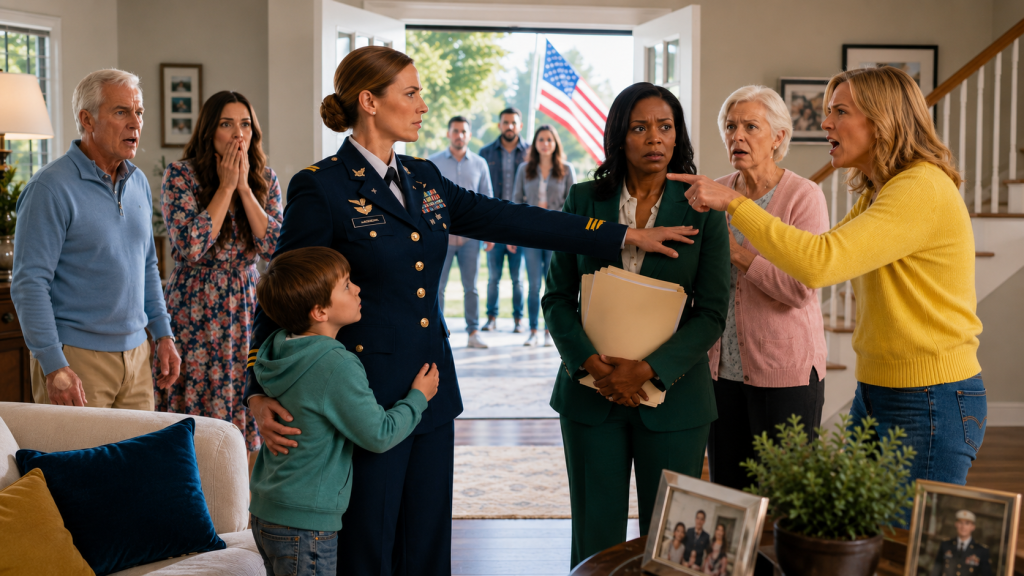
No one answered.
I opened the first folder.
“This contains Eli’s complete pediatric records for the past three years, including every injury, illness, vaccination, and examination. The bruises shown in the photographs were documented by his pediatrician, school nurse, or childcare provider. Each has an ordinary explanation supported by dated records.”
I slid it toward Dana.
Then I opened the second folder.
“This contains my official duty schedules, childcare receipts, after-school attendance, doorbell-camera footage, home alarm logs, and statements from neighbors and teachers. It demonstrates that Eli was not left alone on any of the dates alleged.”
Paul looked toward the county attorney.
Monica’s smirk faded.
I placed my hand on the third folder.
“This contains evidence relevant to motive.”
My sister’s face went still.
I continued.
“Monica is executor of our father’s estate. I recently discovered substantial unauthorized transfers from an account she controlled. Three days after I requested a formal accounting, she began telling relatives that my military service made me unfit. Two weeks later, she offered to become Eli’s guardian. Yesterday, she filed this report.”
“That has nothing to do with protecting Eli,” Monica snapped.
It was the first time she had spoken.
I turned to Dana.
“Inside you’ll find bank statements, emails, and a copy of the letter I sent requesting an independent audit. You’ll also find the trust agreement.”
Paul opened the folder.
The county attorney leaned closer.
I watched her expression change as she read.
Eli’s trust was worth more than $600,000.
If I were declared unfit or unable to serve as trustee, the alternate trustee named in my father’s original documents was Monica.
My mother gripped her tissue.
“Your father trusted Monica.”
“My father changed the trust two months before his death.”
Monica’s face drained of color.
“What?”
I had not told her that part.
“The amended document names an independent financial institution as successor trustee. Not you.”
Monica stared at me.
“You’re lying.”
“The notarized amendment is behind the original trust agreement.”
Paul removed the document and passed it to the county attorney.
For several seconds, the only sound in the room was the hum of the air conditioner.
Then Dana spoke.
“Ms. Mercer, the photographs you submitted were represented as evidence of repeated physical mistreatment.”
“They are.”
“The metadata indicates they were taken over a period of seven months. Several match injuries documented as playground accidents.”
Monica folded her arms.
“Rachel pressured people to create those explanations.”
Dana looked at me.
“Commander Bennett, did you know your sister had access to Eli’s pediatric portal?”
“No.”
Dana turned her laptop around.
A login history appeared on the screen.
Someone had accessed Eli’s medical account from an unfamiliar device on six occasions.
The recovery email belonged to Monica.
I felt something inside me harden.
“You accessed his records?”
Monica’s jaw tightened.
“Mom gave me permission.”
My mother flinched.
“I did not.”
For the first time, fear appeared between them.
Dana continued.
“The account was also used to download records and alter emergency contact information.”
“I was helping,” Monica said.
“Without the legal guardian’s authorization?”
“I’m family.”
The county attorney closed the folder.
“Being family does not grant unrestricted access to protected medical information.”
Monica looked at me.
“This is exactly what Rachel does. She turns everything into a courtroom. She intimidates people with paperwork and rank.”
I kept my voice level.
“You filed a petition to take my child.”
“Because you’re never there.”
“Her duty records show otherwise,” Dana said.
Monica turned toward her.
“She deploys.”
“I have not deployed since Eli was two.”
“You could.”
“So could any service member,” Paul said. “That alone does not establish neglect.”
My mother finally spoke.
“She’s cold with him.”
Mrs. Crawford stood so abruptly that her chair scraped the floor.
“Rachel sat beside that boy’s hospital bed for four nights when he had pneumonia. She left work every day at four-thirty to pick him up from preschool. She learned how to bake dinosaur cakes because he asked for one. You may not like how she lives, Helen, but don’t call that woman cold.”
Dana asked Mrs. Crawford to sit.
She did, but only after giving my mother a look that could have stopped traffic.
Paul reviewed the documents for nearly twenty minutes.
Then he left the room with the county attorney and Dana.
The deputy remained.
Monica leaned toward me.
“You think folders make you untouchable?”
“No.”
“You’ve poisoned everyone against us.”
“I haven’t spoken to anyone.”
“You always act superior.”
I looked at Eli.
He sat beside Mrs. Crawford, covering his dinosaur with his hands as though protecting it from the room.
“This is not about us anymore,” I said quietly. “You frightened my son.”
“He’ll forget.”
“No, he won’t.”
My mother stood.
“You should have listened when we told you to leave the Navy.”
“And you should have asked Monica why she needed access to Eli’s trust.”
Her mouth opened.
Nothing came out.
Paul returned with the others.
“The department will not seek emergency removal today.”
My knees nearly weakened, but I remained seated.
“The investigation will continue,” he said. “However, the documentation provided raises serious concerns regarding the credibility and motivation of the reporting parties.”
Monica stood.
“This is unbelievable.”
Paul’s expression remained flat.
“Sit down, Ms. Mercer.”
She did.
Dana looked at me.
“Until further notice, Monica Mercer and Helen Mercer are not to have unsupervised contact with Eli. We also recommend that you change all medical, school, and childcare access credentials.”
“I will.”
The county attorney turned to Monica.
“The department may refer suspected falsification of evidence and unauthorized access to law enforcement.”
Monica stared at her.
“I was trying to save my nephew.”
“Then you should have reported accurate information.”
Outside the building, Eli ran into my arms.
“Can we go home?”
“Yes.”
“Is Aunt Monica mad?”
“Yes.”
“Did I make her mad?”
I held him tighter.
“No. None of this is because of you.”
Mrs. Crawford drove us home because my hands would not stop shaking.
That evening, after Eli fell asleep, I sat on the kitchen floor and cried.
Not because I believed I would lose him.
Because he had looked at his grandmother and asked whether she wanted to protect him from me.
That question would live inside him longer than any investigation.
The next morning, I received a call from a Norfolk police detective named Aaron Cole.
“Commander Bennett, CPS forwarded information regarding unauthorized access to your son’s medical account and possible financial misconduct. I’d like to speak with you.”
I met him at the precinct with copies of everything.
He reviewed Monica’s messages, account access logs, estate statements, and the security footage.
“When did you first suspect money was missing?” he asked.
“Three weeks ago.”
“And when did the allegations begin?”
“According to relatives, Monica started talking about my parenting within days.”
He tapped the estate records.
“Why would she want guardianship if she wasn’t successor trustee?”
“She believed she was.”
“Would guardianship give her access to any money directly?”
“Not automatically. But she could petition for reimbursement of Eli’s expenses, attempt to influence trustee decisions, or use the appearance of financial responsibility to delay the estate audit.”
Detective Cole nodded.
“More importantly, if you were discredited, your claims about the missing estate funds would look retaliatory.”
“Yes.”
He closed the file.
“She wasn’t only trying to take your son.”
“No.”
“She was trying to destroy the credibility of the person most likely to expose her.”
The investigation moved quickly after that.
Police obtained records showing that Monica had transferred estate funds into a business account controlled by her husband, Craig.
Craig operated a failing home-renovation company. He had hidden debts, tax liens, and two pending lawsuits.
Monica had used money from my father’s estate to keep the business alive.
When I asked for an audit, she panicked.
Taking custody of Eli would have solved several problems in her mind.
She believed she would gain influence over his trust.
She believed the courts would doubt financial accusations from a mother under investigation for abuse.
And she believed my command would quietly remove me from sensitive legal work once CPS became involved.
She had underestimated both the evidence and the people around me.
But the damage did not disappear simply because the truth emerged.
At school, Eli began asking his teacher whether I would still be there at pickup.
He woke twice a night and came into my room carrying his blanket.
Whenever someone knocked at the door, he froze.
I found a child therapist who specialized in family separation fears.
At the first appointment, Eli drew our house with a blue roof, a red door, and two people holding hands.
Then he drew Monica outside the house with a camera.
The therapist looked at me.
“He understood more than everyone thought.”
I knew.
Children often did.
My mother called repeatedly.
I did not answer.
Then she left a voicemail.
“Rachel, I didn’t know about the money. Monica told me you were unstable and that Eli was afraid of you. I thought I was helping. Please call me.”
I saved the message.
Three days later, another arrived.
“Your sister is falling apart. The police searched her house. Craig left. Please don’t let this destroy the family.”
That message, too, I saved.
The family had apparently survived Monica trying to take my child.
It became endangered only when Monica faced consequences.
Two weeks after the CPS visit, Dana returned to my home.
This time, she came alone.
Eli was building a wooden train track across the living-room carpet.
Dana sat at the dining table and opened her file.
“The department is closing the neglect and mistreatment allegations as unfounded.”
I released a breath I felt I had been holding for years.
“There will be a written finding?”
“Yes. You’ll receive it within ten business days.”
“What happens regarding the false report?”
“That is being reviewed by law enforcement and the county attorney. Our role is limited, but we documented material inconsistencies, altered context, unauthorized record access, and attempts to coach the child.”
My fingers tightened around the edge of the table.
“Attempts to coach him?”
Dana’s expression softened.
“During the overnight visits, your sister recorded conversations with Eli. She repeatedly asked whether you hurt him, forgot him, or left him alone. When he said no, she rephrased the questions.”
“How do you know?”
“She submitted edited excerpts as evidence. Police recovered longer audio files from a synced account.”
I closed my eyes.
Monica had not simply asked questions.
She had tried to teach my son to doubt his own memory.
Dana slid a paper toward me.
“This is the preliminary closure notice.”
I read every line.
Unfounded.
No evidence of neglect.
No evidence of physical mistreatment.
Child appears bonded, safe, healthy, and appropriately cared for.
For the first time since the knock, I allowed myself to believe we were going to be all right.
Eli ran over and handed Dana a wooden train.
“This one is the Navy train.”
“What makes it a Navy train?” she asked.
“It’s blue and it helps people.”
Dana looked at me.
“I think he understands your work better than most adults.”
After she left, I put the closure notice in a new folder.
Then I took Eli to the park.
He kicked his red ball across the grass, laughing as our dog chased it. I sat on a bench beneath an oak tree and watched him run.
For an hour, we were not a case, a report, an allegation, or a family scandal.
We were simply a mother and son in the sunlight.
The criminal charges came six weeks later.
Monica was charged with embezzlement, identity-related offenses, unlawful access to protected information, evidence tampering, and making false statements during a child-welfare investigation.
Craig faced charges connected to the estate transfers.
My mother was not charged, but investigators made it clear that her affidavit had been dangerously careless.
She had sworn that she personally observed Eli being neglected.
Under questioning, she admitted she had witnessed nothing.
Monica had written the statement.
My mother signed it.
The Navy conducted its own review because Monica had contacted my command and claimed I was hiding a child-abuse investigation.
Captain Hale called me into his office.
He placed a document on the desk.
“This is the result.”
I read the first paragraph.
No misconduct.
No adverse action warranted.
Full confidence retained.
“I’m sorry this entered your professional life,” he said.
“I expected it would.”
“Your sister contacted six people at the command.”
That surprised me.
“What did she say?”
“That you were emotionally unstable after your husband’s death, that you drank heavily, and that you left your son unattended during duty hours.”
“I don’t drink.”
“We know.”
He leaned back.
“She also said you abused your authority to conceal family problems.”
I almost laughed.
“She accused a Navy attorney of using records to conceal evidence while creating a trail of false emails herself.”
“People in panic rarely think like attorneys.”
“No, sir.”
He studied me for a moment.
“How is your son?”
“Getting better.”
“And you?”
“I’m functional.”
“That wasn’t the question.”
I looked toward the window.
Ships moved slowly across the harbor.
“I’m angry.”
“You’re allowed to be.”
“I should have seen it sooner.”
“No. Trusting a sister to act like a sister is not professional negligence.”
The sentence stayed with me.
I had spent my career analyzing responsibility. I believed every disaster had a moment when someone should have noticed, intervened, or spoken sooner.
But sometimes betrayal worked because it wore a familiar face.
Monica accepted a plea agreement seven months later.
The evidence was overwhelming.
Bank records showed that she had taken more than $126,000 from the estate. Medical-access logs tied her devices to Eli’s account. Security footage showed her photographing injuries while creating false narratives in messages. Audio recordings captured her coaching Eli.
The most painful evidence came from a conversation between Monica and my mother.
Police recovered it from Monica’s cloud backup.
Monica’s voice was calm.
“If Rachel loses custody, the court will appoint me. Once I’m responsible for Eli, no judge will listen to her claims about the estate. They’ll think she’s bitter.”
My mother asked, “What if Eli refuses to say Rachel hurt him?”
“He’s five. Children repeat what adults tell them.”
“And the trust?”
“Dad named me next.”
“He may have changed it.”
“He didn’t.”
The recording ended with my mother saying, “I just don’t want Rachel embarrassing the family.”
Not once did either of them ask what the investigation would do to Eli.
Not once.
At sentencing, Monica wore a dark suit and no makeup.
She looked smaller than I remembered.
The courtroom was crowded with relatives who had spent months avoiding me. Some had believed her. Others claimed they had stayed neutral.
Neutrality, I had learned, often meant watching someone drown while refusing to admit the water existed.
Monica’s attorney described her as a devoted aunt who had made terrible decisions under financial pressure.
The prosecutor described the truth.
She had stolen from her father’s estate, manipulated her mother, invaded a child’s medical privacy, fabricated evidence, and attempted to weaponize a child-protection system against an innocent parent.
When the judge invited me to speak, I stood.
Monica kept her eyes on the table.
“My sister did not merely lie about me,” I said. “She entered my son’s life, studied his injuries, recorded his words, and tried to reshape his memories. She taught him that the people who brought him birthday gifts might also be planning to take him from his home.”
Monica’s shoulders moved slightly.
“I have spent my career believing institutions must take allegations seriously. I still believe that. Child Protective Services was right to investigate. They were right to enter my home, ask difficult questions, and verify every fact. The system did not betray me.”
I looked at Monica.
“My family did.”
The courtroom remained silent.
“My son now asks whether every knock at the door means he will lose his mother. He asks whether being in the Navy is bad. He asks why his aunt wanted him to say things that were not true.”
Monica began crying.
I did not stop.
“I am not asking the court for revenge. I am asking the court to recognize that children are not tools. They are not leverage in financial disputes. They are not evidence to be edited, coached, or repositioned until an adult gets what she wants.”
I sat down.
The judge sentenced Monica to prison, followed by supervised release, restitution, and a prohibition against contacting Eli without court approval.
Craig received a separate sentence.
My mother waited outside the courthouse.
She stood beside a stone column, holding her handbag with both hands.
“Rachel.”
I stopped but did not approach.
“I’m sorry.”
I said nothing.
“I should never have signed that statement.”
“No.”
“I believed her.”
“You chose to believe her.”
Her face crumpled.
“She said you were trying to ruin her.”
“So you helped her take my son.”
“I thought Eli would stay with family.”
“He was already with family.”
The words struck her harder than shouting would have.
She wiped her eyes.
“Can I see him?”
“No.”
“Ever?”
“I don’t know.”
“I’m his grandmother.”
“And you signed a sworn statement saying I neglected him without witnessing a single act of neglect.”
“I made a mistake.”
“A mistake is forgetting his birthday. This was a decision repeated over weeks.”
She looked toward the courthouse doors.
“Monica is going to prison.”
“Yes.”
“She’s my daughter.”
“And Eli is my son.”
My mother lowered her head.
For the first time, she seemed to understand that those truths did not cancel each other.
“I don’t know how to fix this,” she whispered.
“You can’t fix it today.”
“Then what can I do?”
“Tell the truth. All of it. Stop asking other people to protect Monica from consequences. Stop telling relatives that I destroyed the family. And understand that forgiveness, if it ever comes, will not mean access to Eli.”
She nodded slowly.
I walked away.
A year passed.
Eli turned seven.
He lost two teeth, learned to swim, and decided he wanted to become either a pilot, a veterinarian, or a professional dinosaur scientist.
The nightmares faded.
He stopped freezing at the sound of the doorbell.
On the anniversary of the CPS visit, we went to the same park we had missed that afternoon.
He kicked his soccer ball toward me.
I missed completely.
He laughed so hard he fell onto the grass.
“You’re terrible at soccer, Mom.”
“I’m an attorney. We are not known for athletic grace.”
“Dad was good.”
“He was very good.”
“Was he better than you?”
“At almost everything involving a ball.”
Eli sat beside me.
“Would Dad be mad at Aunt Monica?”
I considered the answer.
“Yes.”
“Would he yell?”
“Probably.”
“Do you hate her?”
Children had a way of finding the question adults spent years avoiding.
“No,” I said.
“Why not?”
“Because hate would keep her inside our house even when she isn’t here.”
He thought about that.
“Do you forgive her?”
“Not yet.”
“Is that bad?”
“No. Forgiveness is not pretending something didn’t happen. Sometimes it takes a long time. Sometimes it means letting go of anger without letting the person come back.”
He picked at the grass.
“I don’t want her to come back.”
“Then she won’t.”
He leaned against me.
That answer was the promise I intended to keep.
My mother followed my instructions.
She gave investigators a complete account of Monica’s planning. She corrected relatives who repeated false stories. She sold the Chesapeake house and placed her share of the proceeds into restitution without being asked.
She also began seeing a therapist.
For eighteen months, she sent me letters.
I read them but did not respond.
They contained no demands, no excuses, and eventually no requests to see Eli.
In the final letter, she wrote:
I spent my life believing keeping the family together mattered more than admitting who was wrong. I now understand that protecting appearances allowed real harm. I did not lose you because Monica lied. I lost you because I chose the lie that made my life easier.
I placed the letter in a drawer.
Two months later, I met her alone at a coffee shop.
She looked older.
Not dramatically, but honestly.
There were no tissues, no rehearsed tears, and no speech about family.
“Thank you for coming,” she said.
“I have forty-five minutes.”
“That’s more than I expected.”
We sat in silence until she spoke again.
“How is Eli?”
“He’s well.”
“I’m glad.”
She did not ask for photographs.
She did not ask when she could see him.
That mattered.
“I can’t promise a relationship,” I told her.
“I know.”
“I can’t promise Eli will want one.”
“I know.”
“And I will never leave him alone with you.”
Pain crossed her face, but she nodded.
“I understand.”
“For now, you can write him one letter. I will read it first. If it contains guilt, pressure, excuses, or anything about Monica’s suffering, he will not receive it.”
“All right.”
“If he does not respond, that is his decision.”
“All right.”
It was not forgiveness.
It was a boundary with a door the width of a single envelope.
Sometimes healing began that small.
Monica wrote from prison twice.
The first letter blamed Craig.
The second blamed our mother.
I returned both unopened after reading the sender’s name.
The third came nearly two years after sentencing.
I opened it.
Rachel,
I used to think you had everything because you were disciplined enough to make people respect you. I told myself Dad admired you more, Mom feared disappointing you, and Daniel gave you the life I deserved. When the business began failing and you asked about the estate, I panicked.
I convinced myself that Eli needed me. The truth is that I needed what he represented. Money. Sympathy. Control. A way to make you lose.
I knew you were a good mother.
That is the part I cannot excuse.
I did not make the report because I believed Eli was unsafe. I made it because I knew taking him was the only thing that could truly hurt you.
I am sorry.
I read the final sentence several times.
Then I placed the letter in the third folder.
Not because it erased anything.
Because truth belonged in the record too.
Three years after the knock, I was promoted to captain.
The ceremony took place beneath a row of flags at Naval Station Norfolk.
Eli stood in the front row wearing a small blue blazer. Mrs. Crawford sat beside him, dabbing her eyes before the ceremony even began.
Captain Hale, now retired, returned to administer the oath.
When it was time to pin on my new insignia, Eli stepped forward.
His hands trembled as he attached the pin.
“Did I do it right?” he whispered.
“Perfectly.”
He saluted me.
It was not regulation.
It was better.
Afterward, we took photographs near the water.
One image showed Eli standing in front of me, grinning, while I rested my hands on his shoulders.
Another showed Mrs. Crawford adjusting his crooked tie.
In the last photograph, Eli looked up at me instead of the camera.
Years earlier, Monica had taken photographs of his bruises and tried to turn ordinary childhood moments into evidence of harm.
Now every photograph told the truth without needing explanation.
He was safe.
He was loved.
He was home.
That evening, after the guests left, Eli and I returned to our house.
The same hardwood floor stretched across the entryway.
The same door stood beneath the porch light.
His red soccer ball had been replaced by a larger one, scuffed from years of practice.
At 4:47, someone knocked.
Eli looked toward the door.
He did not freeze.
“I’ll get it,” he said.
Mrs. Crawford stood outside holding a cake and complaining that we had forgotten the serving knife.
Eli laughed and let her in.
I remained in the hallway for a moment, looking at the place where our lives had once nearly broken apart.
The knock had not changed everything.
The folders had not changed everything either.
What changed everything was refusing to panic when panic was what Monica needed from me.
It was trusting evidence over accusation.
It was allowing the system to examine my life without confusing scrutiny with guilt.
It was accepting that family titles did not guarantee family loyalty.
And it was understanding that protecting my son did not require me to destroy the people who attacked us.
I only had to stop them from controlling the truth.
Eli called from the kitchen.
“Mom, Mrs. Crawford says lawyers don’t know how to cut cake.”
“She is spreading dangerous misinformation.”
“I have witnesses,” Mrs. Crawford shouted.
I walked toward them, smiling.
The third folder remained locked in my office.
The CPS closure letter was stored beside Monica’s confession and my mother’s apology.
I did not keep them because I expected another fight.
I kept them because there had been a time when other people tried to rewrite our story.
They failed.
My son was not taken from me.
My career was not destroyed.
My father’s estate was restored, and every missing dollar was accounted for through restitution and the sale of Monica’s assets.
But the greatest victory was not legal, financial, or professional.
It was a seven-year-old boy opening the front door without fear.
It was laughter in the kitchen.
It was knowing that no one would ever again convince him that his home was temporary or his mother’s love was conditional.
I had spent years standing in courtrooms and telling judges that evidence mattered.
The hardest case of my life taught me something more important.
Truth matters.
But courage is what carries it into the room.
Sometimes courage looks like shouting.
Sometimes it looks like fighting.
And sometimes it looks like a woman sitting quietly at a conference table while her sister smirks across from her, placing three carefully prepared folders on the table.
One folder for the facts.
One for the pattern.
And one for the motive that exposed everything.
THE END! THANK YOU FOR READING!