

Maya’s question remained suspended between us.
“If she was your daughter… then why has no one in this house ever spoken her name?”
My mother pressed one trembling hand against her mouth.
My father’s face hardened, but I saw something behind his anger that had never been there when I was seventeen.
Fear.
Not fear of me.
Fear of what Maya was about to learn.
“I asked you a question,” Maya said.
My father lifted his head. “Go inside.”
“No.”
His voice sharpened. “Maya.”
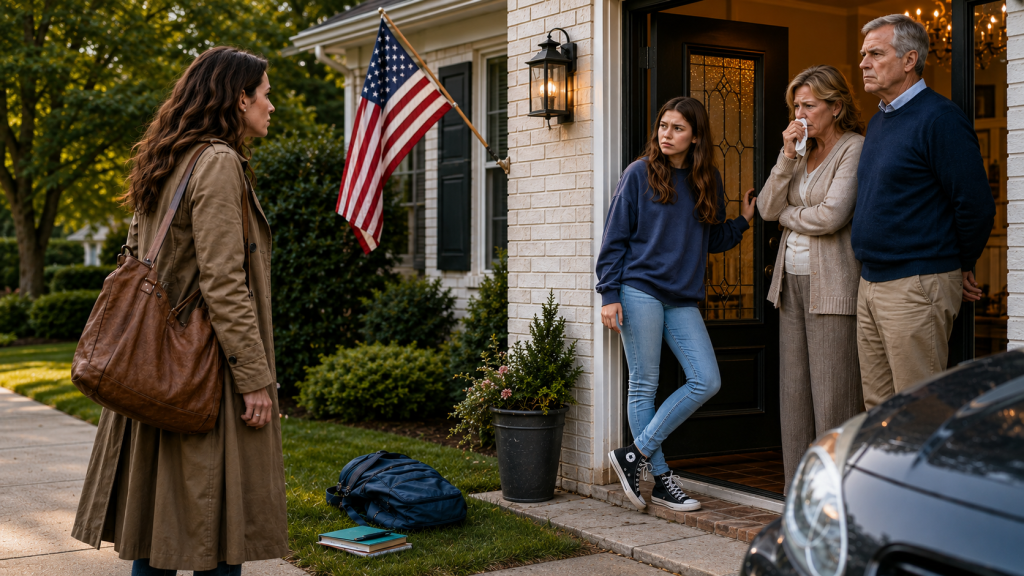
“I said no.” She stepped fully onto the porch and pulled the door closed behind her. “You always tell me that families shouldn’t keep secrets. You tell me that honesty is the foundation of a godly home. So be honest.”
The hypocrisy of that statement struck me so hard I almost laughed.
My father had used those exact words when I was growing up. Honesty was the foundation of a godly home—unless honesty embarrassed him. Unless the truth threatened his reputation. Unless his pregnant seventeen-year-old daughter needed compassion more than punishment.
My mother reached for Maya’s arm.
Maya pulled away.
“Who is she?” Maya demanded.
My mother looked at my father as though waiting for permission to breathe.
He gave her none.
I held out the faded photograph.
Maya hesitated before taking it. Her fingers brushed mine, and the contact sent a painful warmth through my chest.
She studied the picture closely.
I remembered the afternoon it had been taken. I had been standing beside a bus station in a town forty miles away, wearing a borrowed maternity dress and trying to smile for a woman named Ruth, who had given me a room when no one else would.
I had been seven months pregnant.
Terrified.
Alone.
Still foolish enough to hope my parents might call.
Maya traced the curve of my younger face with her thumb.
“You look exactly like me,” she whispered.
“I know.”
“How old were you?”
“Seventeen.”
Her gaze dropped to my stomach in the photograph.
“And you were pregnant.”
“Yes.”
My father stepped between us. “This conversation is over.”
Maya looked around him. “Was the baby me?”
The world became completely still.
A lawn mower hummed somewhere down the street. A dog barked behind a fence. Wind stirred the maple branches above the driveway.
My mother began to sob.
That was her answer.
Maya stared at her.
“No,” she said softly. “No, that doesn’t make sense.”
“Maya,” my mother whispered.
“You told me my birth mother abandoned me.”
My knees nearly gave way.
The sentence entered my body like a blade.
“What did you say?” I asked.
Maya’s eyes remained fixed on my mother. “They told me my biological mother left me at the hospital. They said she didn’t want me.”
“I never left you.”
The words came out too quickly, too loudly.
Maya flinched.
I forced myself to lower my voice.
“I never abandoned my baby.”
My father pointed toward my car. “Leave now, or I’m calling the police.”
I turned toward him.
“Call them.”
His hand dropped.
“Go ahead,” I continued. “Call the police. Tell them the daughter you declared dead twenty years ago has returned to ask why the child she was told had died is standing on your porch.”
Maya’s face went pale.
My mother sank onto the porch bench.
My father’s expression changed for only a second, but it was enough.
Maya saw it too.
“The child she was told had died?” she repeated.
I could hardly look at her.
For twenty years, I had carried one image of my daughter.
A tiny hospital bracelet.
A white knitted blanket.
A nurse who would not meet my eyes.
My mother sitting beside my hospital bed, telling me there had been complications.
My father standing near the window, saying it was God’s judgment.
I had believed them because I was seventeen, exhausted, medicated, and shattered.
I had believed them because parents were supposed to tell the truth when their child was too weak to protect herself.
“My baby was born on October seventeenth,” I said. “At 2:14 in the morning.”
Maya’s lips parted.
“My birthday is October seventeenth.”
“I know that now.”
“How?”
I reached into my purse again and removed a folded envelope.
It contained a copy of a birth certificate I had obtained three weeks earlier.
The original document had been sealed, but a court order and a patient records request had opened more doors than my parents had expected.
The certificate listed the child’s name as Maya Grace Bennett.
Mother: Claire Elise Bennett.
Father: Not listed.
The space where my name should have remained had later been amended.
Adoptive mother: Diane Bennett.
Adoptive father: Thomas Bennett.
My parents.
Maya stared at the document.
Her hands began to shake.
“This is fake.”
“It isn’t.”
“You made this.”
“I didn’t.”
My father snatched the paper from her.
He looked at it for half a second before tearing it down the middle.
Maya gasped.
I didn’t react.
“I have twelve copies,” I said.
My father tore it again.
“I also have the certified original in a safe-deposit box.”
“You have no right to come here with accusations,” he said.
“Accusations?”
I took a step toward him.
“You threw me out when I was pregnant. You told the entire church I had run away because I was rebellious. You refused to answer my calls. Then, when I went into labor, someone contacted you because I was a minor. You came to the hospital, took control while I was unconscious, and walked away with my child.”
“That is not what happened.”
“Then tell me what happened.”
His silence was immediate.
My mother bent forward, covering her face.
I looked at her.
“Tell her.”
“Claire, please.”
“Tell her what you did.”
“I was trying to save everyone.”
Maya recoiled as if she had been struck.
“Save everyone from what?”
My mother looked up.
Her face was streaked with tears. The years had softened her features but not her instinct to make herself the victim.
“You were so young,” she said to me. “You had no money. No husband. No home.”
“Because you threw me out.”
“We thought you would come to your senses.”
“I called you eleven times that night.”
My mother closed her eyes.
“I remember.”
“You answered once.”
“I remember.”
“You told me not to call again unless I was ready to admit that I had murdered my future.”
Maya turned toward her slowly.
“You said that?”
My mother’s voice broke. “I was angry.”
“No,” I said. “You were cruel.”
My father stepped forward. “We will not stand here and allow you to rewrite history.”
“I don’t have to rewrite it. I brought records.”
I opened my purse and removed another folder.
Inside were hospital notes, social-worker reports, copies of guardianship petitions, adoption amendments, and a statement from Ruth Carter, the woman who had taken me in.
I placed the folder on the porch bench beside my mother.
“This is history.”
My father did not touch it.
Maya did.
She opened the folder and scanned the first page.
Her eyes moved rapidly.
“What does ‘maternal patient unconscious during emergency procedure’ mean?”
I answered carefully.
“I lost a lot of blood after you were born. I needed surgery. I was unconscious for almost a day.”
“And this?” She pointed to another line. “‘Infant released to maternal grandparents under emergency temporary custody authorization.’”
My father spoke before I could.
“You were a minor. We were legally responsible for you.”
“You had stopped acting responsible for me months earlier.”
“You were incapable of caring for a newborn.”
“You didn’t ask me.”
“You had no plan.”
“I had Ruth.”
At the mention of her name, my mother looked up.
“Ruth was a stranger.”
“Ruth was the only person who treated me like a human being.”
Ruth Carter had been fifty-six when she found me sitting behind a grocery store with my backpack, a swollen face, and less than thirty dollars in my pocket.
She had owned a small alterations shop and lived in an apartment above it. She gave me soup, a clean bed, and a place to stay.
She never asked me to earn her kindness.
She never called me dirty.
She never said my pregnancy was proof that I had failed God.
She drove me to every prenatal appointment.
When labor began, she held my hand in the hospital and promised she would remain beside me.
Then the hospital called my parents because I was legally a minor.
My father arrived with his Bible and his anger.
My mother arrived with a suitcase and a plan.
Ruth was ordered out of the room because she was not family.
By the time I regained consciousness, Maya was gone.
My mother told me the baby had stopped breathing.
She said I should be grateful I had survived.
She refused to let me see the body because, according to her, it would only make things worse.
My father told me that God had erased my mistake and given me another chance.
Three days later, they drove me back to Ruth’s apartment.
They did not invite me home.
They left me on the sidewalk with forty dollars and a warning never to embarrass them again.
I had spent the next twenty years believing my daughter had died before I could hold her.
Maya lowered the papers.
“You thought I was dead?”
“Yes.”
Her expression twisted.
“And they raised me?”
“Yes.”
“As their daughter?”
“Yes.”
My mother stood abruptly. “We loved you.”
Maya turned on her.
“That isn’t the question.”
“We gave you everything.”
“That isn’t the question!”
My father’s shoulders stiffened. “Do not speak to your mother that way.”
“Which mother?”
The words silenced him.
Maya looked between us, breathing hard.
“Which one of you is my mother?”
My mother reached for her again.
Maya stepped away.
“I changed your diapers,” my mother said. “I stayed awake when you were sick. I took you to school. I taught you to read.”
“And you told me the woman who gave birth to me didn’t want me.”
“We believed it was best.”
“For whom?”
My mother had no answer.
Maya looked at my father.
“And you?”
He remained rigid.
She waited.
When he finally spoke, his voice was quiet.
“We protected you from instability.”
“You stole me.”
“No.”
“You told her I died.”
My father glanced at me.
“What happened was complicated.”
“No,” Maya said. “Complicated is when people misunderstand each other. This is lying.”
He stepped toward her. “You are too young to understand what we faced.”
“I’m nineteen.”
That number struck me strangely.
Nineteen.
She was older than I had been when they took her, yet they still spoke to her as though she were incapable of understanding her own life.
My father continued. “Our family was under enormous scrutiny. I was an elder at the church. Your grandmother directed the women’s ministry. Claire’s behavior had already created rumors.”
“My behavior?” I asked.
He looked at me without shame.
“You became pregnant.”
“I was seventeen.”
“You knew right from wrong.”
“So did you.”
A flicker of rage crossed his face.
For a moment, I saw the father I remembered—the towering man in the living room, holding my pregnancy test between two fingers as if it were contaminated.
I saw my mother emptying my drawers into my backpack.
I saw the bag sailing across the porch and landing on the wet lawn.
I heard my father’s voice telling me that no daughter of his would bring disgrace beneath his roof.
I remembered standing in the driveway while rain soaked my hair and my mother locked the door.
The memories no longer made me feel small.
They made me certain.
Maya gathered the papers and pressed them against her chest.
“I want to know everything.”
My father’s face darkened. “You will not leave this property with her.”
Maya stared at him. “You can’t stop me.”
“You live under our roof.”
“I am legally an adult.”
“You are confused and emotional.”
“I just learned that my entire life began with a kidnapping.”
“It was not kidnapping,” he snapped. “We obtained custody legally.”
“By telling a drugged teenager that her baby was dead?”
My father’s mouth closed.
Maya turned toward me.
“Do you have somewhere we can talk?”
“Yes.”
She walked down the porch steps.
My mother rushed after her. “Maya, wait.”
Maya stopped but did not turn around.
“I love you,” my mother said.
Maya’s shoulders rose with a painful breath.
“I love you too,” she answered. “That’s what makes this so horrible.”
Then she continued toward my car.
I followed, barely able to feel the ground beneath my feet.
I had imagined returning to that house hundreds of times.
In some versions, I screamed.
In others, my parents begged for forgiveness.
Sometimes I walked away without saying a word.
Never once had I imagined leaving with my daughter beside me.
I opened the passenger door.
Maya paused.
“What should I call you?”
The question nearly broke me.
“My name is Claire.”
She nodded once and climbed inside.
We drove to a diner near the highway, the kind with cracked red booths and waitresses who refilled coffee without asking.
Neither of us spoke during the first ten minutes.
Maya stared out the window.
I kept both hands on the steering wheel because they would not stop trembling.
At the diner, she chose a booth in the back.
A waitress brought menus, but neither of us opened them.
Maya placed the folder between us.
“Start from the beginning.”
So I did.
I told her about being seventeen and dating a boy named Daniel Price.
Daniel had been kind, funny, and terrified of my father. We had been together for nearly a year when I discovered I was pregnant.
He wanted to help.
At least, he said he did.
But when his parents found out, they sent him to live with an uncle in another state.
He called twice.
Then the number stopped working.
I never saw him again.
“Was he my father?” Maya asked.
“Yes.”
“Does he know I’m alive?”
“I don’t know.”
She absorbed that quietly.
I told her about hiding the pregnancy test in the bottom of my backpack.
My mother found it while searching for a missing church key.
She called my father home from work.
They made me sit at the dining table while they questioned me for nearly two hours.
My father demanded that I name the baby’s father.
My mother asked how I could do this to her.
Neither asked whether I was afraid.
Neither asked whether Daniel had pressured me.
Neither asked whether I had seen a doctor.
By sunset, my clothes were packed.
By nightfall, I was standing outside.
“I went to three friends’ houses,” I said. “Their parents called mine. Your grandfather told them not to let me inside because I needed to learn consequences.”
Maya’s eyes filled with tears.
“Where did you sleep?”
“The first night, at a bus station. The second night, behind the alterations shop where Ruth found me.”
I told her about Ruth.
How she taught me to sew.
How she made scrambled eggs every morning because they were the only food I could keep down.
How she bought a secondhand crib even though I insisted I would repay her.
How we painted it pale yellow because I didn’t know whether I was having a boy or a girl.
“You picked the name Maya,” she said.
“Yes.”
“Why?”
I smiled despite the ache in my chest.
“I read it in a library book. It meant different things in different languages. Dream. Illusion. Mother. I liked that one name could carry so many meanings.”
Maya looked down at the table.
“They told me they chose it because it was your grandmother’s favorite name.”
My smile disappeared.
“Your grandmother heard me say it at the hospital.”
Maya shut her eyes.
A waitress returned.
We ordered food we barely touched.
Then I described the birth.
Labor lasting eighteen hours.
Ruth beside me until my parents arrived.
My father arguing with the social worker.
My mother whispering to nurses.
The sudden bleeding.
Bright lights.
A mask placed over my face.
Then waking to an empty room.
“I asked for you,” I said. “The nurse left and returned with my mother. She told me you were gone.”
“Did no one verify it?”
“I tried. But every time I asked, they said I was confused. A doctor told me my parents had handled the arrangements. I was weak and heavily medicated. I trusted the wrong people.”
Maya wiped her cheek.
“How did you find out?”
“Three months ago, Ruth died.”
“I’m sorry.”
“She was eighty years old. She had a good life, but losing her felt like losing my real mother.”
I explained that Ruth had kept every document from that period.
After her death, her attorney gave me a sealed box.
Inside were letters Ruth had written to the hospital, child services, and my parents.
There were copies of complaints she had filed when she realized something was wrong.
There was also a note from a nurse who had contacted her years later.
The nurse admitted that my baby had survived.
She said my parents had obtained emergency custody, claiming I was homeless, mentally unstable, and planning to abandon the child.
Ruth tried to challenge them, but my father used his connections at the church and in the community.
By the time she gathered enough evidence, the adoption had been finalized.
“She knew?” Maya asked.
“Not at first. She suspected it. Years later, she confirmed it.”
“Why didn’t she tell you?”
The question had haunted me.
“She wrote that she was afraid the truth would destroy me. By then, I had spent years recovering. I had nightmares. Panic attacks. There were times I could barely function. She convinced herself that telling me without knowing where you were would only reopen the wound.”
“Was she right?”
“No.”
I answered immediately.
“She loved me, but she was wrong. People don’t get to hide the truth because they think pain makes someone incapable of surviving it.”
Maya looked at me for a long moment.
“That includes you.”
“Yes.”
“I need you to understand something.”
“All right.”
“You may be my biological mother, but I don’t know you.”
“I understand.”
“I can’t suddenly act like we’re family.”
“I would never ask you to.”
“And I still love them.”
“I know.”
“Even after this.”
“I know.”
She searched my face, perhaps looking for anger.
I felt none toward her.
Only grief for the impossible position she had been placed in.
“They raised you,” I said. “Whatever they did to me, the love you feel is real. You don’t have to erase it to make room for the truth.”
Her lower lip trembled.
“Why aren’t you angry at me?”
“Because none of this was your fault.”
That was when Maya began to cry.
Not silently like my mother.
Not carefully.
She bent over the table and covered her face as sobs shook her shoulders.
I wanted to hold her.
Every part of me wanted to cross the booth, wrap my arms around her, and make up for twenty years in one impossible moment.
But she had said she didn’t know me.
So I remained where I was.
I slid a clean napkin across the table.
After a few minutes, she reached for it.
“Thank you,” she whispered.
We stayed at the diner for almost three hours.
She told me about her life.
She was in her second year at a community college, studying nursing.
She worked weekends at a veterinary clinic.
She loved old mystery novels, hated mushrooms, and had once broken her wrist falling from a tree when she was eleven.
My mother had sat beside her hospital bed all night.
My father had built her a bookshelf when she turned thirteen.
They had attended every school performance.
They had been strict, controlling, and deeply involved in every decision she made.
But they had also loved her.
That truth hurt, but I refused to resent her for receiving the care I had been denied.
At dusk, Maya checked her phone.
Thirty-two missed calls.
Most were from my mother.
Several were from my father.
One text read: Come home immediately. Do not let that woman manipulate you.
Maya showed it to me.
“That woman,” she said bitterly.
“You should go home if you feel safe there.”
Her eyes widened. “You’re not going to tell me to leave them?”
“No.”
“After everything?”
“I came for the truth. I didn’t come to steal you back.”
Her expression softened slightly.
“I have a hotel room nearby,” I said. “Here’s my number. You can call me tomorrow, next year, or never. The choice belongs to you.”
I wrote my number on a napkin.
Maya folded it carefully and placed it in her wallet.
When we returned to the house, my parents were waiting in the driveway.
My father marched toward the car before I had fully stopped.
He opened Maya’s door.
“Inside.”
Maya climbed out slowly.
My mother stood behind him, twisting her hands.
“Are you all right?” she asked.
“No.”
“We were worried sick.”
“You should have worried about what would happen when I learned the truth.”
My father pointed at me through the windshield. “She is trying to poison you against us.”
Maya looked at him with an expression I recognized.
It was the same expression I had worn at seventeen when I finally understood that his authority depended on everyone else’s fear.
“She didn’t tell me to hate you,” Maya said. “She told me I was allowed to love you.”
My father’s hand dropped.
“She defended you more than you defended yourselves.”
My mother began crying again.
Maya walked toward the house, then stopped.
“I’m staying with Emma tonight.”
“You are not,” my father said.
“I already called her.”
“You will come inside.”
“No.”
He reached for her arm.
I was out of the car before I realized I had moved.
“Do not touch her.”
My voice cut through the driveway.
My father froze.
For twenty years, I had imagined being afraid of him forever.
Now he looked old, furious, and powerless.
Maya pulled away.
“I’ll call you tomorrow,” she told my mother.
Then she walked down the sidewalk.
A small blue car waited at the corner.
A young woman stepped out and hugged her.
I watched until they drove away.
My mother turned toward me.
“You’ve ruined everything.”
“No,” I said. “I revealed it.”
“You came here for revenge.”
“I came here because I spent twenty years mourning a living child.”
“We gave her a good life.”
“You gave her a life built on a lie.”
My father stepped close enough that I could smell the coffee on his breath.
“If you pursue this, you will only hurt her.”
“I already met with an attorney.”
His confidence faltered.
My mother gripped the porch railing.
“What are you going to do?”
“I don’t know yet.”
That was the truth.
There were possible criminal implications, though the statute of limitations and the signed custody documents made everything complicated.
There were civil claims.
There were hospital investigations.
There were sealed records that could expose everyone who had helped.
But standing there, I realized punishment was no longer the only thing I wanted.
I wanted the public truth.
I wanted every person who had praised my parents as righteous examples to understand what their reputation had cost.
Most of all, I wanted Maya to have control over what happened next.
“You will not contact her again,” my father said.
I almost smiled.
“You still haven’t learned.”
“What?”
“You don’t get to decide.”
I returned to my car and drove away.
Maya called the next morning.
Her voice was tired.
“Can we meet?”
We met at a public park.
She sat at a picnic table with two coffees.
One was for me.
“I didn’t know how you take it,” she said.
“Black is fine.”
“It has cream.”
“Cream is also fine.”
For the first time, she smiled.
It was quick and uncertain, but it was enough to make my heart ache.
She had spent the night reading every document in the folder.
She had also confronted my parents separately.
My mother admitted most of it.
My father admitted nothing.
“He says the adoption was legal, so nothing else matters,” Maya said.
“Legality and morality are not the same thing.”
“I told him that.”
“What did your grandmother say?”
“She said she thought they were saving both of us. She believed you would eventually build a new life and forget.”
“Forget my child?”
Maya looked down.
“I’m sorry.”
“You don’t have to apologize for her.”
“She also said you never came back.”
“I believed you were buried somewhere without a grave marker.”
Maya nodded.
“I told her that.”
We sat quietly.
Children played near the swings.
A father ran behind a little girl learning to ride a bicycle, one hand hovering near the seat in case she fell.
I watched him and wondered how many ordinary moments had been taken from us.
First steps.
First words.
School mornings.
Birthdays.
Illnesses.
Arguments.
Forgiveness.
Nothing could return them.
“I want a DNA test,” Maya said.
“I already bought one.”
Her eyebrows rose.
“Not because I doubted it,” I explained. “Because I thought you might need certainty.”
We completed the test that afternoon at a private laboratory.
The results arrived four days later.
Probability of maternity: 99.9998 percent.
Maya read the number three times.
Then she laughed once, but it turned into a sob.
I sat beside her in the laboratory parking lot.
This time, she leaned against me.
I placed my arm around her carefully.
She did not pull away.
A week later, the story became public.
Not because of me.
Because my father stood before his congregation and announced that a troubled woman from his past was attempting to extort the family.
He did not use my name.
He did not mention Maya.
But several church members recognized enough details to begin asking questions.
My attorney advised me to remain silent.
Maya chose otherwise.
She posted a statement online.
My name is Maya Bennett. I recently learned that the people who raised me are my biological grandparents. My biological mother, Claire Bennett, was told I died after birth. She did not abandon me. Documents and DNA evidence confirm the truth. I am asking for privacy while I decide what relationship I will have with everyone involved.
The post spread through the community within hours.
People who had once looked away from me began contacting my attorney.
A retired hospital clerk remembered my father arriving with a church-affiliated lawyer.
A former social worker admitted that concerns had been raised about the emergency custody petition.
A nurse provided a written statement saying my mother had insisted I was emotionally unstable and dangerous.
Then Daniel contacted us.
Maya’s biological father had seen the post through an old classmate.
He was living in Colorado, married, with two children.
His message was brief.
I was told Claire lost the baby. I never knew she survived.
I did not know whether to believe him.
Maya decided to speak with him by video call.
I joined only because she asked me to.
Daniel appeared on the screen with gray beginning at his temples.
For several seconds, none of us spoke.
Then he covered his mouth.
“Claire,” he whispered.
I felt seventeen again.
Not because I still loved him.
Because his face belonged to the last time in my life before everything had fallen apart.
“You knew I was pregnant,” I said.
“Yes.”
“You disappeared.”
“My parents sent me away. I was a coward.”
“That is not an answer.”
“No. It isn’t.”
He admitted that he could have tried harder.
He could have written.
He could have returned after turning eighteen.
Instead, he accepted what his parents told him—that the baby had died and that contacting me would only create more pain.
“I’m sorry,” he said.
Maya looked at him.
“You don’t get to enter my life just because the truth became public.”
“I understand.”
“You might never hear from me again.”
“I understand.”
She ended the call.
Afterward, she sat quietly.
“Everyone says they were protecting someone,” she said. “But really, they were protecting themselves.”
“Yes.”
My mother asked to meet us two weeks later.
Maya agreed on the condition that it happen in my attorney’s office.
My father refused to attend.
My mother arrived carrying a cardboard box.
She looked smaller than I remembered.
She placed the box on the conference table.
Inside were baby clothes, photographs, school drawings, report cards, and birthday cards.
Maya stared at them.
“I kept everything,” my mother said.
Maya’s expression hardened.
“You kept everything except the truth.”
My mother nodded tearfully.
Then she turned to me.
“I know you will never forgive me.”
“Don’t tell me what I will or won’t do.”
She lowered her eyes.
“I wanted to bring Maya to you,” she said. “Many times.”
“But you didn’t.”
“Your father said it would destroy the family.”
“What family?”
The question made her flinch.
“You had already built another life,” she continued.
I had built a life.
I went to college at twenty-four.
I became a physical therapist.
I married a kind man named Michael when I was thirty-one.
He died from cancer six years later.
We had tried to have children but never could.
My parents knew none of that.
They did not know about my education, my marriage, my husband’s illness, or the quiet house I returned to after his funeral.
They had erased me and then used my absence as proof that I did not care.
“You could have found me,” I said.
“I was ashamed.”
“You should have been.”
My mother wept.
This time, I did not feel cruel for refusing to comfort her.
Maya opened the box.
Near the bottom was a photograph of her as a newborn.
She wore the same white knitted blanket I remembered.
Behind her wrist was a hospital bracelet.
Baby Girl Bennett.
Maya handed the picture to me.
My vision blurred.
That was the first time I had ever seen my daughter’s newborn face.
I pressed the photograph against my chest and cried.
Not quietly.
Not politely.
Twenty years of grief came out in that conference room.
My mother watched me with horror, perhaps finally understanding that the pain she had hidden had remained alive all those years.
Maya moved her chair beside mine.
She held my hand.
When I could speak again, I looked at my mother.
“You watched me mourn.”
“I know.”
“You watched me beg to see her.”
“I know.”
“You drove me back to Ruth and left me there believing my baby was dead.”
My mother nodded.
“Why?”
She struggled to answer.
Finally, she whispered, “Because once we had taken the first step, telling the truth would have exposed what we had done.”
There it was.
Not love.
Not protection.
Cowardice.
The lie continued because confession became more frightening than cruelty.
Maya released my hand and stood.
“I can’t see you for a while,” she told my mother.
My mother’s face collapsed.
“How long?”
“I don’t know.”
“Please don’t cut me out.”
Maya looked at her steadily.
“You cut Claire out for twenty years.”
“That was different.”
“No. It only feels different because now it’s happening to you.”
My mother left the box and walked out alone.
The legal case lasted nearly a year.
The hospital settled privately after an investigation found serious failures in consent procedures and infant-release protocols.
Two former staff members acknowledged that my parents’ status in the community had influenced decisions.
The adoption itself could not simply be erased because Maya was already an adult, but the court amended her original records and restored my name as her biological mother.
My father resigned from the church after the congregation demanded an independent review.
He never apologized publicly.
Instead, he released a statement saying that every decision had been made out of love during a difficult season.
Maya read it once and deleted it.
“I’m tired of people using love as an excuse for control,” she said.
She moved out of my parents’ house that spring.
At first, she rented an apartment with Emma.
Then, when her nursing program transferred to a university near my city, she asked whether she could stay with me for one semester.
I said yes too quickly.
She laughed.
“Maybe pretend to think about it.”
“I’ll try again. Let me carefully consider whether my daughter can use the guest room.”
She smiled.
By then, she had started calling me her mother when speaking to other people.
With me, she still mostly used Claire.
I never corrected her.
The first weeks of living together were awkward.
We did not know each other’s habits.
She left cabinet doors open.
I woke early and made too much noise in the kitchen.
She liked music while studying.
I needed silence.
We argued once about laundry and then both became strangely emotional because ordinary conflict felt like proof that we were becoming real.
One evening, I found her sitting on the kitchen floor, crying beside a ruined cake.
It was my birthday.
She had tried to bake it from scratch.
The center collapsed.
The frosting melted.
“It looks terrible,” she said.
“It looks homemade.”
“That is what people say when food looks terrible.”
I sat beside her.
We ate the broken cake directly from the pan.
Halfway through, she leaned her head against my shoulder.
“Happy birthday, Mom,” she whispered.
I stopped breathing.
She immediately pulled back.
“Was that okay?”
I began crying.
“Oh no,” she said. “I’m sorry.”
“No. Don’t be sorry.”
“Then why are you crying?”
“Because I’ve waited twenty years to hear it.”
She hugged me.
That was the first time my daughter called me Mom.
Not in a courtroom.
Not during a dramatic confrontation.
On a kitchen floor beside a collapsed chocolate cake.
It was perfect.
Maya maintained limited contact with my mother.
They met in public once a month.
Their relationship changed slowly.
My mother began seeing a therapist, though she resisted at first.
She wrote me letters.
I did not answer most of them.
Forgiveness, I learned, was not a door that opened once.
It was a hallway with many locked rooms.
Some days, I felt compassion for her.
Other days, I remembered the hospital and could not imagine ever allowing her close again.
My father never changed.
He sent Maya messages about loyalty, duty, and honoring one’s parents.
She blocked his number after he accused her of destroying the family.
Two years after I returned to the driveway, he suffered a mild heart attack.
My mother called Maya from the hospital.
Maya asked me to go with her.
We found him sitting upright in bed, looking frailer than ever.
He stared at me but said nothing.
Maya stood near the window.
“Grandpa, I need you to answer one question.”
He looked at her.
“Do you regret it?”
My father’s eyes moved toward me.
For a moment, I thought illness might have softened him.
Then he said, “I regret that the truth caused so much division.”
Maya’s expression emptied.
“That isn’t what I asked.”
“I did what I believed was necessary.”
“You told a mother her baby was dead.”
“You were raised in a stable home.”
“You threw your daughter away and stole her child.”
His monitor began beeping faster.
My mother whispered, “Maya, please.”
Maya shook her head.
“I came because I thought maybe almost dying had made you honest.”
She walked out.
I remained for a moment.
My father looked at me.
“You turned her against us.”
“No,” I said. “The truth did.”
I followed Maya into the hallway.
She was crying near the elevators.
I held her.
“I wanted him to say he was sorry,” she whispered.
“I know.”
“Why can’t he?”
“Because then he would have to admit that the person he pretended to be never existed.”
She leaned against me.
“Does it ever stop hurting?”
“No,” I said honestly. “But it stops controlling every part of you.”
My father lived another three years.
He died without apologizing.
Maya attended the funeral.
I did not.
My mother sat alone in the front pew while people spoke about my father’s leadership, faith, and service.
Maya later told me that she almost stood up and corrected them.
Instead, she remained silent until the pastor invited family members to speak.
Then she walked to the front.
She did not expose every detail.
She did not humiliate him.
She simply said, “My grandfather believed reputation was the same thing as character. They are not the same. Character is what remains when the truth is finally known.”
Then she returned to her seat.
My mother moved into a smaller home after the funeral.
She sold the house where I had grown up.
Before the sale closed, she asked whether Maya and I wanted to visit one last time.
I almost refused.
Then I remembered the driveway.
I agreed.
The house looked smaller inside than it had in my nightmares.
The dining table was gone.
The walls were bare.
Sunlight revealed pale rectangles where family photographs had once hung.
There had never been a photograph of me after seventeen.
My old bedroom had become a sewing room.
My mother stood in the doorway.
“I kept something,” she said.
She opened the closet and removed my backpack.
The same faded green backpack she had thrown onto the lawn.
The zipper was broken.
A dark stain marked one side from the rain and mud.
I stared at it.
“Why did you keep this?”
“I found it near the curb the next morning.”
“You told me everything I owned was inside.”
“I know.”
She handed it to me.
It was nearly empty.
At the bottom was a small notebook.
My handwriting covered the first page.
Baby names.
Maya was circled three times.
I sat on the floor.
Maya sat beside me.
My mother remained by the door.
“I’m sorry,” she said.
The words were simple.
No explanation.
No request for forgiveness.
No claim that she had acted out of love.
Just sorrow.
I looked at her.
“I believe you are sorry now.”
She nodded.
“But being sorry doesn’t restore what was taken.”
“I know.”
“It doesn’t make you my mother again.”
Her face tightened, but she nodded once more.
“I know.”
“I may never forgive all of it.”
“I understand.”
For the first time, she seemed to.
I took the backpack and notebook with me.
Outside, Maya and I stood in the driveway where my parents had thrown me away.
The maple tree was larger.
The cracks in the pavement had been repaired.
A moving truck waited at the curb.
Maya slipped her arm through mine.
“Are you all right, Mom?”
I looked at the front lawn.
For years, I had imagined my seventeen-year-old self standing there alone.
But now I saw her differently.
She had survived.
She had found Ruth.
She had built a life from almost nothing.
She had carried grief without allowing it to make her cruel.
And somehow, after twenty years, she had returned for the truth.
“I’m all right,” I said.
Maya rested her head against my shoulder.
The new owners arrived a few minutes later—a young couple with two small children.
The little girl ran across the lawn, laughing as her father chased her.
My mother handed over the keys.
Then the three of us walked away from the house.
Not as the family we might have been.
Not fully healed.
Not free from everything that had happened.
But honest.
Years later, when Maya graduated from nursing school, she asked me and my mother to attend.
We sat in different sections.
That was Maya’s choice.
When her name was called, she crossed the stage and looked directly at me.
I stood and applauded until my hands hurt.
Afterward, she found me in the crowd.
She wore her graduation gown open over a blue dress and carried a bouquet from Emma.
My mother waited several feet away.
Maya hugged me.
“You came back,” she said.
“Of course I did.”
“No. I mean all those years ago. You came back to the house.”
“I almost didn’t.”
“What made you do it?”
I thought about Ruth’s box.
The documents.
The birth certificate.
The anger that had fueled my drive into town.
“I needed them to see that I was still alive.”
Maya smiled through tears.
“I’m glad you were.”
“So am I.”
She took my hand and led me toward my mother.
The three of us stood together for a photograph.
It was not a picture of perfect reconciliation.
My mother’s smile was cautious.
Mine was guarded.
Maya stood between us, no longer a secret, no longer a stolen child, and no longer responsible for repairing what others had broken.
When the camera flashed, I did not think about the photographs we had missed.
I thought about the ones we still had time to take.
That evening, Maya gave me a small wrapped box.
Inside was a silver bracelet engraved with three dates.
The day she was born.
The day we met.
The day she called me Mom.
On the back were four words.
The truth brought us home.
I fastened it around my wrist.
For twenty years, I had believed my daughter’s life ended before it began.
For twenty years, Maya believed her mother had walked away.
Neither story was true.
The truth was uglier, more complicated, and far more painful.
But it also gave us something lies never could.
A choice.
We could not recover the years stolen from us.
We could not return to the hospital room and stop my parents from carrying her away.
We could not give seventeen-year-old Claire the protection she deserved or give little Maya the mother who had spent every birthday mourning her.
But we could decide what happened after the truth.
We chose phone calls on Sunday mornings.
We chose shared holidays without pretending everything was simple.
We chose arguments, apologies, grocery trips, birthday cakes, and ordinary afternoons.
We chose boundaries with my mother and distance from my father’s memory.
We chose to speak honestly, even when honesty hurt.
Most of all, we chose each other.
I had driven back to that driveway intending only to look my parents in the eye.
I thought confronting them would be the end of my story.
Instead, the door opened.
My daughter stood on the other side.
And for the first time in twenty years, I finally came home.
THE END! THANK YOU FOR READING!