

I met Richard three years after my divorce, at a neighborhood charity fundraiser neither of us had planned to attend. He was charming without trying too hard, thoughtful in ways that felt genuine, and refreshingly patient. He spoke proudly of his only daughter, Madison, explaining that losing her mother years earlier had made the two of them inseparable.
I respected that bond and never imagined replacing anyone. I simply hoped, in time, we could build one of our own.
During our engagement, Madison was polite enough, though distant. She accepted birthday gifts, thanked me for paying her tuition when Richard admitted money was tight, and happily drove the SUV I helped finance because it was “safer for campus.” Every semester, I quietly transferred money for books, housing, and expenses, believing I was investing in our family’s future.
Richard always called it “our decision,” telling friends I had the biggest heart he had ever known.
Looking back, I realize those words cost him nothing.
Respect would have meant far more.
As I carried the serving dishes to the dining room that evening and watched my relatives laughing around the table, I had no idea the pleasant family dinner I had worked so hard to prepare was about to reveal exactly how little the sacrifices I made truly meant to the people living under my own roof.
The dinner was supposed to celebrate my mother’s seventy-eighth birthday.
My younger brother, Paul, had driven in from Wisconsin with his wife, Denise. My older sister, Carla, had arrived early to help arrange flowers. My two grown sons from my first marriage, Michael and Aaron, were there with their partners. Even my aunt Ruth had made the trip from Rockford, carrying her famous lemon cake in a plastic container she had owned since the nineteen-eighties.
It was the first time my entire family had gathered in our home since Richard and I married.
I wanted everything to feel welcoming.
I had spent two days cooking. I polished the dining table, pressed the linen napkins, bought my mother’s favorite white roses, and made sure there were vegetarian dishes for Aaron’s girlfriend. Richard promised he would handle the wine and pick Madison up from the train station.
He did neither.
At four-thirty, he called to say he had been delayed at the golf club. At five-fifteen, Madison texted me directly.
Train’s here. Where are you?
No greeting. No please.
I was standing over a pan of gravy, wearing slippers and an apron, with guests arriving in less than an hour.
I could have told her to call her father.
Instead, I turned off the stove, grabbed my keys, and drove twenty minutes through rush-hour traffic to collect her.
She climbed into the passenger seat wearing oversized sunglasses, even though the sky was cloudy. She placed her suitcase in the back without thanking me and immediately complained that the car smelled like cinnamon.
“I made an apple crumble,” I explained.
“You know I don’t eat that stuff.”
“I made other desserts too.”
She shrugged and looked at her phone.
On the drive home, she asked whether I had remembered to send the deposit for her study-abroad housing.
“I transferred it yesterday,” I said.
“Good.”
Not thank you.
Good.
I noticed the word, but I let it pass.
That had become my habit with Madison. Notice, absorb, excuse.
She was grieving.
She was adjusting.
She was young.
She felt protective of her father.
She had grown up without a mother.
There was always a reason, and somehow every reason required me to be more generous while asking nothing of her.
When we reached the house, Madison went upstairs without greeting anyone. My family noticed, but they were gracious enough not to comment.
Richard arrived forty minutes later with no wine, no apology, and a cheerful story about nearly making a difficult putt.
By then, I was carrying hot dishes from the kitchen while everyone settled around the table.
The first unpleasant moment came when Madison complained about her seat.
“Why am I all the way down here?” she asked.
She was seated beside my son Michael, only three chairs away from Richard.
“It was the easiest arrangement,” I said. “Grandma needs the chair with arms, and Aunt Ruth has trouble hearing.”
Madison looked at Richard.
“Dad, seriously?”
Richard glanced at me as if I had intentionally humiliated her.
“Brenda, couldn’t you put Madison beside me?”
Every other seat was already occupied.
“I suppose Carla and Paul could switch sides,” I said.
My sister immediately began moving her plate.
Madison did not thank her.
She simply waited until everyone rearranged themselves, then sat beside Richard with the satisfied expression of someone who had successfully corrected poor service.
I caught Michael watching me.
He did not say anything, but his jaw tightened.
Dinner began pleasantly enough. My mother opened her cards. Paul told a funny story about getting lost on the way down. Aunt Ruth complained about the traffic, the weather, and the declining quality of grocery-store tomatoes.
Then Madison started talking about her upcoming semester.
She described the apartment she wanted near campus, a modern building with a fitness center, rooftop lounge, and indoor parking.
“That sounds expensive,” Denise said gently.
Madison speared a piece of chicken.
“It’s not that bad.”
Richard laughed.
“That usually means it’s very bad.”
Everyone smiled.
I did not.
I knew the monthly rent. I had already been shown the paperwork. It was nearly twice the cost of the dorm room Madison had rejected.
Michael asked, “Are you working while you’re in school?”
Madison looked offended.
“My program is demanding.”
“So was mine,” he said. “I still worked weekends.”
Richard leaned back in his chair.
“Not everyone has the same path.”
Michael nodded.
“That’s true.”
There was no challenge in his voice, but Madison heard one anyway.
“I’m not asking you for money,” she said.
The table became quieter.
Michael looked directly at her.
“I didn’t say you were.”
She gave a small laugh.
“Right.”
I stepped in before things became uncomfortable.
“Would anyone like more green beans?”
My mother raised her hand.
I stood, gathered the empty serving dish, and carried it back to the kitchen to refill it from the pan I had kept warm.
That was when I heard Madison say, “At least the help is attentive.”
A few people gave uncertain laughs because they thought it must be a joke.
I returned to the dining room with steam warming my hands through the dish towel.
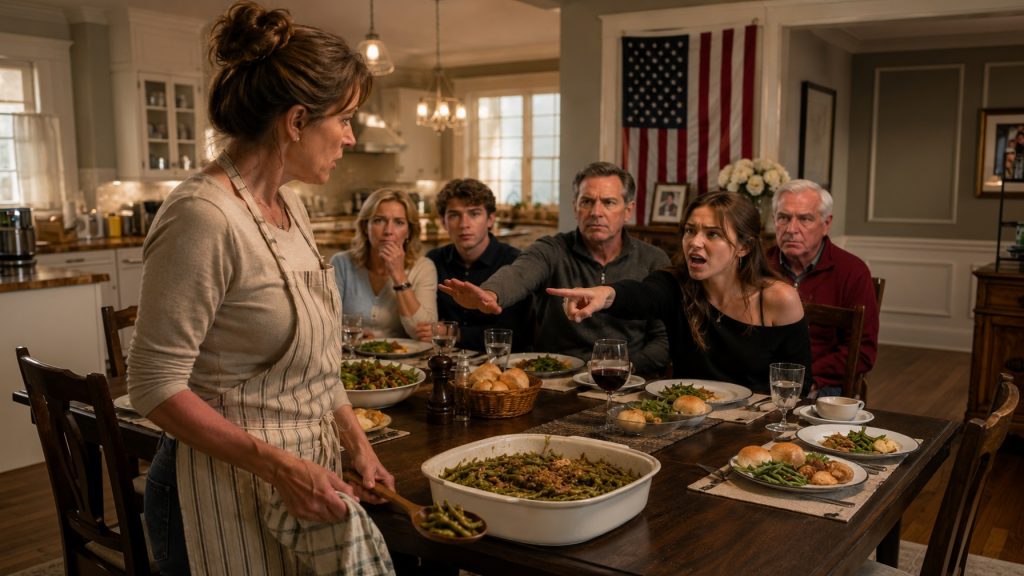
“What did you say?” I asked.
Madison looked straight at me.
“I said the help is attentive.”
Her mouth curved slightly.
She wanted me to hear it.
She wanted everyone to hear it.
I placed the dish carefully on the table.
“Madison, that is disrespectful. You’re a guest in this home, and you will not speak to me that way.”
Her face changed immediately, not with shame but with outrage.
Richard set down his fork.
“Brenda.”
I turned toward him.
He did not look embarrassed by his daughter.
He looked irritated with me.
“She’s not your daughter,” he said. “Don’t correct her.”
The room went silent.
Richard continued eating as though he had merely asked me to pass the salt.
I stared at him.
I had paid his daughter’s tuition.
I had paid the deposit on her apartment.
I had covered her health insurance after Richard’s business changed plans.
I had helped purchase the SUV parked in our driveway.
I had arranged her dental surgery, mailed care packages, remembered deadlines, proofread applications, and listened when she called crying after arguments with roommates.
Yet according to Richard, I had no right to ask for basic respect.
I was not her parent when she behaved badly.
I was only family when the bill arrived.
I felt something inside me go perfectly still.
Not broken.
Still.
There is a kind of clarity that comes when humiliation is complete. You stop searching for kinder interpretations because none remain.
I looked around the table.
My mother’s eyes were wet.
Carla stared at Richard with open disgust.
Michael had gone rigid in his chair.
Even Aunt Ruth, who rarely noticed tension unless it interfered with dessert, seemed shocked.
I could have shouted.
I could have listed every check I had written.
I could have told Madison exactly what her education, vehicle, apartment, insurance, phone, and spending money had cost me.
Instead, I smiled.
“You’re absolutely right,” I said.
Richard seemed relieved.
He mistook my calm for surrender.
Madison did too.
She leaned back in her chair and reached for the green beans.
The rest of dinner continued under a thin layer of strained politeness.
I served dessert.
I lit candles on my mother’s cake.
I took photographs.
I wrapped leftovers for my relatives.
I hugged everyone goodbye.
Michael was the last to leave.
He stood with me near the front door while Richard and Madison talked in the kitchen.
“Mom,” he whispered, “are you okay?”
“I’m fine.”
“You’re not.”
“I will be.”
He studied my face.
“What are you going to do?”
I glanced toward the kitchen, where Madison was laughing about something while Richard poured himself another drink.
“I’m going to take your stepfather’s advice.”
Michael frowned.
Then he understood.
His expression changed.
“Call me if you need anything.”
“I will.”
After he left, I cleaned the kitchen alone.
Richard watched television in the family room. Madison went upstairs to video-chat with friends. Neither offered to help.
I washed the final serving dish, dried my hands, and placed the damp towel over the oven handle.
Then I went to bed.
Richard joined me shortly after midnight.
He acted as though nothing had happened.
“That went pretty well,” he said, removing his watch.
I looked at him from my side of the bed.
“Did it?”
“Your family seemed to enjoy themselves.”
“They did.”
He placed the watch on the nightstand.
“Madison said Michael was interrogating her.”
“He asked whether she had a job.”
“It was judgmental.”
“She called me the help.”
Richard sighed.
“Brenda, she was joking.”
“No, she wasn’t.”
“She has a dry sense of humor.”
“So do I. Would you like to hear a joke about her?”
His eyes narrowed.
“Don’t start.”
I sat up against the pillows.
“I corrected disrespect in my own home, and you publicly told me I had no authority to do that.”
“You were embarrassing her.”
“She embarrassed herself.”
“She’s twenty years old.”
“Exactly. She is old enough to understand manners.”
Richard pulled back the covers sharply.
“I’m not doing this tonight.”
“Neither am I.”
He looked at me.
Something in my voice must have unsettled him, but not enough to make him apologize.
He turned off the lamp and rolled away from me.
Within minutes, his breathing deepened.
I remained awake for nearly two hours.
I thought about my first marriage and all the moments I had explained away because facing the truth would have required action.
I thought about the promise I had made to myself after that divorce: never again would I purchase peace by abandoning my own dignity.
At six the next morning, I rose quietly.
I showered, dressed, brewed coffee, and sat at the kitchen island with my laptop.
Then I began separating generosity from obligation.
The tuition payment scheduled for the following semester had not yet been processed. I canceled it.
The automatic monthly transfer into Madison’s spending account ended with three clicks.
I logged into the insurance portal and removed the SUV from my personal policy effective at the end of the month.
The vehicle itself was titled in my name because Richard’s credit had been poor when we bought it. I printed the documents proving ownership.
I canceled the credit card Madison carried as an authorized user.
I called the apartment complex and withdrew as guarantor from the lease she had not yet signed.
Then I opened the household budget.
That was when I saw the full picture.
For two years, I had been covering far more than I realized.
Richard paid a portion of the mortgage and some groceries. I paid the property taxes, insurance, repairs, vacations, streaming services, landscaping, utilities, and nearly every expense related to Madison.
Whenever I asked how his consulting business was doing, he said money was “temporarily tight.”
Temporarily had lasted twenty-six months.
I created a spreadsheet.
Tuition, fees, books, rent, car payment, insurance, repairs, phone, travel, medical expenses, clothing, and spending money.
The total came to $83,740.
I stared at the figure.
That did not include meals, gifts, family vacations, or the countless smaller costs I had absorbed without recording.
Richard entered the kitchen at seven-thirty, wearing pajama pants and rubbing his face.
“You’re up early.”
“I had things to handle.”
He poured coffee.
Madison came downstairs ten minutes later in one of my bathrobes, scrolling through her phone.
“Did you wash my black sweater?” she asked.
I looked at her.
“No.”
She glanced up, surprised.
“It’s in the laundry room.”
“I saw it.”
“And?”
“And you may wash it.”
Her eyes narrowed.
“Seriously?”
“Very.”
Richard lowered his coffee mug.
“Brenda.”
I smiled.
“She’s not my daughter. I wouldn’t want to overstep by teaching her laundry.”
Madison’s face flushed.
“Oh my God. Are you still upset about last night?”
“No.”
“Then why are you acting like this?”
“I’m respecting the boundaries your father established.”
Richard gave me a warning look.
“Don’t be childish.”
“I’m being precise.”
Madison rolled her eyes and opened the refrigerator.
“There’s no almond milk.”
“You finished it.”
“Can you get more?”
“You have a car.”
She closed the refrigerator door harder than necessary.
“I’m meeting people.”
“Then perhaps stop on your way.”
Madison looked at her father as if waiting for him to restore order.
Richard set down his mug.
“Brenda, enough.”
“I agree,” I said. “Enough.”
I turned the laptop toward him.
He saw the spreadsheet but did not immediately understand.
“What is this?”
“A record of the support I’ve provided Madison.”
Her head snapped toward me.
Richard scanned the figures.
His face tightened.
“Why did you make this?”
“Because I wanted clarity.”
“About what?”
“About what belongs under the category of parenting.”
Madison laughed nervously.
“This is insane.”
“Your father made it clear that I am not your parent and should not behave like one. I accept that. Effective immediately, I will no longer pay your tuition, rent, car expenses, insurance, phone bill, medical costs, travel, or personal spending.”
Silence filled the kitchen.
Richard stared at me as if I had spoken another language.
Madison’s mouth fell open.
“What?”
“You heard me.”
“You can’t do that.”
“I already have.”
She looked at her father.
“Dad?”
Richard pushed the laptop away.
“This is ridiculous. You’re punishing her over one comment.”
“No. I’m following your instruction.”
“You know exactly what I meant.”
“I do. You meant I had responsibilities without authority. You meant my money was welcome, but my voice was not.”
“That isn’t fair.”
“Neither was humiliating me in front of my family.”
Madison crossed her arms.
“I said it was a joke.”
“You did not say that last night.”
“Well, it was.”
“Then it was a bad joke with an expensive consequence.”
Her face hardened.
“You’re seriously going to ruin my life because I hurt your feelings?”
“No, Madison. Your life will not be ruined. You have a father. He can support you.”
Both of them looked suddenly uncomfortable.
That told me more than any confession could have.
Richard stood.
“We’ll discuss this privately.”
“We are discussing it now.”
“Not in front of her.”
“She is the subject of the discussion. At twenty years old, she can hear it.”
He lowered his voice.
“You committed to helping with college.”
“I committed as your wife and as someone who believed she was part of a family. Last night, you publicly removed me from that role.”
“You don’t get to twist my words.”
“I’m not twisting them. I’m finally listening to them.”
Madison grabbed her phone.
“This is unbelievable.”
She marched upstairs, slamming her bedroom door hard enough to shake a framed picture in the hallway.
Richard waited until she was gone.
Then his expression changed from irritated to frightened.
“You canceled the tuition?”
“Yes.”
“The payment is due in three weeks.”
“Then you have three weeks.”
“I don’t have that kind of money available.”
“I know.”
His face paled.
“What does that mean?”
“It means I reviewed our finances.”
“Brenda—”
“I also removed the SUV from my insurance at the end of the month. Since the title is in my name, Madison will return the vehicle before she goes back to campus.”
“You gave her that car.”
“I allowed her to use it.”
“She needs it.”
“Then buy her one.”
He paced toward the window.
“You’re making decisions that affect both of us without consulting me.”
I almost laughed.
“You made a decision about my place in this family without consulting me.”
“That was different.”
“Why?”
“Because she’s my daughter.”
“And the money is mine.”
That stopped him.
Richard had always disliked acknowledging the financial imbalance between us. He preferred words like ours, shared, family, and partnership, but only when discussing what I contributed.
The house had been mine before the marriage.
My savings came from twenty-seven years working in hospital administration, careful investing, and the settlement from selling property I inherited from my father.
Richard had income, but it arrived inconsistently. Before our wedding, he had assured me his business was recovering from a difficult year.
I now wondered whether it had ever recovered at all.
He returned to the island and sat across from me.
“Let’s calm down.”
“I am calm.”
“We can solve this.”
“There is nothing to solve. You established a boundary. I honored it.”
His jaw tightened.
“You’re trying to teach me a lesson.”
“No. I stopped volunteering for a position you say I do not hold.”
Richard leaned closer.
“Marriage doesn’t work this way.”
“I agree.”
“You don’t pull financial support whenever you get angry.”
“I’m not withdrawing support from you.”
“You know this affects me.”
“Supporting your adult daughter is your responsibility.”
“She’s your family too.”
I held his gaze.
“Last night, you said she was not my daughter.”
“That doesn’t mean she isn’t family.”
“What exactly does family mean to you, Richard? Someone who pays but stays silent?”
He looked away.
For the first time, I saw the calculation behind his eyes.
Not remorse.
Calculation.
He was trying to determine which argument might reopen my wallet.
He tried affection next.
“You love her.”
“I cared for her.”
“She needs you.”
“She needed to respect me.”
“She lost her mother.”
“She was nine when her mother died. I have shown compassion for eleven years of grief I did not cause. Grief may explain pain. It does not excuse cruelty.”
He rubbed both hands over his face.
“Give me a few days.”
“For what?”
“To figure this out.”
“You have until the tuition deadline.”
He stood so abruptly that the stool scraped against the floor.
“This is vindictive.”
“No, Richard. Vindictive would be destroying something that belongs to her. I am simply no longer providing what belongs to me.”
He left the kitchen without another word.
For the rest of the morning, the house felt like a building occupied by strangers.
Madison stayed upstairs.
Richard shut himself in his office.
I went to the grocery store, but for the first time, I bought only what I needed. I did not pick up Madison’s preferred yogurt, sparkling water, protein bars, or expensive skin-care products. I did not buy Richard’s imported coffee.
When I returned, Madison’s suitcase stood near the front door.
She came downstairs wearing the black sweater she had apparently learned to wash.
“Dad’s taking me back to campus.”
“All right.”
She waited for something more.
When I did not ask her to stay, her expression sharpened.
“You’re really doing this.”
“Yes.”
“Over one sentence.”
“No. One sentence exposed an entire arrangement.”
She shook her head.
“You’ve been waiting for an excuse to control me.”
“I have spent almost eighty-four thousand dollars supporting you. That is a strange form of neglect.”
“I never asked you to do that.”
The lie was so effortless that it almost impressed me.
“You asked me for the apartment deposit four days ago.”
“I meant I never asked you to act like my mother.”
“That is precisely why the support has ended.”
Richard appeared behind her carrying two bags.
“Come on, Maddie.”
She opened the front door, then turned back.
“You know what? My mom would have hated you.”
The words were meant to wound me.
They did.
But pain does not always require a response.
I looked at her calmly.
“I never knew your mother, so I cannot speak for her. But I doubt she would be proud of how you behaved at that table.”
Madison’s face twisted.
Richard stepped between us.
“That was unnecessary.”
“So was what she said.”
He followed her outside.
The SUV remained in the driveway.
They took Richard’s sedan.
I stood at the window and watched them leave.
Then I called my attorney.
Her name was Elaine Foster, and she had handled my divorce, my estate plan, and the prenuptial agreement Richard reluctantly signed before our marriage.
When I explained what had happened, she did not sound surprised.
“Have you noticed unusual withdrawals?” she asked.
“No. Why?”
“Because financial entitlement often grows quietly before it becomes visible.”
I opened our joint account.
There were several transfers I did not recognize.
Small enough to escape attention individually. Large enough to matter together.
Over eight months, Richard had transferred nearly $19,000 to an account labeled RHC Business Services.
“That’s his company,” I said.
“Were the transfers authorized?”
“Not by me.”
“Your income goes into that account?”
“My salary and investment distributions do.”
Elaine paused.
“Move your direct deposits immediately. Leave enough to cover legitimate shared expenses, but protect the rest. Download every statement.”
My hands grew cold.
I searched further.
There were charges for hotels, restaurants, and airline tickets Richard had described as business expenses. There were also payments to Madison far beyond the allowance I already provided.
In March, he had sent her $2,400.
In May, $3,100.
In June, another $1,800.
All from our joint account.
By the time Richard returned that afternoon, I had opened a new checking account at a different bank, redirected my income, frozen the joint credit line, and printed two years of statements.
He walked into the kitchen and saw the papers spread across the island.
His face changed.
“What are you doing?”
“Finding out how much this family has cost me.”
He set down his keys.
“Where’s Madison’s car key?”
“In my desk.”
“She needs the SUV next week.”
“She will not be driving it.”
“We already talked about this.”
“Yes. I was clear.”
He glanced at the bank statements.
“You went through the accounts?”
“They are my accounts too.”
His voice became defensive.
“Those business transfers were temporary.”
“I did not ask about them yet.”
He froze.
People reveal a great deal when they defend themselves against accusations you have not made.
I pointed to the chair across from me.
“Sit down.”
“I don’t appreciate being ordered around.”
“Then stand.”
He remained where he was.
I lifted one statement.
“You transferred nineteen thousand dollars from our joint account into your business without telling me.”
“I was covering expenses.”
“Which expenses?”
“Operating costs.”
“Be specific.”
“Software, contractors, marketing.”
“Show me the invoices.”
“I don’t keep everything here.”
“Then retrieve them.”
He exhaled sharply.
“You’re acting like I stole from you.”
“Did you?”
“No.”
“Then documentation should resolve the question.”
He stared at me.
I pointed to another page.
“You also sent Madison more than seven thousand dollars from our shared account while I was already paying her allowance.”
“She had needs.”
“What needs?”
“School expenses.”
“I paid her school expenses.”
“She didn’t always feel comfortable asking you.”
“But she felt comfortable calling me the help.”
“Stop returning to that.”
“I will return to it as often as necessary because you seem determined to pretend it was insignificant.”
He pulled out a chair and sat.
For several seconds, neither of us spoke.
Then Richard said, “My business has been struggling.”
“How badly?”
He looked toward the window.
“How badly, Richard?”
“I lost two major clients last year.”
“You told me you replaced them.”
“I expected to.”
“You lied.”
“I was trying to protect you from stress.”
“You were protecting yourself from accountability.”
“I had a plan.”
“Was the plan to continue using my income while pretending everything was fine?”
His expression hardened.
“You knew I had an uneven income when you married me.”
“I did not know you would secretly take money.”
“It was a joint account.”
“For household expenses. Not undisclosed business loans.”
“I was going to replace it.”
“With what?”
He did not answer.
I leaned back.
“Is there debt?”
He rubbed his jaw.
“How much debt?”
“Brenda—”
“How much?”
“About forty-two thousand.”
I felt the room tilt slightly.
“Business debt?”
“Mostly.”
“What does mostly mean?”
“Some credit cards.”
“In your name?”
A pause.
“Yes.”
“Any in mine?”
“No.”
“Are you certain?”
“Yes.”
I watched him carefully.
“I will verify that.”
His eyes flashed.
“You don’t trust me.”
“You have given me no reason to.”
He lowered his voice.
“If you withdraw support now, everything collapses.”
There it was.
Not our marriage.
Not trust.
Everything, meaning the structure built around my money.
“Then it was already collapsing,” I said. “I was merely holding it up without knowing.”
He reached across the table.
I moved my hand away.
“Brenda, I made mistakes.”
“You made choices.”
“I was ashamed.”
“So you deceived me.”
“I thought I could fix it before you found out.”
“And Madison?”
“What about her?”
“Did she know I was paying for nearly everything?”
“She knew you helped.”
“Did she know your business could not support her?”
His silence answered.
I felt a deeper humiliation than I had felt at dinner.
Madison had not mistaken me for the help.
She understood my role perfectly.
I was the funding source.
Richard leaned forward.
“She’s young. Don’t blame her for my situation.”
“I blame her for her behavior. I blame you for yours.”
“We can recover from this.”
“Perhaps. But not by returning to the same arrangement.”
He nodded too quickly.
“Fine. We’ll make a budget.”
“A budget is not enough.”
“What do you want?”
“I want full financial disclosure. Business accounts, personal accounts, credit reports, debts, tax returns, everything.”
His face tightened.
“And I want marriage counseling.”
He looked relieved, as if counseling were a small price.
“And Madison will apologize to me in front of the same people who heard her insult me.”
“That’s unnecessary.”
“Then my support remains unnecessary.”
“You can’t buy an apology.”
“I am not buying one. In fact, I have stopped paying.”
He stood again.
“This is going too far.”
“No. This has gone too far already.”
That evening, Richard slept in the guest room.
The next morning, Madison called me twelve times.
I did not answer until the thirteenth.
“What?” she demanded the moment I picked up.
“Good morning to you too.”
“My card was declined.”
“Yes.”
“I’m at the bookstore.”
“Then use your own card.”
“I don’t have enough money.”
“Call your father.”
“He said he’s in a meeting.”
“Then wait.”
“I need my textbooks.”
“You have three weeks before classes begin.”
“This is so petty.”
“Madison, this conversation will end if you insult me.”
She made an angry sound.
“You’re destroying my education.”
“No. I am declining to finance it.”
“What am I supposed to do?”
“Apply for aid. Find a job. Consider a less expensive apartment. Use federal student loans. Speak to your father.”
“You know Dad can’t pay.”
“Yes.”
The silence on her end was brief but revealing.
“So you knew?” I asked.
“Knew what?”
“That his business was failing.”
“I knew he was having a hard year.”
“He has been having a hard three years.”
“That isn’t my fault.”
“No, but you were happy to let me carry the cost while treating me as beneath you.”
“I said I was sorry.”
“No, you said it was a joke.”
“Fine. I’m sorry.”
The words came out flat and irritated.
“What are you sorry for?”
“Oh my God.”
“Exactly.”
She hung up.
Two hours later, Richard called.
“She’s hysterical.”
“She sounded angry, not hysterical.”
“She needs books.”
“Then purchase them.”
“I told you I’m working on the money.”
“And I told you I will not resume support.”
He was quiet.
“Are you really willing to end our marriage over this?”
The question surprised me, not because I had not considered divorce, but because he framed my refusal to pay as the destructive act.
“Our marriage was endangered when you lied about money and humiliated me in my home.”
“I made one comment.”
“You made your beliefs clear.”
“So that’s it?”
“I have not decided.”
“What do you need to decide?”
“Whether you are sorry for how you treated me or merely frightened by the financial consequences.”
He had no immediate answer.
That became his pattern over the next week.
He apologized when he needed something.
He became defensive when I asked for evidence.
He promised transparency, then delayed giving me access to business accounts.
He agreed Madison should apologize, then insisted she needed time.
Meanwhile, I kept discovering more.
The SUV had been damaged six months earlier. Madison had backed into a concrete pillar in a parking garage and paid a body shop privately so I would not know. Richard had transferred the money from our joint savings.
She had dropped one of her courses the previous semester but kept the refunded tuition instead of returning it.
She had used my credit card to book a weekend hotel in Chicago for herself and three friends, telling me it was a university conference.
Richard knew about all of it.
Each time, he had chosen to protect her from consequences by making me absorb them unknowingly.
When I confronted him, he said, “She was scared of disappointing you.”
“No,” I replied. “She was confident you would help deceive me.”
Elaine advised me to document everything and secure valuables and records.
I hated how clinical my marriage had become.
Passwords.
Statements.
Receipts.
Titles.
Legal protections.
But facts were becoming the only solid ground in the house.
One week after the dinner, Richard asked me to meet him and Madison at a restaurant.
“She wants to make things right,” he said.
I agreed, but chose the restaurant myself—a quiet place near my office where I knew the owner and felt comfortable leaving alone.
Madison arrived ten minutes late.
Richard stood when she approached. I did not.
She sat across from me, placed her phone face down, and sighed.
“Dad says I owe you an apology.”
I looked at Richard.
He looked embarrassed.
“Do you believe you owe me one?” I asked.
Madison stared at the table.
“I shouldn’t have called you the help.”
“Why did you?”
“I was annoyed.”
“About what?”
“The seating. Michael asking about work. Everyone treating me like I’m spoiled.”
“Are you?”
Her head lifted.
“No.”
“Who pays your tuition?”
She clenched her jaw.
“You did.”
“Who paid for your housing?”
“You.”
“Your car?”
“You helped.”
“Insurance?”
“You.”
“Phone?”
“You.”
“Spending money?”
She looked toward her father.
“Why are you doing this?”
“Because I need to understand your definition of spoiled.”
Richard interrupted.
“Brenda, she came to apologize.”
“Then let her.”
Madison’s eyes filled with tears.
Months earlier, I would have softened immediately.
That day, I waited.
“I know you did a lot,” she said.
“And?”
“And I shouldn’t have said what I said.”
“Do you respect me?”
She hesitated.
The hesitation hurt more than the insult.
“I don’t know you that well.”
“You have known me for four years.”
“That doesn’t mean you’re my mother.”
“I have never claimed to be.”
“You act like you get to decide things.”
“In the home I own and with the money I earn, I do get to decide some things.”
She folded her arms.
“So this is about control.”
“No. It is about reciprocity. I offered support because I believed we were family. Families do not require perfection, but they do require basic respect.”
Madison began crying.
Richard moved his chair closer to her.
I watched him place a hand on her shoulder.
Neither of them asked how I had felt.
The old Brenda would have ended the conversation there. She would have accepted the tears as proof of remorse and restored everything to stop the discomfort.
Instead, I waited.
Madison wiped her face.
“What do you want me to say?”
“The truth.”
“The truth is that I didn’t ask you to marry my dad.”
“I did not ask you to approve.”
“You came into our lives and changed everything.”
“I paid to preserve most of your comforts.”
“I didn’t want your money.”
“Then returning it should not trouble you.”
Her face hardened again.
“I can’t return eighty thousand dollars.”
“I’m not asking you to. I’m asking you to stop pretending my contribution meant nothing.”
She looked away.
Richard said quietly, “Maddie, Brenda is right about that.”
It was the first time he had openly supported me in front of her.
Madison looked betrayed.
“You said she was overreacting.”
He glanced at me.
“I said things I shouldn’t have.”
Her tears stopped.
“So you brought me here to gang up on me?”
“No one is attacking you,” I said. “You are experiencing accountability.”
She pushed back her chair.
“I’m leaving.”
Richard reached for her arm.
“Sit down.”
“No.”
“Madison.”
“I said I was sorry. Apparently that isn’t enough unless I crawl across the floor.”
I stood as well.
“No one asked you to crawl. But apology without understanding is simply a strategy.”
She grabbed her purse.
“You’ve always hated me.”
“That is not true.”
“You wanted Dad to choose you.”
“No. I wanted him to treat both of us with honesty.”
She looked at him.
“Are you going to let her talk to me like this?”
Richard’s face changed.
I saw the old reflex return—the instinct to rescue her by silencing me.
But this time, he hesitated.
That hesitation was his first honest act.
Madison saw it too.
She walked out.
Richard remained seated.
For a long moment, he stared at the empty chair.
Then he said, “I created this.”
“Yes.”
He looked at me.
“I thought protecting her was love.”
“Protection from pain can be love. Protection from every consequence becomes permission.”
He nodded slowly.
“Her mother was sick for two years before she died. Madison heard arguments about medical bills. She saw me panic. After Laura died, I promised she would never feel insecure again.”
“So you gave her everything.”
“I tried.”
“And when you could no longer afford it, you gave her mine.”
He closed his eyes.
“Yes.”
The honesty did not erase the betrayal, but it mattered.
“Why didn’t you tell me your business was failing?”
“Because you’re successful. Organized. Careful. I already felt like I was entering your life with less.”
“I never treated you that way.”
“I know.”
“Then the shame was yours.”
“Yes.”
He looked older than he had a week earlier.
“I don’t want to lose you.”
“You may have already done so.”
His eyes filled.
I did not enjoy seeing it.
Despite everything, I had loved him.
Part of me still did.
But love is not a command to remain available for harm.
“I will give you every record,” he said. “I’ll close the business if I have to. I’ll sell my car. I’ll repay what I took.”
“With what money?”
“I’ll find work.”
“Not consulting?”
“Anything.”
“And Madison?”
“She’ll have to adjust.”
“Will you allow her to?”
He looked toward the door through which she had left.
“I don’t know how.”
“Then learn.”
Over the next month, our house changed.
Richard provided the financial records. The debt was worse than he had first admitted: nearly sixty-one thousand dollars, including tax obligations he had ignored.
He sold his sedan and bought an older used car.
He accepted a salaried position with a logistics company outside Chicago, earning less than he once had but bringing home reliable income.
He began individual therapy as well as marriage counseling.
Madison returned the SUV after receiving a formal letter from Elaine reminding her that I owned it.
She left the keys in our mailbox without a note.
She moved into a less expensive shared apartment and took a part-time job at the campus library.
Richard paid for her essential textbooks using his first paycheck. She took loans for the remaining tuition.
For several weeks, she refused to speak to him unless she needed information.
He struggled terribly.
Every silence from her made him want to fix things with money.
Our counselor helped him recognize the pattern.
“You are confusing her dependence with closeness,” she told him during one session. “If your relationship survives only when you remove every obstacle, it is not secure. It is subsidized.”
The sentence stayed with both of us.
I did not immediately forgive Richard.
Trust did not return simply because he finally behaved responsibly.
He had access to only one household account, funded with agreed-upon amounts. We reviewed finances weekly. The house remained legally mine. I updated my will and removed him as sole beneficiary, replacing that arrangement with a trust that protected my sons and provided limited support for him if we remained married.
He was hurt when I told him.
But for once, he did not accuse me of cruelty.
“I understand,” he said.
That was progress.
Three months after the dinner, my mother invited us to Thanksgiving.
Richard asked whether Madison could come.
“That is my mother’s decision,” I said.
“She invited her.”
“Then she may come.”
“Are you comfortable with that?”
“No. But comfort is not the only consideration.”
Madison arrived carrying a store-bought pie.
She looked different.
Not physically, exactly, though she had stopped wearing the expensive hair extensions I had once paid for.
She looked less certain that the world would rearrange itself around her.
She greeted my mother politely.
She thanked Carla for taking her coat.
When she reached me, she stopped.
“Hi, Brenda.”
“Hello, Madison.”
She held out the pie.
“I brought this.”
“I see that.”
“It’s apple. Dad said you like apple.”
“I do.”
We stood awkwardly in my mother’s entryway while voices and dishes clattered from the kitchen.
Then Madison said, “Can we talk somewhere?”
I led her into the small den.
She sat on the edge of the sofa. I remained standing until she gestured nervously toward the chair.
“This isn’t another fake apology,” she said.
“I did not say it was.”
“I know the first one was bad.”
“Yes.”
She twisted her fingers together.
“I was angry at you because Dad changed after he met you.”
“How?”
“He stopped needing me as much.”
The confession surprised me.
She continued before I could speak.
“After Mom died, it was just us. He told me everything. Money problems. Work problems. People he dated. Then you came along, and suddenly he had someone else. You had this house and your job and your sons and everything seemed stable. I felt like I was being absorbed into your life.”
“I never wanted to erase your mother or replace your relationship with him.”
“I know that now.”
“What changed?”
She gave a humorless laugh.
“Having to pay for groceries.”
Despite myself, I smiled.
She did too, briefly.
Then her expression became serious.
“When you stopped paying, I told everyone you were controlling and cruel. My roommates agreed at first. Then one of them asked why my stepmother had been paying my tuition in the first place. I said because we were family. She asked why I called you the help if you were family.”
I waited.
“I didn’t have an answer.”
“That was an honest question.”
“I got a job. It’s only twelve hours a week, but I hate it.”
“I imagine many people hate their first job.”
“Students leave coffee cups everywhere. They talk loudly. They blame me when printers break.”
“That sounds frustrating.”
“It is.”
She looked down.
“But I get it now. A little. What it feels like when people treat you like you’re there to serve them.”
The room became very quiet.
“I treated you that way,” she said. “Not just at dinner. For years.”
“Yes.”
“I knew Dad couldn’t afford everything. I knew you were paying. I told myself it didn’t matter because you had money.”
“Having money does not make someone’s effort meaningless.”
“I know.”
Her eyes filled, but this time she did not use the tears to escape.
“I’m sorry, Brenda. I’m sorry I called you the help. I’m sorry I lied about the hotel and the car. I’m sorry I took your money and acted like you should be grateful I accepted it.”
I felt my throat tighten.
“Thank you for saying that.”
“I don’t expect you to pay for anything again.”
“I won’t.”
She nodded.
“I know.”
There was no anger in her answer.
“I also know you’re not my mother,” she continued. “But you did more for me than I admitted. You showed up when I had surgery. You stayed all night after Dad went home because he had that meeting. You sent me food when I had the flu. You remembered my mom’s birthday and asked if I wanted to visit the cemetery.”
“I remember.”
“I acted like none of it counted because you weren’t her.”
“I never needed to be her.”
“I know.”
She wiped her cheek.
“Could we maybe start over? Not with money. Just… start over.”
I looked at the young woman sitting before me.
She was still flawed.
So was I.
Accountability had not transformed her into a different person. It had simply forced her to see herself clearly for the first time.
Starting over did not mean forgetting.
It did not mean restoring the old arrangement.
It meant allowing new behavior to create a new relationship.
“We can try,” I said.
Madison nodded.
Then she stood and surprised me by hugging me.
I did not immediately lift my arms.
For a second, I remembered the dinner table, the steam on my hands, and Richard’s flat voice telling me not to correct her.
Then I embraced her gently.
When we returned to the dining room, Richard looked from Madison’s face to mine.
He did not ask what happened.
He simply pulled out my chair.
Thanksgiving was not perfect.
Aunt Ruth complained that the pie crust was undercooked.
Paul told the same story twice.
Richard became tense when Madison mentioned student loans.
But he did not offer to rescue her.
And when she carried dishes to the kitchen after dinner, she looked at me and asked, “Where do you keep the dish towels?”
It was such a small question.
Yet I nearly cried.
Our marriage survived, but not because I smiled and forgave everything.
It survived because the version of our marriage that had existed before that dinner ended.
The new one had rules.
Honesty was required.
Respect was not optional.
Money could not be used to hide fear, purchase affection, or excuse betrayal.
Richard spent the next two years repaying the joint account. He worked steadily and rebuilt his credit. His relationship with Madison became more distant for a while, then healthier.
She called him because she wanted to speak with him, not because a payment was due.
She finished college one semester later than planned.
I attended the graduation, but I did not pay the final tuition bill.
Madison had covered part with loans and part with earnings from a paid internship.
When her name was called, she crossed the stage in a blue gown, accepted her diploma, and searched the audience.
Her eyes found Richard first.
Then they found me.
She smiled.
Not the small, satisfied smile she had worn at my dinner table years earlier.
A real smile.
Afterward, she hugged her father and posed for photographs. Then she walked toward me holding her diploma.
“I did it,” she said.
“You did.”
She looked down at the folder in her hands.
“I used to think you ruined everything when you cut me off.”
“I know.”
“You didn’t.”
“No.”
“You made me grow up.”
“I gave you the opportunity. You chose to use it.”
She laughed softly.
“That sounds like something you’d say at work.”
“It probably is.”
She reached into her graduation bag and handed me a small wrapped box.
Inside was a silver bracelet with a simple engraved plate.
The inscription read:
Thank you for refusing to be invisible.
I looked at her.
“I ordered it months ago,” she said quickly. “I know gifts don’t fix things.”
“No. But thoughtful ones can honor what changed.”
Richard joined us and read the inscription over my shoulder.
His eyes filled.
“I owe you the same thanks,” he said.
I fastened the bracelet around my wrist.
For years, I had believed love was proven by how much a person was willing to give.
Money.
Time.
Labor.
Patience.
Second chances.
But giving without boundaries does not always create love.
Sometimes it creates entitlement.
Sometimes it teaches people that your kindness is an endless resource requiring no care in return.
The night Madison called me the help, she believed she was reminding me of my place.
Instead, she forced me to remember my value.
I did not withdraw support to punish her.
I withdrew it because support without respect had become self-betrayal.
The consequences felt harsh because she had never experienced any before.
Richard called my decision vindictive because my silence had been convenient for him.
But the morning I canceled those payments was not the morning I destroyed our family.
It was the morning I stopped allowing money to disguise what our family had become.
Years later, we gathered again in my dining room for my mother’s eighty-second birthday.
Madison arrived early with groceries she had purchased herself.
She tied on an apron and asked what needed to be done.
Richard set the table.
My sons brought flowers.
The house filled with conversation, warm bread, and the smell of green beans.
At one point, Madison carried a steaming dish toward the table.
She paused beside me and whispered, “Careful. The help is attentive.”
I stared at her.
For one dangerous second, Richard stopped breathing.
Then Madison smiled nervously.
“I’m joking properly this time.”
I laughed.
So did she.
The old wound had become something we could acknowledge because she had done the work required to heal it.
Richard wrapped an arm around my waist.
“You all right?” he asked.
“Yes.”
And I was.
Not because everyone finally understood how much I had given.
Not because Madison saw me as a mother.
Not because Richard had become perfect.
I was all right because I had learned that love does not require me to disappear.
I could be generous without being used.
I could forgive without becoming foolish.
I could remain kind without remaining silent.
And when someone told me I had no right to parent the daughter whose life I financed, I did not scream, threaten, or beg for recognition.
I simply listened.
Then I stopped performing a role they insisted was not mine.
The silence that followed taught all of us more than another argument ever could.
THE END! THANK YOU FOR READING!