

Brandon’s fingers hovered over the envelope.
For several seconds, nobody in the conference room moved. The executives had already left in uneasy groups, whispering to one another as they passed through the glass doors. Only Brandon, Frank, and I remained.
The words written across the front seemed darker than ordinary ink.
He Trusted Wrong.
Brandon finally picked it up.
“Wait,” Frank said.
His voice was calm, but his body had gone rigid. He reached into his jacket, removed a pair of thin gloves, and handed them to Brandon.
“Whoever left that envelope wanted us to open it,” Frank said. “That doesn’t mean they wanted us to open it safely.”
Brandon looked at him.
“You think it could be dangerous?”
“I think we stopped assuming anything was harmless weeks ago.”
That was the truth of our lives now. A ringing telephone could be a trap. A familiar face could be an enemy. A grieving widow could be celebrating a death that had never happened.
Brandon slipped on the gloves and carefully opened the envelope with a letter opener from the conference table. Inside were three photographs, a folded document, and a small memory card sealed inside clear plastic.
The first photograph showed Brandon standing outside a restaurant in downtown Charleston. It had been taken nearly six months earlier. Victoria stood beside him, smiling, one hand resting against his chest.
The second photograph showed Victoria entering a black sedan later that same evening.
The man opening the rear door for her was someone I recognized immediately.
I felt the blood drain from my face.
“No,” I whispered.
Brandon looked at me.
“What is it?”
I pointed at the photograph.
“That man worked for your father.”
Brandon frowned and lifted the picture closer.
“My father had hundreds of employees.”
“Not like him.”
The man in the photograph was older now, heavier around the middle, with silver threaded through his dark hair. But the sharp eyes and long scar beside his left ear were unmistakable.
His name was Edwin Mercer.
For fifteen years, Edwin had served as my late husband’s private financial adviser. He had managed investment accounts, reviewed contracts, and attended family meetings that even senior executives were excluded from.
Then, shortly before my husband died, Edwin disappeared.
He claimed he was retiring.
No farewell dinner. No announcement. No forwarding address.
He simply vanished.
Brandon studied the photograph.
“You never told me he disappeared.”
“At the time, I thought he was ashamed.”
“Ashamed of what?”
I looked toward the windows. Beyond the glass, the city moved beneath a pale afternoon sky, unaware that a piece of our past had just walked back into the room.
“Your father discovered money missing from one of the family trusts,” I said. “Not a little money. Nearly three million dollars. Edwin insisted it was an accounting error. Your father planned to investigate, but then he became ill.”
Brandon’s jaw tightened.
“And after Dad died?”
“The records were suddenly clean. The missing money had been returned from an account no one could trace. Edwin resigned the next day.”
Frank took the second photograph from Brandon.
“This was not a random meeting,” he said.
The third photograph proved it.
Victoria sat across from Edwin Mercer in a private room at a hotel restaurant. Between them lay several folders, a laptop, and what appeared to be a copy of Brandon’s signature.
The date printed in the corner was nine months before Victoria had called to announce Brandon’s death.
Nine months before she had smiled through every lie.
Nine months before someone tampered with Brandon’s medication and sent his car spinning across a rain-soaked road.
Brandon unfolded the document.
It was a transfer authorization.
Twenty-two million dollars from a corporate reserve account to a private holding company registered in the Cayman Islands.
The authorization carried Brandon’s name.
The signature looked perfect.
But the date was from the week Brandon had been unconscious in the hospital.
Frank exhaled slowly.
“This is the missing link.”
Brandon stared at the page.
“She wasn’t trying to inherit everything after I died.”
“No,” I said. “She was trying to steal everything before anyone realized you were alive.”
The room felt suddenly colder.
Frank removed the memory card from the plastic sleeve.
“We don’t insert this into any company computer,” he said. “We take it to the police cybercrime unit.”
Brandon nodded, but he was still staring at Edwin’s face.
“He worked for Dad,” he said. “He knew our accounts. Our legal structure. Our signatures.”
“And our weaknesses,” I added.
Frank gathered the photographs.
“The man in the back row wanted us to see this. The question is why.”
That question stayed with us all afternoon.
Detective Mara Collins met us at a secure evidence lab two hours later. She was the same detective who had supervised Victoria’s arrest and had listened to the recorded phone call in which Victoria declared Brandon dead.
Mara had the expression of a woman who trusted facts more than people.
She studied the envelope, the photographs, and the transfer authorization before turning to the memory card.
“Could be evidence,” she said. “Could be malware. Could be both.”
A technician placed the card into an isolated computer that had no connection to the department’s network. We watched from behind a glass partition.
Three folders appeared on the screen.
The first was labeled INSURANCE.
The second was labeled SUCCESSION.
The third was labeled E.M.
Mara opened the insurance folder.
It contained scanned copies of two life insurance policies issued on Brandon within the previous eighteen months. One was legitimate and had been arranged through the company.
The other was not.
The second policy was worth fifteen million dollars.
Victoria was the sole beneficiary.
Brandon had supposedly signed it at a private medical office outside Savannah.
He had never been there.
The succession folder contained drafts of legal documents naming Victoria as temporary chairwoman of the company in the event of Brandon’s death or incapacity.
Several board members’ signatures had been forged.
The E.M. folder contained audio recordings.
Mara clicked the first file.
Victoria’s voice filled the lab.
“He won’t change the will while his mother is alive. She watches him too closely.”
Then Edwin Mercer answered.
His voice was deeper than I remembered, but unmistakable.
“Then stop focusing on the will. The company is where the real money is.”
Victoria laughed softly.
“And Brandon?”
“A temporary obstacle.”
The recording ended.
Brandon turned away from the screen.
I had heard Victoria say terrible things. I had listened as she announced my son’s death with false sorrow. I had watched her reach for a weapon when the truth cornered her.
But hearing another person calmly describe Brandon as an obstacle made something inside me harden.
Mara opened another recording.
This time, Victoria sounded nervous.
“The accident failed.”
“You said the road would be empty.”
“It was.”
“Then why is he still alive?”
A pause followed.
Then Edwin spoke.
“Because you panicked. You left before confirming anything.”
“I saw the car go over the barrier.”
“You saw what you wanted to see.”
Victoria’s breathing became sharper.
“What do we do now?”
“We make him disappear another way.”
The recording stopped.
Nobody spoke.
Mara looked through the glass at the technician, then back at us.
“This changes the case,” she said. “Victoria is no longer facing only fraud and attempted assault charges. We may be looking at conspiracy to commit murder.”
Brandon’s hand closed around mine.
“Who made these recordings?” he asked.
“That is what I intend to find out.”
The final file was a short video.
The camera angle suggested it had been recorded from a hidden device inside a hotel lamp. Victoria sat at a table with Edwin. Another man stood near the window with his back turned.
Edwin slid a folder toward Victoria.
“Once the certificate is filed, you make the call to his mother,” he said.
“And if she asks to see the body?”
“She won’t.”
“You don’t know her.”
“I know grief. People believe what pain tells them.”
Victoria opened the folder.
Inside was a forged death certificate bearing Brandon’s full name.
She smiled.
The third man near the window turned slightly.
It was the stranger from the board meeting.
The man who had left the envelope.
Mara paused the video and enlarged his face.
“Anyone recognize him?”
Frank leaned closer.
“No.”
Brandon shook his head.
But something about the man’s expression troubled me. He was not looking at Victoria or Edwin. He was looking directly toward the hidden camera.
As though he knew it was there.
As though he wanted someone to find it.
Mara printed the image and distributed it to every unit in the city.
By sunset, we had a name.
Caleb Mercer.
Edwin’s son.
He was thirty-eight years old, a former forensic accountant who had worked for his father’s consulting firm until three years earlier. After that, his employment history disappeared.
No social media. No recent address. No active driver’s license.
A ghost.
“Why would Edwin’s son expose him?” Brandon asked.
“Families break in strange ways,” Mara replied. “Sometimes money does it. Sometimes fear. Sometimes conscience arrives late.”
That evening, Frank drove Brandon and me back to the apartment. Rain had started again, tapping softly against the windows.
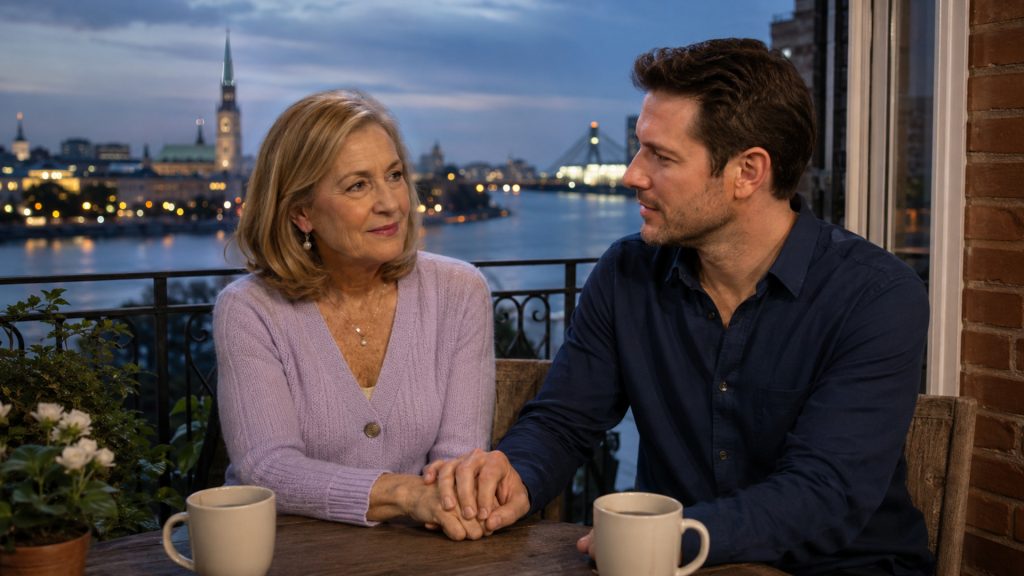
Brandon stood in the living room, staring at the river.
“I spent years thinking Victoria loved me,” he said. “Now I find out she was meeting with a man connected to Dad before we were even married.”
“You cannot blame yourself for believing someone who studied how to deceive you.”
“But I brought her into the family.”
“You brought in the woman she pretended to be.”
He looked at me.
“What if there were signs?”
“There are always signs after the truth is known. Before that, they look like ordinary moments.”
Brandon lowered his head.
For the first time since the accident, he looked less like a company president and more like the boy who used to wait by the front window for his father to come home.
I walked over and touched his cheek.
“You survived because you trusted your instincts before it was too late,” I said. “And because when you finally called me, I believed you.”
His eyes filled, but he did not look away.
“I should have called sooner.”
“Yes,” I said gently. “You should have.”
He gave a faint, broken laugh.
“You always know how to comfort me.”
“A mother’s job is not to make every truth comfortable.”
The following morning, Mara called.
Caleb Mercer had been found.
He was waiting outside the old family cemetery where Brandon’s father was buried.
He had asked to speak with us.
Frank objected immediately.
“He could be bait.”
Mara agreed.
So the meeting took place at the police station in an interview room with cameras in every corner and armed officers outside the door.
Caleb entered wearing the same gray suit he had worn at the board meeting. Up close, he looked exhausted. His face was pale, and a thin cut crossed his lower lip.
He sat across from Brandon and me without removing his coat.
“My father knows I gave you the card,” he said.
Mara leaned against the wall.
“Then you are either very brave or very foolish.”
“Probably both.”
Brandon placed the photograph of Edwin on the table.
“Why are you helping us?”
Caleb looked at the image.
“Because your father tried to help me once.”
I felt a flicker of surprise.
“What do you mean?”
Caleb folded his hands.
“When I was twenty-two, I discovered irregular transfers in accounts managed by my father. I confronted him. He told me I was confused and threatened to destroy my career if I spoke to anyone.”
“And you went to my husband,” I said.
Caleb nodded.
“Mr. Hale listened. He believed me. He began investigating quietly. But my father found out. A week later, Mr. Hale became sick.”
The room went still.
Brandon leaned forward.
“My father had cancer.”
“Yes.”
“You’re suggesting Edwin caused it?”
“No. I’m saying your father’s treatment was delayed.”
I felt my throat tighten.
Caleb reached inside his coat slowly. Mara’s hand moved toward her weapon, but Caleb produced only a folded piece of paper.
He placed it on the table.
It was a copy of a hospital appointment schedule from twelve years earlier.
My husband had been scheduled for a diagnostic scan after unusual bloodwork.
The appointment had been canceled.
The cancellation request had come from Edwin’s office.
I remembered that month.
My husband had complained of exhaustion and abdominal pain. Edwin had convinced him it was stress from an acquisition. By the time the cancer was diagnosed, it had already spread.
I looked at Caleb.
“How did you get this?”
“My father kept records of everything. Insurance. Medical appointments. Travel schedules. Weaknesses.”
Brandon’s face had gone white.
“Why didn’t you come forward then?”
“Because I was afraid.”
Caleb’s answer was immediate and without excuse.
“My father showed me what he could do. He arranged false evidence suggesting I had stolen from clients. He told me that if I spoke, I would go to prison and my younger sister would lose access to the medical care she needed.”
“What happened to your sister?” I asked.
“She died four years ago.”
The pain in his voice needed no explanation.
Caleb stared at the table.
“After that, there was nothing left for him to threaten. But fear becomes a habit. I still waited.”
Brandon’s anger surfaced.
“And during that time, he planned my murder.”
“Yes.”
“You watched?”
“I collected evidence.”
“You watched,” Brandon repeated.
Caleb lifted his eyes.
“Yes.”
The word landed heavily.
Brandon pushed back from the table and stood.
“You expect me to thank you because you finally handed over a memory card?”
“No.”
“Victoria nearly killed me.”
“I know.”
“My mother was told I was dead.”
“I heard the call afterward.”
“And you did nothing.”
Caleb’s voice broke.
“I did not do enough.”
Mara stepped forward, but I raised my hand.
I looked at Caleb.
“Why now?”
He swallowed.
“Because my father ordered Victoria killed.”
Brandon froze.
Caleb continued.
“She knows too much. He believes she will make a deal with prosecutors. He has arranged for someone inside the county jail to stage her death as a suicide.”
Mara was already reaching for her phone.
“When?”
“Tonight.”
She left the room quickly, issuing commands before the door closed behind her.
Brandon stared at Caleb.
“Why should we care what happens to her?”
I understood his anger.
Victoria had tried to erase him. She had poisoned his medication, forged his death certificate, and planned to inherit the life she had stolen.
But I also understood something else.
“If Victoria dies,” I said, “Edwin destroys a witness.”
Brandon’s expression changed.
Caleb nodded.
“She has documents he needs. She hid them before her arrest.”
“Where?”
“I don’t know.”
Brandon turned toward the door.
“Then we keep her alive long enough to tell us.”
Victoria was moved to protective custody before sunset.
The inmate assigned to the cell beside hers was discovered carrying a strip of cloth, sedatives, and a note describing how to position Victoria’s body.
The woman claimed she had never seen the note before.
Nobody believed her.
That night, Victoria asked for a meeting.
She sat behind reinforced glass in a private visitation room. Her expensive clothes were gone. Her hair, once perfectly styled, hung loose around her face. Without makeup and confidence, she looked smaller.
But her eyes remained sharp.
When she saw Brandon, she stopped breathing for a moment.
“You came.”
Brandon picked up the telephone on our side of the glass.
“I came for the truth.”
Victoria lifted her receiver.
“The truth is expensive.”
“You are facing attempted murder charges.”
“And Edwin will make sure I never reach trial.”
“He already tried.”
Fear moved across her face.
So Caleb had been right.
Brandon remained cold.
“Tell us where the documents are.”
Victoria looked at me.
“Your mother always was the problem.”
I leaned toward the glass.
“No, Victoria. I was only the person who noticed you had become too comfortable lying.”
She smiled bitterly.
“You think you won?”
“My son is alive.”
“For now.”
Brandon’s grip tightened around the receiver.
“Careful.”
Victoria looked at him.
For one brief moment, something almost human crossed her face. Regret, perhaps. Or the memory of a life she could have chosen.
Then it vanished.
“Edwin has people everywhere,” she said. “At the company. In the courts. Inside your security team.”
Frank, standing behind us, did not react.
Brandon asked, “Who?”
“I don’t know all their names.”
“Then give us the names you know.”
Victoria leaned closer to the glass.
“I want immunity.”
“You are not getting immunity.”
“Then I want protection and a reduced sentence.”
“That is for the prosecutor.”
“Call her.”
Brandon started to lower the phone.
Victoria’s voice sharpened.
“The files are inside your father’s house.”
He stopped.
Our old family home had been empty for nearly eight years. After my husband died, I could not bear to remain there. Brandon had kept the property but never sold it.
“What files?” I asked.
Victoria looked at me.
“The original trust records. Your husband’s medical correspondence. Payments to doctors, board members, and private investigators. Edwin hid them where nobody would search because everyone assumed the house had been closed.”
“How do you know?”
“I helped him move them.”
Brandon stared through the glass.
“When?”
“Three months after our wedding.”
The betrayal was almost too large to absorb.
She had walked through rooms filled with our family photographs. She had stood in the kitchen where Brandon took his first steps. She had entered my husband’s study and hidden evidence of crimes committed against him.
All while calling me Mother.
“Where in the house?” I asked.
Victoria smiled faintly.
“Behind the wine cellar wall.”
Mara obtained a warrant before midnight.
We drove through heavy rain toward the old house.
The property stood beyond a line of ancient oak trees, dark and silent beneath the storm. Spanish moss whipped in the wind. The windows reflected the headlights like blind eyes.
I had not been inside in years.
The front door opened with the same low groan I remembered.
For one moment, I expected my husband to call from his study. I expected to hear Brandon racing down the stairs as a child.
Instead, police officers entered first, flashlights sweeping across sheet-covered furniture.
The house smelled of dust, wood, and old memories.
Brandon stood beside me in the foyer.
“You don’t have to go farther,” he said.
“Yes, I do.”
The wine cellar was beneath the west wing.
Officers located the false wall exactly where Victoria had described it. Behind the bricks was a narrow metal door secured with a digital lock.
A forensic technician bypassed it.
The room beyond was small and dry.
Metal shelves lined the walls.
Boxes filled every shelf.
Some were labeled with years.
Others carried names.
Hale.
Brandon.
Board.
Medical.
Insurance.
I stood in the doorway as investigators photographed everything.
Frank opened one box after receiving permission from Mara.
Inside were dozens of handwritten notes in Edwin’s sharp, narrow script.
One page described my husband’s symptoms before his diagnosis.
Another listed the names of two doctors and payment amounts beside each.
A third contained a sentence that made my knees weaken.
Delay creates opportunity.
Brandon caught my arm.
“Mom.”
I pressed a hand to my mouth.
For twelve years, I had believed cancer alone had stolen my husband. Now I understood that someone had helped death arrive faster.
Mara came to stand beside us.
“We will prove what we can,” she said quietly.
I nodded, but grief had already opened an old wound.
Across the room, an officer lifted a large ledger from a locked cabinet.
It documented payments stretching back nearly twenty years.
Judges.
Attorneys.
Accountants.
Security contractors.
Executives.
Edwin Mercer had not built a criminal plan.
He had built an empire inside the shadows of legitimate business.
Then an officer called from the far corner.
“There’s another door.”
Behind a shelf, investigators found a narrow passage leading into an older storage tunnel beneath the house.
The tunnel door stood open.
Fresh mud marked the floor.
Someone had been there recently.
Frank knelt beside the footprints.
“These are less than an hour old.”
Mara ordered every exit sealed.
Police moved through the cellar, the tunnel, and the grounds.
Then the lights went out.
Darkness swallowed the house.
A gunshot sounded from somewhere above us.
Brandon pulled me down behind a stone column as Frank drew his weapon.
Emergency lights flickered on, casting the cellar in dim red.
Another shot cracked through the hallway.
Officers shouted.
Footsteps pounded in the tunnel.
Mara ran toward the sound with two detectives.
Frank stayed with us.
“Do not move,” he said.
The red light made the shelves look like rows of bloodless shadows.
Brandon kept one arm around me.
“Who is it?”
I already knew.
Edwin had come for the records.
A crash echoed from the tunnel, followed by a man’s voice shouting.
Then silence.
Long, terrible silence.
Mara returned several minutes later.
Her coat was torn at the shoulder.
“We have one suspect in custody,” she said.
“Edwin?” Brandon asked.
She shook her head.
“Caleb.”
My heart sank.
Police brought him into the cellar in handcuffs.
Mud covered his trousers. Blood ran from a cut above his eyebrow.
Brandon stared at him with disbelief.
“You led us here.”
Caleb looked toward the open tunnel.
“I came to stop him.”
“Stop who?”
“My father.”
Mara held up a handgun sealed in an evidence bag.
“This was found beside Caleb.”
“I did not fire it,” he said.
“The weapon is registered to you.”
“My father registered it in my name years ago.”
Mara’s expression remained unreadable.
“Where is Edwin?”
Caleb looked toward the passage.
“He escaped through the marsh exit.”
Frank stepped closer.
“You expect us to believe you arrived at exactly the same time as he did?”
Caleb’s eyes met mine.
“No. I expect you to believe he told me to come.”
“Why?”
“Because he wanted you to think I betrayed you.”
Brandon gave a bitter laugh.
“Didn’t you?”
Caleb’s face tightened.
“My father sent me a message. He said if I wanted proof about your husband, I had to come alone. I knew it was a trap, but I also knew he would destroy the files.”
“Where is the message?” Mara asked.
“My phone was taken in the tunnel.”
“By your father?”
“Yes.”
The story sounded convenient.
Too convenient.
Then an officer called from the hidden room.
“Detective, you need to see this.”
Inside the cabinet, beneath the financial ledgers, investigators had found a live surveillance system.
Cameras hidden throughout the house had been recording us since we entered.
One screen showed the marsh behind the property.
A small boat moved across the dark water.
At the controls stood Edwin Mercer.
Mara immediately contacted harbor patrol.
But Edwin had prepared carefully.
By the time officers reached the marsh channel, the boat had been abandoned near a service road.
A vehicle was missing from a nearby fishing dock.
Edwin disappeared again.
Caleb remained in custody overnight while investigators examined the surveillance footage. By morning, they confirmed his account.
The cameras showed Edwin entering first through the tunnel. Caleb followed twenty minutes later. Edwin shot at him, planted the gun, took his phone, and escaped when police arrived.
Caleb was released.
But Brandon did not apologize.
Not yet.
Trust had become too expensive.
The evidence from the hidden room led to immediate arrests.
Two board members were charged with fraud.
A private physician was arrested for falsifying records.
A former judge resigned after investigators discovered payments connected to decisions favoring Edwin’s clients.
Every day brought another headline.
The scandal spread beyond our family, beyond Charleston, beyond the company.
Edwin had spent decades collecting secrets and purchasing silence.
Now the silence was collapsing.
Victoria accepted a plea agreement.
She agreed to testify against Edwin in exchange for protection and the possibility of a reduced sentence.
When Brandon learned about the agreement, he stood at the balcony doors for a long time.
“She might be free someday,” he said.
“Perhaps.”
“She tried to kill me.”
“Yes.”
“How am I supposed to accept that?”
“You do not have to forgive the agreement. You only have to understand why it exists.”
He turned toward me.
“Do you forgive her?”
“No.”
My answer surprised him.
“I thought you would tell me forgiveness is necessary.”
“I believe peace is necessary. Forgiveness is personal.”
He looked back toward the river.
“I don’t know if I will ever have either.”
“You will. But not because she deserves it. Because you do.”
The company’s recovery began slowly.
Brandon removed every executive connected to Edwin’s network. He established independent oversight and invited federal auditors to inspect the accounts.
Some investors fled.
Others returned after seeing the changes.
Employees who had feared losing their jobs began to trust again.
Frank became head of corporate security.
He resisted the title at first.
“I prefer working quietly,” he said.
Brandon smiled.
“You nearly tackled a man through a glass wall. Quietly is no longer an option.”
For the first time in weeks, all of us laughed.
Caleb remained nearby, though he kept his distance.
He provided thousands of documents and helped investigators understand Edwin’s financial structures.
One afternoon, I found him standing outside my husband’s grave.
He held no flowers.
Only a folded letter.
“I never thanked him,” Caleb said.
“He did not help you for gratitude.”
“I know.”
He placed the letter beside the headstone.
“I should have been braver.”
I stood beside him.
“Fear does not disappear because we hate ourselves for feeling it.”
“He died because I went to him.”
“No. He died because Edwin chose cruelty.”
Caleb looked at me.
“You really believe that?”
“I have spent too many years blaming myself for things other people chose. I will not watch you do the same.”
He nodded, though I could see he was not ready to believe me.
Perhaps belief, like trust, needed time.
Three weeks later, Edwin made his final move.
It began with a telephone call at 2:13 in the morning.
I answered from the apartment guest room.
For several seconds, there was only breathing.
Then Edwin spoke.
“You always were more intelligent than your husband.”
My hand tightened around the phone.
“Where are you?”
“Close enough.”
I reached for the emergency button Frank had installed beside the bed.
“Do that, and Brandon dies.”
My hand stopped.
Edwin laughed softly.
“You still have the same weakness.”
“My son is protected.”
“Protection is an illusion.”
I listened carefully.
Behind his voice, I heard the low horn of a ship.
Then metal clanging.
A port.
“You want something,” I said.
“The original ledger.”
“The police have it.”
“They have a copy.”
I said nothing.
He continued.
“Your husband kept one page separate. A page with my name, his signature, and a confession he forced me to write.”
I remembered finding nothing like that.
But perhaps Edwin did not know.
“Bring it to Pier Nine at four o’clock,” he said. “Come alone.”
“And Brandon?”
“You will hear his voice.”
A sound followed.
A man groaned.
Then Brandon said, “Mom, don’t—”
The line went silent.
I ran into the living room.
Brandon’s room was empty.
The balcony door stood open.
On the floor lay Frank’s security radio.
I pressed the emergency button.
Within minutes, the apartment filled with officers.
Frank arrived with blood on his collar.
“They took him from the service elevator,” he said. “Someone triggered the fire alarm downstairs. I was attacked in the stairwell.”
Mara listened to the recording of Edwin’s call.
“Pier Nine is abandoned,” she said. “Old warehouse district.”
“He wants a page that may not exist.”
“Then we give him one.”
Caleb arrived while the police prepared.
When he heard the pier number, his face changed.
“My father used Warehouse Fourteen years ago. There is a drainage tunnel beneath it leading to the river.”
Mara ordered tactical teams to cover the tunnel and the surrounding docks.
At three forty-five, I drove toward Pier Nine with a ledger page inside my coat.
It was a copy prepared by investigators.
A transmitter was sewn into my collar.
Mara’s voice came through a small earpiece.
“We are with you.”
The warehouse stood against the river like a dark skeleton.
Broken windows stared toward the water.
I entered through a rusted door.
Brandon sat tied to a chair beneath a hanging work light.
Blood marked one side of his face, but his eyes were clear.
Edwin stood behind him with a gun.
He looked older than in the photographs.
Not weaker.
Just stripped of the respectability that had hidden him.
“Marianne Hale,” he said. “Still walking into danger for men who never listened to you.”
“Release my son.”
“The page.”
I removed the folded document.
He smiled.
“You brought the police.”
“No.”
“You were never convincing when you lied.”
He pointed the gun toward Brandon.
“Put it on the floor and step back.”
I obeyed.
Edwin moved forward and picked it up.
He read the page once.
Then again.
His face twisted.
“This is false.”
“So was my son’s death certificate.”
His eyes hardened.
“You think this is a victory?”
“I think your empire is gone.”
“Empires are replaceable.”
“Your freedom is not.”
He raised the gun.
A voice sounded from the darkness.
“She is right.”
Caleb stepped from behind a row of shipping crates.
Edwin turned.
For the first time, fear entered his expression.
“You,” he said.
Caleb held his hands where they could be seen.
“No weapon.”
“You destroyed everything.”
“No. You did.”
Edwin aimed the gun at him.
“You were always weak.”
“I learned fear from you.”
“You learned survival.”
“No. I learned obedience.”
Caleb moved closer.
“And I am finished obeying.”
Edwin’s attention shifted completely toward his son.
That was the opening Brandon needed.
He threw his weight sideways, knocking the chair into Edwin’s legs.
The gun fired.
The bullet struck the overhead light.
Darkness exploded through the warehouse.
I dropped behind a crate as officers stormed through every entrance.
Shouts filled the building.
Another gunshot sounded.
Then a body hit the floor.
Emergency lights snapped on.
Edwin lay near the river doors.
Frank knelt over him, forcing the gun from his hand.
Mara cut Brandon free.
Caleb stood against the wall, uninjured but shaking.
Edwin stared up at his son as officers handcuffed him.
“You think they will forgive you?” he asked.
Caleb looked down at him.
“I am not doing this for forgiveness.”
Edwin was taken away before dawn.
He never confessed.
Men like him rarely do.
They rename cruelty as strategy, betrayal as necessity, and greed as intelligence.
But the evidence spoke where he refused.
Months later, a federal jury convicted him of conspiracy, fraud, attempted murder, witness intimidation, and dozens of financial crimes.
He received a sentence long enough to ensure he would never again walk freely beside the Charleston river.
Victoria testified for three days.
She described the forged insurance policy, the manipulated medication, the staged accident, and the plan to declare Brandon dead.
When asked why she had participated, she said Edwin had promised her wealth, power, and a life in which nobody could ever make her feel insignificant again.
The prosecutor asked, “Did Brandon Hale ever make you feel insignificant?”
Victoria looked toward him across the courtroom.
“No,” she whispered.
That answer hurt him more than any accusation.
Because it confirmed that his love had not failed her.
She had simply valued power more.
Victoria was sentenced to twenty-two years in prison with the possibility of parole after serving most of that time.
She cried when the judge spoke.
Brandon did not.
Outside the courthouse, reporters shouted questions.
He ignored them.
We walked together toward the car, Frank a few steps behind us.
At the curb, Brandon stopped.
“I thought I would feel different.”
“What did you expect?”
“Relief.”
“It will come quietly,” I said. “Not while cameras are waiting for it.”
The old family house remained closed for another year.
Then Brandon asked me what I wanted to do with it.
I considered selling it.
For years, the house had represented grief, secrets, and everything stolen from us.
But one morning, I walked through the rooms again.
Sunlight crossed the floors.
The hidden cameras had been removed.
The false wall in the cellar was gone.
The house no longer felt haunted.
It felt empty.
There is a difference.
Haunted places belong to the past.
Empty places can still be filled.
We converted the property into a recovery center for families affected by financial abuse, coercive control, and domestic manipulation.
The wine cellar became an archive room for legal resources.
My husband’s study became a counseling office.
The dining room where we had once held formal dinners became a place where families sat together and learned how to rebuild trust.
We named it the Hale Light Foundation.
Brandon protested the name.
“It sounds like we think we are heroes.”
“We are not heroes,” I told him. “We are witnesses.”
Caleb joined the foundation as a forensic consultant.
He helped victims trace stolen money and identify forged documents.
He never sought publicity.
He never asked Brandon to forgive him.
But one afternoon, I saw the two of them repairing a broken fence near the garden.
They worked in silence for nearly an hour.
Then Brandon handed Caleb a bottle of water.
It was a small gesture.
Sometimes small gestures carry the greatest distance.
Frank married Mara the following spring.
Their wedding took place beneath the oak trees behind the foundation.
Mara wore a simple ivory dress.
Frank looked more nervous than he had while confronting armed men.
When the officiant asked for the rings, he searched the wrong pocket three times.
Everyone laughed.
Even Brandon.
Especially Brandon.
Afterward, music drifted across the lawn while children ran between the tables.
I stood near the porch and watched my son dance badly with one of the foundation volunteers.
His ribs had healed.
The scar along his temple had faded.
But survival had changed him.
He listened more carefully.
He trusted more slowly.
He loved with greater honesty.
That night, after the guests left, Brandon and I sat on the same balcony where we had once believed the danger was over too soon.
The Charleston air carried the scent of salt marsh and jasmine.
Lights shimmered across the river.
“You were right,” he said.
“About what?”
“Relief came quietly.”
I smiled.
“Most important things do.”
He leaned back in his chair.
“I used to think winning meant getting everything back.”
“And now?”
“Now I think it means not becoming what hurt you.”
I looked at him with pride.
Below us, the city moved through another peaceful night.
Somewhere behind prison walls, Victoria and Edwin lived with the consequences of believing people were obstacles and love was weakness.
But they no longer controlled our story.
That belonged to us.
The telephone call that was supposed to break me had become the moment their lies began to collapse.
Victoria had called to tell me my son was dead.
She had said I would receive nothing.
She had believed grief would make me powerless.
She had never imagined Brandon would be sitting beside me, alive and listening.
She had never imagined a mother could smile while a trap closed.
And she had never understood the truth that saved us.
Money can be stolen.
Signatures can be forged.
Records can be hidden.
Even death can be falsely announced.
But when people who love one another finally stop protecting the lie and begin protecting each other, darkness loses its safest place to hide.
Brandon reached for my hand.
This time, he did not squeeze it because he was afraid.
He held it because we were free.
And as the first light of morning appeared beyond the river, I realized the storm had not destroyed our family.
It had washed away everything that never truly belonged in it.
THE END! THANK YOU FOR READING!