

Richard stood in the doorway with his keys in one hand and his phone in the other.
Emily’s message glowed on the screen.
Dad, Grandma is trying to ruin everything. Don’t believe whatever story she tells you.
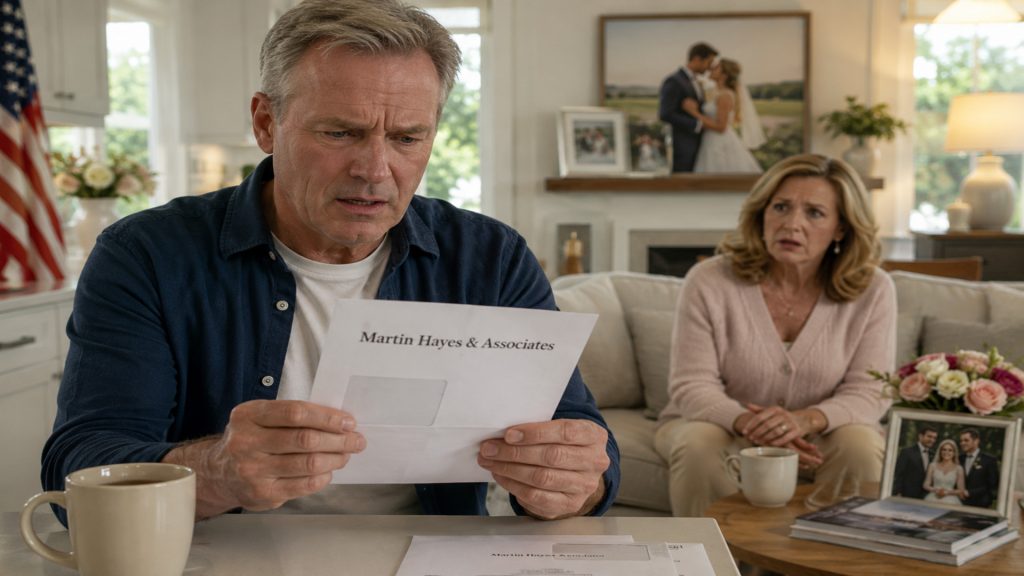
Below it was the email from Martin Hayes.
The subject line read:
Evidence Concerning Green Valley Estate Wedding.
Richard opened it.
The first photograph showed me standing outside the venue beneath the white stone archway. I was wearing the pale blue dress Emily had helped me choose three months earlier. My silver hair had been pinned carefully, and the pearl necklace around my neck had belonged to my mother.
I was holding the wedding invitation.
The second photograph showed a security guard blocking the entrance with one arm while speaking into a radio.
The third showed Susan standing just inside the glass doors.
She was looking directly at me.
Richard enlarged the photograph.
There was no confusion on Susan’s face.
No surprise.
She knew I was there.
She had seen me.
And she had turned away.
Richard’s fingers tightened around the phone.
“What are you looking at?” Susan asked.
He handed her the screen.
Her face changed immediately.
“That picture doesn’t show the whole situation.”
“It shows you looking at my mother while she was being denied entry.”
“I was trying to prevent a scene.”
“What scene?”
Susan crossed her arms.
“Your mother was upset. Emily was already nervous. The ceremony was about to begin. I thought it would be better to deal with it afterward.”
Richard stared at her.
“You thought leaving my seventy-four-year-old mother outside was better?”
“She wasn’t helpless.”
“That isn’t the point.”
“She always makes everything about herself.”
Richard looked down at the photograph again.
I did not look angry.
I looked stunned.
There was something about that expression that reached into him more deeply than tears would have.
He remembered how excited I had been when Emily announced the engagement.
I had opened a bottle of sparkling cider because I knew Emily did not drink.
I had hugged Daniel, her fiancé, and told him he was becoming part of a family that might be imperfect but loved fiercely.
I had offered to contribute to the wedding.
Emily had cried and said, “Grandma, I want you right there beside me.”
Richard remembered those words.
Now they sounded like something from another lifetime.
He scrolled down.
There were witness statements from two venue employees, the security supervisor, a photographer’s assistant, and an elderly woman who had been waiting for a rideshare near the entrance.
The security supervisor’s statement was brief.
At approximately 3:40 p.m., Mrs. Eleanor Parker arrived and presented a valid printed invitation. The guest list supplied by the wedding coordinator did not contain her name. I contacted Mrs. Susan Parker for confirmation. Mrs. Parker instructed me that Eleanor Parker was not permitted to enter under any circumstances.
Richard read the sentence twice.
Then he looked at Susan.
“You told them not to let her in under any circumstances.”
Susan’s lips tightened.
“Emily made the decision.”
“You gave the order.”
“I was protecting our daughter.”
“From her grandmother?”
“From embarrassment.”
Richard’s expression hardened.
“What exactly did Mom do that was so embarrassing?”
Susan looked away.
“She questioned some of the expenses.”
“She was paying them.”
“She made comments about the guest list.”
“Because she wanted to know where she was sitting.”
“She kept asking about the family photographs.”
“Because she was family.”
Susan’s voice rose.
“You don’t understand how much pressure Emily was under. Daniel’s parents are respected people. His father owns three medical clinics. His mother sits on charity boards. Their guests were judges, executives, and people from the country club. Emily wanted everything to feel elegant.”
Richard went still.
“And Mom didn’t fit that image.”
Susan did not answer.
That silence told him more than any confession could have.
My son left the house without another word.
He drove across town with the attorney’s letter resting on the passenger seat.
The entire way, memories came back to him.
He remembered being nine years old and waking to find me sewing a patch onto his school jacket because we could not afford a new one.
He remembered being sixteen and furious because I would not buy him a car. What he had not known then was that I had already taken a second job to save for his college tuition.
He remembered the night his father died, when I sat at the kitchen table after everyone had gone home and quietly calculated whether I could keep the house.
I had never complained.
I had never reminded Richard what I had sacrificed.
When he married Susan, I paid for the rehearsal dinner even though they had not asked me to.
When Emily was born, I spent three weeks sleeping on their couch so Susan could recover.
I attended every recital, birthday, graduation, and school event.
Yet on the day I had spent more than $86,000 making beautiful, I had been treated like an intruder.
Richard pulled into my driveway.
My house was small compared with his, but it was warm.
There were flower boxes beneath the windows and a wooden bench near the porch that Emily had painted yellow when she was twelve.
Richard climbed the steps.
Before he could knock, the door opened.
I was standing there in an old cardigan and slippers.
For one second, neither of us spoke.
Then I said, “You received the letter.”
Richard nodded.
His eyes filled.
“Mom, I’m sorry.”
I looked at him carefully.
“For what part?”
The question stopped him.
“For not knowing.”
“You didn’t know before the wedding.”
“No.”
“But you knew afterward.”
Richard lowered his head.
That was true.
He had called me the morning after the ceremony.
He had asked why I had not attended.
I had told him I was denied entry.
There had been a long pause.
Then he had said, “There must have been a misunderstanding.”
He had promised to speak to Susan and Emily.
But he had not come to see me.
He had not confronted them seriously.
He had accepted Susan’s explanation that the venue had made an administrative mistake.
He had chosen the easiest answer because the truth would have demanded something from him.
I stepped aside.
“Come in.”
Richard followed me into the kitchen.
The wedding invitation rested on the table beside a cup of tea.
The corner was bent from where I had held it too tightly outside the venue.
Richard stared at it.
“Why did you call an attorney?”
“Because your wife and daughter were already rewriting what happened.”
“I don’t understand.”
I reached for my tablet.
The day after the wedding, Susan had posted a message on social media.
We missed Eleanor at the celebration, but unfortunately she chose not to attend after a disagreement about seating. We respect her decision and hope she will reconnect with the family when she feels ready.
Richard read it.
His face turned red.
“I never saw this.”
“She blocked me from seeing it,” I said. “But one of my friends sent me a screenshot.”
There were hundreds of comments beneath the post.
Some people expressed sympathy for Emily.
Others said weddings were stressful and older relatives sometimes became difficult.
One woman wrote that I should have put aside my pride for my granddaughter.
Another said that family members who caused drama did not deserve special treatment.
Susan had liked those comments.
Richard placed the tablet down.
“She made everyone think you refused to come.”
“That was the intention.”
“Why didn’t you call me?”
“I did.”
He looked ashamed.
I had called twice that evening.
The first time, Richard did not answer.
The second time, he sent a message saying he was exhausted and would call the next day.
He did call, but only briefly.
Susan had been standing near him.
I could hear her voice in the background.
The conversation lasted less than four minutes.
I had realized then that my son did not yet have the courage to hear the truth.
“I should have come immediately,” he said.
“Yes.”
“I should have believed you.”
“Yes.”
His eyes met mine.
I did not soften the answer to protect him.
For too many years, I had protected people from the consequences of their choices.
That habit had helped create the situation we were now facing.
Richard sat down.
“What happens now?”
“That depends on what you mean.”
“With the attorney. The contracts. The money.”
“I have no intention of pretending nothing happened.”
“Are you suing them?”
“I am considering every legal option.”
Richard rubbed his forehead.
“Emily just got married.”
“I know.”
“This could destroy her.”
I looked at him steadily.
“No, Richard. Her decisions could destroy her. My response will only prevent her from benefiting from what she did.”
He flinched.
I continued.
“The venue contract was in my name because I paid the deposit. The floral agreement, catering upgrades, lighting package, and orchestra were also in my name. Susan and Emily represented themselves as authorized to change the guest list. They used my money while intentionally excluding me.”
“Can you recover it?”
“Some of it.”
“And the rest?”
“The attorney is reviewing whether fraud or misrepresentation applies.”
Richard stood and paced toward the window.
“This is going to become public.”
“It already became public when Susan lied about me online.”
He looked at the yellow bench outside.
“Emily loved you.”
“I believe she did.”
“Then how could she do this?”
“Love without respect becomes entitlement.”
The words settled between us.
I told him what happened at the venue.
I had arrived forty minutes early because I wanted to watch Emily prepare.
I carried a small velvet box containing my wedding bracelet, something I had planned to give her before the ceremony.
At the entrance, the security guard scanned the list.
He looked apologetic when he could not find my name.
I showed him the invitation.
He called the wedding coordinator.
She called Susan.
Through the glass doors, I saw guests arriving in elegant clothes.
I recognized relatives, neighbors, and even people Emily had complained about inviting.
Then Susan approached.
She did not come outside.
She spoke to the security supervisor from behind the glass.
I could not hear everything, but I heard my name.
I saw her shake her head.
The guard returned and said there had been a private family decision.
I asked him to call Emily.
He said he was not permitted to disturb the bride.
Then I saw Daniel’s mother, Margaret, walk through the lobby.
She glanced toward me.
Susan whispered something to her.
Margaret looked embarrassed, but she did nothing.
The doors closed.
Music began inside.
I stood there while the first notes of the ceremony I had paid for drifted through the walls.
Richard covered his mouth.
“Mom…”
“I waited twenty minutes. I thought someone would come.”
No one did.
Eventually, the photographer’s assistant, a young woman named Kayla, brought me a chair and a glass of water.
She had seen me crying behind the building.
She asked if there was anyone she could call.
I gave her Martin Hayes’s number.
Martin had been my attorney since my husband died.
Kayla photographed the invitation and recorded what the security guard told her.
The elderly witness near the entrance had also overheard Susan’s instructions.
I did not plan revenge while sitting outside.
I planned protection.
There is a difference.
I knew that once the wedding ended, Susan and Emily would control the story unless I preserved the truth.
Richard sat silently for a long time.
Finally, he said, “I want to fix this.”
“You cannot fix what happened.”
“I can try.”
“You can take responsibility.”
He nodded.
“What do you need me to do?”
“Tell the truth.”
That afternoon, Richard returned home.
Susan was waiting in the kitchen.
Emily and Daniel were there too.
Emily still wore the glow of a new bride in the photographs she had posted, but in person she looked furious.
“You went to Grandma’s house?” she demanded.
“Yes.”
“You shouldn’t have done that without talking to me.”
Richard almost laughed.
“You denied my mother entry to a wedding she paid for, and you think I owe you a conversation first?”
Emily glanced at Susan.
“Mom said Grandma was threatening legal action.”
“She is not threatening. She is responding.”
Daniel stepped forward.
“Mr. Parker, maybe everyone should calm down.”
Richard turned to him.
“Did you know?”
Daniel hesitated.
That hesitation was enough.
“You knew my mother was excluded?”
“I knew there were concerns.”
“What concerns?”
Daniel cleared his throat.
“My parents felt some of her behavior during planning was inappropriate.”
“What behavior?”
Emily interrupted.
“She argued about everything.”
“She asked questions about the money she was spending.”
“She made comments about Daniel’s family.”
“What comments?”
“She said the wedding was becoming too expensive.”
“It was.”
“She said the country club guests were strangers.”
“Most of them were.”
“She wanted to sit beside you during dinner.”
“She is my mother.”
Emily’s frustration sharpened.
“You’re making this sound simple, Dad.”
“It is simple.”
“No, it isn’t. Grandma doesn’t understand how important appearances are in Daniel’s family.”
Richard looked at his daughter.
He had loved her from the moment he first held her.
He had attended every parent conference and every school play.
He had driven through a snowstorm to reach her college graduation.
Yet as he listened to her, he realized he had mistaken ambition for maturity.
“What appearance were you protecting?” he asked. “The appearance that your grandmother didn’t exist?”
Emily folded her arms.
“She would have embarrassed me.”
“How?”
“She talks too much. She tells old stories. She would have mentioned that Mom and I changed vendors without asking. She might have said something about how much everything cost.”
“So you removed her.”
“I didn’t remove her.”
“You deleted her name from the guest list.”
Emily’s face changed.
“How do you know that?”
Richard placed the attorney’s letter on the table.
“The venue kept records.”
Susan stepped in.
“Richard, we can solve this privately.”
“You already made it public.”
He showed them Susan’s social media post.
Emily looked at her mother.
“You said Dad agreed with that.”
Richard turned sharply.
“You told her I agreed?”
Susan’s voice became defensive.
“I was trying to protect the family.”
“By lying?”
“By preventing gossip.”
Daniel’s phone buzzed.
He glanced at it.
Then again.
Messages were arriving quickly.
“What is it?” Emily asked.
Daniel did not answer.
He opened a social media page.
Kayla, the photographer’s assistant, had posted a statement.
She did not identify me by name, but she described witnessing an elderly woman barred from a wedding she had financed.
The post included a photograph of the invitation, the entrance, and my empty chair outside the venue.
Within an hour, thousands of people had shared it.
One comment came from a catering employee.
Another came from a musician who had seen me outside.
A florist confirmed that I had personally paid the final invoice two days before the wedding.
The story was spreading.
Emily’s face went pale.
“This is a disaster.”
Richard stared at her.
“That is what concerns you?”
“My wedding is being ruined.”
“Your wedding happened. Your grandmother was the one left outside.”
Daniel’s mother called.
He answered on speaker.
Margaret’s voice was strained.
“Daniel, your father is receiving calls from the clinic board. People are accusing us of mistreating an elderly woman.”
Emily leaned toward the phone.
“Mrs. Collins, we can explain.”
“I told you this was a terrible idea,” Margaret said.
Emily froze.
Richard looked at Daniel.
“Your mother warned you?”
Daniel lowered his eyes.
Margaret continued.
“I said Eleanor should be admitted when I saw her outside. Susan told me the decision was final and that Eleanor had threatened to interrupt the ceremony.”
“That isn’t true,” Richard said.
“I know that now.”
Susan grabbed the phone.
“You could have supported me.”
“I should not have,” Margaret replied. “I was cowardly. I cared more about avoiding an uncomfortable moment than doing what was right.”
The line went silent.
Then Margaret said, “I will make a public statement correcting the record.”
Susan ended the call.
“You have no idea what you’ve done,” she whispered.
Richard’s expression was cold.
“No, Susan. I’m finally beginning to understand what all of you did.”
He packed a suitcase that evening.
Susan followed him upstairs.
“You’re leaving me over one mistake?”
He turned.
“This was not one mistake.”
“It was one bad decision.”
“You lied to my mother, used her money, humiliated her, lied to me, and then lied publicly to protect yourself.”
“I did it for Emily.”
“That makes it worse, not better. You taught our daughter that people are valuable only when they are useful.”
Susan began crying.
For years, tears had ended their arguments.
Richard would soften, apologize, and accept part of the blame.
This time he continued packing.
“Where are you going?”
“To a hotel.”
“People will talk.”
He looked at her.
“That seems to be the only consequence you understand.”
Over the next two days, the situation grew.
Green Valley Estate issued a statement confirming that I had paid for the event and that I was denied entry based on instructions from wedding representatives.
The venue refunded the security fee and offered to return part of the rental payment.
The florist and orchestra sent private apologies, though neither had known what happened.
The photographer provided all photographs showing my arrival and exclusion.
Susan deleted her post, but screenshots remained.
Emily tried posting her own explanation.
She wrote that a private family conflict had been misunderstood and that I had been excluded for the emotional safety of the bride.
The response was immediate.
People asked what danger a seventy-four-year-old grandmother presented.
Others asked why she was safe enough to finance the wedding but not safe enough to attend it.
Emily deleted the post within an hour.
Daniel became increasingly distant.
His parents were furious, not only because of the attention but because he had allowed them to believe I chose not to attend.
Three days after the wedding, Daniel came to my house alone.
I opened the door but did not invite him in immediately.
He held the small velvet box I had brought to the venue.
“The photographer’s assistant found this near the chair outside,” he said.
I took it.
“Thank you.”
“Mrs. Parker, I owe you an apology.”
“Yes, you do.”
He looked surprised by my directness.
Young people sometimes expect older women to make their apologies easier.
I had done that enough.
Daniel stood on the porch.
“I knew Emily removed your name.”
“Why?”
“She said you were creating tension.”
“Did you believe her?”
“I believed it was her decision.”
“You accepted my money.”
His eyes lowered.
“Yes.”
“You ate food I purchased, stood beneath flowers I purchased, listened to musicians I hired, and watched your bride walk through a venue I paid for.”
“Yes.”
“But you decided whether I deserved to enter was not your concern.”
He swallowed.
“When you say it like that…”
“There is no kinder way to say it.”
Daniel looked toward the yellow bench.
“I should have stopped it.”
“Yes.”
“I’m ashamed.”
“That is a beginning. It is not a solution.”
He nodded.
“I want to repay you.”
“With what?”
“My share of the wedding gifts. Savings. Whatever it takes.”
“That could take years.”
“I understand.”
I studied him.
There was regret in his face, but regret often appears when consequences arrive.
I did not yet know whether he was sorry for what he had done or sorry that others knew.
“Speak to my attorney,” I said. “Do not make promises on my porch.”
Daniel left.
That evening, Emily called me for the first time since the wedding.
I let the phone ring.
She called again.
Then she sent a message.
Grandma, please talk to me. Everything is falling apart.
I stared at the words.
Not I hurt you.
Not I am sorry.
Everything is falling apart.
Her suffering was still centered on herself.
I did not respond.
The next morning, Richard came for breakfast.
He looked tired.
“Emily says you won’t answer.”
“She is correct.”
“She wants to apologize.”
“She wants the consequences to stop.”
“Maybe both.”
“Then time will show which one matters more.”
Richard stirred his coffee.
“Daniel moved into his parents’ house.”
I looked up.
“Already?”
“He told Emily he needs space.”
“Marriage reveals character quickly.”
“Do you think they’ll divorce?”
“I don’t know.”
Richard rubbed his hands together.
“Mom, there’s something else.”
He placed a folder on the table.
Inside were bank statements.
For nearly a year, Susan had been withdrawing money from the account I established for Emily’s future home.
I had created the account when Emily was born.
It contained $120,000.
The funds were meant to become a down payment after her marriage.
Susan had access only because I trusted her to manage wedding transfers.
Instead, she had moved $28,000 into another account.
“What was it used for?” I asked.
“Luxury purchases. A trip. Some of Emily’s personal expenses.”
“Did Emily know?”
“I don’t know.”
“Ask her.”
Richard’s face tightened.
“I’m afraid of the answer.”
“So was I when I stood outside that door.”
He nodded slowly.
That afternoon, Martin Hayes froze the remaining account funds while we reviewed the transactions.
Susan called me immediately.
“You had no right to freeze Emily’s money.”
“It is not Emily’s money.”
“You promised it to her.”
“I intended to give it to her under specific conditions.”
“She is married.”
“And she participated in deceiving me.”
“You are punishing her because your feelings were hurt.”
“My feelings are not the legal issue. Your unauthorized withdrawals are.”
Susan’s tone changed.
“I was going to replace the money.”
“When?”
“After we sold some investments.”
“Which investments?”
Silence.
There were none.
“You stole from me,” I said.
“I borrowed it.”
“Without permission.”
“It was for the family.”
“You keep using that word as though it excuses everything.”
Susan began crying.
“You’re destroying us.”
“No. I am refusing to finance the people who harmed me.”
I ended the call.
A week passed.
The wedding photographs disappeared from Emily’s social media accounts.
Her friends stopped posting celebratory messages.
Some defended her privately, but few did so publicly.
Daniel returned to their apartment only to collect clothes.
His mother visited me.
Margaret Collins arrived carrying flowers.
I did not want them, but I accepted them because she looked sincerely uncomfortable, and discomfort can be useful.
We sat in the living room.
“I failed you,” she said.
“You did.”
“I saw you outside. I knew something was wrong. I asked Susan about it, but when she said you had threatened to object during the ceremony, I chose to believe her.”
“Why?”
“Because believing her allowed me to enter the wedding without guilt.”
I appreciated the honesty.
She continued.
“My family has spent years caring about reputation. I thought status meant character. That day proved how wrong I was.”
“What will you do with that knowledge?”
“I have resigned from the charity event committee that planned to honor me next month.”
“That seems dramatic.”
“It is not punishment. It is recognition. I cannot accept an award for community service while ignoring cruelty in front of me.”
For the first time, I saw why Daniel might eventually become better than the man who had stood silently beside Emily.
Margaret gave me a written statement admitting what she had witnessed.
She also offered to repay half of the wedding expenses.
I refused.
“You did not take my money.”
“But my family benefited.”
“Then use the money to help someone your social circle would usually overlook.”
She nodded.
Two weeks later, Margaret donated the amount to a local senior housing program.
She did not attach her name to the gift.
Martin told me because the program director called to thank me for inspiring it.
Emily eventually came to my house.
She arrived without makeup, without expensive clothes, and without the polished expression she used in photographs.
I opened the door but remained in the doorway.
“Can I come in?” she asked.
“Why?”
Her eyes filled.
“Because I’m your granddaughter.”
“That was true on your wedding day.”
She flinched.
“I know.”
“Do you?”
“Yes.”
I stepped aside.
Emily entered slowly.
Her gaze moved toward the photographs on my mantel.
There were pictures of her at every age.
Missing teeth.
School uniforms.
Prom dresses.
College graduation.
I had built an entire wall from the belief that our bond was permanent.
She sat on the couch.
“I’m sorry.”
I waited.
She continued.
“I’m sorry I removed your name.”
“Why did you do it?”
She looked down.
“Daniel’s mother had invited important people. Mom kept saying the wedding would affect how they saw me. She said I needed to look sophisticated.”
“And I made you look unsophisticated?”
“You tell stories.”
“What stories?”
“About when I was little. About our family. About Dad working at the hardware store during college. About Mom using coupons.”
“Those things are true.”
“I know.”
“Were you ashamed of us?”
Emily cried.
“Yes.”
The honesty hurt more than another excuse would have.
She covered her face.
“I hate admitting that.”
“But it is true.”
“Yes.”
I waited.
She lowered her hands.
“I wanted everyone to think I came from the same kind of family Daniel did. Wealthy. Connected. Important.”
“You were willing to take my money because it looked like wealth, but you were ashamed of the woman who earned it.”
Emily sobbed.
I did not rush to comfort her.
She needed to sit inside the truth.
I had earned my savings over decades.
After my husband died, I expanded the small bookkeeping service we had started together.
I worked nights.
I invested carefully.
I bought modest houses, repaired them, and rented them.
By the time Emily became engaged, I had enough to give her a beautiful wedding without risking my security.
But because I wore department-store dresses and drove a twelve-year-old car, she believed I did not belong among people whose wealth was more visible.
“I thought you would forgive me,” she whispered.
“That may be the cruelest part.”
She looked up.
“I never thought you would walk away.”
“You believed my love made me powerless.”
“No.”
“Yes, Emily. You believed I would accept anything because I was your grandmother.”
She wiped her face.
“Daniel left me.”
“I heard.”
“He says he doesn’t know who I am.”
“Do you?”
She shook her head.
“I don’t think so.”
I looked at the young woman I had loved from her first breath.
I still loved her.
That was what made boundaries necessary.
Without love, walking away is easy.
With love, it becomes an act of courage.
“What do you want from me?” I asked.
“I want things to go back.”
“They cannot.”
“I’ll repay you.”
“That is required, but repayment will not restore trust.”
“I’ll post the truth.”
“You should have done that already.”
Emily removed her phone.
Right there in my living room, she wrote a public statement.
She admitted that I had paid for the wedding.
She admitted removing my name from the guest list.
She admitted allowing security to turn me away.
She stated that I had not threatened anyone, caused a disturbance, or refused to attend.
Before posting it, she handed me the phone.
“Is this enough?”
“No statement can be enough. But it is accurate.”
She posted it.
Within minutes, comments began appearing.
Some were harsh.
Some were compassionate.
I told her not to read them.
“Public accountability does not require public self-destruction,” I said. “You have admitted what you did. Now your life must prove whether the apology is real.”
She looked at me with red eyes.
“Will you ever forgive me?”
“Perhaps.”
“When?”
“Forgiveness is not a deadline you can schedule.”
She nodded.
Before leaving, she paused near the door.
“Do you still love me?”
“Yes.”
Her face crumpled.
“Then why does it feel like you don’t?”
“Because you learned to recognize love only when it came with money, protection, and immediate rescue. I am trying to show you another kind.”
Emily left.
The legal negotiations lasted three months.
Susan agreed to repay the $28,000 she had withdrawn.
She sold jewelry, canceled a luxury membership, and used part of her retirement account.
Emily and Daniel signed a repayment agreement covering part of the wedding expenses.
I did not demand the full $86,000.
Martin recovered the venue refund and several deposits.
The remaining repayment was set at $40,000, divided between Emily and Daniel according to their involvement.
Daniel insisted on paying his portion even after filing for separation.
He said the debt represented a lesson he did not want to forget.
Richard moved into a small apartment.
He and Susan began marriage counseling, but counseling did not create reconciliation.
It created clarity.
For years, Susan had controlled the family through appearances, guilt, and quiet exclusion.
Richard had permitted it because confrontation made him uncomfortable.
Six months after the wedding, he filed for divorce.
He did not blame the wedding alone.
He said the wedding revealed a marriage already built on avoidance.
Susan told friends that I had broken the family apart.
This time, Richard corrected her publicly.
“My mother did not end my marriage,” he wrote. “My refusal to face the truth allowed dishonesty to grow inside it. I am responsible for the years I remained silent.”
It was the first time I saw my son speak without hiding behind anyone.
Emily and Daniel’s marriage did not survive.
They attended counseling for several months.
Daniel tried to forgive her.
Emily tried to become the person she had pretended to be.
But eventually they admitted that their relationship had been built around status, admiration, and the image of a perfect future.
Without the wedding photographs and social approval, they did not know how to love each other.
Their divorce was quiet.
No dramatic accusations.
No public battle.
Just two young people realizing that a beautiful ceremony could not create a strong marriage.
Emily moved into a small apartment near her work.
For the first time in her life, she paid every bill herself.
She sold designer clothes and returned wedding gifts where possible.
She began sending monthly payments under the legal agreement.
At first, the payments arrived with no note.
Then one month, she included a letter.
Grandma, I used to think money proved someone’s importance. Now every payment reminds me that money also represents time, work, trust, and sacrifice. I am beginning to understand what I took from you.
I kept the letter.
Not because it erased anything.
Because it was the first sign she was changing when no audience was watching.
A year after the wedding, Emily asked whether she could visit.
I agreed.
She arrived carrying groceries, not flowers.
“I thought we could cook,” she said.
“You never liked cooking.”
“I never learned.”
We made vegetable soup and cornbread.
She chopped onions badly.
She burned the first batch of bread.
We laughed once, unexpectedly.
The sound surprised both of us.
While the soup simmered, she looked toward the mantel.
“You took down some pictures.”
“I moved them.”
“Why?”
“I needed the room to reflect my whole life, not only the people I had centered it around.”
There were new photographs now.
One showed me with women from the senior housing program Margaret supported.
Another showed me standing beside Kayla, the photographer’s assistant, at her college graduation.
After the wedding incident, Kayla lost her job because the photography company disliked the attention caused by her statement.
When I learned that, I helped pay her final semester’s tuition.
She graduated with honors and opened her own photography studio.
She named it Open Door Photography.
The name made me cry when I first saw it.
Emily studied the picture.
“Do you think she replaced me?”
“No one replaces anyone. But when one relationship becomes painful, life can still make room for others.”
Emily nodded.
“I volunteered at the housing program last week.”
“I heard.”
“How?”
“Older women know everything.”
She smiled.
Then her expression became serious.
“I used to think consequences were proof that you stopped loving me.”
“And now?”
“Now I think they were the first honest thing anyone gave me.”
I turned off the stove.
“That is something worth learning.”
Over time, our relationship rebuilt itself slowly.
There were no dramatic reunions.
Trust returned through ordinary acts.
Emily called when she said she would.
She stopped asking for money.
She remembered my medical appointments.
She came to repair the yellow bench.
She listened when I spoke instead of waiting for her turn.
On the second anniversary of the wedding, she completed her final repayment.
The amount arrived by certified check.
Inside the envelope was another letter.
I know repayment does not purchase forgiveness. I only want you to know that I kept my promise. I hope one day I can become someone you are proud to know, not because I am your granddaughter, but because of how I live.
I called her.
“Come for dinner Sunday.”
There was a long silence.
“Really?”
“Yes.”
When she arrived, Richard was already there.
He had rebuilt his life too.
He rented a smaller home, joined a community woodworking group, and visited me every week.
He apologized through actions more often than words.
He no longer avoided difficult conversations.
Susan moved to another state after the divorce.
She sent one apology letter.
It contained explanations about pressure, insecurity, and wanting Emily to marry into a respected family.
I replied with only two sentences.
I accept that you regret the outcome. I hope someday you also regret the choices.
We never became close again.
Some relationships do not need restoration.
They need distance.
That Sunday, Richard, Emily, and I ate dinner around my old wooden table.
Nothing matched.
The plates were from different sets.
The cornbread was slightly dry.
The flowers came from my garden.
It was not elegant.
It was honest.
After dinner, Emily reached into her bag.
She placed the small velvet box on the table.
Inside was my wedding bracelet.
“I never accepted it,” she said.
“I know.”
“I don’t deserve it.”
“Probably not.”
She gave a sad smile.
“Will you keep it?”
I touched the bracelet.
Then I pushed the box toward her.
“Take it.”
Her eyes widened.
“Why?”
“Because it belonged to my mother. She was imperfect, proud, stubborn, and loving. Family heirlooms should not be rewards for perfection. They should be reminders of responsibility.”
Emily touched the bracelet carefully.
“What responsibility?”
“To remember that love does not make people disposable.”
She began crying.
This time, I reached across the table and held her hand.
Forgiveness did not arrive like a sudden light.
It arrived like dawn.
Slowly.
Quietly.
After a long darkness.
Several months later, Kayla asked me to attend the opening of her new studio.
The building had wide glass doors.
Above them, in simple gold letters, were the words:
EVERY STORY DESERVES TO BE SEEN.
Inside, she had created a portrait series featuring older women.
Teachers.
Nurses.
Widows.
Business owners.
Grandmothers.
Women whose families sometimes treated them as background characters in lives they had helped build.
My portrait hung near the entrance.
I was wearing the pale blue dress from the wedding.
But this time, I was not standing outside a locked door.
I was seated beside an open window, sunlight across my face, looking directly at the camera.
Beneath the photograph was a short caption.
Eleanor Parker financed a celebration she was not permitted to enter. She responded not with revenge, but with truth, boundaries, and the courage to stop paying for disrespect.
I stared at the words.
Emily stood beside me.
“Are you angry she included the wedding?”
“No.”
“Why not?”
“Because the story no longer belongs only to the people who tried to hide it.”
Richard joined us.
He placed one hand on my shoulder.
The three of us stood before the portrait.
Not healed completely.
Not returned to what we had been.
Something more honest.
A visitor nearby recognized us.
She whispered to her friend.
For once, I did not care.
Let them talk.
Let them know.
For years, I had confused silence with dignity.
I thought a good mother absorbed pain quietly.
I thought a loving grandmother gave endlessly.
I thought keeping the family together mattered more than asking whether the family deserved access to every part of me.
I was wrong.
Love is generous.
But generosity without boundaries becomes permission.
Forgiveness is powerful.
But forgiveness without accountability becomes surrender.
Family is precious.
But family is not a title that grants unlimited chances to cause harm.
As we left the studio, Emily held the door open for me.
It was a simple gesture.
Perhaps she did not even notice the meaning.
But I did.
Two years earlier, I had stood outside a door while my family celebrated with everything I had given them.
Now my granddaughter stood beside an open entrance, waiting for me to walk through first.
I paused.
Emily looked worried.
“Grandma?”
I smiled.
“I’m coming.”
Then I stepped inside the evening light with my son on one side and my granddaughter on the other.
The wedding they excluded me from had once seemed like the end of our family.
Instead, it became the moment every lie was exposed.
Richard learned that silence could be betrayal.
Emily learned that love could survive without enabling her.
Daniel learned that avoiding wrongdoing was not the same as innocence.
Margaret learned that reputation meant nothing without courage.
And I learned the most important lesson of all.
A closed door does not always mean you have lost your place.
Sometimes it shows you that you were standing in front of the wrong entrance.
Sometimes it forces you to turn around, reclaim your dignity, and build a life where no one can use your love as payment while treating your presence as an inconvenience.
I paid for my granddaughter’s entire wedding.
They left me outside the door.
But in the end, I was not the one who lost everything.
They lost the version of me who would accept disrespect to keep the peace.
What they gained, eventually, was something far more valuable.
A mother who told the truth.
A grandmother who loved with boundaries.
And a family that finally understood a celebration means nothing if the people who made your life possible are left standing outside.
THE END! THANK YOU FOR READING!