

My mother’s trembling fingers hovered over the envelope, but she did not open it.
For the first time that morning, she looked uncertain.
Not embarrassed. Not remorseful. My mother did not arrive at emotions like those easily. Her uncertainty came from realizing that she was no longer the only person in the room who knew the rules of the game.
Dad reached for her wrist.
“Don’t,” he said sharply. “This is another one of Natalie’s dramatic little performances.”
His voice still carried authority, but the confidence behind it had weakened. I had known my father long enough to recognize the difference.
When he was truly certain, he spoke quietly.
When he was afraid, he became loud.
Mr. Hale’s voice came through the kitchen speaker.
“Mr. Carter, I recommend that you allow your wife to read the document.”
Dad looked toward the speaker as if my attorney were hiding inside it.
“This is a private family matter.”
“It stopped being private when you brought a real-estate agent into property you do not own and attempted to obtain Natalie’s signature through false representations.”
Ms Brennan took another slow step backward.
Her tablet was now pressed flat against her chest.
“I was told Mr. and Mrs. Carter were the lawful owners,” she said. “I was not aware of any disagreement.”
“There is no disagreement,” I replied. “There is a deed.”
Mom looked at me.
“You always enjoyed making things difficult.”
I almost laughed.
My mother had said that to me when I was eight and refused to apologize to a cousin who had broken my bicycle.
She had said it when I was seventeen and rejected the college major she had selected for me.
She had said it when I was twenty-six and turned down a position at Dad’s company because I had already accepted a better offer in software engineering.
To my parents, difficulty meant any situation in which I could not be controlled.
Mom finally tore open the envelope.
The paper inside was thicker than ordinary printer paper. Mr. Hale had chosen certified copies because he knew my parents would dismiss anything that looked informal.
She unfolded the first document.
Her eyes moved across the page.
Then they stopped.
Dad snatched it from her.
“What does it say?” Ms Brennan asked carefully.
Dad did not answer.
I walked around the kitchen island and stood beside the suitcase my mother had dropped on the floor.
“The document is a secured promissory note,” I explained. “Six years ago, my parents borrowed $420,000 from my aunt Margaret.”
Ms Brennan’s eyebrows rose.
Mom recovered her voice.
“It was not a loan. Margaret was helping family.”
“It was a loan,” I said. “You signed an agreement stating exactly that.”
Dad slapped the page against the counter.
“She told us we could repay her whenever we were able.”
“Yes. And you agreed to make interest payments every quarter until the principal was repaid.”
“That was a formality.”
“It was a contract.”
My parents had spent my entire childhood teaching me that rules mattered whenever the rules protected them.
Dad believed employees who arrived six minutes late should lose half a day’s pay.
Mom believed wedding invitations should be withdrawn from relatives who failed to send appropriate gifts.
They loved contracts, traditions, obligations, and consequences.
But only when those things belonged to other people.
Mr. Hale spoke again.
“Your final payment was made twenty-two months ago. Since then, the debt has remained in default.”
Mom looked toward the speaker.
“Margaret would never have enforced it.”
“No,” I said. “She probably would not have.”
The truth of that sentence hurt more than I expected.
Aunt Margaret had been generous long after generosity became dangerous to her.
She had forgiven missed payments.
She had accepted excuses.
She had listened when Dad blamed the economy, when Mom blamed medical expenses that did not exist, and when both of them insisted they needed another six months.
Margaret had never wanted their house.
She had wanted them to keep their promise.
Dad pointed at me with the document.
“And you think you can take our home because an old woman left you paperwork?”
Before I could answer, the sound of a car door closing came from the driveway.
Mom rushed toward the front window.
A dark grey sedan had parked behind the Mercedes.
The man stepping out was tall, silver-haired, and carrying a leather briefcase.
Dad’s face changed immediately.
“What is he doing here?”
I recognized him from photographs and a brief video call.
Walter Briggs had served as my aunt’s financial adviser for nearly twenty years.
He crossed the wildflower garden path slowly, pausing to avoid the lavender that had grown over the edge of the stone walkway.
Ms Brennan looked at me.
“You were expecting someone else?”
“I was expecting several people.”
Mom spun around.
“You arranged this.”
“No,” I said. “You arranged it when you told Kevin you were coming here to force me out. Kevin mentioned it to our cousin Laura. Laura called Mr. Briggs because she remembered Aunt Margaret discussing the loan.”
Dad’s mouth tightened.
“Laura has always been a gossip.”
“She was concerned you were attempting to dispose of estate property.”
“This is family property.”
“No. It is my property.”
Walter knocked once before entering.
Unlike my mother, he waited until I invited him inside.
He removed his glasses and looked around the entryway.
“Margaret would be pleased,” he said softly. “You kept the stained-glass panels.”
“I had them repaired last year.”
“She loved those windows.”
Mom stepped between us.
“Walter, tell Natalie she is being ridiculous.”
He looked at her with the expression of a physician preparing to deliver an unpleasant diagnosis.
“I doubt Natalie is the person behaving irrationally this morning.”
Dad lifted the promissory note.
“Did you know about this?”
“I prepared the original financial summary.”
“You told Margaret to do it?”
“No. I advised her not to.”
That silenced everyone.
Walter set his briefcase on the kitchen island.
“Margaret came to my office after Richard called her. Your company had lost a major contract. The bank was threatening foreclosure. You needed $420,000 within ten days.”
Dad glanced toward Ms Brennan.
“Our finances are none of her business.”
“They became relevant when you attempted to sell Natalie’s house.”
Walter opened the briefcase and removed another folder.
“I told Margaret that lending such a large amount to relatives often ends badly. She said she knew that. She also said Elaine had called her crying and claimed the family would become homeless.”
Mom’s chin rose.
“We were under enormous pressure.”
Walter nodded.
“And Margaret saved you.”
“She helped us.”
“She mortgaged part of her investment portfolio to help you.”
I had known about the loan after Aunt Margaret died, but I had not known that detail.
I turned toward Walter.
“She borrowed against her investments?”
“Yes. She did not have $420,000 sitting in cash. The market was unstable, and selling at that time would have created a significant tax loss. She took a secured line of credit instead.”
Dad looked away.
Walter continued.
“She paid interest on that credit while you lived in your house, purchased two new vehicles, renovated your kitchen, and traveled to Europe twice.”
Mom’s face hardened.
“We were not required to report every personal expense to Margaret.”
“No,” Walter said. “You were only required to repay her.”
The room fell quiet.
The only sound was the soft hum of the refrigerator and the faint tapping of rain beginning against the restored windows.
Ms Brennan cleared her throat.
“I believe I should formally state that I will not represent this property or participate in any sale.”
Mom turned on her.
“You have already photographed the house.”
“I will delete the images.”
“You signed an agreement with us.”
Ms Brennan glanced at the document on the island.
“The agreement identifies you and your husband as owners. Since you are not the owners, the agreement is invalid.”
Dad moved toward her.
“You should be careful about making accusations.”
She did not retreat this time.
“I am being careful. That is why I am leaving.”
I picked up the listing agreement and held it out to her.
“Take this with you. My attorney may need a copy.”
She photographed the pages, then handed the original back to me.
“I am very sorry, Ms. Carter. I should have independently confirmed ownership before entering.”
“Thank you for acknowledging that.”
Mom followed her into the hallway.
“You cannot simply walk away.”
Ms Brennan opened the front door.
“I can, and I am.”
Before leaving, she turned to me.
“I have deleted the interior photographs from my phone and cloud folder. I will send written confirmation to your attorney.”
Then she stepped outside and walked quickly toward the black BMW.
Mom stood in the doorway watching her leave.
Rain blew across the porch, darkening the shoulders of her cream-colored coat.
For a moment, she looked smaller than I remembered.
Then she closed the door and became herself again.
“This humiliation is your fault.”
I stared at her.
“You entered my home without permission, photographed my rooms, insulted my career, called me a failure, and tried to order me out. Which part of that did I make you do?”
“You could have explained the situation privately.”
“I asked what gave you legal authority to sell the house.”
“You were being sarcastic.”
“I was giving you an opportunity to stop.”
Dad tossed the loan document onto the island.
“This changes nothing. We will contest the will.”
“The deadline to contest the will expired more than a year ago,” Mr. Hale said through the speaker.
Dad’s eyes narrowed.
“You seem very prepared.”
“I represent a client whose parents have repeatedly tried to interfere with her inheritance.”
Mom looked at me sharply.
“Repeatedly?”
Walter answered before I could.
“The letters you sent to the probate court claiming Margaret lacked mental capacity were not forgotten.”
My parents had never told me about those letters.
I looked at Dad.
“You challenged Aunt Margaret’s competence?”
“It was a reasonable concern,” he said.
“No, it was not,” Walter replied. “Margaret completed two independent medical evaluations. Both found her fully competent.”
Mom folded her arms.
“She had become obsessed with Natalie.”
The cruelty of the sentence surprised even me.
Aunt Margaret had never been obsessed with me.
She had simply treated me with ordinary kindness, something my mother had always interpreted as an attack.
When I was a child, Aunt Margaret attended school plays my parents considered unimportant.
When I graduated from college, she sat in the front row while my parents left early to attend Kevin’s engagement dinner.
When I started my first business and failed, she did not tell me failure proved I was foolish. She brought soup, helped me review the contracts, and asked what I had learned.
She saw me.
That was all.
But to people who survive by controlling affection, being seen by someone else is a threat.
Walter pulled another paper from his folder.
“Margaret’s estate plan was reviewed by two attorneys. Natalie inherited this house, the remaining investment accounts, and all rights associated with the loan secured against your residence.”
Dad leaned against the counter.
“What exactly are you suggesting?”
“I am not suggesting anything,” Walter said. “I am explaining what already happened.”
Mom looked at me.
“You own the debt?”
“Yes.”
“How long have you known?”
“Since the estate closed.”
Her face twisted.
“And you said nothing.”
“You never asked.”
“We are your parents.”
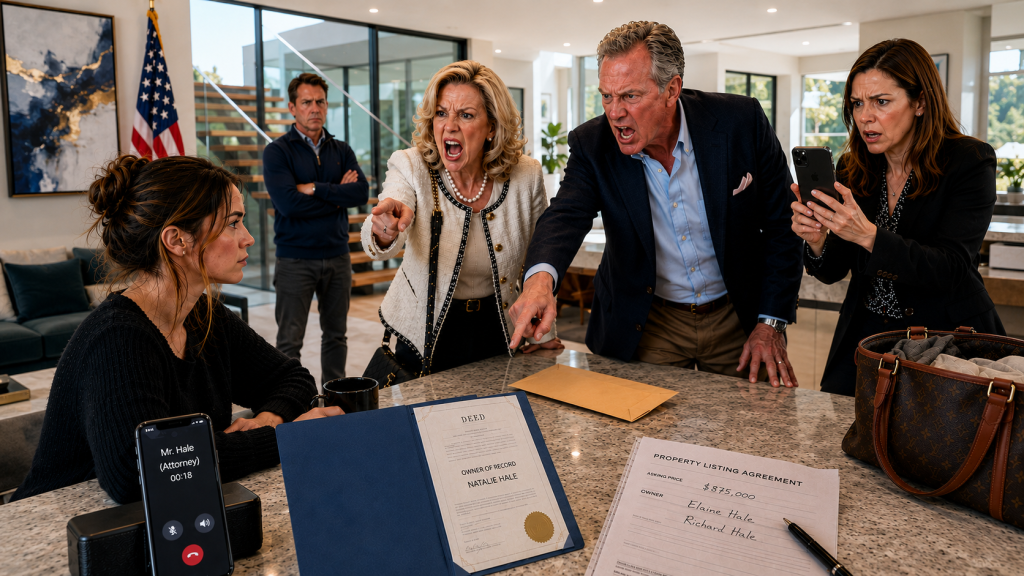
“That did not stop you from trying to make me homeless.”
“You would not have been homeless. We would have helped you find a flat.”
“A suitable flat,” I said. “Ms Brennan was very clear.”
Mom ignored the remark.
“You allowed us to live with this danger hanging over our heads.”
I felt something inside me settle.
For years, conversations with my parents had left me disoriented. They could take any action, no matter how selfish, and reshape it until they became the victims.
When Dad failed to attend my university graduation because of a golf trip, I was selfish for being disappointed.
When Mom announced Kevin’s engagement during my thirtieth birthday dinner, I was jealous for asking why she had not waited until the next day.
When they forgot Aunt Margaret’s final medical appointment, I was dramatic for leaving work to take her.
Now they had entered my home to remove me, yet I was cruel because they had discovered I possessed the legal right to protect myself.
“I did not create the danger,” I said. “You borrowed the money. You stopped paying. You ignored every notice.”
Dad looked at Mr. Hale’s name glowing on my phone screen.
“What notices?”
My attorney answered.
“Three letters were sent by certified mail. The first offered a revised payment plan. The second requested a meeting. The third notified you of formal default.”
Mom looked at Dad.
“I never saw those.”
He did not meet her eyes.
That was when I understood.
“You hid them from her.”
Dad’s jaw tightened.
“I handled our finances.”
Mom took a step toward him.
“Richard?”
“They were meaningless threats.”
“Did you sign for them?”
He said nothing.
Walter opened another document.
“I have copies of the delivery confirmations.”
Mom’s face drained of color.
“You told me the payments had been resolved.”
“They would have been if Natalie had behaved like family.”
I almost admired the speed with which he redirected blame.
Mom did not.
She slapped the counter with her palm.
“You said Margaret forgave the loan before she died.”
Dad turned toward her.
“She should have.”
“That is not what I asked.”
“This is not the time.”
“When were you planning to tell me?”
He lowered his voice.
“Elaine, calm down.”
Those were dangerous words to use with my mother.
Her anger shifted away from me and landed fully on him.
“You let me walk into this house and announce we were selling it.”
“You were the one who wanted to come.”
“Because you told me the property should have passed to us.”
“It should have.”
“You said Natalie had no legal standing.”
“I believed she would surrender if we applied pressure.”
The admission hung in the air.
Even Walter looked surprised by its bluntness.
I picked up my coffee.
It had gone cold.
Dad saw the expression on my face.
“Do not pretend you are innocent. You have been waiting for a chance to punish us.”
“No,” I said. “I have been waiting for you to decide what kind of people you wanted to be.”
Mom laughed bitterly.
“And now you believe you can judge us?”
“I do not need to judge you. Your actions are recorded.”
My phone vibrated again.
Kevin was calling.
I declined the call.
He immediately called a second time.
Then a third.
Dad pointed toward the phone.
“Answer your brother.”
“No.”
“He is worried about us.”
“He sent me a message telling me to leave my own home without asking a single question.”
“He trusted his parents.”
“So did I once.”
The words came out more quietly than I intended.
Mom’s anger flickered.
For half a second, I saw something else in her face.
Not guilt.
Perhaps memory.
Then the front door opened again.
Kevin entered without knocking.
He was wearing a navy suit, though his tie was loose and rain dotted his shoulders.
Behind him came his wife, Amanda.
Kevin stopped when he saw Walter and the documents covering the kitchen island.
“What is going on?”
Mom pointed at me.
“Your sister is threatening to take our house.”
Kevin stared.
“What?”
“I am not threatening anyone,” I said.
Dad spoke quickly.
“Margaret left Natalie an old loan agreement. She thinks it gives her ownership rights over our home.”
Kevin looked at me.
“Is that true?”
“She left me the debt your parents stopped paying.”
“They said the loan was forgiven.”
“It was not.”
Amanda stepped closer to the island.
Unlike Kevin, she did not immediately choose a side.
“May I see the document?”
Dad covered it with his hand.
“This does not involve you.”
Amanda’s expression cooled.
“I am your daughter-in-law, and Kevin is being asked to involve himself. That makes the facts relevant.”
Kevin sighed.
“Amanda, please.”
“No. Your mother called us fifteen minutes ago and said Natalie had tricked Aunt Margaret into changing her will. That is not what these papers appear to show.”
Mom glared at her.
“You have never understood how this family works.”
Amanda gave a small, humorless smile.
“I understand exactly how it works. That is usually the problem.”
Kevin rubbed his forehead.
He had always hated conflict, provided the conflict required him to question our parents.
When the easiest solution was asking me to sacrifice something, he became remarkably decisive.
“Natalie, what do you want?” he asked.
The question revealed everything.
Not what happened.
Not whether I was all right.
Not why our parents had entered my home.
What did I want, as if my greed were the central issue?
“I wanted to work this morning.”
He looked confused.
“What?”
“I was in my office reviewing software code. Mom and Dad arrived with a real-estate agent and ordered me to move out.”
Mom waved a hand.
“We believed the house was part of the family estate.”
“The deed has been in my name for eighteen months.”
“You never announced it.”
“I did not realize I was required to publish a newsletter.”
Kevin looked at the suitcase.
“Did you bring that out?”
“No. Mom did.”
Amanda’s eyes moved toward my mother.
“You actually told her to pack?”
“She has more space than she needs.”
“That is not an answer.”
Mom’s voice sharpened.
“She is alone. Your family needs room. This house has four bedrooms.”
Kevin looked suddenly uncomfortable.
I turned toward him.
“There it is.”
“What?”
“The real reason.”
He glanced at Mom.
“I did not know they were coming here today.”
“But you knew they wanted the house.”
He hesitated too long.
Amanda stared at him.
“Kevin?”
He loosened his tie further.
“Mom mentioned that the property might eventually be sold.”
“And?”
“She said they might help us with the proceeds.”
Amanda stepped back as if he had physically pushed her.
“You told me your promotion bonus would cover the down payment.”
“It will.”
“You were also expecting money from Natalie’s home?”
“No. I mean, not exactly.”
Mom interrupted.
“We were trying to help our son and grandchildren.”
“You have one grandchild,” I said. “And Kevin earns more than I do.”
“That is irrelevant.”
“No. It is the entire argument. You said I was financially struggling. You said I failed at life. Yet the person you planned to fund with the sale of my house earns a six-figure salary.”
Kevin looked at the floor.
Amanda folded her arms.
“How much were you expecting?”
“No amount was promised,” Kevin said.
Mom answered at the same time.
“Two hundred thousand dollars.”
Kevin closed his eyes.
Amanda let out a slow breath.
“Of course.”
“Amanda,” he said, “I can explain.”
“I am sure you can. You always can.”
She turned to me.
“I am sorry.”
Kevin looked offended.
“For what?”
“For arriving here without calling Natalie first. For believing your mother when she said there was an emergency.”
“There is an emergency,” Mom said.
Amanda nodded toward the documents.
“Yes. But Natalie did not create it.”
Dad struck the island with the flat of his hand.
“Enough. This family will not be divided by paperwork.”
Walter looked at him calmly.
“Paperwork did not divide your family, Richard. Your decisions did.”
Dad pointed toward the front door.
“You can leave.”
Walter did not move.
“Natalie invited me.”
“This is still our family.”
“And this is still her house.”
My father looked around the kitchen as if searching for something he could control.
His gaze landed on me.
“What will it take?”
I did not answer immediately.
That was the first honest question he had asked all morning.
“What do you mean?”
“What do you want in exchange for releasing the lien?”
Mom stared at him.
“You said the agreement was unenforceable.”
“I am exploring options.”
“You lied to me.”
“I was trying to protect you.”
“No. You were trying to protect yourself.”
Kevin stepped between them.
“Everyone needs to calm down.”
Amanda laughed once.
“Your father concealed a $420,000 default, your mother tried to steal your sister’s house, and your solution is that everyone should calm down.”
“No one tried to steal anything.”
I held up the property-listing agreement.
“They signed their names as owners.”
Kevin looked at the signatures.
His face reddened.
“Mom, what were you thinking?”
“That Natalie would cooperate.”
“With selling a house she owns?”
“We did not know she owned it.”
“You did not check.”
“She is our daughter.”
The sentence sounded weaker every time she used it.
Kevin looked at me.
“What are your legal options?”
Mr. Hale answered through the speaker.
“Natalie can demand immediate repayment of the outstanding principal, accrued interest, legal fees, and penalties. If payment is not made, she may initiate foreclosure according to the terms of the secured note.”
Mom gripped the edge of the island.
“How much?”
My attorney paused.
“As of this morning, $487,640.”
Amanda inhaled sharply.
Kevin stared at Dad.
“You owe nearly half a million dollars?”
Dad’s face hardened.
“The house is worth more than that.”
“That is not the point,” Kevin said.
“It is exactly the point. We have equity.”
“Then refinance and repay Natalie.”
Dad looked away.
Walter closed his folder.
“They cannot.”
Kevin turned toward him.
“Why?”
“Their current mortgage balance, home-equity line, and tax obligations leave insufficient borrowing capacity.”
Mom looked at Dad again.
“What home-equity line?”
No one spoke.
Her voice became quieter.
“Richard, what home-equity line?”
He reached for the back of a chair.
“It was necessary for the business.”
“You told me the business had recovered.”
“It has.”
“Then why did you borrow against the house?”
“Cash flow.”
“How much?”
“Elaine, this is not the place.”
“How much?”
Dad swallowed.
“Two hundred and sixty thousand.”
The room went still.
Mom sat down.
Not gracefully.
She simply lowered herself into the nearest chair as though her legs had stopped functioning.
Kevin’s voice was barely audible.
“You borrowed another $260,000 against the house?”
Dad’s anger returned because anger was easier than shame.
“I built that company for thirty years. Businesses require capital.”
“Is the company profitable?”
Dad did not answer.
Walter looked at me.
“This may be why the quarterly payments stopped.”
Mom pressed both hands against her temples.
“We own nothing.”
Dad turned on her.
“That is absurd.”
“The mortgage, Margaret’s loan, the credit line—how much is left?”
“The house has appreciated.”
“How much is left, Richard?”
He stared at the floor.
“Not enough.”
Mom began to cry.
I had seen my mother cry many times, but rarely from sadness.
She cried when a restaurant lost her reservation.
She cried when Kevin moved forty minutes away.
She cried when Aunt Margaret refused to change her will.
Her tears were often tools, released with precision.
These were different.
Her shoulders shook.
Her breathing became shallow.
She looked old.
For years, my mother had built her identity around appearances. The white Mercedes. The designer coats. The large house with the circular driveway. The charity lunches where her name appeared on printed programs.
She had called me a failure because I drove a seven-year-old car and worked from home.
She had no idea that I owned my car outright, had no personal debt, and had quietly invested most of my income.
She had mistaken restraint for poverty.
Now she was discovering that nearly everything she considered proof of success had been purchased with borrowed money.
Amanda brought her a glass of water.
Mom accepted it without speaking.
Kevin turned to me.
“You cannot foreclose on them.”
I studied his face.
There was fear there, but also expectation.
He still believed my role was to absorb the consequences.
“I have not said I would.”
“But you are considering it.”
“I am considering every option.”
“They are our parents.”
“They were my parents when they came here to remove me.”
“That was wrong.”
“Thank you.”
“But taking their home would also be wrong.”
Amanda looked at him.
“Do not do that.”
“Do what?”
“Turn Natalie’s response into the main offense.”
“I am trying to prevent the family from being destroyed.”
“The family did not become fragile when Natalie opened the envelope. It was already fragile when your parents decided her home belonged to them.”
Kevin’s face tightened.
“This is not your family.”
Amanda stared at him.
The sentence landed heavily.
He realized too late that he had repeated our father’s favorite tactic: dismiss the person who asked the wrong question.
She set down the water glass.
“You are right,” she said. “Perhaps I should remember that.”
“Amanda, I did not mean it that way.”
“You meant exactly what you said.”
She picked up her handbag and walked toward the front door.
Kevin followed her.
“Please don’t leave.”
“I am taking a taxi home.”
“We came together.”
“That was another mistake.”
The door closed behind her.
Kevin stood in the hallway for several seconds before returning.
He looked at me with helpless frustration.
“Are you happy now?”
The old version of me would have apologized.
I would have taken responsibility for the argument, his embarrassment, Amanda’s anger, my mother’s tears, and my father’s debt.
That was how our family survived.
Every mess was placed at my feet until I cleaned it.
But Aunt Margaret had taught me something during her final months.
A person could be kind without becoming available for destruction.
“No,” I said. “I am not happy. But I am also not responsible for what you just said to your wife.”
Kevin looked away.
Dad began gathering the papers.
“We are leaving.”
I placed my hand on the folder.
“The documents stay here.”
“They concern my house.”
“They are certified copies belonging to me.”
He released them.
Mom remained seated.
“What happens now?” she asked.
I looked toward my phone.
“Mr. Hale?”
My attorney answered.
“I recommend that all parties stop discussing substantive terms without separate legal counsel. Natalie, I will send written notice confirming that no one has authority to enter, list, photograph, or modify your property. Regarding the secured loan, you are not required to make a decision today.”
Dad scoffed.
“How generous.”
Mr. Hale ignored him.
“Natalie, document the condition of the house and save all messages. Ms Brennan’s statement will also be important.”
Mom wiped her face.
“Will you give us time?”
It was the first request she had made instead of an order.
“How much time?” I asked.
“I do not know.”
Dad looked at her.
“Do not beg.”
She turned on him.
“You have lost the right to tell me what to do.”
He flinched.
Mom stood and straightened her coat.
She looked at the suitcase in the hallway.
Slowly, she picked it up and returned it to the closet.
It was not an apology.
But it was the first object she had ever put back after using it to humiliate me.
At the front door, she paused.
“Did Margaret hate us?”
“No,” I said. “That was the problem. She loved you long after you stopped deserving her trust.”
Mom closed her eyes.
Then she left.
Dad followed without looking at me.
Kevin remained behind.
Rain ran down the glass panels beside the door, turning the driveway into a blur of white and grey.
“I did not know they planned to force you out,” he said.
“You knew they believed they could sell the house.”
“I thought it was legally theirs.”
“Did you ever ask?”
“No.”
“Why not?”
He looked exhausted.
“Because when Mom speaks with certainty, asking questions feels disloyal.”
I understood that better than he knew.
“But you had no difficulty questioning me.”
His expression tightened.
“You have always been stronger.”
“That is not a compliment when it means you expected me to tolerate more.”
He nodded slowly.
“I suppose it is not.”
His phone buzzed.
Amanda’s name appeared on the screen.
He stared at it without answering.
“Call your wife,” I said.
“What should I tell her?”
“The truth would be a new beginning.”
He gave me a tired smile.
Then he stepped outside and called her from the porch.
Walter stayed after everyone left.
He helped me collect the documents and place them back inside the blue folder.
The house felt different.
Not damaged.
Exposed.
Every room my mother had criticized now seemed to hold the echo of her voice.
Grey laminate.
Neutral paint.
One person does not need four bedrooms.
Walter walked to the stained-glass window above the staircase.
“Margaret chose this house because of that panel.”
“I know.”
“She said the blue glass reminded her of the ocean.”
“She told me it reminded her of freedom.”
Walter smiled.
“She may have changed the story depending on her mood.”
We stood in silence.
Then I asked the question that had been pressing against me since he arrived.
“Why did she leave me their debt?”
He turned from the window.
“She did not want you to use it against them.”
“That sounds like her.”
“She wanted you to have protection.”
“From what?”
“From exactly what happened today.”
He returned to the kitchen and opened his briefcase one more time.
Inside was a small cream envelope with my name written in Aunt Margaret’s handwriting.
My throat tightened.
“What is that?”
“She gave it to me three weeks before she died. She told me to deliver it only if your parents tried to interfere with the house or challenge your ownership.”
I took the envelope carefully.
The paper smelled faintly of cedar, like the drawers in her bedroom.
Inside was a handwritten letter.
My dear Natalie,
If Walter has given you this, then Richard and Elaine have mistaken your patience for weakness again.
I am sorry.
I spent too many years protecting them from consequences. I told myself I was preserving the family, but sometimes protecting people from consequences only teaches them that someone else will always pay.
This house is yours because you loved it before it had value. You repaired what others wanted to replace. You cared for me when I had nothing left to offer you except stories and difficult mornings.
The loan against your parents’ home is also yours, but I do not ask you to punish them.
I ask only that you never surrender your safety to preserve their comfort.
Choose what lets you sleep peacefully.
Love,
Margaret
I read the letter twice.
Then a third time.
Walter pretended to study the rain.
“I miss her,” I said.
“So do I.”
“She knew they would come.”
“She hoped they would not.”
I folded the letter along its original crease.
“What would you do?”
Walter shook his head.
“Margaret specifically told me not to answer that question.”
Despite everything, I laughed.
“That sounds like her.”
“She believed advice becomes control when given too strongly.”
“She never met my mother.”
“Oh, she knew your mother very well.”
After Walter left, I locked the door and walked through every room.
I photographed the restored wallpaper.
The oak floors.
The brass fixtures.
The built-in shelves.
Not because I feared my parents would return with hammers and buckets of grey paint.
At least, not entirely.
I photographed them because I needed to remember that preservation was work.
A home did not remain beautiful by accident.
Neither did a life.
That evening, Kevin sent me a message.
Amanda agreed to speak with him, but only if he attended counseling with her.
He added that he had told our parents he would not accept money from the sale of my property.
I did not respond immediately.
Then another message arrived.
I am sorry I told you to cooperate before asking what happened. I have done that to you for years.
I stared at the words.
They were imperfect.
Late.
But honest.
I replied.
Thank you for saying it.
My mother did not contact me for four days.
Dad sent three emails.
The first accused me of elder financial abuse, though he was sixty-three and still worked full-time.
The second offered to repay $150,000 if I forgave the remainder.
The third threatened to expose me to the extended family as vindictive.
Mr. Hale responded to each message with increasingly brief legal language.
On the fifth day, Mom called.
Her voice sounded different.
“Your father moved into a hotel.”
I sat at my desk overlooking the garden.
“I am sorry.”
“No, you are not.”
“I am sorry you are hurting. That is not the same as pretending he did nothing wrong.”
She was silent.
Then she said, “I found the statements.”
“What statements?”
“Business accounts. Credit cards. Loans.”
My hand tightened around the phone.
“How bad is it?”
“Worse than he admitted.”
Dad had used company funds to maintain their lifestyle after the business began failing.
He had paid personal expenses from corporate accounts, then covered shortages with credit lines.
He had borrowed against the house.
He had also borrowed $80,000 from Kevin three years earlier and told him it was a temporary investment in inventory.
Kevin had never received repayment.
“Did you know?” Mom asked.
“No.”
“Margaret probably knew.”
“Maybe.”
“She always looked at him as if she could see through his shirt.”
“That was one of her talents.”
Mom did not laugh.
“I need to ask you something.”
I waited.
“Can I stay in the house?”
The question startled me.
“What house?”
“Your house.”
I looked around my office.
“For how long?”
“A few weeks. Until I understand what is happening.”
Every instinct I had developed during childhood told me to say yes.
My mother was distressed.
She was alone.
She needed help.
Then I remembered the suitcase striking the hallway floor.
“No,” I said.
She inhaled sharply.
“You have four bedrooms.”
“And you tried to remove me from all of them.”
“I made a mistake.”
“You made a plan. You hired an agent. You signed a false listing agreement. You told Kevin before you arrived. That is more than a mistake.”
“So you will leave your mother without a home?”
“You are not without a home. You are currently living in your house.”
“A house you may take.”
“I have not made that decision.”
“What am I supposed to do?”
“Hire an attorney. Meet with a financial adviser. Determine what assets remain. Those are the steps Mr. Hale recommended.”
“I thought you might show compassion.”
“I am showing restraint.”
She ended the call.
I cried afterward.
Not because I regretted saying no.
Because saying no still felt like tearing something inside myself.
People who grow up in controlling families often imagine boundaries will feel powerful.
Sometimes they do.
Other times they feel like grief.
Two weeks later, my parents hired separate attorneys.
Dad moved from the hotel into a furnished apartment.
Mom remained in the house.
The company entered a formal restructuring process.
Its accounts were reviewed.
Several expenses were questioned.
Dad insisted everything had been legal, but his attorney advised him to stop communicating directly with me.
The silence was a relief.
Then Mr. Hale called with an update.
My parents’ attorneys had proposed selling their house voluntarily.
After paying the mortgage, credit line, taxes, commissions, and my secured claim, little would remain.
“How little?” I asked.
“Possibly less than $40,000.”
The number felt unreal.
Their home had once been worth nearly $1.2 million.
They had used almost all of it to support the appearance of wealth.
“What happens to Mom?”
“That depends on what arrangement they reach in their separation.”
“Separation?”
“Her attorney indicated she intends to file for divorce.”
I leaned back in my chair.
Despite years of resentment, I could not celebrate.
Their marriage had lasted thirty-nine years.
It had survived because each of them reinforced the other’s certainty.
Dad provided money and authority.
Mom provided admiration and social polish.
Now the money was gone, and authority had become evidence.
A week later, Mom asked to meet me at Aunt Margaret’s favorite café.
I nearly declined.
Then I remembered the letter.
Choose what lets you sleep peacefully.
I agreed.
Mom arrived early.
She wore a plain navy coat I had never seen before.
No jewelry except her wedding ring.
She looked around the café with visible discomfort. Aunt Margaret had loved the place because the tables were mismatched and the owner knew everyone’s name.
Mom had always called it shabby.
We sat near the window.
She ordered tea.
I ordered coffee.
For several minutes, neither of us spoke.
Then she placed a small velvet box on the table.
Inside was Aunt Margaret’s pearl brooch.
“She gave this to me when I married your father,” Mom said. “I should not have kept it.”
“She gave it to you.”
“I sold several things this week.”
I looked at her.
“Jewelry?”
“Handbags. Two watches. Some furniture.”
“That must have been difficult.”
“It was humiliating.”
“At least you are honest.”
Her mouth tightened, but she did not attack.
“I owe you an apology.”
I waited.
She looked down at her tea.
“I should not have entered your home that way.”
“That is true.”
“I should not have insulted your work.”
I said nothing.
“And I should not have assumed that because you were unmarried, your life was somehow incomplete.”
That sentence cost her the most.
I could hear it.
She folded and unfolded her napkin.
“I thought you were wasting your life.”
“Because I did not live like you.”
“Because you did not seem to want the things I wanted for you.”
“I wanted a peaceful home. Meaningful work. Financial independence. People I could trust.”
Her eyes lifted.
“You have those things.”
“Yes.”
“And I called you a failure.”
“Yes.”
She looked toward the window.
“I do not know how to apologize for all of it.”
“Start without asking me to erase the consequences.”
She nodded slowly.
“Your attorney said you may agree to accept less than the full loan amount.”
“Mr. Hale should not discuss my decisions with you.”
“He did not. My lawyer said it was one possible outcome.”
“What are you asking?”
Mom’s eyes filled with tears, but she kept her voice steady.
“I am asking whether you would allow the house to be sold rather than foreclosed.”
“That was always my preference.”
Relief crossed her face.
“But,” I continued, “the sale must be handled professionally. No hidden transfers. No money moved to relatives. No attempt to reduce my claim while paying other personal debts.”
“What about Kevin?”
“If Dad owes Kevin money, Kevin can seek legal advice.”
“He has refused to file a claim.”
“That is his decision.”
Mom touched the pearl brooch.
“Will you take this?”
“No.”
“It belongs to your aunt.”
“She gave it to you. Keep one thing that reminds you of who she was before everything became about money.”
Mom closed the box.
We stayed at the café for nearly an hour.
She told me about the accounts she had discovered.
I told her which financial adviser Walter recommended.
We did not hug when we left.
We were not repaired.
But for the first time in my life, we had spoken as two adults rather than a ruler and a disappointing subject.
The house sold three months later.
The final price was $1,090,000.
After the mortgage, home-equity line, taxes, commissions, and legal costs, my secured claim was paid in full.
There was less than $30,000 left for my parents to divide.
Dad blamed everyone.
The bank.
The market.
Aunt Margaret.
My mother.
Me.
Eventually, Kevin stopped answering his calls.
The business was sold to a competitor for enough to satisfy most corporate creditors but not enough to restore Dad’s lifestyle.
He moved into a modest apartment outside the city.
For several months, he sent me articles about forgiveness.
None included an apology.
I did not respond.
Mom rented a one-bedroom flat near the community college.
The first time I visited, I noticed that she had placed Aunt Margaret’s pearl brooch in a small frame beside the window.
Her furniture was simple.
Her kitchen was narrow.
She had no formal dining room.
“I thought I would hate it,” she admitted.
“Do you?”
“Sometimes.”
She looked around.
“But I sleep better.”
She had started working part-time at a local interior-design shop.
The woman who once said renters had failed at life now helped renters choose curtains, lamps, and removable wallpaper.
Life did not punish her with cruelty.
It educated her with irony.
Kevin and Amanda entered marriage counseling.
They sold their oversized home and bought a smaller one without assistance from our parents.
Kevin repaid the $80,000 Dad had borrowed from him by accepting the loss as an expensive lesson.
He became slower to react when Mom called with a crisis.
He started asking questions.
Our relationship remained cautious, but it became real.
One Sunday afternoon, he brought his daughter, Sophie, to my house.
She ran through the wildflower garden and stopped beneath the porch.
“Grandma says this house used to belong to Aunt Margaret.”
“It did.”
“And now it belongs to you.”
“Yes.”
“Will it belong to me someday?”
Kevin looked horrified.
“Sophie!”
I laughed.
“Maybe. But you will have to promise not to cover the floors with grey laminate.”
She looked through the doorway at the oak boards.
“Grey would be ugly.”
“You may be worthy after all.”
We spent the afternoon baking muffins in Aunt Margaret’s kitchen.
Sophie spilled flour across the island where my mother had once placed the fraudulent listing agreement.
I did not rush to clean it.
Some messes were evidence of life rather than danger.
A year after that morning, Mom asked whether she could visit on Aunt Margaret’s birthday.
I agreed.
She arrived alone, carrying a small wildflower plant.
“I thought we could put it near the lavender,” she said.
We walked into the garden.
The afternoon was warm, and the restored stained glass cast blue and gold shapes across the hallway floor behind us.
Mom knelt in the soil, though she was wearing trousers she probably considered too expensive for gardening.
I handed her a small shovel.
For a while, we worked without speaking.
Then she said, “I was jealous of her.”
I knew who she meant.
“Why?”
“She accepted you without needing you to reflect well on her.”
The honesty made me stop digging.
Mom pressed soil around the plant.
“I thought being your mother meant your choices were evidence of whether I had succeeded.”
“That sounds exhausting.”
“It was. For both of us.”
She sat back on her heels.
“I cannot undo the way I treated you.”
“No.”
“But I am trying to understand it.”
“That matters.”
She looked toward the house.
“When I walked in that morning, I truly believed I was rescuing a family asset from someone who did not appreciate its value.”
“I restored the entire house.”
“I know.”
“You watched Ms Brennan criticize everything.”
“I know.”
“And you still believed I did not appreciate it.”
Mom’s eyes filled.
“I did not see the house. I saw something I could use.”
The sentence settled between us.
It was the closest she had ever come to explaining our relationship.
For much of my life, she had not seen me.
She had seen a daughter-shaped resource.
Someone who could obey, sacrifice, surrender, apologize, and absorb whatever the family needed.
Aunt Margaret had left me more than property.
She had left me proof that love did not require self-erasure.
We planted the wildflower beside the lavender.
Mom washed her hands in the kitchen sink.
Before leaving, she paused beside the concealed compartment in the bookcase.
“Do you still keep the documents there?”
“No.”
“Where are they?”
“In a bank deposit box.”
She gave a faint smile.
“Good.”
At the door, she turned back.
“I am glad you did not let us sell the house.”
“So am I.”
“No. I mean I am glad you stopped us.”
That was different.
I understood what it cost her to say it.
After she left, I walked upstairs to Aunt Margaret’s old bedroom.
I had kept the room mostly unchanged.
Her reading chair remained near the window.
The quilt she loved was folded across the bed.
On the dresser stood a photograph of us taken during my university graduation.
My parents were not in the picture.
They had already left for Kevin’s dinner.
Aunt Margaret stood beside me, one hand on my shoulder, smiling as if my degree mattered.
I opened the drawer where I kept her letter.
The paper had softened along the folds.
I read the final sentence again.
Choose what lets you sleep peacefully.
For years, I thought peace came from avoiding conflict.
I believed that if I stayed quiet, remained useful, expected little, and forgave quickly, the family would remain intact.
But peace built on surrender is not peace.
It is merely silence in a room where your needs have been removed.
The morning my parents entered my house, they believed ownership belonged to whoever spoke with the greatest confidence.
They believed family authority outweighed legal records.
They believed my quiet life was evidence of weakness.
They were wrong.
The deed carried my name.
The loan carried their signatures.
And for once, the truth did not bend simply because they were uncomfortable with it.
I returned the letter to the drawer and walked downstairs.
Evening light moved across the original wooden floors.
The restored wallpaper glowed softly in the hallway.
Outside, the new wildflower stood beside the lavender, its leaves trembling in the breeze.
The house was quiet.
Not the frightened quiet of my childhood.
Not the quiet that followed my father’s anger or my mother’s disappointment.
This quiet belonged to me.
It was the sound of rooms no one could enter without permission.
The sound of a life no one else could list for sale.
The sound of finally understanding that protecting myself was not betrayal.
It was inheritance.
THE END! THANK YOU FOR READING!