

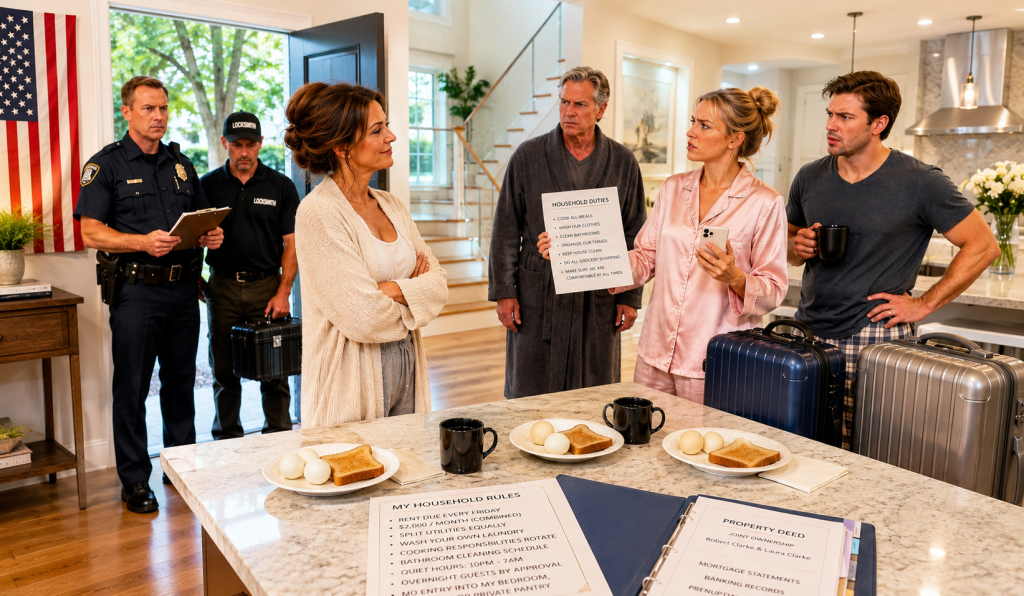
The officer stepped inside only after I invited him, his calm expression contrasting sharply with the panic spreading across Robert’s face.
“Ma’am,” he said, holding up the paperwork, “you requested a civil standby while a locksmith secured the portions of the property you legally occupy. We’re here to keep the peace.”
Madison spun toward her father.
“You called the police on us?”
Robert opened his mouth, but no words came.
I answered instead.
“No. I called because I refuse to let anyone intimidate me inside my own home.”
The locksmith quietly measured the hallway door leading to my office before unpacking fresh locks from his metal toolbox.
Evan whispered, “This is getting out of hand.”
“It didn’t have to,” I replied. “It became necessary the moment you arrived expecting servants instead of respect.”
Madison grabbed the property documents from the kitchen island, scanning them with growing disbelief. Every signature, every payment record, and every legal clause confirmed exactly what I had said.
She looked at Robert again, searching for an explanation, but he simply lowered his eyes.
Then her phone buzzed.
She read the message once, frowned deeply, and slowly looked back at me.
“How do you know my landlord?” she asked.
Robert’s expression turned pale enough to make my next words almost unnecessary.
“I don’t know your landlord personally,” I said. “But his number was printed on the eviction notice sticking out of your suitcase.”
Madison instinctively looked toward the two oversized suitcases sitting beside the staircase.
One of them had a side pocket that would not close properly. A folded sheet of paper protruded from it, displaying the name of an apartment complex and the words FINAL NOTICE in large red letters.
“I wasn’t snooping,” I continued. “You left the document in plain sight when you dropped your luggage in my hallway.”
Madison crushed the paper in her fist.
“That is none of your business.”
“It became my business when you arrived at eleven o’clock at night and announced that you were moving into my home permanently.”
“We were going to explain,” Evan said.
“No,” I replied. “You were going to settle into the guest room, hand me a list of chores, and hope I never asked questions.”
The officer remained near the entrance, silent but attentive. His presence forced everyone to lower their voices, although Madison’s anger still filled the room.
She turned to Robert.
“You told me she knew.”
Robert tightened the belt of his robe.
“I said Laura would understand.”
“That isn’t what you said,” Madison snapped. “You said this house would eventually be yours anyway.”
The kitchen went completely still.
Even the locksmith paused.
Robert looked at his daughter with an expression of pure warning.
“Madison.”
“What?” she demanded. “It’s true. You said Laura was getting older and wouldn’t want to maintain a house this large forever. You said once she agreed to move somewhere smaller, we could take over this place.”
I stared at my husband.
He did not deny it.
For a few seconds, I felt as though I had stepped outside my body and was watching someone else’s marriage collapse from across the room.
Robert and I had been together for eleven years.
We met when I was fifty-four and he was fifty-eight, both of us old enough to believe we had finished making foolish decisions about love.
I had spent most of my adult life working as a financial administrator for a regional hospital network. My first marriage ended quietly when my former husband decided that forty-five was the perfect age to begin a new life with a twenty-nine-year-old fitness instructor.
I did not fight over furniture or photographs. I sold the house, purchased a modest condo, rebuilt my savings, and taught myself how to enjoy being alone.
Robert arrived in my life four years later.
He was charming without being loud, attentive without seeming desperate, and confident in the gentle way that often attracts women who have grown tired of dramatic men.
He brought flowers on ordinary Tuesdays.
He remembered how I took my coffee.
He listened when I spoke about work.
When he proposed, he told me that we were not two incomplete people searching for someone to rescue us.
“We’re two whole people,” he said, “choosing to make the rest of life better together.”
I believed him.
Now I stood in the kitchen we had designed together, listening to his daughter explain how he planned to remove me from it.
The officer cleared his throat.
“Mrs. Clarke, do you want these individuals removed from the property?”
Robert looked at me sharply.
“Laura, be reasonable.”
I held his gaze.
It was the first time that morning he had been brave enough to look directly at me.
“I am being reasonable,” I said. “That is why I am giving them a choice.”
I turned to Madison and Evan.
“You may sign the temporary occupancy agreement, pay the first week’s rent, and follow the rules. Or you may leave.”
Madison stared at me.
“You called the police and a locksmith, but you still expect us to stay?”
“I don’t expect anything from you. I am offering terms because Robert invited you without consulting me, and because I understand that losing your apartment must be frightening.”
“We didn’t lose it,” Evan muttered.
I looked at him.
“Then why are you here?”
His mouth closed.
Madison’s face flushed.
“Our landlord is impossible. He kept demanding payments while repairs weren’t being completed.”
I glanced at the notice in her hand.
“Were you paying rent?”
“That isn’t the point.”
“It is usually the main point in an eviction.”
Robert stepped forward.
“They fell behind temporarily. Evan’s business has been struggling, and Madison had some unexpected expenses.”
“What business?” I asked.
Evan shifted his weight.
“I do online investment consulting.”
“You sell trading courses on social media,” Madison corrected bitterly.
He looked at her.
“You didn’t complain when the money was coming in.”
“I didn’t know you weren’t saving anything.”
Robert raised both hands.
“This conversation is not helping.”
I almost laughed.
For years, Robert had described Madison as independent and successful. She worked in luxury event planning, traveled frequently, and posted photographs from restaurants where a single dinner probably cost more than my weekly grocery budget.
Evan presented himself as an entrepreneur. He wore expensive watches, leased imported cars, and spent every family gathering discussing financial freedom.
Apparently, their freedom had been financed by unpaid rent and Robert’s promises.
“How far behind are you?” I asked.
Madison said nothing.
Evan stared at the floor.
Robert answered.
“Four months.”
“At what monthly rate?”
“Three thousand two hundred.”
I calculated the amount automatically.
“Twelve thousand eight hundred dollars, not including late fees.”
Madison dropped the eviction notice on the island.
“You don’t have to sound so pleased.”
“I am not pleased. I am trying to understand why two employed adults with expensive clothing, recent vacations, and leased vehicles failed to pay their housing expenses.”
Her eyes hardened.
“You’ve always looked down on me.”
“That is not true.”
“You think because you worked in a hospital office for thirty years, you understand everyone’s finances.”
“I understand that shelter should generally be paid for before designer handbags.”
She looked down at the handbag sitting on one of my dining chairs.
It probably cost more than my first car.
Robert’s tone became sharp.
“That’s enough, Laura.”
“No,” I said. “It isn’t.”
The officer looked between us.
“Are they leaving or staying?”
Madison grabbed the pen beside the occupancy agreement.
“Fine.”
She signed her name with an angry stroke and shoved the pen toward Evan.
He hesitated.
“Two thousand dollars a month is ridiculous for one bedroom.”
“You are not renting one bedroom,” I replied. “You are using the kitchen, laundry room, living room, driveway, utilities, internet service, and every other shared space. The amount is still considerably less than your previous rent.”
Evan signed.
Then he looked at Robert.
“You said we wouldn’t have to pay anything.”
Robert rubbed his forehead.
“We’ll discuss it later.”
“No,” I said. “You will discuss it now.”
I removed another document from the folder.
It was a printout of our joint household account.
Three transfers had been made during the previous six months.
Each was sent to Madison.
The first was $4,000.
The second was $6,500.
The third, made eight days earlier, was $10,000.
Robert’s name appeared beside every transaction.
My hands had trembled when I discovered them during the night.
The joint account was intended for mortgage payments, insurance, utilities, and major repairs. Robert and I each contributed to it monthly.
He had taken more than $20,000 without telling me.
I slid the records toward him.
“Would you like to explain these?”
Madison looked down.
Evan swore quietly.
Robert picked up the pages, though he clearly knew what they contained.
“I was helping my daughter.”
“With my money.”
“Half of that account belongs to me.”
“Half does. The rest does not.”
“I planned to replace it.”
“When?”
“Once Evan’s business recovered.”
Evan looked offended.
“Why is everyone acting like I’m a criminal?”
“No one called you a criminal,” I replied. “But I am beginning to understand why your landlord stopped accepting promises.”
Madison moved closer to her father.
“You told me the money came from your savings.”
Robert’s shoulders sagged.
“It did, in a way.”
“No,” I said. “It came from the account that pays for this house.”
The locksmith finished installing the new lock on my office door and handed me two keys.
“I’ll move to the pantry next,” he said.
Madison stared at him.
“You’re actually locking food away from us?”
“I am locking away my private records, valuable property, medication, and personal supplies.”
“Food is included in personal supplies?”
“Anything I purchase for myself is included.”
She laughed bitterly.
“What kind of family behaves like this?”
“The kind forced to establish boundaries after being presented with a servant’s schedule.”
The officer stepped outside with the locksmith while he retrieved another tool from his vehicle.
Their brief absence allowed Robert’s composure to break.
He moved close to me and lowered his voice.
“You are humiliating me in front of my daughter.”
I looked at the man I had slept beside for more than a decade.
“You humiliated yourself.”
“I made a mistake.”
“You secretly removed $20,500 from our joint account.”
“I was trying to keep Madison from becoming homeless.”
“You could have told me.”
“You would have said no.”
“Then you already knew it was wrong.”
His face tightened.
“She is my daughter.”
“And I am your wife.”
“You don’t understand what it means to have a child.”
The words struck harder than he intended.
Robert knew I had once wanted children.
He knew about the two miscarriages during my first marriage and the emergency surgery that ended any possibility of carrying a child.
He had held my hand years earlier while I told him that story.
Now he used it as a weapon because I had challenged him.
Madison looked away.
Even she seemed uncomfortable.
I felt something inside me become very quiet.
“You’re right,” I said. “I don’t know what it means to have a child.”
Robert’s expression softened slightly, as though he believed I was surrendering.
“But I know what it means to have a partner,” I continued. “And apparently, you do not.”
I returned to the island and gathered the account records.
“Beginning today, my income will be deposited into an individual account. I will transfer only my agreed share of household expenses into the joint account. The bank has already been instructed to require both signatures for withdrawals over $1,000.”
Robert stared at me.
“You changed our banking arrangement without discussing it?”
I looked at him in disbelief.
“You stole from the account without discussing it.”
“I did not steal.”
“You took money that belonged partly to me and concealed where it went. Choose whatever word helps you sleep.”
The officer and locksmith returned.
The pantry lock was replaced next.
Then the lock on my bedroom door.
Robert watched every turn of the screwdriver as though the locksmith were dismantling our marriage one piece at a time.
When the work was finished, I paid the locksmith from my personal account.
The officer asked whether I wanted to make a formal report regarding the money transfers.
“Not today,” I said.
Robert exhaled with visible relief.
I noticed.
“So there’s still a chance you might?” he asked after the officer left.
“That depends on what happens next.”
Madison pushed away from the island.
“I’m going upstairs.”
“Before you do,” I said, “your first week’s rent is due.”
She turned slowly.
“You cannot be serious.”
“I told you the terms before you signed.”
“We don’t have five hundred dollars.”
“Then you should not have signed.”
Robert reached for his phone.
“I’ll pay it.”
“No,” I said immediately.
Madison glared at me.
“Why does it matter where it comes from?”
“Because if your father pays your rent, he will be using household money to pretend you are following the agreement.”
“I have my own account,” Robert said.
“Then you may spend your personal money however you choose, after you return the amount you took from our joint account.”
His jaw tightened.
“You cannot dictate how I use my money.”
“I’m not. I am dictating how much you owe me.”
Evan opened his banking application.
“I have three hundred and twelve dollars.”
Madison looked at him.
“That’s all?”
“You said you were handling our remaining cash.”
“I paid the moving company.”
“You told me your father paid them.”
Robert closed his eyes.
I watched the three of them discover, in real time, that every person in their little arrangement had been lying to the others.
Madison had hidden expenses from Evan.
Evan had exaggerated his available funds.
Robert had stolen from our account and misrepresented ownership of the house.
And all three had expected me to absorb the consequences.
I took the unsigned chore list Madison had handed me the night before and tore it neatly in half.
“Here is what will happen,” I said. “You have until five this afternoon to pay the first week’s rent. Until then, your suitcases remain downstairs. You are not moving into the guest room before payment is made.”
“You expect us to sit in the hallway?” Evan asked.
“You may sit in the living room.”
Madison gave a short, disbelieving laugh.
“Dad, do something.”
Robert looked from his daughter to me.
I waited.
This was the moment he could have admitted what he had done, apologized sincerely, and begun repairing the damage.
Instead, he said, “Laura, let them settle in. We can work out the financial details later.”
I nodded once.
Then I picked up my phone and called the locksmith, who had not yet left the driveway.
“Please return,” I said. “There is one additional lock I need changed.”
Robert frowned.
“Which one?”
“The side entrance to the garage.”
His face changed immediately.
That was when I knew there was more.
The garage had always been Robert’s space.
He kept tools there, stored golf equipment in a locked cabinet, and spent hours restoring an old motorcycle he claimed he intended to sell.
I rarely entered unless I needed gardening supplies.
“What’s in the garage?” I asked.
“Nothing.”
“You reacted very strongly for a room containing nothing.”
“It’s my workshop.”
“It is part of our jointly owned property.”
Madison looked nervous now.
“Dad?”
Robert ignored her.
“Laura, leave the garage alone.”
I held up my phone.
“Then I will ask the officer to return.”
“You are being paranoid.”
“Perhaps. But paranoia occasionally becomes useful when your husband secretly removes thousands of dollars from a shared account and promises your home to his daughter.”
The locksmith came back through the front door.
Robert blocked the hallway leading toward the garage.
“I don’t authorize you to change that lock.”
The locksmith stopped.
I held up a copy of the deed.
“I am a legal owner of the property, and I authorize it.”
“You cannot enter a locked cabinet belonging to him,” the locksmith said carefully. “But you may secure an exterior entrance to jointly owned property.”
Robert’s anger rose.
“This is absurd.”
“Then open the garage yourself,” I said.
He remained still.
That was answer enough.
I walked around him.
He grabbed my arm.
The moment his fingers closed around me, Madison gasped.
Evan stepped backward.
The locksmith immediately reached for his phone.
“Take your hand off me,” I said.
Robert released me.
He had never touched me in anger before.
He looked shocked by his own action.
“I’m sorry,” he whispered.
I continued toward the garage.
He followed.
“Laura, please.”
The garage smelled of motor oil, dust, and cold concrete. Robert’s motorcycle sat under a gray cover. Boxes lined the shelves. His locked metal cabinet stood against the far wall.
Nothing appeared unusual.
Then I noticed the fresh tire marks.
A rectangular section of dust near the garage door had been disturbed recently, as though something large had been parked there and removed.
“What was here?”
Robert said nothing.
Madison appeared behind him.
“The Mercedes.”
I turned.
“Our Mercedes is in the driveway.”
“Not yours,” she said. “Mine.”
Robert looked at her with fury.
“You told me it was being repaired.”
“It was here last weekend,” Madison continued. “Dad said he bought it at an auction and was having the paperwork transferred.”
Evan stared at her.
“You have another car?”
Madison’s expression changed.
Apparently, that was another secret.
Robert sat heavily on a workbench.
I felt almost too tired to remain angry.
“What car did you buy?”
“A used Mercedes SUV.”
“How much?”
He looked down.
“Twenty-eight thousand.”
“With what money?”
“I took a loan.”
“Against what?”
Silence.
I walked to the metal cabinet.
“Open it.”
“No.”
“Open it, or I call an attorney and report every unexplained transaction before lunch.”
His hands shook as he removed a key from his robe pocket.
Inside the cabinet were folders, vehicle documents, loan agreements, and a second cell phone.
I picked up the first folder.
The loan was secured against Robert’s investment account, not the house.
That should have brought relief.
It did not.
The vehicle title listed Madison as the owner.
Robert had purchased a $28,000 SUV for his daughter while secretly taking money from our shared account to cover her rent.
Madison stepped forward.
“You said it was a gift.”
“It was supposed to be.”
“Where is it now?”
Robert looked at Evan.
Evan’s face drained of color.
“What?” Madison demanded.
Evan backed toward the door.
“I sold it.”
For several seconds, nobody spoke.
Madison stared at her husband.
“You did what?”
“I needed capital.”
“For your business?”
“Yes.”
“You sold my car?”
“It was sitting here. You didn’t even know about it yet.”
“That doesn’t make it yours.”
“I was going to replace the money after the next launch.”
I almost admired the consistency of their language.
Every stolen dollar was going to be replaced later.
Every unpaid bill was temporary.
Every deception was supposedly committed for someone else’s benefit.
Robert stood.
“How did you get the title?”
Evan looked toward Madison.
She slowly covered her mouth.
“You gave him the garage code,” Robert said.
Madison shook her head.
“I thought he was picking up some boxes.”
Evan raised his voice.
“We needed money. Your father’s transfers weren’t enough, and the landlord was threatening court.”
“Where is the money from the sale?” I asked.
He looked down.
“Gone.”
Madison slapped him.
The sound cracked through the garage.
Evan held his cheek.
“Don’t touch me.”
“You sold a car my father bought for me!”
“With money he stole from his wife!”
Robert stepped between them.
“Stop it.”
I stood beside the cabinet, holding the loan papers.
The ridiculousness of the situation nearly overwhelmed me.
They were fighting over property purchased through lies, sold through lies, and lost through further lies.
I suddenly understood that the chore list had never really been about laundry or breakfast.
It represented an entire system.
Madison believed other people existed to protect her from consequences.
Evan believed every possession around him could be converted into money for his next scheme.
Robert believed love meant rescuing his daughter no matter who else he betrayed.
And I had been assigned the role of silent provider.
I placed the loan documents on the workbench.
“All of you need to leave.”
Robert looked at me.
“Laura.”
“I am no longer offering temporary occupancy.”
Madison’s eyes widened.
“We signed an agreement.”
“The agreement requires payment. You have not paid.”
“You gave us until five.”
“I am withdrawing the offer because stolen property was stored and removed from this home. I will not expose myself to further legal risk.”
Evan pointed at Robert.
“It wasn’t stolen from you.”
“The vehicle was purchased by him and titled to Madison. You admit you sold it without permission. That is not a disagreement I want attached to my address.”
Madison picked up her phone.
“I’m calling the police.”
“Please do.”
Evan grabbed her wrist.
“Don’t.”
She pulled away.
“Why not?”
“Because the buyer paid cash.”
Robert’s face hardened.
“What buyer?”
“A man I know.”
“What man?”
Evan would not answer.
I dialed the officer’s number from the card he had given me.
Evan rushed out of the garage before I finished the call.
Madison followed, screaming his name.
We heard the front door slam.
A moment later, their car started in the driveway.
Madison ran outside, but Evan reversed too quickly for her to reach him.
He disappeared down the street, leaving his wife standing barefoot on the pavement in silk pyjamas.
Robert moved to follow her.
I stopped him.
“Before you comfort her, decide whether you plan to tell the police the truth.”
He looked at me.
“You want my daughter’s husband arrested?”
“I want you to stop asking me to carry the moral responsibility for choices made by other adults.”
“She’ll be devastated.”
“She is already devastated.”
“She could lose her marriage.”
“She may have already lost it.”
“You’re enjoying this.”
The accusation was so unfair that I almost responded with anger.
Instead, I looked around the garage.
At the empty space where the SUV had been.
At the loan documents.
At the hidden phone.
At the cabinet containing secrets my husband had protected more carefully than our marriage.
“No,” I said. “I am grieving.”
Robert’s anger disappeared.
I walked back into the house.
Madison was sitting on the bottom stair, crying into her hands.
For one brief moment, I did not see the arrogant woman who had handed me a chore list.
I saw a frightened daughter whose father had spent years teaching her that someone would always clean up the damage.
I brought her a box of tissues.
She accepted it without looking at me.
“Did you know?” she asked.
“Know what?”
“That Evan was taking money.”
“No.”
“He said his company was about to become profitable.”
“Perhaps he believed it.”
“He sold my jewelry last year.”
I sat in the chair across from her.
“You stayed?”
“He said it was temporary.”
There was that word again.
She wiped her face.
“He always replaced things. Or Dad did.”
I looked toward the garage.
“Your father knew?”
“Not everything.”
“How much has Robert given you over the years?”
She hesitated.
“I don’t know.”
“Estimate.”
“Maybe fifty thousand.”
My stomach tightened.
“During our marriage?”
She nodded.
“Dad said it came from his retirement money.”
Some of it probably had.
Some clearly had not.
“Why did you believe you could move into this house without speaking to me?”
Her expression hardened defensively.
“Dad said you wouldn’t mind.”
“You handed me a schedule requiring me to serve you.”
“That was mostly a joke.”
“It contained specific times for washing your clothes.”
She looked embarrassed.
“Evan wrote it.”
“You handed it to me.”
“He said we needed to establish expectations.”
“And you agreed?”
She twisted the tissue between her fingers.
“I thought you liked taking care of the house.”
“I like caring for my home. That is different from being ordered to care for capable adults.”
Her eyes filled again.
“I didn’t know what else to do.”
“You could have asked for help honestly.”
“You would have judged me.”
“I am judging the deception. I might have responded differently to the truth.”
Robert entered.
“The officer is returning.”
Madison stood quickly.
“Dad, you can’t report Evan.”
“He sold the car.”
“You weren’t supposed to buy it.”
“I bought it for you.”
“With money you didn’t have.”
Robert looked wounded.
“I was trying to help.”
She laughed through her tears.
“You always say that.”
The sentence struck him more effectively than anything I had said.
“You tell me everything is handled,” she continued. “Then it gets worse. You pay one bill, so I ignore the next one. You send money, so Evan launches another business. You promise I can live here, so I don’t find another apartment.”
“I didn’t want you to feel alone.”
“You didn’t want me to be angry with you.”
Robert stared at her.
Madison’s voice dropped.
“Mom made me face consequences. You always made them disappear.”
Robert’s first wife, Caroline, had died fifteen years earlier after a long illness.
According to Robert, she had been overly strict with Madison.
For years, I had listened to stories about how Caroline demanded responsibility, limited spending, and refused to rescue Madison from every mistake.
Robert described himself as the softer parent.
Now I wondered whether Caroline had simply been the only adult willing to say no.
The police officer arrived twenty minutes later.
A second officer accompanied him.
They interviewed Robert and Madison separately in the dining room.
I provided copies of the vehicle documents and explained how the situation had been discovered.
The officers were careful not to make promises. They said the ownership records, sale details, and evidence would determine whether a criminal complaint could proceed.
Evan did not answer Madison’s calls.
By noon, his phone had been disconnected.
At twelve thirty, Madison received an alert from their shared bank account.
The remaining balance, $1,840, had been withdrawn.
She stared at the screen.
“He took everything.”
Robert reached for her.
She stepped away.
“No.”
“Madison.”
“No, Dad. Don’t tell me you’ll fix it.”
His hand fell.
For the first time, he seemed to understand that rescuing her had helped create the disaster standing in front of him.
Madison went upstairs and changed her clothes.
When she returned, she was carrying one suitcase.
“What are you doing?” Robert asked.
“I’m going to a hotel.”
“You don’t have money.”
“I have a credit card.”
“That will make things worse.”
She looked at him.
“Then maybe I need to feel how bad it is.”
I stood near the kitchen island.
“You may stay until tomorrow morning.”
Robert looked at me with surprise.
Madison did too.
“The guest room,” I continued. “One night. No rent. Tomorrow, you begin making your own arrangements.”
She nodded slowly.
“Thank you.”
It was the first respectful thing she had said to me since arriving.
Robert tried to follow her upstairs.
She stopped him.
“I need to be alone.”
He remained at the bottom of the staircase long after she disappeared.
That afternoon, I contacted an attorney named Helen Brooks.
Helen had handled the sale of my condo and reviewed the prenuptial agreement before I married Robert.
She agreed to see me the following morning.
Robert overheard the call.
“Are you divorcing me?”
“I am reviewing my options.”
“You called an attorney before speaking to me.”
“I have been speaking to you since six this morning.”
“You know what I mean.”
“Yes,” I said. “You mean I should discuss my plans openly while you conduct yours in secret.”
He sat down at the kitchen table.
For the first time, he looked old.
Not mature or dignified.
Simply old and tired.
“I never planned to take the house from you.”
“You told Madison she could eventually have it.”
“I thought we might downsize.”
“Did you ask me?”
“No.”
“Did you tell her my name was on the deed?”
“No.”
“Did you tell her half the deposit came from my condo?”
“No.”
“Did you let her believe the house would become yours?”
He looked away.
“Yes.”
“Why?”
“Because she was scared.”
“No. Why did you lie?”
He pressed his palms together.
“Because I wanted her to believe I could protect her.”
“Even from reality?”
“She lost her mother.”
“She was twenty-two when Caroline died.”
“She still lost her.”
“And you lost your wife. Grief does not give you permission to deceive everyone around you forever.”
His eyes became wet.
“I promised Caroline I would take care of Madison.”
“Taking care of someone is not the same as removing every obstacle from her path.”
“You think I failed her.”
“I think you taught her that love is measured by how much damage another person will absorb.”
Robert lowered his head.
That night, I slept in the guest room because Madison had insisted on taking the smaller study downstairs.
I locked my bedroom anyway.
Robert remained in our room alone.
At three in the morning, I woke and heard him walking through the hallway.
He stopped outside the guest-room door.
For a moment, I thought he might knock.
He did not.
The next morning, Madison was already awake when I entered the kitchen.
She had made coffee.
A fresh pot sat on the counter beside three mugs.
“I didn’t know how you take it,” she said.
“Plain, with a little milk.”
She poured it for me.
Not because I had ordered her to.
Because she was trying.
Her eyes were swollen from crying.
“Evan emailed me.”
“What did he say?”
“He said he needs time to clear his head.”
“Did he mention the money?”
“No.”
“The car?”
“No.”
“Where he is?”
“No.”
She gave a humorless smile.
“He did say he still loves me.”
“Words are inexpensive.”
She nodded.
“I contacted my old supervisor. She said there may be contract work available next month.”
“That’s a beginning.”
“I also called a friend. She has a spare room.”
“Will she let you stay?”
“For two weeks.”
“And after that?”
“I don’t know.”
I sat across from her.
“Then use the two weeks to make a plan.”
She looked at me carefully.
“Can I ask you something?”
“Yes.”
“Are you leaving Dad?”
“I don’t know yet.”
“He loves you.”
“I believe he does.”
“Then why isn’t that enough?”
I looked down at my coffee.
“Because love without honesty becomes another form of control.”
She absorbed the words quietly.
Robert entered a few minutes later.
He had dressed carefully in a pressed shirt and dark trousers, as though appearance could restore order.
“I spoke with the bank,” he announced. “I can liquidate part of my investment account and replace the money.”
“When?” I asked.
“Within five business days.”
“I want written confirmation.”
He nodded.
“I also contacted the lender about the vehicle loan. I will remain responsible for it even though the car is gone.”
“That is between you and the lender.”
Madison looked at him.
“Did you report Evan?”
“Yes.”
Her eyes closed briefly.
Then she nodded.
Robert sat down.
“I’m sorry.”
Neither of us responded immediately.
He looked first at Madison.
“I’m sorry I lied to you about the house. I’m sorry I kept giving you money instead of helping you understand why things kept falling apart. I wanted to be the parent you called when you needed something.”
Madison’s voice was quiet.
“You wanted to be the parent I never blamed.”
“Yes.”
She wiped her eyes.
“I blame you now.”
“I know.”
Then Robert turned to me.
“And I’m sorry I betrayed you.”
I held his gaze.
“Sorry is the beginning of accountability, not the end.”
“I understand.”
“No, you understand the sentence. Whether you understand its meaning remains to be seen.”
He nodded slowly.
At nine thirty, I met Helen at her office.
I brought every document I had gathered.
She reviewed the deed, bank records, prenuptial agreement, loan papers, and household contributions.
Legally, my position was stronger than Robert had apparently assumed.
The house was jointly owned, but our prenuptial agreement protected the equity traced directly to the sale of my condo. Robert’s unauthorized transfers from the joint account could also be addressed during financial negotiations.
Helen advised me to document everything, separate my income, freeze joint credit access, and obtain a complete financial disclosure.
“Do you want a divorce?” she asked.
“I want the truth.”
“Those are not always the same process.”
“I know.”
“Sometimes people ask for financial disclosure because they hope the documents will reassure them. Sometimes the documents reveal more.”
“What do you think these will reveal?”
She looked at the second phone sealed in a plastic bag on her desk.
“I think your husband has maintained a separate financial life for some time.”
I had brought the phone from the garage after Robert gave permission to examine it in front of the officers.
Helen arranged for a forensic accountant to review the records legally.
Three days later, we learned the full extent.
Robert had given Madison more than $87,000 during our marriage.
Approximately $31,000 came directly or indirectly from shared funds.
He had opened two credit cards I did not know existed.
He had taken loans against his retirement account.
He had paid Evan’s business debts, Madison’s medical bills, vacations, vehicle leases, and rent shortages.
Worst of all, he had signed a preliminary refinancing application on our house.
The application had not been completed because it required my signature.
But he had begun the process without telling me.
When I placed the copy in front of him, he looked devastated.
“I wasn’t going to proceed without you.”
“You couldn’t proceed without me.”
“I was going to explain.”
“When?”
“When the time was right.”
“There was never going to be a right time to ask me to borrow against my home so your daughter could continue spending.”
“It wasn’t all for Madison.”
“What else was it for?”
He remained silent.
The forensic accountant had already answered that question.
Robert had lost nearly $46,000 in investments recommended by Evan.
Not traditional investments.
Cryptocurrency schemes, speculative technology ventures, and an online property-development project that did not appear to own any actual property.
Robert had concealed the losses.
Then he had continued funding Evan, hoping the next investment would recover everything.
“You weren’t helping him,” I said. “You were chasing your losses.”
Robert sat at the dining table, surrounded by evidence.
“I thought one successful deal would put everything back.”
“That is what gamblers say.”
“I am not a gambler.”
“You risked your retirement, our household account, and potentially our home on secret investments.”
He covered his face.
“I was ashamed.”
“So you kept going.”
“Yes.”
The honesty came too late, but at least it came.
Madison had moved into her friend’s spare room.
She found temporary work coordinating events for a hotel and began meeting with a bankruptcy attorney.
She also filed for legal separation from Evan.
The police located the Mercedes SUV in another state. The man who purchased it claimed he had no idea Evan lacked authority to sell it.
Recovering the vehicle became a complicated legal matter.
Evan eventually contacted Madison through an attorney.
He wanted to negotiate.
He claimed Robert had verbally authorized him to use the SUV as collateral.
Robert denied it.
For once, I refused to participate.
Their dispute belonged to them.
Two weeks after Madison moved out, Robert asked me to attend marriage counseling.
I agreed to one appointment.
The counselor asked what would be necessary for me to remain married.
“Transparency,” I said. “Financial separation. Repayment. No more secret rescue missions. No promises involving our property without my consent. And Robert must accept that Madison’s emergencies are not automatically mine.”
Robert agreed to everything.
The counselor then asked whether I believed him.
“No,” I said.
Robert’s face crumpled.
The counselor did not rush to comfort him.
“Why not?” she asked me.
“Because he agrees when consequences are standing in front of him. I don’t know what he does when they leave the room.”
Robert stared at the carpet.
For the next three months, he tried.
He liquidated investments and returned every dollar taken from the joint account.
He closed the secret credit cards.
He sold his motorcycle and used the proceeds toward the vehicle loan.
He attended individual therapy.
He stopped giving Madison money.
At first, she called him almost daily.
Every conversation began with a crisis.
A legal fee.
A deposit.
A repair bill.
A payment deadline.
Robert listened, expressed sympathy, and refused to transfer money.
After each call, he looked physically ill.
I understood then that his rescuing was not only about her dependence.
It was also about his own.
Being needed made him feel valuable.
Saying no forced him to confront the possibility that his daughter might become angry, distant, or disappointed.
Madison did become angry.
Then something unexpected happened.
She adapted.
She sold several designer handbags.
She canceled expensive memberships.
She traded her leased luxury car for a used sedan.
She moved into a small apartment with a coworker.
She took a full-time position at the hotel.
None of it was glamorous.
All of it was real.
One Sunday, she came to the house carrying a grocery bag.
“I brought lunch,” she said.
Inside were sandwich ingredients, fruit, and a bakery pie.
No chore list.
No suitcases.
No demands.
We ate on the back patio.
Madison told us that Evan had agreed to a divorce settlement. The SUV had been recovered, although its value had decreased and legal costs consumed much of what remained.
She would receive no money from the sale.
“I’m okay with that,” she said. “I just want it finished.”
Robert reached across the table.
“I’m proud of you.”
She looked at him.
“Don’t be proud yet. I’m still a disaster.”
“No,” I said. “You are dealing with a disaster. That is different.”
She smiled at me.
It was small but genuine.
After lunch, she helped wash the dishes.
Before leaving, she placed an envelope on the kitchen island.
Inside were five one-hundred-dollar bills.
“What is this?” I asked.
“The rent I owed for the night I stayed.”
“You stayed one night.”
“You originally asked for one week.”
“You never moved into the room under the agreement.”
“Take it anyway.”
“I don’t want it.”
“Then put it toward the money Dad owes you.”
“He has repaid it.”
She looked surprised.
“All of it?”
“Yes.”
She glanced toward Robert.
He stood in the doorway, looking embarrassed.
Madison pushed the envelope closer to me.
“Then keep it because I handed you that horrible list.”
I almost laughed.
“That list was worth five hundred dollars?”
“It should have cost more.”
I accepted the envelope.
Then I donated the money to a local women’s shelter and sent Madison the receipt.
She called me when she received it.
“That was annoyingly decent of you,” she said.
“I have my moments.”
By the sixth month, Robert had complied with every financial condition.
But compliance was not the same as healing.
I still checked the joint account every morning.
I still locked my office.
Whenever his phone rang after ten at night, my body tightened.
The marriage had become safe on paper and uncertain everywhere else.
One evening, Robert found me sitting alone in the garden.
The wildflowers had begun to bloom along the fence.
He sat beside me.
“I’ve done everything you asked.”
“I know.”
“Is it making any difference?”
“Yes.”
“Then why do I feel like you’ve already left?”
I looked at the house.
The windows reflected the sunset.
It was beautiful.
It was also the place where I learned my husband had quietly offered away my future.
“I don’t know whether trust grows back,” I said.
He nodded.
“I keep waiting for you to forgive me.”
“I have forgiven parts of it.”
“What does that mean?”
“It means I no longer wake up angry every day. It does not mean I want to continue the marriage.”
He closed his eyes.
“Are you asking me to leave?”
“Yes.”
The word was soft.
It still changed everything.
Robert moved into a rented apartment two weeks later.
We did not scream.
We did not divide the furniture in anger.
Helen prepared a separation agreement.
Robert agreed that I would remain in the house for one year while we decided whether to sell it or whether I would buy his share.
Because my condo money was traceable and because he owed significant personal debts, the final calculation favored me more than he expected.
I refinanced the remaining mortgage in my name and purchased his portion of the equity.
The day the new deed was recorded, I sat alone at the kitchen island.
That same island had held Madison’s chore schedule, the roommate agreement, bank statements, loan papers, and documents revealing years of deception.
Now it held a single sheet confirming that the house belonged entirely to me.
I expected triumph.
Instead, I cried.
Not because I regretted protecting myself.
Because protecting myself had required accepting that the future I believed I shared with Robert had never existed in the way I imagined.
A month later, Madison visited.
She found me painting the guest room.
“You’re changing the color,” she said.
“It needed something brighter.”
“Dad picked the gray.”
“I remember.”
She helped me move the furniture.
While we worked, she told me Robert had joined a support group for families dealing with financial codependency.
“He talks about you,” she said.
“What does he say?”
“That losing the house made him understand he had treated love like a debt he could keep refinancing.”
“That sounds like something his therapist said.”
“It probably is.”
She opened the window.
“Do you miss him?”
“Yes.”
“Will you take him back?”
“No.”
She did not argue.
That was how I knew she had truly begun to change.
A year passed.
Madison received a promotion at the hotel.
She moved into a small apartment of her own.
On the anniversary of the morning she handed me the chore list, she arrived carrying a framed document.
It was the original list.
She had somehow retrieved the torn pieces from the recycling bin, taped them together, and placed them behind glass.
Across the bottom, she had written:
The most expensive lesson I ever received for free.
I laughed until tears filled my eyes.
“I thought you could hang it in the pantry,” she said.
“The locked pantry?”
She smiled.
“Especially there.”
Robert and I finalized our divorce that autumn.
We met for coffee afterward.
He looked healthier than he had in years.
Older, certainly.
But calmer.
“I’m sorry I couldn’t become trustworthy soon enough,” he said.
“I’m sorry it took losing everything for you to understand what you were doing.”
“I didn’t lose everything.”
He looked through the café window.
“Madison speaks to me honestly now. I live within my income. I know the difference between helping and rescuing. I lost you, and I’ll regret that for the rest of my life. But I didn’t lose everything.”
I appreciated the answer.
Before we left, he handed me a small envelope.
Inside was one final check.
“What is this?”
“Interest.”
“For what?”
“The money I took. I repaid the amount, but not what it cost you.”
I tried to return it.
He shook his head.
“Please.”
I accepted it.
Not because the money repaired anything.
Because accepting accountability was the last useful thing we could give each other.
Two years after that terrible breakfast, Madison married again.
Not quickly.
Not carelessly.
She spent nearly a year dating a quiet middle-school science teacher named Daniel, who drove an eight-year-old pickup truck and never once described himself as an entrepreneur.
Their wedding was held in a public garden.
Small.
Simple.
Paid for in advance.
Madison invited me.
Not as Robert’s former wife.
As family.
Before the ceremony, she found me near the rose arbor.
“I need to tell you something,” she said.
“What happened?”
“Nothing bad.”
“That is refreshing.”
She laughed nervously.
“Daniel and I signed a prenuptial agreement.”
“I see.”
“And we created a household budget.”
“Very romantic.”
“We also agreed that neither of us can lend more than five hundred dollars to a family member without discussing it.”
“That may be the most romantic promise you make today.”
She hugged me.
“I was awful to you.”
“Yes, you were.”
She pulled back, surprised.
I smiled.
“You were also frightened, misled, and accustomed to being rescued. Those things explain your behavior. They do not erase it.”
“I know.”
“That is why I can trust you now.”
Her eyes filled with tears.
Robert walked her down the aisle.
When he reached the front, he looked toward me.
We exchanged a nod.
There was no bitterness in it.
Only recognition.
We had once loved each other.
We had hurt each other.
We had learned what we could.
And then we had released what could not be repaired.
After the wedding, I returned to my house alone.
The garden was brighter now.
I had replaced the dark living-room furniture, painted the guest room pale blue, and turned Robert’s garage workshop into a studio where I restored old furniture for local charities.
The locked pantry remained locked, though not because I feared anyone entering it.
It reminded me that boundaries did not make a person cruel.
A lock could be an act of fear.
It could also be an act of wisdom.
I placed the framed chore list on the pantry wall.
Beneath it, I added a second frame.
Inside was the first roommate agreement I had printed that morning.
Madison had signed it in anger.
Evan had signed it with resentment.
Neither had understood what it represented.
It was never really about $2,000 in rent.
It was about the cost of entering another person’s life without respect.
It was about the difference between generosity and surrender.
It was about refusing to confuse marriage with ownership, parenthood with rescue, or kindness with obedience.
Sometimes visitors ask why those strange documents hang in my pantry.
I tell them the truth.
“At eleven one night, two adults arrived with suitcases and believed they were entitled to my home.”
Then I point to the agreement.
“At six the next morning, I reminded them that every home has a price.”
The visitors usually assume I mean money.
I do not.
The real price is honesty.
Responsibility.
Respect.
And the willingness to hear no without punishing the person who says it.
Robert learned that too late to save our marriage.
Madison learned it just in time to save herself.
And I learned it before losing the home, savings, and dignity I had spent a lifetime building.
That morning, when I served boiled eggs, dry toast, and black coffee on paper plates, my family thought I was being petty.
Perhaps part of me was.
But I was also waking up.
I had spent years smoothing the edges of other people’s discomfort.
I had swallowed questions to preserve peace.
I had accepted vague explanations because demanding clarity felt impolite.
I had mistaken Robert’s secrecy for protectiveness and Madison’s entitlement for insecurity.
By preparing that plain breakfast, I stopped performing comfort for people who offered me none.
By calling the locksmith, I secured more than a door.
By contacting the police, I announced that intimidation would no longer be mistaken for family conflict.
By opening the financial records, I allowed facts to speak where promises had repeatedly failed.
And by eventually asking Robert to leave, I chose grief over self-betrayal.
Grief passes through you.
Self-betrayal settles inside you and begins calling itself normal.
I refused to let it remain.
These days, my mornings are quiet.
I wake around six, open the curtains, and walk barefoot into the kitchen.
I make coffee exactly the way I like it.
Sometimes I prepare pancakes.
Sometimes bacon.
Sometimes toast with far too much butter and strawberry jam.
I eat from proper dishes.
No one hands me instructions.
No one promises my belongings to someone else.
No one removes money from my accounts and expects silence.
The house is not lonely.
It is peaceful.
There is a difference.
On Sundays, Madison occasionally visits with Daniel and their baby daughter, Caroline Laura.
They named her after both of the women who finally taught their family how love should work.
The first time Madison told me the name, I could not speak.
“You don’t have to be her grandmother,” she said quickly. “I know technically you’re not—”
I stopped her.
“Do not finish that sentence.”
So now there is a wooden high chair in my kitchen.
There are toys in the pale-blue guest room.
There are jars of baby food inside the private pantry.
Madison always asks before opening it.
Every single time.
I usually laugh and hand her the key.
Not because the boundary disappeared.
Because she learned to respect it.
And respect turns locked doors into doors that can safely be opened.
One afternoon, as I held baby Caroline near the window, Madison noticed the framed chore list again.
“I cannot believe you kept that,” she said.
“I consider it historically significant.”
“It makes me look terrible.”
“You survived.”
“Barely.”
“You did more than survive.”
She stood beside me and adjusted the baby’s blanket.
“Do you ever wonder what would have happened if you had simply said yes that night?”
I looked around the kitchen.
I imagined Madison and Evan occupying the guest room indefinitely.
I imagined washing their clothes, preparing special breakfasts, paying increasing bills, and watching Robert remove more money from our accounts.
I imagined the house eventually being refinanced.
I imagined debts multiplying while every objection I raised was described as selfishness.
Perhaps I would have discovered the truth months later.
Perhaps years later.
Perhaps only after my savings were gone.
“Yes,” I said. “I wonder.”
Madison looked worried.
“What do you think would have happened?”
“I think all of us would have become worse.”
She nodded slowly.
“That sounds right.”
The baby stirred.
Madison reached for her.
I held on for one more moment.
Then I placed Caroline carefully in her mother’s arms.
Madison had once entered my home believing love meant being served.
Now she carried her daughter with the steady awareness that love meant responsibility.
That transformation was worth more than the money Robert lost.
It did not excuse the damage.
It simply proved that consequences can become a doorway when a person finally stops trying to escape them.
Before leaving that evening, Madison placed the pantry key in my palm.
“Thank you,” she said.
“For what?”
“For not letting us move in.”
I smiled.
“You did move in for one night.”
“You know what I mean.”
“Yes,” I said. “I do.”
After they left, I stood on the porch and watched their car disappear down the street.
The sky was turning gold above the houses.
Inside, the kitchen waited with a few cups in the sink, crumbs beneath the baby’s chair, and a half-eaten pie on the counter.
For once, the mess did not feel like an obligation.
It felt like evidence of a life freely shared.
I locked the front door.
Not because I was afraid of who might enter.
Because it was my door.
My choice.
My home.
And every person welcomed inside now understood the rules that mattered most.
No lies.
No secret promises.
No financial rescue disguised as love.
No treating kindness as weakness.
No entering private rooms without permission.
And absolutely no printed list of duties for the woman who owns the house.
THE END! THANK YOU FOR READING!