

My fiancé told me to place my five-year-old twin brothers in foster care after I became their legal guardian.
So I decided to make sure he understood exactly what his ultimatum revealed about him.
Elliot and I had been together since high school.
We met when we were sixteen, after our chemistry teacher assigned us to the same lab table. Elliot was confident, funny, and ambitious. I was quieter, more cautious, and usually worried about disappointing everyone around me.
He made me laugh when I took life too seriously.
I helped him study when he forgot about exams until the night before.
By graduation, everyone assumed we would get married someday.
We stayed together through college, first jobs, tiny apartments, and all the uncertainty that came with growing into adulthood. When money was tight, we shared cheap meals and promised that one day we would own a beautiful home with a wide porch and enough bedrooms for the family we planned to have.
After graduation, Elliot proposed beside the lake where we had gone on our first date.
He got down on one knee beneath strings of lights and told me that I was the only person he could imagine building a life with.
I said yes before he finished asking.
For a while, my life seemed almost perfect.
I had recently started working as a junior accountant at a construction company. Elliot had joined his father’s real estate business and talked constantly about how quickly he intended to rise through the company.
We found a small rental house and planned to move in together after the wedding. We argued playfully about furniture, paint colors, and whether our future children would be allowed to have pets.
I believed we wanted the same things.
A stable home.
A loving family.
A life built on loyalty.
Then one rainy evening, the police called.
I was sitting at my desk finishing a report when my phone rang from an unfamiliar number.
The officer asked my name.
Then he asked whether I was the daughter of Robert and Melissa Grant.
Something in his voice made my stomach tighten before he said another word.
My parents had been driving home with my five-year-old twin brothers, Noah and Caleb, when a delivery truck lost control on the wet highway and crossed into their lane.
My parents died at the scene.
The twins had been taken to the hospital with serious injuries.
For several seconds, I could not understand what the officer was telling me.
The office around me became strangely distant. People were speaking, phones were ringing, and printers were humming, but every sound seemed to come from another building.
I remember standing so quickly that my chair rolled backward and struck a filing cabinet.
My supervisor found me gripping the edge of my desk, unable to breathe.
She drove me to the hospital because my hands were shaking too badly to hold my keys.
The emergency room was crowded, bright, and painfully ordinary. A television played quietly in the waiting area. A child complained about a sore throat. A man filled out paperwork at the reception desk.
Meanwhile, my entire life had been destroyed.
A doctor led me into a private room and explained that Noah had a broken leg and internal bruising. Caleb had suffered a fractured arm and a head injury, but the scans showed no permanent damage.
Both boys would survive.
I collapsed into a chair and covered my face.
Relief and grief crashed into each other so violently that I could not separate them.
My parents were gone.
My little brothers were alive.
I wanted to thank God and scream at the world at the same time.
When the nurses finally allowed me into their room, Noah was asleep beneath a thin blanket. His face was bruised, and one side of his forehead was covered with a bandage.
Caleb was awake.
His eyes moved toward me slowly.
“Where’s Mommy?” he whispered.
I sat beside him and held his uninjured hand.
I could not answer.
I had never understood before that heartbreak could be physical. It felt as though something sharp had entered my chest and remained there.
Caleb watched my face.
Then his lower lip began to tremble.
“She’s not coming, is she?”
I leaned over him, held him as carefully as I could, and cried into his hair.
No child should have to understand death by reading it on his sister’s face.
The next several days passed in a blur of hospital rooms, police reports, funeral arrangements, insurance calls, and conversations I was too young to be having.
My mother’s older sister, Aunt Diane, lived across the country and had serious health problems. My father’s brother had not spoken to our family in years. My grandparents were all deceased.
When a social worker named Mrs. Reynolds asked whether anyone in the family could take responsibility for the twins, I did not hesitate.
“I will,” I said.
She studied me carefully.
“You are twenty-two.”
“I know.”
“You are grieving too.”
“I know.”
“Taking care of two children will change every part of your life.”
“They are my brothers.”
Mrs. Reynolds folded her hands on the table.
“Legal guardianship is not a temporary promise. It includes housing, education, medical care, counseling, and daily responsibility. You need to understand what you are accepting.”
“I understand that they lost their parents,” I said. “I understand that they need someone who loves them. And I understand that I am not letting strangers raise them while I am still alive.”
She did not argue.
I signed the temporary guardianship documents that afternoon.
The permanent hearing would take place several weeks later, but Mrs. Reynolds helped arrange for the boys to be released into my care once the doctors approved.
They were my little brothers.
I had held them when they were babies, packed their preschool lunches, read bedtime stories to them, and carried them around the backyard when they pretended to be injured explorers.
Before my parents left for their anniversary trip the previous year, my mother had hugged me in the kitchen and said, “You know that if anything ever happened to us, you would be the person those boys trusted most.”
I had laughed and told her nothing was going to happen.
Now that conversation returned to me every night.
At twenty-two, I became more than their older sister.
I became the person responsible for raising them, protecting them, and helping them rebuild a life after losing almost everything.
I moved into my parents’ house because it was familiar to the boys and large enough for all of us. Every room held memories that hurt to look at.
My mother’s coffee cup still sat beside the sink.
My father’s jacket hung near the back door.
The boys’ drawings remained attached to the refrigerator with colorful magnets.
On our first night home from the hospital, Caleb woke screaming that he could hear metal crushing.
Noah refused to sleep unless the hallway light remained on.
I moved a mattress onto the floor between their beds and slept there for nearly two weeks.
Sometimes they asked questions I could not answer.
Why did the truck hit them?
Did Mom and Dad know they were loved?
Could dead people hear us?
Would I die too?
I told them the truth whenever I could and held them when I could not.
Through all of this, I believed Elliot would support me.
We had spent years promising that we would face every hardship together. He attended my parents’ funeral, carried boxes into the house, and told everyone that he would make sure I was not alone.
I thought the tragedy would prove how strong our relationship was.
Instead, it exposed what had been hidden beneath it.
At first, Elliot avoided discussing the future. He said I needed time to grieve and that we would make decisions when life became calmer.
But life did not become calmer.
The twins needed follow-up appointments, physical therapy, counseling, school meetings, and constant reassurance.
I reduced my hours at work temporarily and used some of my parents’ savings to cover expenses while the estate was being settled.
Elliot began visiting less often.
When he did come, he seemed irritated by the noise.
If Caleb interrupted us, Elliot sighed.
If Noah asked him to play, Elliot claimed he was tired.
Once, when the boys spilled juice near his laptop, he shouted so loudly that both of them froze.
I pulled him into the kitchen.
“They are five,” I whispered. “They made a mistake.”
“That laptop cost more than their entire bedroom furniture.”
“They did not damage it.”
“That is not the point.”
The point, I slowly realized, was that Elliot viewed compassion as something people deserved only when it was convenient.
I tried not to see it.
I told myself he was grieving too.
I reminded myself that he had known my parents for years.
I convinced myself that he simply needed time to adjust.
Then the permanent guardianship became official.
The judge asked me several questions about my finances, housing, and support system. Mrs. Reynolds submitted a report stating that the twins were strongly attached to me and were beginning to stabilize in my care.
When the judge signed the final order, Noah squeezed my fingers.
“Does that mean we get to stay with you forever?” he asked.
“As long as you need me,” I promised.
That evening, I made their favorite dinner and bought a small chocolate cake. We did not call it a celebration because the reason they needed a guardian was still painful.
Instead, we called it Family Night.
We lit three candles—one for each of us—and promised that our home would always be a safe place.
Elliot did not attend.
He said he had an important dinner with a client.
He came to the house two days later.
The twins were exhausted after counseling and had fallen asleep early. I was folding their clothes in the living room when Elliot walked in without knocking.
He looked around at the toys, children’s books, and small shoes near the door.
His mouth tightened.
“Can we talk?” he asked.
I placed the clothes on the sofa.
“Of course.”
He glanced toward the hallway where the twins were sleeping and lowered his voice.
“Sweetheart, this is temporary, right?”
I stared at him.
“What do you mean?”
“You will find another arrangement for them eventually. A foster family or some kind of care program.”
For a moment, I was certain I had misunderstood him.
“I became their guardian because they are my family,” I said. “I am not sending them away. They will live with us until they are old enough to care for themselves.”
His expression changed immediately.
The concern disappeared.
“I am not raising another person’s children,” he said coldly.
“They are not strangers. They are my brothers.”
“That does not make them my responsibility.”
“We are getting married.”
“Exactly. We are supposed to begin our own life.”
“This is my life now.”
Elliot crossed his arms.
“No. This is a tragedy you allowed to take over our future.”
I could hardly believe the words coming from his mouth.
“I did not allow anything. My parents died.”
“And that is terrible. But destroying our plans will not bring them back.”
“Taking care of Noah and Caleb is not destroying my life.”
“It destroys mine.”
I stared at him.
He spoke slowly, as if explaining something obvious to a child.
“Put them in foster care, or the wedding is canceled. What do you think I am—a charity?”
His words made my entire body turn cold.
“They have nobody else,” I replied. “Our parents just died. They are frightened, injured, and grieving. How can you even suggest abandoning them now?”
Elliot laughed without a trace of sympathy.
“I am not ruining my future because of children who are not mine. Either they leave, or I do.”
For several seconds, I could not speak.
This was the man I had loved since high school.
The man who had promised to stand beside me through sickness, grief, and every difficult season of life.
Yet the moment my family needed him, he treated two traumatized children like unwanted baggage.
I wanted to scream.
I wanted to tear off my engagement ring and throw it at him.
I wanted to order him out of the house and erase him from my life immediately.
But simply ending the engagement did not feel like enough.
Elliot needed to understand precisely what kind of man he had revealed himself to be.
So instead of arguing, I slowly smiled.
“Of course,” I said calmly. “You are right. I will do exactly what you asked.”
His eyes widened.
He had expected tears and resistance.
Then relief spread across his face.
“I knew you would eventually be reasonable.”
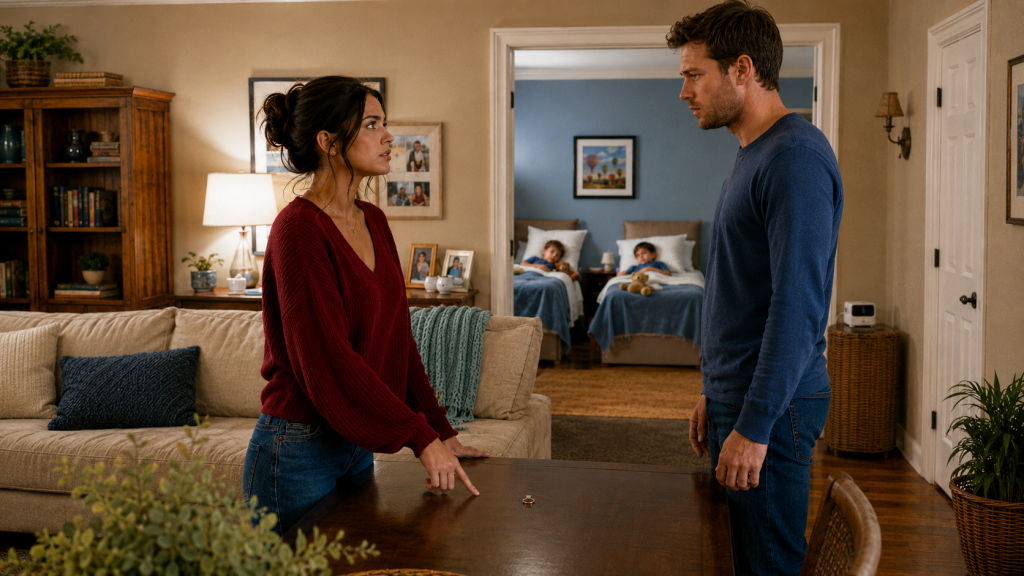
I removed the engagement ring from my finger and placed it carefully on the table between us.
“But I have one condition.”
His smile vanished.
“What condition?”
“The twins are not going anywhere,” I said. “But you are.”
Elliot stared at me as though I had spoken in another language.
Then he laughed.
“Stop being dramatic. You just agreed with me.”
“No,” I replied. “I agreed to remove the person who does not belong in this family.”
I pushed the ring toward him.
His face reddened as he finally understood.
“You are choosing two children over our entire future?”
“I am choosing kindness over cruelty. I am choosing my brothers over a man who sees love as a burden.”
Elliot stood so quickly that the chair scraped across the floor.
“You have lost your mind.”
“Maybe I finally found it.”
“You cannot handle those children alone.”
“I would rather struggle alone than raise them beside someone who resents their existence.”
He accused me of destroying everything we had built. He said I was throwing away seven years because I was emotional and confused.
He insisted that I would regret becoming a parent at twenty-two.
I remained calm, even when he called me foolish, ungrateful, and selfish.
Then a small voice came from the hallway.
“Are you leaving because of us?”
Noah stood there clutching his stuffed dinosaur. His cast had been removed, but he still walked carefully. Caleb hid behind him, holding his healing arm against his chest.
Their frightened expressions shattered my heart.
Before I could answer, Elliot looked at them with open irritation.
That single glance confirmed my decision more powerfully than any insult he had spoken.
I walked toward my brothers and knelt beside them.
“No one is sending you away,” I said. “This is your home. I am your sister, and I am staying with you.”
Caleb looked past me.
“Is Elliot staying?”
“No.”
“Because we were bad?”
“No,” I said firmly. “You did nothing wrong.”
Elliot scoffed.
“You should not involve children in an adult conversation.”
“You involved them when you demanded that I abandon them.”
He reached into his coat and pulled out an envelope.
“At least read this before you make the biggest mistake of your life.”
He dropped it onto the table.
“What is it?”
“A solution.”
I did not touch it.
Elliot tapped the envelope impatiently.
“My father has connections. We found a private residential program that will take both boys. They would not be separated, and the facility has therapists and teachers.”
“You arranged this without speaking to me?”
“I investigated options because you were too emotional to think logically.”
I opened the envelope.
Inside were brochures showing smiling children in bright classrooms and landscaped gardens. Beneath them was a printed application that already contained Noah’s and Caleb’s names.
My hands began to shake.
“You filled this out.”
“Most of it. You only need to sign.”
I turned the page.
The facility was not nearby. It was in another state, nearly eight hours away.
“This is not foster care,” I whispered.
“It is better. They would have professionals.”
“They would be institutionalized.”
“Do not use dramatic words.”
“They would lose their parents and then lose their sister.”
“They would adjust.”
Noah moved closer to me.
Caleb began to cry silently.
I tore the application in half.
Then I tore it again.
Elliot stared at the pieces falling to the floor.
“Get out,” I said.
“You will regret this.”
“Get out of my parents’ house.”
“This house is probably going to be sold anyway. You cannot afford it.”
“That is no longer your concern.”
He picked up the ring and shoved it into his pocket.
“You think you are some kind of hero, but you are condemning yourself to years of misery.”
I opened the front door.
“Leave.”
He walked toward me, stopping close enough that I could smell his expensive cologne.
“When you finally realize what you have done, do not come crawling back.”
“I will not.”
He stepped outside.
I closed the door and locked it.
Then I leaned against it, trembling from head to toe.
The moment Elliot’s car pulled away, Caleb began sobbing.
I gathered both boys into my arms and sat with them on the floor.
Noah kept asking whether I was angry with them.
Caleb begged me not to send them to the place in the brochure.
I told them again and again that they were staying.
“You are not a problem,” I said. “You are not a burden. You are my family.”
That night, all three of us slept in the same room.
The next morning, I called Mrs. Reynolds.
I told her what had happened, including Elliot’s attempt to enroll the twins in a residential program without my permission.
She was quiet for a moment.
“You made the right decision,” she said.
“I know.”
But my voice broke.
Knowing I had made the right decision did not erase seven years of memories.
It did not erase the future I had imagined.
It did not stop me from crying in the laundry room where the boys could not see me.
Mrs. Reynolds helped me locate a family counselor who specialized in childhood trauma. She also advised me to update the school’s emergency contact list and make it clear that Elliot was not authorized to collect the children.
I did so immediately.
At first, Elliot did not contact me.
His silence felt like another punishment.
His mother sent me a message saying she was disappointed that I had ended the engagement without discussing alternatives.
His father called my decision irresponsible.
Several mutual friends tried to remain neutral.
“I understand why you took the boys,” one of them said, “but you also have to understand Elliot never agreed to become a parent overnight.”
“He did not have to become one,” I replied. “He only had to avoid demanding that grieving children be sent away.”
Another friend suggested that Elliot had spoken harshly because he was overwhelmed.
I stopped explaining.
People who wanted to excuse him would always find softer words for cruelty.
Overwhelmed.
Unprepared.
Honest.
Practical.
They avoided the simplest word.
Heartless.
My closest friend, Maya, did not excuse him.
She arrived at my house carrying groceries, cleaning supplies, and three bags of children’s clothes donated by her sister.
When I told her everything, she hugged me so tightly I could barely breathe.
“You did not lose your future,” she said. “You lost someone who would have destroyed it.”
Maya began helping twice a week. She picked the boys up from school when I worked late and stayed with them during some of their medical appointments.
My supervisor arranged a more flexible schedule.
A neighbor named Mrs. Alvarez started bringing us soup and sitting with the twins on the porch while I handled paperwork.
Slowly, I learned that support did not always come from the people who had promised it.
Sometimes it came from people who simply saw someone struggling and stepped forward.
The weeks remained difficult.
Noah became terrified of rain.
Whenever storms began, he crawled beneath the kitchen table and covered his ears.
Caleb developed separation anxiety. On school mornings, he clung to my coat and begged me not to leave.
Their counselor, Dr. Patel, helped us create routines.
We made a calendar showing when I would be at work and when I would return.
We chose a special phrase for moments when they felt afraid.
“Three stars,” I would say.
It meant three people, one family, always finding their way home.
At night, we kept a memory jar on the kitchen counter.
Whenever one of us remembered something good about Mom or Dad, we wrote it on a slip of paper.
Dad singing badly while making pancakes.
Mom dancing with a broom.
The time Noah tried to hide a frog in the bathtub.
The afternoon Caleb covered the dog in washable paint.
Remembering hurt, but it also helped.
Our parents became more than the accident that killed them.
They became laughter, stories, recipes, songs, and love that continued through us.
Two months after the breakup, Elliot appeared at my workplace.
I was leaving for lunch when I saw him waiting near the entrance.
He looked polished and confident, wearing the navy suit he reserved for important meetings.
“We need to talk,” he said.
“No, we do not.”
“I have been thinking.”
“That sounds dangerous.”
He ignored the remark.
“I reacted badly.”
“You demanded that I send my brothers away.”
“I was shocked. Everything changed quickly.”
“Their lives changed more than yours.”
He sighed.
“I am trying to apologize.”
“Then apologize without explaining why your behavior was reasonable.”
His jaw tightened.
“I am sorry for the way I spoke.”
“For the way you spoke, or for what you wanted?”
“There is no point in separating those things.”
“There is every point.”
He looked toward the office windows, clearly uncomfortable that my coworkers might see us.
“I miss you.”
I waited.
“I think we can still fix this,” he continued. “I am willing to reconsider the situation.”
“How generous.”
“I could accept the boys staying temporarily.”
“Temporarily?”
“Until we find relatives who can take them.”
“There are no relatives who can take them.”
“Then perhaps until they are older and can attend boarding school.”
I almost laughed.
“You have learned nothing.”
“I am offering a compromise.”
“My brothers’ home is not something to negotiate.”
“They are controlling your decisions.”
“They are five.”
“You know what I mean.”
“Yes,” I said. “You mean that their needs are interfering with the life you planned for me.”
“Our life.”
“No. Your life, with me fitted conveniently inside it.”
Elliot’s face hardened.
“I came here because I thought grief had made you irrational. Apparently, this is simply who you are now.”
“This is who I always was. You just never saw it because caring about my family had not cost you anything.”
He stepped closer.
“You will not find another man willing to take on this situation.”
“That is fine.”
“You say that now.”
“I would rather be single forever than marry someone like you.”
He walked away without another word.
I watched him leave and felt something inside me finally loosen.
Until then, part of me had wondered whether I had acted too quickly.
His visit erased the doubt.
Three weeks later, a letter arrived from an attorney representing Elliot’s father.
The letter claimed that I owed Elliot $8,000 for wedding expenses he had paid before the engagement ended.
I read it twice, stunned.
Most of the deposits had come from a shared account. Some vendors had refunded us. Others had transferred the bookings to future dates.
I called a legal aid office and brought every receipt, bank record, and contract I could find.
The attorney who met with me, Ms. Green, reviewed the documents carefully.
“You do not owe him $8,000,” she said. “In fact, according to these records, he withdrew the remaining balance from the joint wedding account.”
I stared at her.
“What remaining balance?”
“Almost $11,000.”
I had not checked the account since the breakup.
Elliot had closed it two days after leaving my house.
Nearly half of the money had come from me.
Some had come from my parents, who had contributed to the wedding before their deaths.
Anger burned through my grief.
Ms. Green sent a response demanding a full accounting of the withdrawn funds.
Elliot’s father called me that evening.
“You are making this uglier than necessary,” he said.
“Your son took money that did not belong entirely to him.”
“He paid for most of the wedding.”
“The records prove otherwise.”
“You embarrassed him.”
“He tried to send two children away.”
“Elliot has a right to protect his future.”
“And I have a right to protect my family and my money.”
His voice became colder.
“Do not make an enemy of this family.”
I hung up.
The threat frightened me, but I refused to let fear control me.
A week later, Ms. Green discovered something even worse.
Elliot had not merely withdrawn money from our joint account.
While helping me organize my parents’ estate, he had copied several financial documents. He had used those documents to contact the bank about refinancing my parents’ home.
He had no authority to complete the transaction, but emails showed that he had planned to persuade me to sell the house after placing the twins in residential care.
His father’s company had prepared an offer through an investor.
The price was far below market value.
I sat in Ms. Green’s office reading the emails with numb disbelief.
In one message, Elliot had written, “Once the children are placed, she will not need the larger property. She will be emotional, so the process should move quickly.”
The date on the message was three days before he gave me the ultimatum.
He had not spoken carelessly in a moment of panic.
He had made a plan.
He intended to remove the twins, persuade me to sell my parents’ house cheaply, and move forward with the wedding as if my family had never existed.
I felt sick.
Ms. Green leaned forward.
“This information changes the situation. At minimum, we can use it to protect you from further financial interference. Depending on what else we uncover, there may be grounds for a formal complaint.”
“I thought he loved me.”
“I am sorry.”
“He was planning this while I was sleeping on the floor beside two injured children.”
She let me cry without interrupting.
Then she helped me act.
We notified the bank, changed every account password, froze my credit, and filed reports regarding the unauthorized use of my financial information.
The investor withdrew the offer as soon as he learned the circumstances.
Elliot’s father denied knowing that the boys would be placed outside the home, but the email chain suggested otherwise.
The wedding-money dispute ended quickly after Ms. Green presented the records.
Elliot returned my share of the account, including the amount my parents had contributed.
He did not apologize.
Instead, he sent one final message.
You have destroyed my reputation over a misunderstanding.
I replied with four words.
Your actions destroyed it.
Then I blocked him.
For a few months, life became quieter.
The twins started kindergarten again after missing several weeks.
Noah joined a small art group at school. He drew houses with enormous roofs and three people holding hands in front of them.
Caleb became fascinated by dinosaurs and corrected anyone who confused a stegosaurus with a triceratops.
Their laughter slowly returned.
So did mine.
There were still difficult nights.
There were bills I worried about and moments when exhaustion made me cry over simple things.
Sometimes I stood in my mother’s kitchen wishing she would walk through the door and tell me what to do.
But I kept going.
I learned to cook the meals the boys liked.
I attended parent-teacher meetings.
I sat through soccer practices in the rain.
I celebrated lost teeth, improved reading scores, and the first night both boys slept without nightmares.
On the anniversary of the accident, we visited our parents’ graves.
The boys placed drawings beside the headstone.
Noah’s showed our mother wearing a purple dress.
Caleb’s showed our father riding a dinosaur.
We laughed, then cried, then stood together in the autumn wind.
“Do you think they know we are okay?” Noah asked.
“I think they know we are together,” I said.
Caleb slipped his hand into mine.
“Three stars?”
“Three stars.”
A year passed.
Then another.
The house remained ours.
I received a promotion at work and began taking evening classes to earn an advanced accounting certification.
Maya continued to be part of our lives. Mrs. Alvarez became the twins’ unofficial grandmother. Dr. Patel helped the boys understand that healing did not mean forgetting.
When Noah and Caleb turned eight, they asked why Elliot no longer visited.
I had avoided giving them the full explanation because they were so young when it happened.
This time, I answered honestly.
“He wanted me to choose between him and you.”
Caleb frowned.
“Why would anyone do that?”
“Because some people think love matters only when it is easy.”
Noah looked worried.
“Did you choose us because Mom told you to?”
“No,” I said. “I chose you because I love you.”
“What if you get married someday?”
“Then I will marry someone who understands that loving me means loving the family I already have.”
Caleb considered this.
“He should like dinosaurs.”
“That will be part of the interview.”
The boys laughed.
I did not seriously date for several years.
My life was full, and I had learned not to confuse being chosen with being valued.
Then, when the twins were nine, I met Daniel.
He was the new school librarian.
Our first conversation happened because Caleb had returned a book with grape jelly between two pages.
I arrived prepared to apologize and pay for the damage.
Daniel held up the sticky book.
“I have seen worse.”
“How much worse?”
“A first grader once returned a book about ocean animals after testing whether it could survive underwater.”
“Did it?”
“No.”
Caleb giggled.
Daniel did not treat me like a tragic young woman who had sacrificed her life.
He treated me like a person.
We became friends slowly.
He recommended books to the boys and occasionally joined us for weekend hikes. He never tried to become important too quickly.
When Noah had a panic attack during a thunderstorm at a school event, Daniel sat on the floor beside him and quietly described every object in the room until his breathing slowed.
He did not ask for praise afterward.
He simply helped.
Months later, he asked me to dinner.
I told him the truth about Elliot before accepting.
Daniel listened without interrupting.
When I finished, he said, “Your brothers are part of your life. I would never ask you to make them smaller so I could feel larger.”
That sentence stayed with me.
Our relationship developed carefully.
The boys watched him with suspicion at first.
Caleb asked Daniel whether he planned to send them to boarding school.
Daniel’s face went pale.
“No,” he said. “I plan to remind you to return library books without food inside them.”
Caleb decided he was acceptable.
Daniel did not promise perfection.
He admitted when he was overwhelmed.
He asked questions about trauma and attended a family counseling session before moving into the house.
He learned which sounds frightened Noah and which routines helped Caleb feel secure.
He understood that our family had been shaped by loss but was not defined only by it.
When he proposed, he did not take me to a fancy restaurant.
He asked all three of us to meet him in the backyard.
He had hung three paper stars from the old maple tree.
Then he knelt in front of me.
“I love you,” he said. “I love the family you built, the home you protected, and the two remarkable boys who made me prove I know the difference between a brachiosaurus and an apatosaurus.”
Caleb whispered, “He still gets them confused.”
Daniel smiled.
“I am continuing my education.”
Then he looked at Noah and Caleb.
“I am asking your sister to marry me. But I know that marrying her means becoming part of your family too. I would be honored if all three of you would have me.”
Noah began to cry.
Caleb shouted yes before I could answer.
I laughed through my tears.
Then I said yes too.
We planned a small wedding in the backyard.
There were no expensive decorations, no exclusive venue, and no carefully arranged photographs meant to impress strangers.
Maya stood beside me.
Mrs. Alvarez sat in the front row.
Noah and Caleb carried the rings.
Before the ceremony, the boys placed two empty chairs beneath the maple tree. On each chair, they placed a photograph of our parents.
When I saw them, I had to step inside for a moment because grief still had the power to surprise me.
Daniel found me in the kitchen.
“You do not have to be happy every second today,” he said.
“I wish they were here.”
“I know.”
“My mother would have loved this.”
“I wish I could have met her.”
I looked through the window at the yard filled with people who had helped us survive.
“She would have liked you.”
“That means more than you know.”
We returned outside together.
The ceremony began just before sunset.
When Daniel made his vows, he did not promise to rescue me or complete me.
He promised to be truthful, patient, and present.
Then he turned toward the twins.
“I cannot replace your parents,” he said. “I would never try. But I promise that I will show up for you, listen to you, and protect the home we share.”
Noah wiped his eyes.
Caleb whispered, “And learn more dinosaurs.”
“And learn more dinosaurs,” Daniel agreed.
Years later, Elliot’s name appeared unexpectedly in my inbox.
By then, Noah and Caleb were fourteen.
Daniel and I had been married for five years and had a three-year-old daughter named Sophie, whom the boys treated like the most precious person in the world.
The message had no subject.
I almost deleted it without reading.
Instead, curiosity made me open it.
Elliot wrote that his father’s company had failed after several lawsuits and financial investigations. He said he had moved away, started over, and spent years thinking about what happened between us.
He claimed he finally understood why I had chosen the twins.
Then he asked whether I would be willing to meet so he could apologize.
I showed the message to Daniel.
“What do you want to do?” he asked.
“I do not know.”
“You do not owe him anything.”
“I know.”
In the end, I agreed to a brief meeting in a public café.
Not because Elliot deserved access to my life.
Because I wanted to see whether hearing him apologize would close a door that had remained slightly open in my mind.
He looked older than I expected.
His hair had begun thinning, and the confidence that once filled every room had faded.
We sat across from each other near the window.
“Thank you for coming,” he said.
“You said you wanted to apologize.”
He nodded.
“I was cruel.”
I waited.
“I convinced myself that I was being practical. I thought your parents’ deaths had ruined the future I deserved. I treated those boys like obstacles.”
“Yes.”
“I also tried to use your grief to make money.”
“Yes.”
His eyes lowered.
“My father encouraged it, but I made my own choices. I blamed him for years because it was easier than admitting what kind of person I had become.”
I studied him.
“Why apologize now?”
“Because I have a son.”
The answer surprised me.
“He is four,” Elliot continued. “His mother and I are divorced. Last year, she became seriously ill. For several months, I thought I might have to raise him alone.”
He rubbed his hands together.
“I was terrified. Then I remembered what I said to you. I remembered calling your brothers someone else’s children, as though that made them less deserving of love.”
“They were never someone else’s children to me.”
“I know that now.”
“No,” I said. “You understand it now because the same kind of responsibility reached your life. Back then, you did not care because the children were not connected to you.”
He looked ashamed.
“You are right.”
I had imagined this conversation many times.
In some versions, I shouted at him.
In others, I told him how happy my life had become without him.
But sitting there, I felt no desire to punish him.
He was no longer the center of the story.
He was simply someone who had once shown me a truth before I made a terrible mistake.
“I accept your apology,” I said. “But acceptance does not erase what happened.”
“I understand.”
“I will not become part of your life again.”
“I did not expect that.”
“And you will not contact my brothers.”
He nodded.
“Are they doing well?”
I hesitated.
Then I said, “They are extraordinary.”
A faint smile appeared on his face.
“I am glad.”
I stood.
Elliot remained seated.
Before leaving, I looked back at him.
“The ultimatum you gave me was the most painful gift I ever received.”
He frowned.
“You showed me exactly who you were before I married you. I hated you for it. Now I am grateful I learned the truth in time.”
Then I walked out.
Daniel was waiting in the car.
He did not ask for details immediately.
He simply reached across the console and held my hand.
“Finished?” he asked.
“Finished.”
When we returned home, the house was loud.
Sophie was chasing Caleb through the living room with a toy wand. Noah was arguing that he needed the car that evening. A pot on the stove was beginning to boil over.
It was chaotic, imperfect, and beautiful.
Years earlier, Elliot had warned me that taking responsibility for my brothers would ruin my future.
He had been wrong.
Raising Noah and Caleb did change everything.
I lost sleep.
I postponed plans.
I worked harder than I thought possible.
I learned how frightening it was to love children whose safety I could never completely control.
But they did not destroy my future.
They became part of it.
When the twins graduated from high school, they wore matching blue gowns but decorated their caps differently.
Noah painted three stars across his.
Caleb attached a small plastic dinosaur.
As they crossed the stage, I heard my mother’s voice in my memory.
You would be the person those boys trusted most.
After the ceremony, Noah handed me an envelope.
Inside was a letter written in both their handwriting.
Dear Lena,
You always say you did what any sister would do, but we know that is not true. You were twenty-two. You had plans. You were sad and scared too, but you never made us feel like we had destroyed your life.
We do not remember everything about the accident. We remember the hospital lights. We remember asking for Mom. We remember being afraid that everyone would leave.
But we also remember you sleeping on our floor.
We remember Family Night.
We remember three stars.
You did not just keep us out of foster care. You gave us a home when the world stopped feeling safe.
Daniel says family is not proven by what people promise before life becomes difficult. It is proven by who stays after it does.
You stayed.
We love you.
Noah and Caleb.
I read the letter twice before the words blurred.
The boys stood in front of me, suddenly taller than I was.
“I did not save you,” I said. “We saved each other.”
Caleb hugged me first.
Noah wrapped his arms around both of us.
Daniel lifted Sophie so she could join.
For a moment, all five of us stood together beneath the bright afternoon sun.
Three stars had become five.
That evening, after everyone left, I returned to the kitchen.
The house was quiet.
On the refrigerator hung an old drawing Noah had made years earlier. It showed a crooked house, three stick figures, and three enormous yellow stars.
Beside it was a newer photograph of our entire family.
I thought about the night Elliot placed an ultimatum between me and two grieving children.
He believed he was forcing me to choose between love and responsibility.
He never understood that real love was responsibility.
Real love did not disappear when plans changed.
It did not measure a frightened child’s worth against convenience.
It did not call sacrifice foolish or kindness weakness.
Real love stayed.
It adapted.
It made room.
I touched the edge of the old drawing.
My parents’ deaths had divided my life into before and after.
Before, I believed promises revealed character.
After, I understood that hardship did.
Elliot had promised me forever when forever looked easy.
My brothers had needed me when forever became difficult.
Choosing them was not the end of my life.
It was the moment my real life began.
And I never regretted it.
Not once.
THE END! THANK YOU FOR READING!