

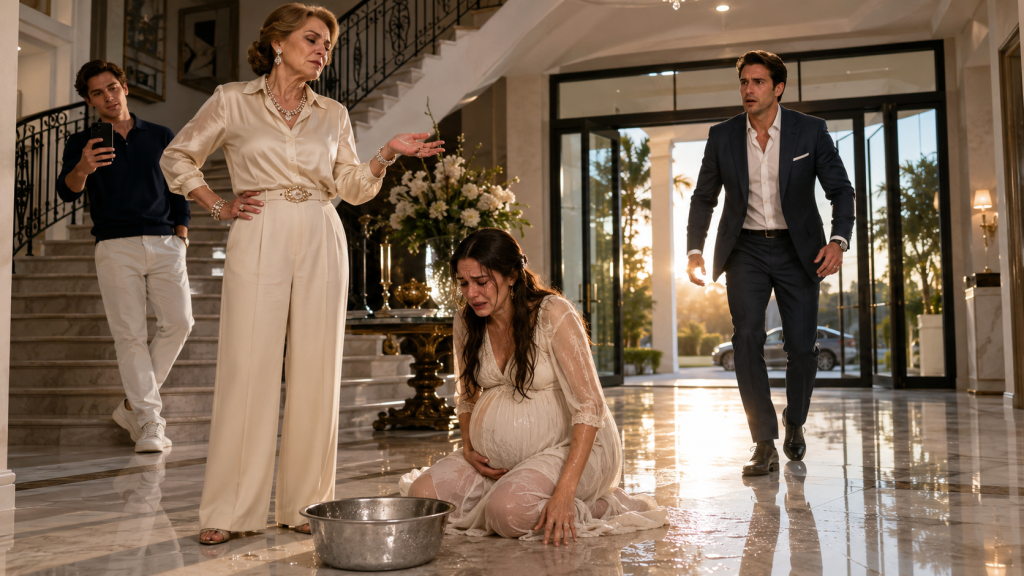
I came home earlier than expected and found my wife, eight months pregnant, kneeling on the marble floor, weeping uncontrollably as my mother asked her to wash her feet.
“This house belongs to my children, not you,” she said.
I didn’t respond.
I just packed two suitcases, opened the bank statements, and exposed whoever had been draining our money for months.
The first thing I saw was my wife’s swollen hands submerged in a silver basin.
The second was my mother’s bare foot resting on Elena’s shoulder as if my eight-month-pregnant wife were a piece of furniture.
I had returned from Singapore two days early. My flight landed at dawn, and I wanted to surprise Elena with breakfast from the little bakery she loved. Instead, I walked through our glass front doors carrying croissants and heard sobbing echoing across the marble foyer.
“Scrub harder,” my mother said. “This house belongs to my children, not you.”
Elena knelt on the floor in a damp maternity dress, tears falling into the water. Her ankles were swollen. Strands of dark hair clung to her pale cheeks.
My younger brother, Lucas, leaned against the staircase, filming with his phone.
“Mom’s teaching her gratitude,” he said when he noticed me. “Don’t ruin it.”
My mother turned slowly.
Her smile never moved.
“Daniel,” she said. “You’re home.”
Elena looked at me, terrified—not relieved.
That hurt more than anything.
It meant this had happened before.
It meant she had learned not to expect rescue.
The basin was engraved with our family crest, a wedding gift from my mother. Elena had once filled it with white roses for our anniversary. Now dirty water sloshed across the silver rim while my mother watched her struggle to breathe.
My unborn son kicked beneath the fabric of Elena’s dress, visible even from the doorway.
I placed the bakery bag on a side table.
Then I crossed the foyer.
Lucas lifted his phone higher.
“Careful,” he said. “You don’t know the whole story.”
I took the phone from his hand and threw it onto the sofa.
Then I lifted my mother’s foot from Elena’s shoulder.
She stared at me as if I had struck her.
I helped Elena stand, but her knees buckled immediately. I caught her before she fell.
There were red marks around both wrists.
“Pack a bag,” I said quietly.
My mother laughed.
“For her?”
“For us.”
Lucas stepped away from the staircase.
“You’re choosing her over family?”
I looked at Elena’s trembling hands. Then I looked at the floor, where a bucket, cleaning cloths, and several pairs of my mother’s shoes had been arranged in a neat row.
“I’m choosing my family,” I said.
My mother’s face hardened.
“You own nothing without me. The company, the house, the accounts—everything came from your father.”
That was what she believed.
For years, I had allowed her to believe it because correcting her would have started a war I had hoped to avoid.
Now the war had found my wife.
I carried Elena upstairs, called her doctor, and packed two suitcases. One for her. One for me.
I did not shout.
I did not threaten.
I did not give my mother the scene she wanted.
While Elena changed, I opened the locked drawer in my study and removed six months of bank statements.
I had begun reviewing the household accounts weeks earlier after our financial controller noticed irregular transfers. At first, I assumed it was an accounting mistake. The amounts were scattered and deliberately inconsistent: $18,500 one week, $42,000 the next, then $9,750, followed by several transfers just below the bank’s automatic review threshold.
There were repeated payments from our household reserve to shell companies with harmless names—Lark Consulting, Northbridge Interiors, Meridian Wellness.
The total missing was $684,000.
My mother appeared in the doorway.
“You’ve been careless,” she said. “Elena spends too much.”
I turned another page.
There was Lucas’s signature on a transfer authorization he thought had been deleted from the company server.
Then I saw the receiving account.
It was not Elena’s.
It belonged to my mother.
I closed the folder.
“You’re right,” I said. “Someone in this house has been careless.”
She smiled, believing I had surrendered.
I picked up the suitcases, took Elena’s hand, and walked out without looking back.
We drove straight to a private maternity clinic.
Elena remained silent for most of the trip. She sat with one hand under her stomach and the other pressed against the passenger window, as though she needed proof that something solid still existed.
At the clinic, her doctor examined her immediately.
The baby’s heartbeat was strong, but Elena’s blood pressure was dangerously high. The doctor said stress could trigger premature labor and ordered complete bed rest for several days.
I sat beside Elena while a nurse attached a monitor around her stomach.
For almost an hour, neither of us spoke.
Then Elena whispered, “I’m sorry.”
I turned toward her.
“For what?”
“For making you leave your home.”
The words broke something inside me.
I took her hand carefully.
“That was never my home if you weren’t safe there.”
She stared at the ceiling.
I waited.
Finally, she said, “Your mother told me you knew.”
“Knew what?”
“That she was correcting me.”
I felt my jaw tighten.
“She said you agreed that I had become disrespectful. She said you wanted her to teach me how your family expected a wife to behave.”
“I never said that.”
“I know that now.”
“How long has this been happening?”
She closed her eyes.
“Since you started traveling more often.”
That meant almost seven months.
My role at Mercer Holdings required international travel, and the Singapore trip had been my fourth overseas trip that year. Every time I left, my mother offered to stay with Elena so she would not be alone.
I had thanked her.
I had actually thanked the person tormenting my wife.
“What did she do?” I asked.
Elena’s fingers tightened around mine.
“At first, it was small things. She criticized my clothes. She said I embarrassed you at dinners. Then she began making lists of chores. If I refused, she said she would tell you I was unstable.”
“She had no right to order you around.”
“She said the house belonged to her.”
“It doesn’t.”
Elena looked at me.
“What?”
“The house doesn’t belong to her.”
“But she always said your father bought it.”
“He did. Then he transferred it to me before he died.”
Elena’s expression changed.
My father had died three years earlier after a long battle with heart disease. He had been a complicated man—brilliant in business, distant at home, and increasingly suspicious of my mother during the final years of his life.
Several months before his death, he called me to his hospital room and made me sign a set of documents.
I had not told anyone what they contained.
Not even Elena.
At the time, I believed silence would preserve peace.
Instead, it had allowed my mother to build her authority on a lie.
“What else did she do?” I asked.
Elena hesitated.
I did not rush her.
“She took my jewelry,” she said. “The pieces my grandmother left me.”
My stomach turned.
“She said she needed them appraised for insurance. When I asked for them back, she told me they were payment for living in her house.”
“Why didn’t you call me?”
“I tried.”
“I never received a call.”
“She would take my phone when she visited. She said constant messages distracted you from business.”
I remembered several missed calls that ended before I answered. Whenever I called back, Elena would say everything was fine.
Now I understood why her voice had sounded strained.
“She also showed me bank records,” Elena continued. “She said money was disappearing and that you suspected me.”
I opened the folder I had brought from the house.
“Did she show you these companies?”
Elena looked at the pages.
Her eyes widened when she saw Meridian Wellness.
“She made me sign invoices from that company.”
“What kind of invoices?”
“She said they were for prenatal treatments and security expenses. I told her I had never received any treatments from them. She said the company handled private family matters and that asking questions would embarrass you.”
“Did you sign?”
“Two of them. Then I refused.”
“What happened when you refused?”
Elena touched her wrist.
“She grabbed me. Lucas recorded it. They said they needed proof that I was violent.”
I stood so quickly that the chair scraped across the floor.
The monitor beside Elena changed rhythm, and I forced myself to sit again.
“I’m sorry,” I said. “I won’t raise my voice.”
“You didn’t do this.”
“I left you there.”
“You trusted your mother.”
“I should have trusted the silence in your voice.”
A nurse entered to check the monitor. After confirming that the baby was stable, she reminded Elena to rest.
I stepped into the hallway and called my attorney, Nathan Cole.
Nathan had been my father’s personal lawyer before becoming mine. He knew every layer of Mercer Holdings, including the layers my mother did not know existed.
“I need an emergency review of several accounts,” I told him.
“How emergency?”
“Freeze everything connected to Evelyn and Lucas Mercer.”
He was silent for a moment.
“Daniel, those are your mother and brother.”
“I am aware.”
“What happened?”
“They assaulted Elena, forged transfer authorizations, and moved at least $684,000.”
Nathan’s voice changed immediately.
“Send me every document you have. Don’t confront them again. And do not warn them that we are freezing anything.”
“They already know I found something.”
“Then we move faster.”
I photographed the statements and sent them to him.
An hour later, Nathan called back.
The shell companies were connected to three properties, several luxury purchases, and gambling debts accumulated by Lucas.
Lark Consulting had paid for a penthouse apartment downtown.
Northbridge Interiors had purchased imported furniture and artwork.
Meridian Wellness had made payments to a private casino account in the Caribbean.
Lucas had lost more than $400,000 gambling online and another $190,000 in private poker games.
My mother had used household reserves to hide the losses.
But that was only the beginning.
Nathan discovered that several transfer approvals contained my digital signature even though I had been outside the country on the dates they were authorized.
“My signature was copied,” I said.
“More than copied,” Nathan replied. “Someone used your secured authorization key.”
Only three people knew where I kept that key: Elena, Nathan, and me.
But the key had once been stored in my father’s study.
The room my mother had claimed after his death.
I returned to Elena’s room and found her sleeping.
Her phone lay on the bedside table.
I picked it up and saw dozens of blocked numbers and deleted message threads. My mother had accessed her device repeatedly. She had even changed my contact name from “Daniel” to a number Elena would not recognize, ensuring that my calls appeared unfamiliar whenever I traveled.
Then a cloud notification appeared.
A video had been uploaded from Lucas’s phone.
Years earlier, I had added my brother to the Mercer family storage plan after he complained that he kept losing photos. He had apparently forgotten that every video he recorded automatically synchronized to the shared account.
I opened the folder.
There were seventy-three videos.
In one, my mother ordered Elena to polish the dining room silver while she was suffering from morning sickness.
In another, Lucas laughed as Elena struggled to carry grocery bags upstairs.
A third showed my mother holding Elena’s grandmother’s necklace.
“You don’t deserve family heirlooms,” she said. “You entered this family with nothing.”
Elena reached for the necklace, and my mother slapped her hand away.
Another clip showed Elena standing in my study while my mother placed documents in front of her.
“Sign,” my mother ordered.
“What is it?” Elena asked.
“A household agreement.”
“It says voting shares.”
“You misunderstand legal language.”
“I’m not signing this.”
My mother grabbed Elena’s wrist.
Elena pulled away.
Lucas moved the camera closer.
“Look how aggressive she is,” he said.
Then my mother leaned toward Elena.
“Once Daniel believes you stole from him, he’ll leave you with nothing.”
I watched the clip twice.
My hands were shaking so badly that I nearly dropped the phone.
Nathan called again.
“Daniel, we found something else. The document Elena refused to sign was not a household agreement. It would have transferred your controlling shares in Mercer Holdings to a trust managed by your mother.”
“How did they expect to complete it without Elena?”
“Your father’s estate structure requires spousal acknowledgment before you can transfer more than twenty percent of your voting interest. They needed her signature.”
“And when she refused, they planned to frame her for stealing the money.”
“That appears to be the strategy.”
Before I could respond, another notification appeared.
Motion detected in my home office.
I opened the security application.
Lucas stood inside my study.
My mother was beside him.
They had opened the hidden wall safe.
Lucas held a thick envelope sealed with my father’s initials.
“Burn it,” my mother said. “Before Daniel learns who truly inherited everything.”
The screen went black.
Someone had disabled the camera.
I looked toward Elena’s room.
She was still asleep.
I called Nathan.
“They opened my safe.”
“What was inside?”
“My father’s original will.”
“I thought I held the original.”
“You hold the official version filed with the court. My father gave me another document two days before he died. He told me not to open it unless my mother tried to take control of the company.”
“What document?”
“I don’t know. I never opened it.”
Nathan let out a slow breath.
“Do not go back alone.”
“I’m not going back for a confrontation.”
“Then what are you going back for?”
“To make sure they don’t destroy the evidence.”
Nathan contacted the police and arranged for two officers to meet me at the property.
By the time I arrived, my mother and Lucas were gone.
The wall safe stood open.
The sealed envelope was missing.
But Lucas had made a mistake.
He had disabled the camera after taking the document, not before.
The footage clearly showed both of them entering the safe and removing it.
An officer photographed the room while I checked the remaining contents.
Several property deeds remained untouched. So did my father’s old journals, a set of company seals, and an encrypted storage drive.
The drive had been placed inside a plain black case.
A note in my father’s handwriting was taped to it.
Daniel,
Trust records, not promises.
I gave the drive to Nathan.
That evening, Elena was discharged under strict instructions to avoid stress. I took her to a furnished apartment owned by one of our holding companies. My mother did not know it existed.
The apartment overlooked the river and had no family photographs, no inherited furniture, and no memories attached to it.
Elena stood beside the window.
“Are we hiding?” she asked.
“No. We’re protecting you while I remove them from our lives.”
She placed both hands over her stomach.
“What happens if your mother takes the company?”
“She can’t.”
“You sound certain.”
“I am now.”
I finally told Elena the truth about my father’s estate.
Mercer Holdings had once been divided among my father, my mother, Lucas, and me. But during his final year, my father discovered that Lucas had been taking company loans without authorization and that my mother had concealed the transactions.
He quietly restructured his shares.
Upon his death, I inherited fifty-eight percent of the voting stock. My mother inherited twelve percent. Lucas inherited five percent. The remainder belonged to long-term investors and an employee trust.
The house, the family investment accounts, and several commercial properties were also transferred to a private trust under my control.
My mother had been permitted to live in the house for life—unless she committed fraud against the trust or harmed another beneficiary.
Elena and our unborn child were beneficiaries.
My mother had unknowingly violated both conditions.
“She thought she owned everything,” Elena said.
“I allowed her to think it.”
“Why?”
“Because after my father died, she became fragile. Or pretended to be. She said taking away her authority would humiliate her. I thought letting her maintain appearances was harmless.”
Elena looked toward the river.
“People who need appearances that badly eventually hurt anyone who threatens them.”
She was right.
The next morning, Nathan arrived with two forensic accountants and the encrypted drive.
My father had preserved years of financial records, emails, audio files, and handwritten notes.
The evidence showed that my mother’s fraud had begun long before his death.
She had diverted company money to cover Lucas’s failed businesses, personal debts, and extravagant lifestyle. When my father confronted her, she threatened to claim he was mentally incompetent.
He began documenting every conversation.
In one recording, my mother’s voice was cold and unmistakable.
“Lucas deserves the company. Daniel already has enough.”
My father responded, “Daniel built the international division. Lucas has never completed a single project.”
“He is your son.”
“So is Daniel.”
“Daniel stopped obeying me.”
“That is not a business qualification, Evelyn.”
Another file contained emails between my mother and a private investigator. She had hired him to search for anything damaging in Elena’s past.
He found nothing except a small student loan, several years of teaching employment, and volunteer work at a children’s hospital.
My mother instructed him to keep searching.
When that failed, she created the story that Elena was stealing.
Lucas helped establish the shell companies.
My mother moved money through them, then printed altered bank statements showing transfers to an account with Elena’s maiden name.
She had planned to present those documents after obtaining Elena’s signature on the share transfer.
The cruelty in the foyer had not been random.
It was pressure.
They wanted Elena frightened, isolated, and desperate enough to sign anything.
Nathan slid a document across the table.
“This terminates your mother’s right to occupy the house. The trust allows immediate removal after documented fraud or abuse.”
“Serve it today.”
“We can.”
“And Lucas?”
“We are filing criminal complaints for fraud, forgery, unlawful access, and conspiracy. The district attorney will decide the charges.”
Elena looked uneasy.
“They’ll say I destroyed the family.”
I turned toward her.
“They destroyed it. You survived it.”
That afternoon, my mother called from an unknown number.
I answered on speaker while Nathan recorded the conversation.
“Daniel,” she said warmly, “we need to stop this foolishness.”
“You assaulted my wife.”
“I corrected her.”
“You stole $684,000.”
“That money belongs to the family.”
“You forged my signature.”
“You were unavailable. Someone had to manage things.”
“You tried to force Elena to transfer my shares.”
Silence.
Then she laughed softly.
“She told you that?”
“I watched the video.”
Another silence.
When she spoke again, the warmth was gone.
“You have always been weak around emotional women.”
“Elena is under medical care because of you.”
“She is dramatic. Pregnancy makes women manipulative.”
Nathan wrote something on a legal pad and pushed it toward me.
Ask about the will.
“You took a sealed document from my safe,” I said.
My mother’s breathing changed.
“I don’t know what you mean.”
“The security camera recorded you and Lucas.”
“That house is mine. Nothing inside it can be stolen from me.”
“The house belongs to the trust.”
“My husband built it.”
“And transferred it before he died.”
“You’re lying.”
“The termination notice is being delivered now.”
She stopped speaking.
Through the phone, I heard a doorbell.
Then Lucas shouted in the background.
“What is this?”
My mother moved away from the phone. Paper rustled.
A moment later, she returned.
“You cannot remove me from my own home.”
“You lost your right to live there when you committed fraud against the trust and abused a beneficiary.”
“Elena is not family.”
“She is my wife. Our son is my heir.”
“You would throw your own mother into the street for that woman?”
“No. I’m removing a criminal from property she used to torment my wife.”
Her voice dropped.
“You’ll regret humiliating me.”
“I regret believing you loved me.”
I ended the call.
The legal process moved quickly because the evidence was overwhelming.
My mother tried to withdraw funds from three accounts, only to discover they had been frozen.
Lucas attempted to sell the downtown penthouse, but the property had been purchased with stolen funds and was immediately placed under a court restriction.
They spent their first night away from the house in a luxury hotel.
On the second morning, the hotel asked them to leave when every credit card they used was declined.
By that afternoon, Lucas had called me thirty-one times.
I did not answer.
He began sending messages.
You’re overreacting.
Mom was just stressed.
Elena is turning you against us.
We can fix the money.
Don’t involve the police.
His final message was different.
I have Dad’s letter. Meet me alone or you’ll never see it again.
I showed it to Nathan.
“He’s admitting possession,” Nathan said. “Let him propose a location.”
Lucas chose an abandoned restaurant near the waterfront.
The police arranged surveillance.
I entered alone, though two officers were positioned outside and another listened through a device under my jacket.
Lucas sat at a dusty table with the sealed envelope in front of him.
He looked exhausted. His shirt was wrinkled, and there were dark circles beneath his eyes.
“You ruined everything,” he said.
“You filmed our mother abusing my pregnant wife.”
“She told me it was necessary.”
“You’re thirty-four years old.”
“She said Elena was stealing.”
“You knew where the money went.”
His gaze moved toward the envelope.
“I borrowed some.”
“You stole hundreds of thousands of dollars.”
“I was going to repay it.”
“With what?”
“My investments were about to recover.”
“You gambled it.”
His face reddened.
“You always judged me.”
“I kept rescuing you.”
“No. You enjoyed being the responsible son. You needed me to fail.”
I almost felt sorry for him.
Almost.
“What do you want?” I asked.
“Drop the criminal complaints. Restore our account access. Let Mom stay in the house.”
“In exchange for a document you stole from my safe?”
“You don’t know what’s inside.”
“Neither do you.”
His expression told me I was wrong.
“You opened it,” I said.
Lucas looked away.
“What did it say?”
He pushed the envelope toward me, but kept one hand on it.
“Dad left a personal statement. He knew what Mom was doing. He knew about the money.”
“We already found his records.”
“That’s not all.”
“What else?”
“He said I wasn’t entitled to inherit anything because I wasn’t his biological son.”
For a moment, the room seemed completely silent.
Lucas released the envelope.
I did not pick it up immediately.
“What?”
“Our mother had an affair. Dad found out years ago.”
I studied his face.
Lucas and I had never looked alike. I had our father’s gray eyes and heavy brow. Lucas was fairer, narrower in the face, with features that resembled no one in our family.
But I had never questioned it.
“Does it matter?” I asked.
“It matters to me.”
“He raised you.”
“He tolerated me.”
“He protected you repeatedly.”
“Because Mom forced him.”
I picked up the envelope.
The original seal had been cut.
Inside was a notarized statement from my father.
He wrote that he had learned of my mother’s affair when Lucas was five. A private test confirmed Lucas was not his biological child.
My father chose to continue raising him and never intended to expose the truth publicly.
But he also wrote that my mother used the secret to manipulate him for decades.
Whenever he tried to hold Lucas accountable, she accused him of punishing an innocent child.
Whenever Lucas failed, she demanded money.
Whenever my father refused, she threatened scandal.
The final paragraph was addressed to me.
Daniel, blood does not make a man worthy, and a lack of blood does not make him unworthy. I loved Lucas as my son, but your mother taught him that love meant rescue without consequence. If he ever chooses honesty, help him stand. Do not help him hide.
Lucas watched me read.
“Well?” he asked.
“Dad still called you his son.”
“He left you the company.”
“He left me responsibility.”
“He left me nothing.”
“He left you five percent of a company worth millions.”
“Which you control.”
“You could have built something with it.”
“I wanted what you had.”
“You wanted the title without the work.”
Lucas stood abruptly.
“You think you’re better than me.”
“No. I think you were given chances most people never receive, and you turned them into debts everyone else had to pay.”
His shoulders dropped.
For the first time, he looked less angry than frightened.
“If you prosecute me, I could go to prison.”
“Yes.”
“You would do that to your own brother?”
“You did it to yourself.”
“What am I supposed to do?”
I folded the letter and placed it back in the envelope.
“Tell the truth.”
He stared at me.
“About everything?”
“Everything.”
He glanced toward the windows.
He must have guessed the police were nearby.
“Mom will never forgive me.”
“That is the leash she has kept around your neck your entire life.”
Lucas sank back into the chair.
Then he began to talk.
He admitted that my mother had created the first shell company eighteen months earlier after he lost $80,000 in a private poker game.
She told him the family reserve was essentially hers and that I would never notice.
When I did notice, she decided to blame Elena.
She ordered Lucas to collect videos that could be edited to make Elena appear unstable.
The foot-washing humiliation had been intended to provoke her into screaming or striking someone.
Instead, Elena had endured it silently.
My early return ruined their plan.
Lucas also revealed where my mother had hidden Elena’s jewelry, the altered bank statements, and several forged documents.
The police entered after he finished.
He did not resist.
My mother was arrested later that evening at a private storage facility while attempting to remove boxes of evidence.
The news spread quickly.
Mercer Holdings was a major employer, and reporters gathered outside the company headquarters by morning.
My board requested an emergency meeting.
Several directors feared the scandal would damage the company.
One suggested that I describe the missing money as a family misunderstanding.
I refused.
“A misunderstanding is forgetting an appointment,” I told them. “This was fraud.”
Another director warned that public charges against my mother could make investors question my judgment.
“They should question my judgment,” I said. “I trusted family members without enough oversight. That ends today.”
We announced an independent audit, new financial controls, and full cooperation with authorities.
Our stock dropped six percent in two days.
Then it recovered when the audit confirmed that the theft involved private family reserves and had not affected employee pensions or operating funds.
Elena remained away from the cameras.
She spent her days resting in the apartment, reading beside the window, and slowly preparing for the baby.
At night, she sometimes woke gasping.
Once, I found her standing in the kitchen at three in the morning, washing the same glass repeatedly.
“Elena,” I said gently.
She froze.
Then she looked down at her hands.
“I thought she was behind me.”
I turned off the faucet and wrapped her in a towel.
“You’re safe.”
She began to cry.
“I should have fought back.”
“You survived.”
“I let her humiliate me.”
“You protected our baby while two people tried to provoke you. That was strength.”
She pressed her forehead against my chest.
“I don’t know how to forget it.”
“You don’t have to forget. We’ll learn how to live beyond it.”
The next week, we began meeting with a therapist who specialized in family abuse.
I attended every appointment.
At first, Elena spoke very little. Then the memories came in fragments.
My mother had controlled her meals, criticized her weight, hidden letters from friends, and repeatedly told her I regretted marrying her.
She had even canceled two prenatal appointments, claiming I had instructed her to do so because the doctors were too expensive.
The cruelty was not only physical.
It was systematic.
My mother had tried to erase Elena’s confidence until she became easy to control.
Every revelation made me angrier, but anger was useless unless it became action.
I replaced the household staff members who had witnessed the abuse and remained silent. Two claimed they feared losing their jobs. One admitted my mother had paid her to report Elena’s phone calls.
I made sure each employee received final wages, then barred them from every property owned by the trust.
The house itself remained empty.
I could not imagine bringing Elena back there.
Too much had happened beneath its chandeliers and polished ceilings.
One evening, I asked her what she wanted done with it.
She looked surprised.
“It’s your family home.”
“It’s a building.”
“What do you want?”
“I want no other woman to feel trapped the way I did.”
Her answer gave us a direction.
We decided to donate the property to a nonprofit supporting pregnant women escaping abusive homes.
The organization planned to convert the mansion into temporary apartments, counseling rooms, childcare facilities, and legal offices.
When the decision became public, my mother’s lawyer called it a vindictive attempt to destroy her legacy.
But it was not destruction.
It was transformation.
The marble foyer where Elena had been forced to kneel would become a reception area where frightened women were welcomed with dignity.
My mother’s private sitting room would become a counseling suite.
Lucas’s game room would become a children’s library.
And the bedroom where Elena had cried alone would become a nursery.
Three weeks after my return from Singapore, Elena went into labor early.
We were eating dinner when she suddenly gripped the edge of the table.
“Daniel.”
I was beside her immediately.
Her water had broken.
At the hospital, the doctors moved quickly. The baby’s heart rate fluctuated, and Elena’s blood pressure climbed again.
I held her hand as nurses prepared her for an emergency delivery.
She looked terrified.
“Stay with me,” she whispered.
“I’m not going anywhere.”
Our son was born just before midnight.
He was small but healthy, with Elena’s dark hair and my father’s gray eyes.
When the nurse placed him against Elena’s chest, she sobbed.
But these tears were different.
They carried relief.
They carried survival.
We named him Samuel, after Elena’s grandfather.
For several hours, the three of us remained together in a quiet recovery room.
I watched Elena touch his tiny fingers.
Then she looked at me.
“This is our family,” she said.
“Yes.”
“No fear. No secrets.”
“No fear. No secrets,” I promised.
My mother’s trial began six months later.
She entered the courtroom dressed in navy blue, wearing the same expression she had worn in the foyer—calm, offended, certain that everyone else had misunderstood her.
Lucas had accepted a plea agreement in exchange for full cooperation.
He testified that she directed the transfers, forged documents, and instructed him to record Elena.
My mother watched him without emotion.
When asked why he participated, Lucas said, “Because she taught me that consequences were something other people suffered.”
Elena testified behind a privacy screen.
She described the insults, threats, forged papers, stolen jewelry, and physical humiliation.
My mother’s attorney tried to portray it as a disagreement between strong-willed women.
Then the prosecutor played the video from the foyer.
The courtroom went silent.
On the screen, my mother’s foot rested on Elena’s shoulder.
Lucas’s voice could be heard laughing.
“Mom’s teaching her gratitude.”
No legal argument could soften what everyone saw.
My mother was convicted of fraud, conspiracy, forgery, unlawful coercion, and financial exploitation of the family trust.
The judge also considered the abuse against Elena when determining the sentence.
Before sentencing, my mother was permitted to speak.
She stood and looked directly at me.
“I sacrificed everything for my sons,” she said. “One betrayed me, and the other allowed a woman to replace me.”
I felt Elena’s hand find mine.
The judge asked whether my mother understood that her actions were illegal.
My mother lifted her chin.
“I did what was necessary to protect my family.”
The judge replied, “You did not protect your family. You treated people as property and money as entitlement.”
She was sentenced to prison and ordered to repay the stolen funds.
The penthouse, artwork, jewelry, and several vehicles were sold.
Most of the money was recovered.
Lucas received a shorter sentence that included incarceration, probation, addiction treatment, and mandatory financial counseling.
Before he was taken away, he asked to speak with me.
We stood on opposite sides of a courthouse holding room.
“I’m sorry,” he said.
I waited.
“For the money?” I asked.
“For all of it. Especially Elena.”
It was the first apology I had ever heard from him that did not include an excuse.
“I don’t know whether she’ll forgive you,” I said.
“I don’t expect her to.”
“What will you do when you get out?”
He looked down at his hands.
“Find work. Real work. Pay back what I can.”
“Then do that.”
“Will you help me?”
I thought of my father’s letter.
If he ever chooses honesty, help him stand. Do not help him hide.
“I’ll help you find a path,” I said. “But I will never remove the consequences again.”
Lucas nodded.
“I understand.”
For once, I believed he might.
A year after Samuel’s birth, the former Mercer mansion reopened as the Elena House Family Center.
Elena had resisted using her name, but the nonprofit’s board insisted after hearing her story.
At the opening ceremony, sunlight poured through the glass doors.
The silver basin with our family crest stood on a pedestal in the foyer.
But it no longer held dirty water.
It was filled with white roses.
A small plaque beside it read:
What was once used to humiliate one woman now welcomes every woman with dignity.
Elena stood beside me holding Samuel, who reached curiously toward the flowers.
Women and children moved through the building. Volunteers carried boxes of clothing. A counselor showed a young mother to a private room. Somewhere upstairs, a child laughed.
I looked across the marble floor.
For months, that image had haunted me—Elena kneeling, my mother watching, Lucas filming.
Now the floor was covered with colorful rugs and children’s drawings.
The house no longer belonged to my mother.
It no longer belonged to me.
It belonged to people who needed safety.
Nathan approached and handed me an envelope.
“This came from Lucas,” he said.
Lucas had been released into a supervised treatment program. He had found work at a warehouse owned by no one connected to our family.
Inside the envelope was a check for $147. It was the first payment toward restitution from his own wages.
There was also a short note.
Daniel,
It isn’t much, but it is the first money I have earned honestly in years. Don’t ask anyone to make the payment easier for me. Dad was right. I need to learn to stand.
Lucas
I folded the note.
Elena read it over my shoulder.
“Do you believe him?” she asked.
“I believe this payment.”
She nodded.
“That’s a beginning.”
Samuel began fussing, and Elena handed him to me.
He grabbed my tie with surprising strength.
I laughed and loosened his fingers.
Across the room, a young pregnant woman entered the building carrying one small suitcase. She looked frightened and exhausted.
A volunteer greeted her.
“You’re safe here,” the volunteer said.
The woman began to cry.
Elena crossed the foyer and stood beside her.
“I know it doesn’t feel possible right now,” Elena said gently. “But your life can become yours again.”
The woman looked at her.
“How do you know?”
Elena glanced back at me and Samuel.
“Because mine did.”
That evening, after the ceremony ended, we returned to our new home.
It was smaller than the mansion and warmer in every way. Elena had chosen soft curtains, wooden furniture, and a round kitchen table covered with scratches from ordinary family life.
There were no crests engraved on anything.
No rooms preserved for appearances.
No locked drawers filled with secrets.
Samuel crawled across the living room floor while Elena sat beside him.
I placed my father’s letter in a small box containing our most important family documents.
Not because I wanted Samuel to inherit the pain inside it.
Because one day, when he was old enough, I wanted him to understand something my family had learned too late.
Love was not control.
Loyalty was not silence.
Forgiveness was not freedom from consequences.
And family was not defined by who demanded obedience.
It was defined by who made you feel safe enough to stand.
Elena looked toward me.
“What are you thinking about?”
“The morning I came home.”
Her smile faded slightly.
“So am I.”
“I wish I had returned sooner.”
“You came when you came.”
“I should have known.”
“You know now.”
I sat beside her.
“I spent years believing that keeping the peace was kindness.”
Elena rested her head against my shoulder.
“Sometimes peace is only silence enforced by the cruelest person in the room.”
Samuel pulled himself upright using the edge of the sofa.
He wobbled, released one hand, and nearly fell.
Elena reached forward instinctively, but I gently touched her arm.
“Let him try.”
Samuel steadied himself.
For one uncertain second, he stood alone.
Then he took a small step toward us.
Elena gasped.
I held out my hands.
He took another step, smiling.
Then another.
When he finally fell forward, we caught him together.
He laughed as if falling had been part of the plan.
Elena kissed his hair.
I looked at my wife and son and understood that this was the inheritance that mattered.
Not the company.
Not the house.
Not the accounts my mother had tried to steal.
It was the chance to build something different from what had built us.
A family without fear.
A home without humiliation.
A life in which no one had to kneel to prove they belonged.
The morning I returned from Singapore, my mother told Elena that the house belonged to her children, not to my wife.
In the end, she had been wrong about more than ownership.
The mansion did not belong to her.
The company did not belong to Lucas.
My loyalty did not belong to the loudest person demanding it.
And Elena had never needed permission to belong.
She was my wife.
She was Samuel’s mother.
She was the woman who survived what my family had done and transformed the place of her humiliation into shelter for strangers.
My mother had believed power meant making someone kneel.
Elena taught me that real power was helping someone rise.
And when our son took his first steps into our arms, there was no marble beneath his feet, no family crest above his head, and no inherited fortune promising him importance.
There was only love.
For the first time in my life, that was more than enough.
THE END! THANK YOU FOR READING!