

The detective removed several photographs from the case file and placed them across the hood of a police cruiser.
They showed Olivia entering a branch of Vale Community Bank after business hours with Marcus’s cousin, Daniel Vale, who worked in the mortgage department. Other photographs showed them meeting in parking garages, exchanging envelopes, and entering the same hotel on several occasions.
“The foreclosure was not caused by missed payments alone,” Detective Aaron Cole explained. “Someone redirected Robert and Helen’s mortgage payments, changed the mailing address connected to their account, and concealed the delinquency notices.”
Helen gripped the porch railing.
Robert stared at Olivia as if he were looking at a stranger.
Marcus shook his head slowly.
“That’s impossible,” he muttered. “Olivia helped my parents. She found the attorneys. She negotiated with the bank.”
“No,” Detective Cole replied. “Colonel Brooks negotiated with the bank through her attorneys. Ms. Grant learned about those negotiations through Daniel. She presented information obtained illegally as her own work.”
Olivia’s face had gone pale, but she quickly recovered enough to point at me.
“This is her revenge,” she snapped. “She’s angry because Marcus chose me.”
The soldiers standing behind me did not move.
Neither did I.
I had spent years facing people who lied more convincingly than Olivia. I had listened to hostile officials deny facts while evidence sat directly in front of them. I had learned that shouting rarely strengthened the truth.
The truth did not need to shout.
Detective Cole handed Marcus a printed copy of several messages exchanged between Olivia and Daniel.
Marcus read the first page.
His expression changed.
“What does it say?” Robert asked.
Marcus did not answer.
His hand began to shake.
Helen pulled the pages from him and read aloud.
“Once the old people panic, they’ll sign anything. Marcus already thinks Amelia is useless. We’ll make Olivia look like the savior, convince them to transfer the deed, and sell before anyone understands what happened.”
Helen stopped reading.
The paper slipped from her fingers.
Olivia rushed forward.
“That was taken out of context.”
Detective Cole blocked her path.
“The complete conversation contains one hundred and eighty-seven messages,” he said. “You will have an opportunity to explain all of them.”
An officer emerged from the house carrying the locked metal box that had been hidden beneath the basement stairs. Daniel’s name was written across the top in black marker.
The detective opened it with a key recovered during Daniel’s arrest that morning.
Inside were copies of mortgage statements, forged notices, banking credentials, prepaid phones, and several handwritten ledgers.
There were also copies of my confidential property documents.
Marcus stared into the box and collapsed onto the porch steps.
For several seconds, no one spoke.
Then Robert looked at his son.
“You knew about this?”
“No,” Marcus whispered.
His voice sounded smaller than I had ever heard it.
“I swear I didn’t.”
I believed him.
Marcus had betrayed me in many ways, but he had not helped plan the foreclosure fraud. He had simply been vain, selfish, and eager to believe whatever made Olivia appear extraordinary and me appear insignificant.
He had not created their scheme.
He had merely made himself useful to it.
Olivia had understood his weaknesses. She knew he wanted admiration without sacrifice, comfort without responsibility, and loyalty without offering any in return.
She had given him flattery.
He had given her access to everything else.
Detective Cole closed the metal box.
“Olivia Grant, you are under arrest for conspiracy to commit bank fraud, identity theft, forgery, unlawful access to financial records, and attempted theft of real property.”
An officer moved behind her and secured her wrists.
Olivia’s confidence disappeared.
She turned toward Marcus.
“Tell them this is a mistake.”
Marcus could not look at her.
“Marcus,” she repeated. “You know me.”
He finally raised his head.
“I thought I did.”
Olivia’s eyes narrowed.
Then she looked at me with hatred.
“You planned this.”
“I purchased the property months before you began accepting praise for it,” I replied. “You planned everything that followed.”
She struggled against the officers.
“You think those uniforms make you powerful?”
“No,” I said. “They remind me of my responsibilities.”
The officers guided her toward a cruiser.
As she passed me, she leaned closer.
“Marcus never loved you.”
The words were meant to wound me.
A week earlier, they might have.
But I had delivered two children alone while my husband celebrated with his mistress. I had watched him glance at our newborn babies as if they were inconvenient luggage. I had heard him demand one child as though twins could be divided like furniture.
Whatever love he had once offered had already become irrelevant.
“I know,” I said quietly.
Olivia was placed inside the police car.
The door closed.
The sound seemed to awaken the entire street.
Neighbors whispered from sidewalks. Robert sat heavily on the porch beside Marcus. Helen remained frozen near the door, one hand pressed against her chest.
The military escort had not come to intimidate anyone. My commanding officers had come because the investigation involved stolen documents connected to my service, unauthorized access to protected personal information, and possible attempts to exploit my security clearance.
They were also there because I had recently given birth and had been advised not to travel alone while the threat was being evaluated.
Brigadier General Evelyn Shaw stepped forward.
She was a calm, silver-haired woman whose presence could quiet a room without a single command.
“Colonel,” she said, “the residence has been cleared. Investigators found no immediate threat to you or your children.”
“Thank you, General.”
Marcus looked from her to me.
“You’re really a colonel?”
I turned toward him.
“Yes.”
“How?”
The question almost made me laugh.
Not because it was amusing, but because it revealed how little he knew about the woman he had married.
The signs had always been there.
The early morning workouts.
The weeks when I traveled without discussing details.
The formal language in certain government correspondence.
The way I immediately noticed exits, license plates, and changes in routine.
The old scar beneath my shoulder.
The framed photograph I kept locked in my office.
Marcus had seen every clue and ignored each one because he had already decided who I was.
To him, I was the quiet wife who handled schedules, paid bills, remembered birthdays, and stood behind him at social events.
He had never asked what existed beyond the role that served him.
“I joined the Army before we met,” I said. “I earned my commission after college. I completed advanced training, served overseas, commanded units, and continued my career throughout our marriage.”
“You said you worked for the government.”
“I did.”
“You let me believe you were an administrative analyst.”
“I told you my work was restricted. You never asked more than once.”
“I thought you were embarrassed.”
“No, Marcus. You assumed I had nothing worth knowing.”
His face tightened.
The truth had struck exactly where it needed to.
Helen turned toward me.
“You bought this house?”
“My company bought it legally from the lender before the foreclosure was completed.”
“Why didn’t you tell us?”
“Because I wanted to preserve your dignity. Robert was ashamed of the financial problems. I intended to place the property into a protected trust and allow you both to remain here for the rest of your lives.”
Robert looked at me with tears in his eyes.
“You did that for us?”
“Yes.”
“After the way we treated you?”
“At the time, I believed we were family.”
Helen began to cry.
I did not move to comfort her.
Compassion did not require pretending that nothing had happened.
She and Robert had not known about Olivia’s fraud, but they had eagerly participated in my humiliation. They had praised Olivia while dismissing me. They had accepted her private dinners with my husband. They had ignored my pregnancy, my isolation, and my absence from their celebration.
They had chosen the version of events that pleased them most.
Now they would have to live with the truth.
Marcus stood slowly.
“Where are Noah and Lily?”
The fact that he remembered their names surprised me.
“They are safe.”
“I want to see them.”
“No.”
“I’m their father.”
“You saw them in the hospital.”
“For five minutes.”
“You chose the length of that visit.”
His jaw tightened.
“I was overwhelmed.”
“You handed me divorce papers less than twenty-four hours after I delivered twins.”
“I made a mistake.”
“A mistake is forgetting an appointment. You abandoned your wife during labor, insulted her in a hospital bed, and tried to separate two newborn children.”
“I didn’t mean it like that.”
“You said you would take one child.”
“I was angry.”
“You were cruel.”
He looked toward the officers, apparently hoping someone would intervene.
No one did.
“This is between us,” he said.
“It became more than that when your mistress helped steal protected documents and used your family’s financial crisis to commit fraud.”
“I didn’t know what Olivia was doing.”
“You knew what you were doing.”
That silenced him.
General Shaw approached and spoke quietly enough that only I could hear.
“The transport is ready whenever you are.”
I nodded.
A dark government vehicle waited near the curb. Inside, my children were being cared for by Captain Sarah Lin, a military physician and one of my closest friends.
I had not brought Noah and Lily into the crowd. They were far too young to be exposed to shouting, police lights, or the curiosity of strangers.
I turned toward Robert and Helen.
“You may remain in this house temporarily. My attorney will contact you regarding a residential agreement.”
Helen’s face lifted with desperate hope.
“You’re not forcing us out?”
“Not today.”
Marcus stepped closer.
“Amelia, please.”
General Shaw moved subtly between us.
Marcus stopped.
I looked at the man I had once promised to love for the rest of my life.
He appeared lost, but I reminded myself that losing control was not the same as losing love.
He had not come to the hospital because he cared about my pain.
He had come to discard me.
Now that he understood my position, my property, and my rank, he wanted another conversation.
That was not remorse.
That was panic.
“My attorney will contact yours,” I said.
Then I walked away.
Every soldier standing near the vehicles saluted as I passed.
I did not feel triumphant.
There was no victory in discovering that your marriage had been built around a person who never truly saw you.
I climbed into the vehicle and found Sarah holding Lily while Noah slept in a secured carrier beside her.
The moment Lily was placed in my arms, the noise outside became unimportant.
Her face was peaceful.
Noah made a small sound in his sleep.
Sarah studied me.
“Are you all right?”
“No.”
It was the first completely honest answer I had given anyone in days.
She rested her hand on mine.
“You don’t have to be.”
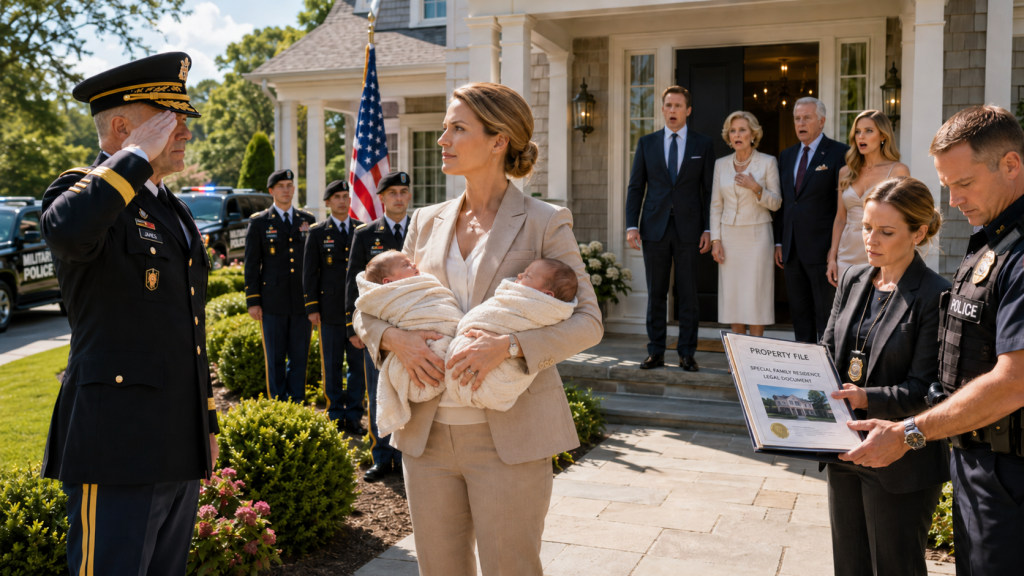
The convoy carried us away from the Vale house.
Through the rear window, I saw Marcus standing in the road.
He remained there until the house disappeared from view.
For the next two weeks, I stayed at a secure residence on a military installation while investigators examined the extent of the stolen information.
The residence was modest but comfortable, with two bedrooms, a small kitchen, and windows overlooking a quiet row of maple trees.
Sarah visited often.
General Shaw arranged temporary staff support, but I refused anything beyond what was medically necessary. I wanted to care for my children myself.
The nights were exhausting.
Noah woke hungry and impatient.
Lily slept lightly and cried whenever her brother cried.
Sometimes I stood between their bassinets at three in the morning, barely able to keep my eyes open, wondering how my life had changed so quickly.
Those were also the moments when I felt most certain.
My marriage was ending.
My family was beginning.
Marcus called repeatedly.
I did not answer.
He sent messages that moved through predictable stages.
First came confusion.
We need to talk.
Then denial.
I had no idea what Olivia was doing.
Then apology.
I should have been there when the twins were born.
Then self-pity.
Everyone thinks I’m a monster.
Finally came desperation.
Please don’t take my children away from me.
I saved every message and forwarded them to my attorney, Laura Bennett.
Laura had represented military families for more than twenty years. She was patient, direct, and nearly impossible to intimidate.
When she visited me, she placed Marcus’s divorce filing on the kitchen table.
“He wants to withdraw the petition,” she said.
“I don’t.”
“I expected that.”
“He also wants shared custody.”
Laura removed her glasses.
“That request will be considered by the court, but his behavior in the hospital, his affair, his financial instability, and the ongoing criminal investigation will all matter.”
“Can he take one of them?”
“No judge is going to divide newborn twins simply because their father demanded it during an argument.”
I released a breath I had not realized I was holding.
I had faced dangerous deployments without trembling, yet the thought of someone separating Noah and Lily filled me with terror.
Laura continued.
“There is another issue. Marcus is claiming you concealed assets and misrepresented your employment during the marriage.”
“My protected financial disclosures were handled correctly.”
“I know. Your military counsel confirmed it. Your income was deposited into the accounts disclosed in the marriage. The LLC used separate funds that predated the marriage, along with investments traceable to your family trust.”
“My grandfather created that trust.”
“And Marcus never contributed to it. The property purchase appears to be separate, although we’ll let the court decide formally.”
I looked toward the bassinets.
“What about Robert and Helen?”
“They have no ownership rights at the moment. Your company owns the property.”
“I want them to remain there under certain conditions.”
Laura raised an eyebrow.
“After everything?”
“They are the twins’ grandparents. Their behavior was cruel, but they are not responsible for Olivia’s crimes.”
“You’re more forgiving than I am.”
“I am not forgiving them. I am choosing not to make two elderly people homeless to prove I can.”
Laura smiled faintly.
“That distinction is important.”
We drafted an agreement allowing Robert and Helen to live in the house for five years, with the possibility of renewal. They would pay a modest monthly amount toward maintenance and utilities. They could not transfer, borrow against, or sublease the property.
Most importantly, Marcus could not live there without my written permission.
The condition infuriated him.
He had been staying at the house since I left because the apartment he shared with Olivia was leased in her name. After her arrest, the landlord changed the locks due to unpaid rent and suspected illegal activity.
Marcus suddenly had nowhere to go.
He had mocked me for not owning a home.
Now he was asking permission to remain in mine.
Robert called me the day after receiving the agreement.
His voice was unsteady.
“We signed it.”
“Laura told me.”
“Thank you.”
“You’re welcome.”
“I don’t deserve your kindness.”
“This is not about what you deserve.”
He was silent for a moment.
Then he said, “Marcus has been sleeping on our couch.”
“That violates the agreement.”
“I know.”
“Then he needs to leave.”
“He’s our son.”
“And I am the owner of the property.”
Robert sighed.
“He lost his job.”
I had not known that.
Marcus worked as a financial consultant for a regional investment company. His employer had suspended him when his connection to the investigation became public. After reviewing his work accounts, the company discovered that he had shared confidential client information with Olivia.
Although he had not known about her foreclosure scheme, he had sent her documents to impress her with his access.
The company terminated him.
“I’m sorry to hear that,” I said.
“Are you?”
“I am sorry he made choices that cost him his career.”
Robert understood the difference.
“He says he wants to fix the marriage.”
“The marriage cannot be fixed.”
“People make mistakes.”
“Did Helen tell you what he said to me in the hospital?”
Robert did not answer.
“He called me useless while I was recovering from childbirth. He demanded one of the babies and walked away.”
“I know.”
“That was not a moment of confusion. It was a revelation.”
“He’s ashamed.”
“Shame is about how he feels. Accountability is about what he does next.”
Robert’s voice cracked.
“What should he do?”
“That is no longer my responsibility.”
The next morning, Marcus left the house.
He rented a room above a hardware store on the other side of town.
The divorce proceedings became increasingly bitter.
Marcus’s first attorney withdrew after Marcus repeatedly ignored legal advice and contacted me directly. His second attorney attempted to portray my military rank as proof that I was too busy to raise children.
Laura dismantled that argument within minutes.
She presented my approved parental leave, childcare plan, service record, and the extensive support available to military families.
Then she introduced the hospital security footage.
The courtroom became completely silent as the video played.
Marcus entered my room carrying the envelope.
He placed it on my bed.
Although the recording did not clearly capture every word, it showed his dismissive posture, his brief glance at the bassinets, and his abrupt departure.
The nurse who had cared for me testified about what she heard.
“He called Colonel Brooks useless,” she said. “He told her another woman had accomplished more for his family. Then he said he would take one of the babies.”
Marcus stared at the table.
His attorney asked whether he had appeared emotional.
“Yes,” the nurse replied.
“Could he have been overwhelmed by becoming a father?”
“He was calm when he entered. He became angry only when Colonel Brooks refused to let him choose one infant.”
The judge looked directly at Marcus.
I saw embarrassment cross his face.
For once, there was nowhere for him to hide.
The court granted me temporary primary custody. Marcus received supervised visits twice a week, subject to review after he completed parenting classes and a psychological evaluation.
I did not celebrate.
Noah and Lily deserved a healthy father.
But they did not deserve to become tools in his attempt to regain control.
The first supervised visit took place at a family services center.
I watched through a one-way window while Marcus entered the room.
He looked thinner.
Dark circles surrounded his eyes.
A social worker showed him how to support Noah’s head. Marcus followed her directions carefully, but his hands shook.
When Lily began crying, he panicked.
“Why is she doing that?”
“She may be hungry,” the social worker said.
Marcus looked toward the window, though he could not see me.
For a moment, I almost went inside.
Then he sat down, held Lily against his chest, and began speaking softly.
I could not hear the words.
Lily gradually stopped crying.
The sight stirred something painful inside me—not love for Marcus, but grief for what might have been.
He could have been there from the beginning.
He could have held our daughter the night she was born.
He could have heard Noah’s first cry.
He had surrendered those moments for a dinner with Olivia and an opportunity to humiliate me.
Some losses could not be reversed by regret.
After the visit, Marcus waited for me in the hallway.
The social worker remained nearby.
“They’re beautiful,” he said.
“Yes.”
“Noah has your eyes.”
“He does.”
“And Lily…”
He swallowed.
“She grabbed my finger.”
“She does that.”
His eyes filled with tears.
“I missed everything.”
“You chose to.”
“I know.”
It was the first time he had admitted it without adding an excuse.
He looked down.
“I kept telling myself Olivia needed me. She made me feel important. Every time I went home, you were calm and capable. You never seemed to need anything.”
“I needed a husband.”
“I thought because you could handle everything, I didn’t have to.”
“That is not love, Marcus.”
“I know that now.”
I shifted Lily’s carrier slightly.
“What do you want from me?”
“Another chance.”
“No.”
He closed his eyes.
“I expected that.”
“Then why ask?”
“Because I needed to hear the answer while looking at you.”
I studied him.
Part of me wanted to punish him with a cruel response.
Instead, I gave him the truth.
“I hope you become a good father. You will never again be my husband.”
He nodded slowly.
“I understand.”
Understanding did not make the consequences disappear.
But it was a beginning.
Olivia’s criminal case moved quickly because Daniel agreed to cooperate with prosecutors.
He confessed that the scheme had begun nearly a year earlier after he learned Robert and Helen were struggling with medical bills and mortgage payments.
Olivia had encouraged him to intercept payments and manufacture a foreclosure crisis. She planned to present herself as the only person capable of rescuing the family.
At first, her goal had been Marcus.
She knew he was married, but she also knew he was insecure about his professional success. She praised him constantly, told him I did not appreciate him, and claimed she had connections that could make him wealthy.
Marcus responded exactly as she expected.
Once the affair began, Olivia gained access to his phone, family contacts, and personal files.
That was how she learned about my LLC.
She did not know I was a colonel, but she discovered that Amelia Brooks was connected to the company purchasing the Vale property. Because Marcus knew me as Amelia Vale, Olivia assumed Brooks was an unrelated investor.
She and Daniel broke into the basement office after the sale and found copies of documents delivered to Robert.
They planned to forge a transfer agreement, move the property into another shell company, and sell it to a developer.
Their scheme might have worked if one document had not contained a restricted government mailing address.
That single detail triggered a security review.
By the time Olivia realized Amelia Brooks and Amelia Vale were the same person, investigators were already watching her.
The military escort had not been assembled for dramatic effect.
It had been the final stage of a coordinated operation.
Olivia pleaded guilty to multiple charges in exchange for a reduced sentence. Daniel also pleaded guilty and agreed to repay stolen funds.
At her sentencing, Olivia asked to speak.
I attended remotely because I did not want to leave the twins.
She faced the camera.
For the first time, she looked ordinary.
No designer clothes.
No perfect makeup.
No admiring audience.
“I know everyone sees me as a manipulator,” she said. “But I grew up with nothing. I learned that people only value you when they think you can give them something.”
The judge listened without expression.
Olivia continued.
“When I met Marcus, he wanted to believe he deserved a better life. I gave him that belief. I didn’t force him to leave his wife.”
Her attorney touched her arm, but she kept speaking.
“He chose me.”
The words no longer hurt.
Marcus had chosen her.
That did not excuse her crimes, but it was true.
The judge sentenced Olivia to several years in federal prison, followed by supervised release and restitution.
Daniel received a shorter sentence because of his cooperation.
The Vale house remained mine.
Months passed.
Noah developed a habit of smiling whenever anyone sneezed.
Lily learned to roll over before her brother and seemed deeply offended whenever he received attention first.
My home filled with bottles, blankets, toys, and the strange exhaustion that accompanies happiness after midnight.
I returned to duty gradually.
My role shifted temporarily to strategic planning so I could remain close to the children. I had spent years believing leadership required personal sacrifice, but General Shaw reminded me that accepting support was not weakness.
“You have carried teams through impossible conditions,” she told me. “Let your team carry you for a while.”
I hired a retired Army nurse named Denise to help during working hours.
Denise was warm, disciplined, and completely unimpressed by rank.
The first morning she arrived, she found me trying to answer a secure message while warming two bottles and folding laundry.
“Colonel,” she said, taking the bottles from my hands, “you are relieved of kitchen command.”
I laughed for the first time in weeks.
Life did not become easy.
It became real.
There were court dates, sleepless nights, and moments when grief appeared without warning.
Sometimes I remembered the early years of my marriage, when Marcus waited outside during my long workdays with coffee and terrible jokes. I remembered the man who once drove six hours because I mentioned missing my grandmother’s birthday.
I wondered when that man had disappeared.
Perhaps he had not disappeared all at once.
Perhaps I had ignored each small absence until nothing remained.
The divorce was finalized eleven months after the twins were born.
Marcus did not contest the final property division.
He signed the agreement quietly.
I retained ownership of my LLC, the Vale house, and my separate assets. Marcus kept his personal retirement account and accepted responsibility for debts he had accumulated during the affair.
The court awarded us joint legal custody, but I remained the primary residential parent. Marcus received increasing visitation after completing every requirement ordered by the court.
To my surprise, he took the parenting classes seriously.
He found a new job at a small accounting office, far below the position he once held. He moved into a modest two-bedroom apartment and filled the second room with two cribs, even though the twins rarely stayed overnight at first.
He never again asked to separate them.
One afternoon, he arrived for a visit carrying a small wooden box.
“I found this at my parents’ house,” he said.
Inside was my old Army insignia.
I had stored it years earlier among personal belongings.
Marcus held it carefully.
“I should have known.”
“You should have asked.”
“Yes.”
He gave me the box.
“I’m sorry I only became interested in who you were after I lost you.”
I looked at him for a long moment.
“That may be the most honest thing you’ve ever said.”
He nodded.
“I’m trying.”
“I can see that.”
His expression lifted slightly.
It was not forgiveness.
But it was acknowledgment.
For the children’s sake, that was enough.
Robert and Helen changed as well.
Helen wrote me a letter every week for three months before I agreed to meet her.
She never demanded a response.
In the letters, she described the ways she had dismissed me.
She admitted that she liked Olivia because Olivia made her feel important. Olivia arrived with flowers, compliments, and dramatic promises. I arrived quietly with groceries, paid medical invoices anonymously, and repaired problems before anyone noticed them.
Helen had mistaken performance for love.
When we finally met, she sat across from me in a small café.
“I don’t expect you to forgive me,” she said.
“Good.”
Her eyes filled with tears, but she nodded.
“I deserve that.”
“This is not about punishment, Helen. I need you to understand that access to my children depends on your behavior.”
“I understand.”
“You will not criticize me in front of them. You will not use them to pressure Marcus and me to reconcile. And you will never compare Lily and Noah or treat one as more valuable than the other.”
“I won’t.”
“If you do, the visits stop.”
She agreed.
Over time, I allowed supervised visits.
Robert held Noah as though he were something sacred.
Helen cried when Lily fell asleep in her arms.
They never asked me to forget.
That made it possible to move forward.
A year after the confrontation at the house, I returned to the property alone.
The street was quiet.
There were no military vehicles, police cruisers, or watching neighbors.
Only autumn leaves moving across the sidewalk.
Robert opened the door.
“You didn’t say you were coming.”
“I was nearby.”
Helen appeared from the kitchen.
For a moment, none of us knew what to say.
Then Robert invited me inside.
The house looked almost exactly as it had before.
Family photographs lined the hallway. The old clock still ticked above the fireplace. A repaired patch of wood marked the place where officers had opened the basement wall.
Helen poured tea.
I walked into the dining room where they had once celebrated Olivia for saving the house.
The same chandelier hung above the table.
I imagined Marcus beside her, raising a glass while I labored alone in a hospital.
The memory no longer controlled me.
It was only a memory.
Robert stood beside me.
“I think about that night often,” he said.
“So do I.”
“We were sitting here celebrating a lie while you were alone.”
“Yes.”
“I don’t know how to live with that.”
“You live differently.”
He looked at me.
“That’s all?”
“That’s everything.”
True remorse did not exist in speeches.
It existed in changed behavior repeated over time.
Helen joined us.
“We want to ask you something.”
I waited.
“When the five-year agreement ends, we’d like the house to become a home for military families,” she said. “Maybe families receiving medical treatment nearby. We don’t want to profit from it.”
I was surprised.
Robert continued.
“We’ve had forty years here. More than enough. What you did gave us time we didn’t deserve. We want that time to mean something.”
I looked around the room.
For years, the house had represented their history.
Then it became a symbol of betrayal.
Perhaps it could become something else.
“I’ll have my attorney explore it,” I said.
Helen smiled through tears.
“Thank you.”
Two years later, the Vale Family Transitional Residence opened its doors.
The house was renovated to support military families traveling for treatment, temporary assignments, or emergency relocation.
Robert and Helen moved into a smaller apartment nearby and volunteered at the residence twice a week.
A plaque near the entrance read:
THIS HOME IS DEDICATED TO FAMILIES WHO SERVE IN SILENCE.
No one placed my name on it.
I did not want them to.
On the opening day, I stood on the lawn holding Lily’s hand while Noah tried to escape toward a table of cookies.
Marcus caught him before he reached it.
“Not before lunch,” he said.
Noah protested loudly.
Lily laughed.
Marcus carried him back to me.
Our relationship had become something neither of us could have imagined during the divorce.
We were not friends exactly.
We were parents who had learned to speak honestly.
He no longer tried to impress me.
I no longer expected him to become the man I had once imagined.
He attended therapy, maintained his job, and never missed a scheduled visit.
He had earned more time with the children, not because he demanded it, but because he proved he could care for them.
As families toured the renovated house, Marcus stood beside me.
“You created something good from all of this,” he said.
“We all did.”
“No. You did. The rest of us finally stopped getting in the way.”
I glanced at him.
“That almost sounded wise.”
He smiled.
“I’m developing slowly.”
General Shaw approached in dress uniform.
She had recently announced her retirement.
The twins adored her and called her Aunt Evelyn, despite her repeated attempts to teach them to say General.
Lily immediately released my hand and ran toward her.
General Shaw lifted her with a smile.
Noah followed, still focused on the cookies.
Marcus watched them.
“Are you leaving again?” he asked.
He meant deployment.
“Not yet.”
“Will you tell me when you do?”
“When it affects the children, yes.”
He accepted the boundary.
There had been a time when he believed my secrecy was an insult to him.
Now he understood that some information was not mine to share.
More importantly, he understood that trust did not mean ownership.
As the ceremony began, I stood before the gathered families.
I had spoken to soldiers, diplomats, and government officials. I had delivered briefings under pressure and commands during crises.
Yet looking at the families gathered on that lawn made my voice catch.
“This house was almost lost because people used fear, secrecy, and pride against one another,” I began. “But a home is more than property. It is the place where people should be able to recover their strength.”
I looked toward Robert and Helen.
They stood together near the porch.
Then I looked at Marcus.
He held Noah in one arm while Lily clung to his hand.
“Service is often misunderstood,” I continued. “People imagine medals, uniforms, and ceremonies. But most service happens quietly. It is a parent staying awake beside a sick child. It is a neighbor bringing food without expecting recognition. It is a family choosing to begin again after everything familiar has changed.”
The crowd remained silent.
“This residence belongs to those quiet acts. May every family who enters know that needing help does not make them weak, and receiving help does not make them indebted.”
When I finished, General Shaw saluted.
The soldiers attending followed.
This time, I did not stand before them as a woman revealing a hidden identity to people who had underestimated her.
I stood as myself.
A colonel.
A mother.
A survivor of betrayal.
A woman who no longer confused silence with peace.
After the ceremony, Robert approached me.
“There’s something inside for you.”
He led me to the room that had once been his office.
On the wall hung a framed photograph.
It showed me returning from deployment years earlier, wearing my uniform. I stood beside my grandfather, who had also served.
I had forgotten the photograph existed.
“Marcus found it in storage,” Robert explained.
Beneath it was a small inscription.
COLONEL AMELIA BROOKS—WHO SAVED THIS HOME BEFORE ANYONE KNEW IT NEEDED SAVING.
I stared at the words.
“I said I didn’t want my name on the plaque.”
“It isn’t on the plaque.”
I gave him a look.
He smiled carefully.
“We thought this room could be named for you.”
I considered refusing.
Then Lily ran inside.
“That’s Mommy!” she shouted, pointing at the photograph.
Noah followed.
“Mommy soldier!”
I knelt beside them.
“Yes,” I said. “That’s Mommy.”
Lily studied the uniform.
“Were you strong?”
The question touched something deep inside me.
I thought about all the years I believed strength meant carrying every burden without complaint. I thought about giving birth alone, signing divorce papers without tears, and standing in front of the Vale house with soldiers behind me.
But those were not the only moments that required strength.
Strength had also meant admitting I was not all right.
It had meant accepting help.
It had meant allowing Marcus to become a father without permitting him to become my husband again.
It had meant giving Robert and Helen a path toward redemption while protecting myself from further harm.
It had meant building a life without needing anyone who had hurt me to regret losing access to it.
“Sometimes,” I told Lily, “being strong means knowing when to speak.”
She nodded as if she understood completely.
Children often accepted truths adults spent years resisting.
Marcus stood in the doorway.
His eyes moved from the photograph to me.
“I remember when that was taken,” he said.
“You weren’t there.”
“No. But you had it in your apartment when we first met. I asked who the man beside you was.”
“My grandfather.”
“You said he taught you everything about duty.”
“He did.”
Marcus looked ashamed.
“I should have asked about the uniform.”
“Yes.”
“I thought it was a costume from some ceremony.”
I almost laughed.
“You believed what was easiest.”
“I did.”
He crouched beside Noah.
“Your mother is the strongest person I know.”
Noah looked at me solemnly.
“Stronger than General?”
General Shaw, standing just outside the room, heard him.
“Absolutely not,” she called.
The room filled with laughter.
It was a simple moment.
No accusations.
No secrets.
No one pretending the past had not happened.
That was what healing looked like.
Not forgetting.
Not returning to what existed before.
Building something honest from what remained.
Later that evening, after the guests left, I drove home with the twins asleep in the back seat.
The sunset stretched across the sky in shades of gold and deep red.
At a traffic light, I caught my reflection in the mirror.
For years, I had lived as two people.
Colonel Brooks wore the uniform, made decisions, and carried responsibility.
Amelia Vale smiled through family dinners, minimized her achievements, and accepted being underestimated because explaining herself felt exhausting.
Now there was only Amelia Brooks.
I no longer needed to divide strength from tenderness.
I no longer apologized for taking up space.
When we reached home, I carried Noah inside first, then returned for Lily.
She woke as I lifted her.
“Mommy,” she murmured.
“I’m here.”
Those two words had become the foundation of everything.
I’m here.
Not at someone else’s celebration.
Not hiding behind a marriage that demanded my silence.
Not waiting for a selfish man to recognize my worth.
I was here for my children.
I was here for myself.
Inside, I placed Lily in bed beside her brother.
Their breathing settled into the same peaceful rhythm.
On the dresser stood the wooden box Marcus had returned to me.
I opened it and touched the old insignia.
The metal reflected the light from the hallway.
I remembered the day Marcus entered my hospital room, dropped divorce papers on my bed, and called me useless.
At the time, he believed he was taking away my future.
In reality, he had released me from a life in which I had become smaller to make him comfortable.
He thought my silence meant weakness.
Olivia thought kindness made me easy to deceive.
Robert and Helen thought importance announced itself with expensive clothes and dramatic promises.
They were all wrong.
Power did not always enter a room loudly.
Sometimes it sat beside a hospital bassinet, signed its name, and made one phone call.
Sometimes it arrived three days later with military vehicles, senior officers, and law enforcement.
And sometimes, after the uniforms were stored away and the courtroom doors closed, power looked like a mother holding two sleeping children in a quiet home she had built for herself.
I closed the wooden box.
Then I turned off the light and walked toward my children.
The house was peaceful.
Not because I had stayed silent.
Because I had finally spoken.
THE END! THANK YOU FOR READING!