

The car stopped on the driveway, and for a moment, nobody moved.
I watched my parents sit inside the vehicle, staring at the house they never imagined I could own. My father’s hands remained on the steering wheel. My mother looked up at the enormous windows reflecting the afternoon sun, and I could almost see the questions forming behind her eyes.
For years, they had been certain they understood my life.
They thought they knew my limits.
They thought they knew my place.
But standing there, looking at the home I had quietly built for myself, they were seeing something they had never bothered to notice.
They were seeing me.
The front door opened slowly, and Mom stepped inside first.
Her eyes immediately traveled upward.
The marble staircase.
The handcrafted wooden railing.
The artwork lining the hallway.
The view of the lake stretching beyond the glass walls.
Everything about her expression changed.
This was the same woman who had looked at my old apartment and told relatives I was “still figuring things out.” The same woman who had compared my career, my clothes, my car, and even my vacations to Vanessa’s.
But now she stood inside a house she had never thought I could achieve.
“Nora,” she whispered.
I smiled politely.
“Tea is ready.”
She looked confused.
That was the funny thing about people who underestimate you. They expect a dramatic reaction when you finally prove them wrong. They expect anger. They expect revenge. They expect you to throw every insult back at them.
But I had spent too many years building this moment to waste it on bitterness.
Dad walked in behind her, silent.
He had always been the quieter one. He rarely insulted me directly, but his silence had always supported Mom’s words. When she said Vanessa was the successful one, he nodded. When she said I needed to be more realistic, he agreed.
He looked around the room carefully.
“How much did this cost?” he finally asked.
I poured tea into the cups.
“That’s the first thing you ask?”
He looked uncomfortable.
“I’m just curious.”
“No,” I said calmly. “You’re surprised.”
Nobody answered.
Because I was right.
The truth was, the money had never been the most interesting part.
The interesting part was that I had learned something years ago.
People only value what they can see.
My family saw Vanessa’s mansion because she invited everyone over every weekend. She posted pictures online. She showed off the kitchen, the pool, the designer furniture.
And there was nothing wrong with that.
Vanessa had worked hard too.
But my family had made her success a measurement of my failure.
That was the part that hurt.
Not that my sister had a beautiful home.
Not that my parents admired her.
It was that they believed there was only room for one successful child.
Vanessa entered the room slowly behind them.
She still looked shaken.
“Mom,” she said quietly.
Mom turned.
“What?”
Vanessa glanced at me.
Then back at her.
“She didn’t tell anyone.”
Dad frowned.
“Tell anyone what?”
Vanessa pointed toward the framed deed.
“She bought this before dinner last week.”
The room went quiet again.
Mom looked at me.
“You already owned this when we said those things?”
“Yes.”
Her face changed.
Not anger.
Not sadness.
Something worse.
Embarrassment.
“You let us talk about you like that?”
I placed the teapot down.
“You were never asking about my plans.”
Mom opened her mouth, but no words came out.
“You were comparing me,” I continued. “There’s a difference.”
Vanessa looked down.
For the first time, she seemed uncomfortable hearing the truth.
Because she knew.
She knew every family dinner where my accomplishments were ignored.
Every holiday where someone mentioned her new purchase but forgot mine.
Every conversation where I became the example of what not to do.
I walked toward the folder on the table.
“There’s something else you should know.”
Dad looked up.
“What?”
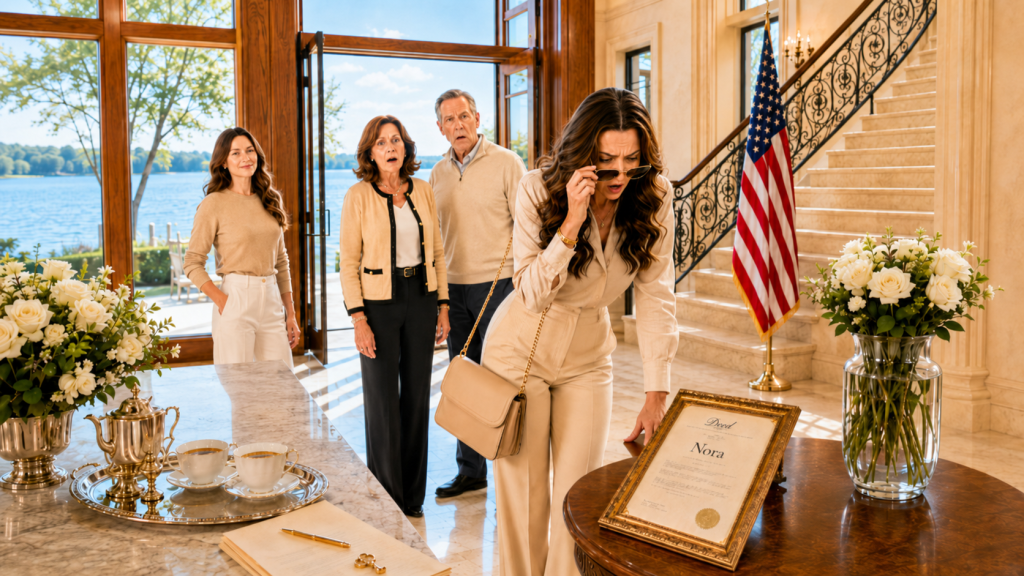
I opened the folder and pulled out another document.
Not the deed.
Not the renovation papers.
Something older.
Something that explained why this house mattered.
I placed it on the table.
Mom picked it up.
Her eyes moved across the page.
Then stopped.
“What is this?”
“It’s the original ownership history.”
Dad leaned closer.
I watched their expressions change as they read.
The lake house had belonged to my grandmother.
Their mother.
My grandmother had lived there for almost thirty years before she passed away.
But nobody in my family talked about the house anymore.
Because after her death, everyone assumed it had been sold.
Everyone except me.
I remembered visiting that house as a child.
I remembered sitting beside the lake with my grandmother while she taught me how to skip stones.
I remembered the old wooden dock.
The garden she cared for.
The small room upstairs where she kept her journals.
But after she died, nobody wanted the responsibility.
The property needed repairs.
The taxes were complicated.
The paperwork was messy.
So everyone walked away.
Everyone except me.
Mom slowly lowered the document.
“You knew?”
“I found the records.”
Dad looked shocked.
“But the house was abandoned.”
“No,” I said. “It was forgotten.”
That sentence stayed in the room.
Because sometimes people don’t lose valuable things.
They simply stop looking.
I had spent months tracking the ownership records, resolving old paperwork, and negotiating with the estate representatives.
The house wasn’t easy to buy.
There were legal issues.
Maintenance problems.
Years of neglect.
But I saw something nobody else saw.
I saw my grandmother’s home.
I saw potential.
And most importantly, I saw something worth saving.
Vanessa walked closer.
“You bought Grandma’s house?”
I nodded.
She looked toward the lake.
“I didn’t know.”
“No one did.”
“Why?”
I looked at her.
“Because nobody asked.”
Her face softened.
And for the first time in years, my sister looked less like my competitor and more like the person I remembered growing up with.
Before everything became a comparison.
Before our parents turned our lives into a scoreboard.
Before success became something we had to fight over.
Mom sat down slowly.
“I don’t understand.”
I smiled sadly.
“I know.”
And that was the hardest truth.
They didn’t understand because they never tried.
They had been so focused on judging the life I had that they never noticed I was creating a different one.
A better one.
A quieter one.
A life that didn’t need approval.
Dad looked around the room again.
“You restored all of this?”
“Yes.”
“By yourself?”
“With help.”
“Why didn’t you ask us?”
I almost laughed.
Not because it was funny.
Because the answer was obvious.
“Would you have believed me?”
Nobody spoke.
Because they knew.
They wouldn’t have.
They would have told me I was dreaming.
They would have warned me about risks.
They would have reminded me that Vanessa already had the successful life.
And maybe that was why I kept it secret.
Not because I wanted to surprise them.
Because I wanted to protect my dream from their doubts.
I looked out toward the lake.
The same lake where I once sat as a child.
The same place where my grandmother told me something I never forgot.
She had said, “Nora, never let someone else decide the size of your future.”
At the time, I thought she was talking about money.
I was wrong.
She was talking about belief.
And now, standing in the home I saved, I finally understood.
The greatest thing I had built wasn’t the house.
It was the confidence to believe I deserved one.
The room remained silent after I finished speaking.
For the first time in years, nobody had a comparison ready.
Nobody had a criticism.
Nobody had a reason why my choices were wrong.
They were simply standing there, looking at the result of something they never believed I could accomplish.
Mom slowly placed the document back on the table.
“I remember this house,” she said quietly.
I looked at her.
“You do?”
She nodded.
“Of course I do.”
Her voice softened.
“Your grandmother loved this place.”
I watched her eyes move toward the lake.
“She used to sit outside every morning with her coffee. She would complain about the birds eating her flowers, but then she would leave seeds out for them anyway.”
A small smile appeared on her face.
It was the first genuine smile I had seen from her that day.
“She always said this house would stay in the family.”
The words hung in the air.
I looked at the deed again.
“It almost didn’t.”
Mom looked at me.
“What do you mean?”
I walked toward the window.
“When I found the records, I discovered the property was close to being sold. Nobody had maintained the paperwork. There were unpaid fees, old disputes, and legal complications.”
Dad frowned.
“So you fixed all of that?”
“Yes.”
“How long did it take?”
“Almost eighteen months.”
Vanessa looked surprised.
“Eighteen months?”
I nodded.
“I spent nights reading documents. Weekends meeting with lawyers. I called offices nobody wanted to deal with. I followed every detail because I knew what this place meant.”
I paused.
“Not because it was expensive.”
My eyes moved around the room.
“Because it was home.”
Nobody spoke.
The irony was almost painful.
My parents had spent years believing I wanted what Vanessa had.
The bigger house.
The luxury car.
The expensive lifestyle.
But they never realized I wanted something completely different.
I wanted something that mattered.
Something with history.
Something that belonged to me.
Something that wasn’t purchased to impress anyone.
Vanessa walked toward the old wooden cabinet near the fireplace.
She ran her fingers along the restored surface.
“This was Grandma’s, wasn’t it?”
“Yes.”
“I remember this.”
Her voice became quieter.
“She kept old photographs inside.”
I smiled.
“I found them.”
Vanessa turned around.
“You did?”
I nodded and opened another drawer beneath the cabinet.
Inside were dozens of carefully restored photographs.
Pictures of our grandmother.
Pictures of our parents when they were young.
Pictures of family holidays.
And pictures of us as children.
Vanessa picked one up.
It was an old photo of the two of us sitting on the dock.
She was holding a fishing pole.
I was holding a bucket full of rocks because I had refused to catch fish and insisted the rocks were “treasures.”
She laughed softly.
“I forgot about this.”
“I didn’t.”
Her expression changed.
“Why?”
I looked at the picture.
“Because those were the days before we were competing.”
That sentence hit harder than anything else.
Vanessa looked away.
Mom became uncomfortable.
Because everyone in that room knew what happened.
Somewhere along the way, we stopped being sisters.
We became rankings.
Vanessa was the successful one.
I was the practical one.
Vanessa was the dreamer.
I was the one who needed to be realistic.
Those labels followed us for years.
But nobody ever asked if they were true.
“Nora,” Vanessa said quietly.
I looked at her.
“I’m sorry.”
The words surprised me.
Not because I didn’t think she meant them.
But because I never expected to hear them.
She took a breath.
“I know I acted like I was better than you.”
I stayed quiet.
She continued.
“I thought because I had the bigger house, the better neighborhood, and the things people noticed, that meant I was winning.”
She looked around.
“But I never knew what you were building.”
I nodded slowly.
“That was the point.”
She smiled sadly.
“You really kept this from everyone.”
“I needed one thing in my life that belonged only to me.”
That was the truth.
For years, every decision I made became a family discussion.
If I changed jobs, they questioned it.
If I moved, they questioned it.
If I saved money instead of spending it, they questioned it.
So when I found the lake house, I made a promise to myself.
I would not announce it.
I would not seek approval.
I would simply do it.
And then, when the time was right, I would open the door.
Not to show off.
To finally let them see.
Dad walked toward the window.
“You know,” he said, “I always thought you were afraid to take risks.”
I almost smiled.
“I was.”
He turned.
“But I learned something.”
“What?”
“Being afraid and doing it anyway are not the same thing.”
My father looked down.
“I should have seen that.”
That was probably the closest thing to an apology I had ever heard from him.
Not perfect.
Not dramatic.
But real.
Mom sat quietly for several minutes.
Then she asked the question I knew was coming.
“Why didn’t you tell us you were buying Grandma’s house?”
I looked at her.
“Because I knew what you would say.”
She looked hurt.
“What would we say?”
I answered honestly.
“You would tell me it was too much. You would tell me Vanessa was already doing better. You would tell me I should buy something smaller.”
Mom looked away.
Because she knew.
She had said those exact things before.
The difference was that this time, she couldn’t pretend they were advice.
They were doubt.
And doubt from people you love hurts more than criticism from strangers.
The sun began setting over the lake.
The golden light filled the room.
For a moment, everyone was quiet.
Then Vanessa walked toward me.
“I want to ask you something.”
“Okay.”
“Can we come here again?”
I looked surprised.
She smiled.
“Not because of the house.”
She looked toward the old photographs.
“Because I miss this.”
I knew exactly what she meant.
She missed the version of us before jealousy.
Before expectations.
Before everyone decided our worth based on what we owned.
I nodded.
“Of course.”
Mom looked at me.
“And us?”
The question was harder.
Because forgiveness is complicated.
You can love people and still remember what they did.
You can understand someone and still need time.
I looked at my parents.
“I don’t know yet.”
Mom lowered her eyes.
And for once, she didn’t argue.
She didn’t defend herself.
She accepted the answer.
That mattered.
Because change doesn’t happen when someone is forced to apologize.
It happens when they finally understand they caused damage.
That evening, after they left, I stood alone by the lake.
The house was quiet again.
But this time, it felt different.
It wasn’t empty.
It was peaceful.
I touched the old wooden railing of the dock.
The same dock where my grandmother once held my hand and told me I was capable of more than anyone realized.
I finally understood something.
The people who underestimate you are often the people who only know your past.
They don’t know the nights you stayed awake planning.
They don’t know the sacrifices you made.
They don’t know the courage it took to keep going when nobody believed in you.
And maybe that was okay.
Because your future does not require everyone’s permission.
A few weeks later, something unexpected happened.
Mom called me.
Not to ask about the house.
Not to compare me to Vanessa.
Just to talk.
At first, I was suspicious.
Old habits are hard to break.
But slowly, our conversations changed.
She asked about my work.
She asked about the renovations.
She asked about the garden I was rebuilding.
And one afternoon, she said something I never expected.
“I’m proud of you.”
I stayed silent.
Because those words were something I had wanted to hear for years.
But now that I heard them, I realized something important.
I had already become proud of myself.
I didn’t need those words anymore.
I appreciated them.
But I no longer depended on them.
That was the real victory.
Not the house.
Not the lake view.
Not the deed with my name on it.
The real victory was becoming someone who knew her own value before anyone else recognized it.
Months later, I invited my family back to the lake house.
This time, there was no surprise.
No secret.
No lesson to prove.
Just dinner.
Just family.
Vanessa brought dessert.
Dad brought a bottle of wine.
Mom brought an old photo album.
We sat outside as the sun disappeared behind the water.
And for the first time in a long time, nobody compared anything.
Nobody talked about who had more.
Nobody talked about who was ahead.
We simply remembered.
And maybe that was the thing I had been searching for all along.
Not a bigger house.
Not a better life than my sister’s.
Just a place where I belonged.
A place where I could finally breathe.
A place I built with my own hands, my own courage, and my own belief.
The same people who once told me I would never own a home like my sister’s were now sitting at my table, watching the sunset from my backyard.
But I didn’t need them to admit they were wrong.
Because I already knew the truth.
I was never trying to become Vanessa.
I was never trying to win.
I was simply trying to become myself.
And that was something nobody could ever take away from me.
THE END! THANK YOU FOR READING!