

The eviction was handed down with the casual, merciless indifference of a morning weather forecast.
“Clara, pack your belongings.”
My mother did not even look up from the granite kitchen island. She stood there in a silk robe, mechanically stirring heavy cream into her coffee while the television played soft jazz behind her.
I remained frozen in the kitchen doorway.
Only six hours had passed since we buried my husband.
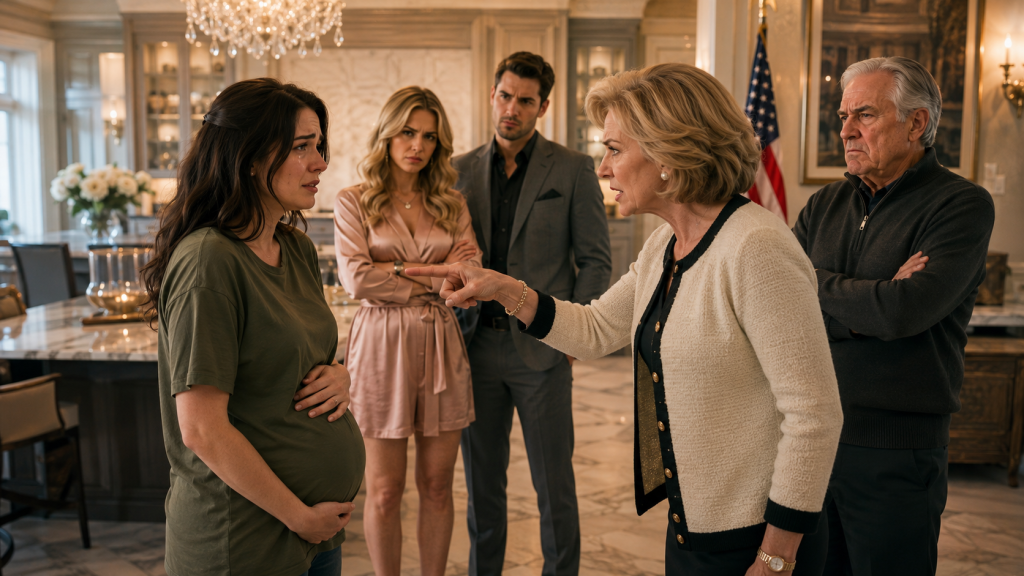
I was twenty-five years old, eight months pregnant, and so exhausted that every bone in my body seemed filled with wet sand. Beneath my black funeral coat, I wore a faded army-green T-shirt that had belonged to David. My hands instinctively wrapped around my swollen stomach as our baby shifted beneath my ribs.
“What are you talking about?” I asked.
Mother finally raised her eyes.
“Your sister and Julian are moving in today,” she said. “They require your bedroom for Julian’s home office and gaming equipment. You will sleep in the garage.”
For several seconds, my mind refused to process her words.
“The garage?”
“Yes, Clara. The garage.”
“It’s ten degrees outside.”
“There’s a camping cot in the utility closet.”
I stared at her, waiting for the cruel punch line.
None came.
“Mom, I’m eight months pregnant.”
My father lowered his newspaper at the dining table. His face carried the same irritated expression he used whenever a waiter made him wait too long for a refill.
“You contribute absolutely nothing to the overhead of this household,” he said. “Since David died, you’ve done nothing but hide in that room, cry, and stare at your computer. Your grief is affecting everyone.”
“My husband was buried today.”
“And your crying is ruining the atmosphere,” Dad snapped. “We are trying to move forward. Chloe deserves a comfortable place to begin her marriage.”
The front door opened before I could answer.
A cloud of expensive floral perfume entered the house, followed by my younger sister, Chloe, and her husband of three months.
Chloe wore white trousers, a camel-colored coat, and sunglasses large enough to hide half her face. Julian followed her carrying a leather laptop case in one hand and the keys to his silver Audi in the other.
He was a regional sales director for Arcturus Defense Systems, a military contractor that supplied communications equipment to the Department of Defense. He spoke constantly about classified projects he was not important enough to understand and referred to soldiers as “end users.”
He had attended David’s funeral in a tailored charcoal suit and spent most of the service checking his phone.
“Oh,” Chloe said when she saw me. “You haven’t packed yet.”
I looked at her.
She removed her sunglasses and sighed dramatically.
“Please don’t create another emotional scene, Clara. Julian needs quiet when he works. Your room has the best natural light, and the garage is perfectly adequate for a few weeks.”
“A few weeks?”
“Or months,” Julian said. “Depending on when you find somewhere else.”
My mother crossed her arms.
“Your sister’s husband has a demanding career. He supports a household. You sit around grieving and expecting everyone to accommodate you.”
I felt my son kick hard against my palm.
David had never known we were having a boy.
I had discovered the pregnancy two days before his final deployment. I planned to tell him when he returned because I wanted to see his face rather than deliver the news through a secure, monitored call.
He never returned.
His team had been trapped during an extraction in a mountain region whose name remained classified. A hostile electronic-warfare signal had jammed their communications and blocked their request for air support.
By the time backup reached them, three soldiers were dead.
David was one of them.
For seven months, I had carried our child and the unbearable knowledge that his father died without knowing he existed.
Now, hours after lowering my husband’s flag-draped casket into the earth, my family was ordering me into a freezing garage because my grief disturbed their mood.
Chloe touched my shoulder with two polished fingers.
“Look at it positively,” she said. “You’ll have privacy.”
I looked from my sister to Julian, then to my parents.
Something inside me became quiet.
The begging version of me—the daughter who spent her childhood trying to earn affection, the sister who always surrendered the larger bedroom, the widow who apologized for crying—simply disappeared.
“Okay,” I whispered.
Mother blinked.
She had expected resistance.
“Excellent,” she said. “Do try to keep your belongings along the wall. Julian will park his Audi in the center.”
I turned and walked upstairs.
Behind me, Chloe began discussing where she wanted to place Julian’s desk.
I packed with clinical precision.
Three pairs of maternity trousers.
Two sweaters.
My medical records.
David’s folded funeral flag.
A framed photograph from our wedding.
My encrypted server laptop.
A small metal case containing six external drives.
Finally, I lifted David’s silver dog tags from the bedside table and fastened them around my neck.
The tags rested against my heart.
I dragged my suitcase downstairs while my family measured the bedroom walls for new shelves.
No one offered to help me.
In the garage, the temperature was barely above freezing. The concrete floor smelled of motor oil, old paint, and damp cardboard. A camping cot stood between a lawn mower and a stack of Christmas decorations.
My parents had placed one thin blanket on it.
I lowered myself carefully and pressed both hands over my stomach.
“I’m sorry,” I whispered to my unborn son. “You deserved better than this.”
The side door slammed as Julian entered.
He carried a box filled with computer monitors.
“Move your things farther back,” he said. “I don’t want anything scratching the car.”
I looked at him without speaking.
His gaze moved to the laptop beside me.
“That looks serious,” he said. “What do you do on that thing all day?”
“Work.”
He laughed.
“Sure.”
He set down the box and crouched beside the electrical outlet.
“Your parents told me you studied computers for a while.”
“Aerospace systems engineering.”
“Right. Before you dropped out.”
“I graduated.”
His smile tightened.
“From where?”
“Massachusetts Institute of Technology.”
He stared at me for a fraction of a second, then laughed again.
“Your family never mentioned that.”
“They never asked.”
He examined my face as though trying to decide whether I was joking.
Then his attention shifted to David’s dog tags.
“I heard your husband’s unit was using experimental communications hardware when they got hit,” he said.
Every muscle in my body stiffened.
“That information is classified.”
Julian shrugged.
“I work in the industry. People talk.”
“What people?”
He smiled.
“Relax, Clara. I’m making conversation.”
He returned to the house, leaving the door ajar.
Cold air swept into the garage.
I rose, closed the door, and locked it.
Then my encrypted phone vibrated.
The device had no brand name and no ordinary telephone number. David had given it to me two years earlier and told me never to let it leave my possession.
A single notification illuminated the screen.
TRANSFER COMPLETE.
HOSTILE ACQUISITION FINALIZED.
DEPARTMENT OF DEFENSE LEVEL FOUR CLEARANCE ACTIVE.
VANGUARD AEROSPACE BOARD APPOINTMENT CONFIRMED.
ARMED SECURITY ESCORT ARRIVING AT 0800.
WELCOME, MADAM CHIEF EXECUTIVE OFFICER.
Below the message was a second encrypted attachment.
It contained the final audit from the acquisition of Arcturus Defense Systems.
I opened it.
Page after page displayed financial records, internal communications, access logs, and security violations discovered during the takeover.
My pulse quickened as I reached a section marked CRITICAL NATIONAL SECURITY EXPOSURE.
An executive credential had been used to transfer restricted communications architecture to an unauthorized foreign intermediary.
The credential belonged to Julian Mercer.
His photograph appeared beside the employee record.
I continued reading.
The transfer occurred forty-eight hours before David’s unit was ambushed.
The compromised files contained the precise operating frequencies of the prototype radio David had been carrying.
I covered my mouth.
For seven months, I had known David’s communications failure was not accidental. I had suspected sabotage, but suspicion was not proof.
Now I was staring at proof.
A final note from the Department of Defense investigative team appeared at the bottom of the audit.
PERSON OF INTEREST REMAINS UNAWARE.
DO NOT CONFRONT.
FEDERAL WARRANT PENDING.
My son moved beneath my hands.
A slow, cold certainty replaced the grief in my chest.
My family believed they had exiled a helpless widow to a freezing garage.
They had no idea they had locked me in a room with the evidence that could destroy Julian.
They had no idea I had spent the last seven months building the company that had just acquired his employer.
Most importantly, they had no idea who I really was.
I had met David when I was twenty-one.
At the time, I was completing a graduate research project involving adaptive communications systems capable of automatically changing frequencies during electronic attacks.
David attended a demonstration with a military technology assessment team. Unlike the executives who treated me like a nervous student, he listened.
He understood immediately what the system could mean for soldiers trapped without communications.
Afterward, he waited outside the laboratory and asked whether he could buy me coffee.
Three months later, we were engaged.
A year after that, we were married in a small ceremony near Fort Bragg.
Together, we founded Vanguard Aerospace.
The company began with my software, David’s operational experience, and money from a retired general named Marcus Hayes, who believed battlefield communications should be designed by people who understood what failure cost.
For security reasons, my name remained buried behind trusts and holding companies. David became the public military adviser while I served as Vanguard’s chief systems architect.
My parents knew I worked “with computers,” but they never cared enough to ask for details.
Chloe once told her friends I repaired websites.
When David died, his controlling shares transferred to me. General Hayes urged me to step forward as CEO immediately, but I refused.
I wanted the people responsible for the communications breach to believe I was broken.
So I moved into my parents’ house.
I wore old clothes.
I let them think I had no income.
Every night, behind my locked bedroom door, I ran secure meetings, reviewed acquisition documents, and helped federal investigators trace the stolen signal architecture.
The hostile purchase of Arcturus had been the final move.
Now the trap had closed.
I slept for less than an hour.
At 7:45 the next morning, I folded the thin blanket and placed it neatly on the cot. I changed into a black maternity dress, pulled on a tailored wool coat, and tied my hair into a low knot.
David’s dog tags remained around my neck.
At precisely 8:00, engines thundered outside.
The garage door trembled.
My father shouted from the living room.
“What in God’s name is happening?”
I pressed the remote.
The garage door rose slowly.
Four matte-black armored SUVs filled the driveway. Two additional vehicles blocked the street. Security officers wearing dark tactical uniforms stepped out first, scanning the property.
Behind them came six soldiers in formal combat uniforms bearing the insignia of David’s former Special Forces command.
At the center of the convoy stood General Marcus Hayes.
His silver hair was cut short, and his dark overcoat carried four stars at the shoulders. Beside him were two federal agents and a woman holding a medical bag.
My mother appeared in the doorway clutching her coffee.
Chloe pushed past her.
Julian followed, tying the belt of an expensive robe.
“What is this?” he demanded. “You’re blocking my car.”
No one answered him.
General Hayes walked directly into the garage.
I stepped forward.
He stopped in front of me and raised his hand in a formal salute.
“Madam CEO,” he said. “Your security detail is prepared. Vanguard headquarters has been secured, and the board is waiting.”
The entire driveway became silent.
I returned the salute the way David had taught me.
“Thank you, General.”
The military physician approached.
“Mrs. Hale, I’m Colonel Ramirez. Before transport, I need to check you and the baby. We were informed you spent the night in an unheated structure.”
General Hayes turned slowly toward my parents.
“You made her sleep here?”
Mother’s lips parted.
“It wasn’t like that.”
“It was ten degrees,” I said.
My father stepped forward.
“This is our private family matter. Who are you people, and why are you referring to Clara as a CEO?”
General Hayes looked at him with open contempt.
“Your daughter is the majority owner and newly appointed chief executive officer of Vanguard Aerospace, the largest independent secure-communications developer contracted by the United States military.”
Dad laughed once.
It was a nervous, disbelieving sound.
“That’s impossible.”
General Hayes gestured toward the armored vehicles.
“Does this appear impossible?”
Chloe stared at me.
“You own Vanguard?”
“Controlling interest,” I said. “As of midnight, Vanguard also owns Arcturus Defense Systems.”
Julian’s expression changed.
The arrogance vanished from his face so quickly that it was almost frightening.
“No,” he said.
I turned toward him.
“Yes.”
“That acquisition was a rumor.”
“It closed last night.”
“You can’t simply purchase a defense contractor.”
“You can when its shareholders approve the sale, its debt has become unsustainable, and its board is facing a federal security inquiry.”
Julian took one step backward.
The federal agents noticed.
One of them, a tall woman with a navy coat, removed a document from her folder.
“Julian Mercer?”
He looked toward the side gate.
Two security officers moved into position.
“What is this?” Chloe asked.
The agent displayed her identification.
“Special Agent Nina Cole, Department of Defense Criminal Investigative Service. Mr. Mercer, we have a warrant to search your electronic devices, vehicle, luggage, and any location under your control.”
Julian lifted both hands.
“There has been a mistake.”
Agent Cole’s expression did not move.
“Place your phone on the ground.”
He looked at me.
“This is your doing.”
“No,” I said. “Your own access records did this.”
His face drained of color.
My father moved between us.
“Wait. Julian is family.”
Agent Cole looked at him.
“Step aside, sir.”
“He’s a respectable executive.”
“He is the subject of an investigation involving unlawful transmission of controlled military technology, conspiracy, bribery, and actions that may have contributed to the deaths of American service members.”
My mother dropped her coffee cup.
It shattered on the concrete.
Chloe grabbed Julian’s arm.
“What is she talking about?”
“Nothing,” he said quickly. “It’s corporate politics. Clara is angry about the bedroom.”
I nearly laughed.
Agent Cole read from the warrant.
“Restricted communications files were accessed using your credentials, your biometric authorization, and a terminal assigned to your office. The data was transferred to an overseas intermediary two days before a Special Forces operation was compromised.”
Julian’s eyes flicked toward David’s dog tags.
That tiny movement told me more than any confession could have.
“You knew,” I said.
He said nothing.
“You knew David carried that prototype radio.”
“No.”
“You asked me about it last night.”
“I was making conversation.”
“You mentioned experimental hardware. That information was never released publicly.”
Chloe released his arm.
“Julian?”
He turned on her.
“Go inside.”
She flinched.
Agent Cole nodded to her partner.
The second agent stepped forward.
“Mr. Mercer, turn around and place your hands behind your back.”
“You cannot arrest me based on an access log.”
“We are detaining you pursuant to a federal warrant. You may contest the evidence through counsel.”
Julian suddenly lunged toward his Audi.
He did not make it two steps.
Two agents forced him against the hood while security officers surrounded the vehicle.
Chloe screamed.
My mother began sobbing.
My father shouted that they were violating Julian’s rights.
Through it all, I stood beside the camping cot with one hand over my unborn son.
Julian twisted his head toward me as the agents secured his wrists.
“You think you’ve won?” he hissed. “You have no idea how many people are involved.”
Agent Cole leaned close.
“Thank you,” she said. “We were hoping you would confirm there were others.”
He went silent.
The agents placed him in the back of an SUV.
Investigators entered the house carrying evidence cases.
Another team began searching his Audi.
Chloe stood in the driveway trembling.
“What did he do?” she whispered.
I looked at her.
“The files he sold may have helped the enemy jam David’s radio.”
She shook her head violently.
“No. Julian would never—”
“He used his biometric signature.”
“Someone could have forced him.”
“Then he can explain that to investigators.”
Mother wiped tears from her face.
“Clara, stop this.”
I turned to her.
“Stop what?”
“This spectacle. Call these people off.”
“I do not control a federal criminal investigation.”
“But you brought them here.”
“They were coming for Julian whether I was here or not.”
Dad’s face had become mottled with anger.
“You deliberately hid all of this from us.”
“Yes.”
“Why?”
“Because every time I tried to speak about my work, you changed the subject to Chloe. When I graduated, you left my ceremony early because Chloe had a dance recital the next day. When Vanguard won its first defense research contract, Mom told me to stop bragging and help Chloe choose wedding invitations.”
“That is not fair,” Mother said.
“You thought I stared at a computer because I was useless. You never once asked what I was doing.”
“We gave you a roof over your head.”
“You gave me an unheated garage hours after my husband’s funeral.”
Mother looked away.
Colonel Ramirez finished checking my blood pressure.
“It’s elevated,” she said quietly. “You need warmth, food, and rest. I recommend we leave immediately.”
General Hayes nodded.
Two soldiers lifted my suitcase and the metal case containing my drives.
Dad stepped in front of me.
“You are not leaving until we resolve this as a family.”
General Hayes moved between us.
“She is leaving.”
“This is my daughter.”
“Then you should have treated her like one.”
Dad’s jaw tightened.
“You have no authority in my home.”
“No,” General Hayes said. “But I have authority over her military security escort, and your daughter has clearly stated her desire to depart.”
He looked at me.
“Mrs. Hale?”
“I want to leave.”
The soldiers formed a protective line.
Mother suddenly reached for my arm.
“Clara, wait. We were upset. Yesterday was difficult for everyone.”
I stared at her hand until she released me.
“Yesterday, I buried my husband.”
“We buried a son-in-law.”
“You complained that my crying ruined your mood.”
Her face crumpled.
“We didn’t understand.”
“You did not need to understand my company or my security clearance. You only needed to understand that I was your pregnant daughter and that it was freezing outside.”
Chloe began crying harder.
“What am I supposed to do now?” she asked. “They are taking my husband.”
The question revealed everything.
Not what had Julian done.
Not whether David had died because of him.
Only what would happen to her.
I stepped closer.
“You should find an attorney. Then you should tell Agent Cole everything you know.”
“I don’t know anything.”
“Think carefully before you say that again.”
Her eyes widened.
“Are you threatening me?”
“No. I am warning you.”
I walked toward the nearest SUV.
Before entering, I looked back at the house where I had spent seven months pretending to be powerless.
My mother stood barefoot among the fragments of her shattered coffee cup.
My father looked smaller than he had the night before.
Chloe stared at Julian’s empty Audi.
For most of my life, I had believed their approval was something valuable.
That morning, I understood it had never been worth earning.
The convoy carried me to Vanguard Aerospace headquarters outside Arlington.
The campus consisted of three glass-and-steel buildings surrounded by layered security fences. An American flag flew above the central entrance, beside a black flag bearing Vanguard’s silver wing emblem.
Hundreds of employees had gathered in the atrium.
Engineers, pilots, retired soldiers, cybersecurity specialists, and administrative staff stood in silence as I entered with General Hayes.
A large photograph of David hung behind the reception desk.
Beneath it were the words:
NO SOLDIER SHOULD DIE BECAUSE HELP COULD NOT HEAR THEM.
My composure nearly broke.
General Hayes placed a hand beneath my elbow.
“You don’t have to speak today.”
“Yes,” I said. “I do.”
I stepped onto the platform overlooking the atrium.
The room became still.
“My name is Clara Hale,” I began. “Many of you know me as the architect of the Sentinel communications platform. Some of you knew my husband, Major David Hale.”
At the sound of his name, several soldiers lowered their heads.
“Yesterday, we buried him. Seven months ago, his team lost communications during an extraction. We now have evidence suggesting that restricted information was deliberately compromised before that mission.”
A murmur moved through the crowd.
“The investigation is ongoing. We will not interfere with it, and we will not rush to judgment. But we will cooperate fully. Every file, every account, and every executive office inherited through the Arcturus acquisition will be opened to federal investigators.”
I rested a hand on my stomach.
“Vanguard was created because David and I believed reliable communication is not merely a technical objective. It is a promise. It is the promise that when someone calls for help, someone will hear them.”
My voice trembled.
I let it.
“We failed to keep that promise to David’s team. I intend to spend the rest of my career making certain we never fail again.”
No one applauded immediately.
Instead, the veterans in the atrium raised their hands in salute.
Then the entire building erupted.
The sound rolled through the atrium like thunder.
For the first time since David’s death, I did not feel alone.
General Hayes guided me into a secure executive suite overlooking the testing field.
On the desk waited a sealed envelope in David’s handwriting.
My name was written across the front.
I looked at Hayes.
“He left this with the corporate attorney before his deployment,” the general explained. “Instructions were to give it to you when you formally accepted leadership.”
My hands shook as I opened it.
Inside was a letter and a small memory card.
I inserted the card into an isolated computer.
David appeared on the screen.
He sat in our old kitchen wearing a gray T-shirt, smiling awkwardly at the camera.
“Hey, Clara,” he said. “If you’re watching this, one of two things happened. Either Hayes finally convinced you to take the CEO position, or I am no longer there to argue with you about it.”
I pressed my fingers to my lips.
He continued.
“You’re going to say you’re an engineer, not an executive. You’re going to say you hate speeches, board meetings, and people who use the word synergy. All of that is true.”
A laugh escaped me through my tears.
“But Vanguard was always yours,” he said. “The idea was yours. The code was yours. The reason I believed we could protect people was you.”
He leaned closer to the camera.
“If I don’t come home, do not turn yourself into a memorial. Live. Build. Be angry when you need to be angry. Laugh when you can. And never let anyone convince you that kindness means surrender.”
He paused.
“One more thing. I know you’ve been acting strange lately. You stopped drinking coffee, you hide crackers in your bag, and you cried during a dog-food commercial. If there’s something you’re trying to tell me, I hope it’s what I think it is.”
I sobbed.
He had known.
Maybe not for certain, but he had known.
His smile softened.
“If we are having a baby, tell him or her that I loved them before I ever knew their name.”
The screen went black.
I sat alone in the office and cried until there were no tears left.
That evening, Agent Cole arrived with an update.
Julian’s devices contained encrypted messaging applications, offshore payment records, and photographs of restricted documents.
“He attempted to wipe his phone during transport,” she said. “Our forensic team recovered the deletion command.”
“Did he confess?”
“No. He claims his credentials were stolen.”
“But?”
“Biometric logs place him at the terminal. Security footage confirms it. We also recovered a payment of two million dollars routed through three shell companies.”
I looked through the glass wall toward the city.
“Was he responsible for David’s death?”
“We cannot say the stolen files directly caused the ambush until the intelligence analysis is complete. But the timing is significant.”
“Who was the buyer?”
“A procurement broker connected to a foreign military intelligence service.”
I closed my eyes.
Agent Cole placed another folder on the desk.
“There is something else.”
Inside were photographs taken from Julian’s phone.
One showed David and me at a family barbecue eighteen months earlier.
Another showed David’s prototype radio case sitting beside his chair.
The photograph had been zoomed in to reveal a maintenance label.
In the corner of the image, Chloe’s reflection appeared in a window.
“She took this,” I said.
“The original photograph came from your sister’s cloud account,” Agent Cole replied. “It was sent to Julian before they were married.”
My stomach tightened.
“Did she know what it showed?”
“We don’t know.”
I called Chloe.
She answered immediately.
“Clara, thank God. They froze our bank accounts. The attorney wants twenty thousand dollars, and Mom says you can fix this.”
“Did you send Julian a photograph of David’s equipment?”
Silence.
“Chloe?”
“It was just a picture from the barbecue.”
“Why did you send it?”
“He asked what David did in the Army. I told him I didn’t know, so I sent pictures.”
“When?”
“Last year.”
“Before you were dating?”
Another silence.
My blood turned cold.
“How long did you know Julian?”
“We met online.”
“When?”
“About a year and a half ago.”
David’s compromised mission happened seven months earlier.
Julian had entered Chloe’s life almost a year before the ambush.
“Did he ask questions about David?”
“Sometimes.”
“What questions?”
“What unit he was in. When he deployed. Whether he brought equipment home. I thought he was trying to make conversation because he worked in defense.”
“You gave a stranger information about a Special Forces soldier’s deployments?”
“He wasn’t a stranger. We were talking every day.”
“You concealed the relationship from us.”
“You were busy with David.”
I struggled to breathe evenly.
“Did Julian ever enter my room?”
“No.”
“Think.”
“I don’t know. Maybe during the barbecue. He needed a bathroom.”
“The guest bathroom is downstairs.”
She began crying.
“I didn’t know.”
“What else did you send him?”
“Nothing important.”
“That is not an answer.”
“He asked for pictures of David’s medals and his radio collection. He said his company might want to interview him for a consulting job.”
I ended the call before anger overwhelmed me.
Agent Cole had heard enough.
“We need to interview her formally.”
“Do it.”
“You understand she may face legal consequences if she knowingly disclosed protected information.”
“She should face whatever the evidence supports.”
Agent Cole studied me.
“Even though she is your sister?”
“David’s team members were someone’s sons, husbands, and fathers.”
Chloe arrived at Vanguard two hours later with my parents.
Security stopped them in the lobby.
Mother called me repeatedly until I agreed to meet them in a conference room.
Dad entered first.
“This has gone far enough,” he announced.
I remained seated.
“Sit down.”
He looked startled by my tone.
Mother took the chair beside him. Chloe sat across from me wearing yesterday’s clothes. Her eyes were swollen.
“Agent Cole wants to interrogate your sister,” Mother said.
“She wants to interview her.”
“Without family present.”
“With an attorney present.”
Dad placed both hands on the table.
“You need to tell them Chloe made an innocent mistake.”
“I was not there when she sent the photographs.”
“You know your sister.”
“I know she gave operational details about my husband to a man she had never met in person.”
Chloe covered her face.
“I loved him.”
“You loved the version of himself he sold you.”
“I didn’t know he was using me.”
“I believe that you did not understand the full consequences. But you ignored every warning sign because he was wealthy and flattering.”
Mother leaned forward.
“She has already lost her husband.”
“So did I.”
“That is different.”
The room became silent.
Mother realized too late what she had said.
I stood.
“No,” I said quietly. “It is not different. The difference is that my husband died serving his country, while hers may have helped sell him to the enemy.”
Chloe flinched as though I had struck her.
Dad rose as well.
“You are enjoying this.”
I stared at him.
“You think I enjoy discovering that my sister may have unknowingly helped a traitor identify my husband’s equipment?”
“You arrived with soldiers. You humiliated us in front of the neighborhood. You had Julian dragged away.”
“Federal agents arrested him.”
“You could have handled it privately.”
“Espionage is not a private family disagreement.”
His face reddened.
“You always thought you were better than us.”
“No. I spent my entire life believing I was not good enough for you.”
The words surprised even me.
I looked at my mother.
“When Chloe failed mathematics, you paid for a tutor. When I won a national science competition, you said the trophy was clutter. When she wanted a wedding, you emptied your retirement account. When I married David at the courthouse before his deployment, you refused to attend because the date was inconvenient.”
Mother began to cry.
“I made mistakes.”
“You made choices.”
“We can change.”
“Maybe. But changing does not begin with demanding that I protect you from consequences.”
Chloe lowered her hands.
“What should I do?”
For the first time, her question sounded honest.
“Tell investigators everything. Give them every message, photograph, password, and account. Do not minimize. Do not lie to protect Julian. The truth is the only useful thing you have left.”
She nodded slowly.
“Will you help me?”
“I will pay for an independent attorney to ensure you understand your rights. I will not influence your testimony.”
Mother looked relieved.
“And our house?”
“What about it?”
“The accounts are frozen. Julian was paying for renovations and household expenses.”
I almost smiled at the absurdity.
“You threw me into a garage so the man funding your lifestyle could have my bedroom.”
Mother looked down.
“I suppose we did.”
“No. You did.”
I arranged temporary legal counsel for Chloe.
I did not invite any of them to stay with me.
Over the next three weeks, Vanguard’s forensic team worked around the clock with federal investigators.
The conspiracy was larger than Julian.
Three Arcturus executives had created a scheme to sell technical vulnerabilities through foreign intermediaries. Julian’s sales position gave him access to client schedules and equipment records. He used Chloe to learn David’s deployment cycle and identify the prototype platform assigned to his team.
A senior systems manager then extracted the operating architecture.
The foreign buyer developed a targeted jamming package.
Intelligence analysts could not prove the enemy knew David’s exact route, but they confirmed that the signal used during the ambush had been designed specifically to attack the Vanguard prototype.
Julian had not pulled the trigger.
He had sold the weapon.
When the findings were delivered, I locked myself in David’s old office.
For months, a secret part of me had hoped the communications failure was random. Randomness could be mourned.
Betrayal demanded something else.
General Hayes found me sitting on the floor beside the desk.
“I should have finished the frequency shield sooner,” I said.
“No.”
“My update could have resisted the attack.”
“You did not know the architecture had been compromised.”
“I knew the system had weaknesses.”
“Every system has weaknesses.”
“David trusted me.”
“And he would be furious to hear you blaming yourself for another man’s treason.”
I looked at him.
Hayes lowered himself stiffly into the chair opposite me.
“I sent David on that mission,” he said. “I approved the equipment. I spent seven months asking myself whether a different aircraft, a different route, or a different hour would have brought him home.”
His voice cracked.
“Guilt is grief pretending it has control.”
I had never heard the general speak about David’s death that way.
“What do we do with it?” I asked.
“We make the next system stronger.”
That became my answer.
I returned to work.
Vanguard accelerated development of Sentinel Shield, a communications network capable of identifying hostile interference and rebuilding its encryption pattern in real time.
I personally led the engineering team.
Pregnancy made the work harder. My back ached constantly, my ankles swelled, and Colonel Ramirez threatened to confiscate my security badge if I skipped another medical appointment.
But every successful test felt like a message sent backward through time.
We could not save David.
We could save the next team.
Meanwhile, Julian’s world collapsed.
Faced with forensic evidence and testimony from two cooperating executives, he accepted a plea agreement on charges including conspiracy to unlawfully export defense information, bribery, unauthorized access to protected systems, and obstruction of justice.
His sentencing exposure stretched across decades.
Chloe was not charged.
Investigators concluded she had been manipulated and had not understood the military significance of the information she shared. However, the public exposure destroyed the glamorous life she had built around Julian.
The Audi was seized.
Their accounts vanished into legal proceedings.
Her social-media friends stopped answering.
She moved back into our parents’ house, taking the bedroom they had evicted me to provide.
The irony was not lost on anyone.
My parents called constantly.
At first, their messages contained excuses.
They were stressed.
They misunderstood my financial position.
They thought I wanted privacy.
They never intended for me to remain in the garage all night.
Then came the requests.
Could I recommend Dad for a consulting position?
Could Vanguard hire Chloe?
Could I pay the mortgage while Julian’s transfers were investigated?
I answered none of them.
A month before my due date, Mother appeared at Vanguard’s gate carrying David’s folded funeral program.
Security called my office.
I nearly sent her away.
Instead, I met her in a small visitor room.
She looked older.
Without makeup and carefully styled hair, she seemed smaller than the woman who had ordered me into the garage.
“I came to apologize,” she said.
“I’ve heard apologies on voicemail.”
“I know.”
She placed the funeral program on the table.
“I found this under the couch. I realized I never read it.”
Inside was a page describing David’s service, commendations, and volunteer work with wounded veterans.
Mother touched his photograph.
“I barely knew him.”
“You never tried.”
“I thought there would be time.”
“There is always time until there isn’t.”
She nodded.
“When your sister was born, she needed surgery. Your father and I were terrified. For years afterward, we treated her as though she might break. I suppose protecting her became a habit.”
“And ignoring me became one.”
“Yes.”
Her answer was so simple that it hurt more than another excuse.
“I saw you as capable,” she continued. “Independent. I told myself you did not need what Chloe needed.”
“Every child needs to know she matters.”
“I understand that now.”
“No. You understand that I am wealthy and powerful now.”
She looked directly at me.
“That is what I am afraid you believe.”
“Can you blame me?”
“No.”
For a long time, neither of us spoke.
Finally, she slid a small key across the table.
“What is this?”
“A key to the house.”
“I don’t want it.”
“The deed is in your name.”
I stared at her.
“What?”
She explained that after Julian’s accounts were frozen, the mortgage company reviewed a series of irregular payments. The house had been refinanced through one of his shell corporations without my parents fully understanding the documents they signed.
As part of the ongoing asset investigation, the loan had been called.
My parents could not pay it.
“I thought you wanted me to save the house,” I said.
“At first, I did.”
“And now?”
“Now I think losing it may be the first honest consequence your father and I have faced.”
She pushed the key closer.
“We are moving into a rental. Your attorney purchased the property from the bank through one of your trusts because it contains evidence connected to Julian. The house is legally yours.”
I had not known my legal team completed the purchase.
Mother stood.
“I do not expect forgiveness. I wanted you to know that I finally understand why you left.”
At the door, she stopped.
“David would have been proud of you.”
Anger flashed through me.
“You do not get to speak for him.”
She lowered her head.
“You’re right.”
Then she left.
I kept the key but never moved into the house.
After the investigation ended, I donated the property to a nonprofit that provided temporary housing for pregnant military widows and their children.
The garage was demolished.
In its place, the nonprofit built a heated family suite with a nursery, a kitchen, and counseling rooms.
The first resident was a twenty-two-year-old widow whose husband had died in a training accident.
When I handed her the key, she began to cry.
“I don’t know how to thank you,” she said.
“You don’t have to,” I answered. “Just keep yourself and your baby warm.”
Two weeks later, Sentinel Shield underwent its final military trial.
The test took place at a remote range in Nevada. Engineers created a simulated hostile environment using every known jamming method, including the signal derived from the files Julian had sold.
I watched from the control room as the interference began.
Screens filled with noise.
For three seconds, the test team disappeared from the network.
Then Sentinel Shield activated.
The system changed its architecture, rebuilt the connection, and restored every channel.
A soldier’s voice came through the speakers.
“Vanguard Control, this is Sentinel One. We read you loud and clear.”
The control room erupted in cheers.
I closed my eyes and imagined David hearing those words in the mountains.
Loud and clear.
Colonel Ramirez stood beside me.
“You can celebrate for exactly five minutes,” she said. “Then we are going to the hospital.”
I looked down.
A dark stain had spread across the floor beneath my boots.
“My water broke.”
General Hayes nearly knocked over three engineers trying to reach the door.
The convoy that had once carried me away from my parents’ garage now raced toward a military medical center.
Labor lasted eleven hours.
It was painful, frightening, and nothing like the calm breathing exercises from the childbirth class David and I never attended.
At 3:17 in the morning, my son entered the world screaming.
The nurse placed him against my chest.
He had dark hair, tightly closed fists, and David’s stubborn chin.
I wept as his tiny fingers curled around one of the dog tags resting against my hospital gown.
“Hello, Daniel David Hale,” I whispered. “Your father loved you before he knew your name.”
General Hayes waited outside the room with half of Vanguard’s board and several members of David’s former team.
When I allowed them inside, hardened soldiers crowded around the bassinet with tears in their eyes.
Hayes held Daniel with the rigid terror of a man handling an unexploded device.
“He looks like David,” he whispered.
“Yes.”
“He is going to be trouble.”
“Definitely.”
For the first time in months, I laughed without guilt.
News of Sentinel Shield’s successful test remained classified, but its deployment began immediately.
Within a year, the system protected units across multiple branches of the military.
Vanguard established the David Hale Foundation to support the families of service members killed in communications-related incidents. The foundation paid for housing, education, therapy, childcare, and legal assistance.
I made certain no widow who came to us was ever told her grief ruined someone else’s atmosphere.
Julian was sentenced eighteen months after his arrest.
Before sentencing, he requested permission to address me.
I attended through a secure video connection from Vanguard.
He appeared thinner, his expensive confidence stripped away.
“I never intended for your husband to die,” he said.
I studied his face.
“You intended to sell information that could be used against soldiers.”
“I thought it was for competitive intelligence.”
“You accepted two million dollars from a foreign intermediary.”
“I made a mistake.”
“A mistake is sending the wrong attachment. You used my sister to identify David’s equipment. You photographed restricted documents. You deleted evidence after agents arrived.”
He looked down.
“I’m sorry.”
“No. You are sorry the armored vehicles came for you instead of me.”
The judge sentenced him to thirty-two years in federal prison.
I felt no triumph when the sentence was announced.
Justice did not bring David back.
It simply prevented Julian from pretending his choices had no cost.
My relationship with Chloe changed slowly.
For months, I saw her only during meetings with investigators and attorneys. She sold nearly everything Julian had given her and used the money to repay some of the people harmed by his fraudulent business dealings.
Eventually, she began working at the military-family housing nonprofit—not in an executive office, but at the reception desk.
She answered phones, prepared rooms, and listened to grieving families.
One afternoon, I found her assembling a crib in the suite built where the garage once stood.
“I used to think being loved meant being chosen over someone else,” she said.
I adjusted Daniel in my arms.
“Mom and Dad taught us that.”
“They taught me I was special. They taught you that you were strong.”
“Neither lesson was healthy.”
She tightened a screw on the crib.
“I’m sorry, Clara.”
I had heard the words before.
This time, she did not follow them with an excuse or request.
“I believe you,” I said.
Forgiveness did not arrive as a dramatic embrace.
It came in cautious, ordinary moments.
A birthday card.
A shared cup of coffee.
Chloe babysitting Daniel while I attended a board meeting.
Trust returned in inches rather than miles.
My father resisted longer.
He blamed Julian, the government, the bank, and me before he finally blamed himself.
Two years after the funeral, he asked to meet me at David’s grave.
I found him standing beside the headstone with his hands in his coat pockets.
“I called him weak once,” Dad said.
My body stiffened.
“When?”
“Before you married. I told him a real man would earn more money instead of risking his life for a government salary.”
I looked at David’s name carved into the stone.
“He never told me.”
“He said you loved me and he would not make you choose.”
That sounded exactly like David.
Dad wiped his eyes.
“I was jealous of him.”
“Why?”
“Because he saw who you were before I did.”
The answer hung between us.
“I cannot repair what I did,” he said. “I know that.”
“No.”
“But I would like to become someone Daniel can know without being harmed by him.”
I looked at my father for a long time.
“Then become that person before asking for access.”
He nodded.
To his credit, he did.
He attended counseling.
He volunteered at the foundation.
He stopped demanding recognition for every decent act.
Nearly a year passed before I allowed him to spend an afternoon alone with Daniel.
My mother changed too, although some wounds remained beyond easy repair.
We never became the family shown in holiday advertisements.
We became something more cautious and honest.
There were boundaries.
There were consequences.
There were also occasional dinners where no one competed for attention and no one mocked another person’s pain.
I learned that reconciliation did not require forgetting.
It required remembering clearly and choosing what could safely be rebuilt.
On the third anniversary of David’s death, I took Daniel to the Vanguard memorial garden.
He was two years old, energetic, and fascinated by airplanes.
A bronze statue of David stood at the center of the garden, not as a heroic warrior holding a weapon, but as an officer kneeling beside a radio.
Daniel touched the engraved dog tags on the statue.
“Daddy?”
“Yes,” I said.
“He fly?”
“He did sometimes.”
“He come home?”
The question pierced me.
I knelt beside my son.
“Not the way we wanted him to.”
Daniel considered this with the solemn concentration only a child could possess.
Then he placed his small hand over my heart.
“Daddy here.”
I smiled through my tears.
“Yes. Daddy is here.”
Behind us, the Vanguard campus stretched toward the horizon.
Engineers worked inside laboratories that carried David’s name.
Families lived safely in homes funded by the foundation.
Soldiers in distant places spoke through communications systems that refused to surrender to silence.
My parents once believed grief had made me useless.
Julian believed my love for my husband made me easy to manipulate.
Chloe believed wealth made a person untouchable.
They were all wrong.
Grief had not destroyed me.
It had burned away every lie I once believed about myself.
I was not helpless because I cried.
I was not weak because I had loved deeply.
I was not cruel because I refused to protect people from the consequences of their choices.
And kindness had never meant surrender.
As sunset covered the memorial garden in gold, Daniel ran ahead, holding a small wooden airplane above his head.
I touched David’s dog tags beneath my blouse.
“I kept the promise,” I whispered.
The wind moved gently through the trees.
For one impossible second, I could almost hear his voice.
Loud and clear.
THE END! THANK YOU FOR READING!