
I was a shy intern, the kind of person who rehearsed “good morning” before stepping into an elevator.
At twenty-two, I had somehow convinced myself that everyone else at Hawthorne Technologies had been born knowing how to belong in places like that.
They walked across the polished marble lobby carrying expensive coffee and speaking in confident little bursts about quarterly projections, acquisition targets, and client portfolios worth more money than my entire family had probably earned in three generations.
I carried visitor badges.
That was mostly my job during my first few weeks.
Visitor badges, spreadsheets, meeting-room schedules, coffee orders, and whatever else my supervisor, Melissa Grant, decided an intern should be doing.
Hawthorne Technologies occupied thirty-two floors of a glass tower in downtown Seattle.
From the outside, the building looked like success itself.
Inside, it felt like a world where everyone knew the rules except me.
I had been there three weeks when Walter walked through the front doors.
It was raining that morning.
Not dramatic rain.
Just the steady gray Seattle kind that coated the sidewalks, streaked the windows, and made everyone hurry as though being wet for thirty seconds might ruin their entire career.
Walter did not hurry.
He was an elderly man, probably in his late seventies, wearing a worn brown coat that looked as though it had survived twenty winters.
His silver hair was damp.
In one hand, he carried an old leather briefcase.
He stopped in front of reception and looked toward the woman behind the desk.
“Good morning,” she said.
Walter smiled politely but did not answer.
“Sir?”
Nothing.
She leaned closer.
“Can I help you?”
Walter pointed to his ear and shook his head.
The receptionist’s expression changed.
Not into kindness.
Into inconvenience.
She raised her voice.
“DO. YOU. HAVE. AN. APPOINTMENT?”
I was fifteen feet away sorting temporary access cards.
My stomach tightened.
Walter shook his head again, then moved his hands.
The receptionist stared blankly.
He signed a second time.
She looked toward security.
“I don’t know what he wants.”
Two executives passed between us.
One glanced at Walter.
Neither stopped.
The security guard near the gate walked over.
“Sir, you need an appointment to go upstairs.”
Walter tried to sign to him.
The guard frowned.
“I’m asking you a question.”
I knew that look on Walter’s face.
I had seen it on my younger brother Lucas hundreds of times.
Lucas had been born Deaf.
When we were children, strangers sometimes treated him as if deafness meant he was stupid.
Waiters would ask me what he wanted to eat while he was sitting right there.
Teachers would speak slowly instead of signing or facing him so he could read their lips.
Once, at an airport, an employee became so irritated when Lucas failed to respond to an announcement that she grabbed him from behind.
He had been fourteen.
He spun around terrified.
I never forgot his expression.
Walter had that same expression now.
Not helplessness.
Not confusion.
The exhausted awareness that everyone around him had decided communication was his problem alone.
I put down the visitor badges.
Every instinct I had developed at Hawthorne told me not to move.
Interns were supposed to observe.
Interns were supposed to learn.
Interns were definitely not supposed to interfere with security.
But then the guard reached toward Walter’s elbow.
My feet moved before my fear could stop them.
I approached slowly and raised my hands where Walter could see them.
“Hello,” I signed. “Can I help you?”
Walter’s shoulders dropped.
The change was immediate.
Relief.
“My name is Walter,” he signed.
“My name is Emma.”
He smiled.
“You sign very well.”
“My brother is Deaf.”
“That explains it.”
“What do you need?”
He pointed toward the elevators.
“I came to see Daniel Hawthorne.”
My hands paused.
Daniel Hawthorne.
Our CEO.
I had seen him exactly twice.
Once during orientation, when he addressed eighty new employees from a stage.
Once in the cafeteria, where I nearly dropped my tray trying to get out of his way.
Daniel Hawthorne was forty-six, tall, controlled, and famous within the company for remembering employees’ names after meeting them only once.
He was also the son of the company’s founder, although almost nobody talked about that anymore.
“Do you have a meeting with Mr. Hawthorne?” I signed.
Walter shook his head.
“No meeting.”
Then he opened his briefcase.
Inside were several old folders, a photograph, and a sealed cream-colored envelope.
He handed me the envelope.
The Hawthorne Technologies logo was embossed in one corner.
I was about to read the handwritten name on the front when a voice cut across the lobby.
“Emma.”
My supervisor was approaching.
Melissa Grant managed administrative operations on our floor.
She was thirty-eight, perfectly dressed, permanently impatient, and capable of making the words “quick question” sound like an accusation.
“What are you doing?” she asked.
“Helping him.”
“You are supposed to be organizing the investor credentials.”
“I finished the first batch.”
“That isn’t what I asked.”
Walter watched our faces.
Then he signed to me.
“She cannot understand me.”
“He says he needs help communicating,” I translated.
Melissa looked at Walter.
Then at his coat.
Then at his battered briefcase.
“Tell him he needs an appointment.”
“He wants to see Mr. Hawthorne.”
Her expression sharpened.
“Daniel?”
“Yes.”
“Why?”
“I don’t know yet.”
Walter tapped the envelope.
“He says the letter is urgent.”
Melissa took it from his hand.
Not accepted it.
Took it.
Walter immediately reached after it.
Melissa turned away and looked at the front.
For one second, her entire face changed.
I noticed because I was standing beside her.
The irritation vanished.
Something colder appeared.
Fear.
Then it disappeared.
She placed the envelope beneath a blue folder on the reception counter.
“Tell him Mr. Hawthorne is unavailable.”
Walter signed rapidly.
“He wants his letter back.”
Melissa ignored me.
“Security.”
The guard approached.
“Escort him outside.”
I stared at her.
“He hasn’t done anything.”
“Emma.”
“He only wants to deliver a letter.”
“That is enough.”
Walter pointed toward the envelope again.
The guard placed a hand on Walter’s wrist.
Walter jerked back.
And suddenly I was fourteen again, watching an airport employee grab my brother.
“Don’t touch him.”
I said it louder than I had intended.
The lobby went quiet.
The receptionist stopped typing.
The security guard looked at me.
Melissa stared as though I had thrown a chair through the window.
“What did you say?”
“I said don’t touch him.”
“You are an intern.”
“I know.”
“You are interfering with security.”
“He isn’t threatening anyone.”
“That is not your decision.”
The guard still had Walter’s wrist.
I stepped between them.
“Please let him go.”
Melissa’s cheeks reddened.
“You’re finished here.”
My heart dropped.
“What?”
“Hand me your badge.”
For three weeks I had been terrified of making a typo in an email.
Now I had apparently managed to get fired in the lobby before nine in the morning.
Melissa held out her hand.
“Your badge, Emma.”
Then the private elevator opened.
Three board members stepped out first.
Daniel Hawthorne followed them.
He wore a charcoal suit and no overcoat.
His eyes immediately went to the security guard.
Then to Walter.
Then to me.
Above the lobby was a glass mezzanine running beside the executive conference level.
From where Daniel had been standing moments earlier, he could have seen almost everything.
Nobody spoke.
Daniel walked toward us.
The security guard finally released Walter.
Daniel stopped several feet from him.
Then, without saying a word, the CEO raised his hands.
“Dad,” he signed, “why are you here?”
Melissa went white.
The receptionist covered her mouth.
I think I stopped breathing.
Walter Hawthorne.
The old man in the worn coat was Walter Hawthorne.
Founder of Hawthorne Technologies.
Daniel’s father.
His photograph had once hung in the original headquarters, although most newer employees had never seen it.
Thirty-eight years earlier, Walter and his wife, Margaret, had started the company in the garage behind their house.
I learned later that Walter had been Deaf since contracting meningitis when he was five.
In interviews from the company’s early years, he had spoken openly about being refused business loans because bankers assumed a Deaf engineer could not run a company.
He built one anyway.
When Hawthorne expanded, he hired interpreters before most major corporations considered accessibility important.
But Walter had retired almost fifteen years earlier.
After Margaret died, he stopped attending corporate events.
Daniel had intentionally removed family photographs from the executive floors because he wanted employees to treat him as a CEO rather than a founder’s son.
As a result, half the people in that lobby had no idea who Walter was.
Melissa did.
That was the problem.
Walter stared at Daniel.
Then he signed.
“I wanted to see whether this company still remembered what you promised me.”
Daniel’s face tightened.
“What promise?”
Walter pointed toward the reception counter.
“The letter.”
Daniel looked at me.
I looked at the blue folder.
Melissa moved first.
She snatched the envelope.
“This is confidential.”
Daniel slowly held out his hand.
“Give it to me.”
Her fingers trembled.
“Daniel, there’s been a misunderstanding.”
“The envelope.”
She surrendered it.
Walter watched his son break the seal.
Daniel read.
The change in him was subtle at first.
His jaw tightened.
Then his eyes stopped moving.
One of the board members, Evelyn Shaw, stepped closer.
“What is it?”
Daniel did not answer.
He read the second page.
Then the third.
Finally, he looked at Melissa.
“Who else has seen this?”
“No one.”
Walter signed beside me.
My hands had begun shaking so badly that I almost missed the first sentence.
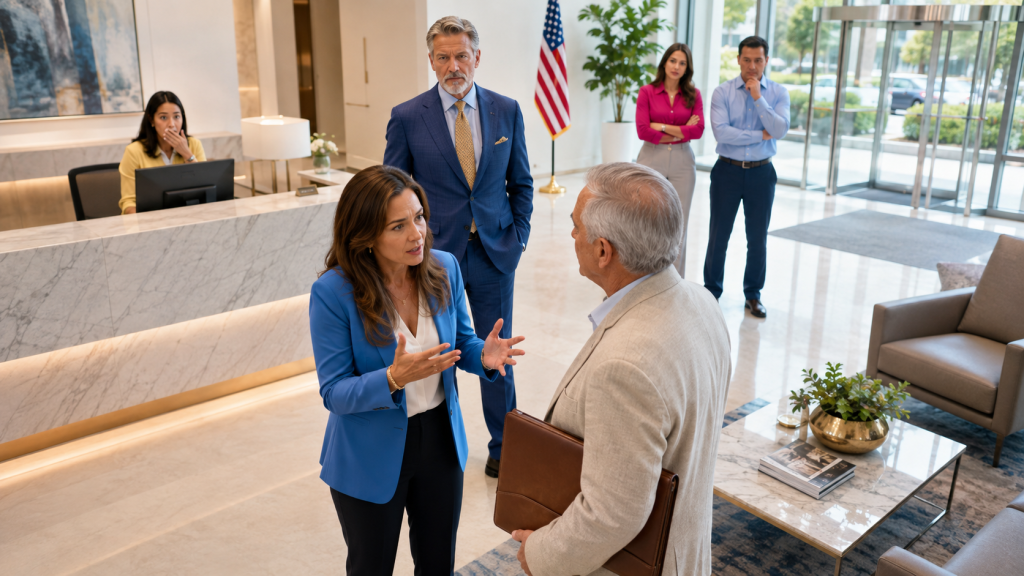
Daniel understood his father, but the others did not.
Walter pointed at Melissa.
“This is not the first letter.”
Daniel looked sharply at him.
“What?”
Walter signed again.
“I delivered the same warning three months ago.”
The air seemed to leave the lobby.
Daniel turned to Melissa.
She shook her head immediately.
“I never received anything.”
Walter signed.
“You did.”
“No.”
“He says you did,” I whispered.
Melissa rounded on me.
“Stay out of this.”
Daniel’s voice became quiet.
“Emma stays.”
Then he turned back to his father.
“What warning?”
Walter answered.
Daniel translated aloud.
“My father believes someone inside Hawthorne Technologies has been stealing from the employee retirement fund.”
Nobody moved.
One of the board members actually laughed once, as though he expected Daniel to tell him this was some strange family joke.
Daniel did not.
Walter removed another folder from his briefcase.
He handed it to his son.
Inside were bank records.
Copies of checks.
Statements.
Emails.
Daniel flipped through them.
“How did you get these?”
Walter signed.
“Arthur Bell.”
I knew the name.
Everyone who had spent more than a week at Hawthorne did.
Arthur Bell had been employee number eleven.
He had started as a machinist in the company’s first manufacturing facility and retired after thirty-four years.
His photograph was displayed near the engineering wing.
Walter continued signing.
“Arthur called me six months ago. His retirement account was missing money. He believed it was a clerical mistake.”
Daniel looked down at the papers.
Walter continued.
“It was not.”
Evelyn stepped forward.
“How much?”
Walter looked at Daniel.
Daniel read one of the pages.
“Potentially six point four million dollars.”
The security guard who had grabbed Walter slowly stepped backward.
Melissa whispered, “That’s impossible.”
Walter looked directly at her.
Then he signed.
“Ask her why my first envelope disappeared.”
Daniel did.
Melissa’s chin trembled.
“I never saw any envelope.”
Walter opened his briefcase again.
He removed a photograph.
It showed Walter standing in the same lobby three months earlier.
The date was printed in the corner.
Beside him was Melissa.
She was holding an envelope.
Silence.
Daniel looked at the photograph.
Then at her.
Melissa’s mouth opened.
Nothing came out.
“Conference room,” Daniel said.
He pointed toward the nearest glass meeting room.
“Now.”
Melissa tried to speak.
He stopped her.
“And nobody leaves the building.”
Within ten minutes, the executive floor had changed completely.
Security locked internal records access.
The board’s audit chair joined by video.
Outside counsel was contacted.
The company’s head of information security began preserving email accounts and transaction logs.
And somehow, unbelievably, I ended up sitting in the executive conference room beside Walter Hawthorne.
I kept waiting for someone to remember I was an intern and send me away.
Nobody did.
Daniel sat opposite his father.
“Why didn’t you call me?”
Walter’s hands moved.
“I did.”
Daniel frowned.
“When?”
“Three months ago. Twice.”
“I never received a message.”
Walter nodded toward Melissa.
She looked at the table.
Daniel’s face changed again.
He picked up the conference phone.
“Get me Richard Vale.”
My stomach tightened.
Richard Vale was Hawthorne’s chief financial officer.
He had been with the company for seventeen years.
Employees spoke his name with the kind of respect usually reserved for surgeons and federal judges.
Five minutes later, Richard entered.
He was sixty, broad-shouldered, silver-haired, and calm.
Even after Daniel explained the accusation, Richard barely reacted.
He examined Walter’s documents.
Then he sighed.
“I know about these discrepancies.”
Daniel stared at him.
“You know?”
“We began an internal review last quarter.”
“And you didn’t inform me?”
“It appeared administrative.”
“Six million dollars is administrative?”
“Potentially duplicated vendor charges. Nothing suggests theft.”
Walter signed.
Richard looked at me.
“What is he saying?”
“He says the vendor does not exist.”
Richard smiled without humor.
“It exists.”
Walter shook his head.
I translated.
“He visited the address.”
Richard’s smile vanished.
Walter continued.
“The address belongs to a mailbox center in Tacoma.”
Daniel turned pages rapidly.
The vendor was called Northstar Benefits Consulting.
For four years, Hawthorne’s employee retirement plan had paid Northstar for compliance reviews, investment audits, and administrative services.
The invoices looked legitimate.
The contracts looked legitimate.
The approvals looked legitimate.
But according to Walter’s investigation, Northstar had no employees.
No real office.
No listed executives.
Its registered agent was an attorney who managed hundreds of shell companies.
Richard folded his hands.
“Daniel, your father is not an auditor.”
Walter’s eyes narrowed.
Richard realized his mistake immediately.
Daniel’s voice became sharp.
“My father built the accounting controls you used for the first eight years you worked here.”
“I meant no disrespect.”
Walter signed.
“I do not require respect from him. I require records.”
For the first time that morning, I almost smiled.
Daniel did too.
Only for a second.
Then Melissa suddenly stood.
“I need a lawyer.”
Everyone looked at her.
Richard’s head turned slowly.
Melissa seemed terrified of him.
That was when I understood.
Whatever she had done, she was not the person at the top.
Daniel understood too.
“Sit down, Melissa.”
“I want counsel.”
“You’re entitled to call counsel. But before you leave this room, your access will be suspended.”
Richard pushed back his chair.
“This is becoming theatrical.”
Daniel looked at him.
“Then help me make it simple.”
He slid the Northstar invoices across the table.
“Who approved these?”
Richard did not touch them.
“My department.”
“Who specifically?”
“Various people.”
“Your signature is on six.”
“As CFO, my signature is on thousands of documents.”
Walter signed something.
I hesitated.
Daniel noticed.
“What did he say?”
My throat went dry.
“He asked Mr. Vale who owns Northstar.”
Richard looked directly at Walter.
“No idea.”
Walter opened the last folder.
He removed one page.
Daniel read it.
Then leaned back slowly.
“What is Aster Bridge Holdings?”
Richard said nothing.
Daniel repeated the question.
“Aster Bridge Holdings.”
“I don’t know.”
Walter pointed to the page.
I could see only fragments upside down.
Corporate registration.
Nevada.
Beneficial ownership.
Then I saw a name.
Jonathan Vale.
Richard’s brother.
Daniel’s voice turned almost emotionless.
“Northstar Benefits is owned through Aster Bridge Holdings. Aster Bridge’s controlling beneficiary is your brother.”
Richard’s composure finally cracked.
“Jonathan has hundreds of investments.”
“You just told me you had no idea who owned Northstar.”
“I didn’t.”
“Your brother owns the company that received millions from a retirement plan you oversee.”
“Indirectly.”
“You signed the payments.”
“My team approved the work.”
Walter slapped one palm against the table.
Everyone looked at him.
He signed slowly.
“That money belongs to people who trusted us.”
Daniel translated.
Richard stared at Walter.
“You’ve always been sentimental about employees.”
Walter did not move.
Richard continued.
“That sentiment nearly bankrupted this company twice.”
Daniel stood.
“That’s enough.”
Richard stood too.
“You want to destroy twenty years of growth because your retired father walked in with printouts?”
“No.”
Daniel picked up the documents.
“I want to determine whether my CFO stole from our employees.”
Richard’s face hardened.
“You should choose your words carefully.”
“So should you.”
Security entered less than a minute later.
Richard’s access was suspended.
His laptop and company phone were collected.
He was escorted from the executive floor.
Melissa remained sitting at the table.
She was crying silently now.
Daniel looked at her.
“Why did you take my father’s first letter?”
Melissa wiped her face.
“Richard told me to.”
There it was.
The sentence that changed everything.
She explained in pieces.
Months earlier, Richard had learned that Walter was asking questions about the retirement plan.
He told Melissa that Walter was becoming confused with age.
He claimed Daniel wanted his father kept away from company matters because family disagreements might embarrass the board.
Melissa had been instructed to intercept Walter’s calls, letters, and visits.
At first, she believed the explanation.
Then she saw the first envelope.
She opened it.
Inside were copies of suspicious transactions.
She brought them to Richard.
He told her the records were fabricated.
She asked why Walter would fabricate them.
Richard became angry.
Then he offered her a promotion.
Director of executive operations.
A significant raise.
All she had to do was make certain Walter never reached Daniel directly.
“So you knew?” Daniel asked.
Melissa stared at the table.
“I knew something was wrong.”
“That isn’t what I asked.”
She began crying harder.
“Yes.”
Daniel sat down again.
“You knew.”
“Yes.”
“And today?”
“He texted me this morning.”
“Richard?”
She nodded.
“He said your father might appear. He told me not to let him upstairs.”
Walter looked at me.
Then toward the lobby.
He signed.
“And she was willing to have security throw me into the rain.”
Melissa covered her face.
“I’m sorry.”
Walter watched her.
Then signed something I did not expect.
“You are sorry because I am his father.”
Melissa looked up.
He continued.
“You were not sorry when you thought I was nobody.”
Nobody in the room spoke.
That sentence landed harder than anything else had.
Because it was true.
If Walter had been an ordinary Deaf pensioner wearing an old coat, there would have been no executive investigation.
No board members.
No apologies.
He would simply have been escorted outside.
And I probably would have been fired for stopping it.
Daniel looked through the glass wall toward the lobby.
Employees were still moving around beyond it.
Some were pretending not to stare.
Then he looked at me.
“Emma.”
My stomach dropped.
“Yes?”
“What would have happened if you hadn’t understood my father?”
I swallowed.
“He would probably have been removed.”
“And if he had been anyone else?”
I knew what he was asking.
“The same thing.”
Daniel lowered his head.
Walter watched him carefully.
For the first time that morning, I saw something between them that had nothing to do with corporate titles.
A father who was disappointed.
A son who knew he deserved it.
Daniel signed.
“I failed.”
Walter answered.
“You stopped looking.”
Daniel’s hands froze.
Walter continued.
“You built a company where everyone tells you what reaches your office. Eventually, the walls became so thick that truth could not.”
Daniel stared at him.
“I thought I was protecting the company.”
“You were protecting your schedule.”
That one hurt.
Even I could see it.
But Daniel nodded.
“You’re right.”
The investigation lasted five weeks.
I expected to be fired at least twenty times during the first two days.
Instead, Daniel personally instructed human resources to extend my internship.
Not because I had helped his father, he told them, but because firing an intern for preventing unnecessary physical force against a visitor would be indefensible.
I appreciated the distinction.
Walter appreciated it even more.
“You did not rescue me,” he signed when we met again.
We were sitting in the company cafeteria.
“You treated me like a person.”
“I nearly lost my job.”
He smiled.
“Courage is often poorly timed.”
That became one of my favorite things anyone ever said to me.
Walter began coming to the office every few days while outside investigators reviewed the retirement accounts.
This time, nobody raised their voice at him.
A certified interpreter was present for formal meetings.
Video relay phones were installed in several conference rooms within two weeks.
The company began an accessibility review that expanded far beyond Deaf employees.
Wheelchair access.
Captioning.
Screen-reader compatibility.
Emergency alerts.
Recruiting practices.
Daniel refused to let the company publish a press release about any of it.
When communications suggested announcing a new “accessibility initiative,” Walter shook his head.
“Fix the doors before taking photographs of yourself opening them.”
So they did.
Meanwhile, the financial investigation grew.
Northstar Benefits Consulting had billed Hawthorne for services that were never performed.
Some payments had come from corporate accounts.
Others had been charged through plan administration expenses that ultimately reduced employee retirement assets.
Investigators traced money through four shell companies.
The total was not six point four million.
It was eleven point eight million.
Richard Vale had been doing it for nearly seven years.
His brother Jonathan controlled two shell entities.
Another belonged to a former college roommate.
The contracts had been structured in amounts small enough to avoid additional board review.
When auditors raised concerns, Richard reassigned them.
When one employee refused to approve a payment, his position was eliminated during a “departmental restructuring.”
Walter had been alerted because Arthur Bell noticed unexplained deductions on statements from a legacy retirement program.
Arthur called three people at Hawthorne.
Nobody returned his calls.
So he contacted the one person he believed would listen.
Walter.
That was the part that made Walter angriest.
Not the money.
The silence.
“These people built this company,” he signed to Daniel during one meeting. “How many times must someone ask for help before we decide they matter?”
Daniel did not defend himself anymore.
He simply wrote the question down.
Melissa eventually cooperated fully.
She turned over text messages from Richard.
Deleted emails were recovered.
There were instructions to block Walter.
Instructions to route retirement complaints away from Daniel’s office.
Instructions to describe Arthur Bell as “confused.”
One message made me feel sick.
If the old man comes in again, have security deal with it.
The old man.
Not the founder.
Not Walter Hawthorne.
Not the person whose company had made Richard wealthy.
Just an obstacle.
Melissa resigned before she could be terminated.
Prosecutors later offered her a cooperation agreement because she provided evidence against Richard and had not personally received stolen retirement funds beyond the promised promotion she never got.
I never saw her again.
For a while, I hated her.
Then Walter asked me something.
“If I had been dressed in a suit, would she have treated me differently?”
“Yes.”
“If I had been hearing?”
“Probably.”
“If you had been a vice president instead of an intern?”
I understood.
“Yes.”
Walter nodded.
“Then the problem is larger than Melissa.”
That did not excuse what she had done.
But it changed the way I understood it.
Organizations did not become cruel because one cruel person walked through the door.
They became cruel when convenience was rewarded more often than compassion.
When hierarchy mattered more than truth.
When people learned that ignoring someone powerless was safe.
Daniel seemed to understand that too.
Three weeks after the investigation began, every employee received an email from him.
It did not name Richard because the criminal inquiry was ongoing.
It did say that financial irregularities had been discovered in retirement-related accounts.
It said the company would restore every dollar of employee losses from corporate reserves before waiting for insurance recovery or litigation.
Then Daniel wrote something I never expected a CEO to write.
The failure was not only financial. It was cultural. Employees and retirees raised concerns, and our systems prevented those concerns from reaching people responsible for acting on them. I am responsible for those systems.
No public-relations language.
No “lessons learned.”
No blaming lower-level employees.
He took responsibility.
The board froze executive bonuses for that year.
Daniel included his own.
Several executives protested.
Walter laughed when he heard.
“People love accountability until it arrives on their paycheck.”
By then I had become comfortable enough around him to laugh too.
My internship was supposed to end in August.
In July, Human Resources called me upstairs.
I assumed they were going to offer me an administrative assistant position.
I was wrong.
Daniel was waiting in the conference room.
So was Walter.
I stopped at the door.
“That feels ominous.”
Walter grinned.
Daniel pointed to a chair.
“We want to offer you a job.”
“Doing what?”
“That depends.”
I frowned.
“That is not usually how job offers work.”
“No,” Daniel admitted. “But this isn’t a usual situation.”
He explained that the company was creating an Office of Employee Access and Advocacy.
Not an HR complaint department.
A separate group with authority to receive concerns that employees believed were being ignored through normal management channels.
Accessibility would be one responsibility.
Retaliation concerns would be another.
The office would report independently to the board’s governance committee.
“We need someone on the launch team,” Daniel said.
I almost laughed.
“I’m twenty-two.”
“I’m aware.”
“I’ve been here three months.”
“I’m also aware.”
“I organize visitor badges.”
Walter signed.
“You also disobey badly.”
I laughed.
Daniel did too.
Then he became serious.
“We’re not offering you the director position. We’re offering you an analyst role with training, mentorship, and tuition support if you want graduate study later.”
I stared at the folder in front of me.
It was more than I had expected.
More than I thought I deserved.
Then another thought came.
“Can I ask something first?”
Daniel nodded.
“If I hadn’t helped Walter that morning, would this office exist?”
He considered the question.
“Probably not yet.”
“And if Walter hadn’t been your father?”
He took longer to answer that one.
“I don’t know.”
I appreciated that he did not lie.
“So how do we make sure the next person doesn’t need to be related to the CEO?”
Walter smiled.
Daniel leaned back.
“That,” he said, “is exactly why I want you on the team.”
I accepted.
But I had one condition.
“I want Deaf employees involved from the beginning.”
“Absolutely.”
“Not just consultants after everything is designed.”
Daniel nodded.
“Agreed.”
“And I know someone you should talk to.”
Walter immediately knew.
“Your brother.”
I smiled.
“Lucas.”
Lucas came to Hawthorne the following week.
He was twenty, studying user-experience design at the University of Washington, and far more confident than I had ever been.
When Daniel greeted him through an interpreter, Lucas stopped him.
Then he signed.
“You know ASL.”
Daniel answered.
“My father made sure of it.”
Lucas looked toward Walter.
“Good father.”
Walter signed back.
“Occasionally.”
That meeting lasted three hours.
Lucas dismantled half of Hawthorne’s proposed accessibility plan in the first thirty minutes.
The emergency video system had no visual alarm on two floors.
Captioning software failed when multiple people spoke.
The careers site had several buttons that screen readers could not identify.
The front desk had no simple way for Deaf visitors to request an interpreter without first communicating verbally.
Watching my shy little brother—except he was not shy anymore—correct senior executives was one of the proudest moments of my life.
Afterward Daniel asked if he wanted an internship.
Lucas signed.
“Paid?”
Daniel smiled.
“Paid.”
Lucas accepted.
Walter pretended he had nothing to do with it.
Nobody believed him.
Richard Vale was arrested four months after Walter walked into the lobby.
The news vans filled the street outside Hawthorne’s headquarters.
Federal prosecutors charged him and two associates with wire fraud, conspiracy, and theft related to employee benefit funds.
Jonathan Vale was charged separately.
Richard initially pleaded not guilty.
Six months later, after investigators produced years of bank transfers, deleted messages, forged invoices, and testimony from former finance employees, he changed his plea.
More money was recovered through seized accounts and property.
Hawthorne had already restored the employee losses.
Arthur Bell received every dollar he had been missing.
Walter drove personally to Arthur’s home to tell him.
He invited me to come.
Arthur lived in a small blue house outside Tacoma.
He opened the door using a walker.
The moment he saw Walter, he started crying.
Not because of the money.
Because someone had believed him.
“I thought I was losing my mind,” Arthur said.
“They kept telling me the statements were complicated.”
Walter signed while I interpreted.
“They were counting on you doubting yourself.”
Arthur looked at me.
“Tell him thank you.”
I started interpreting.
Walter stopped me.
He understood enough lip-reading to know what Arthur had said.
He took Arthur’s hand.
Then he signed slowly while I translated.
“You worked thirty-four years for what was in that account. You never needed to thank me for making sure it stayed yours.”
Arthur cried harder.
So did I.
On the drive back to Seattle, Walter sat beside me in the passenger seat.
I finally asked a question I had wondered about for months.
“Why did you wear that old coat?”
He looked down at it.
He was wearing the same brown coat.
He smiled.
“My wife bought it.”
Margaret.
“She hated shopping,” Walter continued. “It was the last coat she ever bought me. She said if I lost it, she would haunt me.”
I smiled.
“So you weren’t testing anyone?”
Walter gave me a suspicious look.
“Testing?”
“Some people at Hawthorne think you deliberately dressed plainly to see how employees would treat you.”
He laughed so hard he had to wipe his eyes.
“No.”
I laughed too.
That somehow made the story better.
He had not disguised himself.
He had simply arrived as himself.
Everyone else had decided what that meant.
A year passed.
I stopped rehearsing “good morning” before elevators.
Not completely.
But mostly.
My new job forced me to speak with people I would once have avoided.
Engineers.
Janitors.
Executives.
Interns.
Retirees.
People who were angry.
People who were afraid.
People who had good reasons to distrust corporate promises.
Our advocacy office received hundreds of concerns in its first year.
Most were small.
A manager refusing caption requests.
An inaccessible software platform.
A payroll mistake.
A supervisor making jokes about an employee’s accent.
But some were serious.
We investigated retaliation.
We corrected safety procedures.
We created confidential channels that did not require an employee to go through the manager they were complaining about.
And once every quarter, Walter visited our office.
He refused a reserved parking space.
He refused an executive badge.
He still carried the old briefcase.
But the lobby changed.
Not because employees were told Walter Hawthorne might appear.
Because the systems changed.
A tablet at reception allowed visitors to request communication assistance.
Security staff received disability-awareness training.
Interpreters could be reached by video within minutes.
Nobody was instructed to shout at someone who could not hear.
One afternoon, I watched a new security guard kneel beside an elderly woman using a wheelchair so they could speak at eye level.
She was lost.
He stayed with her until her daughter arrived.
Nobody important was watching.
That was when I knew the changes were real.
Almost two years after the day Walter first walked into the lobby, Hawthorne held its annual employee gathering.
Daniel hated company galas, so instead of a hotel ballroom, the event took place in the renovated engineering building where the company had first expanded in the 1990s.
Thousands of employees attended.
Lucas was there too.
By then he was a full-time accessibility designer.
I stood near the back with him.
Daniel walked onto the stage.
Behind him was a photograph of the original Hawthorne team.
Eleven people.
Walter stood in the center.
Much younger.
Same stubborn expression.
Daniel spoke about the company’s future.
Then he stopped.
“My father taught me something two years ago,” he said.
Walter, seated in the front row, raised an eyebrow.
Daniel continued.
“He reminded me that a company’s values are not revealed by how it treats the most powerful person in the room.”
The crowd became quiet.
“They are revealed by how it treats the person everyone assumes has no power at all.”
I felt Lucas glance at me.
Daniel looked toward the back.
“Emma?”
Every nightmare I had ever had about public speaking returned simultaneously.
Lucas grinned.
“Go,” he signed.
“I hate you.”
“I know.”
I walked toward the stage.
Thousands of people applauded.
My legs shook.
Walter stood.
Daniel handed me a small box.
I frowned.
“What is this?”
“Open it.”
Inside was an old brass visitor badge.
I recognized it immediately.
Number 147.
The badge Walter had been issued that morning.
Apparently someone had saved it.
Engraved beneath the number were five words.
YOU STOPPED TO SEE SOMEONE.
My eyes filled.
I looked at Walter.
He was signing.
I wiped my cheeks so I could see his hands.
“You thought you were invisible that day.”
I nodded.
He continued.
“But invisible people often notice what everyone else has trained themselves not to see.”
I could not answer.
He smiled.
Then Daniel looked toward Lucas.
Lucas was already crying and pretending not to.
The room applauded again.
Later that evening, after most employees had left, the four of us stood outside the old engineering building.
Daniel.
Walter.
Lucas.
Me.
Rain had started.
Of course it had.
Seattle seemed determined to make every important moment damp.
Daniel opened an umbrella over his father.
Walter pushed it away.
Daniel tried again.
Walter pushed it away again.
Lucas signed to me.
“Rich people are weird.”
I laughed so loudly Daniel turned.
“What did he say?”
“Nothing.”
Lucas looked innocent.
Walter clearly understood and started laughing.
Daniel sighed.
“I know that expression. Somebody insulted me.”
“No one insulted you.”
Lucas signed.
“I did.”
Walter translated for his son.
Daniel stared at all three of us.
Then he laughed too.
For a moment, none of us were an intern, a CEO, a founder, or an accessibility designer.
We were simply four people standing in the rain.
That should have been the end of the story.
But one final thing happened.
Walter died three years later.
He was eighty-one.
It happened peacefully at home.
Daniel called me personally.
I sat on my kitchen floor afterward and cried so hard Lucas drove across town because I could barely speak.
Hawthorne closed its offices the morning of Walter’s memorial.
Thousands of employees attended.
Former machinists.
Engineers.
Executives.
Retirees.
Receptionists.
Security officers.
People who had never met him but had worked inside the company he created.
Arthur Bell sat in the front row.
Walter’s old brown coat was draped over an empty chair beside Daniel.
During the memorial, Daniel told stories about his father.
Some were inspiring.
Most were funny.
Walter apparently once fired a vice president for parking in a space reserved for an employee who used a wheelchair.
He had also once slept in the factory for six nights because he refused to ask employees to work overtime during a product failure unless he stayed too.
Then Daniel became quiet.
“My father spent his life demanding that people be seen,” he said.
“He knew what it meant to enter a room where people made assumptions before he had a chance to communicate.”
Daniel looked toward me.
“The last major lesson he taught me began in our lobby.”
My throat tightened.
“He walked into the company he founded and was treated as though he did not belong there.”
Daniel paused.
“That story became famous inside Hawthorne because everyone focuses on the surprise. The old man was the founder. The CEO was watching. The intern turned out to be right.”
Several people smiled.
“But my father hated that version.”
I smiled through tears.
Of course he did.
Daniel continued.
“He said the lesson disappears if we make the story about who he secretly was.”
The room became completely silent.
“He should not have been treated with dignity because he was Walter Hawthorne.”
Daniel’s voice broke slightly.
“He should have been treated with dignity because he was a human being standing in our lobby asking for help.”
Lucas reached for my hand.
Daniel looked at me.
“And Emma should not have needed courage to do what was right.”
That sentence stayed with me.
After the memorial, people lined up to speak with Daniel.
I stayed behind.
Eventually the room emptied.
Daniel stood beside Walter’s brown coat.
“He left something for you.”
He handed me the old leather briefcase.
I stared at it.
“I can’t take this.”
“You have to.”
“Why?”
“Because his will says you get it.”
I laughed through my tears.
“That sounds like him.”
Inside were several folders.
Old company photographs.
Letters from employees.
A photograph of Margaret.
And beneath them was an envelope with my name.
Emma.
My hands shook as I opened it.
The letter was written in Walter’s uneven handwriting.
I read slowly.
Emma,
The first day we met, you believed you were the least important person in the lobby.
So did everyone else.
They were wrong.
You saw me.
That was enough.
Never let a title convince you that someone matters more.
Never let fear convince you that your voice matters less.
And when someone is standing alone in a room full of people who do not understand them, go stand beside them.
You already know the rest.
—Walter
I pressed the letter against my chest.
Daniel pretended not to notice me crying.
Then I noticed something else inside the briefcase.
A small photograph.
It had been taken by one of the lobby cameras the morning Walter arrived.
The image showed him standing at reception.
Melissa was facing him.
The security guard was nearby.
And there I was.
A terrified twenty-two-year-old intern stepping away from a stack of visitor badges.
I looked so small.
So uncertain.
But I was walking toward him.
On the back, Walter had written one sentence.
This is what leadership looks like before anyone gives it a title.
I still have that photograph.
Years have passed now.
I eventually became director of the Office of Employee Access and Advocacy.
Lucas teases me because I have an office with glass walls and still eat lunch at my desk like an intern.
Daniel remains CEO.
He signs fluently with Deaf employees and visitors.
Arthur Bell sends us a Christmas card every year.
The original reception desk was replaced during a renovation, but Daniel kept one piece of the old marble counter.
The blue folder Melissa used to hide Walter’s envelope is long gone.
The lesson is not.
Every new employee at Hawthorne now attends an orientation session about accessibility, ethics, and speaking up.
Sometimes I teach it.
I never tell them who I am until the end.
I describe a rainy morning.
An elderly Deaf man enters a building.
Nobody understands him.
People become impatient.
Security approaches.
An intern notices.
Then I ask one question.
“What should happen next?”
The answers are usually easy.
Someone should communicate with him.
Someone should give him time.
Someone should treat him with dignity.
Exactly.
Then I tell them the part that matters.
“You should do those things even if no CEO is watching.”
Because that is the mistake people make when they hear my story.
They think the miracle was that Daniel Hawthorne happened to be standing on the mezzanine.
It wasn’t.
They think the twist was discovering that Walter was the founder.
It wasn’t.
They think my life changed because I impressed the CEO.
That wasn’t it either.
My life changed in the few seconds before anyone important stepped out of that elevator.
It changed when Melissa told me to return to my desk.
When security reached for Walter.
When every sensible, frightened instinct inside me said:
Stay quiet.
You are only an intern.
Do not cause trouble.
And for once, I ignored that voice.
I walked forward.
I raised my hands.
And I said the simplest thing I knew how to say.
Hello.
Can I help you?
I had no idea the CEO was watching.
I had no idea the old man was his father.
I had no idea a hidden letter would expose millions of dollars in theft, bring down one of the most powerful executives in the company, restore retirement savings to people who had worked decades for them, or transform the culture of a corporation.
I only knew someone was standing alone.
And I knew how to speak his language.
Sometimes the moment that changes your entire life does not arrive with applause.
Sometimes it is standing quietly in a lobby wearing an old brown coat while everyone else walks past.
And sometimes all you have to do is be the person who stops.
💬THE END! THANK YOU FOR READING!