
For our twentieth anniversary, I wanted one weekend when my husband, Jeffrey, didn’t have to ask whether I had taken my medication.
I wanted one morning when he didn’t study my face before asking how I felt.
I wanted one dinner where he didn’t automatically choose the chair closest to the restroom in case nausea hit me suddenly.
More than anything, I wanted to feel like his wife again.
Not his patient.
Not the woman whose appointments filled our calendar.
Not the woman he had driven to chemotherapy every Thursday morning for months while pretending he wasn’t terrified.
I had finished chemotherapy five months earlier.
My doctors were cautiously optimistic. My scans were clear. My bloodwork was improving.
Everyone kept telling me I should be celebrating.
But surviving something and feeling alive again were not the same thing.
Before cancer, I had thick auburn hair that reached the middle of my back. I complained about how long it took to dry and spent ridiculous amounts of money trying to tame the curls.
Then, one morning during treatment, I stood in our bathroom and watched handfuls of it come away between my fingers.
Jeffrey found me sitting on the tile floor surrounded by strands of hair.
He didn’t say anything.
He simply sat beside me.
The next day, when I finally asked him to shave what remained, he brought a chair into the kitchen, wrapped a towel around my shoulders, and used the clippers as gently as if he were handling glass.
When he finished, I couldn’t look in the mirror.
Jeffrey could.
He kissed the top of my bare head.
“You’re beautiful, Claire.”
I wanted to believe him.
But I didn’t.
Cancer had taken more than my hair.
It took weight from places I didn’t want to lose it and added swelling where I didn’t want it. Surgery left a scar along my side that I avoided touching. Steroids changed my face. Exhaustion changed the way I walked.
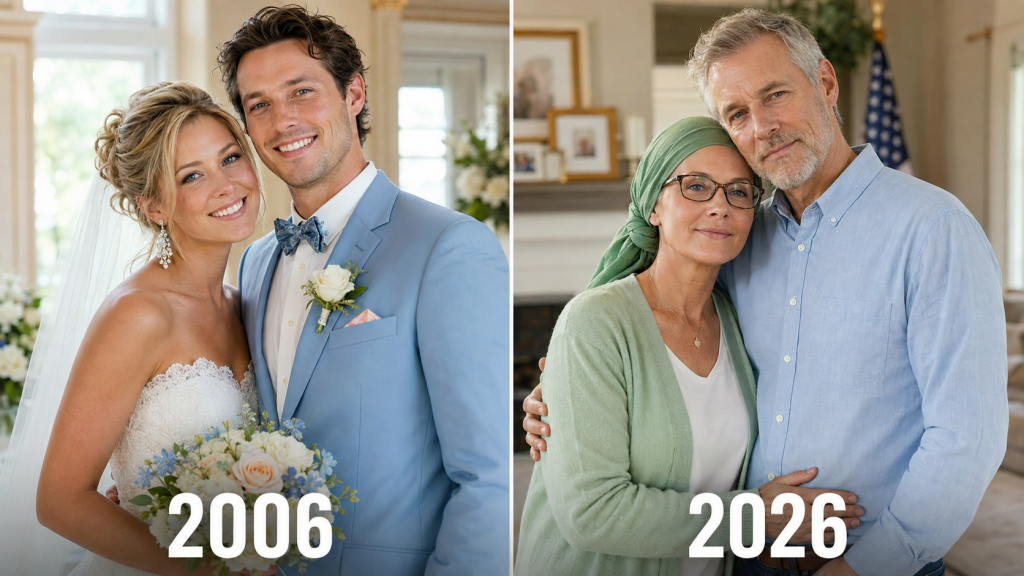
The woman in our wedding photographs looked fearless.
The woman I had become inspected herself under harsh bathroom lights and wondered if her husband ever secretly missed the person he had married.
Jeffrey never gave me a reason to think that.
That almost made it worse.
He was too good.
He cooked.
He cleaned.
He remembered every prescription.
He slept in uncomfortable hospital chairs.
He learned the names of nurses.
He kept crackers beside the bed because they were sometimes the only thing I could eat.
If I woke at three in the morning afraid I was going to die, Jeffrey woke too.
He never complained.
Not once.
And somewhere inside me, gratitude became tangled with guilt.
I started wondering whether he stayed close because he loved me or because leaving a sick wife would have made him a monster.
I hated myself for thinking that.
So when our twentieth anniversary approached, I decided to do something spontaneous.
Twenty years earlier, we had spent our honeymoon at a small mountain hotel overlooking a lake in Vermont.
Back then, we had been twenty-seven years old, broke, and so completely in love that we spent half the trip laughing about the fact that our “luxury mountain-view room” mostly overlooked a parking lot and one very determined pine tree.
The hotel had been renovated since then.
It was nicer now.
More expensive too.
I secretly booked two nights.
When I told Jeffrey I had planned a surprise weekend, his expression shifted strangely.
For just a second, I thought I saw worry.
Then he smiled.
“A surprise?”
“No hospitals,” I told him. “No doctors. No pill organizers on the table.”
“You still have to bring the pills.”
I rolled my eyes.
He kissed my forehead.
“Then yes. Absolutely.”
I bought a dress for the trip.
It was dark green, soft around the waist, with sleeves long enough to hide how thin my arms had become.
I spent almost an hour in the store deciding whether I looked elegant or ridiculous.
Eventually a saleswoman around my age came over.
“Anniversary?” she asked.
I stared at my reflection.
“Twenty years.”
She smiled.
“Then buy the dress.”
So I did.
I imagined wearing it to dinner.
I imagined Jeffrey looking up and seeing me instead of cancer.
For the first time in months, I allowed myself to feel excited.
The drive into the mountains took three hours.
It was early October, and the trees were turning red and gold along the highway.
Jeffrey drove with one hand on the steering wheel.
Normally, his other hand would have rested on my knee.
It didn’t.
I noticed.
I told myself not to.
“You’re quiet,” I said.
“Just enjoying the drive.”
“You hate driving in mountains.”
“I’m evolving.”
I laughed.
He smiled, but it didn’t reach his eyes.
When we reached the hotel, I almost cried.
The old sign was gone, replaced with an elegant stone entrance, but the lake was exactly as I remembered.
The same dark blue water.
The same mountains reflected on its surface.
Jeffrey stood beside me while the bellman unloaded our bags.
“Recognize it?” I asked.
He looked at the building and then at me.
His face softened.
“You remembered.”
“Of course I remembered.”
He kissed my temple.
For one beautiful second, everything felt normal.
Then we entered our room.
There was a fireplace.
A balcony.
A bottle of sparkling cider chilling beside two glasses because I still wasn’t supposed to drink alcohol.
And one enormous king-size bed.
Jeffrey stopped in the doorway.
His entire body became rigid.
His eyes went directly to the bed.
“There’s only one bed?”
I laughed because I thought he was teasing me.
“That’s usually the idea on an anniversary.”
He didn’t laugh.
“Claire.”
Something in his voice made my smile disappear.
“What?”
He looked toward the bathroom, then the balcony, then back at the bed as though searching for an escape route.
“I need another room.”
For a moment, I honestly believed I had misunderstood him.
“You need what?”
“Another room.”
“Why?”
He rubbed a hand over his face.
“I just do.”
I stared at him.
“Jeffrey, we’ve been married for twenty years.”
“I know.”
“We have slept in the same bed for twenty years.”
“I know.”
“So what exactly happened during the three-hour drive that suddenly makes that impossible?”
“Nothing happened.”
“Then stay here.”
He couldn’t look at me.
That hurt more than anything he could have said.
“I can’t.”
Two words.
That was all.
I felt something inside me collapse.
Of course.
Of course he had reached his limit.
Maybe he hadn’t wanted to say it at home because home was where sickness lived.
Maybe this trip had forced him to remember what an anniversary was supposed to mean.
Romance.
Desire.
Intimacy.
And maybe looking at me in a hotel room with one bed made him realize that whatever he had once felt was gone.
I folded my arms over my chest.
“Fine.”
“Claire—”
“I said fine.”
He stepped toward me.
I stepped away.
His face tightened.
“I’ll explain.”
“When?”
“I just need some time.”
That was worse.
There was nothing to explain when a husband couldn’t bear to share a bed with his wife.
He took his suitcase downstairs.
Twenty minutes later, he returned for his toiletry bag.
“Room 317,” he said quietly. “If you need me.”
I didn’t answer.
He stood near the door for several seconds.
Then he left.
The moment the door clicked shut, I sat on the edge of the bed and cried.
Not dramatically.
Not loudly.
Just quietly.
The kind of crying that makes you feel ashamed because you know you are grieving something nobody else can see.
I thought about all the times he had called me beautiful.
All the kisses on my forehead.
All the nights he had held my hand.
Had I mistaken kindness for desire?
Maybe Jeffrey loved me.
I didn’t doubt that.
But perhaps he loved me the way someone loves a wounded person they have promised not to abandon.
I opened my suitcase.
The green dress lay carefully folded beneath a sweater.
I took it out.
For a few seconds, I held it against myself in the mirror.
Then I put it back.
At seven, Jeffrey texted.
Dinner?
I stared at the message.
I wanted to throw the phone.
Instead, I wrote that I wasn’t hungry.
He replied immediately.
Are you feeling sick?
That question broke something in me.
Not: Are you upset?
Not: Can we talk?
Are you feeling sick?
Patient.
Always the patient.
I turned off my phone.
At nine, someone knocked.
I didn’t answer.
A few seconds later, Jeffrey’s voice came through the door.
“Claire?”
I pulled the blanket higher.
“I know you’re angry.”
Silence.
“I’m sorry.”
I shut my eyes.
His footsteps eventually disappeared.
At 11:30, there was another knock.
This time it was softer.
I almost ignored it.
Then he said my name.
There was something different in his voice.
Something frightened.
I got out of bed and opened the door.
Jeffrey stood in the hallway.
His eyes were red.
He wore dark pajama pants and a long-sleeved button-down shirt that was fastened all the way to his throat even though the hallway was warm.
“I’m sorry,” he whispered.
“For what?”
He opened his mouth.
I couldn’t stop myself.
“For finally admitting you can’t stand looking at me?”
His face changed completely.
“What?”
“You heard me.”
“Claire, no.”
“Then tell me the truth.”
“I’m trying.”
“Try harder.”
My voice cracked.
“I bought a dress for you.”
He stared at me.
“I brought makeup I haven’t worn in almost a year. I spent forty minutes trying to figure out whether my hair was long enough to style. I brought the perfume you gave me on our tenth anniversary because I wanted one weekend where I felt like the woman you married.”
“Claire—”
“And then you walked into our room, saw one bed, and looked horrified.”
“I wasn’t horrified by you.”
“Then what were you horrified by?”
He stood motionless.
I wiped my face angrily.
“Just say it, Jeffrey. Please. If you don’t want me anymore, I can survive hearing it. I survived worse.”
His eyes filled.
“God, Claire.”
He stepped inside and closed the door.
Then he locked it.
“I didn’t get another room because I didn’t want you.”
He swallowed.
“I got it because there’s something I’ve been hiding from you since your third round of chemo.”
His hands moved toward his collar.
He opened the first button.
Then the second.
I stopped breathing.
“Jeffrey?”
He continued.
Third button.
Fourth.
Then he pulled the shirt apart.
A scar ran down the center of his chest.
It was long.
Still pink in places.
Another smaller mark appeared near his ribs.
For several seconds, my brain refused to understand what I was seeing.
I had seen medical scars all year.
I knew what surgical scars looked like.
But this one was on my husband.
“What happened?”
Jeffrey lowered his eyes.
“I had heart surgery.”
The room seemed to tilt.
“What?”
“Four months ago.”
Four months.
I stared at him.
Four months earlier I had still been recovering from my final rounds of chemotherapy.
“Heart surgery?”
He nodded.
“What kind of heart surgery?”
“A valve repair.”
My mouth went dry.
“You had open-heart surgery?”
“Yes.”
“And you didn’t tell me?”
His jaw tightened.
“No.”
I slapped my hand over my mouth.
Suddenly I remembered things.
Jeffrey telling me he had pulled a muscle and couldn’t lift grocery bags.
Jeffrey sleeping in the recliner because his back hurt.
Jeffrey wearing loose shirts in July.
Jeffrey insisting that my sister take me to two appointments because he had “work meetings.”
I had never questioned any of it.
I had been too busy surviving.
“When?”
I whispered.
“When did this start?”
“The day of your third chemotherapy cycle.”
He sat carefully in the chair near the window.
“I dropped you off at the infusion center that morning. You remember?”
I did.
Barely.
I had been nauseated before treatment even began.
“My sister came later.”
He nodded.
“Because I collapsed in the parking garage.”
My knees weakened.
I sat on the edge of the bed.
“Someone found me next to the car. They took me to the emergency department downstairs.”
“And I was in the same hospital?”
“Yes.”
“Jeffrey.”
“I know.”
“You were in the emergency department while I was upstairs?”
“Yes.”
Tears blurred my vision.
“They ran tests. I had known for years that I had a mild valve problem, but it had gotten worse. Much worse. The cardiologist said I couldn’t keep ignoring it.”
“You knew you had a heart problem?”
“Mild. At least it was mild the last time I had it checked.”
“When was that?”
He hesitated.
“About six years ago.”
I stared at him in disbelief.
“You lecture me if I’m twelve minutes late taking medication.”
“I recognize the hypocrisy.”
I almost laughed.
Instead, I cried harder.
“When was the surgery?”
“Three weeks after I collapsed.”
“How did I not know?”
“I told you I had a training conference.”
I remembered.
Three nights.
I had hated him being away, but my mother had stayed with me.
“You weren’t at a conference.”
“No.”
“You were having open-heart surgery.”
He nodded.
“Your brother stayed with me.”
My shock turned into anger.
“Michael knew?”
“Yes.”
“My sister?”
“Later.”
“Who else?”
“My boss. Your mother found out after the surgery.”
“My mother?”
That hurt.
“My own mother knew?”
“She wanted to tell you.”
“But you stopped her.”
“Yes.”
“Why?”
His voice broke.
“Because you were dying, Claire.”
The words hit both of us.
He looked away immediately.
“I’m sorry. I shouldn’t have said it like that.”
“But you thought I was.”
“We all thought we might lose you.”
He rubbed both hands over his face.
“The oncologist had just changed your treatment because the first drugs weren’t working the way they wanted. You couldn’t eat. You had that infection. You were sleeping fifteen hours a day.”
I remembered.
Those weeks existed in fragments.
Hospital rooms.
Metallic tastes.
Cold bathroom floors.
Jeffrey’s hand around mine.
“You were scared,” he continued. “You kept apologizing for ruining everyone’s lives. You thought you were a burden because your mother had to stay for a week.”
“So you decided nearly dying yourself would be less stressful if I found out later?”
“I decided I would do whatever I had to do to get you through treatment.”
“Even lie to me?”
“Yes.”
The answer came instantly.
I stared at him.
He looked ashamed.
“I’m not saying it was right.”
“It wasn’t.”
“I know.”
“What if you had died?”
His eyes closed.
That was when I understood.
He had considered it.
“What if you had died during surgery, Jeffrey?”
“My brother had instructions.”
I stood.
“Instructions?”
“To tell you after.”
I stared at him in horror.
“You planned what would happen if you died without letting me know you were even sick?”
“I didn’t know what else to do.”
“You tell your wife!”
“You were fighting cancer!”
“And you were still my husband!”
My voice echoed off the walls.
“I wasn’t some fragile object you had to hide reality from.”
“I know that now.”
“No, you don’t.”
“I was terrified!”
He shouted it.
Jeffrey almost never shouted.
We both froze.
His chest rose carefully beneath the open shirt.
“I was terrified,” he repeated, quieter.
“I sat with a cardiothoracic surgeon while he explained what could go wrong. All I could think about was you upstairs in oncology asking whether you were going to live long enough to see Sophie graduate from college.”
Our daughter.
Sophie was eighteen.
She had left for university two weeks before our anniversary.
“You remember that night?” he asked.
I did.
“I cried because I thought I would miss her life.”
Jeffrey’s eyes filled.
“And the next morning a surgeon told me my own heart could fail.”
He looked down at his scar.
“I couldn’t put that on you.”
I sat again.
For several moments, the only sound was the air conditioner.
Then I remembered why we were in separate rooms.
“What does this have to do with tonight?”
His shoulders tightened.
“This isn’t the whole thing.”
He reached into his pocket.
There was an envelope.
My name was written across the front in Jeffrey’s handwriting.
He held it without giving it to me.
“The surgery went well,” he said. “Structurally, my heart is okay now.”
“Structurally?”
“I’ve been having panic attacks.”
I blinked.
“What?”
“Mostly at night.”
He looked embarrassed.
“After surgery, every sensation scared me. Every skipped heartbeat. Every ache. I would wake up convinced something had gone wrong.”
I remembered the recliner again.
“How often?”
“At first? Every night.”
“And now?”
“Less.”
He paused.
“But it still happens.”
I reached for him instinctively.
He stepped back.
Not because he didn’t want me.
Because he was ashamed.
“I wake up gasping,” he said. “Sometimes I claw at my chest. Once I knocked over a lamp. Michael stayed with me after surgery and said I screamed in my sleep.”
My heart broke.
This man had sat beside my bed while I vomited into plastic bowls.
He had cleaned blood from my surgery dressings.
He had washed my hair when I was too weak to stand.
And he was embarrassed because fear woke him at night.
“Why the separate room?” I asked.
His voice was barely audible.
“Because I was afraid I’d wake you.”
“That’s all?”
“No.”
There it was.
The part he had been struggling to say.
He looked at the envelope.
“Yesterday my cardiologist called.”
My stomach tightened.
“What did he say?”
“My monitor picked up an abnormal rhythm.”
The room went cold.
“Is it dangerous?”
“They don’t know yet.”
“What does that mean?”
“It means it could be harmless. It could be related to healing. It could be something they need to treat.”
“And you came on this trip?”
“You were so excited.”
I stared at him.
He gave a helpless smile.
“You haven’t been excited about anything in almost a year.”
I wanted to scream at him.
Instead, tears ran down my face.
“So you booked another room because you were afraid something would happen while you were asleep?”
He nodded.
“I thought if I woke up having another episode next to you, you’d panic. I thought you’d spend the whole anniversary watching my pulse instead of enjoying yourself.”
I gave a broken laugh.
“You mean exactly what you’ve done to me for a year?”
He smiled sadly.
“Exactly.”
I held out my hand.
“The envelope.”
He hesitated.
“Jeffrey.”
He gave it to me.
Inside was a letter.
Not from his doctor.
From him.
Claire,
If I can’t say this out loud, read it and know I’m sorry.
I didn’t hide this because I stopped trusting you.
I hid it because watching you fight cancer made me believe my only job was to be strong.
Then I got sick, and I didn’t know who I was allowed to be.
I was so afraid that if you saw me scared, you would lose the one person you believed wasn’t scared.
I know now that I confused protecting you with shutting you out.
If I frightened you or made you believe I don’t want you, forgive me.
There has never been a moment—not after surgery, not after chemo, not after losing your hair, not after any scar—when I stopped seeing the woman I married.
I’m the one who has been hiding.
I lowered the paper.
Jeffrey was crying.
Really crying.
Not the quiet tears I had occasionally seen during treatment.
His whole face had crumpled.
For twenty years, I had thought strength meant Jeffrey never fell apart.
Now I realized I had helped create the prison he was living in.
I had expected him to carry everything.
And he had.
Until his own heart literally broke under the weight of it.
I stood and crossed the room.
This time, when I reached for him, he didn’t move away.
I put my hand over the scar on his chest.
He flinched.
“Does it hurt?”
“Sometimes.”
“Why didn’t you let me see it?”
His answer came slowly.
“Because I knew how you felt about yours.”
That nearly destroyed me.
I looked at him.
“You thought I would look at you the way I look at myself?”
He nodded.
I pressed my palm gently against his chest.
“Jeffrey, I don’t see anything ugly.”
His mouth trembled.
Then I understood something else.
All these months, I had believed I was the only one who no longer recognized myself.
I had thought illness created distance between us because I had changed.
But Jeffrey had changed too.
We had both been standing in front of mirrors mourning old versions of ourselves.
And neither of us had told the other.
“Stay here tonight,” I whispered.
He shook his head.
“Claire—”
“Stay.”
“What if I wake you?”
“Then you wake me.”
“What if something happens?”
“Then I call for help.”
“You need rest.”
“So do you.”
His jaw tightened.
I stepped closer.
“For months, you held my hand when I was afraid to sleep because I thought I might not wake up.”
He looked at me.
“Did you ever once wish you were in another room?”
“No.”
“Then don’t ask me to.”
That was the moment he broke.
Jeffrey wrapped his arms around me and buried his face against my shoulder.
We stood there in the middle of that expensive hotel room crying like two exhausted people who had finally stopped trying to protect each other from the truth.
Eventually, I pulled back.
“There’s one more thing.”
His expression became worried.
“What?”
I opened my suitcase.
I took out the green dress.
Jeffrey stared.
“I bought this for dinner.”
His face softened.
“You should wear it tomorrow.”
“I almost returned it.”
“Don’t.”
“I thought you didn’t want to look at me.”
He took the dress from my hands and carefully laid it across the chair.
Then he looked directly into my eyes.
“I have been looking at you every day.”
“That isn’t what I mean.”
“I know.”
His fingers touched the inch of new hair growing over my head.
“You think I don’t notice you because I don’t say the right things anymore.”
I swallowed.
“I think you say them because you’re kind.”
“I am not that kind.”
I laughed through my tears.
He smiled.
“Claire, you could wear that dress. You could wear hospital pajamas. You could shave your head again tomorrow. I would still want you.”
I looked away.
He gently turned my face back.
“But I also know that me saying it isn’t enough.”
“No.”
“What would be?”
I thought about it.
“The truth.”
He nodded.
“Even when it scares me.”
“Okay.”
“And no deciding what I’m strong enough to hear.”
“Okay.”
“And tomorrow morning, we call your cardiologist.”
His face fell.
“Claire.”
“You said truth.”
“That was thirty seconds ago.”
“Congratulations. Marriage moves quickly.”
He laughed.
A real laugh.
I hadn’t heard it in months.
That night, Jeffrey slept beside me.
At 2:17 in the morning, he woke suddenly.
His entire body jerked.
I felt him sit upright.
“Jeffrey?”
“I’m okay.”
He wasn’t.
His breathing was fast.
I reached for the lamp.
“No light.”
“Okay.”
I sat beside him in the darkness.
He pressed two fingers to his neck.
I almost told him not to check his pulse.
Instead, I asked, “What do you need?”
He didn’t answer immediately.
Then he whispered, “Your hand.”
I gave it to him.
Five minutes later, his breathing slowed.
Ten minutes later, he lay down.
“You should sleep,” he murmured.
“So should you.”
“I’m sorry.”
I squeezed his fingers.
“Stop apologizing for being human.”
That sentence stayed with both of us.
The next morning, sunlight came through the curtains.
I woke before Jeffrey.
For the first time, I studied his scar without shock.
It was simply part of him.
A line marking something he had survived.
I touched my own scar beneath my shirt.
For months, I had treated it like evidence that my body had betrayed me.
Looking at Jeffrey, I wondered whether survival could leave evidence too.
When he woke, I was still watching him.
“That’s unsettling,” he mumbled.
“What?”
“Waking up to your wife staring at you.”
“Get used to it.”
He smiled.
Then his expression became serious.
“I’m calling the cardiologist.”
“Good.”
The doctor wanted him evaluated that afternoon.
Our romantic anniversary plans disappeared immediately.
Strangely, neither of us cared.
We drove to the nearest affiliated medical center.
Tests took hours.
I sat beside Jeffrey in a waiting room while he wore the same expression I must have worn countless times.
Every time a nurse opened the door, he looked up.
Every time someone said his name, his shoulders tightened.
For the first time, our roles had reversed.
I finally understood what he had experienced throughout my treatment.
The waiting.
The helplessness.
The bargaining with a universe that didn’t negotiate.
After an ECG, bloodwork, and several hours of monitoring, the cardiologist came to speak with us.
The abnormal rhythm needed attention, but it was treatable.
Jeffrey did not need another open-heart surgery.
His medication would be adjusted.
He would need follow-up monitoring.
The doctor also strongly recommended that he continue therapy for the panic attacks he had finally admitted he was experiencing.
I turned toward him.
“Continue?”
Jeffrey looked guilty.
The doctor looked between us.
“You haven’t told your wife about therapy?”
Apparently there was still more honesty coming.
Jeffrey had attended four sessions.
Secretly.
I waited until the doctor left.
“Anything else?”
He considered.
“I broke your blue mug.”
“You told me the dishwasher did that.”
“I was emotionally vulnerable.”
I stared at him.
He smiled.
I laughed so loudly a nurse looked into the room.
That evening, we returned to the hotel exhausted.
Our anniversary dinner reservation had been canceled.
The kitchen was almost closed.
We ended up eating grilled cheese sandwiches and tomato soup in the hotel bar.
I wore the green dress anyway.
Jeffrey changed into a clean shirt, though this time he left the top two buttons open.
When I walked out of the bathroom, he stopped.
Actually stopped.
His eyes moved over me.
For one second, insecurity whispered that he was only being nice.
Then I looked at his face.
It wasn’t pity.
It wasn’t obligation.
It was my husband.
The man who had first seen me across a crowded college bookstore twenty-three years earlier.
“You’re staring,” I said.
“Yes.”
“Why?”
“Because my wife is beautiful.”
I felt tears coming.
“Don’t.”
“Don’t what?”
“Make me cry. I spent twenty minutes doing mascara.”
He stepped closer.
“Then I’ll say something less emotional.”
“Please.”
“That dress makes me regret having a heart condition.”
I laughed.
“Jeffrey!”
“My cardiologist specifically said avoid unnecessary excitement.”
“He absolutely did not.”
“You weren’t listening.”
We went downstairs holding hands.
There was no candlelit private table.
No elaborate anniversary package.
Just grilled cheese sandwiches, soup, and an elderly pianist playing standards in the corner.
Halfway through dinner, Jeffrey reached across the table.
“I have something for you.”
He pulled a tiny box from his pocket.
I stared at it.
“You brought a gift?”
“Before you accuse me of hypocrisy, it weighs less than my lifting restriction.”
Inside was a silver necklace.
The pendant was shaped like a small mountain.
On the back, engraved in tiny letters, were four words.
Still here. Still us.
I couldn’t speak.
“I ordered it three months ago,” he said. “I was going to give it to you tonight whether I told you everything or not.”
I ran my thumb over the engraving.
“Still here. Still us.”
He nodded.
“I used to think our twentieth anniversary would be about everything we accomplished.”
He looked toward the window.
“The house. Sophie. Careers. All the normal milestones.”
Then he looked at me.
“Now I think reaching twenty years means something different.”
“What?”
“That sometimes you arrive damaged.”
My eyes filled.
“And sometimes that still counts.”
I reached under the table and took his hand.
“It counts more.”
We returned home two days later.
Things did not magically become easy.
That mattered.
Because for years, whenever people told stories about illness, they seemed to end with a dramatic revelation and one perfect embrace.
Real life didn’t.
Jeffrey still had panic attacks.
I still had scan anxiety.
He still occasionally asked whether I had taken my medication in a tone that made me want to throw the pill bottle at him.
I still caught myself avoiding mirrors.
Some nights, one of us woke afraid.
The difference was that we stopped pretending.
Three weeks after our anniversary, I had my next oncology appointment.
Jeffrey came with me.
In the parking garage, he slowed down.
I noticed immediately.
“This is where you collapsed?”
He nodded.
We stood between two rows of cars.
For months, this place had existed only in his story.
Now I could see it.
The concrete pillar.
The elevator.
The parking space where he had apparently been found.
“You were alone?”
“Yes.”
I slipped my hand into his.
“You’re not now.”
He squeezed it.
At my appointment, my scans remained clear.
We cried in the car.
Then, two days later, Jeffrey had his cardiology follow-up.
His medication was working.
The abnormal rhythm was under control.
We cried after that appointment too.
Apparently, surviving middle age involved a surprising amount of crying in parking lots.
Winter came.
My hair grew.
By Christmas, it was long enough that our daughter Sophie jokingly called it my “aggressively confused pixie cut.”
Jeffrey’s scar faded from pink to pale silver.
Mine did too.
One evening, while getting ready for a holiday party, I caught myself standing in front of the mirror.
I was wearing the green anniversary dress again.
For the first time, I didn’t immediately look for what cancer had changed.
I looked at what remained.
My eyes.
My smile.
The small lines around them.
The body that had carried me through treatment.
Jeffrey appeared in the doorway.
“What?”
I asked.
“You’re looking at yourself.”
“I do that sometimes. Mirrors encourage it.”
“No.”
He leaned against the doorframe.
“You’re actually looking.”
I understood what he meant.
I smiled.
Then I noticed he was wearing a shirt with the top buttons open.
A small section of his scar was visible.
“You’re doing it too.”
He looked down.
“I guess I am.”
The following spring, we returned to the mountain hotel.
Not for an anniversary.
Not for anything special.
We simply decided we wanted to go.
This time, when we entered the room, Jeffrey looked at the bed.
Then he looked at me.
“One bed?”
I raised an eyebrow.
“Problem?”
“Definitely.”
My stomach dropped for half a second before I saw his grin.
“The problem,” he continued, “is that I specifically requested one of those beds where you can order breakfast without getting up.”
I hit him with a pillow.
He laughed and caught me around the waist.
I laughed too.
Then we stood there, holding each other.
Through the balcony doors, the same mountains rose beyond the lake.
Twenty-one years after our honeymoon.
Almost a year after cancer treatment.
Almost a year after his heart surgery.
I rested my cheek against his chest.
His heartbeat was steady.
Once, that sound would have terrified him.
Now he let me listen.
“I need to tell you something,” I said.
He immediately tensed.
“What?”
“I’m happy.”
He blinked.
“That sounded ominous.”
“I mean it.”
I looked up at him.
“I kept waiting to feel like the old me again.”
“And?”
“I don’t think she’s coming back.”
His expression softened.
“Are you okay with that?”
I thought about the woman in our wedding photographs.
Thick hair.
Unscarred body.
No idea what waited ahead.
For a long time, I had envied her.
Now I felt something else.
Tenderness.
She had loved Jeffrey when loving him was easy.
I loved him now knowing exactly how fragile a person could be.
Knowing how quickly bodies changed.
Knowing vows were not poetic promises spoken under flowers.
They were medication schedules.
Hospital parking garages.
Hidden tears.
Terrible grilled cheese sandwiches.
Truths you wished you had told sooner.
Hands reaching across beds in the dark.
“I think I am,” I said.
Jeffrey smiled.
“Good.”
“What about you?”
“What about me?”
“Are you waiting to become the old Jeffrey again?”
He thought for a moment.
“No.”
“Why not?”
“Old Jeffrey was an idiot who thought hiding heart surgery from his wife was a reasonable plan.”
“That is true.”
“He also broke your blue mug.”
“Unforgivable.”
“I’m working through it in therapy.”
I laughed.
Then his face became serious.
“I like this version better.”
“Why?”
“He asks for help.”
Those four words meant more than he probably knew.
That night, we sat on the balcony wrapped in blankets.
The lake reflected the moon.
Jeffrey told me about things he had never shared.
How afraid he had been before surgery.
How he had cried after waking from anesthesia because his first thought was whether I was still alive.
How his brother Michael had sat beside him and finally said, “You know Claire is going to kill you when she finds out you did this without telling her.”
He told me he had laughed so hard his chest hurt.
I told him things too.
I admitted that during chemotherapy, there were days when I resented him for being healthy.
I had never said it because it felt cruel.
Jeffrey didn’t look offended.
He nodded.
“I figured.”
“You knew?”
“You glared at me once because I ate a cheeseburger.”
“I was nauseated.”
“You called me a selfish cow.”
“I was on steroids.”
“You were creative.”
I buried my face in my hands.
He laughed.
Then I admitted the hardest thing.
“I thought you stayed because you pitied me.”
His laughter disappeared.
“For how long?”
“Months.”
“Claire.”
“I know.”
“No, I mean… why didn’t you tell me?”
I looked at him.
Then both of us started laughing because we heard it at the same time.
Why didn’t you tell me?
It had become the sentence that defined our worst year.
We had spent months living inches apart while privately carrying fears that could have been softened simply by speaking.
“I guess we were both trying to protect each other,” I said.
“We were terrible at it.”
“Spectacularly.”
He reached for my hand.
“New rule.”
“What?”
“No noble secrets.”
I smiled.
“No noble secrets.”
“Even if we think we’re protecting the other person.”
“Especially then.”
He held out his little finger.
I stared at him.
“A pinky promise?”
“I have a repaired heart. I’m embracing vulnerability.”
I hooked my finger around his.
“Fine.”
We stayed outside until the air became too cold.
Before going inside, I looked across the lake.
Twenty years earlier, I thought love meant never wanting to spend a night apart.
Then, on our twentieth anniversary, one separate hotel room nearly convinced me my marriage was ending.
Instead, it exposed something neither of us understood.
Distance does not always mean rejection.
Sometimes it means fear.
Sometimes the person pulling away isn’t tired of loving you.
Sometimes they are terrified of becoming another burden.
And sometimes two people can love each other deeply while still getting everything wrong.
The important thing is what happens when the door finally opens.
Jeffrey had stood outside mine at 11:30 that night wearing a shirt buttoned to his throat because he was ashamed of a scar.
I had opened the door convinced my own scars had made me unlovable.
Neither of us had been right.
Years later, the necklace he gave me still sits against my chest most days.
The mountain pendant is scratched now.
The engraving has softened.
But the words remain readable.
Still here.
Still us.
Our marriage did not return to what it had been before cancer.
I’m grateful for that.
Before, we loved each other with the confidence of people who secretly believed they had unlimited time.
Now we love each other knowing better.
We say the frightening things.
We go to the appointments.
We ask for help.
We wear the scars.
Sometimes Jeffrey still wakes during the night.
When he does, he no longer slips quietly from bed so I won’t notice.
He reaches for my hand.
Sometimes I still panic before scans.
When I do, I no longer pretend I’m fine so he won’t worry.
I tell him.
Last month, we celebrated our twenty-fifth anniversary.
Sophie, now twenty-three, surprised us by booking the same mountain hotel.
When we opened our room, there was one king-size bed.
Jeffrey looked at it dramatically.
Then he turned to our daughter.
“I specifically requested separate rooms.”
Sophie went pale.
I burst out laughing.
Jeffrey couldn’t maintain the joke for more than five seconds.
“Dad!”
She punched his arm.
“Do you know how weird that sounds?”
“You should have seen your mother’s face the first time.”
I stopped laughing.
“Oh, absolutely not.”
Sophie looked between us.
“What happened the first time?”
Jeffrey and I exchanged a glance.
For years, that story had belonged only to us.
Then I smiled.
“Your father was an idiot.”
“Your mother misunderstood.”
“You lied about major surgery.”
“You assumed I hated your dress.”
“You didn’t even know about the dress.”
“I sensed it.”
Sophie stared at both of us.
“Should I leave?”
“Yes,” we said together.
She laughed and closed the door.
Jeffrey put his suitcase down.
I walked to the balcony.
The mountains were still there.
So was the lake.
So were we.
Older.
Scarred.
A little slower.
Far less certain about life.
And far more certain about each other.
Jeffrey came up behind me and wrapped his arms around my waist.
“Twenty-five years,” he said.
“Twenty-five.”
“You know what I was thinking?”
“What?”
“That I still like the green dress.”
I turned.
“You remember?”
“Claire, I have a heart condition, not amnesia.”
I laughed.
He kissed me.
Not like a caretaker.
Not like a frightened patient.
Not like two people pretending nothing bad had ever happened.
He kissed me like my husband.
And I kissed him like his wife.
Later that night, we lay in the same bed while rain tapped against the windows.
Jeffrey’s hand rested over mine between us.
Before falling asleep, he whispered, “Still here?”
I squeezed his fingers.
“Still us.”
And for the first time in a very long time, neither of us needed anything more.
💬THE END! THANK YOU FOR READING!