

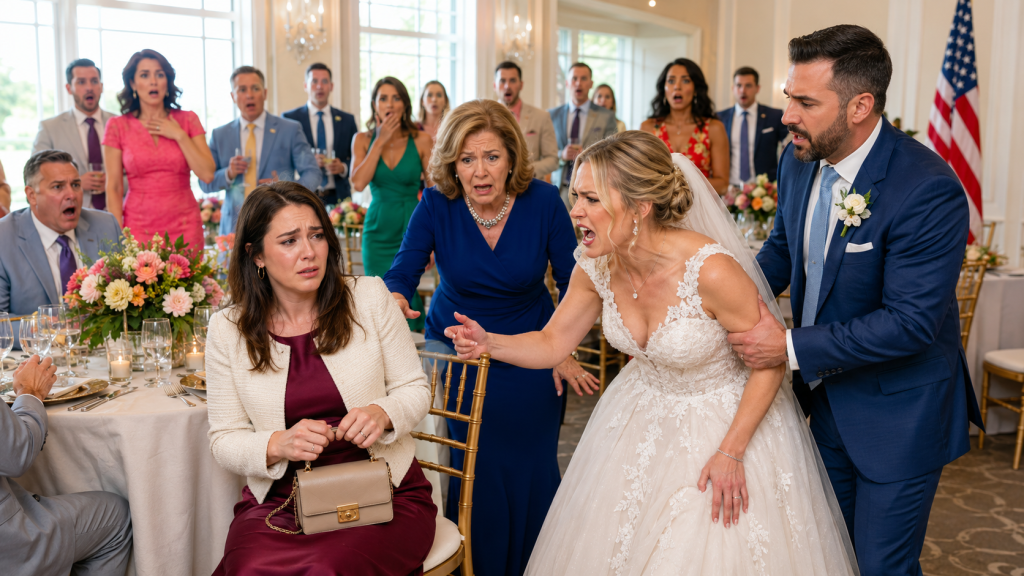
My sister pulled my chair away just as I was about to sit down and said coldly, “This table is for family—not you.”
I didn’t argue.
I picked up my purse and started walking toward the exit.
Then Grandma stood.
My aunts followed.
One cousin after another pushed back their chairs until nearly the entire family table was empty.
Before the first toast could even begin, half the ballroom was preparing to leave—and when the groom finally realized what was happening, he turned toward my sister and demanded:
“What did you do to her?!”
Brooke stared at her new husband as if he were the one embarrassing her.
“Nothing.”
Ethan lowered the microphone.
“Half your family is walking out before dinner. That is not nothing.”
Brooke’s cheeks flushed.
“She’s being dramatic.”
That made me stop near the ballroom doors.
I turned around.
“I haven’t said a single word.”
And that was exactly the problem for Brooke.
There was no screaming sister she could blame.
No shattered champagne glass.
No public insult she could twist later.
There was only the chair she had pulled away from me and an entire table full of relatives who had watched her do it.
Grandma Rose stepped beside me, her handbag looped over one arm.
“She told Claire this table was for family,” Grandma said. “Then she told her she wasn’t family.”
Ethan looked at Brooke.
“You said that?”
Brooke crossed her arms.
“She’s my half-sister.”
The silence that followed was somehow worse than shouting.
Aunt Diane shook her head.
“You have been calling her your sister for twenty-eight years whenever it benefited you.”
Brooke shot her a furious look.
“Stay out of this.”
“No,” Grandma said.
Her voice wasn’t loud.
It didn’t need to be.
“This is exactly the kind of thing the rest of us stayed out of for too long.”
Brooke looked around the ballroom.
More guests were turning toward us.
The jazz trio had stopped playing.
The photographer had quietly lowered his camera.
Even the servers seemed uncertain whether they should continue carrying salads to the tables.
Ethan rubbed one hand across his jaw.
Then his eyes moved toward the head table.
One chair sat empty beside his mother.
His expression changed.
“Brooke.”
She didn’t answer.
“Where did Claire’s original seat go?”
My stomach tightened.
I hadn’t known there was another seat.
Brooke looked at him.
“What are you talking about?”
“The seating chart.”
Ethan pointed toward the head table.
“My mother asked why there were seven place settings when only six people were seated.”
Brooke shrugged too quickly.
“I changed some things.”
“When?”
“This morning.”
“Why?”
“It’s my wedding.”
“Our wedding,” Ethan corrected.
Brooke stared at him.
For a few seconds, neither moved.
Then Ethan looked at me.
“Claire, you were supposed to be at the head table.”
I blinked.
“What?”
He seemed genuinely confused that I didn’t know.
“I put you beside Mom.”
Brooke’s eyes closed briefly.
That tiny reaction told him everything.
Ethan continued.
“You were on the final seating chart last night.”
“I never saw it.”
“Because Brooke changed it,” Aunt Melissa muttered.
Brooke snapped around.
“Oh, please. It was one chair.”
Grandma Rose’s grip tightened around her purse.
“No, sweetheart. It was never about one chair.”
Brooke laughed without humor.
“Of course you’d say that.”
I didn’t want to do this.
Not there.
Not in front of two hundred people at my sister’s wedding.
Whatever Brooke thought of me, I refused to become the reason her reception turned into a family spectacle.
I looked at Ethan.
“You should continue the reception.”
Then I looked at Grandma.
“And you should stay.”
Grandma shook her head.
“No.”
“Grandma.”
“I have spent eighty-one years learning the difference between peace and pretending,” she said. “They are not the same thing.”
Brooke’s face hardened.
“There. That’s exactly what Claire does.”
Everyone looked at her.
“She doesn’t even have to say anything,” Brooke continued. “She just stands there looking wounded and everyone rushes to protect her.”
“Brooke,” Ethan warned.
“No. I’m tired of it.”
I felt something inside me go very still.
Brooke pointed toward me.
“Since she came into this family, everything has been about Claire.”
I almost laughed.
“Since I came into the family?”
“You know what I mean.”
“No,” I said quietly. “Actually, I don’t.”
Brooke and I had the same father.
Dad married Brooke’s mother, Vanessa, when he was twenty-four.
Brooke was born two years later.
Their marriage ended when Brooke was four.
Three years after the divorce, Dad met my mother.
I was born when Brooke was eight.
There had never been a time in my life when Brooke wasn’t my sister.
When I learned to walk, she was the person I followed around the house.
When I started kindergarten, she braided my hair.
When I was ten and broke my wrist falling out of a tree, Brooke sat beside me at the emergency room making ridiculous faces until I stopped crying.
For most of our childhood, I didn’t even understand what “half-sister” meant.
She was simply Brooke.
And I adored her.
Things changed slowly.
Our father died when I was sixteen.
A heart attack at forty-eight.
One ordinary Tuesday morning, he left for work after burning his toast and complaining that the coffee was too weak.
By lunchtime, he was gone.
Brooke was twenty-four then.
Old enough to already have an apartment and a job.
I was still in high school.
Mom fell apart.
Grandma Rose became the person who held us together.
And for the first time, I began hearing words I had never thought mattered.
First marriage.
Second family.
Half-sister.
Inheritance.
Brooke’s mother told people Dad had “replaced” Brooke with Mom and me.
It wasn’t true.
Dad had attended every school play, every volleyball game, every birthday.
Brooke had keys to our house.
She spent Christmas mornings with us even when she spent Christmas Eve with her mother.
But grief has a strange way of making old resentments feel like evidence.
Within a year of Dad’s death, Brooke began pulling away.
Not completely.
Just enough for me to feel it.
She stopped calling me “little sis.”
Then she stopped calling unless she needed something.
She still came to birthdays.
Still posed for photographs.
Still introduced me as her sister in public.
But there was always a small distance between us.
I spent years pretending not to notice.
Apparently Grandma had noticed.
Now, standing in that ballroom, Brooke looked at me with twenty years of resentment in her eyes.
“You got everything after Dad died.”
I stared at her.
“What did I get?”
“Grandma.”
That answer surprised me.
Brooke laughed bitterly.
“See? You don’t even realize it.”
Grandma’s face softened.
“Brooke—”
“No. She moved in with you after college. She took you to appointments. She became the granddaughter who did everything right.”
“I moved in because Grandma fell and broke her hip.”
“And nobody asked you to.”
“Someone had to help her.”
“I could have helped.”
Grandma looked directly at Brooke.
“I asked you.”
Brooke froze.
Aunt Diane looked down.
Grandma continued gently.
“I asked you three times.”
“That was different.”
“How?”
“I was working.”
“So was Claire.”
“I had a career.”
The words landed harder than Brooke seemed to realize.
I worked as a freelance book editor.
From home, mostly.
Brooke had always treated that as something between unemployment and a hobby, despite the fact that I made a perfectly decent living.
Grandma shook her head.
“Claire rearranged her work because I needed help.”
Brooke’s voice rose.
“Exactly. And then suddenly she became your favorite.”
“There is no favorite.”
“Really?”
Brooke looked around at everyone standing beside me.
“Look at this.”
For the first time, I understood.
Not agreed.
But understood.
To Brooke, this wasn’t a wedding chair.
It was proof of a story she had been telling herself for years.
Every casserole Aunt Melissa brought me after my appendectomy.
Every Thanksgiving Grandma asked me to carve the turkey because Dad used to let me help him.
Every cousin who called me first with family news because I answered the phone.
Every ordinary act of closeness had become evidence in Brooke’s mind that I had stolen something from her.
And maybe the saddest part was that I hadn’t known we were competing.
I took a breath.
“Brooke, I never wanted your place.”
Her eyes filled suddenly.
Not with softness.
With anger.
“You didn’t have to want it.”
I nodded.
“Okay.”
She blinked, as if she expected an argument.
“I can’t convince you of something you’ve already decided,” I said. “But I am not going to stand here at your wedding and fight with you.”
I turned toward Ethan.
“I’m sorry.”
“You have nothing to apologize for.”
“Maybe not. But this is still your wedding day.”
Then I looked at Brooke.
“I hope someday you understand that I spent most of my life wanting a sister, not winning a competition.”
Her mouth tightened.
I walked toward the doors.
Grandma followed me.
Then everyone else moved again.
Brooke panicked.
“No. Stop.”
Grandma kept walking.
Brooke stepped forward.
“Grandma, please.”
Grandma stopped.
For one hopeful second, I thought Brooke might apologize.
Instead, she said, “People are watching.”
Grandma’s expression changed.
It was the saddest look I had ever seen on her face.
“That,” she said quietly, “is your problem.”
Brooke went silent.
“You are worried about what strangers are watching,” Grandma continued, “instead of what you just did to your sister.”
Ethan handed the microphone to the DJ.
Then he walked toward us.
“I need five minutes,” he told his mother.
She nodded.
Brooke stared at him.
“Where are you going?”
“To talk to Claire.”
“On our wedding day?”
“Yes, Brooke. On our wedding day.”
He followed me into the hallway.
I didn’t make it far.
The second the ballroom doors closed behind me, I leaned against the wall.
My hands were shaking.
Grandma touched my arm.
“I’m okay,” I said.
“No, you aren’t.”
“I will be.”
That was more truthful.
My cousins gathered near the coat check, whispering angrily.
Tyler wanted to leave immediately.
Aunt Diane was already asking the valet to bring Grandma’s car around.
Then Ethan came through the doors.
“Claire.”
I straightened.
“I’m sorry.”
He shook his head.
“No. I’m sorry.”
“You didn’t do anything.”
“I should have seen this coming.”
That confused me.
“What do you mean?”
He glanced at Grandma.
Then at the relatives standing around us.
“Brooke has been making comments about you for months.”
My chest tightened.
“What kind of comments?”
He hesitated.
“Mostly small things. She said you tried to control the wedding. That you kept inserting yourself into family decisions. That Grandma paid more attention to you. I thought it was wedding stress.”
“I barely spoke to Brooke about the wedding.”
“I know that now.”
Aunt Melissa frowned.
“What did she say Claire did?”
Ethan looked uncomfortable.
“She told me Claire insisted on being seated with immediate family.”
I stared at him.
“I never discussed seating with her.”
“I know.”
“How?”
“Because I put you there.”
He rubbed the back of his neck.
“When we were planning tables, Brooke originally put you at table fourteen with some of my coworkers.”
Grandma’s eyebrows rose.
Ethan continued.
“I thought it was a mistake. I told her you should be with the family. We argued about it.”
I felt embarrassed despite having done nothing.
“Ethan, you didn’t have to—”
“Yes, I did.”
His voice was firm.
“You’re her sister.”
Brooke’s voice came from behind him.
“You don’t understand.”
We all turned.
She stood just outside the ballroom doors.
Her veil was gone now.
One side of her hair had started coming loose.
For the first time that day, she didn’t look like the perfect bride in the photographs.
She looked tired.
Angry.
And afraid.
Ethan faced her.
“Then explain it to me.”
Brooke looked at all of us.
“Not with everyone standing here.”
Grandma nodded toward a small lounge across the hall.
“Then we will talk privately.”
I almost refused.
But I knew if I left without hearing the truth, Brooke would rewrite the night in her mind forever.
So five of us entered the lounge.
Me.
Brooke.
Ethan.
Grandma.
And Aunt Diane, who had been executor of Dad’s estate and had suddenly developed a very serious expression.
That should have warned me.
Brooke closed the door.
For several seconds, no one spoke.
Then she looked at Grandma.
“Tell her.”
Grandma frowned.
“Tell her what?”
“The house.”
My stomach dropped.
Grandma sat down slowly.
Aunt Diane exhaled.
“Brooke.”
“No,” Brooke said. “She deserves to know why everyone treats her like some saint.”
I looked between them.
“What house?”
Grandma closed her eyes.
“My house.”
I stared at her.
“What about it?”
Grandma’s home was a modest four-bedroom colonial she and Grandpa had bought in 1969.
It wasn’t a mansion.
But the neighborhood had changed dramatically over the decades, and the property was now worth far more than they had paid for it.
Grandma looked at me.
“I updated my will last year.”
My pulse quickened.
“Okay.”
“I left the house to you.”
I honestly thought I had heard her wrong.
“What?”
Brooke laughed bitterly.
“There it is.”
I looked at Grandma.
“Why?”
“Because you live there. Because you have maintained it with me. Because you paid for the new roof when insurance wouldn’t cover it. Because it is your home too.”
“No.”
Grandma looked surprised.
I shook my head.
“No, Grandma. I don’t want Brooke thinking I took your house.”
Brooke scoffed.
“Too late.”
I turned toward her.
“I didn’t know.”
“You expect me to believe that?”
“Yes.”
“She didn’t know,” Aunt Diane said.
Brooke glared at her.
“You expect me to believe Claire spent four years playing nurse without ever asking what she would get?”
Something snapped inside me.
Maybe it was the chair.
Maybe it was the word half-sister.
Maybe it was hearing four years of grocery runs, physical therapy, midnight hospital visits, and sitting beside Grandma when she cried because she was afraid she’d never walk without a cane reduced to an inheritance strategy.
I looked Brooke directly in the eyes.
“I helped Grandma because I love her.”
Brooke rolled her eyes.
“No one is that selfless.”
“I’m not selfless.”
My voice shook.
“I complained. I got exhausted. I lost clients because I canceled meetings. I cried in the grocery store once because Grandma refused to use her walker and fell again. I got angry with her. She got angry with me. We drove each other crazy.”
Grandma smiled faintly through tears.
“That is true.”
“But none of it was about a house.”
I looked back at Brooke.
“You could have been there too.”
Her expression hardened.
“I had a life.”
“So did I.”
There it was.
The sentence neither of us could escape.
I continued.
“You keep talking like I stole things you abandoned.”
Brooke’s face changed.
“That’s not fair.”
“Neither was pulling my chair away in front of our family and telling me I didn’t belong.”
She looked down.
Ethan remained silent.
I think he knew there were some wounds a husband couldn’t fix.
Brooke sat on the edge of a chair.
“I found out about the will six months ago.”
Grandma turned toward Aunt Diane.
“How?”
Aunt Diane looked furious.
“I have no idea.”
Brooke laughed bitterly.
“Mom told me.”
That explained more than it should have.
Vanessa.
Brooke’s mother had never forgiven Dad for remarrying.
Even after he died, she talked about my mother like she had personally destroyed her life.
“How would Vanessa know?” Aunt Diane asked.
Brooke hesitated.
Then I saw it.
Guilt.
Grandma saw it too.
“Brooke?”
Brooke swallowed.
“Mom went through the papers in your office.”
Grandma became very still.
“When?”
“At Christmas.”
I remembered Christmas.
Vanessa had come to pick Brooke up after dinner.
She had asked to use the bathroom.
Apparently she had wandered much farther down the hallway.
Grandma’s voice became quiet.
“She went through my private papers?”
Brooke said nothing.
“And then told you the contents of my will?”
“I had a right to know.”
“No,” Grandma said. “You did not.”
Brooke stood again.
“I’m your granddaughter too.”
“Yes.”
“Then why does Claire get the house?”
“Because Claire lives there.”
“I could sell it.”
Grandma stared at her.
Brooke realized what she had said.
Too late.
Grandma leaned back.
“And that is precisely why.”
Silence.
Brooke’s eyes filled.
“So that’s it? Claire wins again?”
I felt tired.
Not angry anymore.
Just deeply tired.
“There is no winning, Brooke.”
“Easy for you to say.”
“No. It isn’t.”
I stepped closer.
“You had Dad for eight years before I was even born.”
Her lips parted.
“I used to envy that.”
She looked startled.
“You remembered him when he had dark hair. You remembered the apartment he lived in before he met Mom. You remembered Grandpa before he died. You had years with people I barely knew.”
Brooke said nothing.
“I never thought that meant you stole them from me.”
Her face crumpled for half a second before she controlled it.
I continued.
“You want to know what I inherited from Dad?”
I touched my chest.
“Sixteen years.”
My voice broke.
“That was it.”
Grandma looked away, crying.
“I would trade every house and every dollar in this family for one more Tuesday morning with him complaining about burnt toast.”
Brooke covered her mouth.
For the first time, the anger in her eyes disappeared.
Underneath it was grief.
Old grief.
The kind that had never healed because it had been fed resentment instead.
She whispered, “He left Mom.”
There it was.
Not Dad died.
He left Mom.
Brooke had been carrying two losses for decades.
The divorce.
Then the death.
And somewhere along the way, her mother had convinced her both losses had the same villain.
My mother.
Then me.
“Dad and your mother’s marriage ended before he met mine,” I said gently.
“I know.”
“Do you?”
Brooke’s eyes closed.
“Mom said he wanted another family.”
Aunt Diane shook her head.
“Vanessa has been saying that since 1993.”
Brooke looked at her.
“And?”
“And it wasn’t true.”
Aunt Diane sat forward.
“Your father left because he and Vanessa fought constantly. They tried counseling for almost two years.”
Brooke stared at her.
“He never told you because he refused to make you choose between your parents.”
“But Mom said—”
“Your mother was hurt.”
Aunt Diane’s voice softened.
“Hurt people sometimes build stories that let them survive what happened. But a story does not become true because it is repeated for thirty years.”
Brooke’s shoulders sagged.
Ethan finally spoke.
“Is that why you didn’t want Claire at the table?”
Brooke didn’t answer.
He waited.
Eventually she whispered, “I wanted one day.”
“One day of what?”
“Being first.”
The words almost broke my heart.
Not because they excused her.
They didn’t.
But because I suddenly saw how miserable she had made herself.
Brooke looked at me.
“I know how childish that sounds.”
“Yes,” I said.
She almost smiled.
Almost.
Then tears spilled down her face.
“I wanted one day where Grandma looked at me first. Where everyone talked about me. Where I wasn’t wondering whether they secretly wished you were the one getting married.”
I stared at her.
“Why would anyone wish that?”
“Because everyone likes you.”
“That isn’t true.”
“It feels true.”
Ethan crouched in front of her.
“Brooke, I married you.”
She looked at him.
“I chose you.”
Her chin trembled.
“And what you did to Claire was cruel.”
Brooke’s face fell.
Ethan continued.
“But I need to know something before we walk back into that ballroom.”
She wiped her cheeks.
“What?”
“Did you marry me because you wanted a life with me, or because you wanted a day where everyone proved you mattered?”
Brooke stared at him.
I quietly looked away.
That question belonged to them.
After a long silence, Brooke whispered, “I love you.”
“Then start acting like the woman I thought I married.”
She flinched.
Ethan stood.
“I’m not asking you to be perfect.”
He glanced toward me.
“I am asking you not to humiliate people you supposedly love just because you’re afraid they are loved too.”
Nobody spoke.
Finally Brooke looked at me.
“I’m sorry.”
The words sounded unfamiliar in her mouth.
I didn’t rush to rescue her from the discomfort.
She needed to feel it.
“I’m sorry I moved your seat.”
I waited.
“And?”
Her face reddened.
“I’m sorry I said you weren’t family.”
Grandma said nothing.
Brooke swallowed.
“And I’m sorry I accused you of taking care of Grandma for money.”
That one mattered most.
I nodded.
“Thank you.”
Brooke looked almost disappointed.
“That’s it?”
“What do you want me to say?”
“That you forgive me.”
I looked at her for a long moment.
“I’m not there yet.”
She stared at me.
The old Claire would have forgiven her immediately.
Not because I truly had.
Because I hated conflict.
Because I wanted everyone comfortable.
Because being “the nice one” had sometimes become another way of disappearing.
But I was tired of pretending wounds vanished the moment someone acknowledged causing them.
“I love you,” I said. “But loving you doesn’t mean what happened tonight didn’t hurt.”
Brooke began crying again.
“I don’t know how we got here.”
I did.
“One small thing at a time.”
I sat across from her.
“You stopped calling.”
She nodded.
“I stopped asking why.”
Another nod.
“You made comments.”
“I ignored them.”
“You assumed the worst of me.”
“I kept trying to prove I wasn’t what you thought.”
Brooke wiped her eyes.
“And eventually we became strangers who knew all the same childhood stories.”
That sentence landed between us.
Grandma reached for both our hands.
“Then perhaps you stop trying to repair twenty years tonight.”
She squeezed Brooke’s hand.
“You start with the next twenty minutes.”
Brooke gave a broken laugh.
“What do I do?”
Grandma looked toward the ballroom.
“You tell the truth.”
Brooke went pale.
“To everyone?”
“You humiliated Claire publicly.”
Grandma’s voice was gentle but firm.
“The apology should not be hidden privately so that you can return to your party with everyone believing Claire caused the disruption.”
Brooke looked at Ethan.
He nodded.
“I agree.”
She inhaled slowly.
Then she looked at me.
“Will you come back inside?”
I didn’t answer immediately.
I thought about leaving.
Part of me wanted to.
I could go home, take off my dress, make tea, and sit with Grandma later.
Nobody could have blamed me.
But leaving would freeze the story at its ugliest moment.
And maybe, just maybe, we had a chance to write one better sentence after it.
“I’ll come back.”
Brooke’s shoulders dropped with relief.
“But I’m not going to pretend nothing happened.”
“I know.”
We returned to the hallway.
Our relatives were still waiting.
Tyler looked ready to challenge someone to a duel.
Aunt Melissa hugged me.
Then Brooke stepped forward.
“I owe all of you an explanation.”
Grandma shook her head.
“Not us first.”
Brooke looked at me.
Then toward the ballroom.
The room was still restless when we entered.
People had returned to their seats only because Ethan’s mother had asked them to wait.
The DJ had put on quiet instrumental music.
Nobody was eating.
Two hundred guests were trying desperately to look like they hadn’t been discussing us for the last fifteen minutes.
Brooke walked to the microphone.
Her hands shook as she picked it up.
Ethan stood beside her.
I remained near Grandma.
Brooke looked across the room.
“I need to say something before we continue.”
The room quieted.
“A few minutes ago, I removed my sister Claire’s chair from the family table.”
She paused.
“She had a place card there. She was supposed to be seated with us. I deliberately moved her because I was angry about things that had nothing to do with tonight.”
You could hear nothing except the air-conditioning.
“I told her the table was for family and that she was not family.”
Brooke looked at me.
“That was cruel.”
Her voice cracked.
“She didn’t cause a scene. She didn’t insult me. She simply tried to leave.”
Grandma squeezed my hand.
“My family stood because they saw what I had done. Claire did not ask them to.”
Several people looked down.
Probably people who had already assumed otherwise.
Brooke continued.
“I have spent a long time blaming my sister for things she did not take from me.”
Tears appeared in her eyes.
“My parents divorced when I was young. My father remarried. When he died, I carried a lot of anger, and instead of dealing with it, I turned Claire into a symbol for everything I thought I had lost.”
My throat tightened.
“She did not deserve that.”
Brooke wiped one cheek.
“And tonight, on a day that was supposed to be about love, I chose to make someone feel unwanted because I wanted to feel important.”
She looked toward Ethan.
“My husband reminded me that being loved does not require someone else to be rejected.”
Ethan’s expression softened.
Brooke turned back to me.
“Claire, you are my sister.”
The room blurred.
“You always were.”
A quiet sob came from Aunt Melissa.
Of course it did.
She cried at commercials.
Brooke gave a shaky laugh.
“And apparently almost my entire family is willing to leave an open bar to prove it.”
That got a few laughs.
Even I smiled.
Brooke took a breath.
“I’m sorry.”
Then, to my surprise, she walked toward the family table.
She picked up the chair she had moved earlier and carried it herself.
The ballroom watched as she placed it back beside Grandma.
Then she picked up my crumpled place card from the service station where she had tossed it.
She smoothed it against her dress.
CLAIRE BENNETT.
Brooke placed it in front of the chair.
“No,” Ethan said.
Everyone looked at him.
Brooke froze.
His mouth twitched.
“That’s still the wrong seat.”
For the first time all evening, genuine confusion replaced the tension.
Ethan walked to the head table.
He pulled out the empty chair beside his mother.
“This is Claire’s seat.”
I covered my face.
“Ethan.”
His mother, Linda, laughed.
“Get over here, sweetheart.”
Brooke stared at the place setting.
Then at Ethan.
“You really put her there?”
“Yes.”
“Why?”
He shrugged.
“Because when Mom was in the hospital last year and I was three states away for work, Claire sat with her for six hours until I could get there.”
Brooke looked at me.
I had forgotten about that.
Linda hadn’t.
She smiled.
“You brought terrible vending-machine coffee.”
“It was all they had.”
“And you listened to me panic about my biopsy.”
Brooke lowered her eyes.
Ethan continued.
“So when we made the seating chart, I wanted Claire near Mom. Not because she was more important than you.”
He looked at Brooke.
“Because people can matter without threatening your place.”
Brooke nodded slowly.
Then she took my hand.
“Sit there.”
I hesitated.
“Are you sure?”
“Yes.”
I sat.
The family returned to their seats.
Nobody left.
The jazz trio started again.
Servers resumed carrying plates.
And somehow the reception continued.
Not normally.
There was no pretending the previous twenty minutes hadn’t happened.
But something strange occurred.
The pressure disappeared.
Brooke had spent months trying to create a flawless wedding.
Once perfection shattered publicly, she seemed almost relieved.
She stopped checking whether the flowers were straight.
She took off her heels halfway through dinner.
When the best man forgot half his toast, she laughed instead of looking mortified.
Grandma danced with Ethan.
Tyler danced terribly with three aunts at once.
Even Brooke laughed when Aunt Melissa knocked over a champagne flute while telling a story about Dad trying to assemble Brooke’s childhood bicycle backward.
For a while, I simply watched.
Then Brooke approached me during dessert.
“Walk with me?”
We stepped onto the terrace.
The city lights stretched beyond the hotel garden.
For several seconds, we stood without speaking.
Finally Brooke said, “I was horrible to you.”
“Yes.”
She glanced at me.
“You really aren’t going to make this easy.”
“I spent years making it easy.”
She nodded.
“That’s fair.”
We leaned against the railing.
“I remembered something while Aunt Melissa was talking about Dad,” Brooke said.
“What?”
“When you were six, you wanted to sleep in my room every time I stayed at your house.”
I smiled.
“You hated it.”
“I pretended to.”
“You kicked me off the bed.”
“You kicked in your sleep.”
“I was six.”
“You had violent little feet.”
We both laughed.
The sound felt strange.
Familiar, but rusty.
Brooke looked down at her wedding ring.
“Do you remember the glow-in-the-dark stars?”
I did.
She had covered the ceiling above her bed with plastic stars.
When Dad turned off the light, they glowed green.
I thought they were magic.
“You told me each one was a planet.”
“I was lying.”
“I know that now.”
“You believed me for years.”
“You also told me chocolate milk came from brown cows.”
Brooke laughed.
“I was an excellent older sister.”
“For about eight years.”
Her smile faded.
“I’m sorry.”
This apology felt different.
Quieter.
Without an audience.
“I know.”
She looked at me.
“I don’t expect everything to go back.”
“It can’t.”
Her eyes watered.
“But maybe we can make something new.”
I thought about it.
“Maybe.”
Brooke nodded.
For that night, maybe was enough.
The reception ended just after midnight.
Grandma was exhausted.
I drove her home.
As I helped her inside, she refused to use the walker correctly, which made me threaten to call her physical therapist.
She threatened to remove me from her will.
We both stopped.
Then burst out laughing.
“Too soon?” she asked.
“Way too soon.”
Inside the kitchen, I made tea.
Grandma sat at the table.
For a while, neither of us spoke.
Then I said, “Change the will.”
She frowned.
“No.”
“Grandma.”
“My decision has nothing to do with Brooke.”
“It does now.”
She studied me.
“I don’t want the house to become proof of her worst assumptions.”
“And I will not design my estate around someone else’s jealousy.”
I sighed.
She had a point.
I hated when she had a point.
“What if you leave it to both of us?”
“No.”
“Why not?”
“Because you will live here.”
“You don’t know that.”
“I know you.”
She stirred her tea.
“You love the window seat in the upstairs hall. You planted the hydrangeas. You complain about the ancient plumbing and then refuse every suggestion to renovate the bathroom because your grandfather installed that ugly tile himself.”
“It’s extremely ugly.”
“It is hideous.”
We smiled.
Grandma reached across the table.
“Claire, inheritance should follow reality, not guilt.”
I stared at our hands.
“What about Brooke?”
“She has her own life.”
“That doesn’t mean she should feel forgotten.”
Grandma nodded.
“She isn’t forgotten.”
I looked up.
“I’m leaving her my investment account.”
I blinked.
“What?”
Grandma smiled.
“Your sister saw one page of a document she had no business seeing and built an entire tragedy from it.”
“How much is in the investment account?”
Grandma’s eyebrows lifted.
“That is none of your business either.”
I laughed.
“Fair.”
She squeezed my hand.
“I love you both differently because you are different people. Equal love does not always look identical.”
That sentence stayed with me.
Three weeks after the wedding, Brooke called.
Not texted.
Called.
I nearly didn’t answer because I was editing a manuscript.
Then I saw her name.
“Hello?”
“Are you busy?”
“Yes.”
“Oh.”
“But I can talk.”
There was a pause.
Then she said, “I started therapy.”
That surprised me.
“Okay.”
“I told Ethan I would.”
“How is it?”
“Terrible.”
I laughed.
“Probably means it’s working.”
“My therapist says I have unresolved abandonment issues.”
“I could have saved you the copay.”
Brooke laughed.
Then her voice softened.
“I told her about Dad.”
I closed my laptop.
“And?”
“She asked me to describe him without talking about Mom.”
That sounded simple.
It wasn’t.
Brooke continued.
“I realized almost every memory I’ve repeated about Dad for years came with Mom’s interpretation attached.”
I stayed quiet.
“So I tried remembering him as just my dad.”
Her voice cracked.
“I remembered him teaching me to ride a bike.”
“The backward bike?”
“That story has been exaggerated.”
“By multiple witnesses.”
“He fixed it eventually.”
We laughed.
Then Brooke began crying.
“I remembered how he used to leave notes in my lunch.”
I closed my eyes.
Dad did that for me too.
Stupid little notes.
Have a good day, bug.
Don’t trade your sandwich.
Math cannot defeat you.
“I forgot he did that,” Brooke whispered.
“No,” I said softly. “You didn’t forget. You just hadn’t thought about it in a while.”
We talked for almost an hour.
Not about the wedding.
Not about Grandma’s will.
About Dad.
For the first time in years, grief belonged to both of us without becoming a contest.
Months passed.
Brooke didn’t transform overnight.
Neither did I.
Sometimes she made a defensive comment and caught herself.
Sometimes I assumed she was criticizing me when she wasn’t.
Sometimes we went two weeks without speaking.
Healing turned out to be extremely ordinary.
No music.
No dramatic speeches.
Just small decisions.
Answer the phone.
Send the birthday message.
Ask the uncomfortable question.
Apologize before resentment hardens.
At Thanksgiving, Brooke came early.
That alone nearly caused Aunt Diane to faint.
She brought two pies.
One was homemade.
One was clearly purchased and transferred into a ceramic dish.
I pointed at it.
“You didn’t bake that.”
“You can’t prove anything.”
“The grocery-store label is still underneath.”
She grabbed the dish.
“Mind your business.”
Grandma laughed so hard she had to sit down.
Later, Brooke and I were washing dishes when she nudged me.
“I talked to Grandma.”
I tensed.
“About what?”
“The will.”
I set down a plate.
“Brooke—”
“No. Listen.”
She dried her hands.
“I told her I don’t want the house.”
I stared at her.
“She said good, because she wasn’t giving it to me.”
I laughed before I could stop myself.
Brooke rolled her eyes.
“She could have been gentler.”
“That was gentle for Grandma.”
“True.”
Then Brooke looked serious.
“I told her I was sorry for making her feel like she had to justify loving you.”
That surprised me.
“She cried.”
“Grandma cries when the weather channel shows rescued puppies.”
“She does.”
Brooke leaned against the counter.
“And she told me about the investment account.”
My eyes widened.
“She told you?”
“Yes.”
“How much?”
Brooke grinned.
“None of your business.”
I threw the dish towel at her.
She laughed.
Then her expression softened.
“I was so stupid.”
“You were hurt.”
“Those things can coexist.”
I smiled.
“Therapy really is working.”
“Annoying, isn’t it?”
Very.
A year after the wedding, Grandma turned eighty-two.
We held the party in her backyard.
Brooke arrived carrying a folding chair.
Everyone stared at her.
She set it beside mine.
A card was taped to the back.
FAMILY ONLY.
I looked at her.
“Seriously?”
She grinned.
Then flipped the card over.
On the other side she had written:
CLAIRE’S RESERVED SEAT. TOUCH IT AND GRANDMA WILL DESTROY YOU.
Grandma read it.
“Accurate.”
We laughed until Brooke cried.
This time, they were good tears.
Ethan took a photograph.
It became one of my favorites.
Not because everything was perfect.
But because it wasn’t.
Brooke and I lost almost twenty years believing love was something that could be divided until one person had more and another had less.
We learned too late that families don’t usually break in one dramatic moment.
They break slowly.
A withheld phone call.
A resentment left unspoken.
A cruel comment disguised as a joke.
An assumption repeated until it becomes a belief.
A chair pulled away at exactly the wrong moment.
But sometimes repair happens the same way.
Slowly.
A returned call.
An honest apology.
A difficult conversation.
A place made at the table.
Grandma lived another six years.
She made it to eighty-seven.
She remained stubborn until the end.
Her last Thanksgiving, she insisted on sitting at the head of the table even though we offered her a softer chair in the living room.
Brooke sat on one side.
I sat on the other.
At some point during dinner, Grandma looked from Brooke to me.
Then she smiled.
“What?” Brooke asked.
“Nothing.”
“That means something.”
Grandma shook her head.
“I was just thinking your father would have liked this.”
Neither of us spoke.
Brooke reached beneath the table.
Her hand found mine.
We sat there holding hands like two little girls beneath a ceiling covered in glow-in-the-dark stars.
Grandma died peacefully the following spring.
Brooke was with me.
We both held her hands.
After the funeral, Aunt Diane gathered us in Grandma’s kitchen.
The house felt impossibly quiet.
I had spent years listening for Grandma’s cane against the floor.
Now there was nothing.
Aunt Diane opened the estate documents.
Grandma had not changed the house.
She left it to me.
Brooke received the investment account.
Neither of us asked what the other had received.
Not at first.
We simply sat together crying.
Eventually Brooke looked around the kitchen.
“You’re going to keep the ugly tile, aren’t you?”
“Obviously.”
“Dad hated that tile.”
“Grandpa installed it.”
“Badly.”
“Very badly.”
We laughed through tears.
Then Brooke said, “Promise me something.”
“What?”
“Don’t ever sell the house without telling me.”
I looked at her.
“You want it?”
“No.”
She shook her head.
“I just want to know before the place disappears.”
I understood.
It wasn’t about ownership anymore.
It was about memory.
“I promise.”
Years later, the house still stands.
The hydrangeas are bigger.
The plumbing remains terrible.
The bathroom tile is still offensively ugly.
And every Thanksgiving, our family gathers around Grandma’s old dining table.
Brooke usually arrives first now.
She married the right man.
Ethan never forgot what happened at their wedding, but he also never used it as a weapon.
They did the difficult work after the photographs were printed and the flowers died.
Two years later, they had a daughter.
They named her Rose.
When little Rose turned four, Brooke asked me to become her legal guardian if anything ever happened to her and Ethan.
I stared at the document for a long time.
“You’re sure?”
Brooke looked offended.
“Obviously.”
“But I’m only your half-sister.”
She threw a pen at me.
I laughed so hard I nearly fell out of my chair.
Then she hugged me.
“I hate that I ever said that.”
“I know.”
“I really hate it.”
“I know.”
She pulled back.
“You’re never going to let me forget, are you?”
“No chance.”
She smiled.
“Good.”
Because forgetting wasn’t the goal.
Remembering differently was.
That wedding could have become the night our relationship ended.
For a few minutes, I thought it had.
I thought the kindest thing I could do for myself was walk through those ballroom doors and never look back.
And perhaps, if Brooke had refused to take responsibility, that would have been exactly what I needed to do.
Family does not get unlimited permission to hurt you.
Blood does not turn cruelty into love.
Sharing a parent does not require sharing your peace with someone determined to destroy it.
But accountability changed what happened next.
Brooke didn’t just ask me to forgive her.
She changed.
Slowly.
Imperfectly.
Repeatedly.
And I changed too.
I stopped confusing silence with kindness.
I learned that keeping peace by swallowing every hurt does not preserve a relationship.
It only delays the argument while resentment grows underneath.
I learned to say, “That hurt me.”
I learned to say, “No.”
I learned that forgiveness can be offered without pretending nothing happened.
Most importantly, I learned something Grandma had understood long before either of us.
There is no single chair at the family table.
Love is not musical chairs.
Someone else being welcomed does not mean you have been replaced.
Someone else being cared for does not mean you matter less.
Someone else receiving love does not steal yours.
Brooke had spent decades afraid that my chair existed because hers had been taken away.
It never had been.
She simply stopped sitting down.
Now every holiday, she sits beside me.
Sometimes we argue.
Sometimes she steals food from my plate.
Sometimes I remind her she once told me I wasn’t family just so I can watch her groan.
And every single time, she answers the same way.
She drags her chair closer to mine and says,
“Too bad. You’re stuck with me now.”
And maybe that is the ending Grandma would have wanted.
Not a perfect family.
Not a spotless history.
Not people who never hurt one another.
Just people who finally learned that when someone you love approaches the table, you do not pull their chair away.
You make room.
💬THE END! THANK YOU FOR READING!