

My son did not defend me.
Instead, Daniel was quiet for several seconds before saying, “I know. I’ve been thinking about it too.”
Something inside me changed in that hallway.
Not shattered.
Not broke.
Changed.
There is a difference.
When you are young, betrayal feels like a knife.
At seventy-one, betrayal feels more like a light being switched on in a room you have been pretending was not dark.
I stood there with a basket of Daniel’s children’s clean laundry in my arms and listened.
Renee lowered her voice.
“I’m not trying to be cruel. I just think we need our space back.”
“Our space?”
“She’s been here almost two years.”
Daniel sighed.
“She lost Dad.”
“I know.”
“She sold the house.”
“I know.”
“And the kids love having her around.”
Renee gave a short laugh.
“Of course they do. She waits on them.”
That one hurt.
Not because it was entirely false.
Because, in a way, it was true.
I had allowed myself to become the person who solved every small inconvenience in their lives.
Forgotten lunch?
Grandma would bring it.
Soccer practice overlapped with a dentist appointment?
Grandma would drive.
Daniel and Renee wanted dinner alone?
Grandma would babysit.
Nobody could find clean uniforms Monday morning?
Grandma had already folded them.
I had confused being needed with being loved.
Maybe because after Harold died, being needed was easier than being alone.
I carried the laundry downstairs without making a sound.
That evening, nobody noticed anything different.
Renee asked whether I could pick up Emma from dance class on Thursday.
I said yes.
Daniel reminded me that Luke needed a permission slip signed for a museum trip.
I found it in his backpack.
I made spaghetti.
I washed the dishes.
And after everyone went upstairs, I sat alone at the kitchen table and looked at my hands.
Harold used to hold those hands across restaurant tables.
He used to kiss the back of my fingers when we were stuck at red lights.
He used to tease me about the tiny scar near my thumb from the time I tried opening a can of peaches with a butter knife during our first year of marriage.
Thirty-eight years in one house.
Forty-five years of marriage.
An entire life.
And somehow, after he died, I had permitted myself to become grateful for a bedroom at the end of my son’s hallway.
I went to bed before midnight.
The next morning, I bought a lottery ticket.
That part sounds dramatic when I say it now.
It wasn’t.
I bought lottery tickets occasionally.
Harold used to buy one every Friday.
He would put it on the refrigerator with a magnet shaped like a cactus and tell me, “Don’t make weekend plans, Maggie. By Monday we might be irresponsible millionaires.”
We never were.
After he died, I kept buying them once or twice a month.
Not because I expected to win.
Because it reminded me of him.
Three weeks after overhearing Daniel and Renee, I stopped at a grocery store after picking up a prescription.
The jackpot was enormous.
I bought one ticket using numbers Harold had always chosen.
Our anniversary.
Daniel’s birthday.
My birthday.
The number of the first house we owned.
Harold’s favorite number.
And 38, for the years we lived in our Tucson home.
The next morning, I forgot about it.
For two days.
Then, while making coffee, I heard a television reporter announce that the winning ticket had been purchased in Scottsdale.
I nearly dropped my mug.
I retrieved the ticket from the side pocket of my purse.
Checked the numbers once.
Then again.
Then a third time.
I sat down.
The room became strangely quiet.
I remember hearing the refrigerator motor.
A dog barking somewhere outside.
Water moving through the pipes upstairs.
I remember thinking that Harold should have been sitting across from me.
That was my first thought.
Not mansions.
Not cars.
Not diamonds.
Harold.
I whispered, “You finally did it.”
Then I cried so hard I had to cover my mouth because I didn’t want anyone upstairs to hear me.
The jackpot was eighty-nine million dollars.
Even after choosing the payment structure recommended by my attorneys and accounting for taxes, fees, trusts, gifts I intended to make, and a conservative investment plan, I would have more money than I could reasonably spend during the rest of my lifetime.
I told nobody.
Not Daniel.
Not Renee.
Not my sister.
Not my closest friend, Carol.
Nobody.
The only people who knew initially were the attorney I hired, the financial adviser she recommended, an accountant, and eventually the representatives required to process the claim.
Arizona allowed enough privacy through the structure we established that I did not have to stand beneath flashing cameras holding an oversized check.
Thank God.
The attorney’s name was Elaine Carter.
She was fifty-six, sharp-eyed, patient, and unimpressed by money.
During our second meeting, she asked the most important question anyone asked me during those weeks.
“What do you want your life to look like now, Margaret?”
I stared at her.
Nobody had asked me that since Harold died.
Everyone had told me what would be best.
Daniel thought living with them was best.
Renee thought keeping busy was best.
Friends thought traveling would be best.
My doctor thought routine was best.
Elaine asked what I wanted.
“I don’t know,” I admitted.
She smiled.
“That’s a perfectly acceptable answer.”
Then she pushed a legal pad toward me.
“Start by writing down what you don’t want.”
That was easier.
I didn’t want to be anyone’s burden.
I didn’t want to be anyone’s unpaid servant.
I didn’t want people pretending to love me because I could buy them something.
I didn’t want the money to erase my common sense.
I didn’t want to spend the rest of my life punishing people.
And I never again wanted to live somewhere that another person could make me feel I had overstayed my welcome.
Elaine read my list.
Then she tapped the final line.
“That one sounds like a place to begin.”
Harold had established a small company years earlier called HMB Holdings.
The letters stood for Harold and Margaret Briggs.
Nothing glamorous.
Harold used it when purchasing a small rental property with his brother, and later for a few modest investments.
After his brother died, Harold retained the company mostly because closing it seemed more complicated than keeping it.
Daniel had seen the name his entire adult life.
Tax folders.
Bank envelopes.
Documents on Harold’s desk.
He never cared about it because it never represented anything exciting.
After my lottery win, Elaine suggested we restructure HMB Holdings beneath the broader estate and trust plan.
It became useful again.
For the next three months, I changed almost nothing.
That was intentional.
I wanted to know what people thought of Margaret Briggs before anyone knew what Margaret Briggs possessed.
I continued sleeping in the guest room.
I continued driving my twelve-year-old Toyota Avalon.
I continued packing lunches.
I continued cooking dinners.
But internally, something had shifted.
I stopped needing their approval.
And once I stopped needing it, I began noticing things.
Renee would come home from shopping with four bags from expensive boutiques and complain that my yogurt was taking too much room in the refrigerator.
Daniel would ask me to babysit Saturday, then forget to mention they wouldn’t return until Sunday afternoon.
Renee once handed me a grocery receipt and said, “Your things were about forty-six dollars this week.”
I stared at the paper.
“My things?”
“Your oatmeal, yogurt, bananas, tea. That kind of stuff.”
I gave her fifty dollars.
She kept the change.
Another evening, Daniel complained about property taxes while wearing a watch Harold had given him for his fortieth birthday.
I wondered whether Harold had ever imagined his son would one day calculate the cost of his mother’s bananas.
Still, I said nothing.
I wasn’t collecting evidence for revenge.
I was allowing myself to finally see my circumstances without excuses.
The only uncomplicated part of living there was my grandchildren.
Emma was thirteen.
Luke was ten.
They loved me with the casual selfishness children often have, which is somehow more honest than adult politeness.
Emma came into my room without knocking and borrowed my scarves.
Luke left half-finished drawings on my pillow.
They expected pancakes because Grandma made pancakes.
They expected me in the bleachers because Grandma attended games.
They did not calculate electricity.
They did not measure refrigerator space.
They simply loved me.
That made what happened next harder.
Three months after my lottery ticket changed my financial life, Daniel raised the subject at dinner.
It was a Sunday.
I had made pot roast.
Renee had spent most of the meal scrolling through photographs of a house on her tablet.
I knew the property.
Anyone who spent much time around Daniel and Renee knew the property.
It sat against the lower slope of Camelback Mountain behind a long stone wall and iron gates.
Five bedrooms.
Six bathrooms.
A swimming pool shaped around desert landscaping.
Mountain views.
A detached guest casita.
An enormous kitchen.
Two home offices.
A courtyard with an old olive tree.
The house had belonged to a retired surgeon and his wife.
Daniel and Renee had toured it eight months earlier when it first went on the market.
They could not afford it.
Not even close.
But that did not stop Renee from talking about it.
She called it “the forever house.”
She had screenshots.
Floor plans.
Saved furniture ideas.
Once, jokingly, she had shown me which bedroom would be mine.
“The casita would actually be perfect for you,” she had said.
I remembered that.
That Sunday night, the house had been relisted after a previous buyer’s financing collapsed.
Renee turned the tablet toward Daniel.
“They reduced it again.”
Daniel glanced at the price.
“Still too much.”
“If we sold this place and stretched—”
“We’d still be short.”
“What if your bonus is bigger?”
“It won’t be that big.”
Renee groaned.
“It’s perfect.”
I cut my carrots.
Luke asked whether he could have another roll.
I passed the basket.
Then Daniel cleared his throat.
“Mom?”
Something in his tone made me look up.
“Yes?”
He set down his fork.
Renee suddenly became very interested in her wine.
Daniel rubbed his palm over his jaw.
“We’ve been meaning to talk.”
Emma looked between us.
“About what?”
Daniel ignored her.
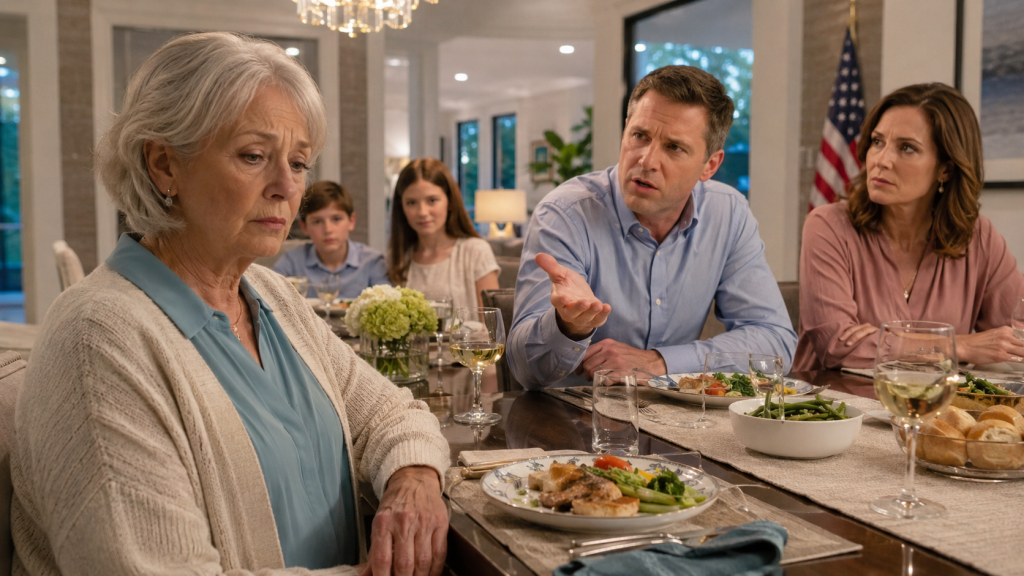
“Mom, when are you finally moving out?”
There it was.
Not cruelly shouted.
Not angrily delivered.
Almost worse.
Casual.
As if he were asking when I planned to pick up the dry cleaning.
For a moment, Harold’s empty chair existed in my mind.
Not literally.
But I could feel him beside me.
I wondered what he would have said.
Probably something impolite.
Harold loved our son fiercely, but he never believed love required pretending.
I placed my fork beside my plate.
“When would you like me to leave?”
Daniel blinked.
He clearly expected resistance.
“Well… not tomorrow.”
Renee spoke quickly.
“Nobody’s throwing you out, Margaret.”
I turned toward her.
She smiled too brightly.
“We just think it might be healthy for everyone to have their own space.”
Emma’s face changed.
“What?”
“Honey,” Renee said.
“No. Grandma lives here.”
Luke stopped eating.
Daniel gave them the parental look that meant stay out of adult conversations.
Then he turned back to me.
“We thought maybe by the end of the month?”
“The end of the month,” I repeated.
“That gives you almost three weeks.”
Three weeks.
I had given them nearly two years.
Thousands of meals.
School pickups.
Appointments.
Weekends.
Laundry.
My time.
My love.
Three weeks sounded very generous to them.
I nodded.
“All right.”
Daniel frowned.
“All right?”
“I’ll leave.”
Renee looked relieved so quickly that she couldn’t hide it.
“We can help you find something.”
“That won’t be necessary.”
Daniel reached across the table.
“Mom, don’t take this personally.”
I looked at his hand.
Then at his face.
“How should I take it?”
He opened his mouth.
Nothing came out.
I smiled gently.
“I’m not angry.”
And strangely, I wasn’t.
I had passed anger.
Sometimes dignity arrives after disappointment has exhausted itself.
I finished dinner.
Washed my plate.
Then went upstairs.
Emma followed me.
She stood in my doorway with tears in her eyes.
“You’re really leaving?”
“Yes, sweetheart.”
“Because Dad said that?”
“Because it’s time.”
She crossed her arms.
“I hate this.”
I sat on the edge of the bed.
“Come here.”
She did.
I held her the way I had when she was five and terrified of thunderstorms.
“You will still see me.”
“Where will you live?”
“I’ll figure it out.”
“Are you mad at us?”
“Never.”
“At Dad?”
I considered the question.
“No.”
That wasn’t entirely true.
But children should not be drafted into adult disappointment.
“I think your father and I forgot that I was supposed to be building a life, not borrowing one.”
Emma did not fully understand.
Neither did I, yet.
The next morning, I called Elaine.
“I’m ready,” I told her.
“For what?”
“To buy a home.”
She laughed softly.
“Excellent.”
I spent that day looking at properties online.
Not twenty-million-dollar palaces.
Not ridiculous estates.
I wanted warmth.
Privacy.
A garden.
A kitchen with sunlight.
A bedroom large enough for Harold’s cedar chest.
A porch.
I kept returning to one property north of Scottsdale on a quieter road.
Single-story.
Adobe exterior.
Three bedrooms.
A library.
Mountain views.
A courtyard filled with citrus trees.
It was beautiful.
I scheduled a viewing for Tuesday.
I loved it immediately.
Then, before we submitted an offer, Elaine called.
“There’s another property I think you should know about.”
“What property?”
She sent me the address.
I stared at my phone.
Camelback Mountain.
The house.
Daniel and Renee’s forever house.
I called her.
“Why are you sending me this?”
“Because you asked me to keep an eye out for strong real-estate opportunities in the area, and objectively, it qualifies. The price reduction is significant.”
“I know who wants that house.”
“Who?”
“My son.”
Silence.
Then Elaine said carefully, “Do you want to buy it because your son wants it?”
“No.”
“Good.”
I appreciated that she asked.
Because buying it purely to hurt Daniel would have made me smaller than I wanted to become.
But I looked at the listing again.
Five bedrooms.
A detached casita.
Beautiful grounds.
Space for guests.
Privacy.
Accessibility features already incorporated by the previous owners.
The courtyard olive tree.
A kitchen with enormous windows.
And something else.
A separate studio with northern light.
Harold had painted after retirement.
Badly.
Joyfully.
I still had thirty-seven of his paintings in storage.
I suddenly imagined hanging them there.
Not because Daniel wanted the house.
Because I did.
That distinction mattered.
I toured the property Wednesday morning.
The listing agent did not know who I was.
Elaine arranged everything through HMB Holdings.
I walked slowly through each room.
The house was beautiful but not flashy.
Warm stone floors.
Wood beams.
Deep windowsills.
A library with built-in shelves.
In the main bedroom, French doors opened toward a private garden.
The casita had its own entrance.
I imagined Carol visiting.
My sister spending Christmas.
Emma doing homework at the kitchen island.
Luke cannonballing into the pool.
I walked outside.
Camelback Mountain rose behind the property in rust-colored afternoon light.
There was a stone bench beneath the olive tree.
I sat there.
Harold would have loved it.
That decided me.
“What would make the seller say yes quickly?” I asked Elaine.
She smiled.
“Cash usually helps.”
We submitted the offer.
HMB Holdings.
No mortgage contingency.
Flexible closing.
Proof of funds.
The sellers accepted that afternoon.
Six days after Daniel asked when I was finally moving out, HMB Holdings owned the house his family had spent almost a year dreaming about.
I told nobody.
Not yet.
Instead, I rented a small furnished condominium for several weeks while the estate was prepared for me.
Daniel assumed that was my permanent destination.
He even helped carry two suitcases downstairs.
That was all I took at first.
Most of my belongings were still in storage from the Tucson house.
Renee stood in the foyer while I put on my jacket.
“You know you can come for dinner anytime.”
I nearly smiled.
Dinner.
In the house where I had cooked hundreds of them.
“Thank you.”
Daniel hugged me.
It was an awkward hug.
He smelled like the aftershave Harold had always bought him at Christmas.
For one dangerous second, I nearly told him everything.
Not about the lottery.
About the pain.
I wanted to say, You were supposed to make room for me because you loved me, not keep score until I became inconvenient.
Instead, I whispered, “Take care of yourself.”
He stepped back.
“You too.”
Emma refused to come downstairs.
I found her sitting on her bed.
“You were going to let me leave without goodbye?”
She wiped her face.
“I’m mad.”
“You’re allowed.”
“At them.”
“You’re allowed that too.”
She looked toward her window.
“Mom already has plans for your room.”
Of course she did.
“What plans?”
“A home gym.”
I laughed.
I couldn’t help it.
Emma stared.
“Why is that funny?”
“Because your grandmother is apparently worth less than a treadmill.”
Emma tried not to smile.
Then she hugged me.
Luke slipped a folded piece of paper into my purse before I left.
I found it later.
He had drawn a stick-figure house with three people outside.
Him.
Emma.
Me.
Above it he had written:
GRANDMA’S HOUSE SOMEDAY.
I framed it.
My condominium was small.
Quiet.
The first night, I woke at two in the morning because nobody needed anything from me.
It was disorienting.
No footsteps.
No doors.
No television downstairs.
No schedule taped to the refrigerator.
I made tea.
Sat on the balcony.
And cried.
Freedom can resemble loneliness before you become accustomed to it.
But each morning, I woke feeling a little lighter.
I joined a grief support group I had previously claimed I was “too busy” to attend.
I called Carol.
I told her I had moved.
She said, “Good.”
Not “I’m sorry.”
Good.
That surprised me.
“You knew?”
“I knew you were disappearing in that house.”
“What does that mean?”
“It means every time I called, you were driving somebody somewhere, cooking something, cleaning something, or whispering because someone was sleeping.”
I was quiet.
Carol continued.
“You’re seventy-one, Maggie. You’re allowed to have a life that isn’t useful to someone else.”
A week later, I told her about the lottery.
She screamed so loudly I pulled the phone away from my ear.
Then she cried.
Then she said, “Harold, you ridiculous man. Your numbers finally worked.”
That made me cry too.
I asked her not to tell anyone.
She didn’t.
The renovations on the Camelback house were minor.
I changed one bedroom into a painting room.
Another became a guest room.
The library became mine.
I brought Harold’s cedar chest from storage.
His paintings.
Our wedding photograph.
My mother’s dishes.
The brass lamp from our Tucson living room.
I bought new furniture, but not all new.
I wanted the house to contain my life, not replace it.
In the courtyard, I planted yellow roses.
The same variety Harold had planted for me thirty-nine years earlier.
My new home was ready seven weeks after I moved out of Daniel’s house.
I planned to tell him after I settled in.
Fate was faster.
One Saturday morning, Renee called.
Her voice sounded strange.
“Margaret?”
“Yes?”
“Did you hear what happened with the Camelback house?”
I was standing in its kitchen drinking coffee.
“No. What happened?”
“It sold.”
“I’m sorry.”
“All cash.”
“That happens.”
“Daniel knows someone at the brokerage. Apparently some company bought it.”
I looked through my windows toward the mountain.
“What company?”
“HMB Holdings.”
I said nothing.
Renee continued.
“That name sounds familiar.”
“Does it?”
“I swear I’ve seen it somewhere.”
I took a sip of coffee.
“You probably have.”
“Daniel thinks maybe it’s some investment group.”
“That would make sense.”
She sighed.
“I’m devastated. I know that sounds stupid.”
“It doesn’t sound stupid.”
“We loved that house.”
“I know.”
“Daniel keeps saying we could never really afford it anyway, but I thought maybe the buyer would renovate it and resell.”
“That’s possible.”
Of course it wasn’t.
“Anyway,” she said, “Emma wants to see you. Are you free Sunday?”
“I am.”
“Come here around three?”
I looked around my kitchen.
“Actually, why don’t you all come to my place?”
There was a pause.
“The condo?”
“My new place.”
“You moved again?”
“Yes.”
“When?”
“Recently.”
“You bought somewhere?”
“Yes.”
Another pause.
“Well… okay. Text me the address.”
“I will.”
When I sent it, my phone rang thirty seconds later.
Daniel.
I let it ring twice.
“Hello?”
“Mom.”
“Yes?”
“This address.”
“Yes.”
“What is this?”
“My house.”
Silence.
Then, “No.”
I smiled.
“I’m afraid so.”
“Mom, that’s the Camelback property.”
“I know.”
“Renee must have sent you the wrong listing or something.”
“She didn’t send me anything.”
“How did you—”
He stopped.
I heard movement.
Probably checking the address again.
“Mom, who owns that house?”
“I do.”
Another long silence.
“That’s not possible.”
“Why?”
“Because it sold to HMB Holdings.”
“Yes.”
His breathing changed.
I could almost see his face as memory connected the name.
“HMB,” he said.
“Yes.”
“Dad’s company?”
“Our company.”
“How could that company afford—”
He stopped again.
Finally, Daniel asked the question that mattered.
“Mom, what are you not telling me?”
I looked at Harold’s photograph on the counter.
“Come tomorrow at three.”
Then I ended the call.
They arrived at 2:47.
Renee walked through the courtyard as if she had entered a dream that belonged to someone else.
Emma ran straight toward me.
“You LIVE HERE?”
Luke shouted from behind her.
“Grandma has a pool!”
I laughed.
“Hello to you too.”
Emma hugged me.
Then looked around.
“This is insane.”
Daniel did not speak.
Renee looked pale.
I led them inside.
Her eyes moved across every feature she had once shown me on her tablet.
The beams.
The kitchen.
The mountain view.
The courtyard.
The glass doors.
Finally, she turned.
“You bought this?”
“Yes.”
“How?”
“Sit down.”
We gathered in the living room.
Emma and Luke were too excited to remain seated, so I told them they could explore the courtyard but not the pool.
After the doors closed behind them, Daniel leaned forward.
“Mom.”
I folded my hands.
“Three months before you asked me to move out, I won the lottery.”
Neither of them moved.
Then Renee laughed once.
A small, disbelieving sound.
“What?”
“Eighty-nine million dollars.”
Daniel stared at me.
“You’re joking.”
“No.”
“Eighty-nine million?”
“Yes.”
“When?”
I told him.
His face went through several emotions.
Shock.
Confusion.
Calculation.
Then pain.
“You knew when we had that conversation?”
“Yes.”
His eyes dropped.
Renee looked around the room again.
“So you bought this house after we asked you to leave.”
“Six days later.”
Her cheeks flushed.
“Why?”
“Because I liked it.”
She blinked.
“You knew we wanted it.”
“Yes.”
“And you bought it anyway?”
I studied her.
“The property was publicly listed, Renee.”
“That’s not what I mean.”
“What do you mean?”
“You knew how much this house meant to us.”
“And you knew how much having a home meant to me.”
The room became silent.
Daniel rubbed his forehead.
“Mom, was this revenge?”
“No.”
He looked at me.
I pointed toward the windows.
“Your father would have loved that mountain view. There’s a studio where I put his paintings. There is a library I’ve wanted my whole life. The house is one level. The casita means friends can stay without feeling they’re invading my space. I bought it because I can imagine living here until I die.”
Then I added, “The fact that you wanted it made the timing uncomfortable. But it did not create the desire.”
Renee crossed her arms.
“You could have helped us buy it.”
There it was.
The sentence I had suspected would eventually arrive.
Daniel turned sharply.
“Renee.”
“What? She could have.”
I nodded.
“Yes. I could have.”
Renee stared at me.
“And you didn’t.”
“No.”
“Why?”
I looked at her carefully.
“Three months ago, you wanted me to contribute forty-six dollars for yogurt and bananas.”
Her face changed.
Daniel looked toward her.
I continued.
“You complained that I lived in your house for free while I cared for your children, cooked your meals, did your laundry, and rearranged my life whenever your schedule required it.”
Renee opened her mouth.
“I never—”
“I heard you.”
That stopped her.
“In your bedroom. The door was partly open.”
Daniel’s face reddened.
“Mom—”
“I heard you too.”
He looked down.
“I stayed because I loved you. Both of you. And because after Harold died, I was terrified that living alone meant accepting that he was really gone.”
My voice shook.
I let it.
“I made myself useful because usefulness gave me a reason to get out of bed. And you became accustomed to it.”
Daniel whispered, “I’m sorry.”
Renee remained defensive.
“We did appreciate you.”
“Sometimes.”
“That’s not fair.”
“No,” I said softly. “What wasn’t fair was turning my grief into free labor and then asking when I was finally leaving once my presence became less convenient than the bedroom I occupied.”
She stared at me.
I did not raise my voice.
I did not need to.
Daniel stood and walked toward the windows.
For several moments, he looked outside.
Then he turned.
“Why didn’t you tell me you won?”
“Because I needed to know whether anything changed without the money.”
His expression tightened.
“What does that mean?”
“It means if I had told you immediately, every conversation afterward would have been contaminated by eighty-nine million dollars.”
“I’m your son.”
“Yes.”
“You think I’d only care about you because of money?”
“I didn’t say that.”
“You’re implying it.”
“I’m saying I needed space to understand who I had become and what our relationship had become.”
Daniel sat again.
His anger was beginning to mix with shame.
“Did you test us?”
“No. Life did that without my help.”
That sentence silenced him.
Renee stood.
“This is unbelievable.”
She walked toward the kitchen, then back.
“You were sitting there with eighty-nine million dollars while we worried about bills?”
“You earn a very good income.”
“That’s not the point.”
“It is partly the point.”
“We’re family.”
“Yes.”
“And family helps family.”
I nodded.
“I agree.”
“Then—”
“Family also doesn’t invoice seventy-one-year-old grandmothers for bananas while accepting hundreds of hours of free childcare.”
Renee went silent.
Daniel closed his eyes.
I hated the satisfaction I felt in that moment.
Not because the statement was wrong.
Because Harold would have reminded me that winning an argument is not the same thing as repairing a family.
So I softened.
“I am not going to punish you financially.”
Renee looked at me quickly.
“But I’m also not going to reward entitlement.”
“What does that mean?” she asked.
“It means my money belongs to me.”
Daniel looked wounded.
“I never said it didn’t.”
“No. But I need that understood clearly now before people begin imagining inheritances.”
His face reddened again.
I continued.
“I have updated my estate plan. Emma and Luke will have education trusts that cannot be controlled by either of you. They will have opportunities. They will not become spoiled because Grandma happened to buy a lucky ticket.”
Daniel nodded slowly.
“That’s fair.”
“I will also help family when there is real need. Medical emergencies. Education. Something meaningful. But I will not finance lifestyles designed around what anyone believes I can afford.”
Renee looked toward the mountain.
“So this is really your house.”
“It is.”
She almost smiled despite herself.
“It’s beautiful.”
“I know.”
Then Luke burst through the doors.
“Grandma! There’s a tiny house outside!”
“The casita.”
“Can I live there?”
Daniel laughed for the first time.
“You’re ten.”
“So?”
Emma followed him.
“Grandma, can we swim?”
I looked toward Daniel.
He nodded.
“Sure.”
Within fifteen minutes, the children were in borrowed swimsuits I had purchased specifically because I knew them well enough to anticipate the question.
Their laughter carried across the courtyard.
Daniel and I sat beneath the olive tree while Renee stayed inside.
For a while, neither of us spoke.
Then he said, “Dad would have loved this.”
“I thought so.”
He looked at Harold’s painting visible through the studio doors.
“I forgot about those.”
“You never liked his desert paintings.”
“They were terrible.”
I laughed.
“They were.”
Daniel smiled.
Then his smile disappeared.
“I really hurt you.”
“Yes.”
He nodded.
I appreciated that he didn’t add an excuse.
“I don’t know when I became that person.”
“I do.”
He looked at me.
“When?”
“When everything became normal.”
He frowned.
I explained.
“When I first moved in, you noticed every favor. Then the favors became routine. Eventually, routine became expectation. People rarely wake up one morning and decide to take someone for granted. They just stop noticing what that person gives.”
Daniel rubbed his hands together.
“I should have noticed.”
“Yes.”
“I’m sorry.”
This time, I believed him.
Not because I needed the apology.
Because he finally seemed to understand what he was apologizing for.
Then he looked toward the pool.
“Renee’s going to have a harder time with this.”
“I know.”
“She feels humiliated.”
“I didn’t humiliate her.”
“I know.”
“She’s disappointed because she wanted something I purchased.”
“I know.”
“That isn’t the same thing.”
He nodded.
After a moment, he said, “We were wrong to ask you to leave like that.”
“You were allowed to want your home back.”
He looked surprised.
“I mean that,” I continued. “It was your house. Two years is a long time. You had every right to want privacy.”
“Then why—”
“Because wanting privacy wasn’t the betrayal.”
He waited.
“The betrayal was pretending I had contributed nothing.”
His eyes filled.
I had rarely seen my son cry as an adult.
Not even at Harold’s funeral.
“You sold your house because I asked you to.”
“Yes.”
“I told you you’d always have a place with us.”
“Yes.”
“And then I made you feel like a guest who stayed too long.”
“Yes.”
He covered his face.
I placed my hand on his shoulder.
Not because he deserved immediate absolution.
Because I was still his mother.
Those two things can exist together.
Daniel apologized again before leaving.
Renee did not.
Not that day.
For the next month, our relationship became awkward.
Daniel called every few days.
Sometimes he asked about the money.
Mostly he didn’t.
Renee became distant.
The grandchildren visited often.
Emma claimed the guest bedroom overlooking the courtyard as “hers,” although I reminded her repeatedly that she did not own real estate in my house.
Luke made a schedule for pool visits.
I started painting.
That surprised me.
Harold had tried for years to convince me to join him.
I always said I had no talent.
One afternoon, I stood inside his studio holding one of his old brushes.
I painted a terrible yellow rose.
Then another.
Soon, I understood why Harold had loved it.
It wasn’t about talent.
It was about attention.
Painting required looking carefully at something ordinary until you realized how complicated it was.
A rose was not simply yellow.
A mountain was not simply brown.
A marriage was not simply happy or unhappy.
A son was not simply good or selfish.
A mother was not simply generous or resentful.
People contained layers.
That realization helped me with Renee.
Six weeks after the revelation, she came to see me alone.
I expected Daniel was behind it.
He wasn’t.
She brought a grocery bag.
“What’s that?”
She placed it on my kitchen island.
“Oatmeal. Yogurt. Bananas. Tea.”
I stared.
Then, despite everything, I laughed.
Renee did too.
It was the first honest moment we had shared in months.
“I deserved that,” she said.
“Yes.”
“I was awful.”
“At times.”
She sat down.
I poured coffee.
For several minutes, she said nothing.
Then she looked toward the courtyard.
“I grew up terrified of money.”
I hadn’t known that.
“My dad lost his job twice. We lost our house when I was thirteen. My mother treated every bill like a disaster. When Daniel started doing well, I promised myself I would never feel insecure again.”
I listened.
“That doesn’t excuse how I treated you.”
“No.”
“But I think I turned everything into numbers. Mortgage payments. Grocery bills. Retirement accounts. House values.”
“Even people?”
She looked ashamed.
“Maybe.”
I sat across from her.
“I thought if we had the right house and the right savings and enough money, I’d finally feel safe.”
“And now?”
She glanced around my enormous house.
“Now my mother-in-law secretly has more money than anyone I’ve ever met, and somehow I feel even less secure.”
I smiled.
“That’s because money is terrible at doing emotional work.”
She laughed softly.
“That sounds like something Harold would say.”
“He would have added a swear word.”
Renee’s eyes filled.
“I miss him.”
“So do I.”
She took a tissue.
“I’m sorry, Margaret.”
I waited.
“For what?”
“For making you feel like an expense.”
That was the apology I had needed.
Not “sorry you were offended.”
Not “sorry things became tense.”
The truth.
I reached across the island and squeezed her hand.
“I forgive you.”
Her shoulders dropped.
“But,” I added.
She groaned.
“There’s a but?”
“There is always a but at my age.”
She laughed.
“What?”
“You don’t get the house.”
She laughed harder.
“I figured.”
Life after that did not become perfect.
That would be a lie.
Money does not make families suddenly wise.
It simply gives existing problems larger rooms to stand in.
Daniel occasionally suggested investments I did not want.
I said no.
Renee once asked whether I would consider helping them renovate their kitchen.
I asked what was wrong with it.
She admitted nothing.
I said no.
They survived.
In fact, something unexpected happened.
Without me living there to absorb their responsibilities, Daniel and Renee had to reorganize their lives.
Daniel started leaving work earlier twice a week to take Luke to soccer.
Renee adjusted her schedule around Emma’s dance classes.
They cooked.
Badly, according to the children.
They hired a babysitter when they wanted weekends away.
They paid her.
Within months, Daniel told me something that made me strangely happy.
“I didn’t realize how much you were doing until you stopped.”
“That was part of the problem.”
“I know.”
Then he added, “I know my kids better now.”
That mattered more than any apology.
As for the money, I became careful.
I donated quietly.
A portion went to a hospice organization that had cared for Harold.
I funded scholarships for older women returning to college.
I donated to a community center in Tucson.
I helped Carol replace her leaking roof, although she argued with me for three days before accepting.
I traveled.
Not extravagantly at first.
I went back to the little coastal town in California where Harold and I had spent our tenth anniversary.
I walked the beach alone.
I carried some of his ashes.
For years, I had been saving them because scattering them felt too final.
That morning, standing ankle-deep in cold Pacific water, I finally understood something.
Keeping his ashes did not keep Harold.
Selling our house had not erased him.
Leaving Daniel’s home had not abandoned him.
Buying a new house did not replace him.
Love is not preserved by refusing to move.
I opened the container.
The wind took him.
I cried.
Then I laughed because some of the ashes blew back onto my coat, and I could practically hear Harold saying, “Maggie, you could complicate a one-car funeral.”
I stayed on that beach until sunset.
When I returned home, the yellow roses in my courtyard had begun blooming.
The following Christmas, I hosted everyone.
Daniel.
Renee.
The children.
My sister.
Carol.
Old neighbors.
Even Elaine came for dessert.
Thirty-two people filled the house Daniel and Renee once dreamed of owning.
At one point, I stood in the kitchen watching Daniel carve turkey while Renee argued with Carol about whether pecan pie required whipped cream.
Emma played music.
Luke chased cousins through the courtyard.
I realized something extraordinary.
The house had become valuable for a reason completely unrelated to its price.
It contained people I wanted there.
That was what a home was.
Not square footage.
Not ownership documents.
Not market value.
Permission.
The freedom to open your door because you wanted someone inside.
Later that evening, after everyone left, Daniel stayed behind.
We carried glasses into the kitchen.
He glanced around.
“You know something funny?”
“What?”
“If Dad knew what happened, he’d probably think this whole thing was hilarious.”
“He absolutely would.”
“He’d pretend to be furious with me first.”
“He would actually be furious with you.”
“Fair.”
Then Daniel picked up an old envelope sitting beside my desk.
It had HMB Holdings printed in the corner.
He stared at it.
“I saw this name my whole life.”
“I know.”
“I never once asked what HMB meant.”
“Really?”
“No.”
I smiled.
“Harold and Margaret Briggs.”
He shook his head.
“I thought it was some boring investment thing.”
“It was.”
“And then it bought my dream house.”
“My house.”
He grinned.
“Right. Your house.”
I nudged him.
He became serious.
“Mom, can I ask you something?”
“Yes.”
“If I hadn’t asked you to move out… would you have told me about the lottery?”
“Eventually.”
“And would you have bought us this house?”
I looked around.
“No.”
He laughed.
“At least you’re consistent.”
“I might have helped you with something sensible one day.”
“Something sensible?”
“Your children’s college. Retirement. Maybe a house within your means.”
He leaned against the counter.
“I think I’m glad you didn’t give us a fortune.”
I raised an eyebrow.
“Really?”
“Ask me again when the mortgage payment hits.”
We laughed.
Then he said, “I mean it. I was starting to think I deserved things because I wanted them.”
I looked at him.
“You’re not the only person who has made that mistake.”
He kissed my forehead.
“Goodnight, Mom.”
“Goodnight.”
After he left, I walked outside.
The desert was cold.
People imagine Arizona as endlessly hot, but winter nights can cut through a sweater.
I wrapped Harold’s old cardigan around myself and sat beneath the olive tree.
From there, I could see Camelback Mountain silhouetted against the night.
For the first time since Harold’s death, I did not feel as though my life had ended and I was simply filling the leftover years.
I was seventy-one.
Then seventy-two.
Then seventy-three.
I had money, yes.
An absurd amount.
More than I needed.
But the lottery had not given me the most important thing.
Daniel had.
Not intentionally.
That terrible question across the dinner table had forced me to confront something I had avoided.
“Mom, when are you finally moving out?”
At first, I thought he was asking when I would leave his house.
Eventually, I understood the deeper question.
When was I finally moving out of grief?
Out of dependence?
Out of the belief that being useful was the price I had to pay to deserve a place in someone’s life?
Out of the little guest room where I had stored my identity along with four boxes of Harold’s belongings?
The answer had been:
Now.
Years later, people who eventually learned about the lottery often asked what I bought first.
Some expected me to say the Camelback house.
Others guessed a car.
Jewelry.
A trip.
The truth was less dramatic.
The first thing I bought after becoming wealthy was a notebook.
The one Elaine pushed across her desk.
On the first page, beneath the list of things I didn’t want, I eventually wrote another list.
Things I did want.
A home nobody could ask me to leave.
Time with my grandchildren that came from love, not obligation.
Friends who knew the amount in my bank account and cared more about whether I remembered their birthdays.
Work worth supporting.
Yellow roses.
Travel.
A dog.
I eventually adopted one, by the way.
A ridiculous twelve-pound terrier named Harold Junior, which my late husband would have considered an unforgivable insult.
And one more thing.
I wanted my son.
Not a perfect son.
Not a permanently ashamed son.
Not a son who spent the rest of his life apologizing.
Just Daniel.
Human.
Flawed.
Learning.
The same way I was.
The money made certain things easier.
But forgiveness was not something I could purchase.
Neither was self-respect.
Neither was family.
Those had to be rebuilt the old-fashioned way.
One conversation.
One boundary.
One apology.
One Sunday dinner at a time.
On my seventy-fifth birthday, Daniel gave me a framed photograph.
It was taken the previous Christmas.
I was standing in the courtyard surrounded by Emma, Luke, Daniel, Renee, Carol, and Harold Junior.
Everyone was laughing.
On the back, Daniel had written:
“Mom,
Thank you for teaching me that giving someone a place in your house is not the same as giving them a place in your heart.
I’m sorry it took me so long to understand the difference.
Love,
Daniel.”
I read it twice.
Then I cried.
Daniel looked alarmed.
“Good crying or bad crying?”
“At seventy-five, they’re all the same crying.”
He laughed.
I hung the photograph beside the drawing Luke had made years earlier.
The stick-figure house.
GRANDMA’S HOUSE SOMEDAY.
Luke was fourteen by then.
He was horrified that I had saved it.
“I drew people like potatoes.”
“You were ten.”
“Please take it down.”
“Never.”
He groaned.
Emma, now seventeen, said, “Leave it. It’s cute.”
“You look like a potato too.”
They argued.
I watched them.
And I thought of the woman I had been when I first entered Daniel’s Scottsdale house carrying boxes after Harold died.
She had been frightened.
Lonely.
Grateful.
So desperate not to become a burden that she had slowly agreed to become invisible.
I wished I could sit beside her.
I wished I could tell her:
You can love people without disappearing inside their needs.
You can be generous without surrendering your dignity.
You can forgive without returning to the same arrangement that hurt you.
And sometimes losing your place at someone else’s table is how you finally learn to build your own.
As for the eighty-nine million dollars?
I never regretted keeping it secret.
Not because Daniel and Renee were monsters.
They weren’t.
That would have made everything simpler.
They were ordinary people who became comfortable taking someone for granted.
And I was an ordinary woman who allowed it because grief had convinced me gratitude should have no boundaries.
The secret gave me time.
Time to see them.
Time to see myself.
Time to decide what money should change and, more importantly, what it should not.
I still drove my old Toyota for another year.
Then the transmission failed.
Daniel begged me to buy something ridiculous.
“A Bentley,” he suggested.
“No.”
“Mercedes?”
“No.”
“Porsche?”
“I’m seventy-six now, Daniel. Where exactly do you think I’m racing?”
He bought me a little toy sports car for Christmas.
It still sits on my bookshelf.
Eventually, I purchased a comfortable Lexus.
Renee approved.
I told her that was unfortunate.
We became close again.
Different from before.
Healthier.
She no longer handed me grocery receipts.
I no longer automatically volunteered whenever they needed help.
Sometimes they asked me to babysit.
Sometimes I said yes.
Sometimes I said, “I have plans.”
The first time I said that, Daniel looked shocked.
“What plans?”
“None of your business.”
I was having dinner with Carol.
But the expression on his face was worth the secrecy.
My life belonged to me again.
That is what mattered.
Not the jackpot.
Not the company.
Not even the house.
The morning after my seventy-sixth birthday, I carried tea into the courtyard and sat beneath the olive tree.
The yellow roses were blooming.
Harold Junior was digging somewhere he absolutely should not have been digging.
Camelback Mountain glowed orange in the sunrise.
My phone buzzed.
A message from Daniel.
Dinner Sunday?
I typed back:
Your place or mine?
His reply came immediately.
Yours. Your kitchen is better.
I smiled.
Then another message appeared.
We’ll bring groceries.
A few seconds later:
Including your yogurt and bananas.
I laughed so loudly that Harold Junior stopped digging and looked at me.
Some wounds heal because people apologize.
Others heal because eventually you can laugh in the place where they once hurt.
I leaned back in my chair.
Seventy-one had seemed old to me when Harold died.
Now it seemed almost young.
Life had surprised me after I thought surprise was finished.
It had broken me.
Enriched me.
Embarrassed me.
Freed me.
And in the end, the greatest thing I purchased with eighty-nine million dollars was not the house my son wanted.
It was the freedom to learn that I never needed his house in order to belong somewhere.
I already belonged to myself.
The rest was just real estate.
💬THE END! THANK YOU FOR READING!