

The coffee was still warm when my son told me he would not move the truck.
I had stepped onto the porch at six that morning, expecting nothing more dramatic than the Tennessee hills slowly brightening beneath the sunrise.
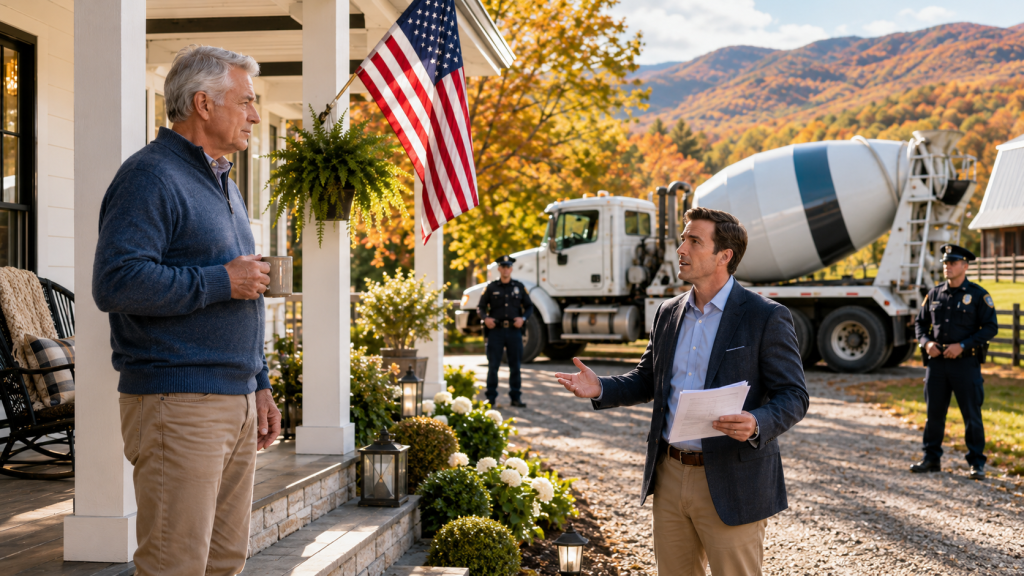
Instead, a concrete mixer sat sideways across my driveway.
Its front bumper hung near the shallow embankment, and its rear wheels nearly touched the tree line. The machine was positioned so perfectly that no ordinary vehicle could squeeze past it.
Michael stood beside it wearing a navy suit that probably cost more than my first pickup truck.
In one hand, he held a folded contract.
In the other, his phone.
“The truck stays until we settle the land issue, Dad.”
For forty years, that property had been my home.
Margaret and I had bought the place when we were both twenty-nine, back when the farmhouse leaned slightly to the east and the roof leaked in four different places.
We repaired the house ourselves.
We planted apple trees.
We cleared the back pasture.
We turned an abandoned chicken shed into Margaret’s pottery studio.
And when Michael was six, I hung a rope swing from the largest oak tree near the creek.
Margaret had been gone two years.
Cancer took her slowly enough that we had time to say goodbye, but not slowly enough that goodbye ever felt finished.
Her gardening gloves still hung beside the back door.
Her handwritten recipes remained tucked into a wooden box near the stove.
Some mornings, when I walked past the bedroom, I could almost convince myself I heard her humming.
Michael knew what the land meant to me.
He knew every tree had a story.
He knew which porch board still carried the faint scratches from the rocking chair his mother used when he was a baby.
He knew the hill behind the barn was where we had scattered part of Margaret’s ashes.
And yet he had started asking about the property before she was even buried.
At first, he called it concern.
“You shouldn’t be managing forty-six acres alone, Dad.”
Then it became advice.
“You could sell, move closer to Nashville, buy a condo.”
Then it became business.
“I know investors who would pay quickly.”
Finally, six months after Margaret died, he brought me an offer.
It was less than half the property’s appraised value.
I declined.
Michael tried again.
I declined again.
After that, his visits became less frequent.
His phone calls became shorter.
Eventually, we barely spoke at all.
Until that morning.
Looking at the concrete mixer blocking my driveway, I finally understood that his silence had not been hurt feelings.
It had been strategy.
He believed grief had softened me.
He believed isolation had weakened me.
And worst of all, he believed being my son gave him permission to corner me.
“You planned this,” I said.
Michael shrugged.
“I tried talking to you.”
“You tried buying my home for half its value.”
“That offer was reasonable.”
“It was insulting.”
“You are seventy-one years old and living alone on forty-six acres.”
“That doesn’t make the land yours.”
His jaw tightened.
“You cannot maintain this forever.”
“I’m maintaining it today.”
Michael pointed at the folded contract.
“We can argue, or we can be practical.”
“What’s practical about blocking an old man inside his own property?”
“I’m not blocking you inside.”
I looked toward the truck.
Michael followed my eyes.
“You can walk out.”
“That mixer is on my driveway.”
“Temporarily.”
“Move it.”
“No.”
The word came easily.
Too easily.
Then he smiled.
“The truck stays until you agree to discuss the contract.”
My coffee trembled slightly in my hand.
Michael noticed.
His smile widened.
That smile clarified everything.
He thought I was frightened.
“You counted on my grief,” I said.
His expression hardened.
“Call it whatever you want.”
He tapped the contract against his leg.
“The truck is not moving.”
I walked inside.
I did not slam the door.
That surprised him.
Michael had always expected anger from me.
When he was a teenager and stayed out past curfew, he expected shouting.
When he wrecked his first car, he expected shouting.
When he dropped out of engineering school after Margaret and I had paid two years of tuition, he expected shouting.
But Margaret had taught me something during our marriage.
“People reveal more when you stop filling the silence for them.”
So I locked the door and climbed upstairs.
At the end of the hallway was the room Margaret had used for sewing.
I had barely entered it since her funeral.
Her fabric was still stacked by color.
A half-finished quilt remained folded across the table.
Behind the closet door hung winter coats we had not worn in years.
Margaret had always been cautious about storms.
Not frightened.
Prepared.
She kept flashlights in every room, cash hidden inside an old flour tin, and a satellite phone behind the winter coats because tornadoes occasionally knocked out cell service in our area.
I pulled the phone from its charging cradle.
The battery indicator blinked weakly.
For a moment, I thought it was dead.
Then one signal bar appeared.
I called Harry Collins.
Harry lived about three miles away and had been my neighbor for thirty-five years.
Before retiring, he had spent twenty-eight years with the sheriff’s department.
He answered on the fourth ring.
“Robert?”
“Morning, Harry.”
“You calling me from Margaret’s apocalypse phone?”
Despite everything, I almost laughed.
“Looks that way.”
“What happened?”
I told him.
The truck.
The contract.
Michael’s refusal to leave.
The threat.
Harry remained silent for several seconds.
Then he asked one question.
“Your porch camera catch any of it?”
I turned toward the small monitor beside Margaret’s sewing table.
We had installed two security cameras years earlier after packages started disappearing from rural mailboxes.
I had forgotten how wide the porch microphone reached.
“I think so.”
“Check.”
I pulled up the recording.
There was Michael.
Clear as daylight.
His arrival.
The truck.
The conversation.
The words were unmistakable.
“The truck stays until we settle the land issue, Dad.”
Then later:
“You are seventy-one and alone.”
And finally:
“The truck is not moving.”
Harry exhaled slowly.
“Save that footage somewhere besides the camera system.”
“I will.”
“And Robert?”
“Yes?”
“Don’t sign anything.”
“I wasn’t planning to.”
“I mean anything. Not a receipt. Not a delivery form. Nothing Michael hands you.”
That made me pause.
“Why?”
“Because people don’t bring concrete mixers to family discussions.”
The sentence landed heavier than it should have.
“You think there’s more?”
“I think you should behave as though there is.”
I copied the footage onto a memory card.
Then I slipped it into my shirt pocket.
Downstairs, the concrete mixer’s engine suddenly roared.
I went to the kitchen window.
Michael was pacing near the porch, talking on his phone.
A black SUV had appeared on the county road beyond the blocked driveway.
Two men stepped out.
Both wore work boots.
One carried a tripod.
The other held a bundle of orange survey stakes.
Michael waved them forward.
My stomach tightened.
The men walked around the concrete mixer and entered my property.
Michael pointed toward the lower pasture.
Then toward Margaret’s rose garden.
One of the men unfolded a map.
The other drove an orange stake into the ground less than fifteen feet from the flowers Margaret had planted during our twentieth anniversary year.
I opened the back door.
For one furious second, I wanted to march outside and rip every stake from the earth.
Then I remembered Harry’s warning.
Do not confront him.
Save everything.
So instead, I walked into the mudroom.
There was another camera facing the barn.
I checked the feed.
It captured most of the pasture.
I pressed record.
For the next twenty minutes, I watched my son walk strangers around my property as if he were already giving them a tour of something he owned.
He pointed to the creek.
The barn.
The ridge.
The old access trail Margaret and I used for firewood.
Then the taller surveyor asked a question.
The porch microphone could not reach them from that distance.
But the barn camera caught video.
Michael answered while gesturing broadly toward the west field.
He looked excited.
Not guilty.
Excited.
That hurt more than I expected.
I had spent most of Michael’s childhood believing that one day the land would belong to him anyway.
Not because I owed it to him.
Because I imagined he would love it.
When he was eight, he followed me everywhere.
He carried fence staples in a coffee can while I repaired posts.
At twelve, he could identify nearly every bird that visited the creek.
At sixteen, he told Margaret he wanted to build his own house on the north ridge.
She had smiled for a week.
Somewhere along the way, the boy who wanted to build a home there had become a man who saw forty-six acres as numbers on a spreadsheet.
My satellite phone rang.
Harry.
“I called someone I trust at the county,” he said.
“You working again?”
“Old habits.”
“What did you find?”
“Has Michael ever mentioned a development company called Cumberland Vista?”
“No.”
“Has he mentioned townhouses?”
I stared through the window.
“No.”
Harry was quiet.
Then he said, “Robert, Cumberland Vista submitted a preliminary development inquiry three months ago involving property in your area.”
My grip tightened around the phone.
“My property?”
“I can’t confirm that yet.”
“But you think so.”
“I think you need a lawyer.”
“I have one.”
“Call her.”
My attorney was Linda Graves.
She had handled Margaret’s estate, updated my will, and once threatened a roofing contractor so politely that the man refunded me before she finished the sentence.
I called her.
When I explained what was happening, Linda did not interrupt once.
Then she asked, “Is Michael listed anywhere on the deed?”
“No.”
“Power of attorney?”
“No.”
“Beneficiary deed?”
“No.”
“Any partnership arrangement?”
“No.”
“Did you ever sign anything giving him permission to negotiate on your behalf?”
“Absolutely not.”
“Good.”
Her voice sharpened.
“Photograph every vehicle. Record every person. Do not physically interfere with them. I’m contacting the sheriff’s office and the county property department.”
“Harry’s already making calls.”
“Of course he is.”
There was affection in her irritation.
Then she added, “Robert, I want you to think carefully. Has Michael ever asked you to sign routine paperwork recently? Insurance forms? Tax documents? Medical forms?”
I almost said no.
Then I remembered Thanksgiving.
Michael had visited for the first time in nearly four months.
He brought a stack of papers.
He told me they were related to updating Margaret’s old life insurance information.
I had refused to sign because I wanted Linda to review them.
Michael became irritated.
I had thought he was frustrated with my stubbornness.
Now I wondered what had actually been inside that folder.
“There was something,” I said.
I explained.
Linda became very quiet.
“Do you still have those papers?”
“I think so.”
“Find them.”
I searched the kitchen office.
Nothing.
The desk drawer.
Nothing.
Then I remembered tossing the folder into the old cedar cabinet because Michael had left it behind.
It was still there.
I opened it.
The first page looked harmless.
Insurance information.
The second page did too.
But underneath those were several pages of dense legal language.
Linda asked me to photograph them.
I sent the images using my regular phone through the house Wi-Fi.
Five minutes later she called.
“Robert.”
Something in her voice made my skin turn cold.
“What?”
“This is not an insurance form.”
“I guessed that.”
“It’s a limited authorization agreement.”
“For what?”
“For property representation.”
I sat down.
“Meaning?”
“If you had signed it, Michael could have claimed authority to communicate with potential buyers and developers regarding your land.”
“Could he sell it?”
“Not directly.”
“Then what was the point?”
“He could create the appearance that negotiations had your approval.”
Outside, one of the surveyors drove another orange stake into my field.
I watched Michael nod.
Linda continued.
“There’s more.”
“What?”
“The final page references an option agreement.”
I looked again.
“What does that mean?”
“It means somebody may have promised a developer the future right to purchase your property.”
“But Michael can’t promise them my land.”
“No.”
“Then why are they here?”
“That’s what I intend to find out.”
Fifteen minutes later, Michael knocked on the front door.
Not gently.
“Dad!”
I did not answer.
“Dad, open the door.”
I stayed in the kitchen.
He knocked again.
“You’re making this harder than it needs to be.”
I turned on my phone recorder.
Then I opened the inner door but left the screen door locked.
Michael held the contract up.
“I need five minutes.”
“You’ve had forty years.”
His expression changed.
“What does that mean?”
“It means I spent forty years being your father. Surely somewhere in all that time I taught you not to trespass.”
His eyes flicked toward the men in the field.
“They’re just surveyors.”
“On my property.”
“They’re gathering information.”
“For whom?”
Michael hesitated.
Only half a second.
But I saw it.
“Potential partners.”
“Cumberland Vista?”
His face emptied.
That was the moment I knew Harry was right.
Michael had not expected me to know the name.
“Who told you that?”
I almost smiled.
“Interesting question.”
“Dad.”
“What did you promise them?”
“Nothing you need to worry about.”
“It’s my land.”
“I’m trying to save you from making a terrible financial mistake.”
“By blocking my driveway?”
“By forcing you to finally listen.”
I leaned closer to the screen door.
“What did you promise them, Michael?”
His voice dropped.
“A development opportunity.”
“Using property you don’t own.”
“Property I will eventually inherit.”
There it was.
Not “property you may leave me.”
Not “property we might discuss.”
Property I will eventually inherit.
“You’re waiting for me to die?”
His eyes widened.
“That’s not what I said.”
“It’s exactly what you said.”
“You know what I mean.”
“I’m beginning to.”
He pressed the contract against the screen.
“Sign the preliminary agreement. Nobody is taking the house today. Cumberland Vista develops the western acreage. You keep the farmhouse and ten acres.”
I stared at him.
He said it like he was offering mercy.
“And the hill?”
“What hill?”
“The one behind the barn.”
Michael looked away.
The hill where Margaret’s ashes rested.
“The development plan includes most of the ridge.”
I felt something inside me become perfectly still.
Michael knew.
He knew exactly what that hill meant.
“Get off my porch.”
“Dad—”
“Get off my porch.”
“You’re emotional.”
“No. I was emotional two years ago when I buried your mother.”
I pointed toward the ridge.
“This is clarity.”
His face flushed.
“You’re letting sentiment destroy millions of dollars.”
“And you’re letting millions of dollars destroy whatever is left of you.”
Michael stepped closer.
“You think Mom would want you dying alone out here?”
That hurt.
He knew it would.
For two years, I had occasionally awakened before dawn terrified by the silence beside me.
Michael knew that too.
Margaret had been the bridge between us.
After she died, I kept hoping grief would eventually bring Michael closer.
Instead, he had learned where grief made me vulnerable.
But what he did not know was that grief had also taught me something.
Once you survive losing the person you loved most in the world, threats lose much of their power.
“You don’t get to use your mother against me.”
Michael’s expression hardened.
“Then don’t make me.”
He walked away.
My phone had recorded everything.
At 8:17, a sheriff’s cruiser arrived.
The deputy could not enter because the concrete mixer blocked the drive.
So he parked on the county road and walked in.
Michael intercepted him.
I watched through the window.
Michael suddenly became the reasonable businessman.
His shoulders relaxed.
His hands moved calmly.
The deputy listened.
Then knocked on my door.
His name was Deputy Aaron Wells.
I knew his father from church.
“Mr. Bennett, your son says this is a civil disagreement.”
“My son is blocking my driveway with heavy machinery.”
“He says the vehicle belongs to a contractor conducting authorized work.”
“Authorized by whom?”
Wells looked toward Michael.
“Your son says the family is discussing a property transfer.”
“There is no transfer.”
I handed Wells a printed copy of the deed Linda had emailed me.
“My name. Only my name.”
Wells read it.
Then I showed him the porch recording.
Michael’s voice played clearly.
“The truck stays until we settle the land issue, Dad.”
Wells watched the rest.
His expression changed.
“Mr. Bennett, did you ask him to move the truck?”
“Twice.”
“And he refused?”
“Yes.”
The deputy turned toward Michael.
Michael’s confident posture disappeared.
Wells walked back outside.
They spoke beside the mixer.
Michael began gesturing.
The deputy pointed toward the road.
Michael shook his head.
The deputy pointed again.
Then Michael made a phone call.
Twenty minutes later, the driver of the mixer emerged from the black SUV.
The truck moved.
For the first time that morning, my driveway was open.
I thought that would end it.
I was wrong.
As the mixer pulled away, another vehicle arrived.
Linda Graves stepped out carrying a leather case.
Behind her came Harry.
Michael stared at them.
“Seriously?”
Harry smiled.
“Morning, Michael.”
“You called him?”
“I called several people.”
Linda walked directly toward the surveyors.
“Who authorized your work?”
The taller man pointed at Michael.
Linda asked for documentation.
He handed her a work order.
She read it.
Then looked at Michael.
“This document identifies you as authorized representative for the property owner.”
Michael said nothing.
Linda raised an eyebrow.
“Are you?”
“I’m his son.”
“That was not my question.”
The surveyor looked uncomfortable.
Michael said, “There’s an agreement in progress.”
“No signed agreement exists.”
“They were told otherwise,” Linda replied.
She turned to the surveyors.
“You are currently trespassing. Please remove your equipment and markers.”
They did not argue.
Within ten minutes, they were gone.
Michael remained.
“You’re embarrassing me,” he said.
I almost could not believe it.
“You blocked my driveway.”
“You didn’t have to turn this into a spectacle.”
Harry laughed once.
It was not a pleasant laugh.
“Son, you parked a concrete mixer across your father’s driveway at sunrise. The spectacle arrived before we did.”
Michael glared at him.
Linda opened her case.
“We need to discuss Cumberland Vista.”
Michael’s face tightened.
“There’s nothing to discuss.”
“Excellent,” Linda said. “Then you won’t mind explaining why they wired seventy-five thousand dollars to Bennett Strategic Holdings six weeks ago.”
Silence.
Absolute silence.
Even the birds seemed quieter.
I looked at Michael.
“What?”
He stared at Linda.
“How do you know that?”
Linda’s answer was calm.
“County filings, public business records, and a very useful conversation with their attorney.”
I felt sick.
“Seventy-five thousand?”
Michael rubbed his forehead.
“It was an advance.”
“For what?” I asked.
He did not answer.
I stepped closer.
“For what, Michael?”
“A consulting fee.”
Linda shook her head.
“No. Their attorney describes it as consideration connected to securing development rights.”
Michael snapped, “That doesn’t mean anything.”
“It means they paid you because you represented that you could deliver access to this land.”
“I never guaranteed anything.”
“You apparently guaranteed enough.”
He looked at me.
“Dad, listen.”
I had heard those words hundreds of times during his life.
Dad, listen.
When he wanted a motorcycle.
When he needed tuition money.
When he needed help paying rent.
When his first business failed.
When his second business nearly failed.
When Margaret begged me to stop rescuing him and I always found one more reason.
I suddenly wondered whether love without boundaries had helped create the man standing before me.
“What happens if I don’t sign?”
Michael looked down.
Linda answered for him.
“The development company may demand repayment.”
“How much?”
“The advance plus contractual penalties, depending on what he signed.”
I looked at my son.
“How much?”
He swallowed.
“Maybe one hundred and forty.”
“One hundred and forty thousand dollars?”
He nodded.
Harry muttered something under his breath.
I stared at Michael.
“So this isn’t about helping me maintain the property.”
He said nothing.
“You need my signature because you owe them money.”
“They expected the deal to move faster.”
“You took money against land you didn’t own.”
“I took a calculated risk.”
“No. You gambled with my home.”
His temper returned.
“You’re sitting on an asset worth millions!”
“It isn’t your asset.”
“One day it will be!”
“Will it?”
Michael froze.
For the first time that morning, he looked frightened.
Not because of the police.
Not because of Linda.
Because of those two words.
Will it?
Margaret and I had written our wills years earlier.
Michael was our only child.
He had always assumed everything would eventually pass to him.
Until that moment, I had never seriously considered changing it.
Michael’s voice became quieter.
“You wouldn’t.”
I looked toward the oak tree.
The rope swing was gone now, but the branch remained.
I remembered Michael at six years old.
Barefoot.
Laughing.
Begging me to push him higher.
I remembered Margaret standing on the porch telling us dinner was ready.
For one painful second, that child and this man occupied the same space in my mind.
“I don’t know what I’ll do,” I said.
“But I know what your mother would tell me.”
Michael’s jaw tightened.
“Don’t.”
“She would tell me to stop protecting you from consequences.”
He turned away.
That afternoon brought another surprise.
Cumberland Vista sent two executives and their attorney.
They did not come to pressure me.
They came to apologize.
Once Linda provided proof that Michael had no authority over my land, their lawyer looked genuinely alarmed.
“We were led to believe Mr. Bennett had family authorization.”
“I am Mr. Bennett,” I said.
The lawyer corrected himself.
“Michael Bennett.”
One executive opened a folder.
Inside were emails.
Michael had written them.
Dozens.
He described me as elderly.
Confused.
Emotionally impaired after my wife’s death.
He claimed he was managing my affairs informally.
He wrote that transferring control was “a matter of timing.”
I read those sentences twice.
Then a third time.
Michael stood at the far end of the porch.
For the first time all day, he could not look at me.
One email hurt more than everything else.
My father no longer understands the financial realities of the property.
I remembered exactly where I had been on the date Michael sent it.
Sitting beside Margaret’s grave on what would have been our forty-second wedding anniversary.
Michael had called that evening.
He asked whether I was doing okay.
I told him I missed his mother.
He said he understood.
Ten minutes after our call ended, according to the timestamp, he emailed Cumberland Vista describing my grief as evidence that I could no longer make rational decisions.
I folded the page.
My hands were steady now.
“Leave,” I told Michael.
“Dad.”
“Leave.”
“We need to fix this.”
“You need to fix what you did.”
“I can’t repay them immediately.”
“That is not my problem.”
“You’re my father.”
There was desperation in his voice.
And once, those words would have worked.
They had worked for forty-four years.
You’re my father.
Translation: rescue me.
Pay this.
Forgive that.
Explain me.
Protect me.
Margaret had seen the pattern before I did.
Six months before she died, she had said something while we sat together on the back porch.
“Robert, after I’m gone, don’t let loneliness make you surrender your judgment.”
At the time, I thought she was talking about remarrying too quickly.
Now I understood.
She knew our son.
Maybe better than I wanted to admit.
“Yes,” I said. “I am your father.”
Michael stepped toward me.
“And being your father means I should have taught you sooner that loving you does not require saving you from everything you choose to do.”
His face crumpled briefly.
Then anger covered it.
“So that’s it?”
“For today.”
“You’ll let them sue me?”
“I didn’t sign their agreement.”
“You could solve this with one signature!”
“There it is.”
“What?”
“The reason you came.”
He opened his mouth.
I raised my hand.
“No more.”
Michael stared at me for several seconds.
Then he walked to his car.
Before getting inside, he turned.
“Mom would hate this.”
My chest tightened.
But I answered calmly.
“Your mother would hate what happened here.”
He drove away.
The legal mess lasted months.
Cumberland Vista terminated its proposed deal involving my property.
Then it filed a civil claim against Michael’s company.
Investigators also reviewed whether documents he had submitted falsely represented his authority.
I did not celebrate.
There was nothing satisfying about watching your child face consequences.
Some nights, I sat alone in the kitchen wondering where Margaret and I had gone wrong.
Had we given too much?
Expected too little?
Mistaken rescuing for love?
Harry told me not to torture myself.
Linda told me adults eventually become responsible for their own choices.
Both were probably right.
Still, fatherhood does not switch off simply because your child becomes a middle-aged man.
Three weeks after the driveway incident, I found something inside Margaret’s sewing room.
I was putting the satellite phone back when I noticed a small envelope wedged behind the charging cradle.
My name was written on it.
Robert.
Margaret’s handwriting.
I sat down before opening it.
Inside was a note.
My dear stubborn husband,
If you are reading this, you are probably looking for something I hid, which means I am probably gone and you are probably complaining about where I put it.
I laughed.
Then immediately cried.
The note continued.
Do not turn this house into a museum for me.
Live here if living here makes you happy.
Leave if leaving makes you happy.
But never let anyone convince you that memories make you weak.
They are proof that your life mattered.
And Robert, please remember something about Michael.
Love him.
Always love him.
But do not confuse love with surrender.
He needs to know that your kindness has edges.
I covered my mouth.
Margaret had known.
Of course she had.
She always knew.
At the bottom she had written:
The land is ours because of the life we built on it, not because of a deed. When your time comes, give it to whoever will protect what mattered here.
I read the note until sunset.
A week later, I called Linda.
We changed my estate plan.
Michael was not completely disinherited.
I could not bring myself to do that.
But the land would no longer pass directly to him.
Instead, most of the property would enter a conservation trust.
The farmhouse and surrounding acreage would eventually support a small nonprofit program teaching local teenagers agriculture, woodworking, and land stewardship.
The hill where Margaret’s ashes rested would remain untouched.
The oak tree would remain.
The creek would remain.
No townhouse complex could erase them.
Harry called it the most Robert Bennett solution imaginable.
Michael called it betrayal.
He learned about the change because I told him.
I did not want him discovering it after my death.
He came to the house six months after the driveway incident.
This time, no suit.
No contract.
No truck.
He looked thinner.
Older.
We sat across from each other at the kitchen table.
For several minutes, neither of us spoke.
Finally, he said, “Cumberland Vista settled.”
I waited.
“I sold my condo.”
“I heard.”
“And my shares in the consulting company.”
I nodded.
“I’m paying the rest over three years.”
“That sounds difficult.”
“It is.”
For the first time in his life, I did not say I would help.
Michael stared at his hands.
“I was angry at you.”
“I know.”
“I told myself you were selfish.”
I said nothing.
“I told myself the property was being wasted.”
Still nothing.
“And eventually I convinced myself that because I would inherit it someday, I was just accelerating something inevitable.”
He looked up.
“That sounds insane when I say it out loud.”
“It sounded insane when you said it quietly too.”
To my surprise, Michael laughed.
Only once.
Then his eyes filled with tears.
“I’m sorry.”
I had imagined that apology many times.
In some versions, I forgave him immediately.
In others, I delivered a speech so powerful Margaret would have applauded from heaven.
Reality was quieter.
“I believe you’re sorry today,” I said.
His face fell.
“What does that mean?”
“It means trust takes longer.”
He nodded slowly.
“I understand.”
“I hope you do.”
Another silence.
Then Michael looked toward the back door.
“Is Mom’s garden still alive?”
“Mostly.”
“Can I see it?”
We walked outside.
The roses were blooming.
The orange survey stakes were long gone.
Michael stopped beside the place where one had been driven into the soil.
“I remember Mom planting these.”
“You complained because she made you haul compost.”
“I was fourteen.”
“You complained professionally at fourteen.”
He smiled.
Then he crouched beside one of the rose bushes.
“She would be furious with me.”
“Yes.”
He looked surprised.
“You could have softened that.”
“I spent too many years softening things for you.”
He nodded.
“That’s fair.”
We walked toward the oak tree.
The old rope had disappeared years ago.
Only a faint scar remained in the bark where it had rubbed against the branch.
Michael touched it.
“Do you remember pushing me from here?”
“Every weekend for about three years.”
“You always said you were going to let me touch the clouds.”
“You kept demanding higher.”
“I thought you could do anything.”
I looked at him.
“When you’re six, fathers seem that way.”
Michael’s voice cracked.
“I think part of me never stopped believing it.”
That sentence explained more than he probably intended.
I had always solved things.
When Michael failed, I had a solution.
When he lost money, I had savings.
When he made mistakes, I had explanations.
Maybe somewhere inside him, the six-year-old boy on the swing still believed his father could push him high enough to avoid the ground forever.
“I can’t fix everything,” I said.
“I know.”
“I shouldn’t have tried.”
He looked at me.
“That doesn’t excuse what I did.”
“No.”
“I know.”
And that mattered.
For the first time, he did not attach a “but.”
He came back the following Saturday.
Not to talk about money.
To repair the west fence.
I did not ask him to.
He arrived in jeans at seven in the morning carrying fencing pliers.
We worked mostly in silence.
The next weekend, he returned.
Then again.
For nearly a year, that became our arrangement.
No dramatic reconciliation.
No pretending the betrayal had disappeared.
Just work.
Fence posts.
Barn repairs.
Clearing storm debris.
Coffee on the porch.
Sometimes he talked about therapy.
Sometimes he talked about debt.
Once he admitted that his business had been failing long before he approached Cumberland Vista.
He had been ashamed.
He wanted one huge development deal to erase years of poor decisions.
“Why didn’t you just tell me you were in trouble?” I asked.
He gave me a sad smile.
“Because you would have helped.”
“That seems backward.”
“I needed to stop being someone who expected you to.”
That answer stayed with me.
A year and three months after the concrete mixer morning, Michael brought his daughter, Emma, to the farm.
She was seventeen.
Margaret had adored her.
Emma asked whether she could help restore the old pottery shed.
Michael and I looked at each other.
Then he said, “Ask your grandfather. It’s his property.”
A small sentence.
But I noticed it.
Mine.
Not ours.
Not his future inheritance.
Mine.
“Sure,” I told Emma.
We spent most of the summer repairing the shed.
Michael replaced rotten boards.
Emma painted.
I repaired the windows.
One afternoon, Emma found Margaret’s old pottery wheel under a tarp.
“Can we keep this?”
Michael immediately answered, “That’s Grandpa’s decision.”
Another small sentence.
Another repaired fence post between us.
“Keep it,” I said.
By autumn, Emma was making crooked bowls and lopsided cups exactly like Michael had when he was nine.
One evening, we sat on the porch watching her work through the open shed door.
Michael handed me coffee.
“Do you regret changing the will?”
I looked at him.
“No.”
He nodded.
“I thought you’d say that.”
“Does it still bother you?”
“Sometimes.”
I appreciated the answer.
Then he added, “But I understand now.”
“Do you?”
He looked across the pasture.
“I spent years thinking inheritance meant something belonged to me before it actually did.”
I waited.
“And I treated you like an obstacle between me and something I thought I deserved.”
“That’s about right.”
He laughed softly.
“You really stopped softening things.”
“Your mother left instructions.”
Michael looked at me.
“What?”
For the first time, I told him about Margaret’s letter.
Not everything.
Some words belonged only to me.
But I told him the sentence that mattered.
Love him.
Always love him.
But do not confuse love with surrender.
Michael looked down.
“She wrote that?”
“Yes.”
“When?”
“Near the end, I think.”
He wiped his eyes.
“I wish she’d said it to me.”
“She probably did.”
He smiled sadly.
“Probably.”
We sat there until the sky darkened.
Years passed.
The conservation trust became official.
The youth program started with six teenagers from the county high school.
Then twelve.
Then twenty.
The old barn became a workshop.
The lower pasture became a community garden.
Emma eventually studied environmental science.
After college, she returned to Tennessee and became one of the program directors.
Michael never owned the property.
He stopped asking.
Instead, he volunteered.
The first time I saw him teaching a fourteen-year-old boy how to set a fence post straight, I stood behind the barn and cried where nobody could see me.
He sounded exactly like I had when teaching him.
“Don’t rush.”
“Measure twice.”
“Ground doesn’t care how confident you are.”
Margaret would have loved it.
I turned eighty one spring morning.
Michael came early.
He carried coffee onto the porch.
The same porch where, almost nine years earlier, he had stood holding a contract while a concrete mixer blocked my road.
We watched the sunrise.
“You know,” he said, “I think about that morning all the time.”
“So do I.”
“I still can’t believe I did that.”
“I can.”
He laughed.
“Thanks.”
“I’m eighty. I’ve earned the right to be difficult.”
“You earned that around sixty-five.”
We drank quietly.
Then Michael pulled something from his pocket.
The old satellite phone.
I stared at it.
“Where did you find that?”
“Emma was cleaning the sewing room.”
I had forgotten the phone was still there.
Michael turned it over.
“This thing ruined my plan.”
“No.”
He looked at me.
“What?”
“The phone didn’t ruin your plan.”
I pointed toward him.
“You did.”
He nodded slowly.
“Fair enough.”
Then he smiled.
“Still, I hate this thing.”
I laughed harder than I had in years.
“Your mother bought it.”
“Of course she did.”
“She saved me with it.”
Michael became serious.
“More than once, apparently.”
I knew what he meant.
Margaret’s phone had allowed me to reach Harry.
Her camera had recorded Michael’s threat.
Her hidden letter had reminded me how to love my son without surrendering to him.
In her own way, Margaret had been protecting both of us long after she was gone.
Michael stood.
“Emma wants to put a new swing on the oak for the younger kids.”
I looked toward the tree.
The branch was still strong.
“Use better rope than I did.”
“She already bought it.”
“Then why is she asking?”
Michael smiled.
“Because it’s your tree.”
That afternoon, we hung the swing.
A little boy from the youth program was the first to try it.
Michael pushed.
The boy shouted for him to go higher.
Higher.
Higher.
I stood on the porch, listening to the laughter drift across the yard.
For years, I had believed protecting the land meant keeping it exactly as Margaret and I had left it.
I had been wrong.
Protecting something does not always mean freezing it in time.
Sometimes it means making sure whatever comes next respects what came before.
Michael never became the man I imagined when he was a child.
Neither did I.
Life rarely follows those plans.
But he became better than the man who once blocked my driveway.
Not because I rescued him.
Because I finally refused to.
And I became a better father at seventy-one than I had sometimes been at forty.
I learned that boundaries are not the opposite of love.
Sometimes they are the shape love must take when kindness has been mistaken for weakness.
The concrete mixer is long gone.
The contract was shredded.
The survey stakes disappeared.
Cumberland Vista built somewhere else.
But Margaret’s roses still bloom beside the porch.
Her hill remains untouched.
The creek still cuts through the western field.
The oak tree still holds a swing.
And every now and then, when sunlight spreads across those Tennessee hills, Michael and I sit with coffee in the same place where our relationship nearly ended.
We do not pretend that morning never happened.
We do not rewrite it.
We remember it.
Because forgetting consequences is how people repeat mistakes.
Michael once believed the land was his future.
Now he understands it was never really about ownership.
It was about stewardship.
About memory.
About respecting another person’s right to decide what happens to the life they built.
One Sunday, after the youth program held its annual picnic, I stayed on the porch while everyone else packed tables.
Emma came over and sat beside me.
“Grandpa?”
“Yes?”
“Dad told me what happened here years ago.”
I looked across the yard toward Michael.
He was helping Harry’s grandson load folding chairs.
“All of it?”
“I think so.”
“That must have been a long conversation.”
She smiled.
“He said he was a complete idiot.”
“That sounds accurate.”
She laughed.
Then she became serious.
“He said you could have destroyed him.”
I frowned.
“I didn’t.”
“He knows.”
Emma looked toward the oak tree.
“He said that’s what changed him.”
“What?”
“You didn’t destroy him, but you didn’t save him either.”
I leaned back.
Margaret would have understood immediately.
Emma continued.
“He said you made him carry his own consequences.”
“I suppose I did.”
“He says it was the first time anyone had.”
That sentence hurt in a different way.
Because I knew exactly who “anyone” meant.
Me.
I had spent decades clearing obstacles from my son’s path.
Then wondered why he became a man who believed obstacles should always move for him.
Even fathers must admit where they failed.
“I should have started earlier,” I said.
Emma touched my arm.
“Maybe.”
Then she smiled.
“But you started.”
Across the yard, Michael looked toward us.
He raised a hand.
I raised mine.
That was enough.
There are stories where betrayal ends a family.
There are stories where forgiveness erases everything.
Ours did neither.
Betrayal changed us.
Consequences humbled us.
Time repaired some things and left scars on others.
I never trusted Michael exactly the way I had before that morning.
Trust is not porcelain.
You cannot glue it together and pretend the cracks are invisible.
But sometimes the repaired thing becomes honest in a way the unbroken thing never was.
Before, I trusted Michael because he was my son.
Afterward, I trusted him only when his actions earned it.
And slowly, year after year, they did.
When I finally updated my estate plan for the last time, Michael drove me to Linda’s office.
On the way home, he asked only one question.
“Is the hill protected?”
“Yes.”
“Good.”
He did not ask what he would receive.
He did not ask about money.
He did not ask about acreage.
Just the hill.
That was when I knew the lesson had finally taken root.
Margaret’s resting place mattered more to him than the property value.
When we reached home, Michael stopped the truck halfway up the driveway.
“What are you doing?”
He pointed ahead.
A group of teenagers were walking from the barn to the garden carrying tools.
“They’re blocking the road.”
I looked at him.
He looked at me.
For one second, neither of us spoke.
Then we both burst out laughing.
“Careful,” I said. “You’ve had bad experiences blocking this driveway.”
Michael wiped his eyes.
“Apparently it runs in the family now.”
We waited until the kids moved.
Then he drove forward.
No threats.
No contracts.
No demands.
Just patience.
It is strange how an ordinary driveway can hold so much history.
On one morning, it became the place where my son tried to take control of my life.
Years later, it became the place where I realized he had finally learned to let other people move at their own pace.
Margaret used to say land remembers footsteps.
I never believed her literally.
But I understand what she meant now.
Everywhere I look, I see the people we used to be.
A young husband repairing a roof.
A woman planting roses.
A little boy swinging beneath an oak.
A grieving widower standing alone.
A desperate man holding a contract.
A father finally saying no.
A son returning without excuses.
A granddaughter shaping wet clay in her grandmother’s studio.
None of those lives disappeared.
They became layers.
Like rings inside a tree.
And perhaps that is what home really is.
Not wood.
Not acreage.
Not money.
Not a deed locked in a cabinet.
Home is where your choices leave marks.
Some beautiful.
Some painful.
Some you spend years repairing.
The hidden phone Margaret kept behind the winter coats eventually stopped working.
Its battery finally died for good.
I never replaced it.
I didn’t need to.
I kept it on the shelf in her sewing room beside her letter.
Michael occasionally jokes that the phone deserves its own plaque.
Maybe it does.
But the truth is, the phone was only a tool.
The real thing that saved me that morning was remembering that being alone did not mean being powerless.
Michael had mistaken my age for weakness.
My grief for confusion.
My love for permission.
And my silence for surrender.
He was wrong about all four.
I was seventy-one.
I was grieving.
I loved my son.
And I was silent.
But I still knew exactly where the boundary stood.
Right at the end of my driveway.
And when Michael crossed it, I finally taught him the lesson I should have taught him years earlier.
Love may open the door.
But love does not give anyone the right to take the house.
Not even your own child.
Especially not your own child.
Because sometimes the most loving thing a parent can say is not “I’ll fix it.”
Sometimes it is simply:
“No.”
And then you let them become the person they should have learned to be all along.
💬THE END! THANK YOU FOR READING!