

The detective opened the folder.
Inside was a copy of the same savings account, but the balance printed across the bottom made my stomach twist.
$486,320.
“That money was never your grandmother’s retirement fund,” he said. “It was originally created in your name the week you disappeared.”
I stared at him.
For several seconds, I could hear nothing except the blood pounding in my ears.
“Disappeared?”
The detective nodded slowly.
“My name is Thomas Hale. I worked this case twenty-seven years ago. I was a patrol officer then.”
He looked older than the photograph clipped to the inside of the folder. In that picture, his hair was dark and his face smooth. Now there were deep lines around his mouth and silver at his temples.
But his eyes had not changed.
They were the eyes of a man who had carried something unfinished for far too long.
“You were nine months old,” he said.
I looked down at the missing-child notice.
The baby in the picture had round cheeks, a tiny curl above one ear, and a crooked little smile.
My smile.
Across the top, in large black letters, were the words:
MISSING INFANT — EMILY ROSE BENNETT.
Emily Rose Bennett.
My knees weakened.
“My name is Emily Henderson.”
Detective Hale swallowed.
“That is the name you have been using.”
I turned toward Ms. Caldwell.
She stood beside the desk with both hands folded.
“You knew?”
“We suspected,” she said carefully. “But banks are not law-enforcement agencies. We could not accuse anyone based only on an old alert.”
“Then why was there an alert on this account?”
She pulled another document from her folder.
“Because your maternal grandfather created the trust.”
I could barely follow the words.
“My grandfather?”
“Charles Bennett.”
I had never heard that name in my life.
Ms. Caldwell continued.
“He was a contractor who owned several commercial properties. Shortly after you were born, he established a custodial investment account and a trust for you.”
“How much?”
“The original deposit was seventy-five thousand dollars.”
I looked again at the balance.
“Then how—”
“Interest. Investments. Reinvested dividends. And additional deposits made by your grandmother over the years.”
My mouth went dry.
“My grandmother knew?”
No one answered immediately.
That silence hurt more than an answer.
I looked at Detective Hale.
“She knew who I was?”
“Yes.”
I stood.
The grocery bag fell from my lap.
For one horrible second, anger burned through everything else.
Grandma.
The woman who raised me when my father disappeared for weekends.
The woman who packed my lunch.
Who taught me to sew buttons.
Who slipped twenty-dollar bills into birthday cards even when I knew she could barely afford groceries.
She knew.
“She lied to me.”
Detective Hale leaned forward.
“Emily—”
“She knew my mother wasn’t dead.”
His expression tightened.
“She knew more than she told you.”
I backed toward the wall.
“No. Don’t make excuses for her.”
“I’m not.”
“Then explain it.”
Detective Hale closed the folder.
“Your grandmother’s name was Margaret Henderson.”
“I know that.”
“Richard Henderson was her biological son.”
“My father.”
“Yes.”
He paused.
“But Margaret was not your paternal grandmother.”
I stared at him.
“What?”
“She became your grandmother because she chose to.”
The room seemed to tilt.
I held the edge of the filing cabinet.
Detective Hale took a breath.
“Twenty-eight years ago, Richard Henderson met your mother, Rose Bennett, while working construction for Rose’s father.”
My mother.
Rose.
For the first time in my life, she was becoming more than a blurry name.
“Richard was charming,” Hale continued. “At least, that is what witnesses told us. Rose was twenty-two. Richard was thirty-one.”
I pictured my father at thirty-one.
The thick dark hair.
The confident smile in the old photographs.
The same smile he used whenever he needed someone to trust him.
“They dated?”
“Yes.”
“Were they married?”
“No.”
I closed my eyes.
That shouldn’t have mattered, but somehow every fact felt enormous.
“Rose became pregnant. Her father disapproved of Richard almost immediately. Not because Richard was poor, as Richard later claimed. Charles Bennett believed Richard was dishonest.”
“That sounds like him.”
The detective gave me a sad look.
“There had already been accusations involving forged checks, stolen equipment, and fraudulent invoices.”
I almost laughed.
Of course there had.
My father had spent my entire childhood calling wealthy people crooked while stealing forty dollars from my birthday envelopes.
“Rose stayed with him anyway,” Hale said. “You were born the following year.”
“And then?”
“Richard started demanding money.”
The words did not surprise me.
Nothing about my father and money could surprise me anymore.
“At first he asked Rose. Then Charles. He claimed he wanted to start a business. Charles refused.”
Ms. Caldwell slid a letter across the table.
The paper was yellowed.
The handwriting was neat.
I recognized it immediately.
My grandmother’s.
I did not touch it.
“What is that?”
“Margaret wrote it twenty-seven years ago.”
I finally picked it up.
My hands shook.
To Detective Hale,
My son has done something terrible.
I believe he has taken the Bennett baby.
I do not know where he is.
If he contacts me, I will inform you.
Please understand that I am frightened of him.
Margaret Henderson.
I read it twice.
Then a third time.
My throat closed.
“She reported him?”
“Yes.”
“But I lived with her.”
“Eventually.”
Detective Hale leaned back.
“For the first three months after you disappeared, Richard moved constantly.”
“Where?”
“Motels. Friends’ houses. A campground in Kentucky. We believe he also spent several weeks in Tennessee.”
“And nobody found me?”
“This was before smartphones, nationwide digital databases, social media, automated plate readers. Records did not move the way they do now.”
He looked ashamed even though none of it had been his fault.
“We came close twice.”
I looked at the photograph of myself.
“Where was my mother?”
His face changed.
That was when I knew the answer would hurt.
“Looking for you.”
My eyes filled immediately.
“She looked for me?”
“For years.”
The first tear fell before I could stop it.
I wiped it away angrily.
“My father said she died.”
“She didn’t.”
“Where is she?”
No one spoke.
I looked from one face to another.
“Where is my mother?”
Detective Hale lowered his eyes.
“She died twelve years ago.”
Something inside me collapsed.
Not dramatically.
Not loudly.
It simply gave way.
I sat down.
Twelve years.
I had been fifteen.
At fifteen, I had lived three states away from a mother who was apparently still alive.
At fifteen, I had been fighting with Dad because he refused to sign permission for a school trip.
At fifteen, I had asked Grandma whether my mother had liked music.
Grandma had cried while washing dishes.
I had thought she was crying because Rose was dead.
Now I understood.
“She died believing I was gone?”
Detective Hale hesitated.
“Not exactly.”
I looked at him sharply.
“What does that mean?”
He opened another section of the case file.
“Rose received information when you were eleven.”
My breathing stopped.
“What information?”
“A photograph.”
He slid it toward me.
The picture showed a school playground.
Children were running in the background.
Near a metal climbing structure stood a skinny girl with brown hair wearing a yellow sweatshirt.
Me.
I remembered that sweatshirt.
Grandma bought it at a church rummage sale.
On the back of the photograph someone had written:
She is alive.
Do not contact police or you will never see her again.
I felt sick.
“Who sent this?”
“We never proved it.”
“My father?”
“We believed so.”
“Why?”
“Because Rose had recently hired a private investigator.”
I pressed my palm over my mouth.
The detective continued softly.
“After receiving the photograph, she became terrified that attempting contact might cause Richard to disappear with you again.”
“But why didn’t she come get me?”
“She tried.”
He pulled out another report.
“When you were twelve, she traveled to Ohio after the investigator located Margaret.”
A memory flashed through me.
A rainy afternoon.
Grandma pulling the curtains closed.
Dad yelling in the driveway.
A red car across the street.
I had been told to stay upstairs.
I suddenly stood.
“Oh my God.”
“What?”
“I remember something.”
Detective Hale became very still.
“There was a woman.”
He waited.
“When I was twelve. A woman came to Grandma’s house.”
My voice shook.
“I never saw her face clearly. Dad pushed me upstairs. He was screaming outside.”
My stomach twisted.
“I heard a woman crying.”
Detective Hale’s eyes filled with recognition.
“That was Rose.”
I grabbed the back of the chair.
“She came to the house?”
“Yes.”
“And nobody told me?”
“Margaret called police.”
“Then why wasn’t I taken away?”
Detective Hale closed his eyes.
“Because by the time officers arrived, Richard had already taken you.”
I remembered that too.
Not the reason.
Just the night.
Dad throwing clothes into trash bags.
Grandma crying.
Me being told we were going on an adventure.
We spent six weeks living with a man named Uncle Danny who was not actually my uncle.
“Richard produced documents claiming Rose was mentally unstable,” Hale said. “He claimed she was an estranged relative stalking his daughter.”
“What documents?”
“Forged psychiatric records. A false birth certificate. A notarized custody order that later turned out to be fabricated.”
I laughed bitterly.
“That sounds like him.”
“And by then,” Hale said, “you had been known publicly as Emily Henderson for more than a decade.”
My head hurt.
The scale of the lie was impossible to comprehend.
One false sentence had become another.
Then another.
Until my entire childhood had been built inside them.
“Did Grandma help him?”
Detective Hale did not answer quickly enough.
“Tell me.”
“She helped him at first.”
I stared at him.
The betrayal sliced straight through me.
“How?”
“She allowed him to use her address. She told neighbors you were her granddaughter. She enrolled you in school.”
I felt tears burn my eyes.
“She knew I was stolen.”
“Yes.”
I turned away.
I hated her in that moment.
I hated the kitchen where she made pancakes shaped like hearts.
I hated the quilts she sewed.
I hated every birthday candle she watched me blow out while another woman somewhere wondered whether I was alive.
Then Detective Hale said something that stopped me.
“But she also spent twenty-seven years trying to undo what she had done.”
I turned back.
“How?”
Ms. Caldwell opened the passbook.
“Look carefully.”
I had seen the entries before.
Deposits.
Interest.
Transfers.
Tiny handwritten notes in my grandmother’s cramped writing.
But now Caldwell pointed to the dates.
“Every year, Margaret deposited money.”
“Where did she get it?”
“Her pension. Part-time work. Eventually proceeds from selling a small parcel of land.”
I looked at the numbers.
Some deposits were fifty dollars.
Some one hundred.
One was eleven thousand.
“She knew Richard had attempted to access the account multiple times,” Caldwell said.
“When?”
“The first documented attempt was when you were seven.”
I felt a cold anger settle over me.
“He tried stealing money from a seven-year-old?”
“He submitted forged guardianship papers.”
“Did the bank give it to him?”
“No.”
“The second attempt occurred when you were eighteen.”
My chest tightened.
That was the year my college money disappeared.
Dad had told me an investment went bad.
I had worked two jobs and attended community college instead.
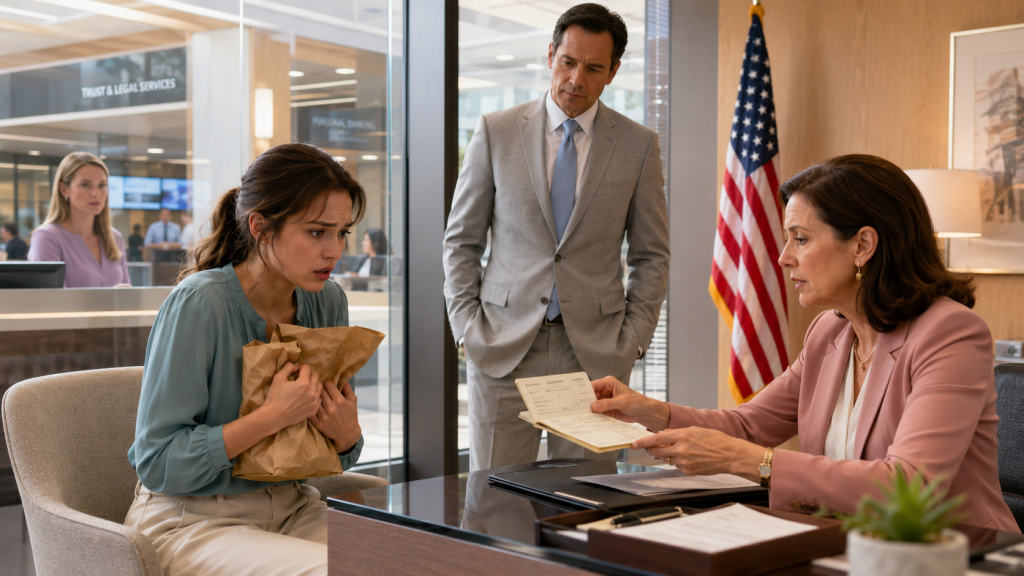
“The third attempt,” Caldwell said, “was five years ago.”
“Why wasn’t he arrested?”
“He never completed the withdrawal. When additional identification was requested, he left.”
Detective Hale tapped the passbook.
“Margaret contacted the bank afterward and renewed the alert.”
I remembered Grandma growing strangely secretive five years earlier.
She started keeping documents in a metal box.
She stopped allowing Dad inside her bedroom.
“She knew he would try again,” Caldwell said.
The message inside the passbook flashed in my mind.
If Richard says it’s worth nothing, it’s because he already tried to cash it.
My grandmother had known exactly what he would do.
She had written that sentence expecting me to find it.
I suddenly remembered the funeral.
Dad standing beside the open grave.
The rain.
The priest stepping away after the service.
Dad holding Grandma’s purse because I had been too numb to carry anything.
He found the passbook inside.
He flipped through it.
Then laughed.
“This old thing?”
I had reached for it.
He pulled it away.
“Worthless. Bank probably doesn’t even exist anymore.”
Then, before I could stop him, he tossed it into the grave.
It landed on the edge of Grandma’s casket.
I had screamed at him.
He told me not to be dramatic.
That night I barely slept.
At six the next morning, I drove back to the cemetery.
The groundskeeper knew me.
I told him something valuable had accidentally fallen into the grave before it was fully closed.
He helped me recover it from the loose soil beside the vault.
Dad had no idea.
He thought the passbook was underground forever.
I looked at Detective Hale.
“My father threw it into the grave because he knew.”
“Yes.”
“He wanted it buried.”
“Yes.”
“Then he knows what’s in this account.”
“Almost certainly.”
I stood.
“Where is he now?”
Hale looked toward the uniformed officers.
“That is why they are here.”
I felt suddenly cold.
“What happened?”
“This morning, approximately twenty minutes before you entered the bank, Richard Henderson called the customer service line.”
My skin prickled.
“What did he want?”
“He asked whether an old custodial account could be accessed after the death of the account holder.”
Grandma had been dead less than forty-eight hours.
My father had already started hunting the money.
“What did you tell him?”
“The representative flagged the call.”
Ms. Caldwell pushed another paper toward me.
“The phone number matched a previous attempted fraud report.”
I almost smiled.
For once, Dad’s greed had outrun his intelligence.
Detective Hale stood.
“We need to ask you something.”
I braced myself.
“Did Richard know you were coming here?”
“No.”
“Did you tell anyone?”
“No.”
“Does he know you recovered the passbook?”
“No.”
The detective nodded.
“Good.”
“Why?”
“Because right now, he believes it is still in the grave.”
I understood immediately.
“You want him to try something.”
“We believe he already has.”
One of the officers stepped forward.
“Your father was observed near Margaret Henderson’s property approximately forty minutes ago.”
“My house?”
“Was it your grandmother’s residence?”
“Yes.”
“What would he be looking for?”
I thought of Grandma’s bedroom.
The metal lockbox.
Her old cedar dresser.
Then I remembered.
“The blue suitcase.”
“What blue suitcase?”
“She kept documents inside it.”
Detective Hale grabbed his phone.
“Where?”
“Top shelf of her closet.”
He made a call.
The room became suddenly active.
Officers moved.
Ms. Caldwell closed the folder.
The manager stepped into the hallway.
I sat frozen while everyone around me seemed to understand what came next.
Then Detective Hale turned back.
“Emily, you cannot return to Margaret’s house right now.”
“Why?”
“If Richard is there—”
“That is my grandmother’s house.”
“And if he believes evidence is inside, he may be desperate.”
“You don’t know my father.”
Hale looked directly at me.
“I know enough.”
The words landed hard.
Because I knew he was right.
Dad had never hit me.
But he had punched walls beside my head.
He had smashed my phone when I threatened to call Grandma.
He had once driven ninety miles an hour because I refused to give him my tax refund.
He always stopped just short of whatever line allowed me to keep pretending he was merely difficult.
Grandma had stopped pretending long before I did.
My phone rang.
DAD.
Every person in the room looked at it.
My hand shook.
“Answer,” Detective Hale said.
I looked at him.
“Speaker?”
He nodded.
I accepted the call.
“Hello?”
Dad’s voice came through immediately.
“Where the hell are you?”
The familiarity of his anger almost calmed me.
Almost.
“Out.”
“I went by Grandma’s. Your car isn’t there.”
“What do you want?”
A pause.
Then his voice softened.
Dad always became gentle when he wanted something.
“I’m worried about you.”
I nearly laughed.
“Why?”
“You were upset yesterday.”
“My grandmother died.”
“She was my mother, Emily.”
The possessiveness in his tone made my stomach turn.
He continued.
“I know you were angry about that stupid passbook.”
Detective Hale raised one finger, telling me to stay calm.
“What about it?”
“It was junk.”
“I know.”
Another pause.
“Did you go back to the cemetery?”
My heartbeat accelerated.
“Why would I?”
“No reason.”
I could hear something in the background.
A drawer shutting.
He was inside Grandma’s house.
Dad cleared his throat.
“I just wanted to make sure you didn’t waste your time.”
“Okay.”
“Where are you?”
“At breakfast.”
“Where?”
I looked at Hale.
He shook his head.
“With a friend.”
Dad’s voice hardened.
“What friend?”
“It doesn’t matter.”
“Yes, it does.”
“No, it doesn’t.”
There was silence.
Then he said something that made the entire room go still.
“Emily, did Grandma ever tell you anything about your mother?”
My eyes filled.
I looked at the photo of Rose.
“No.”
“Good.”
The word came too quickly.
Too naturally.
I stopped breathing.
Dad continued.
“She got confused near the end.”
“She seemed pretty clear to me.”
“Old people say things.”
“Like what?”
“Nothing.”
His breathing changed.
“If you find any papers in the house, don’t read them.”
“Why?”
“Because there are things you wouldn’t understand.”
A rage I had carried for twenty-seven years without knowing its name rose inside me.
“I’m twenty-seven.”
“You’ll always be a child to me.”
That sentence had controlled half my life.
I looked at Detective Hale.
Then at the photograph.
Then at my grandmother’s passbook.
“No,” I said.
Dad went quiet.
“No what?”
“I’m not a child.”
“Emily—”
“And I think I understand more than you want me to.”
Hale’s eyes widened slightly.
Dad stopped breathing.
“What did you do?”
There it was.
Not what do you mean.
What did you do?
I felt strangely calm.
“I’ll talk to you later.”
“Emily.”
I hung up.
My hands trembled so violently I almost dropped the phone.
Detective Hale exhaled.
“He knows.”
“Then go arrest him.”
“We need probable cause tied to a current offense.”
“He is breaking into Grandma’s house.”
“If the property legally belongs to—”
“It doesn’t.”
Everyone looked at me.
I suddenly remembered the lawyer at the funeral.
“Grandma left the house to me.”
Detective Hale straightened.
“Are you certain?”
“I signed papers yesterday.”
That was all they needed.
Within minutes, officers were on their way.
I wanted to go.
They refused.
So I sat inside the bank with a cup of water I never drank while my entire identity was rearranged around me.
Ms. Caldwell eventually sat beside me.
“There is something else.”
I laughed without humor.
“Of course there is.”
She removed an envelope from the folder.
It had my name on it.
Not Emily Henderson.
Emily Rose Bennett.
I recognized Grandma’s handwriting.
“When did she leave this?”
“Six months ago.”
I stared at the envelope.
“She came here?”
“Yes.”
“Why?”
“To update the trust and leave instructions regarding your identity.”
I took it.
The paper felt heavier than paper should.
“Did you read it?”
“No.”
I opened it.
My dearest Emily,
If you are reading this, then I have run out of time to tell you the truth with my own mouth.
There is no apology large enough for what I did.
Your father brought you to me when you were a baby and told me your mother had abandoned you.
I believed him for three days.
On the fourth day, I saw your picture on television.
I knew.
And I was afraid.
Afraid of losing my son.
Afraid of prison.
Afraid of what Richard would do.
So instead of doing the right thing immediately, I waited.
That delay became my greatest shame.
When I finally contacted police, Richard ran with you.
For years afterward, he used my guilt to control me.
Whenever I threatened him, he threatened to disappear with you forever.
I convinced myself that keeping you where I could see you was safer than risking losing you again.
That was cowardice dressed as protection.
I am sorry.
My vision blurred.
I wiped my face and continued.
Your mother never stopped loving you.
Her name was Rose Marie Bennett.
She loved yellow roses, strawberry ice cream, old country songs, and dancing badly in the kitchen.
You have her laugh.
The first time I heard you laugh, I almost dropped the bottle I was holding because I had heard Rose laugh exactly the same way outside my house while begging Richard to let her see you.
I should have opened the door.
I did not.
That memory will follow me beyond this life.
I pressed the letter against my mouth.
The room disappeared behind tears.
After a moment, I forced myself to continue.
Rose eventually contacted me without Richard knowing.
For six years, we exchanged letters through a post office box.
She wanted to approach you when you were older.
I wanted that too.
Richard found one of her letters.
He took you away for nearly two months.
After that, Rose became terrified.
When you turned eighteen, she planned to contact you directly.
She died before she could.
Cancer.
She made me promise that the trust established by her father would someday reach you.
That is why I protected the passbook.
Richard found out about the account when you were seven.
He never knew the full balance.
He only knew enough to want it.
If he tells you the account is worthless, do not believe him.
If he throws the book away, retrieve it.
If he threatens you, go to the bank.
They have instructions.
Most importantly, Emily, do not let my shame become yours.
You were loved before you were stolen.
You were loved while you were missing.
And you were loved in my home, imperfectly and selfishly, by a woman who should have been braver.
I do not ask you to forgive me.
I only ask you to know the truth.
Grandma Margaret.
I lowered the letter.
No one spoke.
I cried so hard my shoulders shook.
Not because everything was forgiven.
It wasn’t.
Maybe some things never could be.
But Grandma had finally told me the truth.
Too late.
Painfully.
Imperfectly.
But she had told it.
An hour later, Detective Hale returned.
His expression told me something had happened.
“Richard was inside the house.”
My stomach tightened.
“Did you arrest him?”
“Yes.”
“For burglary?”
“Initially.”
“Initially?”
“We found the blue suitcase.”
I stood.
“What was inside?”
“Letters.”
My mother’s letters.
“Also copies of forged documents, old photographs, and records apparently belonging to Charles Bennett.”
“How did Dad get them?”
“We’re still determining that.”
Hale hesitated.
“There was also a safe.”
I remembered it.
Grandma kept it under a stack of blankets.
“What was inside?”
“Cash. Several false identification documents.”
My heart sank.
“How many?”
“Four identities using Richard’s photograph.”
Of course.
“And something else.”
Detective Hale placed a clear evidence bag on the desk.
Inside was a necklace.
A tiny gold heart.
My fingers went numb.
I knew it.
Not because I had ever seen it.
Because I had dreamed about it.
My entire life.
A gold heart swinging above me.
A woman humming.
Warm hands.
The smell of vanilla.
“What is that?”
“Rose was wearing it in several photographs.”
I started crying again.
My father had kept it.
All these years.
Like a trophy.
“Where did he get it?”
“We don’t know.”
That question led investigators somewhere nobody expected.
Three days later, Richard Henderson was charged not only with burglary and attempted financial fraud, but with offenses connected to my childhood abduction.
The old kidnapping case had never technically been closed.
Evidence had simply stopped moving.
Now it moved quickly.
Technology changed everything.
Old fingerprints were reexamined.
Letters were authenticated.
Financial records were subpoenaed.
Grandma’s notes were matched against police reports.
And Richard started talking.
Not because he felt guilty.
Because he wanted a deal.
That was my father.
If the Titanic were sinking, Richard would sell someone else’s life jacket.
I did not attend his first interrogation.
I did attend the second.
Behind glass.
He never knew I was there.
Detective Hale asked him why he took me.
Dad leaned back in his chair.
“Rose was keeping my daughter from me.”
“You did not have custody.”
“She was mine.”
“Children are not property.”
Dad rolled his eyes.
That tiny gesture broke something inside me more completely than any confession could have.
He had always believed I belonged to him.
Not loved.
Belonged.
Detective Hale continued.
“Why did you change her identity?”
“To protect her.”
“From whom?”
“The Bennetts.”
“Why?”
“They thought money made them better than everyone.”
“And the trust?”
Dad’s expression changed.
Just slightly.
But I saw it.
Greed.
Even now.
“I didn’t know about any trust.”
Hale placed copies of his withdrawal attempts on the table.
Dad stopped talking.
Later, investigators discovered something worse.
When Rose became terminally ill, she sent Grandma one final package.
Inside were family photographs, medical history, letters for me, and the gold necklace Rose had worn when I was born.
Richard intercepted it.
He opened everything.
He kept the necklace.
He burned most of the letters.
Then he told Grandma Rose had stopped contacting her.
Grandma did not discover the truth until years later.
By then Rose was dead.
I spent weeks reading what remained.
My mother’s handwriting was round and messy.
She dotted her i’s with tiny circles.
She wrote about ordinary things.
That hurt most.
Emily would be eleven today.
I wonder what books she likes.
Does she still hate peas?
She used to make a face when I gave her mashed peas.
I saw a girl at the grocery store with brown curls and nearly followed her down the cereal aisle before realizing she was too young.
I dream about Emily speaking to me.
I never know what she says.
I only wake up crying.
There were dozens.
Grandma had hidden them in the lining of the blue suitcase.
Dad never found those.
One letter was written when I turned sixteen.
Sweet Emily,
Today I bought a birthday cake.
Your aunt Claire told me it was foolish because there was nobody here to eat it.
I told her I was here.
So I lit sixteen candles.
I made the same wish sixteen times.
Come home.
I had to stop reading.
Aunt Claire.
I had an aunt.
That realization opened another door.
Rose had a sister.
Claire Bennett Mercer.
Alive.
Living in Virginia.
Detective Hale asked whether I wanted her contacted.
I said yes before he finished the question.
She called me that evening.
Neither of us spoke at first.
I could hear her breathing.
Then she whispered,
“Emily?”
I cried.
So did she.
“You sound like her,” Claire said.
I closed my eyes.
“Everyone keeps saying that.”
“She would have loved hearing you.”
We talked for four hours.
Claire told me about my mother.
Rose hated thunderstorms but loved rain.
She was terrible at math.
She once drove twelve hours to rescue an injured dog.
She sang loudly while vacuuming.
She wanted three children.
She kept my nursery untouched until I was six.
Then my grandfather convinced her to turn it into an office because walking past the crib every day was destroying her.
My grandfather died when I was eight.
Heart attack.
He never stopped paying private investigators.
He never stopped searching.
The trust continued because he had built it so Richard could never legally touch it.
“Your grandfather was stubborn,” Claire said.
“What was he like?”
“Loud.”
I laughed.
She laughed too.
“Bossy. Opinionated. Loyal. He would have moved heaven itself to find you.”
For the first time, my history extended beyond Dad and Grandma.
I had people.
Stories.
Photographs.
A family tree that had been cut down before I could see it.
Over the following months, pieces returned to me.
Claire mailed my mother’s recipe box.
A cousin sent videos transferred from old VHS tapes.
I watched my mother hold me for the first time.
The footage lasted forty-three seconds.
I watched it perhaps two hundred times.
Rose looked exhausted.
Her hair was stuck to her forehead.
Someone behind the camera said, “She has your nose.”
Rose laughed.
That laugh.
My laugh.
Grandma had been right.
I paused the video every time she kissed my forehead.
Sometimes grief is strange.
You can miss someone you barely remember.
You can mourn twenty-seven years all at once.
Dad’s case went to court eight months later.
His attorneys argued that too much time had passed.
They challenged records.
They questioned witnesses.
They painted Grandma as the architect of everything.
She could not defend herself.
That made me angrier than I expected.
Grandma had failed me.
But she had also spent decades trying to protect what remained.
Both things could be true.
During sentencing, I finally spoke.
Dad sat across the courtroom in a dark suit.
For once, he could not interrupt me.
I carried no notes.
“My whole life,” I said, “you told me my mother was dead.”
He stared straight ahead.
“You told me nobody wanted me except you.”
His jaw tightened.
“You told me Grandma was confused whenever she disagreed with you.”
I looked directly at him.
“You did not raise me out of love.”
His eyes finally met mine.
“You raised me inside a lie because the lie gave you control.”
The courtroom was silent.
“You stole my mother from me.”
Dad flinched.
Barely.
But I saw it.
“You stole my name.”
Another breath.
“You stole my childhood.”
I looked at the judge.
“But you did not steal everything.”
I thought of Claire.
My mother’s letters.
The forty-three-second video.
Grandma’s final note.
The passbook rescued from dirt.
“I know who I am now.”
Dad received a lengthy prison sentence on several convictions related to fraud, identity documents, burglary, and the unlawful removal and concealment that had begun twenty-seven years earlier.
The exact legal language mattered to attorneys.
To me, only one thing mattered.
He could no longer reach me.
The trust was released six months after the criminal proceedings ended.
After taxes, legal adjustments, and final accounting, the amount was slightly over half a million dollars.
I did not buy a mansion.
I did not buy a sports car.
I did something that surprised everyone.
I went back to school.
At eighteen, my father had taken the money Grandma saved for my first semester.
I had dropped out after two years because I could not keep working nights and studying during the day.
At twenty-eight, I enrolled again.
The first tuition payment came from the account Richard tried to steal.
I stared at the confirmation screen for a long time.
Then I laughed.
Grandma would have appreciated that.
I also created a small scholarship in Rose Bennett’s name for students who had experienced family displacement or identity-related trauma.
Claire cried when I told her.
“She would hate that you used her middle name.”
“Why?”
“She hated Marie.”
I laughed.
“What did she want instead?”
“She used to tell people it stood for Michelle.”
“Then maybe I’ll change it.”
“Don’t you dare. Let her be embarrassed.”
That was the kind of conversation I had never imagined having.
Normal family teasing.
Stories that did not involve fear.
The following spring, Claire and I visited Rose’s grave.
I had never been there.
The cemetery sat beneath tall oak trees outside Richmond.
Her marker was simple.
ROSE MARIE BENNETT.
BELOVED DAUGHTER, SISTER, MOTHER.
Underneath were the dates.
I calculated again even though I already knew.
She was thirty-seven when she died.
Too young.
I brought sixteen yellow roses.
Claire noticed.
“Why sixteen?”
I took Rose’s birthday letter from my purse.
“Because she bought me a cake when I turned sixteen.”
Claire covered her mouth.
We stood quietly.
Then I placed the gold heart necklace on the stone.
I had considered keeping it.
For weeks, I wore it.
But eventually I realized it belonged here.
Not because I wanted to give it away.
Because my father had stolen it from her final gift to me.
Returning it felt like correcting one small piece of the past.
“I wish you had found me,” I whispered.
The wind moved through the branches.
“I wish I had known you.”
My voice broke.
“But I know you tried.”
Claire took my hand.
“And I came home eventually.”
Before leaving, I touched the engraved word MOTHER.
For the first time, it belonged to someone real.
Not a blank space.
Not a forbidden question.
Rose.
A month later, I visited Grandma’s grave.
The grass had grown over the place where the soil had once been loose enough for me to recover the passbook.
I sat beside her marker.
“You really made a mess of things.”
I smiled through tears.
“You know that, right?”
A bird chirped somewhere behind me.
I pictured Grandma rolling her eyes.
I took her final letter from my purse.
I had read it so many times the fold was beginning to tear.
“I was angry with you.”
I traced her name on the stone.
“I still am sometimes.”
That was important.
Forgiveness did not require pretending.
“But you saved the letters.”
I swallowed.
“You saved the account.”
I looked toward the path.
“And eventually, you saved the truth.”
I placed something beside her marker.
The old passbook.
Not the original.
The bank had kept the original as part of the evidence and later returned it to me, but I could not bear to leave it outside.
So I made a photocopy.
On the final page, beneath Grandma’s warning, I had written something.
Richard said it was worthless.
He was wrong.
The money mattered.
Of course it did.
It paid for school.
It gave me security.
It allowed me choices I had never had.
But the real value of that battered little book was not the number printed beside my name.
It was the trail.
The dates.
The signatures.
The alert.
The proof that someone had spent twenty-seven years trying to keep one door open long enough for me to walk through it.
Dad thought burying the passbook would bury everything with Grandma.
Instead, tossing it into her grave was the mistake that finally exposed him.
If he had simply left it in her purse, I might have waited weeks before finding it.
If he had taken it home, he might have destroyed it.
But he had laughed.
He had called it worthless.
And because I had spent my entire life watching Richard Henderson lie about money, I went back for it.
That single decision gave me my mother’s name.
My real birth certificate.
My aunt.
My grandfather’s history.
My mother’s letters.
My education.
And finally, myself.
Two years after I first walked into that bank with cemetery dirt on my hands, I graduated.
Claire sat in the front row.
Detective Hale came too.
So did Ms. Caldwell.
When my name was announced, it was not the name printed on my high-school diploma.
I had legally changed it.
Not completely.
I kept Henderson as a middle name.
Some people thought that was strange.
Maybe it was.
But I did not want to erase the life I had survived.
My name became Emily Henderson Bennett.
A reminder that identity is not always clean.
Sometimes it is inherited.
Sometimes stolen.
Sometimes reclaimed.
And sometimes you choose which pieces deserve to remain.
After graduation, Claire handed me a small wrapped box.
Inside was another copy of Rose’s photograph holding me outside the hospital.
On the back, Claire had written:
She found her way home.
I hugged her so tightly we both cried.
That evening, alone in my apartment, I placed the photograph beside Grandma’s letter.
For years, whenever I thought about my childhood, I remembered Dad telling me not to ask questions.
Your mother is dead.
Don’t go digging where you don’t belong.
Maybe he understood something I did not.
Digging was dangerous.
Because buried things do not always stay buried.
Sometimes they wait.
Inside graves.
Inside bank files.
Inside old suitcases.
Inside letters hidden beneath fabric.
Sometimes the truth survives because one frightened woman finally becomes brave enough to leave directions.
And sometimes a daughter who has been lied to her entire life learns to distrust the word worthless.
I still have the original passbook.
It sits inside a glass frame above my desk.
Visitors sometimes ask why I display something so ordinary.
A faded bankbook.
Blue cover.
Bent corners.
A little dirt permanently embedded near the spine.
I usually smile.
Then I tell them:
“My father threw this into my grandmother’s grave because he believed burying the evidence would keep me from discovering who I was.”
They always look at the balance.
They think the story is about the money.
It never was.
The most valuable thing inside that passbook was not $486,320.
It was one handwritten sentence from my grandmother.
If Richard says it’s worth nothing, it’s because he already tried to cash it.
Those words sent me to the bank.
The bank sent me to a twenty-seven-year-old case.
The case led me to Rose.
And Rose led me home.
💬THE END! THANK YOU FOR READING!