

Frank had married my mother when I was four years old.
By the time I was five, I had stopped calling him Frank.
I called him Dad.
There was no ceremony around it.
No conversation.
No moment where he sat me down and asked permission.
One morning, I woke up from a nightmare, ran down the hallway, and climbed into the bed where he and my mother were sleeping.
“Dad,” I whispered.
He opened his eyes immediately.
“What happened, pumpkin?”
Only later did my mother tell me that he had gone into the bathroom afterward and cried.
Frank never had biological children of his own.
At least, that was what I had always believed.
He used to joke that I had arrived in his life “fully assembled.”
“No diapers,” he would say. “No midnight bottles. I got the deluxe four-year-old package.”
I would roll my eyes.
“You also got tantrums.”
“Premium feature.”
“And picky eating.”
“Factory defect.”
Those were the kinds of conversations we had.
Easy.
Warm.
Ordinary.
That was what made his words in the hospital feel so terrifying.
“I’ve lied to you your entire life.”
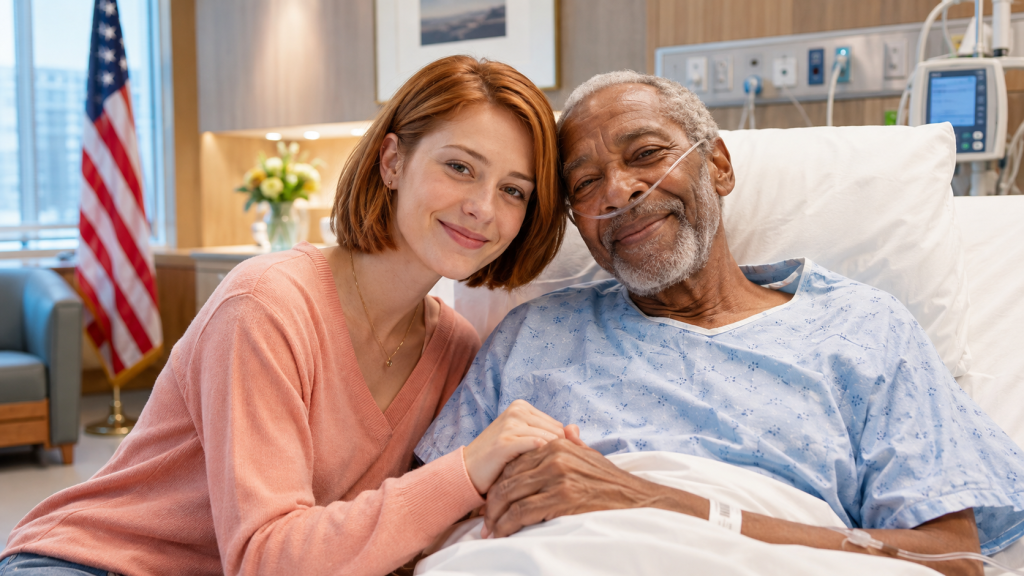
I stared at the photograph in my hand.
A faded blue house.
White porch railing.
A maple tree leaning toward the roof.
On the back was an address about forty miles from the hospital.
“What does this mean?”
Frank looked exhausted.
His breathing had become more labored.
“Dad, what does it mean?”
He squeezed my fingers.
“Go there.”
“Who lives there?”
His eyes closed.
I thought he was slipping away, and fear surged through me.
“Dad.”
He opened them again.
“Eleanor.”
“Who is Eleanor?”
He swallowed.
The effort seemed painful.
“She’ll tell you what I couldn’t.”
I felt anger rising beneath the fear.
“You have to tell me.”
“I should have.”
“Then tell me now.”
His eyes moved toward the photograph.
“I thought I had more time.”
“More time for what?”
His lips trembled.
“To be brave.”
That sentence frightened me more than anything else.
Frank Sullivan had always been brave.
He was the man who climbed onto our roof during thunderstorms because my mother insisted she heard “something rattling.”
He was the man who once walked six blocks through a blizzard after our car died because seven-year-old me had forgotten my stuffed rabbit at school.
He held my mother’s hand through eighteen months of chemotherapy.
He sat beside her hospice bed until she took her last breath.
Afterward, he walked into the kitchen, made me coffee, and said, “We don’t have to know how to survive the rest of our lives today. We just survive this morning.”
That was Frank.
So hearing him say he had been afraid made my stomach twist.
“Did you do something wrong?”
A long pause.
“Yes.”
My chest tightened.
“But not the thing you’re thinking.”
“I don’t know what I’m thinking.”
His fingers loosened around mine.
“I loved your mother.”
“I know.”
“More than anything.”
“I know.”
“And I loved you before you ever called me Dad.”
My throat closed.
“Then why does this sound like goodbye?”
His expression broke.
“Because it is.”
I shook my head.
“No.”
“Claire.”
“No.”
“My body’s tired.”
“No.”
The monitor continued its quiet rhythm.
I hated it for being so calm.
“You promised to teach Sophie how to drive.”
My daughter, Sophie, was sixteen.
Frank had already bought a second brake pedal attachment as a joke.
He kept it in his garage.
“Tell her I’m sorry.”
“You tell her.”
“Claire.”
“You tell her yourself.”
He gave me the same look he used whenever I tried bargaining with reality.
Gentle.
Sad.
Unmoved.
I bent forward until my forehead touched his hand.
For several minutes, neither of us spoke.
Then Frank whispered, “There’s a key in the envelope.”
I looked again.
At first, I had not noticed it.
A tiny brass key had slipped into one corner.
“What does it open?”
“Eleanor knows.”
“Dad, please.”
His eyelids fluttered.
“Promise me you’ll go.”
I wanted to refuse.
I wanted to tell him that I would only promise if he explained everything himself.
But something in his face stopped me.
“Okay.”
“Say it.”
“I promise.”
His shoulders relaxed.
“Good girl.”
I laughed through tears.
“I’m fifty-one.”
“You’ll be eighty and still be my girl.”
Those were the last clear words Frank ever spoke to me.
He slipped into unconsciousness shortly after midnight.
My husband Daniel arrived around one in the morning with Sophie.
She walked into the room wearing sweatpants, one of Frank’s old college sweatshirts, and the terrified expression of a child trying to pretend she understood death.
“Grandpa?”
I stood.
She crossed the room quickly and buried herself against me.
Daniel wrapped his arms around both of us.
We stayed that way until dawn.
Frank died at 6:17 in the morning.
His hand was inside mine.
Sophie held his other hand.
Daniel stood behind us.
The nurse turned off the monitor.
The silence afterward was unbearable.
I kept expecting Frank to complain that everyone was being too dramatic.
He hated fuss.
At his seventieth birthday, when we rented a restaurant room, he tried sneaking out before dessert.
“Why would seventy candles improve anything?” he asked.
Now there would be no more birthdays.
No pancakes.
No sarcastic comments about my driving.
No voicemail messages that began, “This is your father. You know that already because phones identify callers now, but anyway…”
I kissed his forehead.
Then I whispered the words he had said to me after my mother died.
“We only have to survive this morning.”
Three days later, we buried him beside her.
The funeral was crowded.
Frank had spent thirty-six years teaching high school history.
Former students came from several states.
One man stood beside the casket crying and told me Frank had once bought his winter coat because his family could not afford one.
A woman told me he had helped her fill out college applications after her parents refused.
Another man said Frank drove him to rehab at twenty-three and checked on him every week for a year.
I knew my father was kind.
I had not known how widely he had distributed that kindness.
After the funeral, people filled his house.
Someone brought lasagna.
Someone else brought chicken.
There were enough casseroles to feed a minor army.
I moved through the rooms mechanically, accepting hugs.
Then I saw the kitchen drawer.
The star-shaped pancake cutter was inside.
I closed the drawer immediately.
That night, after everyone left, I sat alone at Frank’s kitchen table.
Daniel found me there.
“You should sleep.”
“So should you.”
He pulled out the chair across from me.
Between us lay the envelope.
Daniel had not asked about it.
I had told him only that Frank had left an address.
“He said he lied to me,” I said.
Daniel leaned forward.
“About what?”
“I don’t know.”
“You don’t have to go tomorrow.”
“Yes, I do.”
“Then I’ll come.”
I shook my head.
“He asked me to go.”
“Claire—”
“I think I have to do this myself.”
Daniel studied me for a moment.
Then nodded.
“Call me if you need me.”
The next morning, I drove forty miles east.
The farther I got from the city, the smaller the roads became.
Subdivisions disappeared.
Fields replaced shopping centers.
Eventually, my navigation directed me onto Willow Creek Road.
The blue house stood near the end.
It looked almost exactly like the photograph.
The paint was darker now.
The maple tree was enormous.
Wind chimes hung from the porch.
I parked but did not immediately get out.
For ten minutes, I sat gripping the steering wheel.
My mind invented possibilities.
Frank had another family.
Frank had committed a crime.
My mother had committed a crime.
Maybe Eleanor was some old girlfriend.
Maybe she was my biological father’s wife.
That possibility struck hard.
I knew almost nothing about my biological father.
My mother had told me his name was Michael Reed.
She said he left before I turned two.
She never spoke badly about him.
She barely spoke about him at all.
“He wasn’t ready to be a father,” she once said.
That had always been enough.
Frank filled every empty space so completely that I rarely wondered.
I finally stepped out.
Before I could knock, the front door opened.
An elderly woman stood there.
She was perhaps eighty.
Silver hair.
Dark cardigan.
Sharp blue eyes.
She stared at me.
Then covered her mouth.
“Oh.”
My heartbeat accelerated.
“Are you Eleanor?”
She nodded slowly.
“You’re Claire.”
It was not a question.
“Yes.”
Tears immediately filled her eyes.
“Oh, my goodness.”
I took a step backward.
“How do you know me?”
She gripped the doorframe.
“Frank called two weeks ago.”
The world seemed to tilt.
“He told you I was coming?”
“He said you might.”
“Who are you?”
Eleanor looked past me toward the driveway.
“Did he come with you?”
I could not speak for a second.
Then I understood.
She did not know.
“Frank died.”
Her face collapsed.
“When?”
“Four days ago.”
She closed her eyes.
One hand went to her chest.
“I’m sorry.”
“No. I’m sorry.”
For a moment, we stood together on the porch, grieving the same man for reasons I did not understand.
Eventually she opened the door wider.
“You should come inside.”
The house smelled like cinnamon and old books.
Family photographs lined the walls.
I tried not to look.
Then I saw Frank.
I stopped.
A photograph rested on a table beside the staircase.
Frank was young.
Maybe twenty-five.
He stood beside Eleanor.
Between them was another man.
He looked enough like Frank to be his brother.
“What is this?”
Eleanor turned.
“That was taken in 1976.”
“Who’s the other man?”
Her expression became cautious.
“My son.”
I looked at her.
Then back at the picture.
“What was his name?”
She did not answer.
I already knew.
“Michael?”
Eleanor sat down.
My knees weakened.
“No.”
She nodded.
“Michael Reed Sullivan.”
I stared at her.
“My biological father was Michael Reed.”
“Yes.”
“Why is Sullivan his middle name?”
“It wasn’t.”
My pulse hammered.
“What are you saying?”
Eleanor folded her hands.
“Michael was Frank’s younger brother.”
I could hear a clock ticking somewhere.
Nothing else.
I sat across from her.
“My father was Frank’s brother?”
“Yes.”
Every childhood memory rearranged itself.
Frank meeting my mother.
Frank marrying her.
Frank raising me.
Frank never saying anything.
“Why?”
Eleanor shook her head.
“You need the whole story.”
“Then tell me.”
She took a slow breath.
“Michael was seven years younger than Frank. They were very different. Frank was responsible from the moment he could walk. Michael was charming, impulsive, always chasing something.”
“What happened?”
“Michael met your mother when they were both twenty-two.”
I stared.
“They were serious?”
“Very.”
That contradicted everything I knew.
My mother had made it sound brief.
“They planned to marry,” Eleanor continued. “But Michael had problems.”
“What kind?”
“Gambling. Alcohol. Eventually pills.”
My stomach twisted.
“He loved your mother. I believe that. But loving someone and being safe for them are not the same thing.”
I looked down at my hands.
“When she became pregnant with you, Michael swore he would change.”
“He didn’t.”
“No.”
Eleanor’s voice cracked.
“He disappeared for days. Borrowed money. Lied. Your mother finally left.”
“And Frank?”
“Frank helped her.”
Something cold moved through me.
“He was in love with her?”
Eleanor hesitated.
“Not then.”
I narrowed my eyes.
“Then?”
“Later.”
She stood.
“Come with me.”
We walked down a short hallway to a small office.
Eleanor opened an old wooden desk.
“Frank mailed this to me eighteen years ago.”
She removed a metal cashbox.
My brass key fit the lock.
My hands were shaking.
Inside were letters.
Dozens of them.
Some addressed to Frank.
Others to Michael.
Several bore my mother’s handwriting.
I recognized it instantly.
There was also a birth certificate.
Mine.
I removed it.
My mother’s name appeared exactly as expected.
Under father, however, was blank.
I looked at Eleanor.
“Why wasn’t Michael listed?”
“Your mother refused.”
I opened the first letter.
It was dated three months before my fourth birthday.
Frank,
I don’t know where Michael is. I don’t know if he’s alive, and I’m tired of waiting to find out. Claire asked yesterday why other children have fathers who pick them up from preschool. I didn’t know what to say.
Thank you for fixing the sink.
Thank you for bringing groceries.
But I need you to stop rescuing us every time your brother fails.
I am starting to depend on you, and that frightens me.
—Anne
My vision blurred.
I unfolded another.
Anne,
I understand.
But please believe me when I say I am not helping you because Michael asked me to.
He doesn’t know I’m helping.
I’m doing it because you should not have to carry everything alone.
And because Claire deserves someone who shows up.
—Frank
I pressed my fingertips against the paper.
That phrase.
Someone who shows up.
Frank said it constantly.
Birthdays.
Recitals.
Graduations.
“Half of love is showing up,” he used to say.
I kept reading.
Over the following months, Frank and my mother fell in love slowly.
Painfully.
My mother resisted.
Frank worried he was betraying his brother.
Then came a letter from Michael.
Frank,
Stay away from Anne.
She belongs to me.
Claire is my daughter.
You don’t get to steal them because you think you’re better.
I am getting clean.
When I come back, I want my family.
Michael.
Another letter.
Frank’s response.
Michael,
Anne does not belong to anyone.
Claire is not something you can abandon and reclaim.
If you want to be her father, become someone safe enough to stand near her.
Until then, do not threaten Anne again.
I sat back.
“He threatened her?”
Eleanor nodded.
“When Michael realized Anne and Frank were together, he became furious.”
“Did he hurt her?”
“Not physically.”
“But?”
“He followed her. Called constantly. Appeared outside her apartment.”
I felt sick.
“My mother never told me.”
“She didn’t want you afraid.”
“What happened?”
“Frank gave Michael money to leave.”
I stared.
“What?”
Eleanor nodded.
“That was his lie.”
I did not understand.
“He paid my biological father to disappear?”
“Yes.”
“How much?”
“Twenty-five thousand dollars.”
Back then, that was enormous.
“Frank gave him everything he had saved.”
“Why?”
“Michael demanded it.”
The room seemed to grow colder.
“He blackmailed him?”
“In a way.”
Eleanor picked up another envelope.
Inside was a photocopy of a handwritten agreement.
Michael promised to leave the state and make no attempt to contact my mother or me.
In exchange, Frank paid him.
I felt anger rise.
“He bought me.”
“No.”
“That’s exactly what this looks like.”
“Claire—”
“He paid my father to leave.”
“Your father had already left many times.”
“That doesn’t make this right.”
“No.”
Eleanor did not defend him.
That stopped me.
“No?”
“No. It was not right.”
I looked away.
“Frank knew that.”
“Then why did he do it?”
“Because Michael had threatened to take you.”
I turned back.
“What?”
“Your mother was terrified.”
Eleanor’s face tightened.
“Michael told her that if she married Frank, he would file for custody. He had no real chance, but he knew how to frighten her.”
“So Frank paid him.”
“Yes.”
“Then what happened?”
“Michael took the money.”
“And disappeared.”
Eleanor looked toward the window.
“For a while.”
My stomach dropped.
“What does that mean?”
“He came back.”
“When?”
“You were thirteen.”
I stood so quickly the chair scraped the floor.
“No.”
“He came here first.”
“Did he see me?”
“No.”
“Did Frank know?”
“Yes.”
My anger exploded.
“He lied to me again.”
Eleanor flinched.
“He was trying to protect you.”
“I’m tired of hearing that.”
I began pacing.
“What happened when Michael came back?”
“He was sober.”
That surprised me.
“How long?”
“Six years.”
“And?”
“He wanted to meet you.”
I stopped.
“Frank said no?”
“Your mother said no.”
I stared.
Eleanor continued.
“Anne was terrified that Michael would destabilize your life. You adored Frank. You thought of him as your father.”
“He was my father.”
“Yes.”
“Then why didn’t they let me decide?”
“Because you were thirteen.”
“I was old enough to know I had another parent who wanted to see me.”
“Yes.”
Eleanor’s eyes filled.
“I told them the same thing.”
I sank back into the chair.
“What happened to Michael?”
“He respected the decision.”
“Just like that?”
“No.”
She gave a sad smile.
“Michael never did anything just like that.”
“He wrote letters.”
“To me?”
“Yes.”
My throat tightened.
“Where are they?”
Eleanor pointed to the box.
At the bottom were seventeen sealed envelopes.
Each had my name.
Claire — Age 13.
Claire — Age 14.
Claire — Christmas.
Claire — Graduation.
My hands began trembling violently.
“Frank kept these?”
“Michael sent them to Frank.”
“And Frank never gave them to me.”
“No.”
I felt betrayed in a way I could not explain.
This was not about loving Michael.
I had never known him.
It was about choice.
Everyone had made choices around me.
For me.
About me.
While pretending there was nothing to choose.
“Where is he now?”
Eleanor’s face changed.
I knew before she spoke.
“Michael died seventeen years ago.”
I closed my eyes.
“How?”
“Heart failure. His years of addiction damaged him badly.”
I covered my mouth.
A man I had never known had died wanting to meet me.
A man I had thought abandoned me completely.
Maybe he had abandoned me at first.
But he had come back.
He had written.
And Frank knew.
My father knew.
I stood.
“I need to leave.”
“Claire.”
“I can’t do this.”
“Take the letters.”
“I don’t want them.”
“You may someday.”
“I don’t want them.”
I walked toward the hallway.
Then Eleanor called my name.
“There’s one more thing.”
I stopped.
She approached slowly.
“Frank didn’t keep the letters because he was jealous.”
I turned.
“How would you know?”
“Because Michael asked him to.”
I stared.
“That makes no sense.”
Eleanor returned to the box and removed a final envelope.
She handed it to me.
The front read:
For Claire, when Frank believes she’s ready.
Inside was a letter dated two months before Michael’s death.
Claire,
If you are reading this, then either Frank finally found the courage to tell you, or I ran out of time.
Maybe both.
There are things you deserve to know.
The first is that I failed you.
Not Frank.
Me.
I was your father by blood, but when you were small, I chose everything except being your dad.
I blamed everyone.
Your mother.
Frank.
My childhood.
Addiction.
Bad luck.
But the truth is simpler.
I was selfish.
Frank paid me to leave, yes.
For years I hated him for that.
I told myself he stole my daughter.
But a good man could not have been paid to abandon his child.
I took the money.
That was my decision.
When I became sober, I wanted you back because I finally understood what I had thrown away.
Your mother refused.
Frank refused.
I was angry.
Then Frank did something I did not expect.
He met me.
He brought photographs.
School pictures.
Birthday pictures.
A picture of you holding a science fair ribbon.
He told me stories about you.
He told me you hated peas and loved thunderstorms.
He told me you cried when your goldfish died and insisted on holding a funeral.
He made me understand something.
You already had a father.
And he was doing the job I had abandoned.
I asked him not to give you my letters while I was alive.
I was afraid I would become another disruption.
Maybe that was cowardice.
Maybe it was the first decent decision I made.
But I asked him for one promise.
That someday, after you were grown, he would tell you everything.
If you hate me, I understand.
If you never think of me again, I understand.
But do not hate Frank for loving you too fiercely.
He carried guilt because he married Anne.
Because he paid me.
Because he became your father.
I hope someday you understand that none of those things were theft.
He did not steal my place.
I left it empty.
He simply refused to let you grow up without someone standing there.
Michael.
By the time I finished, I could barely see.
I lowered the letter.
Eleanor was crying too.
“He made Frank promise?”
“Yes.”
“Then why did Frank wait so long?”
“That’s the part Frank could never forgive himself for.”
I wiped my face.
“He was supposed to tell me when I became an adult?”
“Yes.”
“Why didn’t he?”
“Fear.”
I almost laughed.
Frank had said exactly that.
“He thought you would see him differently.”
“I do.”
Eleanor looked worried.
“I do see him differently.”
I picked up the photograph.
“I thought loving me was easy for him.”
She waited.
“I didn’t know it cost him anything.”
Eleanor smiled faintly.
“Real love usually does.”
I left with the box.
For two days, I did not open another letter.
I barely slept.
Daniel asked questions carefully.
I told him the basics.
He never told me what I should feel.
That was one of the reasons I loved him.
Sophie found me sitting on the garage floor beside Frank’s old workbench.
“Mom?”
I wiped my eyes.
She sat beside me.
“What happened at the house?”
I looked at my daughter.
Sixteen.
Old enough to understand more than adults usually believed.
“Grandpa kept something from me.”
“Bad?”
“I don’t know.”
“That sounds bad.”
I laughed.
“Yeah.”
She leaned against my shoulder.
“Did he hurt you?”
“Not the way you mean.”
She was quiet.
Then she said, “Grandpa was scared of losing you.”
I turned.
“How do you know that?”
“He told me once.”
My heart stopped.
“When?”
“Last year.”
“What did he say?”
“He said sometimes people keep secrets because they’re selfish, and sometimes they keep them because they’re scared. Then he said fear can make good people do dumb things.”
I stared at her.
“What were you talking about?”
“Nothing important.”
“Sophie.”
She sighed.
“I broke your ceramic bowl.”
“What?”
“The one from Italy.”
I stared.
“Grandpa helped me glue it.”
“You told me the cat broke that.”
“I know.”
Despite everything, I started laughing.
Then Sophie laughed.
Soon we were both crying.
It felt exactly like something Frank would have arranged.
For the next week, I read Michael’s letters.
He did not romanticize himself.
That surprised me.
He wrote about addiction.
Recovery.
Regret.
He told me about seeing my photograph in Frank’s wallet.
He wrote about my grandmother Eleanor.
He described how, when he was little, Frank took punishment for him after Michael broke a neighbor’s window.
One letter contained something I did not expect.
I used to resent Frank because he was always the better brother.
Then I realized he wasn’t better.
He just kept choosing better.
That difference matters.
Another was written after my high school graduation.
Frank sent me a photograph today.
You’re wearing a blue cap.
He says you’re going to Northwestern.
I told everyone at my recovery meeting that my daughter got into Northwestern.
They clapped.
Nobody asked why I wasn’t invited.
I’m glad they didn’t.
I cried so hard reading that letter that Daniel came upstairs.
“I hate this,” I told him.
He sat beside me.
“I hate that I’m grieving someone I never knew.”
“That makes sense.”
“No, it doesn’t.”
“You’re grieving the possibility.”
I looked at him.
“What?”
“The relationship you could have had.”
That was exactly it.
I was not grieving Michael the father.
Frank was my father.
I was grieving the stranger who might have become something else.
An uncle.
A friend.
A complicated man who shared my eyes.
I looked through old photographs differently after that.
At my fifth birthday, Frank stood behind me while I blew out candles.
At ten, he held my bicycle seat.
At eighteen, he cried at graduation.
At twenty-seven, he walked me down the aisle.
At thirty-four, he held newborn Sophie.
He had been there.
Again.
Again.
Again.
Showing up.
I began going through Frank’s house.
There were things that needed sorting.
Clothes to donate.
Documents to organize.
Books to give away.
One afternoon, I found a journal behind old tax files.
Frank was not a journal person.
Most entries were short.
Dates.
Notes.
Repairs.
But several pages concerned me.
May 14, 1993.
Claire asked why I don’t look like her.
Told her children don’t have to look like their dads.
True.
But not enough truth.
October 2, 1999.
Michael called.
Anne cried afterward.
I hate him for returning.
I hate myself for hating him.
Claire deserves the truth.
Anne says not yet.
January 11, 2004.
Claire turned eighteen today.
I should tell her.
I did not.
Coward.
June 7, 2010.
Michael is gone.
Eleanor says his final letter is for Claire.
I promised him.
Still haven’t done it.
Every year makes it harder.
I sat on the floor reading.
Then I found the final entry.
Written three months before Frank entered the hospital.
I have loved Claire for forty-seven years.
Perhaps I confused protecting our relationship with protecting her.
Those are not the same thing.
If there is time, I will tell her.
If there isn’t, I pray she eventually understands that the worst lie of my life grew beside the greatest love of it.
I pressed the journal against my chest.
For the first time since the hospital, my anger softened.
Not disappeared.
Softened.
Love does not erase harm.
But harm does not always erase love either.
Sometimes both survive in the same room.
Two months after Frank died, I returned to Eleanor’s house.
She opened the door and smiled.
“I wondered if you would.”
“I almost didn’t.”
“That’s fair.”
We drank tea.
I brought photographs.
She brought albums.
For the first time, I saw Michael as a child.
He had my smile.
Or maybe I had his.
There was one picture of Frank and Michael standing beside a lake.
Frank looked about fourteen.
Michael was seven.
Frank’s arm rested protectively around him.
“They loved each other,” Eleanor said.
“Even after everything?”
“Especially after everything.”
She told me that Frank visited Michael during recovery.
Quietly.
My mother knew.
I did not.
Before Michael died, Frank spent three days at his bedside.
That detail broke something open inside me.
“I thought Frank hated him.”
“He was angry with him.”
“That’s not the same.”
“No.”
Eleanor smiled.
“Frank knew that better than most.”
Before I left, she handed me a small paper bag.
Inside was a metal pancake cutter.
A star.
I stared.
“No way.”
“Michael bought it.”
“What?”
“He saw one at a thrift store when you were little. He mailed it to Frank.”
I began laughing.
“The stupid pancakes.”
Eleanor laughed too.
Apparently, Frank’s star pancakes had begun because Michael once remembered that I liked stars.
That knowledge felt almost too perfect.
Two fathers.
One disappeared.
One stayed.
Yet somehow, across years of mistakes, guilt, sobriety, fear, and silence, both had contributed to burned pancake points.
On the anniversary of Frank’s death, Sophie and I made breakfast.
I took out his cutter.
The first pancake burned.
The second broke.
The third looked more like an injured sea creature than a star.
Sophie stared.
“Grandpa would be embarrassed for you.”
“Grandpa’s pancakes were terrible.”
“They were better than these.”
“Traitor.”
Daniel came downstairs.
“What’s burning?”
“Legacy,” Sophie said.
We laughed.
Then I placed three plates on the table.
One for me.
One for Sophie.
One for Daniel.
For a moment, I considered setting out a fourth.
Instead, I placed Frank’s journal beside my coffee.
I had spent a year learning that families are rarely built from clean stories.
My mother loved Frank while carrying fear from Michael.
Michael loved me while failing me.
Frank loved me while lying to me.
Eleanor loved two sons who hurt each other and still remained brothers.
And I loved Frank while being angry at him.
That last part had been hardest to accept.
For months, I thought forgiveness required pretending the secret did not matter.
It did matter.
I should have been told.
Michael should not have been erased.
Frank should have kept his promise sooner.
But forgiveness was not declaring him innocent.
It was deciding that forty-seven years of fatherhood could contain one terrible failure without being reduced to it.
That morning, I drove to the cemetery.
I brought two things.
The star cutter.
And Michael’s final letter.
Frank’s grave sat beside my mother’s beneath an oak tree.
I knelt.
“Hi, Dad.”
The word came naturally.
It always would.
“I went to the house.”
Wind moved through the grass.
“I met Eleanor.”
I smiled.
“She’s terrifyingly observant, by the way. So thanks for not warning me.”
I placed my hand against his headstone.
“I read everything.”
My voice broke.
“All of it.”
I sat there quietly.
Then I said the words I had rehearsed for months.
“You should have told me.”
Tears slipped down my face.
“You were wrong.”
I took a breath.
“But you were still my dad.”
That was when I finally understood what had troubled me most.
Frank had feared that truth would somehow cancel him.
That blood would rewrite history.
That finding Michael would make me question whether Frank had really belonged in my life.
It did the opposite.
Knowing the truth made every ordinary act larger.
He did not raise me because he had to.
He chose me while knowing exactly whose child I was.
He chose school pickups.
Dentist appointments.
Parent-teacher conferences.
Broken hearts.
Tuition bills.
Wedding speeches.
Hospital waiting rooms.
Star pancakes.
He chose every boring, exhausting, repetitive part of fatherhood.
Not once.
Thousands of times.
I leaned against the stone.
“You didn’t steal me.”
My voice shook.
“He left a space.”
I smiled through tears.
“And you stood there.”
Before leaving, I placed the cutter beneath the flowers.
Then I changed my mind.
I took it back.
Some things belong with the dead.
Others belong in kitchens.
When I got home, Sophie was waiting.
“Well?”
“Well what?”
“Did Grandpa forgive you for making terrible pancakes?”
I hugged her.
She complained immediately.
“Mom. Too tight.”
I hugged tighter.
That evening, I gave Sophie copies of the letters.
Not because she needed to carry the family’s secrets.
Because I wanted the cycle to end.
“No more hidden boxes,” I told her.
She looked through them.
“Was Michael my grandfather too?”
“Biologically.”
“But Frank was Grandpa.”
“Yes.”
She thought for a moment.
“Can both be true?”
I smiled.
“That’s what took me a year to learn.”
Sophie kept one photograph.
The one of Frank and Michael beside the lake.
She framed it and placed it on her desk.
Years later, when she left for college, she took it with her.
Frank never got to teach her how to drive.
I did.
Badly.
The first time she hit the curb, I heard his voice in my head.
“Brake pedal’s there for a reason.”
I laughed so suddenly Sophie thought I was angry.
“What?”
“Nothing.”
“Mom.”
“Your grandpa would have loved this.”
She smiled.
“I know.”
That was another thing I eventually understood.
Death did not turn Frank into a mystery.
The secret did.
Then the truth turned him back into a person.
Not a saint.
Not a liar.
A man.
A good man who made a fearful choice.
Then another.
Then waited too long to correct it.
A man who loved imperfectly but relentlessly.
A man whose final act was not confessing because he wanted relief.
He confessed because I deserved the truth, even if the truth changed how I remembered him.
And it did.
I no longer remember my childhood as simple.
I remember it as chosen.
I remember my mother standing between fear and hope.
I remember Michael as absence, regret, and the possibility of redemption.
Most of all, I remember Frank.
At the stove.
Holding that ridiculous metal cutter.
Pouring batter carefully inside it.
Burning every pointed edge.
Pretending they were perfect.
Whenever Sophie comes home now, we make star pancakes.
Mine are still terrible.
She complains.
I tell her to eat them anyway.
And every single time, before I take the first bite, I think about the hospital.
Frank’s hand around mine.
His frightened eyes.
His whispered confession.
I used to wish he had never said it.
For months, I wanted the simpler version of my life back.
Now I am grateful he found enough courage at the end.
Because truth did not take my father away from me.
Death did that.
Truth gave him back.
Not as the flawless man I had imagined.
But as the complicated, frightened, stubborn, generous human being he really was.
And somehow, I love him more clearly now.
Not because he never failed me.
Because after knowing exactly how he failed me, I can finally see everything else he did.
He stayed.
When another man left, Frank stayed.
When my mother became sick, he stayed.
When I screamed at him as a teenager, he stayed.
When I moved away, he called.
When I came back, he opened the door.
When my daughter was born, he stood outside the delivery room crying.
When my mother died, he held me together while his own heart was breaking.
And when his own life was ending, he chose truth over the safety of being remembered perfectly.
That is the father I carry with me now.
Not perfect.
Not biological.
Not replaceable.
Just Dad.
And every time pancake batter fills that old metal star, I remember the sentence that defined him better than any secret ever could.
Half of love is showing up.
Frank showed up.
For forty-seven years.
And in the end, that was the truth that mattered most.
💬THE END! THANK YOU FOR READING!