

The person I called was seventy-two years old, lived outside Santa Fe, and had not spoken to Grant in nearly eight years.
Dr. Eleanor Shaw.
The woman who had given us our first chance.
Before Mercer Dynamics had investors, before there were glass offices and magazine profiles and Grant posing in charcoal suits beside headlines calling him a “visionary founder,” there had been a cramped university laboratory with flickering fluorescent lights and three computers that overheated if we ran simulations for too long.
Eleanor had been my doctoral adviser.
She had also been the first person who believed the software I was building could become something larger than a research project.
Grant met her through me.
That detail had somehow disappeared from the story he told reporters later.
According to Grant, he had “assembled a small technical team” after identifying an opportunity in predictive logistics.
What actually happened was that I had spent nearly four years developing a new optimization model while Grant was still working in enterprise sales.
He used to sit beside me in the laboratory after midnight, drinking terrible vending machine coffee while I showed him what the system could do.
He didn’t understand the mathematics.
But he understood money.
“This could be a company,” he told me one night.
I laughed.
He didn’t.
Within nine months, we had incorporated Mercer Dynamics.
My surname at the time was also Mercer.
Something else the press releases eventually forgot.
When Eleanor answered my call, her voice was cautious.
“Claire?”
I almost cried just hearing my own name spoken by someone who remembered who I had been before Grant transformed me into an inconvenient footnote.
“Yes.”
There was a long pause.
Then Eleanor said, “I wondered when you would call.”
That sentence stopped me cold.
“What do you mean?”
“I mean,” she said carefully, “that I have been watching your husband rewrite history for years.”
My fingers tightened around the phone.
“Why didn’t you say something?”
“I tried.”
I sat down.
“When?”
“Six years ago.”
I remembered the year instantly.
Mercer Dynamics had just completed its Series C funding round.
Grant was everywhere.
CNBC.
Business magazines.
Conference stages.
He had started referring to himself as the company’s sole founder.
I had asked him about it once.
He laughed.
“Investors like a simple narrative.”
I remember staring at him across our kitchen island.
“But I founded it with you.”
“You’re chief research officer.”
“That isn’t the point.”
“Claire, don’t be emotional.”
Those four words had become his favorite weapon.
Don’t be emotional.
Whenever I asked why he received five times my salary.
Don’t be emotional.
Whenever I questioned why my ownership percentage seemed to shrink after financing rounds I had not been invited to discuss.
Don’t be emotional.
Whenever I asked why patents containing my work were suddenly being filed under Mercer Dynamics instead of listing me personally as the inventor.
Don’t be emotional.
Eventually, I stopped asking.
Eleanor’s voice pulled me back.
“I contacted Grant’s corporate counsel,” she continued. “I reminded them that several foundational research components were developed while you were still affiliated with the university.”
My heart began pounding.
“What did they say?”
“That the matter had been resolved.”
“Resolved how?”
“They sent me a copy of an assignment agreement.”
I stood.
“What assignment agreement?”
“That was my question.”
I began pacing across my apartment.
After Grant removed me from the company, I rented a small two-bedroom place fifteen minutes away from the house we had shared for thirteen years.
He stayed in the house.
Of course he did.
Grant always stayed.
Everyone else was expected to leave.
“Eleanor,” I said, “I never signed an assignment agreement with the university.”
“I know.”
My stomach tightened.
“How?”
“Because I supervised the research.”
She sighed.
“And because the signature on the document was not yours.”
For several seconds, I couldn’t speak.
“What are you saying?”
“I am saying I believed someone forged your signature.”
My knees weakened.
I sat again.
“Do you still have it?”
“Yes.”
“Send it to me.”
“Claire.”
“Please.”
Another pause.
Then she said, “There’s more.”
There always was.
That was the thing about betrayal.
You thought you had reached the bottom until someone quietly opened another trapdoor.
“What?”
“The assignment wasn’t the only document.”
By midnight, my inbox contained fourteen attachments.
I opened them one by one.
The first was the university assignment agreement.
My name was typed beneath the signature line.
Claire Mercer.
The signature looked convincing.
It even had the ridiculous looping C I used.
But I knew immediately that I had never signed it.
The date proved it.
March 18.
I remembered March 18 because that was the morning I was admitted to the hospital during my pregnancy.
Our son, Daniel, had stopped moving.
I was twenty-eight weeks pregnant.
By afternoon, the doctors told us there was no heartbeat.
I spent that night in a hospital bed with Grant sitting beside me.
Or at least I thought he had remained beside me.
According to the timestamp on the assignment agreement, I had electronically authorized the transfer of intellectual property rights at 8:47 p.m.
I was in labor at 8:47 p.m.
Our dead son was delivered at 11:16.
My hands began shaking.
I opened the next document.
Board consent.
The next.
Licensing amendment.
The next.
Patent assignment.
Every one of them transferred control away from me.
Every one carried my signature.
Every one had been executed within six months of Daniel’s death.
A period when I barely remembered eating.
Grant handled everything then.
Bills.
Mail.
Company paperwork.
He told me to rest.
He told everyone I was fragile.
I thought he was protecting me.
Now I realized he had been busy.
I called Eleanor again at one in the morning.
“You knew?”
“I suspected.”
“Why didn’t you tell me?”
“I tried to reach you. Grant said you were receiving psychiatric treatment and that lawyers had advised everyone not to burden you with company matters.”
I closed my eyes.
Psychiatric treatment.
I had attended grief counseling.
Once a week.
Grant had converted mourning into incapacity.
“He told the board the same thing,” Eleanor added.
My eyes opened.
“What?”
“He said your mental health was unstable.”
The room went silent around me.
Suddenly, dozens of memories rearranged themselves.
Meetings I had stopped being invited to.
Board dinners Grant said were “too stressful.”
Investor presentations scheduled while I was in therapy.
The gradual removal of my administrative access.
The way people began speaking slowly around me.
The sympathetic looks.
Grant had not merely stolen my work.
He had constructed a story explaining why I should not be trusted to defend it.
The next morning, I called my attorney, Maya Patel.
Until then, Maya believed we were handling an ugly but conventional divorce.
Grant wanted nearly everything.
He claimed the company was separate property because the majority of its current valuation came from investments and growth occurring after incorporation.
His attorneys argued I had been an employee.
A highly compensated employee.
Nothing more.
I carried the hard drive into Maya’s office.
She looked at it.
Then she looked at me.
“What’s on there?”
“Possibly my marriage.”
She didn’t smile.
Two hours later, neither of us was smiling.
Maya called in a forensic technology specialist.
Then an intellectual property attorney.
Then another lawyer from her firm who specialized in corporate fraud.
By the end of the day, there were six people in the conference room.
Nobody touched the hard drive without gloves.
Nobody copied anything without creating a forensic image.
Every file was hashed, dated, logged, and preserved.
Grant loved accusing me of being emotional.
So I decided to become meticulous.
For the next nine months, I said almost nothing.
That silence made Grant reckless.
He mistook quiet for surrender.
At mediation, he arrived twenty minutes late carrying an espresso.
Vanessa Ross, his attorney, sat beside him.
She was brilliant, aggressive, and expensive enough that Grant mentioned her hourly rate whenever he wanted to intimidate me.
Grant leaned back in his chair.
“I’m willing to be generous.”
Maya raised an eyebrow.
His definition of generosity was remarkable.
He offered me $400,000.
Our marital home alone was worth $3.2 million.
Mercer Dynamics had recently been valued at more than $240 million.
Grant personally controlled stock worth somewhere between $60 million and $80 million depending on the preferred share structure.
I owned less than two percent on paper.
According to Grant, that was all I deserved.
“You’re lucky,” he told me.
I looked at him.
“Lucky?”
“You walked away from the company years ago.”
“You removed me.”
“You resigned.”
“I never resigned.”
Vanessa slid a document across the table.
There it was.
Another signature.
Another lie.
My supposed resignation letter.
Dated two weeks after Daniel’s funeral.
I stared at it.
Grant smiled.
“You signed it.”
“No.”
“Claire.”
His voice softened in that familiar way.
The voice he used whenever he wanted to make me doubt my memory.
“You were going through a difficult period.”
Maya’s hand touched my wrist beneath the table.
A warning.
Not yet.
I looked down at the resignation.
Then back at Grant.
“You’re right.”
Everyone became still.
Grant blinked.
“What?”
“I was going through a difficult period.”
His shoulders relaxed.
He thought I was collapsing.
“So you understand.”
“I understand more than I did.”
I slid the document back.
“I’m rejecting the offer.”
Grant laughed.
“Maya, explain reality to your client.”
Maya closed her folder.
“My client understands reality extremely well.”
We left.
Outside the conference room, Maya whispered, “You almost gave me a heart attack.”
“Sorry.”
“No, you’re not.”
For the first time in months, I laughed.
Our strategy was simple.
We would not confront Grant prematurely.
First, we needed proof that the documents were forged.
Not suspicion.
Proof.
The forensic analysis gave us the first breakthrough.
The external hard drive contained original source code dating back almost seventeen years.
Not copies.
Original repositories.
Development logs.
Commit histories.
Metadata.
Versions showing my work evolving line by line before Mercer Dynamics had even been incorporated.
Even better, many files contained comments discussing Grant by name.
One note read:
“G thinks this can be sold to freight carriers. Need explain why prediction confidence still insufficient.”
Another:
“Grant wants investor demo next month. Probably too early.”
Another:
“Rebuilt routing function after Grant crashed laptop trying to ‘optimize’ it.”
Maya laughed at that one for nearly thirty seconds.
But the technical evidence was only the beginning.
The metadata from several forged documents showed they had been created on a laptop registered to Charles Becker.
Charles had been Grant’s personal attorney before Mercer Dynamics hired a major corporate law firm.
He was also the man sitting beside Vanessa at our final divorce hearing.
That discovery changed everything.
Maya subpoenaed records.
Grant fought every request.
He accused us of harassment.
Fishing expeditions.
Vindictive litigation.
Judge Whitmore tolerated exactly three weeks of it.
Then he ordered production.
Emails arrived first.
Thousands.
Most were irrelevant.
Schedules.
Invoices.
Contract negotiations.
Then one subject line appeared.
CLAIRE PAPERWORK.
The email was from Grant to Charles.
Three days after Daniel died.
“Need these handled while she’s still out. Better now than after she returns and starts asking questions.”
Charles replied.
“What exactly has she agreed to?”
Grant wrote:
“She agrees with me. That’s enough.”
No signature mentioned.
No authorization.
Three hours later, Charles emailed Grant another document.
“Use this version. Cleaner.”
Attached was my supposed resignation letter.
I remember reading that email in Maya’s office.
For months, I had imagined I would feel triumphant if we found something undeniable.
Instead, I felt hollow.
Because part of me still remembered Grant sleeping in a chair beside my hospital bed.
Part of me remembered him carrying Daniel’s tiny memory box to the car.
Part of me remembered his hand on my back while I cried in our shower because my milk had come in for a baby who was already gone.
How could that man have returned to his office and stolen my company?
Maya must have seen something in my face.
“You don’t have to read the rest today.”
“Yes, I do.”
There were twenty-three more emails.
In one, Charles warned Grant that obtaining my signature through digital replication could create exposure.
Grant replied:
“Only if she challenges it.”
In another:
“She won’t. Claire hates conflict.”
That one hurt more than everything else.
Because he was right.
I hated conflict.
I compromised.
I forgave.
I rationalized.
I spent years believing peace was something two people built together.
Grant believed peace was what happened when the other person stopped resisting.
Then we found the letter.
Not my letter to the judge.
Another letter.
One Grant had written.
It was addressed to the board of Mercer Dynamics.
Dated fourteen years earlier.
Six weeks after Daniel’s death.
In it, Grant explained that I had suffered a “serious psychological breakdown.”
He claimed I was voluntarily stepping away.
He recommended that all voting authority attached to my founder shares be temporarily transferred to him.
Temporarily became permanently.
The board approved the measure.
Four directors had since retired.
Two agreed to testify.
One, Samuel Ortiz, sounded devastated when Maya called him.
“He told us Claire requested it.”
“She didn’t.”
“God.”
Samuel went silent.
“I owe her an apology.”
He gave us board minutes.
Original ones.
Not the sanitized versions Grant’s company initially produced.
Those minutes contained a sentence that would eventually destroy Grant’s case.
“Mr. Mercer confirms Mrs. Mercer’s consent has been obtained in writing.”
It had not.
Meanwhile, Grant remained convinced he was winning.
He bought a new car.
Started appearing publicly with a woman named Juliette who worked in investor relations.
He posted photographs from Napa.
He moved money.
That was his biggest mistake.
Our financial subpoena discovered $6.8 million transferred into entities registered in Delaware and Nevada.
Another $2.1 million moved overseas.
Vanessa claimed they were legitimate business investments.
They were not.
Two of the entities had no employees.
No websites.
No operating history.
One shared an address with Charles’s brother-in-law.
Judge Whitmore issued a temporary order freezing certain assets.
Grant exploded.
He called me seventeen times that evening.
I didn’t answer.
Then he sent a message.
YOU HAVE NO IDEA WHAT YOU’RE DOING.
I stared at it.
Then typed:
I think I finally do.
I did not send it.
Maya had taught me the most useful phrase in divorce litigation:
Do not feed the evidence.
So I took a screenshot and forwarded it to her.
Three months before trial, Grant came to my apartment.
He was not supposed to.
I opened the door but left the chain attached.
He looked older.
Not remorseful.
Just angry.
“What are you doing?”
“Following my lawyer’s advice.”
“You’re trying to destroy the company.”
“No.”
“You’re attacking everything we built.”
I looked at him through the narrow opening.
“We?”
His expression changed.
He knew.
Maybe not everything.
But enough.
“Claire.”
There was suddenly warmth in his voice.
Fake warmth.
The kind I once mistook for love.
“Whatever Maya is telling you, remember who actually knows you.”
I almost smiled.
That was his mistake.
He still believed I was the same woman who needed him to explain reality.
“You’re right,” I said.
His shoulders lowered.
“I know you.”
I leaned closer.
“And now I know you too.”
I closed the door.
Trial began on a Monday morning in April.
Grant wore navy.
He always wore navy when he wanted to appear trustworthy.
Vanessa opened by describing our marriage as a conventional partnership that had unfortunately deteriorated.
She portrayed Grant as the visionary executive who built Mercer Dynamics through relentless work.
Me?
I was described as a talented early employee who eventually chose motherhood and personal healing over corporate leadership.
The phrase “chose motherhood” nearly made me laugh.
We had never had another child.
After Daniel died, Grant said he was not ready to try again.
Then another year passed.
Then three.
Then eight.
Whenever I mentioned adoption or fertility treatment, Grant changed the subject.
Eventually, I accepted that motherhood was another future I had lost.
Yet there I sat while his attorney used it to explain why I deserved less.
Maya said nothing.
Not yet.
Grant testified for nearly four hours.
He was excellent.
Grant had always been excellent in front of an audience.
He talked about sacrifice.
Risk.
Leadership.
He described nights spent sleeping in the office.
He forgot that during many of those same nights, I had been sleeping under my desk too.
Vanessa asked him about my ownership.
“Did you ever intentionally deprive your wife of company equity?”
“Absolutely not.”
“Did she voluntarily reduce her involvement?”
“Yes.”
“Did she sign documents reflecting that decision?”
“Yes.”
“Did you conceal marital assets?”
“No.”
“Did you falsify company records?”
“No.”
“Did you ever forge Claire’s signature?”
Grant looked directly at me.
“No.”
That was the moment.
Maya wrote something on her legal pad.
Three words.
HE COMMITTED NOW.
During cross-examination, she began gently.
Almost boringly.
Dates.
Job titles.
Corporate structure.
Grant relaxed.
Then she showed him the resignation letter.
“Your testimony is that Claire signed this?”
“Yes.”
“Where?”
“I don’t remember.”
“You don’t remember where your wife resigned from the company you founded together?”
“It was a difficult period.”
“Because your son had died?”
Vanessa stood.
“Objection.”
“Overruled.”
Grant swallowed.
“Yes.”
Maya walked slowly toward the witness stand.
“Mr. Mercer, what date did Daniel die?”
Grant’s face tightened.
“March twentieth.”
I closed my eyes.
Wrong.
Maya didn’t react.
“Are you certain?”
Grant looked toward Vanessa.
“March nineteenth.”
Wrong again.
My son was born dead on March 18.
His father could not remember.
Maya placed the hospital record on the screen.
“March eighteenth.”
Grant stared.
“Your wife was admitted at 2:14 p.m.”
Silence.
“She delivered your son at 11:16 p.m.”
Grant nodded.
Maya changed slides.
“According to this intellectual property assignment, Claire digitally signed away significant rights at 8:47 p.m. that same evening.”
The courtroom became completely still.
Grant’s eyes moved toward Charles.
Charles looked down.
Maya asked, “Was your wife negotiating intellectual property rights while she was in labor delivering your deceased child?”
Vanessa objected again.
Judge Whitmore’s expression had gone hard.
“Answer.”
Grant cleared his throat.
“I don’t remember.”
“You testified twenty minutes ago that she signed it.”
“I believed she did.”
“Who prepared the document?”
“Charles.”
Charles’s head lifted.
Maya turned.
“Mr. Becker?”
Vanessa jumped up.
“Your Honor, counsel is attempting—”
“I asked the witness,” Maya said calmly.
Judge Whitmore nodded.
“Proceed.”
The rest unfolded slowly.
Painfully.
Metadata.
Emails.
Board minutes.
Forensic reports.
Expert testimony.
By Wednesday afternoon, Grant’s story had collapsed.
But he still believed the divorce itself could be contained.
He thought corporate issues could be separated.
He thought the judge would divide existing marital assets and leave Mercer Dynamics for another court.
That was when my letter appeared.
Months earlier, Maya had asked me to write a statement.
Not a legal brief.
Not an accusation.
A timeline.
She wanted me to explain what I knew, what I remembered, and what I had discovered.
I wrote thirty-seven pages.
Then deleted twenty-nine.
The final eight pages contained no insults.
No speculation.
Only dates.
Promises.
Documents.
And one request.
If Grant testified under oath that nothing had been concealed, I asked the court to compare his sworn statements against the evidence before deciding whether his disclosures were made in good faith.
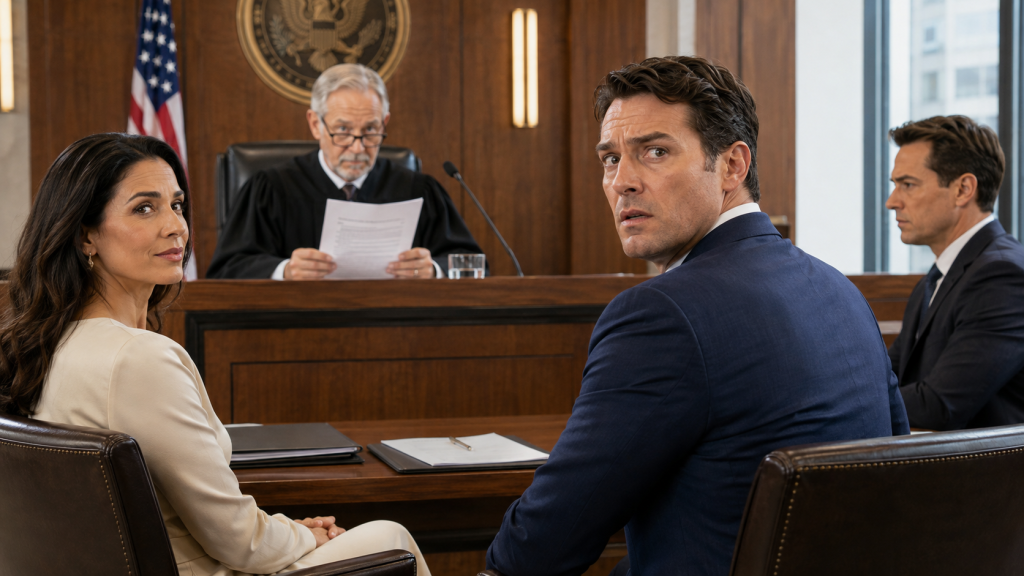
Judge Whitmore read it during a recess.
When court resumed, he carried the letter himself.
That was where everything began.
“Yes, Your Honor.”
“And that no material information has been concealed.”
“Correct.”
Judge Whitmore folded the first page neatly.
“I certainly hope that’s true.”
Grant’s confidence flickered.
Only for a second.
He quickly recovered, flashing another smug smile toward me.
“What exactly is this?” he asked. “Some conspiracy theory?”
The judge ignored him.
Instead, he turned another page.
His smile became even wider.
“Oh…”
He whispered it almost to himself.
“…she really did think this through.”
Vanessa frowned.
Grant looked toward his lawyer.
Charles suddenly wasn’t smiling anymore.
Judge Whitmore continued reading.
Then he looked directly at Grant.
“Mr. Mercer, your wife’s letter references an agreement dated June 14, approximately seventeen years ago.”
Grant shifted.
“What agreement?”
Judge Whitmore handed the page to the clerk.
A copy appeared on the courtroom monitors.
I watched Grant’s face.
Confusion.
Recognition.
Then fear.
It was the document from the BOARD—OLD folder.
The founders’ intellectual property agreement.
The one Grant himself had signed before our first investor meeting.
At the time, neither of us had money for sophisticated legal counsel.
Eleanor connected us with a small-business clinic.
The agreement was simple.
Anything developed by either founder before incorporation remained that founder’s separate intellectual property unless explicitly assigned through valid written consent.
There was more.
If any founder obtained additional ownership through fraudulent concealment, forged authorization, or material misrepresentation, the affected founder could seek restoration of the original equity position.
My original equity position?
Forty-nine percent.
Grant’s attorney stood.
“Your Honor, that document is ancient and superseded.”
Judge Whitmore looked at him.
“By what?”
Charles opened his mouth.
Nothing came out.
Maya stood.
“The later assignment agreements they intend to rely upon are the very documents our forensic expert determined were forged.”
Judge Whitmore nodded.
“I’m aware.”
Grant leaned toward Vanessa.
She whispered something.
He shook his head.
Then Judge Whitmore read the next section of my letter.
“Your Honor, I am not asking the court to reward me because my marriage failed. I am asking the court not to reward fraud simply because it remained undiscovered for many years.”
My throat tightened hearing the words aloud.
“I did not stop contributing because I lacked ability. I was removed through documents created while I was grieving. I did not knowingly surrender my ownership. I did not authorize my husband to represent me as mentally incompetent. I did not consent to the transfer of my voting rights.”
Grant stared straight ahead.
Judge Whitmore continued.
“If the court finds that I signed those documents, then I will accept the consequences. But if the court finds that I did not, then I ask that my silence not be mistaken for permission.”
That sentence changed something in the room.
I could feel it.
For years, silence had been Grant’s favorite evidence.
She didn’t object.
She didn’t complain.
She didn’t sue.
She stayed married.
She must have agreed.
But silence is not consent.
Grief is not consent.
Trust is not consent.
Love is not consent.
Judge Whitmore closed the letter.
Then he turned toward Grant.
“Do you still maintain that all material information has been disclosed?”
Vanessa whispered urgently.
Grant answered anyway.
“Yes.”
Maya stood.
“Then we would like to introduce Exhibit 214.”
Grant’s face drained.
Exhibit 214 contained a bank statement.
The account in Luxembourg.
$4.4 million.
Created eleven months before Grant filed for divorce.
Funded through three shell companies.
None disclosed.
Vanessa froze.
I genuinely believe she had never seen it.
She turned slowly toward Grant.
“You told me there were no foreign accounts.”
He whispered something.
Her expression changed.
Not anger.
Professional horror.
Judge Whitmore removed his glasses.
“Mr. Mercer.”
Grant began talking quickly.
“It’s corporate money.”
“No,” Maya said.
She held up another page.
“The transfer originated from a personal stock sale.”
Grant’s hands began shaking.
“It was reinvested.”
“In a trust.”
“It’s still investment capital.”
“A trust naming whom as beneficiary?”
Grant said nothing.
Maya answered.
“Juliette Ames.”
The courtroom exploded in whispers.
Juliette.
Investor relations.
Napa.
The woman Grant insisted was merely a colleague.
$4.4 million had been placed into a trust benefiting her.
Six months before our divorce filing.
Grant turned toward me for the first time that day.
He looked furious.
As though I had betrayed him by discovering his betrayal.
Judge Whitmore called a recess.
Vanessa requested a private conference.
When everyone returned forty minutes later, Charles was gone.
Grant had new counsel sitting beside Vanessa.
By the following morning, Charles Becker had retained his own criminal defense attorney.
The divorce hearing suddenly became much larger than divorce.
Grant’s lawyers asked for settlement negotiations.
I agreed.
Not because I was afraid.
Because I was tired.
Maya presented our terms.
Restoration of my founder equity subject to independent valuation.
Half of all marital assets.
Full repayment of funds transferred into undisclosed trusts.
Ownership of the house.
Reimbursement of legal fees.
And a formal correction to Mercer Dynamics’ corporate history naming me as cofounder and primary architect of its foundational technology.
Grant rejected everything.
“You’re trying to erase me,” he said during mediation.
I looked at him across the table.
“No.”
“You want my company.”
“Our company.”
“I built it.”
“You sold what I built.”
His face turned red.
“You couldn’t have done anything without me.”
I nodded.
“That might be true.”
He looked surprised.
I continued.
“And you couldn’t have done anything without me.”
That was the difference between us.
I could acknowledge his contribution.
He needed mine to disappear.
We returned to court.
Three weeks later, Judge Whitmore issued his ruling.
I remember almost none of the legal language.
Maya squeezed my hand while he read.
The court found substantial evidence of intentional concealment.
The court found that multiple documents bearing my signature were not authentic.
The court found that Grant had materially misrepresented my consent to corporate boards, investors, and legal representatives.
The court ordered valuation proceedings regarding my original ownership rights.
The court awarded me the marital home.
Half of remaining disclosed marital assets.
A reimbursement judgment covering millions Grant had transferred.
Attorney fees.
And something I had not asked for.
Judge Whitmore referred evidence of forgery, perjury, and financial concealment to appropriate authorities for review.
Grant stopped moving.
His face looked gray.
Then came the company.
The valuation process lasted another seven months.
Mercer Dynamics’ board initially resisted.
Then investors learned what had happened.
People who had spent years praising Grant’s leadership suddenly became extremely interested in governance.
An independent investigation began.
Two directors resigned.
Grant was placed on administrative leave.
Then permanently removed as CEO.
The company negotiated with me.
I did not receive forty-nine percent of the current corporation.
Years of dilution and legitimate financing made that impossible.
But after months of negotiation, forensic accounting, and litigation, my restored ownership and settlement interest became worth more than Grant had once offered me by a factor of nearly forty.
Forty.
The man who said I would get nothing eventually watched me leave with more financial security than I could spend in several lifetimes.
But the money was not the moment that stayed with me.
The moment came on an ordinary Tuesday.
Mercer Dynamics had scheduled a company-wide meeting.
I had not walked into headquarters since the day security escorted me out carrying that cardboard box.
This time, nobody stopped me.
Employees gathered in the auditorium.
Some were people I knew.
Most were strangers.
The interim CEO stood at the podium.
Behind him was a redesigned company history.
The first slide read:
MERCER DYNAMICS
Founded by Claire Mercer and Grant Mercer.
I stared at it.
My name.
First.
Not because I demanded it.
Because the original incorporation documents listed it that way.
The interim CEO invited me onto the stage.
I almost declined.
Then I thought about the woman who once sat alone in that laboratory writing code until sunrise.
The woman who believed brilliant work would speak for itself.
It doesn’t always.
Sometimes you have to speak for it.
I walked onto the stage.
Everyone stood.
Not everyone clapped.
I didn’t need them to.
I stepped behind the microphone.
“My name is Claire Mercer.”
My voice shook.
Then steadied.
“I wrote the first version of the software this company was built on.”
The room became quiet.
“For a long time, I believed losing credit for my work was the price of keeping peace in my marriage.”
I looked toward the screen.
“I was wrong.”
There were tears in my eyes now.
“But I also want to say something important. Mercer Dynamics became what it is because thousands of people improved what began in a small laboratory. Engineers. Designers. Researchers. Sales teams. Operations staff. Nobody builds something like this alone.”
I paused.
“That includes Grant.”
People looked surprised.
“So correcting the past does not require erasing someone else.”
I let that sentence sit.
“It only requires telling the whole truth.”
Afterward, Eleanor found me backstage.
She had flown in from Santa Fe.
The moment I saw her, I cried.
Not delicate tears.
Ugly, exhausted sobbing.
She hugged me.
“I’m sorry,” she whispered.
“For what?”
“For not fighting harder.”
I pulled away.
“You tried.”
“So did you.”
“No.”
I looked toward the auditorium doors.
“I survived.”
Eleanor smiled.
“Sometimes that’s how fighting begins.”
Grant pleaded guilty to two financial reporting offenses the following year.
The more serious forgery allegations were resolved through a negotiated case I never fully followed.
I stopped reading updates.
Charles lost his license.
Vanessa withdrew from representing Grant long before everything ended.
Once, she sent Maya a message intended for me.
Three sentences.
“I did not know. I should have looked harder. I am sorry.”
I believed her.
Juliette disappeared from Grant’s public life almost immediately after the foreign trust became public.
The money was recovered.
I sold the marital house.
People were shocked.
After everything, they assumed I would keep it.
But I did not want the kitchen where Grant taught me to doubt myself.
I did not want the bedroom where we stopped speaking honestly.
I did not want the hallway where Daniel’s nursery door had remained closed for fourteen years.
Before selling, I entered that room one final time.
It was mostly empty.
Grant had converted it into storage.
Of course he had.
Behind a stack of old boxes, I found a small wooden chest.
Inside was Daniel’s hospital bracelet.
A photograph of his tiny hand.
The knitted elephant.
I sat on the floor holding it.
For years, I thought healing meant learning not to feel pain anymore.
It doesn’t.
Healing means the pain no longer gets to decide who you become.
I bought a smaller house near the coast.
Nothing enormous.
Nothing impressive.
Three bedrooms.
Big windows.
A messy garden.
I turned one room into a research studio.
Another became a guest room.
The third remained empty for almost a year.
Then Eleanor called.
She was mentoring a nineteen-year-old engineering student named Sofia whose scholarship had fallen through.
Brilliant.
Stubborn.
No family support.
“Do you know any foundations?” Eleanor asked.
I stared at the empty bedroom.
“I know one.”
That year, I created the Daniel Mercer Foundation.
We fund young researchers who are developing technology but lack access, money, or connections.
No founder has to surrender ownership to participate.
No student signs anything without independent counsel.
Every intellectual property agreement must be explained in plain language.
That rule is non-negotiable.
Sofia became our first fellow.
Three years later, there were forty-two.
Sometimes people ask whether I regret marrying Grant.
It’s an easy question.
The answer is complicated.
I regret trusting him after he gave me reasons not to.
I regret confusing patience with loyalty.
I regret letting someone else tell me I was too fragile to understand my own life.
But if I erase the marriage entirely, I erase Daniel.
I erase Mercer Dynamics.
I erase the laboratory nights.
I erase the woman I became afterward.
So no.
I don’t wish Grant never existed.
I simply wish I had understood sooner that love does not require surrendering authorship of your own life.
The last time I saw Grant was outside a courthouse.
Almost four years after he first told me I would get nothing.
He looked different.
Thinner.
Quieter.
He walked toward me alone.
For a moment, neither of us spoke.
Then he said, “You destroyed everything.”
Once, those words would have shattered me.
I would have searched my behavior.
My choices.
My tone.
I would have wondered whether I had been cruel.
Instead, I looked at him calmly.
“No.”
He laughed bitterly.
“You took the company.”
“I didn’t.”
“The house.”
“You hid assets.”
“My reputation.”
“You lied under oath.”
His jaw tightened.
“You could have handled this privately.”
“I tried to handle our entire marriage privately.”
That silenced him.
He looked away.
Then he said something I never expected.
“I loved you.”
Maybe he believed it.
Maybe part of him had.
I nodded.
“I loved you too.”
His eyes met mine.
“Then why did you do this?”
That question explained everything.
Even after all those years, Grant believed love should have protected him from consequences.
“I didn’t do this because I stopped loving you.”
I adjusted the strap of my bag.
“I did it because I finally started believing myself.”
He stared at me.
There was nothing left to say.
I walked away.
Six months later, I received a package.
No return address.
Inside was an old photograph.
Grant and me.
Twenty-six years old.
Sitting on the laboratory floor.
Pizza box between us.
Three computer monitors glowing behind us.
I was laughing at something outside the frame.
Grant was looking at me.
On the back, someone had written:
Before we ruined it.
The handwriting was his.
I turned the photograph over again.
I studied those two young people for a long time.
Then I placed it in a drawer.
Not the trash.
Not a frame.
A drawer.
Some memories do not need to be honored or destroyed.
They can simply become history.
The next morning, I drove to the foundation office.
Sofia was waiting outside my door.
She had become our youngest research director.
“You’re late,” she said.
“Two minutes.”
“Still late.”
I smiled.
“What’s the emergency?”
She handed me a tablet.
A simulation filled the screen.
I stared.
Then looked closer.
“What did you change?”
“The prediction model.”
“You rewrote the constraint layer?”
“Most of it.”
“It shouldn’t run this quickly.”
“That’s what everyone keeps saying.”
I looked at her.
She tried not to grin.
It reminded me of myself.
Not the woman from the courtroom.
Not Grant’s wife.
Not the woman carrying a cardboard box past security guards who refused to look her in the eye.
The younger me.
The one who believed impossible problems were invitations.
I pulled a chair beside her.
“Show me.”
We spent six hours working.
At some point, Sofia ordered pizza.
At some point, the sun disappeared.
At some point, I forgot entirely about Grant.
That was when I understood the divorce had finally ended.
Not when the judge signed the order.
Not when the money transferred.
Not when Grant lost control of the company.
It ended when my life became interesting enough that I no longer measured time by what he had done to me.
That night, after Sofia left, I opened the original external hard drive one last time.
There were thousands of files.
Code.
Emails.
Research.
Photographs.
Evidence.
Seventeen years of memory preserved in metal and silicon.
I created three encrypted copies.
One went to the foundation archive.
One to my attorney.
Then I opened a folder called PERSONAL.
Inside was a document I had completely forgotten.
A note written before Mercer Dynamics existed.
The date was June 2.
Almost eighteen years earlier.
I had typed:
“If this company becomes real, I want to remember why I started. Not money. Not investors. I want to build something useful and prove that complicated ideas can become practical tools. If Grant and I ever forget that, someone should remind us.”
I read it twice.
Then laughed softly.
“Well,” I whispered to the empty room, “consider us reminded.”
I printed the note.
The next morning, I framed it.
It now hangs in the foundation lobby.
Visitors usually think it is about technology.
It isn’t.
It is about ownership.
Not ownership of shares.
Ownership of identity.
Your work.
Your voice.
Your memory.
Your right to say, “That happened to me,” even when someone more powerful insists it didn’t.
For years, Grant controlled the story because he spoke louder.
He had lawyers.
Money.
Titles.
Boards.
Investors.
I had an old hard drive.
A dead son’s hospital record.
A mentor who kept copies.
A lawyer who believed evidence mattered.
And eight pages I finally had the courage to write.
That letter did not save me.
The truth did.
The letter simply made sure the truth was finally read aloud.
Sometimes I think about Judge Whitmore turning those pages.
About the small smile crossing his face.
About Grant realizing, one paragraph at a time, that the woman he had dismissed as weak had quietly documented everything.
He once told me I would walk away with nothing.
He was wrong.
I walked away with my name.
My work.
My future.
My peace.
And, for the first time in years, my own version of the story.
That turned out to be worth far more than anything Grant ever tried to keep from me.
💬THE END! THANK YOU FOR READING!