
I stared at Emily, certain I had misunderstood her.
“What do you mean, today wasn’t the first time?”
She lay against the white hospital pillow with an IV running into her arm, her face still pale beneath the fluorescent lights.
For several seconds, she said nothing.
Her eyes drifted toward the bassinet beside her bed, where Noah had finally fallen asleep after nearly an hour of crying.
Then she looked back at me.
“Your mother has been doing things when you’re not home.”
A cold sensation moved through my chest.
“What things?”
Emily swallowed.
“I didn’t want to tell you like this.”
“Tell me.”
My voice came out softer than I expected.
Maybe because some part of me already knew.
Not the details.
But the truth.
I had spent years standing between my mother and reality, turning every complaint into an excuse before Emily had even finished explaining it.
Mom didn’t mean it that way.
She grew up differently.
She’s just blunt.
She worries about us.
Try not to take it personally.
I had said those sentences so many times they had become automatic.
Emily looked exhausted.
“She criticizes everything I do when you’re gone.”
I lowered myself into the chair beside her bed.
“Everything?”
“How I hold Noah. How often I feed him. What I eat. How clean the house is. Whether the laundry is folded quickly enough. She says I’m lazy because you hired someone to clean twice a month.”
I stared at her.
Emily gave a tired laugh that contained no humor.
“She told me mothers in her generation didn’t need help.”
“When did she say that?”
“Tuesday.”
Mom had arrived Tuesday morning to stay with us for what was supposed to be ten days.
I remembered walking into the kitchen that evening and finding Emily unusually quiet.
I had asked whether she was okay.
She had smiled and said she was tired.
And I had accepted that.
“What else?”
Emily looked away.
“Daniel.”
“What else?”
“She wakes me up.”
I frowned.
“What do you mean?”
“When Noah naps.”
Something inside me tightened.
“She waits until I fall asleep, then she finds a reason to wake me up. She’ll knock on the bedroom door because she wants coffee. Or because she can’t find a towel. Or because she thinks there’s something in the refrigerator that needs throwing away.”
I shook my head.
“That doesn’t make sense.”
“I know.”
“No. I mean… why would she do that?”
Emily finally looked directly at me.
“Because she thinks I shouldn’t be sleeping during the day.”
I remembered my mother making a comment two nights earlier.
Must be nice to nap whenever you want.
At the time, Emily had been feeding Noah at two in the morning, and again at four.
I had heard Mom say it.
I had even laughed awkwardly.
Not because it was funny.
Because I didn’t want an argument.
The memory made me feel sick.
“She told me,” Emily continued, “that if I had energy to scroll through my phone while nursing, I had energy to clean.”
I closed my eyes.
“Why didn’t you tell me?”
The question left my mouth before I could stop it.
Emily’s expression changed.
Not anger.
That would have been easier.
It was disappointment.
“I did.”
The room went silent.
I looked at her.
“When?”
“Sunday before she arrived.”
My stomach dropped.
Then I remembered.
We had been in the kitchen.
Emily had said, “I’m nervous about your mom staying here again.”
I had been reading an email while eating breakfast.
I remembered responding without even looking up.
“She’ll be fine.”
Emily had said, “Last time she made me feel like I couldn’t do anything right.”
And I had answered,
“Just ignore her.”
I rubbed both hands over my face.
“Oh God.”
“You didn’t want to hear it.”
Her voice wasn’t cruel.
That made it worse.
“I thought I was keeping the peace.”
Emily’s eyes filled.
“You were keeping peace with her.”
I lowered my hands.
“And leaving me alone with the war.”
She nodded once.
I had no defense.
No explanation worth giving.
I had failed her.
Not because I hadn’t known everything.
Because I had deliberately refused to know enough.
A nurse entered to check Emily’s blood pressure.
I stepped aside.
Her numbers had improved, but the nurse said they wanted to keep her for observation until morning.
“She needs rest,” the nurse said.
I almost laughed at the simplicity of it.
Rest.
The thing my wife had apparently been begging for while my mother treated exhaustion like a character flaw.
My phone buzzed.
Mom.
I silenced it.
It buzzed again.
Then again.
Finally a message appeared.
I cannot believe you embarrassed me in front of strangers. We need to talk privately when you calm down.
I read it twice.
When you calm down.
As if I were a child throwing a tantrum.
As if my wife hadn’t been unconscious ten feet away from her dinner plate.
I put the phone face down.
Emily watched me.
“You can answer her.”
“No.”
“Daniel—”
“No.”
I leaned forward.
“For once, she can wait.”
Emily looked surprised.
That hurt too.
The fact that basic loyalty felt unfamiliar to her.
I stayed beside Emily until nearly midnight.
My sister, Rachel, came to the hospital after I called her.
Rachel was four years younger than me and had moved to Milwaukee after college.
She and Mom had always had a complicated relationship.
I told myself that was because Rachel was stubborn.
That was another story I had accepted because it was convenient.
Rachel arrived carrying a diaper bag, two coffees, and the expression of someone who had expected this day eventually.
She hugged me first.
Then Emily.
Then she leaned over Noah and whispered, “Hey, little guy.”
After Emily fell asleep, Rachel and I went into the hallway.
I told her what had happened.
She didn’t interrupt once.
When I finished, she exhaled slowly.
“You finally saw it.”
The words irritated me.
“What’s that supposed to mean?”
Rachel raised an eyebrow.
“It means Mom has always been like this.”
“Not like this.”
“Yes, Daniel. Like this.”
I stared at her.
Rachel leaned against the wall.
“Do you remember when I lived with Mom for six months after my divorce?”
“Sure.”
“Do you remember why I moved out?”
“You two fought constantly.”
“That’s what Mom told you.”
My pulse quickened.
“What happened?”
Rachel looked down at her coffee.
“She decided my divorce proved I was irresponsible. She opened my mail. She called my attorney without permission. She told my employer I was emotionally unstable after I asked her to stop coming to my workplace.”
“What?”
“She told relatives I was drinking too much.”
“Were you?”
“No.”
I felt stupid immediately for asking.
Rachel gave me a bitter smile.
“See?”
“I’m sorry.”
“She’s good at making you question the person she’s targeting.”
I looked through the hospital room window at Emily.
Rachel followed my gaze.
“She likes control, Daniel. When she doesn’t get control, she creates a story where the other person is unreasonable.”
I thought about my childhood.
Mom deciding which friends were “good influences.”
Mom calling coaches if she thought I wasn’t getting enough playing time.
Mom choosing my college applications.
Mom criticizing every girlfriend I had until I met Emily.
At first she had liked Emily.
Or seemed to.
Emily was organized, educated, polite.
Then we got engaged.
The criticism started slowly.
Emily was too quiet.
Then too opinionated.
Too career-focused.
Then not ambitious enough after Noah was born.
No matter what Emily did, the target moved.
“Why didn’t you tell me all this?”
Rachel laughed softly.
“I did.”
That was the second time someone had said those words to me that night.
I looked at the floor.
“I guess I wasn’t listening.”
“No. You were listening to Mom.”
The truth sat between us.
I had always been the child Diane trusted most.
The responsible son.
The peacemaker.
The one who called every Sunday.
The one who helped with appointments, taxes, repairs, insurance, everything Dad had handled before he died.
Mom praised me constantly.
You’re the only one I can depend on.
I had believed that was love.
Now I wondered how much of it had been obligation disguised as affection.
Rachel touched my shoulder.
“You don’t have to hate her.”
“I don’t.”
“Good. But loving someone doesn’t mean giving them unlimited access to your life.”
I looked back through the glass.
Emily was asleep.
Noah’s bassinet stood beside her.
My family.
The family I had chosen.
And nearly lost because I was afraid of disappointing the family I had come from.
The next morning, the doctor discharged Emily with strict instructions.
Fluids.
Regular meals.
Sleep.
No unnecessary exertion until she had recovered from the infection.
I drove her home around ten.
My mother’s car was gone.
For a moment, I felt relieved.
Then we entered the house.
Her suitcase was gone too.
But the kitchen looked exactly as we had left it.
Her half-eaten dinner still sat on the table.
The plate had dried gravy around its edges.
Emily stopped when she saw it.
I put Noah’s carrier down.
“I’ll handle everything.”
She looked at me.
“Daniel, I can—”
“No.”
I caught myself.
Then softened my voice.
“You don’t have to do anything.”
I cleared the table.
Washed the dishes.
Threw away the food.
Opened the refrigerator.
That was when I noticed several containers stacked on the top shelf, each labeled in my mother’s handwriting.
Diane’s lunch.
Diane’s soup.
Do not use.
I stared at them.
Then at the mostly empty section where Emily usually kept prepared meals for herself.
“Did Mom bring all this?”
Emily, sitting at the kitchen island, nodded.
“For herself.”
“She didn’t share?”
“She said she bought it with her own money.”
I closed the refrigerator.
“And yesterday she made you cook?”
Emily looked uncomfortable.
“Daniel, please don’t work yourself up again.”
“I’m not.”
But I was.
Not explosively.
The anger had changed overnight.
It was no longer fire.
It was something colder.
More focused.
I understood now why people said clarity could hurt.
Because once you recognized a pattern, you started seeing it everywhere.
Mom called twenty minutes later.
I answered.
“Daniel.”
Her voice was clipped.
“Mom.”
“I assume you’ve calmed down.”
“No.”
A pause.
“Well, I’m at your Aunt Linda’s. I had to explain why my own son threw me out of his house in the middle of dinner.”
“You weren’t thrown into the street. You have a car, money, family nearby, and several hotels within five miles.”
“That’s not the point.”
“No, the point is Emily collapsed and you did nothing.”
“She fainted.”
“She was unconscious.”
“For attention.”
I looked toward Emily.
She couldn’t hear Mom from across the room, but I lowered my voice anyway.
“You’re not going to say that again.”
Mom laughed sharply.
“I know women like her.”
“What does that mean?”
“She’s manipulating you.”
“How?”
“By making herself helpless.”
“She had dangerously low blood pressure and needed IV fluids.”
“That doesn’t mean—”
“Stop.”
Silence.
I had never interrupted my mother like that.
“Here is what happens now,” I said. “You’re not coming back to our house.”
“What?”
“Not until Emily wants you here.”
“That is my son’s home.”
“It is Emily’s home too.”
“I’m your mother.”
“And she’s my wife.”
“You’ve known me fifty-eight years.”
“I’m thirty-six.”
The silence stretched.
Then Mom said, “You know what I mean.”
Actually, I did.
She meant history gave her seniority.
She believed because she had been first, she should always be first.
Marriage was supposed to change that.
Parenthood certainly had.
But perhaps I had never made the transition clear.
Until now.
“You need to apologize to Emily.”
“For what?”
I nearly laughed.
“For forcing a sick woman to prepare your dinner, ignoring her after she collapsed, calling her dramatic while she was unconscious, and everything else you’ve been doing when I’m not home.”
Mom went quiet.
That silence told me something.
I had not given details.
Yet she understood exactly what “everything else” meant.
“She’s exaggerating.”
“So something happened.”
“I didn’t say that.”
“You didn’t have to.”
Her breathing changed.
“Daniel, listen to me. Emily is trying to turn you against your family.”
“No. I’m finally listening to my wife.”
“Because she’s poisoned you.”
“Goodbye, Mom.”
“Daniel—”
I ended the call.
My hands were shaking.
Emily had tears in her eyes.
I walked over.
“What?”
She shook her head.
“You’ve never hung up on her.”
“I’ve never needed to.”
Emily looked down.
“I don’t want you to lose your mother because of me.”
“I’m not losing her because of you.”
I crouched beside her chair.
“If I lose a relationship with Mom, it will be because of choices she makes after today.”
Emily stared at me for several seconds.
Then she whispered, “Thank you.”
Those two words almost broke me.
A husband shouldn’t need gratitude for protecting his own home.
Over the next three days, the story spread through my extended family.
Aunt Linda called.
Then Uncle Mark.
Then my cousin Stephanie.
Mom had apparently told everyone I had “evicted” her because Emily resented her relationship with Noah.
According to Mom’s version, Emily had experienced “a minor dizzy spell,” panicked, and blamed Diane.
I had expected manipulation.
I hadn’t expected speed.
At first I tried explaining.
Then I realized something.
Anyone who called already convinced Mom was the victim wasn’t looking for information.
They were recruiting me back into my old role.
Fix this.
Calm her down.
Apologize so everyone can stop feeling uncomfortable.
I refused.
When Aunt Linda said, “She’s still your mother,” I replied, “Yes, which is why I hope she chooses to take responsibility.”
When Uncle Mark said, “You only get one mother,” I said, “And Noah only gets one mother too.”
He had nothing to say to that.
Emily recovered slowly.
For the first time since Noah had been born, I rearranged my work schedule completely.
I had always considered myself involved.
I changed diapers.
Made bottles.
Handled bedtime on weekends.
I had thought that made me an exceptionally supportive husband.
Then I spent five consecutive days doing what Emily did every day.
The constant interruption.
The crying when you were halfway through eating.
The laundry multiplying mysteriously.
The bottles.
The sterilizing.
The appointments.
The grocery lists.
The mental calculations about nap windows and feeding times.
The inability to finish a single task without another beginning.
By Thursday evening, I was exhausted.
And I had slept seven uninterrupted hours the night before.
Emily noticed me staring blankly into the refrigerator.
“Welcome to the glamorous life,” she said.
I laughed.
Then turned serious.
“I really didn’t understand.”
“No.”
“I thought I did.”
“I know.”
“I’m sorry.”
She leaned against the counter.
“You’ve apologized a lot this week.”
“I have years to cover.”
Emily smiled faintly.
Something between us had changed.
Not fully repaired.
Trust wasn’t a switch.
I had learned that too.
One good decision did not erase dozens of smaller betrayals.
But for the first time, I wasn’t trying to rush her forgiveness.
I wanted to become someone who deserved it.
The following Saturday, Mom appeared at our front door.
Without calling.
I saw her through the camera.
She held two shopping bags and wore the expression she used whenever she expected the world to return to normal.
Emily was upstairs feeding Noah.
I stepped outside and closed the door behind me.
Mom blinked.
“You’re not going to invite me in?”
“No.”
Her expression tightened.
“I brought food.”
“That’s thoughtful.”
She held up one bag.
“I made your favorite casserole.”
“Thank you.”
I took it.
She didn’t release the handle.
“Daniel.”
“Mom.”
“This has gone far enough.”
I gently pulled the bag free.
“What has?”
“This ridiculous punishment.”
“It isn’t punishment.”
“What else would you call banning your mother from your home?”
“A boundary.”
She stared at me as if I had used profanity.
“I’m not some stranger.”
“Boundaries aren’t only for strangers.”
“I drove forty minutes.”
“You should have called.”
She glanced toward the house.
“Is Emily there?”
“Yes.”
“I want to talk to her.”
“Does she want to talk to you?”
Mom scoffed.
“She’s your wife. Tell her to come down.”
There it was.
So automatic Mom didn’t even hear herself.
Tell her.
As if Emily were an employee.
“No.”
Mom’s face changed.
“Excuse me?”
“I don’t order my wife around.”
“You’re being theatrical.”
That word.
The family specialty.
Any emotion Diane disliked became drama.
Any resistance became disrespect.
Any boundary became cruelty.
“I’ll tell Emily you stopped by.”
Mom folded her arms.
“I’m not leaving until I see my grandson.”
“You’re not seeing Noah today.”
She went still.
Then her face reddened.
“You cannot keep my grandson from me.”
“He is my son.”
“He is my family.”
“Yes.”
I kept my voice calm.
“And being family doesn’t give anyone automatic permission to enter our home.”
“You’ve changed.”
I nodded.
“I hope so.”
She looked almost wounded.
That hurt.
Of course it did.
She was my mother.
I remembered her sitting beside my hospital bed when I had my appendix removed at eleven.
Her cheering at basketball games.
Her making birthday cakes.
Her crying when I left for college.
People are complicated.
Cruelty does not erase every loving memory.
Love does not excuse cruelty.
Both can be true.
Mom’s eyes filled.
“Your father would be ashamed of you.”
That one landed.
Dad had died five years earlier.
He had been quiet, patient, endlessly accommodating of Mom.
For years I had admired that.
Now I wondered whether he had simply learned survival.
I breathed slowly.
“Dad taught me to take care of my family.”
“I am your family!”
“Yes.”
I looked toward the door behind me.
“So are they.”
Mom wiped beneath one eye.
“She’s won.”
“This isn’t a competition.”
“It became one when she made you choose.”
“She never asked me to choose.”
“Of course she did!”
“No, Mom.”
My voice rose for the first time.
“You did.”
She stared at me.
“Every time you insulted her and expected me to laugh. Every time you criticized her and expected me to defend you. Every time you treated our home like you outranked her. Every time you made me choose silence over standing up for my wife, you were forcing a choice.”
Mom opened her mouth.
I continued.
“And I kept choosing you.”
Her expression shifted.
Not triumph.
Confusion.
“Until last week.”
I shook my head.
“That was wrong.”
She stared at me for a long moment.
Then picked up her second shopping bag.
“I don’t know who you are anymore.”
“I’m your son.”
“No.”
Her voice became cold.
“My son would never speak to me like this.”
I felt the old instinct immediately.
Apologize.
Repair.
Make her comfortable.
It rose inside me like muscle memory.
For once, I let it pass.
“I’m sorry you feel that way.”
She turned and walked to her car.
I watched until she drove away.
When I went inside, Emily stood near the stairs.
She had heard.
“I wasn’t spying,” she said. “The baby monitor app alerted me when the doorbell rang.”
“It’s okay.”
She looked worried.
“Are you?”
I considered lying.
Then stopped.
“No.”
Emily came closer.
“I’m sad.”
She nodded.
“I’m angry.”
She touched my arm.
“And I still love her.”
“I know.”
I looked at her.
“But none of that means I should let her hurt you.”
Emily wrapped her arms around me.
I held her tightly.
Not because the problem was over.
Because for the first time, we were facing it from the same side.
Two weeks passed.
Then Rachel called.
“Mom went to the emergency room.”
My heart jumped.
“What happened?”
“Chest pain.”
I stood immediately.
“Is she okay?”
“Doctors think it was a panic attack, but they’re running tests.”
“I’m coming.”
I told Emily.
She didn’t hesitate.
“Go.”
The hospital was the same one where Emily had been treated.
That detail felt almost unreal.
I found Mom in a private room.
Aunt Linda sat beside her.
When I entered, Mom looked surprised.
Then relieved.
For half a second, she was simply my mother again.
“Daniel.”
I walked to her bedside.
“How are you?”
“They say my heart is fine.”
“That’s good.”
Aunt Linda gave me a pointed look.
“She’s been under enormous stress.”
Mom looked down.
I knew what Linda wanted.
An apology.
A surrender.
I didn’t give one.
After a while, Aunt Linda went downstairs for coffee.
Mom and I were alone.
She picked at the edge of her blanket.
“I thought you wouldn’t come.”
“I’m still your son.”
“You don’t act like it.”
I sat down.
“Mom, caring about you and agreeing with you are different things.”
She looked toward the window.
“Emily hates me.”
“She doesn’t.”
“She must.”
“She’s afraid of you.”
Mom turned sharply.
“Afraid?”
“Yes.”
“I’ve never laid a hand on her.”
“Fear isn’t only physical.”
Mom looked offended.
I continued carefully.
“She never knows when you’re going to criticize her. She never knows whether something she says will become a family story later. She feels watched in her own house when you’re there.”
Mom shook her head.
“That’s ridiculous.”
“Do you want to understand, or do you want to win?”
The question silenced her.
For nearly a minute, neither of us spoke.
Then she said something I didn’t expect.
“Your grandmother did worse to me.”
I frowned.
“My grandmother?”
“Your father’s mother.”
I had barely known her.
She died when I was nine.
Mom stared at her hands.
“She inspected my kitchen cupboards.”
“What?”
“She would come into our first apartment and open cabinets to see whether I kept things organized.”
I said nothing.
“She criticized my weight after you were born. Told me your father deserved a wife who looked presentable.”
Mom laughed bitterly.
“When Rachel was a baby, she told me I was spoiling her by holding her whenever she cried.”
I watched her.
“Did Dad defend you?”
Mom’s mouth tightened.
“Sometimes.”
“And when he didn’t?”
“I hated him for it.”
The words hung between us.
I didn’t need to point out the obvious.
Mom saw it herself.
Her face changed.
Only slightly.
But enough.
“I’m not like her,” she whispered.
“I hope not.”
“She was cruel.”
“So were you.”
Mom looked at me.
I had expected outrage.
Instead, she looked tired.
“What if I thought I was helping?”
“Then you need to learn that helping someone they didn’t ask you to control isn’t help.”
She stared at her blanket.
“I thought Emily was weak.”
“Why?”
“She complains about being tired.”
“She had a baby.”
“So did I.”
“And apparently you needed support you didn’t get.”
Mom looked at me sharply.
I leaned forward.
“Maybe instead of making Emily suffer because you suffered, you could decide she shouldn’t have to.”
Her eyes filled.
For the first time since this started, she didn’t wipe the tears away.
“I don’t know how to talk to her now.”
“Start with the truth.”
“I don’t know what that means.”
“It means no excuses.”
Mom swallowed.
“No ‘I’m sorry you were offended.’ No ‘I only wanted to help.’ No blaming her for being sensitive.”
Mom looked irritated at that.
I almost smiled.
“Those are apologies.”
“No, they’re explanations designed to make the other person responsible for forgiving you.”
She frowned.
“When did you become a therapist?”
“I married someone smarter than me.”
To my surprise, Mom laughed.
It was small.
Almost unwilling.
Then she grew serious again.
“Will she let me see Noah?”
“I don’t know.”
“You don’t know?”
“That’s something we decide together.”
Mom winced slightly.
There was the problem in one sentence.
She wanted access through me.
I was no longer willing to grant it alone.
“Would you ask her?”
“I’ll tell her we spoke.”
“That’s all?”
“For now.”
Mom nodded.
It wasn’t acceptance.
But it wasn’t a fight either.
Three days later, Emily received a letter.
Not a text.
Not a phone call.
A handwritten letter.
She read it alone.
Then gave it to me.
I hesitated.
“She said I could show you.”
Mom’s handwriting covered three pages.
The letter wasn’t perfect.
She admitted she had judged Emily.
She admitted waking her from naps deliberately.
She admitted making comments about breastfeeding, housework, Emily’s career, and her weight after pregnancy.
Then came the sentence that mattered most.
I believed being a good mother meant enduring what I endured, and I punished you for receiving the support I wish someone had given me.
I read it twice.
Another sentence followed.
That was unfair, and it was cruel.
No excuses.
No “but.”
At the end, Mom wrote that she understood if Emily did not want contact.
She asked permission to apologize face-to-face whenever Emily felt ready.
“What do you think?” I asked.
Emily folded the letter.
“I think she means it today.”
The wording caught my attention.
“Today?”
“People can mean an apology and still fall back into old behavior tomorrow.”
That was true.
“So what do you want?”
Emily looked at Noah playing on a blanket.
“I want to try.”
“You sure?”
“For Noah.”
I shook my head.
“No.”
Emily looked at me.
“Not for Noah.”
I sat beside her.
“If you try, it should be because you want to. Noah doesn’t need a grandmother badly enough that you have to sacrifice your peace.”
Emily smiled softly.
“You really have changed.”
“I’m working on it.”
She thought for a moment.
“Then I want to try for me.”
We invited Mom to a coffee shop the following Saturday.
Neutral ground.
Rachel joined us.
That had been Emily’s idea.
Mom arrived ten minutes early.
She looked nervous.
I had rarely seen Diane nervous in my life.
Emily sat across from her.
For a moment, nobody spoke.
Then Mom said,
“I’m sorry.”
Emily nodded.
Mom continued.
“What I did last month was wrong. But I know this wasn’t only about that day.”
Emily’s eyes stayed fixed on her.
“I’ve treated you like you had to prove you deserved Daniel.”
I looked down.
“And that was never my decision to make.”
Mom’s voice trembled.
“I was jealous.”
That surprised all of us.
Even Rachel looked up.
Emily frowned.
“Of me?”
“Yes.”
Mom gave an embarrassed laugh.
“Not romantically, obviously.”
Despite everything, Emily smiled.
Mom continued.
“When Daniel married you, he called me less. Then after Noah was born, everything changed again. I knew that was normal, but emotionally…”
She struggled for the words.
“I felt replaced.”
Emily’s expression softened slightly.
Mom shook her head.
“And instead of admitting I was lonely and scared, I treated you like you had stolen something from me.”
I felt tears prick my eyes.
Mom looked at me.
“I raised you to become independent. Then punished you for actually doing it.”
Rachel snorted.
“Mom, that might be the most self-aware thing you’ve ever said.”
“Rachel.”
“What? It’s true.”
Mom almost snapped back.
I saw the reaction form.
Then she stopped.
Another small change.
Emily folded her hands.
“I can forgive you.”
Mom’s eyes filled.
“But I can’t go back to pretending everything is fine.”
“I understand.”
“There will be rules.”
Mom nodded.
“You don’t come over without calling.”
“All right.”
“You don’t criticize how I parent Noah unless there is an actual safety issue.”
Mom hesitated.
Rachel coughed loudly.
Mom glared at her.
Then nodded.
“All right.”
“You don’t discuss private things about me with the family.”
“I can do that.”
“And if I say I’m tired, sick, overwhelmed, or need space, you believe me.”
Mom looked down.
“That one should have been obvious.”
“Yes.”
Emily’s voice remained calm.
“It should have.”
Mom nodded.
“I’m sorry.”
I watched the two women.
For years, I had believed peace meant preventing conversations like this.
Now I understood real peace required them.
Avoiding conflict had not protected anyone.
It had simply protected the person creating the conflict.
The first visit happened two weeks later.
Mom stayed for ninety minutes.
She brought lunch.
For everyone.
When Noah started fussing, Mom reached toward him, then stopped.
“May I?”
Emily smiled.
“Of course.”
It was such a tiny question.
May I?
Yet it represented everything that had been missing.
Permission.
Respect.
Recognition that being a grandmother did not make Noah hers.
Mom held him while Emily ate an entire meal while it was still warm.
At one point, she noticed laundry sitting in a basket.
I saw her eyes linger.
The old Diane would have said something.
Instead she asked,
“Would it help if I folded that?”
Emily looked surprised.
“Yes, actually.”
Mom folded baby clothes while Emily rested upstairs for half an hour.
She didn’t wake her.
She didn’t complain.
She didn’t announce later how much she had done.
She simply helped.
That didn’t erase the past.
But change isn’t erasure.
It is evidence.
Months passed.
There were setbacks.
Of course there were.
One Sunday, Mom criticized the baby food Emily bought.
Emily immediately said, “Diane.”
Mom stopped.
Her mouth tightened.
Then she exhaled.
“You’re right. None of my business.”
Another time, Mom told Aunt Linda something about Noah’s sleep routine that Emily had asked her to keep private.
We suspended visits for two weeks.
Mom was furious at first.
Then she called and apologized.
Not perfectly.
But honestly.
Boundaries worked because we enforced them.
Not because everyone liked them.
The biggest change, however, happened between Emily and me.
One night after Noah finally fell asleep, we sat together on the sofa where she had collapsed months earlier.
For a long time, that sofa had bothered me.
I considered replacing it.
Emily refused.
“It’s furniture,” she said.
But I knew it was more than that.
The room held a memory.
Not only of her collapse.
Of my awakening.
I turned toward her.
“Can I ask something?”
“Sure.”
“Why did you stay?”
Emily looked confused.
“With you?”
“Yes.”
She thought for a while.
“Because you weren’t cruel.”
I winced.
“That’s a low standard.”
“I’m not finished.”
I smiled.
“Sorry.”
“You were kind. You were loving. You were a good father.”
She paused.
“But you were weak around your mother.”
I nodded.
“And weakness can hurt people too.”
That sentence stayed with me.
We often imagine betrayal as something dramatic.
An affair.
A lie.
A secret account.
But sometimes betrayal is silence.
Sometimes it is laughing when you should speak.
Sometimes it is saying, “That’s just how she is,” because confronting someone feels inconvenient.
Sometimes good people hurt the people they love because they’re more afraid of conflict than consequences.
“I should have protected you sooner.”
“Yes.”
Emily didn’t soften it.
I was grateful.
Then she took my hand.
“But you did eventually.”
“I almost waited too long.”
“You did.”
Again, no rescue.
No easy absolution.
Then she rested her head against my shoulder.
“But you didn’t wait forever.”
A year after that terrible afternoon, we celebrated Noah’s first birthday.
Nothing extravagant.
Just family and close friends in our backyard.
Balloons.
Cupcakes.
A little blue cake Noah destroyed enthusiastically with both hands.
Rachel drove down from Milwaukee.
Aunt Linda came.
A few neighbors stopped by.
And Mom came too.
She arrived early.
But only because Emily had invited her early.
She helped arrange food.
When Emily said she wanted the cake table moved closer to the patio, Mom started to say something.
Stopped.
Moved it.
I noticed.
So did Emily.
Later that afternoon, I stood near the grill watching Mom sit on the grass beside Noah.
He was trying to stack wooden blocks.
Mom handed one to him.
He knocked everything over and laughed.
Mom laughed too.
Emily came beside me.
“She’s good with him.”
“She is.”
Emily leaned against my shoulder.
“I’m glad we didn’t have to cut her off forever.”
“Me too.”
Then I added,
“But I’m glad we were willing to.”
Emily looked at me.
I meant it.
Because the willingness mattered.
Mom had changed partly because for the first time, she understood our boundaries were real.
Love was available.
Access was conditional.
Respect was required.
That evening, after everyone left, I found something on the dining table.
A small envelope.
My name was written on the front.
Inside was a note from Mom.
Daniel,
I spent most of your life believing being needed meant being loved.
When you grew up, I tried to keep you needing me.
When you stopped, I blamed Emily.
I understand now that raising you well was supposed to mean you would build a life that did not revolve around me.
I am proud of the husband and father you have become.
Even if it took me too long to accept that becoming that man meant learning to say no to me.
Dad would be proud too.
Love,
Mom.
I sat down at the table.
For several minutes, I couldn’t move.
Emily came downstairs carrying a sleepy Noah.
She saw my face.
“What happened?”
I handed her the note.
She read it.
Then placed it beside me.
“That’s nice.”
I laughed through tears.
“Nice?”
“Very nice.”
She kissed my forehead.
I lifted Noah from her arms.
He immediately grabbed my nose.
I looked around the room.
At the high chair.
The scattered toys.
The bottle drying beside the sink.
At my wife.
At my son.
I thought about the afternoon that had changed everything.
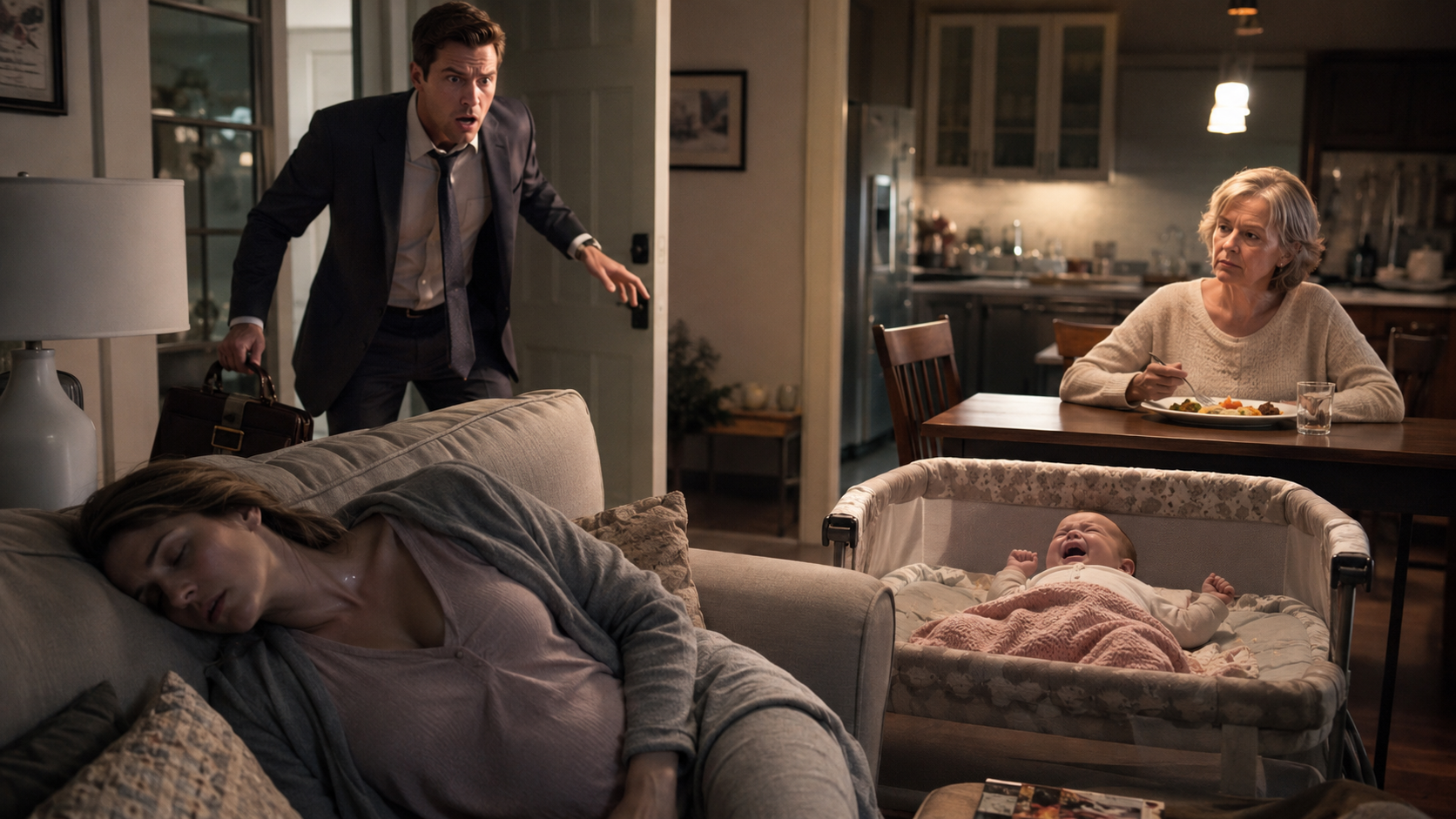
I remembered opening the front door and hearing Noah scream.
Emily unconscious.
My mother eating dinner.
Drama queen.
For a long time, I wished that day had never happened.
Now I understood something uncomfortable.
Sometimes the moment that breaks a family pattern looks terrible while you are living through it.
Had I not come home early, maybe Emily would have awakened eventually.
Maybe Mom would have convinced us it was nothing.
Maybe I would have laughed awkwardly again.
Maybe Emily would have stopped telling me how she felt.
Maybe she would have quietly lost trust in me until one day there was nothing left to repair.
Instead, I saw everything at once.
Cruelty.
Entitlement.
My own cowardice.
And the cost of pretending not to see.
I had spent most of my life believing being a good son meant never disappointing my mother.
I know better now.
Being a good son does not require being a bad husband.
Respecting your parents does not mean surrendering your marriage.
Keeping peace does not mean forcing the quietest person in the room to absorb everyone else’s cruelty.
And family does not mean unlimited access without accountability.
A week after Noah’s birthday, Mom called.
“Can I ask you something?”
“Sure.”
“Would Emily mind if I came over Thursday afternoon?”
I smiled.
“You’re asking me if you can ask her?”
Mom sighed.
“I’m learning.”
“I know.”
“I thought maybe I could watch Noah for an hour while she naps.”
My chest tightened unexpectedly.
“That would probably mean a lot to her.”
“Will you ask?”
“No.”
Mom paused.
Then laughed.
“Right. I should ask her.”
“Exactly.”
She texted Emily herself.
Emily said yes.
Thursday afternoon, I checked our doorbell camera from work.
Mom arrived carrying soup.
She rang the bell.
She waited.
Emily opened the door.
Mom held up the container.
I couldn’t hear everything through the camera, but I caught enough.
“I brought enough for both of us.”
Emily smiled.
“Come in.”
That evening, I got home and found Noah asleep upstairs.
Emily sat on the sofa reading.
Mom stood in the kitchen washing two bowls.
I stopped in the doorway.
For half a second, the scene looked almost identical to the day everything went wrong.
Same house.
Same dining table.
Same sofa.
Same three people.
But everything important was different.
Emily was resting because she wanted to.
Noah was sleeping peacefully.
Mom was washing the dishes after bringing someone else dinner.
She looked over.
“You’re home early.”
I smiled.
“Apparently I have a habit of doing that.”
Emily laughed.
Mom didn’t understand.
That was fine.
Some memories belong to the people who survived them.
I walked over and kissed Emily.
Then I kissed Noah’s head when I went upstairs.
Later, after Mom left, Emily and I stood together in the kitchen.
“You know something?” she said.
“What?”
“The first time your mother visited after Noah was born, I used to listen for your car.”
I frowned.
“Why?”
“Because when I heard you pull into the driveway, I knew I could breathe again.”
The words hurt.
Emily saw my expression.
“That was then.”
She took my hand.
“Now I can breathe whether you’re here or not.”
I understood what she meant.
Not because Mom had disappeared.
Because Emily finally knew the home belonged to her too.
Her voice mattered.
Her boundaries mattered.
She did not need me to translate her pain into something acceptable before it counted.
I squeezed her hand.
“I love you.”
“I love you too.”
“And if my mother ever makes you cook while sick again—”
Emily laughed.
“She won’t.”
“You seem confident.”
“She asked me today whether she could make tea in my kitchen.”
I laughed.
“Seriously?”
“Seriously.”
“That might be excessive.”
“Nope.”
Emily smiled.
“I’m enjoying it.”
Fair enough.
The following Christmas was the first holiday in years that didn’t leave Emily exhausted.
Mom asked what she could bring.
Rachel chose dessert.
I cooked the main meal.
Emily did absolutely nothing until she decided she wanted to make cranberry sauce.
At dinner, Noah threw mashed potatoes onto Mom’s sweater.
Everyone froze.
Then Mom looked down at the stain.
Noah stared at her.
His lower lip trembled.
Mom burst out laughing.
“Well,” she said, “apparently someone has an opinion about my outfit.”
The table laughed.
Emily laughed too.
And I realized I had not felt anxious once all evening.
No watching expressions.
No preparing excuses.
No anticipating the next insult.
Just dinner.
What I had once called peace had really been tension managed through silence.
This was peace.
Not perfection.
Not obedience.
Safety.
After dessert, Mom came into the kitchen while I loaded the dishwasher.
“Can I tell you something?”
“Sure.”
“I was angry with you for months.”
“I know.”
“I thought you humiliated me.”
“I know.”
She leaned against the counter.
“Then one day I realized I was more upset about being embarrassed than I had been about Emily being unconscious.”
I stopped loading the dishwasher.
Mom looked ashamed.
“That scared me.”
I said nothing.
She continued.
“I don’t want to be someone who cares more about being right than whether another person is safe.”
I nodded slowly.
“Then don’t be.”
Mom smiled sadly.
“You make everything sound simple.”
“It isn’t.”
“No.”
She looked toward the living room, where Emily was helping Noah tear wrapping paper from a toy.
“But sometimes the choice is.”
“Yes.”
Mom hugged me.
Not tightly.
Not desperately.
Just a hug.
“I love you.”
“I love you too.”
When she stepped back, she said something I never thought I would hear.
“And you don’t have to agree with me.”
I laughed.
“Who are you, and what did you do with Diane?”
She swatted my shoulder.
“Don’t push it.”
Some things never change completely.
Maybe they shouldn’t.
That night, after everyone had gone home and Noah was asleep, Emily and I sat beside the Christmas tree.
The lights reflected in the dark windows.
She handed me a mug of cocoa.
“Do you regret it?”
“What?”
“Throwing your mom out that day.”
I thought about it.
“No.”
“Not even a little?”
“I regret that it had to happen.”
I took a sip.
“But I don’t regret doing it.”
Emily nodded.
“I used to think setting a boundary meant you didn’t love someone.”
“So did I.”
“Now?”
“Now I think sometimes it’s the only chance love has to survive.”
Emily rested her head on my shoulder.
Outside, snow started falling.
Inside, the house was quiet.
Not the dangerous kind of quiet.
Not silence maintained through fear.
The peaceful kind.
The kind that happens when everyone inside knows they are safe.
I thought about the version of myself who had walked through that door more than a year earlier.
The man who thought being neutral made him good.
The husband who heard his wife’s complaints but never really listened.
The son who believed his mother’s feelings were his responsibility.
That man had disappeared the moment I saw Emily unconscious on the sofa and heard my mother call her a drama queen.
I wish I could say I became better instantly.
I didn’t.
I became aware instantly.
Becoming better took longer.
It took difficult conversations.
Apologies.
Boundaries.
Consequences.
Listening.
It took learning that guilt does not always mean you are doing something wrong.
Sometimes guilt is simply what you feel when you stop doing what someone else expects.
It took understanding that forgiveness and access are not the same thing.
That apologies matter, but changed behavior matters more.
That marriage requires courage, not just love.
Most of all, it took realizing that the family you build deserves protection from the unhealthy patterns of the family you came from.
The next morning, Noah woke before sunrise.
I heard him babbling through the monitor.
Emily groaned beside me.
“My turn,” I whispered.
She opened one eye.
“You sure?”
“Go back to sleep.”
I went into Noah’s room.
He stood inside his crib holding the rail, hair sticking in every direction.
“Dada!”
I smiled.
“Hey, buddy.”
I lifted him.
He rested his warm cheek against my shoulder.
We walked downstairs together.
The remnants of Christmas were everywhere.
Wrapping paper.
Half-empty cups.
A toy truck beneath the coffee table.
I sat on the sofa with Noah in my arms.
The same sofa.
He curled against me.
Morning light slowly filled the room.
For a second, I could almost see the old scene layered underneath the new one.
Emily pale and unconscious.
Noah screaming.
Mom eating alone.
Me standing in the doorway.
Angry.
Confused.
Finally awake.
I kissed my son’s hair.
One day, when Noah was older, perhaps I would tell him some version of the story.
Not the ugly details.
Not to make him angry with his grandmother.
But because I wanted him to learn earlier what took me thirty-six years to understand.
Love without respect becomes control.
Peace without honesty becomes silence.
Loyalty without boundaries becomes permission.
And sometimes the most loving word you can say to someone is no.
No, you may not treat my wife that way.
No, you may not disrespect our home.
No, history does not entitle you to harm the people I love.
No, being my mother does not place you above accountability.
And sometimes that no creates space for a better yes.
Yes, you may return when you can respect us.
Yes, you can rebuild trust.
Yes, people can change.
Yes, families can heal.
But only after someone finally decides the old way ends here.
Noah stirred against me.
From upstairs, I heard Emily moving.
A few minutes later, she appeared wearing one of my old college sweatshirts.
She stopped at the bottom of the stairs.
“Coffee?”
“Please.”
She walked into the kitchen.
I watched her.
Healthy.
Safe.
Home.
And I knew with absolute certainty that if I could go back to that terrible afternoon and stand beside the version of myself opening the front door, I would tell him one thing.
Don’t look away.
Because what you tolerate teaches people how far they can go.
What you excuse becomes normal.
And the moment you finally protect the person who trusted you to stand beside them may be the moment your entire family gets a chance to become better.
Emily returned with two mugs.
She sat beside me.
Noah reached for her.
She took him into her arms.
I looked at the two people who had changed my life simply by needing me to become braver than I had been.
“You okay?” Emily asked.
I smiled.
“Yeah.”
She studied me suspiciously.
“What?”
“Nothing.”
“You’re doing that sentimental face again.”
“I don’t have a sentimental face.”
“You absolutely do.”
Noah laughed as if agreeing with her.
“Traitor,” I told him.
Emily leaned against me.
The three of us sat there as morning filled the house.
No shouting.
No fear.
No walking on eggshells.
Just us.
And for the first time in a very long time, nobody in my home had to earn the right to feel safe there.
That was when I understood what I had actually done the day I carried my mother’s suitcase downstairs.
I hadn’t chosen my wife over my mother.
I had chosen respect over entitlement.
Accountability over excuses.
Courage over avoidance.
And by doing that, I hadn’t destroyed my family.
I had finally given it a chance to heal.
💬THE END! THANK YOU FOR READING!