

One year after my divorce, my ex-husband cornered me beneath the cold white lights of St. Catherine’s Hospital and announced that my body had been the failure in our marriage.
He had no idea the man walking toward us carried proof that could destroy the life he had built on that lie.
Ethan leaned against the maternity-wing wall, expensive watch gleaming beneath the fluorescent lights, his smile as sharp as broken glass.
Beside him stood Madison—my former best friend—holding a sleepy one-year-old boy and wearing the pearl earrings she had once admired in my jewelry box before she helped ruin my marriage.
“Leaving you was the best decision I ever made,” Ethan said loudly enough for two passing nurses to hear.
He looked me up and down like he was inspecting something defective.
“A useless woman can’t have children. I’m lucky Madison gave me a son.”
Madison lowered her eyes, pretending embarrassment, but I saw the satisfaction hiding at the corners of her mouth.
The same expression she used to wear whenever she beat me at something trivial.
A promotion.
A dress on sale.
A reservation at a restaurant we both wanted to try.
Except this time, she believed she had won my entire life.
A year earlier, Ethan had served me divorce papers three days after what I thought had been my final failed fertility treatment.
He told everyone I had become bitter.
Unstable.
Obsessed.
Madison supported every word.
She told mutual friends that I had pushed Ethan away.
She told my mother that I had become impossible to live with.
She even sat beside me on my sofa two weeks before the divorce, held my hand, and whispered that sometimes marriages simply couldn’t survive the pressure of infertility.
By then, she was already sleeping with my husband.
After the divorce, Ethan kept the house.
He kept most of our mutual friends.
He kept the polished social image we had built together.
And through a series of legal maneuvers I had been too exhausted to fight properly, he even managed to take control of the charity foundation I had created six years earlier.
For months, I woke in a rented apartment above a bakery with my hands pressed against an empty stomach.
Every morning at four-thirty, the scent of cinnamon and fresh bread rose through the floorboards.
For a while, I hated it.
The smell reminded me that the world kept creating things while I believed my own body could not.
But grief does strange things when you live with it long enough.
Eventually, the bakery became comforting.
The owner, Mrs. Delgado, started leaving a coffee and croissant outside my door every Sunday.
She never asked why I cried sometimes when I came downstairs.
She simply said, “Eat something, sweetheart.”
During those months, I studied medical reports until the words blurred together.
Hormone levels.
Ultrasounds.
Follicle counts.
Blood tests.
Medication schedules.
I learned terminology I had once trusted doctors to explain to me.
I discovered inconsistencies.
Dates that didn’t match.
Pages missing from records.
Results that had been summarized but never attached.
I requested copies from every clinic we had visited.
Most sent them.
One didn’t.
That clinic had closed abruptly eight months after my divorce.
Its former medical director had relocated.
Its records had supposedly been transferred to St. Catherine’s.
That was how I met Dr. Adrian Vale.
They believed I had disappeared because I was broken.
In reality, I had disappeared because I was investigating.
So when Ethan mocked me in that hospital corridor, I simply smiled.
“Really?”
He laughed.
“Still pretending you know something?”
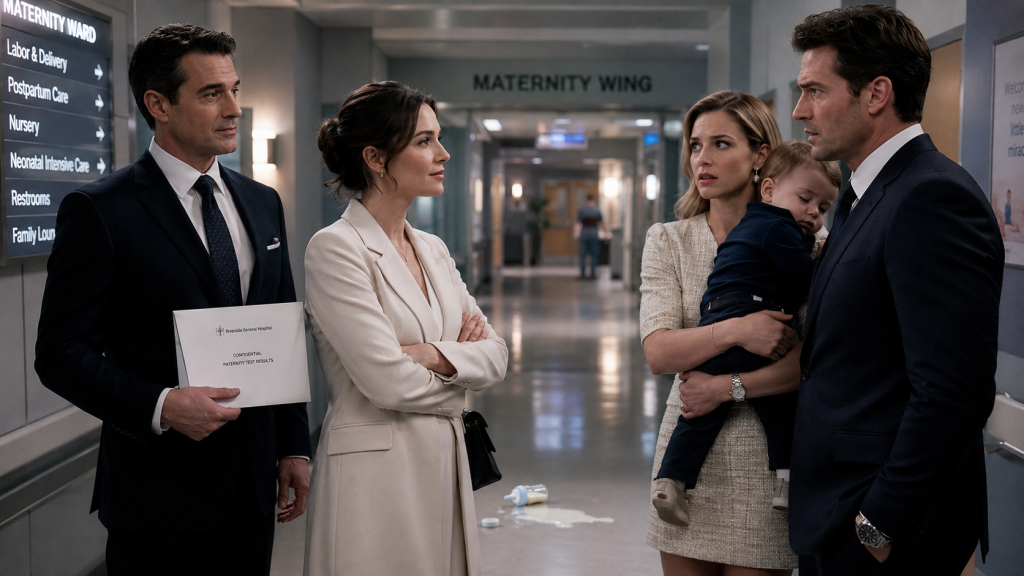
Two minutes later, Dr. Adrian Vale stepped out of the elevator in a dark navy suit, carrying a sealed hospital envelope.
Madison saw him first.
The baby bottle slipped from her hand and struck the floor.
Milk spread across the polished tile.
Ethan frowned.
“What’s wrong with you?”
Madison went pale.
“Why is he here?”
Adrian stopped beside me and gently touched my back.
“Because Claire asked me to come.”
Ethan’s smirk faltered.
He knew Adrian by reputation.
Everyone in the city did.
He was the director of St. Catherine’s reproductive medicine center, a physician who had testified before medical boards and helped expose two fraudulent fertility clinics.
More importantly, he was the doctor who had reviewed my old fertility records after I discovered that several pages were missing from my divorce file.
Adrian looked at Ethan.
Then at the child.
“I have the final laboratory report,” he said.
Ethan’s face tightened.
“What report?”
I watched Madison clutch the baby closer.
“The report proving,” Adrian said calmly, “that Claire was never infertile.”
Silence swallowed the corridor.
For the first time in years, I looked into Ethan’s eyes and felt no pain at all.
Only timing.
Ethan stared at Adrian as though he had spoken in another language.
“That’s impossible,” he snapped. “We spent years trying. Every doctor said Claire was the problem.”
Adrian’s expression remained professional.
“No. That is what Claire was told.”
Madison took a nervous step backward, nearly slipping on the milk.
I noticed her fingers trembling around the baby’s blanket.
Ethan turned toward her.
“Why are you acting like this?”
She opened her mouth.
Nothing came out.
Adrian handed me the sealed envelope.
“The original test results were recovered from archived records. Claire’s evaluations were normal.”
Ethan’s face slowly lost its color.
“Then why couldn’t we have children?”
I looked down at the envelope before meeting his eyes.
“That’s the question I spent a year trying to answer.”
Adrian continued.
“There was another set of test results performed during your marriage, Ethan. Results that never appeared in the documents Claire received.”
Madison whispered, “Please don’t.”
Ethan spun toward her.
“Don’t what?”
Her eyes filled with panic.
The little boy stirred in her arms.
Adrian reached into his folder and removed another page.
“Before anyone makes another accusation,” he said, “you need to understand something about this child.”
Ethan froze.
I watched Madison’s face collapse.
Suddenly, I knew the next truth would be worse than the first.
Adrian did not hand the document to Ethan.
Instead, he looked toward me.
“Claire, are you certain you want to discuss this here?”
I appreciated the question.
For eleven months, every person involved in my old life had made decisions for me.
Doctors.
Lawyers.
Ethan.
Madison.
Even friends who thought they were protecting me.
Adrian never did.
He always gave me the choice.
“Yes,” I said.
My voice was steady.
“Here is fine.”
Ethan gave a humorless laugh.
“What is this? Some performance?”
“No,” I said. “The performance was our marriage.”
His jaw tightened.
Madison flinched.
Adrian turned the document around.
“During Claire’s fertility treatments, samples from both partners were analyzed. According to the original laboratory results, Ethan had a severe male-factor fertility condition.”
Ethan stared at him.
“No.”
“The probability of natural conception was extremely low.”
“No.”
“Additional testing was recommended.”
Ethan’s voice rose.
“You’re lying.”
Several people in the corridor looked toward us.
A nurse slowed, then continued walking after Adrian gave her a small reassuring nod.
He had expected Ethan’s reaction.
So had I.
“The original report is authenticated,” Adrian said. “The hospital retained transferred backup files from the laboratory. We also verified the physician’s electronic signature.”
Ethan shook his head violently.
“That doesn’t mean anything.”
His eyes moved to Madison.
Then to the baby.
Then back to Adrian.
“My son is standing right there.”
Adrian’s expression changed slightly.
Not cold.
Not cruel.
Just careful.
“That is precisely why you should listen.”
Madison whispered, “Ethan, we should go home.”
He ignored her.
“What are you saying?”
She grabbed his arm.
“Please.”
He pulled away.
“What are you saying?”
Adrian looked at the child before responding.
“I’m saying the fertility report raises a legitimate question about biological paternity.”
For three seconds, Ethan didn’t move.
Then he laughed.
It was a strange sound.
Too loud.
Too forced.
He looked at Madison as if expecting her to laugh with him.
She didn’t.
“Tell him,” Ethan said.
Madison stared at the floor.
“Tell him he’s ridiculous.”
Her mouth trembled.
“Ethan—”
“Tell him.”
The baby began to fuss.
Madison shifted him against her shoulder.
The movement made everything worse because Ethan looked at the little boy differently now.
Not as his son.
As evidence.
“Madison.”
“I can explain.”
Those three words changed his entire face.
I remembered saying them once.
Years earlier, when I had accidentally scratched his new car backing out of the garage.
He had shouted for twenty minutes before letting me speak.
Now Madison said them softly, and Ethan went completely silent.
“You can explain what?”
She glanced at me.
That was when I understood something important.
She still blamed me.
Even now.
Even after stealing my husband, participating in the lies surrounding my fertility, and building a life on top of my humiliation, some part of Madison believed I was responsible for the moment collapsing around her.
I stepped closer.
“No,” I said. “Don’t look at me.”
Her eyes narrowed.
“You wanted this.”
“I wanted the truth.”
“You wanted revenge.”
“For months, I wanted revenge.”
I surprised myself by admitting it.
Ethan looked at me.
Madison did too.
“I imagined embarrassing both of you. I imagined taking everything back. I imagined making every friend who believed you apologize to me.”
I tightened my fingers around the envelope.
“But eventually I stopped wanting revenge.”
Madison scoffed.
“Then what do you call this?”
“Closure.”
Ethan snapped, “Stop talking around me like I’m not here.”
For once, I understood exactly how he felt.
That had been my entire marriage.
He turned toward Madison.
“Who is the father?”
She closed her eyes.
The baby began crying.
She rocked him automatically.
“Please don’t do this here.”
“Who is his father?”
“I don’t know.”
Ethan stepped backward.
The answer hit him harder than a name would have.
“What?”
Madison started crying.
“I don’t know.”
He stared at her.
“You told me he was mine.”
“I thought he was.”
“You told me the dates matched.”
“They did.”
“You showed me the test.”
Madison’s face crumpled.
My stomach tightened.
“What test?” I asked.
Ethan looked at me, still stunned.
“The paternity test.”
Adrian’s eyes sharpened.
“You had genetic testing performed?”
“Yes.”
“When?”
“When Oliver was three months old.”
Madison shook her head quickly.
“Ethan, please.”
“Shut up.”
Adrian stepped forward.
“Do not speak to her that way.”
Ethan looked ready to explode, but Adrian’s calm stopped him.
“Where was the test performed?” Adrian asked.
Ethan named a private laboratory.
Adrian’s expression became unreadable.
I recognized the name.
It was connected to the same clinic where Ethan and I had undergone our fertility treatments.
Adrian clearly recognized it too.
“Do you have the report?”
“At home.”
“Did you speak directly with the laboratory?”
“No. Madison arranged everything.”
Ethan looked at her.
A horrible understanding moved through his face.
“You arranged everything.”
Madison’s shoulders sagged.
I suddenly felt exhausted.
This moment had lived in my imagination for months.
In those fantasies, I stood tall while Ethan and Madison crumbled.
I thought satisfaction would feel warm.
Instead, it felt quiet.
Almost empty.
There was no victory in watching people discover that deception had consequences.
There was only truth.
And truth, I had learned, was rarely as glamorous as revenge.
Adrian spoke carefully.
“The laboratory you named is currently under investigation.”
Ethan’s head snapped toward him.
“For what?”
“Improper record handling, falsified reporting, and unauthorized alteration of patient files.”
The blood drained from Ethan’s face.
I knew that part.
What I hadn’t known was how Madison’s baby fit into it.
Ethan turned toward me.
“You knew?”
“I knew the clinic was under investigation.”
“You knew my test was wrong?”
“No.”
“But you came here expecting this.”
“I came here because Adrian called me this morning and said the archived files had been recovered.”
Ethan stared at the folder.
“Why today?”
Adrian answered.
“Because the last encrypted archive was restored yesterday.”
Madison suddenly sat in one of the corridor chairs.
The baby was crying harder now.
A nurse approached.
“Would you like somewhere private?”
Madison nodded immediately.
Adrian gestured toward an unused family consultation room.
We moved inside.
The room was small.
Beige walls.
A round table.
Six chairs.
A painting of wildflowers.
Someone had clearly designed it to make terrible conversations feel less terrible.
It didn’t work.
Madison sat in the corner with Oliver.
Ethan remained standing.
I sat beside Adrian.
For several seconds, nobody spoke.
Then Ethan said, “Start from the beginning.”
He wasn’t looking at me.
He was looking at Adrian.
So Adrian did.
Three years earlier, during our second year of fertility treatment, both Ethan and I had undergone routine testing.
My results were normal.
Not perfect.
No body is perfect.
But normal.
Healthy ovarian reserve.
Normal hormone levels.
No structural abnormalities.
Nothing that would justify the diagnosis I later received.
Ethan’s results were different.
His initial analysis showed a severe issue.
The clinic recommended repeating the test because results can vary.
A second test showed the same problem.
The physician documented the findings.
Then something happened.
The report in my patient portal disappeared.
A new summary appeared weeks later indicating that Ethan’s results were within acceptable parameters and that my reproductive function was the primary concern.
I remembered that appointment.
I remembered sitting beside Ethan while a doctor told me my chances were poor.
I remembered apologizing to my husband in the parking lot.
Apologizing.
As though I had chosen it.
As though my body had betrayed him intentionally.
Ethan had held my hand.
He had told me it wasn’t my fault.
Then, months later, whenever we argued, he began using it against me.
“After everything I’m sacrificing for this.”
“You don’t understand what it’s like knowing I may never be a father.”
“If you loved me, you’d try another cycle.”
So I did.
Hormones.
Injections.
Appointments before sunrise.
Procedures.
Hope.
Failure.
Repeat.
But according to the recovered records, the treatment strategy had been built on a lie.
Adrian continued.
“The metadata indicates that several records were manually modified.”
Ethan finally sat.
“By who?”
“That is being investigated.”
Madison stared at the wall.
Adrian noticed.
So did I.
Ethan noticed last.
He turned slowly.
“Madison?”
She didn’t answer.
“Madison.”
Her eyes filled with tears.
“I never thought it would go this far.”
My heart began pounding.
“What did you do?”
She hugged Oliver tighter.
“I didn’t change the records myself.”
“That isn’t what I asked.”
“I knew someone who worked at the clinic.”
Ethan stood again.
“Who?”
“My cousin Rachel.”
I remembered Rachel.
Madison’s cousin had attended one of our Christmas parties.
She worked in medical administration.
At the time, I hadn’t thought anything of it.
Madison continued.
“I told her things.”
“What things?” I asked.
“That you and Ethan were having problems.”
Ethan snapped, “We weren’t having problems then.”
Madison looked at him.
“You complained constantly.”
His face hardened.
“About what?”
“About Claire.”
I almost laughed.
Of course.
While I was apologizing for being unable to give him a child, Ethan had apparently been complaining about me to my best friend.
Madison wiped her cheek.
“You said you felt trapped.”
Ethan looked at me, then away.
“You said you didn’t know whether you could stay married if there were no children.”
My throat tightened.
Not because I loved him anymore.
Because some wounds still remember being wounds.
Madison continued.
“Rachel had access to scheduling and records. I asked questions. At first, that was all.”
“What kind of questions?” Adrian asked.
“About the results.”
“And?”
“She told me Ethan had the problem.”
Ethan looked as though the floor had moved.
“You knew?”
Madison nodded.
“How long?”
Her answer came barely above a whisper.
“Almost three years.”
He laughed once.
No humor.
“So before we started sleeping together.”
“Yes.”
“And you still told me Claire was infertile.”
Madison began sobbing.
“I was in love with you.”
“That wasn’t the question.”
“I thought if you knew, you would stay with her.”
The room went silent.
There it was.
Not complicated.
Not accidental.
Not a misunderstanding.
Madison had learned the truth.
And she had decided the truth was inconvenient.
“What did Rachel do?” Adrian asked.
Madison looked frightened.
“I don’t know everything.”
“Tell us what you do know.”
“I asked whether there was any way Claire could be listed as the primary infertility factor.”
I felt something inside me go still.
Ethan whispered, “Jesus.”
Madison rushed on.
“I didn’t understand what that meant legally. I thought it was just notes.”
“You thought falsifying medical records was just notes?” I asked.
“I was desperate.”
“No. You were selfish.”
She looked at me.
“I loved him.”
“And I was your best friend.”
Her face folded.
“I know.”
“No, you don’t.”
I stood.
For a moment, I was no longer in the consultation room.
I was back in my old bedroom.
Madison was sitting beside me on the carpet while I organized medication.
She had learned how to prepare injection ice packs.
She drove me to two appointments when Ethan was busy.
She brought soup after one procedure.
She held me while I cried.
All while knowing.
“You watched me inject hormones into my body.”
Madison covered her mouth.
“You watched me blame myself.”
“I’m sorry.”
“You watched Ethan blame me.”
“I know.”
“You encouraged me to try again.”
“I know.”
My voice broke for the first time.
“You knew.”
She started crying harder.
“I’m sorry.”
I shook my head.
“That word is too small.”
Ethan looked at her with disgust.
“You destroyed our marriage.”
I turned toward him.
“No.”
He looked surprised.
“Don’t do that.”
“Do what?”
“Don’t pretend she did everything.”
His face changed.
“You were my husband.”
“I didn’t know about the records.”
“No. But you knew how you treated me.”
He opened his mouth.
“You called me defective.”
His eyes dropped.
“You told me no other man would want a woman who couldn’t give him children.”
“I was angry.”
“You let me believe your affair was understandable because I had failed you.”
He rubbed his face.
“I said terrible things.”
“You did terrible things.”
“I didn’t know.”
“You knew enough.”
That stopped him.
Because it was true.
He may not have known the medical records were false.
He may not have known Madison had manipulated the situation.
But he knew he was cruel.
He knew he was cheating.
He knew his wife was physically and emotionally exhausted.
And he chose himself anyway.
Adrian remained silent.
This was no longer medicine.
This belonged to us.
Ethan eventually looked at Madison again.
“The baby.”
She lowered her head.
“Who else?”
“Ethan…”
“Who else were you sleeping with?”
She whispered a name.
“Lucas.”
Ethan went completely still.
I knew Lucas.
He had been Ethan’s business partner for seven years.
They had started their consulting company together.
Best man at our wedding.
Godfather to Oliver.
Ethan’s closest friend.
The symmetry was almost too perfect.
My best friend had betrayed me with my husband.
His best friend had possibly betrayed him with her.
I should have felt satisfaction.
Instead, I felt sorry for the child.
Oliver had done nothing.
He slept against Madison’s chest, unaware that four adults were questioning the foundation of his identity.
Ethan sat heavily.
“Lucas?”
Madison nodded.
“When?”
“Before the divorce.”
“How long?”
She didn’t answer.
“How long?”
“Six months.”
He stared at her.
“So when you were telling me to leave Claire…”
“Yes.”
“You were sleeping with both of us.”
Madison said nothing.
Ethan looked at Adrian.
“I want a test.”
Adrian nodded.
“That can be arranged.”
“Today.”
“We would need consent and proper procedures.”
“I’m his legal father.”
Madison suddenly stood.
“No.”
Everyone looked at her.
“No?”
“I don’t want him tested.”
Ethan’s laugh was bitter.
“That tells me everything.”
“It doesn’t.”
“It tells me enough.”
Madison backed toward the door.
“I’m taking Oliver home.”
Ethan blocked her path.
Adrian immediately stood.
“Move away from the door.”
Ethan turned.
“This is my family.”
“And this is a hospital. You will not prevent anyone from leaving.”
Ethan stared at him for several seconds.
Then stepped aside.
Madison hurried out.
The door shut behind her.
For a long moment, Ethan stared after her.
Then he looked at me.
I had never seen him look small before.
Ethan had always filled rooms.
Confident.
Charming.
Certain that other people existed slightly below him.
Now he looked like a man who had discovered the world could continue without asking his permission.
“Claire.”
I gathered my bag.
“No.”
“I just need—”
“No.”
“You were right.”
“I know.”
He winced.
“I deserve that.”
“This isn’t about what you deserve.”
I walked toward the door.
“Then what is it about?”
I looked back.
“Me finally understanding what I deserve.”
Then I left.
Outside, I found Madison standing near the elevators.
Oliver had fallen asleep again.
She looked at me.
“Claire.”
I pressed the elevator button.
“Please.”
I said nothing.
“I know you hate me.”
“I don’t.”
She looked startled.
“I did.”
The elevator numbers descended.
Nine.
Eight.
Seven.
“I hated you so much that it scared me.”
She started crying again.
“I’m sorry.”
“But hatred is exhausting.”
Six.
Five.
“I spent months giving you space in my head.”
Four.
“Then I realized you had already taken enough.”
Three.
Madison wiped her face.
“I never meant for you to get hurt.”
I turned toward her.
“That may be the worst thing you’ve said today.”
She stared at me.
“You changed medical information that affected my body. You encouraged me through unnecessary treatment. You slept with my husband. You helped him humiliate me publicly. What exactly did you think would happen?”
She had no answer.
The elevator arrived.
The doors opened.
Before stepping inside, I looked at Oliver.
“He deserves the truth one day.”
Madison’s arms tightened around him.
“I know.”
“And whatever happens next, remember that none of this is his fault.”
“I know.”
I stepped into the elevator.
The doors began closing.
“Claire.”
I looked at her one last time.
“I really did love you like a sister.”
The doors almost touched.
“Then you should have treated me like one.”
They closed.
That afternoon, I walked through the city alone.
I did not go home immediately.
For the first time, there was nowhere I needed to be.
No appointment.
No lawyer.
No records request.
No phone call.
For eleven months, finding the truth had become my routine.
Now I had it.
And strangely, I felt lost.
I ended up at the small bakery beneath my apartment.
Mrs. Delgado was icing cupcakes.
She looked up.
“You look different.”
“I found out I wasn’t infertile.”
She froze.
The piping bag stopped in her hand.
“What?”
I sat at the counter.
“The diagnosis was wrong.”
She came around immediately.
“Oh, sweetheart.”
I laughed.
Then I cried.
Not delicately.
Not quietly.
I cried like a woman who had spent three years grieving children she might never have when the entire grief had been manufactured.
Mrs. Delgado wrapped her arms around me.
I cried for the treatments.
For the nights I apologized to Ethan.
For the friendships I lost.
For the marriage I once believed was worth saving.
And strangely, I also cried for the future.
Because now the door I thought had been permanently closed was open again.
That frightened me more than I expected.
Later that night, Adrian called.
“Are you all right?”
“I don’t know yet.”
“That’s a reasonable answer.”
I smiled.
He had a way of saying things without demanding that I feel differently.
“What happens now?”
“The medical board investigation continues.”
“And Madison?”
“If her statement is accurate, investigators will likely want to speak with her cousin.”
“Could there be criminal charges?”
“Potentially.”
I closed my eyes.
“And the treatments?”
“Claire, I need you to hear this clearly.”
His voice softened.
“What happened to you was medically and ethically unacceptable.”
I swallowed.
“You were subjected to treatment based on false information.”
“Can I still have children?”
There.
The question I had been afraid to ask.
Adrian was quiet for half a second.
“Based on your current testing, I see no reason to conclude otherwise.”
I began crying again.
I hated how easily tears came lately.
“You’re thirty-four,” he continued. “Your recent evaluation is reassuring. Nobody can promise pregnancy, but your medical history does not support the conclusion you were given.”
I pressed my hand over my mouth.
For years, I had imagined hearing those words.
I thought I would scream.
Celebrate.
Call everyone.
Instead, I whispered, “Thank you.”
After we hung up, I stood at my apartment window and watched people move along the street below.
Couples.
Parents.
Children.
Delivery drivers.
A man walking three dogs.
Normal life.
I had spent so much time waiting for my old life to be restored that I had forgotten something important.
I didn’t want it anymore.
I didn’t want the house Ethan kept.
I didn’t want our old friends.
I didn’t want our marriage.
I wanted whatever came next.
Three weeks later, Ethan called me.
I ignored him.
He called again.
And again.
Eventually, he sent one message.
The DNA test came back.
Oliver isn’t mine.
I stared at the screen.
Then locked my phone.
Five minutes later, another message arrived.
Lucas is the father.
Then another.
I’m sorry for everything.
Another.
I know that means nothing.
Another.
Can we talk?
I didn’t answer.
The next morning, there were fourteen missed calls.
By afternoon, twenty-two.
Then he appeared outside my building.
Mrs. Delgado called upstairs.
“There’s a man here who looks expensive and miserable.”
I almost laughed.
“Tell him I’m not home.”
“He can see your car.”
“Tell him I moved.”
She paused.
“You’re terrible.”
“I learned from professionals.”
But Ethan waited.
For two hours.
Eventually, I went downstairs.
He stood beneath the bakery awning holding no flowers.
That surprised me.
Old Ethan would have brought flowers because flowers looked like apology.
This Ethan simply looked exhausted.
“Five minutes,” I said.
He nodded.
We walked to a bench across the street.
For a while, he stared at traffic.
Then he said, “Lucas admitted everything.”
I waited.
“He and Madison were sleeping together before she and I started.”
I said nothing.
“She wasn’t sure who the father was.”
Still nothing.
“She had the paternity result altered.”
“That sounds familiar.”
He flinched.
“I deserved that.”
I looked at him.
“You keep saying that.”
“What?”
“That you deserve things.”
He frowned.
“Maybe stop making yourself the center of every consequence.”
His face tightened, but he nodded.
“You’re right.”
That surprised me more than the lack of flowers.
He looked down at his hands.
“The company is finished.”
“Why?”
“Lucas and I are dissolving the partnership.”
“I’m sorry.”
He looked at me.
“No, you’re not.”
“You’re right.”
For the first time, a small laugh escaped him.
Then disappeared.
“Madison moved out.”
I nodded.
“She’s staying with her mother.”
“Okay.”
“She says she wants Lucas involved.”
“That sounds like something the three of you need to figure out.”
He looked at me carefully.
“I ruined my life.”
I considered that.
“No.”
His eyebrows lifted.
“You damaged your life.”
“What’s the difference?”
“Ruined means there’s nothing left.”
I looked toward the bakery window.
“You still have choices.”
He studied me.
“You’ve changed.”
“Yes.”
“You’re stronger.”
“No.”
That seemed to confuse him.
“I was strong before. You just benefited from me not knowing it.”
He looked away.
For several minutes, neither of us spoke.
Then he whispered, “I blamed you because I was afraid.”
I waited.
“Even before the clinic told us anything, I was terrified there might be something wrong with me.”
His mouth twisted.
“My father used to talk constantly about sons. Legacy. Carrying on the family name. All that garbage.”
I remembered.
Ethan’s father once joked at Thanksgiving that if I didn’t produce a grandson soon, Ethan should “trade me in.”
Everyone laughed.
Including Ethan.
I didn’t.
“When the doctor said you were the problem,” Ethan continued, “I felt relieved.”
The honesty was ugly.
But at least it was honesty.
“I hated myself for feeling relieved.”
“So you punished me instead.”
“Yes.”
He looked at me.
“I’m ashamed of that.”
I believed him.
That didn’t mean I forgave him.
“I need to ask something,” he said.
“No.”
“You don’t know what I’m asking.”
“Yes, I do.”
His eyes filled.
“Is there any chance—”
“No.”
He stopped.
I didn’t soften it.
I had softened too many truths for him already.
“There is no version of this where we get back together.”
“I’ve changed.”
“It’s been three weeks.”
“I can change.”
“Maybe you can.”
I stood.
“But you’re going to have to do it for someone other than me.”
He looked shattered.
A year earlier, that expression would have broken me.
Now I simply felt sad.
Not because I wanted him.
Because I once had.
“I loved you,” I said.
“I know.”
“No. I don’t think you ever understood.”
He looked at me.
“I loved you enough to believe your cruelty was grief.”
My throat tightened.
“I loved you enough to think being treated badly was the price of keeping you.”
“Claire…”
“I will never love anyone that way again.”
Then I walked back into the bakery.
He did not follow.
Six months passed.
The investigation into the fertility clinic became public.
Three employees lost their licenses.
Madison’s cousin Rachel accepted a plea agreement after admitting she had altered records in exchange for money and personal favors.
That detail shocked me.
Madison had paid her.
Not much.
Just enough to turn betrayal into a transaction.
My attorney reopened portions of the divorce settlement.
Once the falsified medical records and Madison’s involvement were documented, the legal landscape changed.
So did public opinion.
Friends who had abandoned me began reaching out.
Some apologized sincerely.
Others apologized because the truth had become embarrassing.
I learned to recognize the difference.
I accepted some apologies.
Ignored others.
The charity foundation’s board voted to remove Ethan from his controlling position after discovering he had used foundation resources during our divorce campaign against me.
I was invited back as executive director.
I declined.
That surprised everyone.
Especially Ethan.
But I had built that organization during a different life.
I didn’t want to spend my future rebuilding something that reminded me of him.
Instead, I started a patient advocacy nonprofit with three former fertility patients and a medical ethics attorney.
We called it Clear Path.
Our purpose was simple.
Help patients obtain their complete records.
Explain their rights.
Connect them with independent second opinions.
No one should go through years of treatment without access to accurate information.
Adrian became one of our volunteer medical advisors.
At first, our relationship remained entirely professional.
Mostly.
He sent articles.
I sent questions.
He corrected my terrible interpretations of medical studies.
I teased him for writing emails that sounded like court testimony.
Then one evening, after a fundraiser, we found ourselves eating tacos from a food truck at eleven-thirty.
He had loosened his tie.
I had kicked off my heels beneath the picnic table.
For the first time, I realized I had never actually seen him outside a hospital or conference room.
“You’re less intimidating with salsa on your sleeve,” I said.
He looked down.
“I was intimidating?”
“Terrifying.”
“That seems unlikely.”
“You explain everything with the seriousness of a man announcing a lunar landing.”
He smiled.
“That’s because people deserve clarity.”
The answer caught me off guard.
I looked at him.
He looked back.
There was no dramatic music.
No instant revelation.
Just a quiet shift.
Something opening.
We started dating four months later.
Slowly.
Painfully slowly, according to Mrs. Delgado.
But I needed slow.
The first time Adrian kissed me, he asked.
Not because he was uncertain.
Because he cared whether I wanted it too.
That simple question nearly made me cry.
I said yes.
A year after the hospital confrontation, I received an invitation in the mail.
Madison was requesting mediation.
Not legal mediation.
Personal.
She wanted to meet.
I almost threw the letter away.
Instead, I kept it for three days.
Then agreed.
We met in a quiet café on the other side of town.
Madison looked older.
Not physically, exactly.
But whatever confidence used to hold her face together was gone.
She wore no jewelry.
No makeup.
Oliver was not with her.
She stood when I approached.
“Thank you for coming.”
I sat.
“I almost didn’t.”
“I know.”
For a while, she stirred untouched coffee.
Then she said, “Lucas sees Oliver every weekend.”
I nodded.
“He and Ethan haven’t spoken since the DNA results.”
“I figured.”
“Ethan sends Oliver birthday gifts anyway.”
That surprised me.
“He does?”
Madison nodded.
“He loved him.”
Something in my chest softened.
Not toward Ethan.
Toward the strange complexity of human attachment.
Biology had become a weapon in all our lives.
Yet Ethan had spent a year loving that child.
DNA didn’t erase every bedtime.
Every bottle.
Every first step.
“Why did you want to see me?” I asked.
Madison took a breath.
“To tell you I’m sorry without asking you to forgive me.”
I waited.
“I used to rehearse explanations.”
She looked down.
“That I was lonely. That Ethan and I connected. That your marriage was already struggling.”
Her eyes filled.
“But those are excuses.”
“Yes.”
“I wanted what you had.”
I hadn’t expected that.
She laughed bitterly.
“Not Ethan specifically, at first.”
“What do you mean?”
“You always had something.”
“What?”
“Certainty.”
I nearly smiled.
“You clearly didn’t know me very well.”
“I thought I did.”
She wiped one cheek.
“You walked into rooms like you belonged there. You built the foundation. People listened when you spoke. Ethan adored you when we were younger. Your parents were proud of you.”
She looked at me.
“I spent years comparing myself to you.”
“And instead of dealing with that, you destroyed my medical records?”
She closed her eyes.
“When you say it like that…”
“How else should I say it?”
“You shouldn’t.”
She shook her head.
“There is no better version.”
That was the first thing Madison had said that sounded like accountability.
“I’m not asking you to let me back into your life.”
“Good.”
“I just needed you to know that I understand now.”
“Understand what?”
“That I didn’t win anything.”
I looked at her for a long moment.
“No.”
She nodded.
“I lost my best friend.”
I swallowed.
“You lost me before I knew I’d lost you.”
Tears rolled down her face.
“I know.”
We sat in silence.
Then I stood.
She looked up.
“That’s it?”
“That’s it.”
“Will I ever see you again?”
“I don’t know.”
It was the truth.
Before leaving, I paused.
“Madison.”
She looked at me.
“Be a good mother.”
She nodded.
“I’m trying.”
“For Oliver. Not to prove anything to anyone.”
“I understand.”
I left.
Outside, Adrian was waiting across the street.
Not because I needed rescuing.
Because we had dinner plans.
He smiled when he saw me.
“How did it go?”
“It went.”
“That bad?”
“Not bad.”
I thought about it.
“Finished.”
He took my hand.
That night, over dinner, I told him I wanted to try.
He misunderstood at first.
“Try what?”
I laughed nervously.
“To have a baby.”
His fork stopped.
“You’re sure?”
“No.”
He smiled.
“Good answer.”
“I’m terrified.”
“Also reasonable.”
“I spent years thinking pregnancy was impossible. Now that it might be possible, I’m scared to hope.”
He reached across the table.
“Then we don’t turn hope into a guarantee.”
I looked at him.
“We just let it be hope.”
Seven months later, I stood barefoot in my bathroom holding a pregnancy test.
Two lines.
I stared at them until my knees weakened.
Then I checked another.
Two lines.
Then a third.
Also two lines.
I called Adrian.
He answered from the hospital.
“Everything okay?”
I couldn’t speak.
“Claire?”
“I think you need to come home.”
His voice changed instantly.
“What happened?”
“Nothing bad.”
Silence.
Then he understood.
“Are you serious?”
I started laughing.
And crying.
“Yes.”
He was home twenty-three minutes later.
I know because I watched the clock.
He came through the door breathless.
I held up three tests.
He stared.
Then sat directly on the floor.
“Adrian?”
He covered his face.
For a terrifying second, I thought something was wrong.
Then he started crying.
I sat beside him.
We laughed so hard neither of us could speak.
The pregnancy was not simple.
No pregnancy really is when you know too much about what can go wrong.
Every appointment scared me.
Every scan.
Every test.
But Adrian never treated me like a patient unless I asked him something medical.
Mostly, he treated me like Claire.
At twenty weeks, we learned we were having a girl.
I cried again.
Apparently pregnancy did not improve my relationship with tears.
One afternoon, when I was seven months pregnant, I received a handwritten letter.
From Ethan.
I almost didn’t open it.
But I did.
There was no request to meet.
No attempt to reconcile.
No grand declaration.
Just an apology.
A real one.
He wrote about therapy.
About his father.
About the pressure he had internalized.
About how none of it excused what he did.
He wrote that he had sold our old house because he finally understood it had never felt like home without the person who made it one.
He wrote that he had started volunteering twice a month with a men’s infertility support organization.
That surprised me most.
At the bottom, he wrote:
I spent years believing fatherhood would prove something about me as a man.
Losing Oliver taught me that loving a child and creating one are not the same thing.
Losing you taught me that love without respect isn’t love worth keeping.
I am sorry I learned both lessons at your expense.
I folded the letter.
Then placed it in a drawer.
I did not respond.
Some apologies are valuable even when they do not reopen doors.
Two months later, on a rainy Thursday morning, my daughter was born.
We named her Evelyn Rose.
Not after anyone.
We simply liked the name.
She had dark hair.
A furious cry.
And the strongest grip I had ever felt.
When the nurse placed her against my chest, the entire room disappeared.
For years, I thought motherhood was the thing stolen from me.
But holding Evelyn taught me something else.
The real theft had been my ability to trust myself.
My body.
My instincts.
My worth.
Getting pregnant did not repair me.
Because I had never needed repairing.
The repair happened earlier.
In the apartment above the bakery.
In medical archives.
In attorney offices.
In long walks alone.
In learning to say no.
In discovering that being abandoned can sometimes reveal how badly you had abandoned yourself.
Three weeks after Evelyn was born, I saw Ethan again.
Completely by accident.
I was leaving a pediatric appointment at St. Catherine’s.
The same hospital.
The same corridor.
Almost the same spot.
He stepped off the elevator as Adrian pushed Evelyn’s stroller beside me.
For one second, all four of us froze.
Ethan looked at the stroller.
Then at me.
His eyes widened.
I saw recognition.
Understanding.
Pain.
But this time, he did not make the moment about himself.
He smiled.
A small, sincere smile.
“Congratulations, Claire.”
“Thank you.”
He looked at Adrian.
“Doctor.”
Adrian nodded.
“Ethan.”
Then Ethan looked toward the stroller again.
“What’s her name?”
“Evelyn.”
“That’s beautiful.”
He swallowed.
“I’m happy for you.”
And strangely, I believed him.
“Thank you.”
He stepped aside.
We walked past.
After several steps, I looked back.
Ethan was still standing there.
Not staring bitterly.
Just watching.
Then the elevator opened and he disappeared inside.
Adrian squeezed my hand.
“You okay?”
I looked down at Evelyn.
She yawned.
“Yeah.”
And I was.
Really.
Years earlier, I imagined that justice would look dramatic.
Ethan begging.
Madison losing everything.
Everyone who doubted me apologizing.
Instead, justice turned out to be quieter.
It was waking up without wondering whether I was enough.
It was having people in my life who did not require me to shrink.
It was trusting doctors who answered questions instead of hiding information.
It was using what happened to me to help someone else.
It was loving again without surrendering myself.
Clear Path eventually grew beyond anything I expected.
Within three years, we had offices in four cities.
We helped thousands of patients obtain second opinions and understand their medical rights.
Sometimes people wrote to tell me we had saved their marriage.
Other times they wrote to tell me we had helped them realize their marriage needed to end.
Both mattered.
Truth does not always preserve what existed before it.
Sometimes truth clears the ground for something better.
Madison and I never became friends again.
We exchanged occasional messages about the investigation.
Years later, she sent me a photograph of Oliver on his first day of kindergarten.
I stared at it for a long time.
He had Lucas’s eyes.
There was no denying it.
Madison wrote:
I know you don’t owe me a response. I just wanted you to see that he’s doing well.
I replied with four words.
I’m glad he is.
That was enough.
Ethan never remarried quickly.
I heard through mutual friends that he dated occasionally.
He eventually reconciled enough with Lucas to speak to him, though they never became business partners again.
And once, years later, I learned he still attended some of Oliver’s school events.
Not as his father.
Not exactly.
But as someone who had loved him during the first year of his life.
Human relationships rarely fit into the neat boxes we imagine.
Some people betray us and still contain good parts.
Some people love us and still damage us.
Some apologies arrive after forgiveness is irrelevant.
Some truths come too late to save a relationship but exactly in time to save a person.
As for Adrian and me, we married when Evelyn was two.
Small ceremony.
Mrs. Delgado made the cake.
I asked her to keep it simple.
She created five tiers.
“Simple is emotionally dishonest,” she told me.
I laughed so hard I almost ruined my makeup.
Our wedding had forty-two guests.
No expensive ballroom.
No society photographers.
No foundation board members.
Just people who had earned seats in our lives.
During his vows, Adrian said something I will never forget.
“I cannot promise that nothing will hurt you again. I can promise you will never have to question whether I am standing beside you while it does.”
That was the kind of promise I understood now.
Not perfection.
Presence.
Three years later, we had another child.
A boy.
Samuel.
When I held him for the first time, I thought briefly about that hospital corridor.
Ethan leaning against the wall.
Madison holding Oliver.
The bottle falling.
Milk spreading across tile.
The sentence designed to destroy me.
A useless woman can’t have children.
For years, I thought the most satisfying response to that sentence would be proving Ethan wrong by becoming a mother.
It wasn’t.
My daughter and son were not evidence.
They were not revenge.
They were not proof of my value.
The real victory happened before either of them existed.
The real victory was the day I understood that even if I never became a mother, Ethan’s words still would have been wrong.
A woman’s value is not measured by what her body can produce.
A marriage is not a contract guaranteeing children.
Infertility is not failure.
And cruelty does not become acceptable simply because someone is grieving.
That understanding changed everything.
Sometimes, late at night, after the children are asleep, I think about the woman I was during my marriage.
I want to reach backward through time.
I want to sit beside her on the bathroom floor after another negative pregnancy test.
I want to take the needles from her hands.
I want to tell her to stop apologizing.
I want to tell her that the man sleeping beside her has confused her love with permission.
I want to tell her that her best friend’s sympathy is not what it seems.
But most of all, I want to tell her this:
You are going to survive the thing you think will destroy you.
Not gracefully.
Not quickly.
Not without scars.
But you will survive.
And one day, you will walk through the same hospital where someone tried to shame you, holding the life you rebuilt with your own hands.
You will not need revenge.
You will not need anyone to regret losing you.
You will not need to prove that you won.
Because peace is what winning eventually looks like.
On Evelyn’s fifth birthday, she asked how Adrian and I met.
We were decorating cupcakes in Mrs. Delgado’s bakery.
Adrian glanced at me.
“That is a complicated story.”
Evelyn covered her hands in frosting.
“Was it romantic?”
I laughed.
“Not at first.”
“Did Daddy save you?”
The question stopped me.
Children absorb fairy tales quickly.
Princesses.
Heroes.
Rescue.
Adrian waited for my answer.
I crouched beside her.
“No, sweetheart.”
She looked confused.
“Then what happened?”
“I saved myself.”
Adrian smiled.
“And then?”
I looked at him.
“Then I met your dad.”
Evelyn considered this.
“So you both saved yourselves?”
Adrian laughed.
“That sounds about right.”
She nodded seriously.
Then returned to destroying a cupcake.
I looked around the bakery.
Mrs. Delgado was arguing with Samuel about sprinkles.
Adrian was wiping frosting from Evelyn’s hair.
Rain tapped softly against the windows.
Nothing about the moment looked extraordinary.
And that was exactly why I loved it.
For so many years, my life had been built around dramatic milestones.
Marriage.
Pregnancy attempts.
Treatments.
Divorce.
Betrayal.
Investigations.
Court filings.
I used to think happiness would arrive dramatically too.
Instead, it came in ordinary pieces.
Coffee beside someone I trusted.
Children laughing in a bakery.
Work that mattered.
A home where silence felt peaceful instead of punishing.
A body I no longer hated.
A past I no longer wished to rewrite.
That evening, after the birthday party, we drove home beneath a violet sky.
Samuel fell asleep in his car seat.
Evelyn talked for fifteen straight minutes about why unicorns would probably dislike broccoli.
Adrian caught my eye in the rearview mirror.
“You’re smiling.”
“I know.”
“What are you thinking about?”
I looked out the window.
“Timing.”
He smiled.
“That sounds mysterious.”
“It isn’t.”
I thought about the first day he had walked toward me carrying that envelope.
Two minutes.
That was all it took for Ethan’s certainty to collapse.
But the truth was, my life had not changed in those two minutes.
It had been changing for months.
Every time I requested another medical record.
Every time I refused to answer Ethan’s cruel messages.
Every morning I got out of bed when staying beneath the blankets felt easier.
Every time I chose curiosity instead of shame.
Every time I admitted I deserved better.
The envelope had only revealed what I was finally strong enough to hear.
I had never been the failure.
Years after everything happened, a journalist interviewing me about Clear Path asked a question I had heard many times.
“Do you believe what happened to you was a blessing in disguise?”
I disliked the question.
Pain does not need to become a blessing to justify surviving it.
“No,” I said.
She seemed surprised.
“No?”
“No. Betrayal was betrayal. Medical misconduct was misconduct. I would never romanticize what happened.”
She leaned forward.
“Then how do you view it now?”
I thought about Ethan.
Madison.
Oliver.
Adrian.
My children.
The bakery.
My nonprofit.
The woman I used to be.
“I think something terrible happened,” I said. “And afterward, I chose to build something good.”
That answer was printed at the top of the article.
It became one of Clear Path’s unofficial mottos.
Not because it was profound.
Because it was true.
We do not choose every loss.
We do not control every betrayal.
We cannot always stop someone from lying to us.
But eventually, if we are fortunate, there comes a moment when the next decision belongs to us.
Stay or leave.
Speak or remain silent.
Forgive or simply move on.
Begin again or keep staring backward.
My decision happened beneath the cold white lights of St. Catherine’s Hospital.
Ethan thought he was showing me how happy he had become without me.
Madison thought holding that baby proved she had taken the life I wanted.
Neither understood that I had already begun building something they could no longer touch.
So when Ethan smirked and told me leaving me had been the best decision he ever made, maybe, in one strange way, he was right.
Leaving me was the best decision he ever made.
For me.
Because eventually I stopped fighting to return to a marriage that had required me to disappear.
I stopped begging people to see my value.
I stopped treating motherhood like proof of womanhood.
I stopped confusing endurance with love.
And I finally understood the lesson hidden beneath all that pain.
Sometimes the person who abandons you is unknowingly opening the door you were too afraid to walk through yourself.
Sometimes the truth arrives one year late.
Sometimes it arrives in a sealed envelope.
Sometimes it walks toward you down a hospital corridor while the people who betrayed you are still laughing.
And sometimes, when that truth finally arrives, the most powerful thing you can do is smile and say:
“Really?”
Then let the truth speak for itself.
💬THE END! THANK YOU FOR READING!