

Exactly one week after my twelve-year-old son told a judge that I could not give him the kind of future he needed, I stood beneath the bright fluorescent lights of John Glenn Columbus International Airport and wondered how a mother was supposed to say goodbye to her child without falling apart.
I had spent seven days trying not to replay the courtroom in my mind.
Seven days trying not to hear Noah’s voice.
“I want to live with Dad. Mom can’t give me anything.”
Seven days telling myself that children sometimes chose comfort.
Money.
Big houses.
Private schools.
Vacations.
Things I could not provide, at least not then.
And yet, deep inside, something still bothered me.
It wasn’t simply that Noah had chosen Ellis.
It was the way he had done it.
The strange stiffness in his shoulders.
The careful tone of his voice.
The complete absence of emotion.
Noah had always been sensitive.
He cried during sad movies even when he pretended he didn’t.
He apologized to spiders before carrying them outside in a cup.
When he was nine, he once spent three days making a birthday card for me because he couldn’t decide which drawing I would like best.
That boy would not casually look at me and say I could give him nothing.
At least, that was what I kept telling myself.
But doubt had a cruel way of creeping in when the house was quiet.
Maybe I had misunderstood him.
Maybe my son had simply grown up.
Maybe Ellis had shown him a life that looked better than the one I could offer.
Those thoughts followed me all the way to the airport.
Ellis had texted me the night before.
Taking Noah to Chicago for a few days before school arrangements begin. You may say goodbye at the airport if you want.
If I wanted.
As if there were any possibility I wouldn’t.
So I arrived twenty minutes early.
Ellis arrived ten minutes late.
Of course he did.
He came through the sliding doors wearing a camel-colored coat and speaking into his phone, pulling a leather suitcase behind him.
Noah walked several steps behind.
The instant our eyes met, something changed in his face.
The controlled expression disappeared.
For one second, he was my little boy again.
Then he ran.
“Mom!”
His arms wrapped around me so hard I nearly lost my balance.
I held him just as tightly.
Every instinct inside me screamed not to let go.
I pressed my cheek against his hair.
“I love you,” I whispered.
“I love you too.”
My throat tightened.
It was the first time he had said it since the hearing.
Ellis remained several feet away, still distracted by his phone conversation.
That was when I felt Noah’s hand move against my coat.
Something slipped into the outer pocket.
Thin.
Hard.
Plastic.
I started to pull back.
Noah held on tighter.
“Don’t,” he whispered.
I froze.
“Don’t open it here.”
My heart began pounding.
Before I could ask what he meant, Ellis ended his call.
“Noah.”
My son immediately stepped backward.
His entire expression changed.
It happened so quickly that it frightened me.
His shoulders straightened.
His face went blank.
“Time to go,” Ellis said.
Noah nodded.
Ellis looked at me.
There was something almost triumphant in his eyes.
“I’m sure he’ll call once we’re settled.”
Settled.
The word irritated me.
Noah was not furniture.
He was not luggage.
He was our son.
But I said nothing.
I had learned during our marriage that Ellis loved confrontation when he believed he controlled the outcome.
He enjoyed forcing people into emotional reactions and then pointing at those reactions as proof that they were unreasonable.
So I refused to give him one.
I simply looked at Noah.
“Call me anytime.”
“I will.”
Ellis placed one hand on our son’s shoulder.
They walked toward security.
Noah looked back once.
Then twice.
The third time, Ellis noticed.
He said something I couldn’t hear.
Noah immediately faced forward.
I stood there until they disappeared.
Only then did I reach inside my coat pocket.
My fingers touched smooth plastic.
I pulled it out.
It was a black hotel key card.
No logo on the front.
Only a small silver stripe.
I turned it over.
There, in Noah’s unmistakable handwriting, were four words.
ROOM 814. THURSDAY. ALONE.
Underneath them, written smaller, was one sentence.
Dad lied to the judge.
I stared at the card until the letters blurred.
Thursday.
Two days away.
Room 814.
But where?
Chicago?
Columbus?
A hotel near the airport?
I flipped the card again.
Nothing.
Then I noticed something I had missed.
Along the bottom edge, almost invisible beneath the black plastic, was a tiny embossed name.
The Wellington.
I knew it immediately.
The Wellington was one of the most expensive hotels in downtown Columbus.
Ellis used it for business meetings.
He had taken clients there dozens of times during our marriage.
Why would Noah tell me to go there on Thursday?
And why did he want me alone?
I slipped the card back into my pocket.
For the first time since the custody hearing, grief gave way to something else.
Purpose.
I drove home and barely slept.
Wednesday passed painfully slowly.
I considered calling my attorney, Miriam Grant.
Three times I picked up the phone.
Three times I stopped myself.
Noah had specifically written ALONE.
Whatever he was trying to show me, he was afraid.
I needed to understand why before involving anyone else.
Thursday morning, I woke before sunrise.
At 1:45 that afternoon, I parked two blocks from the Wellington.
The hotel lobby smelled like polished wood and expensive flowers.
People in business suits crossed the marble floor carrying laptops and briefcases.
Nobody paid attention to me.
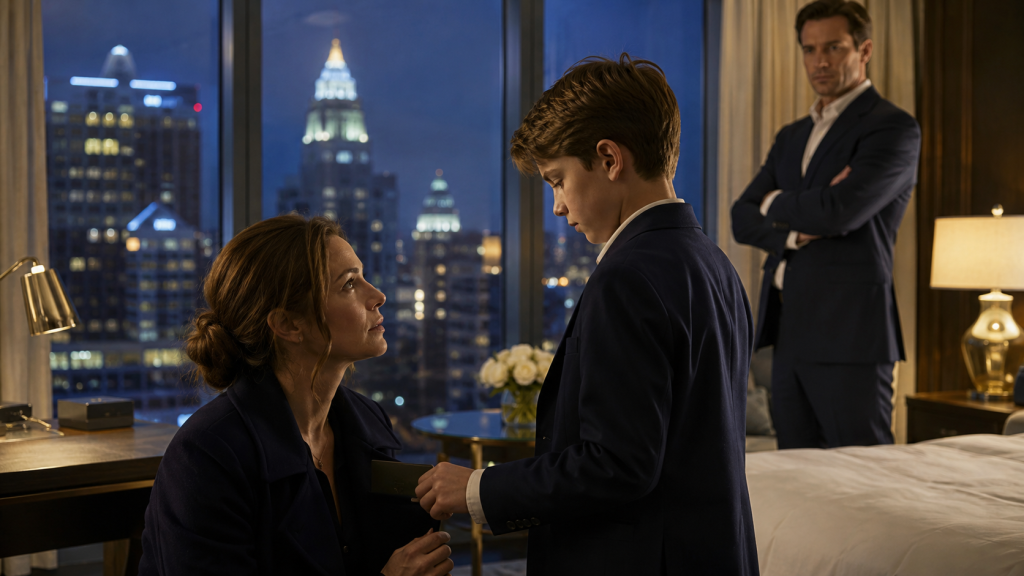
I wore jeans, a sweater, and the long navy coat Noah had slipped the key card into.
The elevator required a room card.
I held the black card against the reader.
The light turned green.
My pulse jumped.
Whatever this was, the card still worked.
I pressed 8.
The elevator doors closed.
By the time they opened again, my palms were damp.
Room 814 stood at the end of a quiet hallway.
I walked toward it.
Every step felt impossibly loud.
I stopped outside the door.
For several seconds, I simply stared.
Then I inserted the card.
Green light.
Click.
I pushed the door open.
The room was empty.
At first, I thought I had made a mistake.
The bed was perfectly made.
The curtains were closed.
No luggage.
No clothes.
Nothing personal.
Then I saw the envelope.
It sat in the center of a small desk.
MOM written across the front.
My knees nearly gave out.
I locked the door behind me and crossed the room.
Inside the envelope was a folded note.
Mom,
I’m sorry.
I didn’t mean what I said.
Dad told me I had to say it exactly like that.
Please don’t be mad.
I kept reading.
Dad said if I chose you, he would make sure you lost the house and that you would have nowhere to live. He said he could prove you were unstable and that if I tried to help you, the judge might stop me from seeing you at all.
I felt the air leave my lungs.
The page trembled in my hands.
There was more.
He told me if I chose him, he would leave you alone. I thought I was protecting you. But after court I heard him talking to someone and realized he lied.
On the desk was a small silver flash drive taped beneath the note.
I removed it carefully.
The final line read:
Please listen before Dad finds out I copied it.
I stared at the drive.
Then at the hotel room around me.
Noah had planned this.
Somehow, my twelve-year-old son had created a way to get evidence to me without Ellis knowing.
I opened my laptop.
My hands were shaking so badly that I inserted the flash drive twice before it connected.
There were six audio files.
Three photographs.
And one document.
I clicked the first recording.
Ellis’s voice filled the room.
“Noah, you need to understand something. Judges care about what children say at your age.”
My blood turned cold.
Then Noah’s voice.
“What if I want to stay with Mom?”
“You don’t.”
“Yes, I do.”
Silence.
Then Ellis again.
“You think you do because she has made you feel responsible for her.”
“That’s not true.”
“Noah, listen to me. Your mother has no money. No job. She can’t even afford the house without me.”
“That’s because you told her not to work.”
A pause.
I covered my mouth.
My son remembered.
Ellis continued.
“If you choose her, things will get ugly. Lawyers. Evaluations. Maybe the house gets sold. Maybe she ends up somewhere much worse. Is that what you want?”
“No.”
“Then help her.”
“How?”
“Tell the judge you want to live with me.”
The file ended.
I sat frozen.
Then I opened the second.
This recording was shorter.
Ellis sounded irritated.
“You cannot hesitate.”
Noah whispered, “I don’t want to hurt her.”
“You’ll hurt her more if you don’t do this.”
“What do I say?”
“Say she can’t give you anything.”
There was a long silence.
Then Noah’s voice cracked.
“That’s mean.”
“It needs to sound believable.”
I began crying.
Not because Noah had betrayed me.
Because he hadn’t.
My child had been sitting in that courtroom carrying the impossible belief that humiliating me was the only way to protect me.
The third recording changed everything.
It was Ellis speaking with another man.
I recognized the voice as Grant Sawyer, Ellis’s business attorney.
“The custody case is finished,” Ellis said.
“Good.”
“She took it exactly how I expected.”
“And the house?”
“Once Noah is permanently with me, I’ll push the sale.”
“You said the house is partly hers.”
“Technically.”
“You cannot simply take her share.”
“I don’t need to. She has no income. She won’t maintain it. Once the support terms are modified, she’ll be forced to sell.”
“And then?”
“I’ll buy it through another entity.”
My stomach turned.
Our house.
The home I had spent fourteen years maintaining.
The place where Noah had taken his first steps.
The backyard where I had planted an oak tree on his fifth birthday.
Ellis wasn’t merely trying to win custody.
He was systematically dismantling my life.
I opened the photographs next.
The first showed screenshots of text messages between Ellis and someone saved as HARRIS.
Keep the boy focused.
Second photograph.
The messages continued.
If he gets emotional, remind him what happens to her financially.
Third photograph.
One line stood out.
Once custody is finalized, she has no leverage.
I stared at the screen.
Then I opened the document.
It appeared to be a draft financial strategy prepared months earlier.
The heading read:
POST-DISSOLUTION ASSET POSITIONING.
There were references to reducing support obligations.
Forcing sale of jointly held property.
Reclassifying expenses.
Moving business assets.
And one sentence that made my entire body go cold.
Primary objective: secure sole residential custody to strengthen negotiation position regarding marital property.
Noah had never been the objective.
He was leverage.
My son had been used as leverage against me.
I called Miriam.
This time, I did not hesitate.
She answered on the second ring.
“Clara?”
“I need you to come to the Wellington.”
“What happened?”
“I have evidence.”
“What kind?”
I looked at the flash drive.
“The kind that could reopen everything.”
There was silence.
Then Miriam’s voice changed.
“I’m coming.”
Forty minutes later, she entered room 814 carrying her briefcase and the expression of someone who already knew this was serious.
We listened to every recording.
She asked where I obtained them.
I told her everything.
The airport.
The card.
The note.
Noah.
When I finished, Miriam leaned back slowly.
“This changes the case.”
“How much?”
“A lot.”
“Can we get him back?”
She didn’t offer false reassurance.
That was one reason I trusted her.
“We can ask the court for emergency review. We can argue coercion, manipulation, potentially witness tampering depending on how the judge interprets Ellis’s conduct. But we need to be careful.”
“Why?”
“Because Noah made these recordings.”
“He was scared.”
“I know. But Ellis’s attorneys will challenge how they were obtained. They’ll say you encouraged him.”
“I didn’t even know.”
“The note helps.”
I handed it to her.
She read it again.
Then she looked at me.
“Do you know where Noah is right now?”
“Ellis said Chicago.”
Miriam’s expression tightened.
“What?”
“I’m not sure he’s in Chicago.”
My heartbeat accelerated.
“Why?”
“This hotel room.”
I looked around.
“What about it?”
“Someone booked it.”
We both turned toward the desk.
Miriam pulled out her phone.
“Clara, a twelve-year-old cannot rent a room.”
A cold sensation spread through me.
Of course.
I had been so focused on the evidence that I hadn’t asked the obvious question.
Who gave Noah access to room 814?
Miriam walked to the hotel phone and called the front desk.
She identified herself as an attorney and asked whether the room was registered to a particular guest.
They refused to answer.
Expected.
Then she asked a different question.
“Can you tell me whether the reservation remains active?”
Pause.
“Yes,” she said.
Another pause.
Her eyes moved to me.
“What time is checkout?”
She listened.
“Thank you.”
She hung up.
“The room is booked until tomorrow.”
“Under whose name?”
“They won’t say.”
I looked at the empty bed.
“Maybe Ellis booked it.”
“That would make no sense if Noah intended to hide this from him.”
Unless someone else was helping Noah.
The answer arrived ten minutes later.
A knock sounded.
Miriam and I froze.
Three slow knocks.
Then two fast ones.
I opened the door cautiously.
A woman stood in the hallway.
Mid-fifties.
Short silver-blond hair.
Cream-colored coat.
I recognized her immediately.
“Elaine?”
Elaine Chappell.
Ellis’s older sister.
We had not spoken in almost three years.
She stepped inside.
“I’m glad you came.”
I stared at her.
“You booked the room?”
“Yes.”
Miriam closed the door.
I could barely process it.
“Why?”
Elaine looked exhausted.
“Because my brother has gone too far.”
She sat near the window.
For the next hour, I learned that Noah had not been completely alone.
After the custody hearing, Ellis took him to Elaine’s home for dinner.
Ellis celebrated.
Actually celebrated.
Champagne.
Steak.
Talk about transferring Noah to a prestigious private school.
Noah barely ate.
Later, Elaine found him crying in her guest bathroom.
“He told me everything,” she said.
“Everything?”
“He told me Ellis threatened you financially.”
My throat tightened.
“Why didn’t you call me?”
“Because Noah begged me not to. He was terrified Ellis would find out.”
Elaine stared at her hands.
“My brother has always been controlling. But I didn’t know how bad it had become until Noah showed me recordings.”
“So you helped him?”
“Yes.”
The hotel room was Elaine’s idea.
She booked it under her own name.
She gave Noah the blank key card.
He wrote the instructions.
The flash drive contained copies.
“The originals are safe,” Elaine said.
“Where?”
“With me.”
Miriam leaned forward.
“Elaine, are you willing to testify?”
She hesitated.
Then nodded.
“Yes.”
I almost cried again.
But Miriam wasn’t finished.
“What else do you know?”
Elaine looked at me.
“There’s more.”
Those three words changed the direction of my entire life.
Elaine explained that Ellis had been hiding substantial marital assets for years.
Accounts.
Investment partnerships.
A property holding company.
Bonuses that had never appeared on the financial disclosures he provided during our divorce.
“I thought they were business arrangements,” she said. “I didn’t understand what he was doing until I saw the asset strategy document Noah copied.”
Miriam’s face hardened.
“You’ve seen it?”
“Yes.”
“Do you know who created it?”
Elaine nodded.
“Grant Sawyer.”
Ellis’s attorney.
The same attorney whose voice appeared on the recording.
Miriam stood.
“We need copies of everything.”
“You’ll have them.”
The following morning, Miriam filed an emergency motion.
What happened afterward moved faster than I expected.
By Monday, we were back inside the same courthouse where I believed I had lost my son.
Only this time, Ellis was not smiling.
He sat beside his attorney with his jaw clenched.
Noah was not present.
The judge had ordered that he remain temporarily with Elaine while the allegations were reviewed.
Ellis objected.
The judge denied his objection.
Then the recordings were played.
I will never forget Ellis’s face when his own voice filled the courtroom.
“You’ll hurt her more if you don’t do this.”
His attorney immediately objected.
Questioned authenticity.
Suggested manipulation.
Argued context.
But then Elaine testified.
She described Noah’s condition after the hearing.
She described Ellis’s comments.
She confirmed helping Noah preserve the recordings.
Then Miriam introduced the financial document.
Ellis’s attorney went pale.
The judge read silently.
Minutes passed.
Nobody moved.
Finally, the judge looked at Ellis.
“Mr. Chappell, did you tell your son that his mother could lose her home if he chose to live with her?”
Ellis leaned toward his microphone.
“I explained financial realities.”
“That was not my question.”
Ellis hesitated.
“I may have discussed possible outcomes.”
The judge’s expression hardened.
“Did you instruct him to say his mother could give him nothing?”
“No.”
Miriam immediately requested permission to play the second recording again.
The judge granted it.
Ellis’s own voice echoed through the room.
“What do I say?”
“Say she can’t give you anything.”
The silence afterward was devastating.
The judge removed her glasses.
“Mr. Chappell, you have placed this court in an extraordinary position.”
Ellis shifted.
His composure was slipping.
“I was trying to protect my son.”
“No,” the judge said. “You were trying to influence his testimony.”
Those words settled over the room.
For the first time in years, Ellis looked genuinely afraid.
The custody order was temporarily suspended.
A guardian ad litem was appointed.
Noah would be interviewed privately.
Both parents would undergo evaluation.
And the court referred the financial evidence for further examination.
Outside the courtroom, Ellis confronted me.
“You think you won?”
I looked at him.
For years, those words would have frightened me.
But something had changed.
Maybe because I finally understood that power only worked when you believed the other person held all of it.
“I think Noah deserves the truth.”
Ellis stepped closer.
“You’re destroying his stability.”
“No. You used his fear to create your stability.”
His face tightened.
“You have nothing without me.”
There it was.
The sentence beneath every argument we had ever had.
The belief beneath every financial decision.
Every time he convinced me not to return to work.
Every time he insisted one income was simpler.
Every time he laughed when I talked about going back to school.
You have nothing without me.
I looked directly at him.
“You already proved that isn’t true.”
Then I walked away.
The investigation lasted six weeks.
They were the longest six weeks of my life.
Noah stayed with Elaine.
I was allowed regular visits.
During our first supervised meeting, he sat across from me with tears in his eyes.
“I’m sorry.”
I moved closer.
“Noah.”
“I didn’t mean it.”
“I know.”
“I thought Dad would hurt you.”
I reached for his hands.
“You should never have had to protect me.”
“But he said—”
“I know what he said.”
His face crumpled.
I pulled him into my arms.
“I need you to understand something.”
He nodded against my shoulder.
“You are the child. I am the parent. It is my job to protect you. Not the other way around.”
“I thought I was helping.”
“You were incredibly brave.”
He looked up.
“You’re not mad?”
“Never.”
That was when he finally cried.
Not quietly.
Not politely.
He sobbed.
Months of fear came pouring out of him.
I held him until he had nothing left.
Then he whispered something that broke my heart in a completely different way.
“Dad said love doesn’t pay for college.”
I closed my eyes.
“No. Love doesn’t pay tuition.”
He looked confused.
“But love also doesn’t threaten you.”
He stared at me.
“Money matters, Noah. Education matters. Opportunities matter. But anyone who tells you love is worthless because it doesn’t come with a price tag doesn’t understand what a future actually is.”
He nodded slowly.
“Are we going to be okay?”
“Yes.”
I didn’t know exactly how.
But for the first time, I believed it.
Because while the custody review continued, something else happened.
The financial forensic team discovered that Ellis had hidden nearly $2.4 million in marital assets.
Investment accounts.
A commercial property share.
Deferred compensation.
Transfers routed through companies I had never heard of.
The divorce settlement was reopened.
The house was no longer vulnerable.
In fact, the court temporarily froze several of Ellis’s accounts pending review.
The irony was difficult to ignore.
The man who spent years telling me I had no financial intelligence had apparently believed I was too foolish to discover his deception.
But losing control did something predictable to Ellis.
He became reckless.
He sent angry emails.
He violated communication guidelines.
He attempted to contact Noah outside approved channels.
Each mistake was documented.
Each one weakened him.
Three months after the airport meeting, the final custody hearing began.
This time Noah entered the courtroom differently.
He still wore a navy blazer.
But his shoulders were relaxed.
He sat beside the guardian appointed to represent his interests.
I deliberately avoided staring at him.
I wanted him to know there was no answer he needed to give for me.
No performance.
No protection.
No pressure.
When the judge asked whether Noah wanted to speak privately, he said yes.
They left the courtroom.
Twenty-three minutes later, the judge returned.
Noah remained outside.
The judge reviewed several documents.
Then she spoke.
“The court finds substantial evidence that Mr. Chappell improperly pressured the minor child regarding custodial preference.”
Ellis stared straight ahead.
“The court further finds that this conduct created emotional distress and undermined the child’s relationship with his mother.”
My hands trembled.
“Primary residential custody will therefore be awarded to Ms. Clara Chappell.”
I stopped breathing.
Miriam touched my arm.
Ellis whispered something to his lawyer.
The judge continued.
“Mr. Chappell will receive structured parenting time, subject initially to therapeutic supervision.”
I heard the words.
But all I could think was:
Noah is coming home.
Outside the courtroom, I found him sitting on a wooden bench.
He stood when he saw me.
Neither of us spoke.
Then he smiled.
A real smile.
The first one I had seen in months.
“Can we go home?”
Three words.
That was all.
I hugged him.
“Yes.”
We drove back to the house together.
Nothing had changed physically.
Same driveway.
Same mailbox.
Same oak tree.
But when Noah walked through the front door, he stopped.
His eyes moved around the hallway.
Then he dropped his backpack.
“Can I see my room?”
I laughed through tears.
“It’s exactly the way you left it.”
He ran upstairs.
I stood at the bottom of the staircase listening to his footsteps.
For years, Ellis had taught me to measure security in numbers.
Income.
Net worth.
Square footage.
School rankings.
Investment returns.
And those things mattered.
But standing there, I understood something more important.
A future was not simply something purchased.
It was something built.
Slowly.
Honestly.
One safe day at a time.
The financial case continued long after custody ended.
Ellis eventually agreed to a revised settlement rather than face a longer public dispute.
I received my proper share of the hidden marital assets.
The house became entirely mine.
More importantly, I made a decision I should have made years earlier.
I returned to work.
Before Noah was born, I had worked in marketing.
I had loved it.
Ellis convinced me that staying home was practical.
Then practical became permanent.
Then permanent became dependence.
So I enrolled in a certification program.
Updated my skills.
Built a portfolio.
Started freelancing.
My first client paid me $850.
I printed the payment receipt.
Not because it was a fortune.
Because it represented something bigger.
Choice.
Six months later, I accepted a position with a regional nonprofit.
The salary was modest compared with Ellis’s income.
But when I received my first paycheck, Noah insisted we celebrate.
“Where do you want to eat?” I asked.
He thought carefully.
“Pizza.”
“Fancy.”
“With extra cheese.”
“Very fancy.”
We sat in a small neighborhood restaurant under plastic red lamps.
No white tablecloths.
No expensive reservations.
No private room.
No valet parking.
No waiters who remembered Ellis’s name.
Noah raised his soda.
“To Mom’s future.”
I nearly cried.
I lifted my glass.
“To ours.”
We clinked them together.
Life did not become perfect.
Noah still loved his father.
That was complicated.
And painful.
And healthy.
I never asked him to choose emotionally.
Ellis was still his father.
Therapy helped Noah separate loving someone from approving of what they had done.
Eventually, supervised visits became ordinary visits.
Ellis became quieter.
Whether that was genuine change or simply consequence, I could not say.
But boundaries remained firm.
One evening, nearly a year after the original custody hearing, Noah and I were cleaning out a kitchen drawer when I found the black hotel key card.
I had forgotten I kept it.
He noticed immediately.
“Oh.”
I held it up.
“You know, this little thing caused a lot of trouble.”
He smiled nervously.
“Sorry?”
I laughed.
“Good trouble.”
He took the card.
For a moment, he studied his handwriting on the back.
ROOM 814. THURSDAY. ALONE.
Then he looked embarrassed.
“That was dramatic.”
“You were twelve.”
“I watched too many spy movies.”
“I gathered.”
He flipped the card between his fingers.
“Were you scared?”
“Yes.”
“When you went there?”
“Very.”
He nodded.
“I was scared too.”
I sat beside him.
“I know.”
He looked down.
“Sometimes I still feel bad about what I said.”
I took the card gently from his hand.
“Noah, look at me.”
He did.
“You told the truth afterward.”
“But everyone heard me say you couldn’t give me anything.”
“And you know what happened?”
“What?”
“You gave me something.”
His eyebrows lifted.
“What?”
“A reason to stop believing your father when he said I was powerless.”
He stared at me.
I continued.
“You thought you were saving me. You never should have been put in that position. But your courage helped expose what was happening.”
His eyes filled.
“So you don’t remember the courtroom when you think about it?”
“I remember it.”
I smiled.
“But I remember the airport more.”
He smiled back.
I placed the black card in his palm.
“You keep it.”
“Why?”
“Because one day, when something feels impossible, I want you to remember that being afraid does not mean you’re helpless.”
He closed his fingers around the card.
Years passed.
Noah grew taller.
His voice deepened.
The navy blazer from the custody hearing eventually became too small and disappeared into a donation box.
He joined the robotics club.
Then debate.
Then student council.
At sixteen, he got his first job at a bookstore.
Ellis offered to buy him a car.
Noah accepted the car only after insisting he would pay for his own gas.
I said nothing.
But privately, I smiled.
At seventeen, Noah began applying to colleges.
One Saturday morning, we sat at the kitchen table surrounded by brochures.
He looked overwhelmed.
“Too many options.”
“You’ll figure it out.”
“What if I choose wrong?”
“You probably will at some point.”
He stared at me.
“That’s terrible advice.”
“It’s excellent advice.”
“How?”
“Because your future isn’t one decision. It’s thousands.”
He leaned back.
“Dad says I should go to Wharton.”
“What do you want?”
“I don’t know.”
“Then don’t decide based on what either of us wants.”
He smiled.
“You’re not going to manipulate me?”
“I considered dramatic threats.”
“Nice.”
“Maybe tell you I’ll lose the house if you major in art history.”
He laughed.
That joke would once have been impossible.
Now it felt like evidence of healing.
Noah eventually chose Northwestern.
Not because Ellis wanted it.
Not because I wanted it.
Because Noah wanted it.
The night before we drove him to campus, I passed his bedroom and saw something sitting on his desk.
The black hotel card.
He had kept it all those years.
Beside it was a photograph of us at the pizza restaurant.
My first-job celebration.
Cheap soda.
Paper plates.
Huge smiles.
I stood in the doorway.
“You packing that?”
He followed my gaze.
“The card?”
“Yes.”
He nodded.
“Definitely.”
I leaned against the frame.
“Still watching spy movies?”
“Obviously.”
Then he became serious.
“I remember what you told me.”
“What?”
“That being scared doesn’t mean you’re helpless.”
I smiled.
He added, “And that a future isn’t something somebody gives you.”
I felt my throat tighten.
“No.”
“You build it.”
I nodded.
“Yes.”
The next morning, we loaded the car.
Ellis met us at the university later that afternoon.
Our relationship had settled into something distant but functional.
He had changed in some ways.
Or perhaps consequence had taught him limits.
Either way, Noah no longer feared him.
That mattered more than anything.
After we finished moving boxes into the dorm, the three of us stood outside beneath a row of trees.
For one strange second, I remembered the courthouse.
Noah at twelve.
Ellis in his gray suit.
Me feeling like my entire existence had been erased by one sentence.
Mom can’t give me the kind of future I need.
If I could have spoken to that version of myself, I would have told her something simple.
Do not confuse this moment with the ending.
Sometimes the worst sentence you hear is not the truth.
Sometimes betrayal is fear wearing a disguise.
Sometimes people who appear powerless are simply waiting for the one piece of information that changes everything.
And sometimes the person who saves you is the child you thought you had lost.
Noah hugged Ellis first.
Then he walked toward me.
“You okay?”
“Absolutely.”
“You’re crying.”
“Allergies.”
“In August?”
“Very aggressive pollen.”
He laughed and hugged me.
Then he whispered,
“You gave me a good future, Mom.”
I closed my eyes.
For twelve years after he was born, I thought giving him a future meant protecting him from disappointment.
Then I thought it meant having enough money.
Enough opportunities.
Enough security.
But standing there, I finally understood.
The best thing I had given Noah was not a house.
Not tuition.
Not a prestigious school.
It was permission to tell the truth.
Permission to choose without fear.
Permission to become his own person.
I pulled back.
“You gave yourself one.”
He smiled.
Then he walked toward his dorm.
Halfway there, he turned.
Raised one hand.
And disappeared through the doors.
I stood beneath the afternoon sun feeling something I had not felt the day I left the courthouse years earlier.
Peace.
Ellis stood several feet away.
For a while, neither of us spoke.
Then he said quietly,
“You did a good job with him.”
I looked at him.
Years earlier, those words would have meant everything.
Now they were simply words.
“I know.”
His expression shifted.
Not anger.
Something closer to acceptance.
Then he nodded and walked away.
I remained there another minute.
Thinking about courtroom benches.
Airport terminals.
Hotel rooms.
Flash drives.
Court orders.
First paychecks.
Pizza dinners.
College applications.
All the strange pieces of a life that once looked completely shattered.
My phone buzzed.
A message from Noah.
Look in your purse.
I frowned.
Then laughed.
Inside the front pocket was the black hotel key card.
On the back, beneath his old twelve-year-old handwriting, he had added a new line.
YOU CAN KEEP IT THIS TIME.
And underneath:
Thanks for believing me before I knew how to believe myself.
I pressed the card against my chest.
Around me, students hurried between buildings.
Parents carried boxes.
Cars arrived.
Doors opened.
Lives moved forward.
Years earlier, Ellis had convinced me that a future belonged to whoever could afford the most impressive version of it.
He had been wrong.
A future could be rebuilt.
A mother could begin again.
A frightened child could find his voice.
A woman who had spent fifteen years believing she had nothing could discover that independence was not something someone else granted her.
It was something she claimed.
I slipped the black card into my wallet.
Not because I needed evidence anymore.
Not because I was afraid.
But because some objects stop being reminders of what happened and become reminders of who you became afterward.
Then I looked once more toward Noah’s dorm.
And I smiled.
The boy who once told a courtroom I could not give him a future had grown into a young man who understood the truth.
I had never needed to give him one.
I only needed to love him enough to help him build his own.
And in the process, I had finally built mine too.
💬THE END! THANK YOU FOR READING!