

My father’s hand tightened around the phone so hard that I could almost hear the leather case creak through the line.
“Emily,” he said again, but the authority had disappeared from his voice. “Who exactly did you marry?”
I looked across the hotel suite at Adrian.
Morning sunlight fell through the enormous windows behind him, outlining the calm set of his shoulders. He was still wearing the dark glasses he had worn throughout our wedding. His white shirt sleeves were rolled neatly to his forearms, his tie was gone, and there was something almost amused in the way he tilted his head toward my father’s voice.
For less than twenty-four hours, Adrian Vale had been my husband.
For less than twenty-four hours, my family had believed they had handed me over to a man they considered damaged, dependent, and easy to manipulate.
And now a convoy of black cars was parked outside our hotel.
I turned toward the window.
Men and women in tailored suits were stepping onto the sidewalk. Two carried briefcases. One woman was already speaking into her phone while another opened the rear door of the center vehicle.
No one moved like an employee arriving to serve a helpless man.
They moved like an executive team arriving to take control of a crisis.
I brought the phone back to my ear.
“Someone you should have researched more carefully,” I told my father.
There was silence.
Then Dad lowered his voice.
“You come home immediately.”
The command was so familiar that my body reacted before my mind did.
My shoulders tightened.
My stomach knotted.
For nearly three decades, those four words had been enough.
Come home immediately.
When I was nineteen and stayed too late at a university study group.
Come home immediately.
When I was twenty-three and interviewed for a job Dad hadn’t approved.
Come home immediately.
When I once suggested selling the small block of Whitmore shares my grandmother had placed in my name.
Each time, I had obeyed.
Each time, I had told myself I was keeping the peace.
But peace built on fear was only obedience wearing nicer clothes.
“No,” I said.
The word came out quietly.
Dad apparently didn’t hear it.
“What?”
“I said no.”
Across the room, Adrian’s mouth curved slightly.
My father inhaled.
“Emily, you have no idea what you’re involved in.”
“I think that’s the problem,” I replied. “I finally do.”
I ended the call.
For several seconds, I simply stood there with the phone in my hand.
My heart was hammering.
Not because I regretted hanging up.
Because I had never done it before.
Adrian extended his hand toward me.
“Come here.”
I crossed the room and placed my fingers in his.
His grip was warm and steady.
“You’re shaking,” he said.
“I just hung up on my father.”
“Terrifying man?”
“When I was eight, he fired our housekeeper because she let me eat chocolate cake before dinner.”
Adrian considered that.
“Monstrous.”
Despite everything, I laughed.
It surprised me.
So did the sudden sting of tears behind my eyes.
Adrian must have heard the change in my breathing.
“You don’t have to pretend with me,” he said.
That sentence nearly broke me.
For years, pretending had been my greatest skill.
Pretending Vanessa’s jokes didn’t hurt.
Pretending Mother’s disappointment didn’t matter.
Pretending Dad’s control was concern.
Pretending I didn’t notice when board conversations stopped the moment I entered a room.
Pretending I believed them when they said I was too emotional for business.
Too sensitive.
Too indecisive.
Too soft.
Too weak.
I pulled in a slow breath.
“I’m not going to cry.”
“You’re allowed.”
“I know.”
That was new too.
A knock sounded at the suite door.
Adrian released my hand.
“That will be Mara.”
I blinked.
“Who’s Mara?”
“My chief legal officer.”
Before I could respond, Adrian crossed the room with the ease of someone who knew its dimensions perfectly. His cane found the carpet edge near the sitting area, then the wood floor leading to the door.
There was no hesitation in his movements.
No helplessness.
No uncertainty.
Nothing remotely resembling the man my father had described.
Adrian opened the door.
A woman in her early forties entered wearing a charcoal suit and carrying a slim leather folder.
“Good morning,” she said. “Congratulations, by the way.”
“Thank you,” Adrian replied.
She looked at me.
“Mrs. Vale.”
The name startled me.
Emily Vale.
Yesterday it had felt like a sentence.
This morning it sounded strangely like a beginning.
“Emily is fine.”
“Mara Chen.”
We shook hands.
Her expression was calm but direct.
Then she handed Adrian the folder.
“Whitmore Properties’ financing package is ready for signature. Their bridge facility expires at five this afternoon. Without the Vale Meridian commitment, their lenders are unlikely to extend.”
My stomach dropped.
I looked at Adrian.
“How bad is it?”
Mara glanced at him.
He nodded.
She opened the folder.
“Whitmore has approximately one hundred and eighty-seven million dollars in outstanding short-term obligations across several subsidiaries. Twenty-eight million comes due immediately. Another sixty-three million matures within ninety days.”
I stared at her.
“That can’t be right.”
“It is.”
“My father always said the company had very little debt.”
“Your father says many things,” Adrian replied.
Mara continued.
“More concerning is how some of that debt was collateralized.”
She placed several documents on the table.
I recognized three subsidiary names instantly.
Whitmore Development Holdings.
Rosewood Asset Management.
CWH Legacy Partners.
My grandmother’s trust held interests in all three.
My fingers went cold.
“They used the trust assets.”
“Indirectly,” Mara said. “Which is how they likely intended to defend it.”
I leaned closer.
The papers were filled with corporate language, but I had spent years quietly learning the vocabulary my father insisted women like me didn’t need.
Cross-guarantees.
Pledged interests.
Preferred distributions.
Collateral assignments.
Dad and Vanessa hadn’t simply borrowed against company assets.
They had positioned liabilities around my grandmother’s holdings so that if the debt collapsed, the trust would absorb part of the damage.
My inheritance had been turned into a shield for their bad decisions.
I sat slowly.
“They thought I’d never look.”
“They were counting on that,” Adrian said.
I looked at him.
“And you knew?”
“Not all of it. My team discovered the structure while reviewing your father’s financing request.”
“Then why agree to marry me?”
It was the question I had barely slept because of.
The air in the room changed.
Mara quietly gathered several papers.
“I’ll give you both a moment.”
When the door closed behind her, Adrian remained silent.
I folded my arms.
“You said you agreed because my father offered the marriage as proof of permanent family alignment.”
“He did.”
“That isn’t an answer.”
“No.”
I waited.
Adrian removed his glasses.
I had seen his eyes only once before, late the previous night after he told me the truth.
They were dark brown but unfocused, with faint scarring near his left temple from the accident.
He faced me.
“I first heard your name six years ago.”
My anger faltered.
“What?”
“My father came home furious after a Whitmore board dinner. He told me Charles Whitmore had two daughters. One, he said, was loud enough to inherit the room. The other was quiet enough to notice everything happening inside it.”
I said nothing.
“He meant you.”
“My father knew yours?”
“They competed. Occasionally cooperated. Mostly distrusted each other.”
“That sounds accurate.”
Adrian smiled briefly.
“After my accident, I stepped away from public appearances. Your father assumed that meant I stepped away from business.”
“So did everyone.”
“That was useful.”
I paced toward the windows.
“Still doesn’t explain the marriage.”
“No.”
I turned.
Adrian’s expression became serious.
“When your father approached Vale Meridian six months ago, he didn’t know I personally reviewed distressed-company transactions.”
My pulse slowed.
“I saw the Whitmore file.”
“And?”
“And I saw your name.”
I stared.
“You remembered me from something your father said six years earlier?”
“I remembered the unusual trust structure attached to your name. Then I saw signatures authorizing transactions that didn’t match earlier examples of your signature.”
My stomach twisted.
“What are you saying?”
“I’m saying I suspected someone might be acting without your informed approval.”
For a moment, I couldn’t breathe.
“Forgery?”
“Possibly.”
I thought of the endless papers Dad had pushed across desks.
Routine approvals.
Tax restructuring.
Estate housekeeping.
Documents Vanessa had joked were too boring for me to understand.
I had signed some.
Not others.
And suddenly I couldn’t remember which was which.
Adrian continued.
“When your father proposed the marriage, I assumed you were involved.”
“That I was helping him?”
“Yes.”
“Were you planning to use me to investigate him?”
He didn’t answer immediately.
That hurt more than if he had lied.
“At first,” he said, “I intended to understand what you knew.”
I laughed once, without humor.
“So we were both traded.”
“I won’t insult you by pretending my motives were noble.”
I looked away.
Yesterday, I had been furious at my family for treating my marriage like a financial instrument.
Now I discovered Adrian had entered it with calculations of his own.
“That sounds a lot like using me.”
“It was.”
His honesty stopped me.
Adrian rested both hands on the top of his cane.
“But then I met you.”
“When?”
“Your father arranged that charity dinner three months ago.”
I remembered.
Adrian had sat across from me but barely spoken.
Vanessa had spent the evening loudly describing skiing trips to a blind man.
I had wanted to crawl under the table from embarrassment.
“I thought you hated me.”
“I thought you hated me.”
“Why?”
“You barely spoke.”
“My sister asked whether you missed sunsets.”
“I remember.”
“I was trying not to throw my drink at her.”
“That would have improved the dinner.”
A reluctant smile pulled at my mouth.
Adrian continued.
“Afterward, you helped an elderly waiter pick up a tray Vanessa knocked over.”
“So?”
“Everyone else stepped around him.”
I looked down.
“It wasn’t important.”
“It told me something.”
“What?”
“That you weren’t like them.”
The room went quiet.
Then Adrian said, “If you want this marriage annulled, I will arrange it immediately. Your trust will still be protected. My team will still give you the evidence we have.”
I looked at him.
“You would do that?”
“Yes.”
“Even if it hurts your leverage with my father?”
“Yes.”
“Why?”
“Because whatever arrangement Charles thought he made, he did not purchase you.”
Something inside my chest shifted.
No one in my family had ever spoken about my choices that way.
I walked back to the table.
The financing package waited there.
“What happens if you cancel Whitmore’s loan?”
Adrian’s expression changed.
“The company goes into crisis.”
“How quickly?”
“Hours.”
“And my father?”
“He loses control.”
I stared at the signature line.
“Cancel it.”
Adrian tilted his head.
“Are you sure?”
“For the first time in my life.”
He reached for his phone.
“Mara.”
She entered almost immediately.
“The financing is canceled,” Adrian said.
Mara gave one nod.
“Understood.”
My phone began ringing before she reached the door.
Dad.
I declined the call.
It rang again.
Vanessa.
Decline.
Mother.
Decline.
Dad again.
Then a message appeared.
COME TO THE OFFICE.
A second followed.
NOW.
I stared at the screen.
Adrian said, “We should probably go.”
I looked at him.
“To Whitmore?”
“Yes.”
“Why?”
“Because I suspect your father is about to call an emergency board meeting.”
He slipped his glasses back on.
“And because you should be there when he discovers whose votes actually matter.”
An hour later, the convoy pulled into the circular driveway of Whitmore Properties headquarters.
I had entered that building thousands of times.
As a child holding my father’s hand.
As a teenager visiting after school.
As an adult carrying coffee no one had requested, sitting silently at board lunches I had not been invited to participate in.
But I had never arrived like this.
Three black sedans stopped beneath the stone canopy.
Security officers rushed forward.
Employees gathered behind the glass walls of the lobby.
Someone clearly had recognized the Vale Meridian insignia on one of the vehicles.
Mara stepped out first.
Then two attorneys.
Then Adrian.
I climbed out beside him.
The whispering started immediately.
Inside, Vanessa stood near reception wearing yesterday’s confidence with none of yesterday’s color.
Dad stood beside her.
Mother was there too.
My mother never came to the office unless there were photographers or champagne involved.
That told me everything.
Dad crossed the lobby toward us.
“What is the meaning of this?”
Adrian calmly adjusted his cuff.
“Good morning, Charles.”
Dad ignored him.
“Emily.”
For years, he could say my name in a way that turned me twelve years old again.
This time it didn’t work.
“Dad.”
“We need to speak privately.”
“No.”
His eyes flickered.
Vanessa marched forward.
“What is wrong with you?”
I almost laughed.
“You’re going to have to be more specific.”
“You humiliated this family.”
“It hasn’t even been twenty-four hours since my wedding.”
“Exactly.”
Vanessa lowered her voice.
“You married him and suddenly think you’re important?”
Adrian’s face remained neutral.
My mother hissed, “Vanessa.”
But my sister had never known when to stop.
She looked directly at Adrian.
“You should understand something. Emily has never had anything to do with business decisions. She gets emotional. She misunderstands things.”
There it was.
The script.
The one they had repeated so often even I had started believing it.
I opened my handbag and removed a folder.
“Then maybe you can explain these.”
I placed copies of three loan agreements onto the reception desk.
Vanessa froze.
Dad did not.
He was better at hiding fear.
“Where did you get those?”
I smiled.
“Interesting question.”
“They’re confidential.”
“So is my trust.”
Mother’s face changed.
“Emily, this is not the place.”
“It’s exactly the place.”
Employees were pretending not to listen.
Some weren’t even pretending anymore.
Dad stepped closer.
“You are coming upstairs.”
Adrian moved slightly.
Not between us.
Just close enough that I knew he was there.
“No,” I said again.
Dad looked at him.
“You stay out of family business.”
Adrian turned his face toward Dad’s voice.
“You asked my company for one hundred and twenty million dollars.”
“That was a corporate negotiation.”
“You offered your daughter as reassurance.”
Mother went completely still.
Vanessa’s mouth opened.
Dad’s face hardened.
“Be careful.”
“I was,” Adrian replied. “That’s why I recorded the meeting.”
The lobby fell silent.
Even the receptionist stopped typing.
Dad’s complexion drained.
“You recorded—”
“My representatives informed everyone present that the meeting would be documented.”
Mara opened her folder.
“Your counsel acknowledged the disclosure in writing.”
Dad looked toward his general counsel, who had just appeared near the elevators.
The man avoided his eyes.
I almost admired the efficiency of it.
My father had spent decades making other people uncomfortable.
Now everyone in the room was watching him experience it.
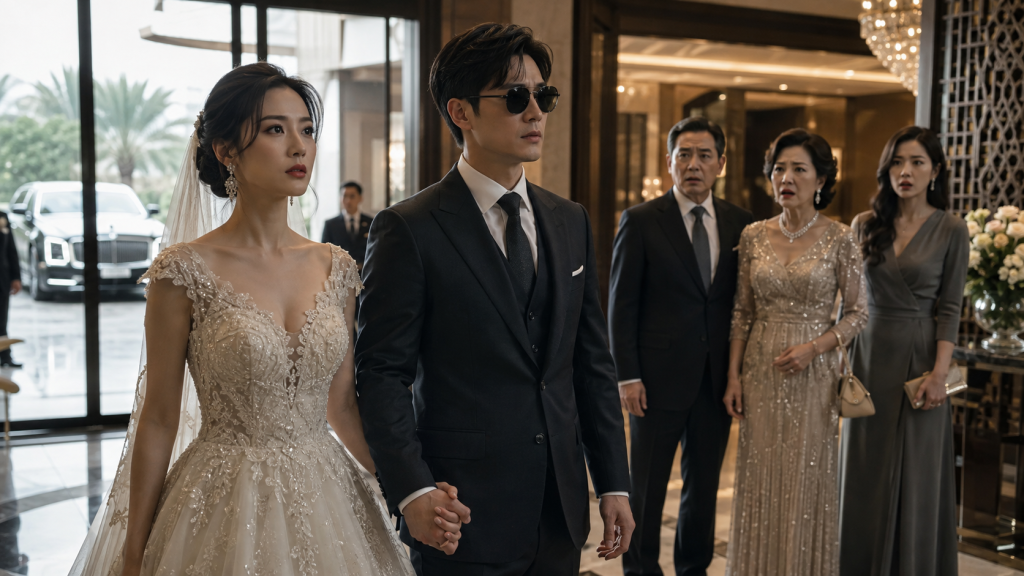
He turned back to me.
“This is ridiculous. Whatever Adrian thinks he heard—”
“He heard you describe me as an asset.”
Dad’s jaw flexed.
“That was business language.”
“You said marrying me would guarantee permanent cooperation between our families.”
“Because marriage creates alignment.”
“You said I was compliant.”
My mother closed her eyes.
Vanessa looked at Dad.
He said nothing.
That silence answered everything.
I swallowed.
Even knowing the truth did not prepare me for hearing its shape in public.
Adrian’s hand brushed mine.
Not grabbing.
Not claiming.
Just there.
I let my fingers curl around his.
Dad saw.
And something ugly flashed across his face.
“You think he cares about you?” he said.
There was almost relief in his voice now, as though he had found the weapon he understood.
“You think this man married you for love?”
I felt Adrian go still beside me.
Dad continued.
“He married you because you were useful.”
The words hurt because they contained enough truth to cut.
I looked at Adrian.
He did not interrupt.
He did not defend himself.
He let me choose what came next.
So I faced my father.
“At least he told me.”
Dad’s expression shifted.
“You lied to me for twenty-nine years.”
“I protected you.”
“You controlled me.”
“We gave you everything.”
“You gave me everything except permission to become someone you couldn’t manage.”
Mother stepped forward.
“Emily, sweetheart, please.”
I looked at her.
She almost never called me sweetheart unless she wanted something.
“You knew?”
Her lips parted.
That was enough.
I stared at her.
“You knew about the marriage proposal?”
“Your father said it would secure everyone’s future.”
“Mine too?”
“Of course.”
“How?”
No answer.
I nodded slowly.
“That’s what I thought.”
The elevator doors opened.
Six board members stepped into the lobby.
One of them, Arthur Bell, had worked with my grandmother before my father became CEO.
He looked at me, then at Dad, then at the army of lawyers standing behind Adrian.
“Well,” he said, “I suppose the meeting has started early.”
Dad straightened.
“There will be no meeting.”
Arthur lifted one eyebrow.
“I received notice of an emergency session twenty minutes ago.”
Dad glanced toward his counsel.
“I didn’t authorize that.”
“No,” Arthur said. “Emily did.”
Every head turned toward me.
Including mine.
I looked at Mara.
She smiled faintly.
Adrian whispered, “I’ll explain upstairs.”
The boardroom occupied the top floor.
I had been allowed inside exactly four times in my life.
Once for a holiday photograph.
Twice to deliver documents.
Once when Vanessa became vice president and Dad made me sit in the back while everyone toasted her promotion.
Now I took a seat at the table.
Not the back.
The table.
Dad remained standing.
“She has no authority to convene this board.”
Mara opened a binder.
“According to the Whitmore charter, any shareholder controlling more than fifteen percent of voting stock may call an emergency meeting in the event of material financial risk.”
Dad scoffed.
“Emily doesn’t control fifteen percent.”
Mara looked directly at him.
“Yes, she does.”
Silence.
Vanessa laughed.
It sounded nervous.
“No. Grandma’s shares were transferred into the family holding company.”
Mara slid a document across the table.
“Economic interests were transferred.”
She tapped another page.
“Voting rights were not.”
Dad didn’t touch the document.
Arthur Bell did.
He adjusted his glasses.
Then he read it twice.
“My God.”
Mother leaned toward him.
“What?”
Arthur looked at me.
“Your grandmother retained voting rights for Emily’s shares until Emily turned thirty.”
I frowned.
“I’m twenty-nine.”
“Correct.”
“Then Grandma still controls them?”
Arthur shook his head.
“She died.”
My heart started pounding.
Mara answered.
“The trust instrument provides that upon Eleanor Whitmore’s death, voting authority transfers directly to Emily.”
Vanessa stood.
“That’s impossible.”
“No,” Arthur said quietly. “It isn’t.”
Dad finally grabbed the document.
His eyes moved down the page.
Once.
Twice.
He went white.
I stared at him.
“You didn’t know?”
He didn’t answer.
And suddenly I understood.
My grandmother had distrusted him too.
Maybe she had seen what I was only now beginning to understand.
She had built a door into my cage.
And Dad had never found the key.
“How much?” I asked.
Mara placed another sheet in front of me.
“Seventeen-point-four percent.”
My breath caught.
Arthur leaned back.
“Combined with the independent directors—”
“Enough to block extraordinary financing,” Mara said.
“And enough,” Adrian added, “to demand a forensic audit.”
Dad slammed the papers onto the table.
“No.”
I looked at him.
“No?”
“This company employs three thousand people. You will not destroy it because your feelings are hurt.”
The old shame tried to rise.
Feelings.
That word again.
As though emotion automatically made facts disappear.
I folded my hands.
“I don’t want to destroy Whitmore.”
“Then sign the financing authorization.”
“No.”
“You have no idea what happens next.”
“Then explain it.”
Dad stared.
I continued.
“Explain why the company is one missed payment away from default.”
No answer.
“Explain why debt was moved into entities connected to Grandma’s trust.”
Silence.
“Explain why appraisals were altered.”
Vanessa’s head snapped toward Dad.
There.
That reaction mattered.
I saw Adrian angle his face slightly.
He had noticed too.
I turned to Vanessa.
“You didn’t know about the appraisals?”
She recovered quickly.
“I have no idea what nonsense you’re talking about.”
I opened the folder.
Three years of documents sat inside.
Three years of being dismissed had given me a great deal of free time.
I pulled out two appraisals for the same property.
Whitmore Lakes Commercial Center.
One valued it at forty-two million dollars.
The other at sixty-eight.
Same month.
Same supposedly independent evaluator.
Different lender.
Arthur examined them.
“This is serious.”
Dad pointed at me.
“Those documents were stolen.”
“They were stored on a family-company server I had authorized access to.”
“You copied confidential information.”
“Yes.”
“You had no right.”
I looked at him.
“You pledged my assets against your debt.”
That ended the argument.
For a moment.
Then Vanessa leaned across the table.
“This is insane. What do you want, Emily?”
The question sounded genuinely baffled.
“What do I want?”
“Yes. Money? A title? An apology?”
She laughed sharply.
“Is this because nobody made you vice president?”
I looked at my sister.
For most of my life, Vanessa had been the sun in our family.
Beautiful.
Confident.
Quick.
Dad praised her ambition.
Mother praised her elegance.
People moved around her.
I had mistaken visibility for strength.
But now I noticed something I had never seen before.
She was scared.
Not of losing money.
Of losing position.
“I want the truth,” I said.
“That’s childish.”
“No. Thinking the truth belongs only to people with power is childish.”
Vanessa sat back.
Adrian’s attorney distributed audit resolutions.
Dad refused to look.
“You can force a vote,” he said. “You cannot force me to cooperate.”
Arthur spoke.
“Charles, if these documents are authentic, cooperation may be the least of your concerns.”
Dad turned on him.
“You owe everything to this company.”
Arthur’s expression hardened.
“I owe my fiduciary duty to its shareholders.”
The vote happened eleven minutes later.
Four in favor.
Two against.
One abstention.
The forensic audit passed.
Dad left the room without speaking to me.
Vanessa followed.
Mother remained for several seconds.
She looked suddenly older.
“Emily.”
I waited.
Her eyes filled.
“You have no idea what you’ve done.”
That sentence used to terrify me.
Now it only made me tired.
“No, Mom. You have no idea what you did.”
She walked out.
The door closed.
I sat very still.
Then my hands started shaking again.
Arthur and the other directors left gradually.
Mara began gathering paperwork.
Adrian remained beside me.
Finally, the room was quiet.
“I thought revenge would feel better,” I said.
Adrian nodded.
“It rarely feels the way people imagine.”
“I’m not even happy.”
“You’re not supposed to be.”
I looked at him.
“What am I supposed to be?”
“Free.”
I swallowed.
“That doesn’t feel good either.”
“Not yet.”
The audit began that afternoon.
By evening, Whitmore’s lenders had been notified of material irregularities.
By the following morning, two banks had frozen additional credit lines.
By the third day, the company’s outside accountants resigned from a pending certification.
Dad blamed me publicly.
Of course he did.
A statement appeared in the financial press describing the crisis as “a family disagreement involving an inexperienced minority shareholder.”
I read it over breakfast.
Adrian sat across from me.
“Inexperienced,” I said.
“You dislike that word.”
“I’ve been reading Whitmore financial statements since I was seventeen.”
“Then it’s inaccurate.”
“They know that.”
“That’s why they used it.”
I put the tablet down.
“What would you do?”
Adrian poured coffee carefully.
“Nothing.”
I frowned.
“Nothing?”
“For forty-eight hours.”
“Why?”
“People reveal more when they believe you’re losing.”
I watched him.
“You’ve done this before.”
“Many times.”
“You enjoy this.”
“I enjoy patience.”
“Same thing.”
“No. Revenge is emotional. Strategy is expensive.”
I smiled despite myself.
Then my phone buzzed.
Vanessa.
I almost ignored it.
Adrian said nothing.
I answered.
“What?”
Her voice was low.
“We need to meet.”
“No.”
“Emily.”
“I’m done taking orders.”
“I’m not ordering you.”
That got my attention.
Vanessa had never admitted to requesting anything in her life.
“What do you want?”
“To talk without Dad.”
I looked toward Adrian.
He was facing the window.
Giving me privacy while hearing every word.
“Where?”
“The old greenhouse at Grandma’s house.”
My chest tightened.
The Whitmore estate had been sold two years after Grandma died, but the greenhouse remained on a neighboring parcel held by the family trust.
We had played there as children.
Before comparison became competition.
Before Dad taught Vanessa to win and me to disappear.
“Tomorrow,” I said.
“No lawyers.”
“I decide who comes.”
“Emily—”
“Tomorrow at ten.”
I ended the call.
Adrian turned.
“You’re going.”
“Yes.”
“I assume you don’t want me there.”
I hesitated.
“I want you nearby.”
“Done.”
The next morning, the greenhouse looked smaller than I remembered.
I entered alone.
Vanessa stood beside an old iron table.
No makeup.
No heels.
No perfect posture.
For the first time in years, she looked like my sister instead of my opponent.
“You came,” she said.
“What do you want?”
She rubbed her hands together.
“Dad lied to me too.”
I almost laughed.
“That’s your opening?”
“I didn’t know about the inflated appraisals.”
“But you knew about the debt.”
“Yes.”
“You signed documents.”
“I signed what he put in front of me.”
The irony nearly took my breath.
“You mocked me for doing exactly that.”
Her face tightened.
“I know.”
I waited.
Vanessa looked around the greenhouse.
“Do you remember when Grandma used to hide lemon drops in that cabinet?”
I stared at her.
“Why are we talking about candy?”
“Because I’m trying to remember when everything became like this.”
I crossed my arms.
“You mean when you started enjoying it?”
She flinched.
Good.
I wanted her to.
“I was horrible to you.”
“Yes.”
“I thought you were weak.”
“You told me often.”
“Dad told me first.”
I said nothing.
Vanessa looked down.
“When we were teenagers, he told me that one of us had to be strong because you weren’t built for the real world.”
Something cold settled in my chest.
“He told you that?”
“All the time.”
“He told me you were smarter.”
Her head lifted.
“What?”
“He said I should stop competing because I would embarrass myself.”
Vanessa stared at me.
I laughed softly.
“Efficient, wasn’t he?”
She sat down.
For several moments neither of us spoke.
Then Vanessa said, “He made us compete for things that belonged to both of us.”
“Yes.”
“I still chose how I treated you.”
“Yes.”
Her eyes filled.
“I’m sorry.”
I wanted the apology to heal something.
It didn’t.
Maybe forgiveness was not a door.
Maybe it was a road.
“I don’t know what to do with that yet,” I said.
“You don’t have to do anything.”
That was the first decent thing my sister had said to me in years.
She reached into her bag.
“I brought something.”
A flash drive.
I didn’t take it.
“What is it?”
“Dad’s private correspondence with Martin Kessler.”
I knew the name.
Whitmore’s chief financial officer.
“What’s in it?”
“Proof the appraisals were intentional.”
My stomach tightened.
“How did you get this?”
“Kessler sent copies to me because he wanted protection.”
“From Dad?”
“From both of us.”
“Why give it to me?”
Vanessa gave a bitter laugh.
“Because apparently you’re the only person in this family who saved evidence instead of excuses.”
I finally took the drive.
“What happens to you if this comes out?”
“I lose my position.”
“Maybe more.”
“I know.”
“You could be implicated.”
“I know.”
I studied her.
“Why?”
She met my eyes.
“Because Dad told me yesterday that if investigators came, we should say the financial structure was your idea.”
I went cold.
“What?”
“He planned to blame you.”
“Why would anyone believe that?”
“Because your name is on trust paperwork.”
The old fear rushed back.
Not irrational fear.
Evidence-based fear.
Dad had been positioning me as a shield for years.
Vanessa’s voice cracked.
“He said you were already married into another family. That you were expendable.”
I looked down at the flash drive.
Something inside me went quiet.
Not broken.
Finished.
My father had offered me in marriage to secure his company.
Then, when the company began collapsing, he planned to make me legally responsible.
There was no family bond left to preserve.
Only truth.
I looked at Vanessa.
“Come with me.”
She blinked.
“Where?”
“To the lawyers.”
She hesitated.
Then nodded.
The forensic audit became a criminal referral twelve days later.
Not because of me.
Because evidence required it.
Several appraisals had been deliberately inflated.
Loans had been obtained using misleading financial representations.
Money had moved through consulting entities owned by longtime Whitmore associates.
Some transactions were legitimate.
Others were not.
And beneath everything was the trust structure Dad had tried to manipulate without understanding the protection Grandma had built into it.
When investigators arrived at Whitmore headquarters, I was not there.
I did not want to watch.
Instead, Adrian and I sat in a small café three streets away.
“Do you want to know what’s happening?” he asked.
“No.”
“Good.”
“Why good?”
“Because you’ve spent your whole life measuring yourself through that building.”
I looked at him.
“You notice too much.”
“So I’m told.”
His phone buzzed.
He ignored it.
I smiled.
“That could be important.”
“It usually is.”
“And you’re ignoring it?”
“I’m having lunch with my wife.”
The word still surprised me.
Wife.
Our marriage had begun as leverage.
A transaction.
A trap built by other people.
But something had changed.
Not into romance overnight.
That would have been too easy.
Instead, trust was forming slowly.
In cups of coffee.
In shared documents.
In the way Adrian always asked before taking my hand.
In the way he never told me what decision to make.
One evening, about three weeks after the wedding, I found him standing on the balcony of his apartment.
Our apartment, technically.
I had not decided whether I believed that yet.
“You’re quiet,” he said.
“How do you know it’s me?”
“Your footsteps are uneven when you’re thinking.”
I frowned.
“They are not.”
“They are.”
I stood beside him.
City noise drifted upward.
“Can I ask you something?”
“Yes.”
“If your accident had never happened, would you have married me?”
Adrian was silent for a long time.
“I don’t know.”
The answer hurt.
But I appreciated it.
He continued.
“I was different before.”
“How?”
“Arrogant.”
I smiled.
“You’re still arrogant.”
“More arrogant.”
“That sounds unbearable.”
“It apparently was.”
I looked toward him.
“What happened?”
His fingers tightened slightly around the balcony rail.
“I was driving.”
I knew the accident had involved a vehicle, but not more than that.
“Yourself?”
“Yes.”
“I thought someone else—”
“The newspapers assumed my driver was responsible.”
“What really happened?”
“I left a meeting angry. I was speeding. It rained. I lost control.”
I waited.
“A colleague was with me.”
My chest tightened.
“Did they survive?”
“No.”
The word was almost soundless.
I understood then why Adrian rarely discussed the accident.
The blindness was not the deepest wound.
“I’m sorry.”
“So am I.”
“You blamed yourself.”
“I was responsible.”
“That’s not exactly what I said.”
“No.”
He turned his face toward me.
“Afterward, everyone treated me differently. Some with pity. Some with fear. Some people disappeared entirely.”
“And business?”
“I discovered people make assumptions when they think you cannot see them.”
I smiled faintly.
“So you listened.”
“I listened.”
“That’s how you rebuilt Vale Meridian?”
“That’s how I rebuilt myself.”
We stood quietly.
Then he said, “Would you have married me if your family hadn’t forced you?”
I thought carefully.
“Not the man they described.”
“And the man standing here?”
My heartbeat changed.
“I’m still deciding.”
He smiled.
“Fair.”
Two months later, the Whitmore board removed my father as CEO.
The vote was not close.
Vanessa resigned the same day.
Martin Kessler was dismissed and later charged with multiple financial crimes.
Dad was not immediately arrested, despite every dramatic fantasy I had briefly entertained.
Real consequences were slower.
Investigations.
Depositions.
Attorneys.
Frozen assets.
Court filings.
Public embarrassment delivered in boring documents rather than cinematic handcuffs.
For Dad, that might have been worse.
He had built his identity around control.
Now every decision required someone else’s approval.
I became interim chairwoman of Whitmore Properties after Arthur Bell nominated me.
I almost refused.
That surprised everyone.
Especially Adrian.
“You’ve spent years preparing for this,” he said.
We were sitting in his study.
“No. I’ve spent years preparing to survive them.”
“Different skill set.”
“Exactly.”
“Then why are you considering it?”
“Because three thousand people still work there.”
He nodded.
“That’s a better reason than wanting the title.”
“I’m terrified.”
“Good.”
I stared at him.
“Good?”
“People who are never afraid of power usually shouldn’t have it.”
So I accepted.
Temporarily.
My first act was not firing everyone loyal to my father.
My first act was commissioning a full independent review of compensation, debt, and governance.
My second was restoring employee retirement contributions Dad had quietly reduced.
My third was selling two vanity developments he had refused to abandon because his name was attached to them.
Within six months, Whitmore stabilized.
Smaller.
Less glamorous.
More honest.
Some shareholders hated me.
Others praised me.
Neither mattered as much as I expected.
The strangest change happened with Vanessa.
She disappeared for almost two months after resigning.
Then one afternoon, she walked into my office wearing jeans.
Jeans.
Vanessa once changed clothes during a flight because she refused to arrive at baggage claim looking “creased.”
I stared.
“What happened to you?”
She glanced down.
“I own denim.”
“Apparently.”
She sat.
“I got a job.”
I blinked.
“With whom?”
“A nonprofit housing group.”
I laughed.
“You?”
“I know.”
“They hired you?”
“Apparently my years terrorizing contractors qualify as project-management experience.”
I laughed harder.
She smiled.
It was the first time we had laughed together since childhood.
Then her expression became serious.
“I’m seeing someone.”
My eyebrows rose.
“A therapist.”
“Oh.”
“I thought you meant—”
“I know what you thought.”
I leaned back.
“That’s good.”
“It’s horrible.”
“That also sounds good.”
She looked toward the window.
“I spent my entire life becoming Dad.”
“No.”
She looked at me.
“You became yourself. You just used him as the blueprint for too long.”
Vanessa swallowed.
“Are you ever going to forgive me?”
I considered lying.
I didn’t.
“Some days I already have.”
“And other days?”
“I remember things.”
She nodded.
“That’s fair.”
“But I don’t hate you anymore.”
Her eyes filled.
“Thank you.”
“Don’t make me regret it.”
She laughed shakily.
“I’ll try.”
My relationship with Mother took longer.
She stayed beside Dad through the investigation.
Not because she believed he was innocent.
Because she had built her entire identity around being Charles Whitmore’s wife.
Without him, she did not know who she was.
For months, she barely spoke to me.
Then one rainy Sunday afternoon, she appeared at my door.
No driver.
No makeup.
No appointment.
Adrian answered.
“Margaret,” he said.
Mother hesitated.
“Is Emily home?”
“She is.”
He stepped aside.
I came downstairs.
My mother looked smaller.
“I need somewhere to stay.”
I stared at her.
“What happened?”
“Your father told me to leave.”
“Why?”
“I testified.”
My chest tightened.
“Against him?”
“I told the investigators the truth.”
She looked toward the floor.
“I should have done that sooner.”
I didn’t know whether I wanted to hug her or scream.
So I did neither.
“How long do you need?”
“A few days.”
She stayed six weeks.
Living under the same roof exposed things I had never noticed.
My mother was terrified of silence.
She apologized constantly for small mistakes but rarely for large ones.
She had no idea how to manage her own bank accounts.
She didn’t know passwords.
She had never chosen a car.
Never negotiated insurance.
Never booked her own travel.
Dad had controlled her too.
Not the same way he controlled me.
But control does not become kindness simply because the cage is comfortable.
One evening, we sat at the kitchen island drinking tea.
Mother said, “I thought I was protecting you.”
I looked at her.
“From what?”
“From your father.”
“You helped him.”
“I know.”
“Then how were you protecting me?”
She stared into her cup.
“By teaching you how not to anger him.”
The answer was so sad I almost couldn’t speak.
“That wasn’t protection.”
“No.”
“It was training me to live afraid.”
“Yes.”
I swallowed hard.
She looked at me.
“I’m sorry.”
This apology landed differently.
Maybe because it contained no excuse.
I reached across the counter.
For the first time in years, I held my mother’s hand.
Adrian never pushed me to reconcile with anyone.
That mattered.
When Dad sent letters, Adrian put them unopened on my desk.
When Vanessa wanted to visit, he asked whether I wanted company.
When Mother stayed with us, he quietly rearranged meetings so I had space.
He never rescued me.
He stood beside me while I rescued myself.
A year after our wedding, I discovered something else about him.
We were attending a Vale Meridian anniversary dinner.
Three hundred guests.
Investors.
Employees.
Partners.
People who clearly respected Adrian and barely noticed his blindness anymore because he carried himself with such assurance.
During dessert, Mara tapped her glass.
“I have one more announcement.”
Adrian frowned.
“That worries me.”
Everyone laughed.
Mara continued.
“Five years ago, after Adrian’s accident, Vale Meridian established an accessibility investment initiative.”
I turned toward him.
He went very still.
“The program has now funded adaptive technologies in twenty-three countries and supported more than sixty startups.”
Applause filled the ballroom.
I stared at my husband.
“You never told me.”
“I don’t tell you everything.”
“I’m noticing.”
Mara smiled from the stage.
“And this year, Adrian has asked the board to rename the initiative.”
He muttered something under his breath.
“What?” I whispered.
“You’re going to hate this.”
Mara continued.
“The Eleanor Fund.”
I stopped breathing.
My grandmother.
I looked at Adrian.
“Why?”
He leaned closer.
“Because the woman who protected your future deserves to protect a few others.”
My eyes filled instantly.
“You did this without asking me.”
“I did.”
“I should be angry.”
“You can be.”
“I’m not.”
“Convenient.”
I laughed through tears.
Then something happened that would have horrified the woman I had been on my wedding day.
I leaned forward and kissed him in a ballroom full of people.
Not because cameras were watching.
Not because families expected it.
Not because anyone arranged it.
Because I wanted to.
He looked stunned.
I smiled.
“You’re blushing.”
“I am not.”
“You absolutely are.”
“I’m blind, not incapable of retaliation.”
“That sounded like a threat.”
“It was.”
Life did not become perfect.
Stories often end after the villain falls.
Real life continues.
Whitmore Properties spent two years rebuilding.
We sold assets.
Closed divisions.
Laid off people despite doing everything possible to avoid it.
I lost sleep over decisions.
Made mistakes.
Was criticized.
Learned.
Dad eventually pleaded guilty to fraud-related charges connected to false financial statements.
His sentence was far lighter than some people believed he deserved and far harsher than Mother had feared.
I did not attend the sentencing.
He sent me one final handwritten letter before reporting.
I stared at the envelope for nearly an hour.
Adrian sat across from me.
“Want me to read it?”
I shook my head.
“Want me to destroy it?”
Another shake.
Finally I opened it.
The letter contained six pages.
Justifications.
Memories.
Blame.
Regret.
One apology buried near the end.
I read every word.
Then folded it carefully.
“What did he say?” Adrian asked.
“That he only wanted the family to survive.”
“And?”
“I believe him.”
Adrian waited.
I looked at the letter.
“That doesn’t mean what he did was right.”
“No.”
“I spent so long thinking understanding someone meant excusing them.”
“It doesn’t.”
I placed the letter in a drawer.
“I’m done carrying his choices.”
Adrian reached across the desk.
I took his hand.
Two years after our arranged wedding, we held another ceremony.
Small.
Thirty guests.
No business partners unless they were actual friends.
No photographers.
No society pages.
No financial arrangements.
Vanessa stood beside me.
Mother cried through the entire ceremony.
Arthur Bell fell asleep before dinner.
Mara threatened to give a speech and was banned from the microphone.
Adrian stood beneath an oak tree wearing the same dark glasses he had worn on our first wedding day.
This time, when I walked toward him, no one had forced me.
No one had threatened my inheritance.
No one had negotiated my future.
I chose every step.
When I reached him, he whispered, “You’re late.”
“Three minutes.”
“I counted.”
“You’re impossible.”
“You married me.”
“Twice.”
He smiled.
“Yes, you did.”
The officiant asked us to exchange vows.
Adrian went first.
“Emily,” he said, “when we met, everyone around us believed they understood our weaknesses. They believed blindness made me powerless. They believed kindness made you weak.”
My throat tightened.
“They were wrong about both of us.”
He squeezed my hands.
“You taught me that seeing someone has nothing to do with sight. It means allowing them to exist without turning them into what you need them to be.”
My eyes blurred.
“I promise never to decide who you are for you.”
Then it was my turn.
I had written a speech.
Seven hundred words.
Printed twice.
Practiced for weeks.
I forgot every sentence.
So I looked at Adrian and said the only thing that mattered.
“You were the first person who gave me a choice.”
His expression softened.
“But you were wrong about one thing.”
He tilted his head.
“What?”
“You didn’t save me.”
A faint smile appeared.
“I know.”
“You just stood there long enough for me to realize I could save myself.”
“That sounds more accurate.”
Everyone laughed.
I continued.
“My entire life, people told me strength meant being louder, colder, harder. You showed me something different.”
I held his hands tighter.
“Strength can be quiet.”
Adrian’s smile disappeared.
Emotion moved across his face.
“Strength can listen. Strength can wait. Strength can refuse to become cruel simply because cruelty would be easier.”
Somewhere behind me, Vanessa started crying.
Probably loudly.
I didn’t turn around.
“And I promise,” I said, “to choose you every day I’m free to choose.”
The officiant barely finished pronouncing us married before Adrian kissed me.
Later, while everyone danced beneath strings of lights, Vanessa approached with two glasses of champagne.
She handed me one.
“You realize this is technically your second wedding to the same man.”
“Yes.”
“That is extremely inefficient.”
“I learned financial management from you.”
She laughed.
Then her expression softened.
“Do you remember what I said at the first wedding?”
I did.
Of course I did.
At least now you know your place.
“Yes.”
Her eyes dropped.
“I wish I could take it back.”
I looked across the lawn.
Adrian stood near Mara, listening while she described something with dramatic hand movements even though he could not see them.
My mother sat nearby speaking with Arthur.
People laughed.
No one was pretending.
“I don’t,” I said.
Vanessa looked surprised.
“Why?”
“Because you were right.”
Her face fell.
I smiled.
“I finally learned my place.”
She frowned.
I touched my champagne glass lightly to hers.
“My place is wherever I choose to stand.”
Vanessa laughed through tears.
“I walked into that one.”
“You really did.”
Five years after the wedding my family had arranged to control me, Whitmore Properties was no longer the empire my father built.
It was better.
Smaller, yes.
Less flashy.
But profitable.
Transparent.
Employee-owned in part.
The board adopted governance protections preventing any one family member from controlling the company again.
Including me.
Especially me.
Vanessa eventually joined the board of her housing nonprofit.
Mother bought a small house near the coast and learned, at sixty-two, how to negotiate with contractors.
She was terrible at it.
Adrian coached her.
She ignored everything he said and called me afterward complaining about tile prices.
Some families heal dramatically.
Mine healed awkwardly.
In pieces.
With boundaries.
With distance.
With difficult conversations and occasional slammed doors.
With apologies that mattered and others that came too late.
Dad and I never returned to what we had been.
I visited him twice during his sentence.
The first visit was terrible.
The second was quieter.
He looked older.
Smaller.
Human.
That was perhaps the strangest revelation of all.
The man who had ruled my childhood like a king was simply a flawed person who had been given too much authority and too few consequences.
When he asked whether I could forgive him, I answered truthfully.
“I’m working on not needing to hate you.”
He nodded.
Maybe that was enough.
Adrian and I built our marriage slowly.
We argued.
Frequently.
Usually because he believed patience solved everything and I believed some people deserved immediate emails written in capital letters.
He accused me of weaponizing punctuation.
I accused him of enjoying suspense.
We were both correct.
Three years into our marriage, Adrian underwent an experimental procedure that restored a small amount of light perception in one eye.
Not full vision.
Not a miracle.
He could distinguish windows from walls.
Movement from stillness.
Light from darkness.
The first evening after the procedure, we stood on our balcony.
Sunset spread across the city.
Orange, pink, gold.
I described it badly.
Adrian laughed.
“You’re terrible at this.”
“I’m doing my best.”
“You said the clouds look like expensive peaches.”
“They do.”
“That explains nothing.”
“You’re ungrateful.”
He turned toward the fading light.
For a long time, neither of us spoke.
Then he reached for my hand.
“I can see brightness.”
My throat tightened.
“Yeah?”
“Yes.”
I watched his face.
The sunset reflected faintly in his eyes.
“Is it beautiful?” I asked.
He smiled.
“I don’t know.”
I laughed softly.
“You’re impossible.”
“I remember beauty differently now.”
“What does that mean?”
He turned toward my voice.
“It means I don’t need to see something to know when I’m standing in front of it.”
I stared at him.
“That was disgustingly romantic.”
“I’ve been saving it.”
“For how long?”
“Approximately three years.”
“Worth the wait.”
He pulled me closer.
Far below us, traffic moved through the city.
Somewhere beyond those streets stood the Whitmore headquarters.
The building where I had once believed my entire future existed.
I thought about the woman I had been on my first wedding night.
Sitting beside a stranger.
Humiliated.
Terrified.
Convinced she had been handed away because she was too weak to resist.
I wanted to reach backward through time and tell her something.
Not that everything would be easy.
It wasn’t.
Not that everyone would receive justice.
They didn’t.
Not even that marrying Adrian would make her happy.
Happiness could never be handed over like a wedding contract.
I wanted to tell her that one decision was coming.
Then another.
Then another.
And every time she chose for herself, the cage would become smaller.
Until one morning she would look around and discover there were no bars left.
My family thought they were punishing me by marrying me to a blind man.
They thought Adrian was useless because he could not see.
They thought I was weak because I did not fight loudly.
They thought control was the same thing as power.
They were wrong.
Adrian saw them more clearly than anyone.
And I had been watching all along.
Years later, Vanessa occasionally joked that our father had accidentally arranged the most expensive corporate takeover in family history.
She wasn’t entirely wrong.
But Whitmore Properties was never the most important thing I gained.
Neither was my grandmother’s trust.
Neither was revenge.
The greatest thing I gained was something no contract could guarantee and no inheritance could purchase.
Choice.
The freedom to walk away.
The freedom to stay.
The freedom to forgive without forgetting.
The freedom to love without owing.
The freedom to decide who belonged in my life.
And the freedom to decide who I wanted to become.
One evening, many years after that first wedding, Adrian and I attended a Whitmore Foundation dinner.
A young woman approached me afterward.
She looked nervous.
“My parents keep telling me I’m too soft to lead,” she said.
The words stopped me.
I saw myself in her immediately.
Not because of her clothes.
Not because of her family.
Because of the apology hidden in her posture.
I smiled.
“Do you want advice?”
She nodded.
“Soft isn’t the opposite of strong.”
She looked uncertain.
“Then what is?”
“Giving someone else authority over your choices because they speak louder.”
Her eyes filled.
I touched her hand.
“You don’t have to become cruel to become powerful.”
Behind me, Adrian waited patiently.
The same way he had waited on our wedding night.
I joined him.
“Ready?” he asked.
“Yes.”
We stepped outside.
A black car waited at the curb.
I stopped.
Adrian tilted his head.
“What?”
I started laughing.
“What’s funny?”
“Nothing.”
“Emily.”
“The cars.”
“What about them?”
I remembered that first morning.
The convoy.
My father’s panicked phone call.
Vanessa’s disappearing smile.
The beginning of everything.
“They used to scare my family.”
Adrian smiled.
“They were meant to.”
“I knew it.”
“You suspected.”
We climbed inside.
As the car pulled away, I rested my head against his shoulder.
“Do you ever think about our first wedding?”
“Occasionally.”
“What part?”
“The moment you told Vanessa, ‘Neither can you.’”
I laughed.
“You heard that?”
“I was standing approximately four feet away.”
“I thought you weren’t paying attention.”
“I’m blind, Emily.”
He squeezed my hand.
“Not deaf.”
I laughed until my stomach hurt.
And as the city lights moved beyond the window, I realized something that would once have seemed impossible.
I no longer needed my family to regret what they had done.
I no longer needed Vanessa’s shame.
I no longer needed my father’s apology.
I did not need witnesses to my victory.
The revenge I once imagined would involve seeing my family lose everything.
But revenge turned out to be smaller and larger at the same time.
It was waking up without fear.
It was making decisions without permission.
It was walking into rooms where I had once been told to sit quietly.
It was learning that love did not require surrender.
It was realizing the person everyone called weak had been carrying enough strength to survive them all.
My family forced me to marry a blind man because they believed neither of us could see the trap.
They thought he would depend on me.
They thought I would depend on them.
Instead, we found the truth.
Then we found ourselves.
And by the time my family realized their mistake, the black cars outside that hotel were the least of their problems.
Because the daughter they thought they could trade away had finally learned something they should never have taught her.
How to walk away without asking permission.
And the blind man they thought was powerless?
He had seen them coming from the very beginning.
💬THE END! THANK YOU FOR READING!