

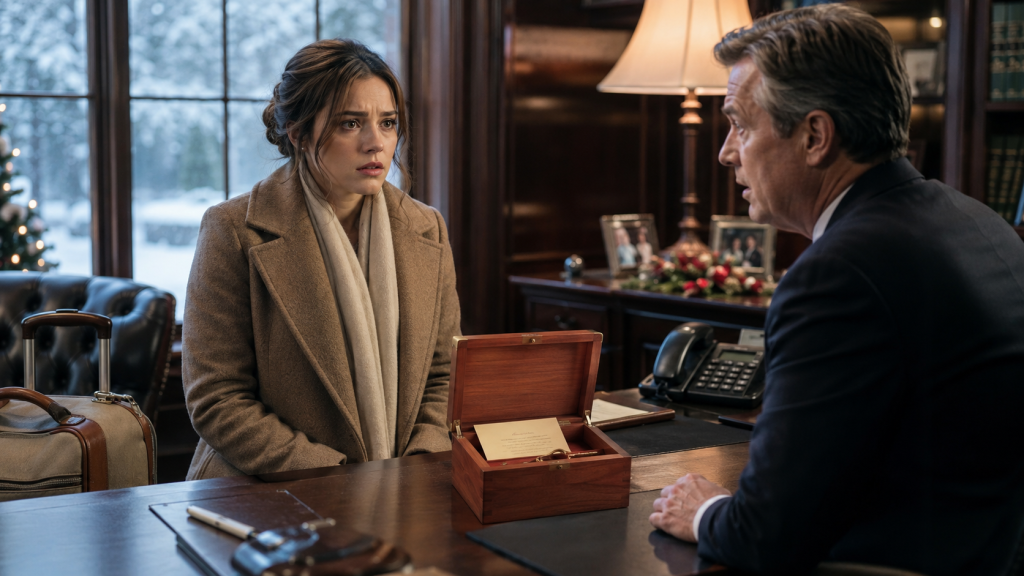
Thomas Reeves looked directly at me.
“Enough that your signature now determines whether your father remains president tomorrow morning.”
For several seconds, the only sound in the office was the soft hum of the heating vent.
Outside the closed blinds, Christmas music played faintly through the bank lobby.
Some cheerful song about home and family.
I almost laughed.
An hour earlier, my family had thrown me into the snow.
Now I was sitting in a locked bank office being told that I controlled the company my father had spent my entire life claiming belonged to him.
“I don’t understand,” I whispered.
Mr. Reeves folded his hands on the desk.
“Your grandfather anticipated that.”
He lifted the cedar box carefully and turned it toward me.
“May I?”
I nodded.
He opened it fully.
Underneath the documents was a second compartment I had never noticed.
Mr. Reeves pressed his thumb against a small brass latch hidden beneath the lining.
The bottom lifted.
Inside were three envelopes, a flash drive, an old photograph, and a brass key attached to a faded leather tag.
The photograph showed Grandpa standing outside Hale Manufacturing almost forty years earlier.
Beside him was a younger man I recognized immediately.
My father.
Dad looked barely twenty-five.
Grandpa had one arm around his shoulders.
Both were smiling.
On the back, Grandpa had written:
I built the company.
I hoped my son would build the family.
Only one of those dreams survived.
My throat tightened.
Mr. Reeves placed the photograph gently on the desk.
“Your grandfather began Hale Manufacturing with twelve employees and one warehouse,” he said. “Your father joined the company years later.”
“That’s not what Dad told us.”
“I suspected not.”
According to my father, he had rescued Grandpa’s failing little company and turned it into an empire.
Every Christmas, every anniversary dinner, every company banquet, Dad told some version of the same story.
Grandpa had been a hardworking but old-fashioned businessman.
Dad had been the visionary.
Grandpa had supposedly handed him control years ago.
Apparently, none of that had been true.
Mr. Reeves opened the first envelope.
It contained a legal document.
Arthur Hale Family Trust.
Beneficiary: Claire Elizabeth Hale.
Voting interest: sixty-two percent.
My name appeared over and over.
I stared at it until the letters blurred.
“Why me?”
Mr. Reeves gave me a sad smile.
“I think your grandfather answers that better than I can.”
He handed me the second envelope.
My name was written across the front in Grandpa’s shaky handwriting.
Claire.
I hesitated before opening it.
The paper inside smelled faintly like his house.
Cedar.
Coffee.
The pipe tobacco he had stopped smoking twenty years earlier but somehow never completely vanished from his study.
Dear Claire,
If you are reading this, then I am gone, and I am sorry that I am not there to explain things properly.
More importantly, if you have opened the cedar box, then the people closest to you have finally shown you exactly who they are.
I wish I could tell you that I hoped this day would never come.
That would be a lie.
I expected it.
Your father has always confused being obeyed with being respected.
Your mother has confused appearances with character.
And your sister has spent too many years learning that charm excuses selfishness.
But you, Claire, have always been different.
You listen before you speak.
You help without announcing it.
You remember the names of employees everyone else ignores.
You once spent your entire eighth birthday party sitting with a frightened waitress who had dropped a tray because the manager was yelling at her.
You were eight.
Your father complained that you had embarrassed him.
I remember thinking you were the only Hale in the room who understood what dignity meant.
I stopped reading.
The memory hit me unexpectedly.
I remembered that waitress.
Her name was Tina.
She had been crying behind the restaurant.
I had brought her a piece of my birthday cake.
Grandpa had sat beside us.
Dad had been furious afterward.
“People like that are paid to serve us,” he’d said in the car.
Grandpa had replied, “And people like you need to remember that money does not make you taller.”
I smiled despite myself.
Mr. Reeves waited quietly.
I continued.
I did not leave you this responsibility because you are my favorite grandchild.
I left it to you because responsibility should belong to the person least hungry for power.
For years, I watched your father use Hale Manufacturing as though it were his personal bank account.
Some mistakes were foolish.
Others were dangerous.
When I confronted him, he promised they would stop.
They did not.
Over the last three years, he borrowed against company property, guaranteed personal investments using corporate assets, and redirected money through consulting agreements I never approved.
I began taking steps to protect the company.
Your father discovered some of them.
He accused me of betrayal.
Perhaps he will eventually accuse you of the same thing.
Remember this:
Preventing someone from destroying what they were trusted to protect is not betrayal.
It is stewardship.
My hands trembled slightly.
I looked at Mr. Reeves.
“You knew about this?”
“Parts of it.”
“How bad is it?”
“Bad enough that your grandfather created safeguards.”
He opened another folder.
There were loan records.
Property documents.
Account transfers.
One number after another.
Some were hundreds of thousands.
One was $1.8 million.
Another was $2.4 million.
“What did Dad do with this money?”
“Some went into property developments.”
“Dad doesn’t develop property.”
“Your sister’s fiancé does.”
I looked up sharply.
“Ethan?”
Mr. Reeves nodded.
Ethan Cole.
Madison’s perfect fiancé.
Tall.
Polished.
Expensive watch.
Perfect hair.
He had spent Christmas Eve talking about how his development company was preparing to acquire several luxury properties.
Apparently, my father had helped finance them.
“With company money?”
“Indirectly.”
That was apparently banker language for yes.
Mr. Reeves continued.
“Your father authorized Hale Manufacturing to guarantee several loans connected to Cole Development Group.”
“Can he do that?”
“Not without board approval for amounts above a specified threshold.”
“And he didn’t have it.”
“No.”
I leaned back.
Suddenly, Madison’s announcement made more sense.
When she had shouted through the doorway that she and Ethan were going to “take over Dad’s company,” I had assumed she was bragging.
Maybe she hadn’t been.
Mr. Reeves reached for the flash drive.
“Your grandfather instructed that this be given to you only after the trust became active.”
“What’s on it?”
“Recordings, documents, correspondence.”
“Recordings?”
“He suspected your father might challenge the trust.”
I closed my eyes.
Christmas morning had begun with me worrying about rent.
Now I was apparently holding enough evidence to destroy my father’s career.
“I don’t want to destroy anyone.”
Mr. Reeves studied me.
“That sentence is probably why Arthur chose you.”
I looked out through the narrow opening between the blinds.
Snow drifted past the windows.
People walked through the bank lobby carrying shopping bags and wearing Santa hats.
Normal people having normal Christmas mornings.
“Could I lose the company?”
“You personally?”
“No. Hale Manufacturing.”
His expression changed.
“Yes.”
That answer frightened me more than anything else.
“How?”
“Several loans become callable if certain financial conditions are violated. Your father has concealed liabilities. If the lenders discover that before the company restructures…”
He didn’t finish.
“What happens?”
“They could force asset sales.”
“How many employees?”
“Just over eight hundred.”
Eight hundred.
I thought about the Christmas party Grandpa had taken me to when I was twelve.
He walked around the warehouse shaking everyone’s hand.
He knew whose daughter had started college.
Whose wife was recovering from surgery.
Whose son played baseball.
Dad had once mocked him for wasting three hours doing it.
“Employees don’t need a friend,” Dad had said. “They need a paycheck.”
Grandpa replied, “Companies don’t exist on spreadsheets. They exist because people show up.”
Eight hundred people.
Suddenly, this wasn’t about revenge.
It wasn’t about Madison laughing.
Or Mom throwing me out.
Or Dad calling me a failure.
It was about people who had mortgages.
Children.
Medical bills.
Christmas presents under trees.
“What do I have to do?”
Mr. Reeves pulled a legal pad toward him.
“First, call the trust attorney.”
“Today?”
“He’s expecting you.”
Of course he was.
Grandpa had planned everything.
Mr. Reeves smiled slightly.
“Arthur believed Christmas revealed character. He told me once that if your family ever crossed the final line, they would probably do it on a holiday.”
“That sounds like Grandpa.”
We called the attorney.
His name was Harold Bennett.
He answered on the second ring.
“Claire?”
“How did you know?”
“Your grandfather told me I’d hear from you eventually.”
I almost smiled.
“Apparently everyone knew more about my life than I did.”
“Only the pieces Arthur believed would protect you.”
Mr. Bennett’s voice became serious.
“Did Thomas explain the situation?”
“Most of it.”
“Then I need to ask you something before we proceed.”
“Okay.”
“Are you prepared to act in the company’s best interest even if doing so makes your family angry?”
I looked at the cedar box.
Then I remembered Dad shoving my suitcase through the doorway.
Mom saying they didn’t need my negativity.
Madison raising champagne.
Back to your place, loser.
“Yes.”
“Good.”
We spent nearly ninety minutes reviewing documents.
By the end, my head hurt.
The trust didn’t simply make me wealthy.
It made me the controlling shareholder of Hale Manufacturing.
Grandpa had also appointed two independent trustees who could assist me temporarily.
And there was an emergency clause.
If evidence existed that the company president had committed financial misconduct, the controlling shareholder could call an immediate board meeting.
I could suspend Dad.
Not fire him automatically.
But suspend him pending investigation.
“What happens if I do nothing?” I asked.
Mr. Bennett didn’t soften the answer.
“Your father is expected to sign another guarantee on December twenty-seventh.”
“For Ethan?”
“Yes.”
“How much?”
“Eleven million dollars.”
I nearly dropped the phone.
“For what?”
“A hotel development.”
Using Hale Manufacturing as collateral.
My father was gambling an eight-hundred-person company on my sister’s fiancé.
“Stop it.”
There was silence.
“What?”
“Stop the guarantee.”
Mr. Bennett’s voice remained calm.
“To do that, we need to suspend your father’s authority.”
I looked at Mr. Reeves.
He nodded once.
“Then do it.”
The words came out surprisingly easily.
That was the moment my old life ended.
At 12:47 p.m. on Christmas Day, emergency notices were sent to the board.
By 1:03, my phone began ringing.
Dad.
I stared at his name.
I didn’t answer.
He called again.
Mom.
Then Madison.
Then Dad.
Then Ethan.
Apparently, the legal notices had arrived quickly.
A text appeared.
DAD:
WHAT DID YOU DO?
Another.
ANSWER YOUR PHONE NOW.
Then Madison.
Are you insane?
Where are you?
Dad says Grandpa left you some voting proxy. You have NO IDEA what you’re doing.
I turned the phone over.
Mr. Reeves looked amused.
“Your grandfather predicted this too.”
“You’re kidding.”
He pulled out another note.
If they suddenly decide you are important, remember how they treated you when they believed you were not.
I laughed.
Actually laughed.
The first real laugh I’d had all morning.
“That man planned his own ghost appearances.”
Mr. Reeves laughed too.
“He enjoyed preparation.”
At two o’clock, I left the bank.
The snow had slowed.
My dented Honda sat beneath a layer of white.
I put Grandpa’s cedar box on the passenger seat.
For a moment, I didn’t know where to go.
My apartment was forty minutes away.
Christmas dinner was a frozen lasagna in my freezer.
I imagined heating it alone.
Oddly, that didn’t feel sad anymore.
It felt peaceful.
Then someone called my name.
“Claire!”
I turned.
Madison was crossing the parking lot in ankle boots completely unsuited for snow.
Dad was behind her.
Mom followed more carefully.
Ethan remained beside their SUV.
So much for Christmas dinner.
Dad reached me first.
“What the hell did you do?”
People near the ATM turned.
I kept my voice calm.
“I protected Hale Manufacturing.”
“You don’t know anything about Hale Manufacturing.”
“I know you were preparing to guarantee an eleven-million-dollar loan for Ethan.”
His face changed.
Only slightly.
But I saw it.
Madison stepped closer.
“That is none of your business.”
“I own sixty-two percent of the voting shares.”
She blinked.
Dad stared at me.
Mom whispered, “What?”
Nobody spoke for several seconds.
Then Madison laughed.
A sharp, disbelieving sound.
“That’s impossible.”
I opened the passenger door.
Grandpa’s cedar box sat on the seat.
Madison’s smile vanished.
Dad looked at it like it was a bomb.
“You opened it.”
“Yes.”
“What did Arthur put in there?”
“Enough.”
Dad grabbed my wrist.
“Claire.”
I looked down at his hand.
Then at him.
“Let go.”
Something in my voice surprised him.
He released me.
Mom glanced around the parking lot.
“Can we please discuss this somewhere private?”
That was Mom.
Humiliation was acceptable.
Witnesses were not.
“You threw me out of your house two hours ago.”
“We were emotional.”
Madison rolled her eyes.
“Oh my God, Claire, stop being dramatic.”
I turned toward her.
“You said, ‘Back to your place, loser.’”
Her cheeks reddened.
“That was a joke.”
“No. It was a sentence you felt safe saying because you believed I had nothing.”
Her mouth opened.
I continued.
“The interesting thing is that I’m still the same person I was this morning.”
Dad stepped between us.
“Enough of this childish nonsense.”
“Agreed.”
I opened my car door.
“The board meeting is tomorrow at nine.”
His jaw tightened.
“You will cancel it.”
“No.”
“I am your father.”
“And currently, you are the suspended president of Hale Manufacturing.”
Mom gasped.
Madison went pale.
Dad stared at me.
I had never seen him speechless before.
Not once.
Ethan finally approached.
He wore the calm expression he used whenever he wanted everyone to believe he was the smartest person in the room.
“Claire, I think there’s been a misunderstanding.”
“No.”
“Those guarantees are routine.”
“Eleven million dollars isn’t routine.”
“The project is worth four times that.”
“Then finance it without Hale Manufacturing.”
His eyes hardened.
“You don’t understand corporate finance.”
“Maybe not.”
I smiled.
“But tomorrow I’ll be surrounded by people who do.”
For the first time, Ethan looked worried.
I got into my Honda.
Dad knocked on the window.
I rolled it down halfway.
“This company is mine.”
I looked at him.
“No, Dad.”
I glanced at Grandpa’s box.
“It never was.”
I drove away.
My phone rang seventeen times before I reached my apartment.
I turned it off.
That Christmas dinner became one of the strangest meals of my life.
Frozen lasagna.
A glass of supermarket wine.
Grandpa’s letter beside my plate.
No insults.
No criticism.
No comparisons.
No Madison taking photographs of food nobody was allowed to eat until she had posted it online.
At around eight, someone knocked.
I expected Dad.
Instead, it was Uncle Robert.
Dad’s younger brother.
He held a pie.
“Merry Christmas?”
I stared at him.
“How did you find me?”
“Your mother gave me the address.”
“That’s concerning.”
He smiled.
“Can I come in?”
Uncle Robert had always been the quiet relative.
He left Hale Manufacturing twenty years earlier to become a high school science teacher.
Dad called him “the family underachiever.”
I suddenly noticed the pattern.
“Come in.”
He placed the pie on my counter.
“Your grandfather told me some of it.”
“How much?”
“That he was leaving you control.”
“And you didn’t tell me?”
“He made me promise.”
I crossed my arms.
“Apparently Grandpa had half the state under confidentiality agreements.”
Robert laughed.
“Pretty much.”
Then his expression softened.
“He worried about you.”
“Why?”
“Because your father trained you to believe love had to be earned.”
That landed harder than I expected.
I looked away.
Robert continued.
“Arthur watched you become useful to everyone.”
He pointed toward my small dining table.
“You remember everybody’s birthdays.”
A chair.
“You fix everyone’s problems.”
The medication receipt sticking from my purse.
“You pay bills nobody knows you pay.”
I looked at him.
“How do you know about Mom’s medication?”
“Arthur knew.”
Of course he did.
Robert sat down.
“Claire, your grandfather didn’t choose you because he wanted revenge on your father.”
“I know.”
“He chose you because he thought you were the only person who might save the company without turning it into a weapon.”
I sat across from him.
“What happened between Grandpa and Dad?”
Robert was quiet for a long time.
“Your father wanted Arthur to transfer full ownership years ago.”
“Why didn’t he?”
“Because Arthur saw something changing.”
“What?”
“Your father stopped building the company and started using the company to build his image.”
Private club memberships.
Cars.
Vacations.
Corporate boxes.
Consultants.
Madison’s lifestyle.
“Grandpa confronted him?”
“Many times.”
“And Mom?”
Robert gave me a sad smile.
“Your mother preferred not knowing where the money came from.”
I thought of her Christmas kitchen.
Imported marble.
French stove.
Designer dishes.
Everything curated.
Everything photographed.
Everything financed, apparently, by a company Dad was slowly draining.
“Does Madison know?”
“Probably not everything.”
I believed that.
Madison was selfish.
But she wasn’t financially sophisticated.
Ethan, however, was.
“What about Ethan?”
Robert’s expression darkened.
“Arthur didn’t trust him.”
“Why?”
“Because men who talk constantly about what they own usually owe somebody for most of it.”
That sounded exactly like Grandpa.
The next morning, I arrived at Hale Manufacturing at 8:20.
I had been there hundreds of times.
But I had never entered as the controlling shareholder.
The headquarters looked different somehow.
A steel-and-glass building on the edge of town.
Grandpa’s name was still on a small bronze plaque near the entrance.
ARTHUR J. HALE, FOUNDER.
Dad had wanted it removed during renovations.
Grandpa refused.
Inside, employees moved quietly through the lobby.
Some recognized me.
Some didn’t.
A receptionist named Denise stood when I approached.
“Claire?”
I remembered her from company picnics.
Her husband had died three years earlier.
“How are you, Denise?”
She seemed surprised I remembered her name.
“Good.”
Then she lowered her voice.
“There are rumors.”
“I’m sure.”
“Is the company okay?”
That question mattered more than everything else.
“We’re going to make sure it is.”
Her shoulders relaxed.
“Thank you.”
The boardroom filled slowly.
Seven directors.
Two attorneys.
An outside accountant.
Mr. Bennett.
And my father.
Dad entered at exactly nine.
No tie.
Dark suit.
Fury.
Madison and Ethan followed.
“They’re not board members,” Mr. Bennett said.
“They’re my guests.”
“No,” I replied.
Dad stared at me.
“This is my meeting.”
“It’s a board meeting.”
I looked at Madison and Ethan.
“They can wait outside.”
Madison laughed.
“You cannot be serious.”
“I am.”
Dad leaned toward me.
“Do not humiliate your sister.”
The irony was almost beautiful.
“I’m not humiliating anyone.”
I turned to security.
“Please show them to the conference lounge.”
Ethan touched Madison’s arm.
“Come on.”
He understood before she did.
This wasn’t Christmas dinner anymore.
The board meeting lasted three hours.
I learned more about my father in those three hours than I had in thirty years.
Some directors had suspected financial problems.
Others had trusted Dad.
One looked physically sick when the outside accountant explained the loan guarantees.
Dad defended everything.
“These are investments.”
“These are strategic partnerships.”
“These are temporary.”
Then the accountant displayed a chart.
Hale Manufacturing’s cash reserves had fallen forty-one percent in twenty-eight months.
Debt exposure had nearly doubled.
Two corporate properties had been pledged as collateral.
One was the main distribution center.
My stomach dropped.
“You pledged the distribution center?”
Dad snapped, “Temporarily.”
“That building employs three hundred people.”
“And nothing happened.”
“Yet.”
His face reddened.
“This company requires ambition.”
One board member, Elaine Foster, spoke.
“Ambition isn’t the issue, Richard. Disclosure is.”
Dad slammed his hand against the table.
“I built this company.”
Nobody responded.
Then I reached into my bag.
I removed Grandpa’s photograph.
The one outside the original warehouse.
I placed it in front of Dad.
“No.”
His eyes fell to the picture.
“Grandpa built it.”
The room became silent.
Dad looked older suddenly.
Not defeated.
But exposed.
Mr. Bennett read the resolution.
Richard Hale would remain suspended pending forensic review.
All new borrowing would require board approval.
Existing guarantees linked to Cole Development Group would be audited.
Emergency negotiations would begin with lenders.
The vote was six to one.
Dad voted against.
I voted in favor.
When it ended, he stayed seated.
Everyone else left.
Finally, it was just us.
He looked at me.
“You enjoyed that.”
“No.”
“Yes, you did.”
I shook my head.
“I hated every minute.”
He laughed bitterly.
“You expect me to believe that?”
“I don’t care what you believe.”
He stood.
“Arthur poisoned you against me.”
“Grandpa has been dead eight months.”
“He hated that I became more successful than him.”
“You almost mortgaged his company to finance Ethan’s hotel.”
“It was a good investment.”
“Then why hide it?”
That stopped him.
I leaned against the table.
“Why didn’t you tell the board?”
He looked toward the windows.
“Because old men are afraid of risk.”
“Grandpa wasn’t on the board anymore.”
Silence.
“Why, Dad?”
He finally faced me.
“Because I needed one deal to work.”
The anger left my body.
“What does that mean?”
He sat again.
His shoulders sagged.
And for the first time in my life, my father looked tired.
Not angry.
Not commanding.
Tired.
“The property developments were supposed to pay everything back.”
“How much have you lost?”
He stared at the table.
“Personally?”
“Yes.”
“Almost nine million.”
I couldn’t speak.
“How?”
“Investments.”
“With Ethan?”
“Some.”
My chest tightened.
“Does Mom know?”
“No.”
“Madison?”
“No.”
“Does Ethan?”
Dad looked away.
That answer was enough.
He knew.
The polished fiancé who toasted Dad’s brilliance at Christmas dinner knew my father was drowning.
And he was still asking him to guarantee another eleven million dollars.
“Dad.”
My voice became quiet.
“Ethan is using you.”
His head snapped up.
“You don’t know him.”
“I know he’s asking a desperate man to risk company assets.”
“He is marrying your sister.”
“That doesn’t make him honest.”
Dad walked out.
Two days later, we learned how dishonest Ethan really was.
The forensic accountant found the first discrepancy.
Then another.
Then twelve more.
Cole Development Group had billed Hale Manufacturing for “consulting services” totaling $740,000.
Several invoices referenced projects that didn’t exist.
Payments had been approved by Dad.
But the bank accounts didn’t belong directly to Ethan’s company.
They belonged to intermediaries.
One was registered to Ethan’s cousin.
Another to a former employee.
Then we found something worse.
A $1.2 million loan Dad believed had funded a residential development had been redirected three days after transfer.
Half went toward repayment of another loan.
The rest disappeared into accounts the accountants couldn’t immediately identify.
I called Dad.
He didn’t answer.
I drove to my parents’ house.
The same house I had been thrown out of on Christmas morning.
Mom opened the door.
She stared at me.
“You have some nerve coming here.”
“Where’s Dad?”
“In his office.”
“I need to speak with him.”
“You’ve humiliated him enough.”
I stepped inside.
“Mom, Ethan may have stolen money.”
Her face changed.
“What?”
Madison appeared at the staircase.
“Don’t start.”
I looked up.
“Did Ethan tell you about the payments from Hale Manufacturing?”
She froze.
“What payments?”
“Seven hundred forty thousand dollars in consulting fees.”
Mom looked at her.
Madison looked confused.
Actually confused.
“I don’t know what you’re talking about.”
“Where is Ethan?”
“He went to Chicago.”
“When?”
“This morning.”
Of course he did.
Dad appeared behind them.
His face looked gray.
He had already heard.
“You knew,” I said.
He nodded slowly.
“The accountant called.”
Madison descended the stairs.
“What is everyone talking about?”
Dad looked at her.
“Call Ethan.”
“I did. He’s in meetings.”
“Call him.”
She rolled her eyes.
Then she dialed.
Straight to voicemail.
Again.
Voicemail.
The third time, her confidence disappeared.
“Maybe his phone is off.”
Dad sat heavily in an armchair.
I had never seen him like that.
Madison stared between us.
“Dad?”
He covered his face.
And suddenly Madison looked like a child.
“What happened?”
I explained.
Not cruelly.
Not dramatically.
Just facts.
By the time I finished, she was crying.
“No.”
She shook her head.
“No, Ethan wouldn’t do that.”
“There’s an investigation.”
“We’re getting married.”
I said nothing.
She called him twenty-three times that afternoon.
He didn’t answer once.
By evening, Ethan’s social media accounts were gone.
His apartment was empty.
And Cole Development Group’s office had been cleared.
The engagement ended without a conversation.
Three days later, investigators discovered Ethan had left the country.
Madison disappeared into her bedroom for almost a week.
I could have felt satisfied.
Part of me thought I would.
She had laughed when I lost my job.
Called me pathetic.
Called me a loser.
But seeing her life collapse didn’t feel good.
It just looked sad.
Dad’s collapse was quieter.
The forensic audit showed that he hadn’t personally stolen from Hale Manufacturing.
But he had concealed debts.
Violated corporate rules.
Approved reckless guarantees.
Ignored obvious conflicts.
The board offered him a choice.
Resign voluntarily.
Or face removal.
He resigned.
The announcement went out on January eighth.
RICHARD HALE STEPS DOWN AS PRESIDENT.
The news spread quickly through the industry.
Dad stopped leaving the house.
Mom stopped attending charity lunches.
Madison stopped posting online.
I started working.
Not as president.
That surprised everyone.
The board assumed I would take Dad’s office.
I refused.
“I don’t know enough.”
Elaine Foster became interim CEO.
She had been with Hale Manufacturing for twenty-two years.
She knew operations.
Finance.
Employees.
Suppliers.
Everything.
I took a board seat.
And I listened.
Grandpa had been right about that too.
Power made people talk differently around you.
Some flattered.
Some feared.
Some tried to impress.
But warehouse workers usually just told you what was broken.
So I spent my first month visiting facilities.
At the distribution center Dad had nearly pledged away, I met a forklift operator named Marcus who had worked there seventeen years.
He showed me a roof leak management had ignored for two winters.
“We submitted five requests,” he said.
I looked at the ceiling.
Water stains spread across three panels.
“How much to repair?”
“Maintenance estimated thirty grand.”
Dad had spent more than that on one company dinner.
The roof was repaired the following week.
At another plant, employees had been asking for safer loading equipment.
Approved.
At headquarters, executives had reserved parking while night-shift employees walked half a mile from overflow lots.
Changed.
None of those decisions were glamorous.
None belonged on magazine covers.
But people noticed.
One afternoon, Denise stopped me in the lobby.
“Your grandfather would be proud.”
I swallowed.
“I hope so.”
“No.”
She smiled.
“He would.”
My family noticed too.
Especially Dad.
Three months after his resignation, he called.
Not texted.
Called.
I almost didn’t answer.
“Claire.”
“Hi, Dad.”
There was a long silence.
“Can we talk?”
We met at a diner.
Not the country club.
Not his house.
A diner Grandpa used to love.
Dad arrived early.
He looked different.
No expensive suit.
No watch.
Just a blue sweater and tired eyes.
“I ordered coffee.”
“Thanks.”
I sat.
Neither of us knew how to begin.
Finally, he said, “I hated you.”
I looked at him.
“After the board vote.”
“I assumed.”
“I told myself you had stolen everything.”
“I didn’t.”
“I know.”
He stirred his coffee.
“I told myself Dad planned it because he wanted to punish me.”
“Did he?”
Dad smiled without humor.
“Probably a little.”
I smiled too.
That felt strange.
Then his expression changed.
“But mostly, I think he wanted to stop me before I destroyed something I couldn’t rebuild.”
I waited.
Dad looked toward the window.
“I spent thirty years trying to prove I was better than him.”
“Why?”
“Because everybody loved Arthur.”
His answer surprised me.
“Employees loved him. Customers trusted him. Your uncle admired him. People walked into a room and relaxed when he arrived.”
Dad laughed quietly.
“When I walked into a room, people stood straighter.”
“That’s not the same thing.”
“No.”
He looked at me.
“I know that now.”
The waitress refilled our coffee.
Dad waited until she walked away.
“I’m sorry.”
Two words.
Simple.
But I had waited my entire life to hear them.
“For the company?”
“For Christmas.”
My throat tightened.
He continued.
“For every Christmas before that too.”
I said nothing.
“I made you feel small because Madison made me feel successful.”
That hurt.
But at least it was true.
“She looked successful,” he continued. “The clothes. The boyfriend. The photographs. You were always struggling quietly.”
“I wasn’t always struggling.”
“I know.”
He looked ashamed.
“Your mother told me about the money.”
“What money?”
“The four thousand dollars.”
I had almost forgotten.
Dad had asked me for it three weeks before Christmas.
“I transferred it.”
“I know.”
He swallowed.
“You sent it the same day.”
“Yes.”
“And then I threw you out.”
“Yes.”
He stared at his coffee.
“I don’t have an excuse.”
For once, neither of us tried to create one.
“I can’t make you forgive me,” he said.
“No.”
“But I wanted to say it.”
“That matters.”
Dad nodded.
It wasn’t reconciliation.
Not yet.
But it was the first honest conversation we had ever had.
Mom took longer.
Much longer.
She blamed me for months.
For Dad’s resignation.
For Madison’s broken engagement.
For the gossip.
Especially the gossip.
Then one afternoon, she arrived at my apartment carrying a grocery bag.
I opened the door.
She looked around.
“You still live here?”
“Yes.”
“You have forty-three million dollars.”
“More now.”
Her eyes widened.
I smiled.
“That was a joke.”
She almost laughed.
Almost.
“I brought soup.”
“Why?”
“You always bring soup when someone is upset.”
“I’m not upset.”
“I am.”
There it was.
At least she was trying.
I let her in.
We ate soup at my tiny kitchen table.
Halfway through, Mom began crying.
Not elegantly.
Not discreetly.
Actually crying.
“I thought if the family looked successful, we were successful.”
I handed her a napkin.
“I know.”
“I thought people envied us.”
“They probably did.”
“That made me happy.”
She laughed through tears.
“How ridiculous is that?”
“Pretty ridiculous.”
She gave me the offended mother look.
Then laughed again.
“I deserved that.”
We talked for two hours.
Mom apologized.
Not perfectly.
She still defended things she shouldn’t have.
But she apologized.
Madison was last.
For nearly six months, she barely spoke to me.
She moved out of my parents’ house.
Sold the Mercedes.
Closed her social media accounts.
And took a job.
A real job.
At an interior design firm.
Entry level.
One afternoon, I received a message.
Can we meet?
We chose a park.
Madison arrived wearing jeans and sneakers.
No designer bag.
No makeup.
She sat beside me on a bench.
“You look normal,” I said.
“Shut up.”
I laughed.
She smiled reluctantly.
Then she looked at her hands.
“I was horrible to you.”
“Yes.”
Her head snapped up.
“You’re supposed to say I wasn’t.”
“Why?”
She laughed.
Then her eyes filled.
“I really was.”
“You were.”
“I hated you.”
That surprised me.
“Why?”
“Because Grandpa respected you.”
I stared at her.
“He loved you too.”
“Not the same way.”
Madison pulled her knees toward her chest.
“He thought I was shallow.”
“You were shallow.”
“Can you stop agreeing with all my insults?”
“No.”
She laughed again.
Then became serious.
“Ethan told me you were jealous.”
“Of what?”
“Everything.”
I shook my head.
“He said you were bitter because I had a better life.”
“You believed him?”
“I wanted to.”
She looked at me.
“Because if you were jealous, then everything I had meant something.”
That sentence told me more about Madison than years of arguments ever had.
I reached into my purse.
I took out a small photograph.
A copy of Grandpa outside Hale Manufacturing.
“Grandpa left me this.”
She studied it.
“I remember that jacket.”
“So do I.”
Madison flipped the photograph over.
I had written something there.
Your worth is not determined by who envies you.
She read it.
Then looked at me.
“Did Grandpa write this?”
“No.”
“You did?”
“Yes.”
She handed it back.
“Annoyingly wise.”
“Thank you.”
She smiled.
“I’m sorry about Christmas.”
“I know.”
“No.”
She turned toward me.
“I mean it.”
Her voice shook.
“I watched Dad push your suitcase out. And I enjoyed it.”
That honesty hurt.
But it also mattered.
“I thought you finally looked lower than me.”
She wiped her eyes.
“And then two hours later, it turned out you owned everything.”
I shook my head.
“That’s not why you were wrong.”
“I know.”
She nodded.
“That’s what took me six months to understand.”
I looked at her.
“You were wrong when you thought I had nothing.”
“Yes.”
“And you would have been wrong even if Grandpa had left me fishing hooks.”
Madison laughed through her tears.
“Yes.”
That was when I forgave her.
Not because she apologized.
Because she finally understood what she was apologizing for.
A year after Grandpa died, Hale Manufacturing stabilized.
We refinanced the dangerous loans.
Sold two unnecessary luxury properties.
Ended the private club memberships.
Recovered some of the money tied to Ethan’s schemes.
Authorities eventually located him in Portugal.
His legal case continued for years.
Madison never asked about him.
She built a life that belonged to her instead.
Dad joined a small manufacturing consultancy.
For the first time in decades, he worked for someone else.
He hated it initially.
Then, surprisingly, he got good at it.
Without the pressure of proving he owned the room, he became more useful inside it.
Mom volunteered twice a week at a community clinic.
At first, I suspected she did it because she wanted people to see her volunteering.
Then one winter afternoon, I stopped by unexpectedly.
She was sitting beside an elderly woman filling out insurance paperwork.
Nobody was watching.
Mom never mentioned it later.
That was how I knew something had really changed.
As for me, I kept my apartment for another year.
Everyone thought that was absurd.
Maybe it was.
But I liked it.
Eventually, I bought Grandpa’s old house from the estate.
Not because it was large.
Because the cedar trees still grew behind the porch.
His workshop still smelled like sawdust.
His coffee mug was still chipped beside the sink.
I placed the cedar box in his study.
Not in a safe.
Not behind glass.
On the bookshelf.
Sometimes people asked what Grandpa left me.
They expected me to say money.
Shares.
Control.
Forty-three million dollars.
But those were just assets.
The real inheritance was the sentence written inside the final envelope.
I didn’t find it until almost two years later.
The envelope had slipped beneath the box lining.
Inside was one sheet of paper.
Seven lines.
Claire,
Someday you may become wealthy.
Do not confuse that with becoming valuable.
You were valuable when you had nothing.
You will be valuable if you lose everything.
Never allow people who measure worth badly to measure yours.
Love,
Grandpa
I framed that letter.
Not the stock certificate.
Not the bank statement.
That letter.
Three Christmases after the morning my parents threw me out, we gathered at Grandpa’s house.
My house now.
Dad carved the turkey.
Mom brought soup nobody needed.
Uncle Robert complained that the mashed potatoes lacked salt.
Madison arrived late carrying a lopsided pie she had baked herself.
“It looks terrible,” I told her.
“Back to your place, loser.”
Everyone froze.
Then Madison started laughing.
I stared at her.
She covered her mouth.
“Too soon?”
Dad groaned.
Mom whispered, “Madison.”
And then I laughed.
Really laughed.
The kind that makes your stomach hurt.
Madison joined me.
Then Robert.
Eventually even Dad laughed.
After dinner, we went outside.
Snow covered the cedar trees.
The house windows glowed behind us.
Madison stood beside me.
“Do you ever think about that Christmas?”
“Yes.”
“Do you hate me when you do?”
“No.”
She looked surprised.
“Why not?”
I watched snow settle across Grandpa’s old workshop.
“Because you gave me useful information.”
“What information?”
“You showed me who you were.”
She winced.
“Ouch.”
“And then you showed me you could become someone better.”
She looked down.
“That part helps.”
Dad joined us on the porch.
For several seconds, none of us spoke.
Then he said, “Your grandfather would like this.”
I smiled.
“He’d complain about the turkey.”
“He always complained about the turkey.”
“He said you cooked it too long.”
“I did not.”
“You absolutely did.”
Dad smiled.
And there it was.
Something I once believed money might buy.
Peace.
But money hadn’t bought it.
Truth had.
Boundaries had.
Consequences had.
Forgiveness had.
And time had.
That night, after everyone left, I sat alone in Grandpa’s study.
The cedar box rested on the shelf.
I opened it.
The compartments were empty now.
Documents had gone to lawyers.
Certificates were stored securely.
The brass key had belonged to Grandpa’s old safety deposit box.
Nothing valuable remained inside.
At least, nothing anyone else would call valuable.
I ran my fingers across the cedar grain.
That Christmas morning, I had carried this box through the snow believing it might contain a watch.
Some photographs.
Maybe a few thousand dollars.
Instead, it opened a door into the truth.
But the biggest truth wasn’t that my father didn’t own the company.
It wasn’t that Ethan was a fraud.
It wasn’t even that Grandpa had left me a fortune.
The biggest truth was something I should have understood years earlier.
My family had treated me like a failure because I allowed their definition of success to matter.
I had measured myself using people who didn’t know how to measure.
A job title.
A car.
A relationship.
A house.
A photograph.
None of those things tell you whether someone will sit beside you when you are frightened.
Whether they keep their word.
Whether they protect people who cannot reward them.
Whether they remain decent when nobody is watching.
Grandpa understood that.
He always had.
I closed the box.
Then I noticed something scratched faintly into the inside of the lid.
I leaned closer.
Four words.
Probably carved decades earlier.
Character outlives circumstance.
I laughed softly.
“Of course.”
Even the box had one final lesson.
I walked to the window.
Snow was falling again.
Almost exactly like that Christmas morning.
But this time, there was no suitcase on the porch.
No slammed door behind me.
No voice telling me to go back to my place.
Because I finally understood where my place was.
It wasn’t below Madison.
It wasn’t beneath my father’s approval.
It wasn’t inside some corporate office.
It wasn’t even in Grandpa’s house.
My place was anywhere I could stand without shrinking myself so somebody else could feel taller.
And once I understood that, nobody could throw me out of it again.
💬THE END! THANK YOU FOR READING!