

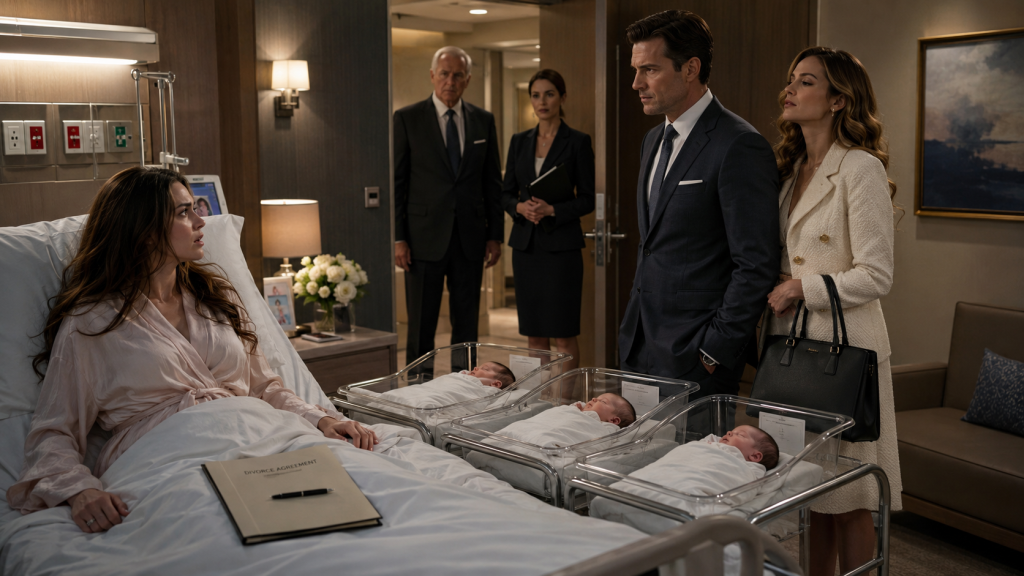
I had three newborn sons sleeping beside me when my husband walked into my hospital room holding another woman’s hand.
Forty minutes earlier, a nurse had told me I was lucky to be alive.
Now Ethan looked at my bloodless face and decided it was the perfect moment to bury me.
My body still shook from the hemorrhage, and every breath pulled against the fresh incision across my abdomen. I could barely lift my arms to touch the boys.
Ethan saw all of it.
And instead of mercy, satisfaction settled across his face.
Vanessa Cole entered first, tall, polished, and smiling beneath perfectly curled hair. A black Birkin hung from her wrist like a trophy.
Ethan tossed a folder onto my blanket.
“Sign.”
I stared at the divorce papers, then at the man I had loved for eight years.
“You brought her here?”
Vanessa laughed softly.
“Don’t be dramatic, Claire. Stress isn’t good for the babies.”
My sons—Noah, Caleb, and Luke—were less than a day old.
Ethan leaned over the bed.
“Look at you. Who could ever want you now?”
The words landed harder than the emergency surgery.
He had spent my entire pregnancy disappearing into “client meetings,” freezing joint accounts, and telling me I was paranoid whenever I asked why our company’s numbers no longer matched the reports sent to me.
I had suspected an affair.
I had not expected an execution.
Vanessa set her bag beside my flowers.
“We’ll be moving into the lake house. Ethan says you won’t need something that large.”
“That house belonged to my grandmother,” I said.
Ethan smirked.
“Everything belongs to the marriage until a judge says otherwise.”
That was his mistake.
He still believed I had been merely his wife.
Before our marriage, I had been a forensic accountant.
My father, Daniel Mercer, had built Mercer Holdings from a two-truck logistics business into a national company. When I married Ethan, Dad quietly placed my inheritance, several commercial properties, and controlling shares of Mercer Logistics into a protected family trust.
Ethan knew about the trust.
He did not know its exact terms.
He also did not know that three months earlier, when I noticed unexplained transfers from a subsidiary Ethan managed, I began copying everything.
Invoices.
Wire instructions.
Shell-company payments.
And one familiar name.
Vanessa Cole.
I picked up the pen.
Ethan smiled.
Then I signed only the acknowledgment of receipt.
His smile disappeared.
“I’ll have counsel review the rest.”
“You don’t have counsel,” he snapped.
The hospital door opened.
My father stepped inside with our family attorney, Rebecca Shaw.
Dad looked at the divorce papers, then at Ethan.
His voice was almost gentle.
“Actually,” he said, “she has an entire legal department.”
Rebecca crossed the room and calmly picked up the folder from my bed.
“Before Claire signs anything,” she said, “you should know the lake house, her trust assets, and seventy-one percent of Mercer Logistics are not marital property.”
Ethan’s face tightened.
Vanessa stopped smiling.
My father stepped closer.
“And there’s another problem.”
Rebecca opened her briefcase and removed a second file.
Inside were copies of transfers Ethan had authorized from Mercer subsidiaries into companies secretly connected to Vanessa.
“Three-point-eight million dollars,” Rebecca said. “Moved without board approval.”
Ethan turned toward me.
“You’ve been spying on me?”
I managed a weak smile.
“Auditing you.”
Vanessa grabbed her Birkin.
“Ethan, you said everything was protected.”
My father’s eyes narrowed.
“Interesting choice of words.”
Rebecca continued.
“As of this morning, Ethan has been suspended from every Mercer-controlled company pending an internal fraud investigation. His corporate cards are frozen, his access credentials revoked, and security has been instructed not to admit him.”
Ethan went pale.
“You can’t do this.”
Dad looked toward my sleeping sons.
“You walked into my daughter’s hospital room hours after she nearly died and tried to strip away her future. You should be grateful losing your office is the smallest problem waiting outside this door.”
Then Rebecca’s phone rang.
She answered, listened, and looked directly at Ethan.
“They found the offshore account.”
For the first time since he entered the room, Ethan stopped pretending he was in control.
“What offshore account?”
Rebecca gave him a look I recognized immediately.
It was the same expression she used in depositions when someone had just lied so badly that they had made her job easier.
“The account in the Cayman Islands receiving transfers from Vale Consulting.”
Vanessa’s hand slipped from the handle of her Birkin.
Ethan recovered quickly.
“I don’t know what you’re talking about.”
“You should,” I whispered. “You approved twelve payments to Vale.”
“That was a vendor.”
“No,” I said. “It was a shell company.”
He stared at me.
I had spent the final trimester of my pregnancy pretending not to notice.
Pretending I still believed him when he returned home at midnight smelling like Vanessa’s perfume.
Pretending I accepted his explanations about delayed revenue, missing vendor reconciliations, and restricted accounting access.
But pregnancy had not erased fifteen years of financial training.
Numbers had always spoken more clearly to me than people.
And Ethan’s numbers had been screaming.
At first, the discrepancies were small.
Thirty thousand dollars here.
Forty-five thousand there.
Amounts designed to blend into a company processing hundreds of millions each year.
Then the transfers grew.
One hundred eighty thousand.
Three hundred thousand.
Nearly half a million.
Each one routed through legitimate-looking vendor invoices.
Transportation consulting.
Fleet optimization.
International logistics analysis.
The services sounded plausible.
The vendor was not.
Vale Consulting had no office.
No employees I could verify.
No operating history.
Its registered agent shared an address with a law firm Vanessa had used two years earlier.
When I discovered that connection, I said nothing.
Instead, I started building a file.
Rebecca had helped me without Ethan knowing.
My father knew only that I had “concerns.”
He did not know the full extent until the week before I went into labor.
By then, we had enough evidence to suspect Ethan was not simply having an affair.
He was building an exit.
An exit funded with stolen money.
And apparently, today had been intended as the final step.
Rebecca turned toward Vanessa.
“Ms. Cole, I assume your attorney will want to know that several of the transfers ultimately funded purchases in your name.”
Vanessa’s confidence cracked.
“I don’t know anything about his business.”
Ethan snapped his head toward her.
“Don’t say anything.”
Rebecca smiled faintly.
“That’s probably the first intelligent advice you’ve given today.”
My father stepped between Ethan and my hospital bed.
“You need to leave.”
Ethan looked at me.
Not with remorse.
Not even fear.
With fury.
“You planned this.”
I stared back at him.
“I planned to survive childbirth.”
His jaw tightened.
“You think your father can protect you forever?”
“No,” Dad answered before I could. “But she doesn’t need me to.”
The nurse who had been checking monitors outside appeared at the doorway.
“Mrs. Mercer needs rest.”
Ethan laughed bitterly.
“Mrs. Mercer?”
He looked at me.
“You’ve always loved hiding behind your maiden name.”
I had legally kept Mercer after we married.
Ethan had complained about it for years.
He said it made him feel like an outsider in my family.
At the time, I thought his insecurity was understandable.
Now I realized he had resented anything he could not own.
My career.
My family.
My inheritance.
Even my name.
He stepped closer.
“Sign the papers, Claire. This marriage is over.”
Rebecca moved between us.
“The marriage may be over. Your negotiation leverage is not what you think it is.”
Ethan gave her a cold smile.
“You lawyers love threats.”
“That wasn’t a threat.”
She placed the divorce papers inside her briefcase.
“That was information.”
Security arrived less than a minute later.
Two hospital officers stood in the doorway.
Vanessa lifted her chin.
“This is humiliating.”
I almost laughed.
She was worried about humiliation.
I was lying in a hospital bed with stitches across my abdomen while three premature newborn sons slept beside me, and the woman sleeping with my husband was concerned about appearances.
Dad pointed toward the hall.
“Leave.”
Ethan looked at the bassinets.
Something passed across his face.
For one stupid second, I hoped it might be tenderness.
Instead he said, “I’ll be requesting custody.”
My entire body went cold.
Dad moved forward, but Rebecca touched his arm.
She looked directly at Ethan.
“Then I strongly suggest you find competent counsel before making statements that can be introduced later.”
Ethan stared at her.
Then at me.
“I’m their father.”
“Yes,” I said.
The weakness in my voice disappeared.
“And they will someday know exactly what kind of father you chose to become.”
His face hardened.
He turned and walked out.
Vanessa followed.
But at the door, she looked back.
Not at me.
At my sons.
There was something strange in her expression.
Fear.
At the time, I assumed she was frightened by the investigation.
I would learn later that she had another reason.
The door closed.
And suddenly, everything inside me collapsed.
I started crying.
Not gracefully.
Not quietly.
The kind of crying that shakes the body until breathing hurts.
Dad came to my side.
He had always been a composed man.
He had negotiated acquisitions worth hundreds of millions without raising his voice.
But now his eyes were wet.
“I’m sorry, sweetheart.”
I shook my head.
“You didn’t do this.”
“I should have seen him.”
“I didn’t see him.”
“You loved him.”
“So did you.”
Dad looked away.
That hurt him.
Because it was true.
My father had welcomed Ethan into Mercer Holdings six years earlier.
He had promoted him.
Mentored him.
Trusted him.
Ethan had started in operations after leaving a regional shipping company. He was ambitious, smart, and charming enough to make everyone believe his success was inevitable.
Dad used to say Ethan reminded him of himself at thirty.
That was before money revealed the difference between them.
My father wanted to build something.
Ethan wanted to possess something.
Rebecca sat beside me.
“Claire, I need you to focus on recovery. We can handle everything else.”
“How bad is it?”
She hesitated.
That scared me.
“Financially?”
“Yes.”
“We know of at least three-point-eight million in unauthorized transfers. The offshore account suggests there may be more.”
“How much more?”
“We don’t know yet.”
I closed my eyes.
“And the company?”
“Stable.”
“Dad?”
“Stable,” he repeated firmly. “Claire, Mercer is fine.”
I opened my eyes.
“No. Tell me the truth.”
He exchanged a look with Rebecca.
I knew that look.
It was the look adults use when deciding how much reality someone can survive.
“I nearly died this morning,” I said. “Stop protecting me from numbers.”
Dad exhaled.
“There are signs Ethan may have used a company credit facility to guarantee obligations connected to one of the shell entities.”
My heart sank.
“How much?”
“Possibly eighteen million.”
The monitors beside me seemed suddenly louder.
“Eighteen?”
“We’re still verifying.”
“And if he did?”
“The board can challenge the authorization. There are fraud provisions.”
“But lenders will freeze activity.”
“Some already have.”
I looked toward my babies.
Noah had one tiny hand curled beside his cheek.
Caleb made a soft squeaking noise.
Luke slept through everything.
I had imagined their first day differently.
I thought Ethan would sit beside me.
I thought we would argue lovingly about which baby looked like whom.
I thought he would cry.
Instead, my sons had entered the world on the same day their father tried to dismantle our family.
“I need my laptop.”
Rebecca immediately shook her head.
“No.”
“Rebecca.”
“You lost almost two liters of blood.”
“I can review statements from a bed.”
My father almost smiled.
“You sound like your mother.”
That silenced me.
Mom had died eleven years earlier.
She had been the one who taught me never to confuse softness with weakness.
She used to say, “You can forgive people, Claire. Just don’t finance their ability to hurt you twice.”
I had forgotten that lesson with Ethan.
I would not forget it again.
For the next twenty-four hours, Rebecca refused to let me work.
Hospital policy helped her.
My blood pressure dropped twice.
Luke needed extra monitoring.
Caleb struggled briefly with feeding.
Noah developed mild jaundice.
The world shrank to nurses, alarms, tiny blankets, and minutes of sleep stolen between checks.
But outside my hospital room, Ethan’s world was beginning to unravel.
The first call came the next morning.
Mercer Holdings’ board had voted unanimously to remove Ethan from every executive position pending investigation.
The second came three hours later.
One of our banks froze the accounts belonging to Vale Consulting after receiving evidence from counsel.
The third call changed everything.
Rebecca entered my room carrying coffee for Dad and a folder for me.
“The offshore account wasn’t Ethan’s only account.”
I sat straighter.
“How many?”
“Four that we know of.”
My stomach tightened.
“Total?”
“Eleven-point-six million.”
Even Dad went silent.
“Eleven million?”
Rebecca nodded.
“Money moved through three shell companies over twenty-two months.”
“Where did it go?”
“Property. Investments. Luxury purchases. Transfers to Vanessa. And approximately four million remains in accounts we’re trying to restrain.”
I looked down at my hands.
For almost two years, Ethan had been stealing from my family while sleeping beside me.
“How much went to Vanessa?”
“Directly?”
“Yes.”
“Just over one-point-two million.”
I thought about her bag.
The designer clothes.
The apartment Ethan claimed belonged to a “client.”
The vacations Vanessa posted online while insisting they were sponsored by brands.
My marriage had apparently subsidized all of it.
Rebecca opened another document.
“There’s something else.”
“Of course there is.”
“Vanessa owns a condo downtown.”
“I know.”
“Purchased eighteen months ago for one-point-seven million cash.”
I looked at her.
“She doesn’t earn that kind of money.”
“No.”
“Ethan bought it.”
“Almost certainly.”
Dad muttered something under his breath.
Rebecca continued.
“The purchase funds came through an LLC called Northshore Capital.”
I recognized the name.
I had seen it once on a ledger.
“What does Northshore own?”
Rebecca’s expression changed.
“The lake house mortgage.”
I stared at her.
“That doesn’t make sense. The lake house doesn’t have a mortgage.”
“Your trust owns the property outright.”
“Exactly.”
“That’s why we’re concerned.”
She slid the paper toward me.
Someone had used forged documentation showing Ethan as authorized trustee.
A loan had been taken against my grandmother’s lake house.
Seven million dollars.
The signature beneath the authorization was mine.
Except I had never signed it.
For several seconds, I couldn’t speak.
Dad did.
“He forged her signature?”
Rebecca nodded.
“That appears to be the case.”
Something inside my father changed.
Until that moment, he had been angry.
Now he became still.
My father’s stillness had always been more dangerous than his anger.
“Call federal counsel,” he said.
Rebecca nodded.
“Already done.”
I stared at the forged signature.
It looked almost perfect.
Ethan had watched me sign thousands of documents over the years.
He knew the loops.
The slant.
Even the way I sometimes shortened the final stroke.
My husband had studied my handwriting so he could steal my home.
That realization hurt more than the affair.
An affair could be explained by selfishness.
This required planning.
Patience.
Practice.
He had not betrayed me impulsively.
He had engineered my destruction.
My phone buzzed on the side table.
Thirty-eight missed calls.
All from Ethan.
I ignored them.
Then a message appeared.
You have no idea what your father has done.
Another.
Tell him to release my accounts.
Then:
We need to talk privately.
And finally:
Think about the boys.
That one made my hands shake.
I took a screenshot and sent everything to Rebecca.
She read the messages.
“Don’t respond.”
“I wasn’t going to.”
“Good.”
My phone rang again.
Vanessa.
Rebecca looked surprised.
“Answer it,” she said. “Put it on speaker.”
I hesitated, then accepted.
Vanessa’s voice came fast.
“Claire?”
“What?”
“You need to tell Ethan to stop calling me.”
I almost laughed.
“You came into my hospital room holding his hand yesterday.”
“I didn’t know.”
“Know what?”
“All of it.”
Rebecca held up a finger, telling me to keep her talking.
Vanessa continued.
“He told me the money was his.”
“The money he stole?”
“He said Mercer owed him.”
“For what?”
“For building the international division.”
I closed my eyes.
“That division existed before he joined the company.”
Silence.
“He told me you were divorcing.”
“He served me papers while I was recovering from surgery.”
“He said you had been separated for months.”
“We shared a bed four nights ago.”
More silence.
For the first time, Vanessa sounded less like the triumphant woman who had entered my room and more like someone realizing she had stepped onto a frozen lake.
“I didn’t know about the forged documents,” she whispered.
Rebecca wrote on a notepad.
ASK ABOUT ACCOUNTS.
“Did you know about Vale Consulting?”
Vanessa hesitated.
That answer was enough.
“Vanessa?”
“He told me it was legitimate.”
“What did Vale do?”
Another pause.
“I don’t know.”
“How much money did Ethan send you?”
Her voice sharpened.
“That’s none of your business.”
“It became my business when the money came from my company.”
“I didn’t steal anything.”
“Then you should have no trouble explaining it.”
She started crying.
I did not comfort her.
“I need protection,” she said.
“From whom?”
She lowered her voice.
“Ethan.”
Dad stood.
Rebecca’s expression sharpened.
“What do you mean?”
“He’s losing it. He came to my condo last night. He said I needed to move money before the accounts were frozen.”
“Did you?”
“No.”
“Why?”
“Because I checked the account and it was already blocked.”
Of course.
“He accused me of betraying him. He said none of this would have happened if I hadn’t gone to the hospital.”
I looked at Rebecca.
“He brought you.”
“I know.”
“Then why blame you?”
“Because that’s what Ethan does.”
For once, Vanessa and I agreed.
She inhaled shakily.
“There’s something else you need to know.”
My entire body tightened.
“What?”
“He didn’t want the babies.”
The room went silent.
“What did you say?”
“He told me months ago that after the divorce, he was going to challenge paternity.”
I felt as though the floor had disappeared.
“They’re his sons.”
“I know.”
“How would you know?”
“Because he told me they were. He just thought accusing you publicly would pressure you into settling.”
Dad walked away from the bed because he was visibly struggling to control himself.
Rebecca wrote quickly.
“Did Ethan say that directly to you?”
“Yes.”
“When?”
“Several times.”
“Would you testify to that?”
Silence.
Then Vanessa whispered, “If you protect me.”
Rebecca took the phone.
“This is Rebecca Shaw, counsel for Claire Mercer. I suggest you retain independent counsel immediately. We cannot represent you, and Claire is not making promises.”
Vanessa began speaking quickly.
“I have messages.”
“What kind?”
“Texts. Emails. Voice notes. Ethan sent me everything.”
Rebecca became very still.
“How much is everything?”
“I don’t know. Hundreds.”
“Do not delete anything.”
“I won’t.”
“Do not send anything to Claire directly. Have your attorney contact my office.”
Vanessa started crying again.
“He told me we were going to get married.”
I looked toward my sons.
“That sounds like a problem between you and Ethan.”
I ended the call.
Dad stared at me.
“You okay?”
“No.”
It was the first honest answer I had given all morning.
But I would be.
Three days later, my sons and I left the hospital.
I did not return to the house Ethan and I had shared.
I went to my father’s home.
The nursery there had been prepared overnight.
Three white cribs stood beneath the windows.
My father had bought approximately enough diapers to supply a small country.
Rebecca joked that he had apparently handled grandparenthood the way he handled corporate expansion: aggressively and with excessive inventory.
For the first time in days, I laughed.
Healing came slowly.
Physically, every movement hurt.
Emotionally, some moments were worse.
At three in the morning, while feeding Luke, I would suddenly remember Ethan’s face when he said, Who could ever want you now?
Sometimes I hated myself for caring.
Then I realized grief does not ask permission.
I wasn’t grieving the man Ethan had become.
I was grieving the man I thought he had been.
The husband who once drove six hours through a snowstorm because my mother’s memorial service had been moved.
The man who sat beside me through fertility treatments.
The man who cried when the doctor told us we were expecting triplets.
Had those moments been fake?
Maybe not.
That was somehow worse.
Because it meant Ethan had once been capable of love and later decided greed mattered more.
Two weeks after I came home, Vanessa’s attorney contacted Rebecca.
The evidence she turned over was devastating.
Ethan had messaged her about moving funds.
Discussed falsifying consulting invoices.
Complained that my trust made it “impossible to get what he deserved.”
And months before my delivery, he had written one sentence that Rebecca hesitated to show me.
Once the babies come, she’ll be too exhausted to fight.
I read it twice.
Then a third time.
There was no rage.
Just clarity.
Ethan had mistaken vulnerability for surrender.
He had planned the divorce around childbirth because he believed my weakest physical moment would also be my weakest legal moment.
He had underestimated three things.
My records.
My family.
And himself.
Because arrogant people rarely imagine their plans failing.
They leave evidence everywhere.
The fraud investigation expanded.
Federal authorities became involved because several transactions crossed state and international banking lines.
Mercer Holdings filed civil claims seeking recovery of stolen funds.
The lender holding the fraudulent lake house lien suspended enforcement after receiving evidence that my signature had been forged.
Vanessa surrendered the condo and several luxury items purchased with disputed funds as part of negotiations between her attorney and company counsel.
Including the Birkin.
I found out because Rebecca mentioned it during a meeting.
I stared at her.
“The bag?”
Rebecca almost smiled.
“The bag.”
“What happens to it?”
“Likely liquidated.”
For some reason, that made me laugh harder than anything had in weeks.
That black handbag had entered my hospital room like a victory flag.
Now it was evidence.
Ethan did not find it funny.
He filed for emergency custody when the triplets were six weeks old.
His petition described me as physically fragile, emotionally unstable, and overly dependent on my father.
Rebecca read the filing without blinking.
Then she placed a stack of documents on the conference table.
Hospital records showing I was recovering normally.
Pediatric records showing every appointment attended.
Statements from night nurses.
Evidence Ethan had visited the babies exactly once after their birth.
And screenshots of his messages threatening to challenge their paternity as a negotiating tactic.
His emergency request was denied.
But he was granted supervised visitation while the financial investigation continued.
The first visit happened at a family center downtown.
I almost canceled.
Not legally.
Emotionally.
I did not want him near the boys.
But my therapist told me something I needed to hear.
“You don’t have to forgive Ethan to allow your sons to form their own understanding of him.”
So I went.
Ethan arrived fifteen minutes late.
He looked different.
No tailored suit.
No expensive watch.
No company car.
Just jeans, a gray sweater, and the expression of a man who still believed someone else had caused his problems.
He stared at the boys.
“They got big.”
“They’re two months old.”
He looked at Noah.
Then Caleb.
Then Luke.
“Which one is which?”
That question broke something in me.
Not because it was cruel.
Because it was revealing.
Their own father could not identify them.
I pointed.
“Noah has the green blanket. Caleb is in blue. Luke is asleep.”
Ethan sat beside the cribs.
“They look like me.”
“They look like themselves.”
He glanced at me.
“You always have to make everything difficult.”
I almost responded.
Then I didn’t.
That was another lesson I was learning.
Not every accusation deserves a defense.
For twenty minutes, Ethan held Noah awkwardly.
Noah cried.
Ethan became irritated.
“He doesn’t like me.”
“He’s eight weeks old.”
“You’re turning them against me already.”
The supervisor looked up from her notes.
I said nothing.
Ethan noticed.
His frustration increased because my silence gave him nowhere to place his anger.
Finally he whispered, “If you had just signed, none of this would have happened.”
I looked at him.
“No, Ethan. If you hadn’t stolen millions of dollars and forged my signature, none of this would have happened.”
His eyes flicked toward the supervisor.
“You’re trying to humiliate me.”
“No. You keep doing that yourself.”
The visit ended shortly afterward.
Outside, Rebecca was waiting.
“How was it?”
“He asked which baby was which.”
She winced.
I handed her the diaper bag.
“I used to think losing Ethan would destroy my family.”
Rebecca looked through the glass door at him.
“You didn’t lose your family.”
She nodded toward my sons.
“You found out who belongs in it.”
Three months later, the financial picture became clearer.
Ethan had stolen approximately fourteen million dollars over two years.
Some was recovered.
Some remained missing.
He had used part of it to fund investments he believed would make him independently wealthy.
Those investments had failed.
That explained the acceleration in theft.
He was not building an empire.
He was covering losses.
Every time one investment failed, he stole more money to hide the previous theft.
The pattern was almost embarrassingly predictable.
Vanessa had known more than she initially admitted.
She eventually acknowledged helping establish one shell company, though she insisted Ethan told her it was legal.
Prosecutors would decide how much that explanation mattered.
What mattered to me was simpler.
Neither of them could touch my sons’ future.
The trust remained intact.
The lake house remained mine.
Mercer Holdings survived.
And I returned to work.
Not full-time at first.
Two mornings each week.
Then three.
Eventually, when the boys were six months old, I stepped into my father’s boardroom for the first time since giving birth.
The directors stood when I entered.
I almost cried.
Not because of the gesture.
Because six months earlier, I had believed I might never walk normally again.
Now I was wearing heels.
Rebecca whispered, “Careful.”
“I know.”
Dad stood at the end of the table.
“Welcome back.”
I looked around the room.
Then at Ethan’s old chair.
Empty.
I sat in it.
Not because I wanted his position.
Because I wanted the reminder.
People can occupy your space for years without ever owning it.
The board appointed me interim chief financial officer during the restructuring.
Within nine months, we recovered more than nine million dollars through asset seizures, insurance claims, and civil settlements.
The company introduced new approval systems.
No executive could authorize high-value vendor transfers alone.
External audits became quarterly.
Every subsidiary received independent compliance oversight.
I refused to hide what happened.
Some advisors wanted us to minimize the scandal.
I disagreed.
“We were defrauded by an executive we trusted,” I told the board. “Pretending we were never vulnerable guarantees we will be vulnerable again.”
Dad smiled.
After the meeting, he stopped me in the hallway.
“You know I’m retiring eventually.”
“Don’t start.”
“I’m serious.”
“So am I.”
“You’d be good at this.”
“I’m an accountant.”
“You’re a leader.”
I rolled my eyes.
He laughed.
It felt good.
Life gradually became ordinary again.
Not the old ordinary.
A better one.
Noah became fearless.
He crawled before his brothers and climbed everything he could reach.
Caleb was observant and cautious.
Luke laughed constantly.
Our house became filled with bottles, toys, laundry, and the kind of chaos I once thought would overwhelm me.
Instead, it healed me.
Ethan’s visits became less frequent.
Then inconsistent.
He blamed legal expenses.
Work.
Stress.
Eventually, his supervised visitation was modified after repeated cancellations.
By the boys’ first birthday, he had missed six scheduled visits.
He did attend their birthday party.
Dad had wanted it private.
I allowed Ethan to come.
Not for him.
For the boys.
He arrived carrying three enormous wrapped boxes.
Inside were identical electric ride-on cars designed for children at least three years older.
Typical Ethan.
Expensive.
Impressive.
Useless.
He spent most of the afternoon telling relatives how much the gifts cost.
At one point, he approached me near the kitchen.
“You look different.”
“I am.”
He looked me over.
I knew what he was thinking.
My hair had grown back thicker after pregnancy.
My body had healed.
I had regained strength.
But the real difference was not visible.
I no longer needed his approval.
He noticed that.
“You know,” he said, “I never meant what I said in the hospital.”
I stared at him.
“Which part?”
He looked uncomfortable.
“About no one wanting you.”
I smiled.
“That’s good.”
He seemed relieved.
Then I continued.
“Because I stopped caring whether anyone does.”
His face changed.
He had expected forgiveness.
What I gave him was irrelevance.
The criminal case moved slowly.
Cases involving complicated financial transactions usually do.
But evidence does not become weaker merely because time passes.
Ethan eventually accepted a plea agreement involving fraud, conspiracy, and falsification of financial documents.
The sentence would include prison time.
When Rebecca told me, I expected joy.
Instead, I felt tired.
“Is that it?” I asked.
“That’s it.”
After years of marriage, months of betrayal, and countless legal meetings, his downfall was summarized on two sheets of paper.
Dad sat beside me.
“You don’t look happy.”
“I’m not unhappy.”
“What are you?”
“Finished.”
That was the word.
Finished.
I attended the sentencing because I wanted closure.
The courtroom was smaller than I expected.
Ethan sat beside his attorney wearing a navy suit.
For a moment, he looked like the man I married.
Then he turned.
Our eyes met.
And I saw the difference.
The Ethan I loved had existed partly because I believed in him.
Without that belief, he looked ordinary.
His attorney described him as a devoted father who had made catastrophic mistakes under financial pressure.
I almost objected aloud.
But Rebecca touched my arm.
The prosecutor spoke about repeated decisions.
Forged documents.
Stolen funds.
Concealed accounts.
Attempts to manipulate divorce proceedings.
The judge called the behavior calculated.
Not impulsive.
That mattered to me.
Because it confirmed what I already knew.
Ethan had not ruined his life with one mistake.
He had built the ruin brick by brick.
When allowed to speak, he stood.
He apologized to Mercer Holdings.
To my father.
To employees.
Then he looked at me.
“And to my wife.”
Ex-wife, I thought.
The divorce had been finalized four months earlier.
“I hurt someone who trusted me,” he continued. “I wish I could take back what I said and what I did.”
I watched him carefully.
Maybe he meant it.
Maybe prison had frightened him into remorse.
Maybe losing everything had finally taught him something.
But remorse does not require reconciliation.
The judge imposed the sentence.
Ethan closed his eyes.
His mother cried behind him.
I stood and left.
Outside the courthouse, reporters waited.
Rebecca guided me toward the car.
One shouted, “Ms. Mercer, do you feel vindicated?”
I stopped.
Rebecca looked at me.
I turned toward the cameras.
“No.”
They quieted.
“I feel grateful that my sons are healthy, my family is safe, and the company survived.”
Another reporter asked, “Do you forgive your former husband?”
I thought carefully.
“Forgiveness is personal. Accountability is public. Today was about accountability.”
Then I left.
That quote appeared everywhere.
For three days, strangers on the internet debated whether I was brave, cold, bitter, powerful, or calculating.
I ignored all of them.
People who have never stood inside your pain are often strangely confident about how you should carry it.
The boys were eighteen months old when I returned to the lake house for the first time.
I had avoided it.
Too many memories.
Ethan proposing on the dock.
Our wedding photos beneath the oak trees.
Christmas mornings.
The nursery we had planned there before deciding to stay closer to the hospital.
Dad offered to sell it.
I refused.
My grandmother had left that house to me.
Ethan did not get to poison everything he touched.
So one Friday afternoon, I drove there with the triplets.
Rebecca came.
Dad came.
My cousin Olivia brought groceries.
We opened every window.
Changed the furniture.
Removed photographs.
Painted the primary bedroom.
By sunset, the house felt different.
Not erased.
Reclaimed.
Noah ran across the lawn chasing bubbles.
Caleb sat near the dock throwing pebbles into the water.
Luke fell asleep against Dad’s chest.
I stood beneath the oak tree where Ethan once promised me forever.
Rebecca handed me a glass of lemonade.
“You okay?”
I nodded.
“I thought coming here would hurt.”
“Does it?”
“A little.”
“That’s allowed.”
I looked at the water.
“He told Vanessa we’d never keep this house.”
Rebecca smiled.
“Apparently Ethan was wrong about many things.”
“Yes.”
Especially one.
Who could ever want you now?
For months, his question haunted me.
Eventually I understood why.
Because I had spent years measuring my worth through roles.
Wife.
Daughter.
Mother.
Executive.
I thought being wanted proved value.
But value does not disappear when someone stops choosing you.
A diamond does not become glass because a thief throws it away.
The realization changed how I raised my sons.
I wanted Noah, Caleb, and Luke to understand that strength did not mean domination.
That love did not mean ownership.
That apologies mattered only when accompanied by change.
And that a person’s weakest day was never permission to exploit them.
Years passed.
Mercer Holdings recovered completely.
I became chief executive after Dad retired.
He pretended retirement meant golf.
In reality, he appeared at headquarters twice a week claiming he “happened to be nearby.”
The boys started school.
Noah loved sports.
Caleb loved numbers.
Luke loved music.
They knew their father.
Not through lies.
Not through revenge.
Through age-appropriate truth.
When they were small, I said Ethan had made serious choices that required him to live somewhere else for a while.
When they grew older, I answered more.
I never called him evil.
I never needed to.
Facts are enough.
Ethan completed his sentence when the boys were seven.
He requested to rebuild contact.
By then, he had no money.
No executive title.
No Vanessa.
She had left him before sentencing and eventually moved across the country after resolving her own legal case.
The first time Ethan saw me after his release, we met in Rebecca’s office.
He looked older.
So did I.
But age had been kinder to me because peace tends to be.
He sat across the table.
“I want to be their father.”
I studied him.
“You are their father.”
“You know what I mean.”
“Yes.”
He swallowed.
“I want a relationship.”
“That depends on what you build.”
He nodded.
“I know.”
For once, no argument.
No demand.
No accusation.
Just consequence.
“The boys know you’re coming back into their lives slowly,” I said. “Their therapist will guide the process.”
He looked embarrassed.
“They need therapy because of me?”
“They need support because life is complicated.”
He nodded again.
Then looked at me.
“I was horrible to you.”
“Yes.”
“I thought if I made you feel small, you would give me what I wanted.”
“I know.”
His eyes filled.
“I don’t expect forgiveness.”
“Good.”
He almost smiled.
That surprised me.
“I guess I deserved that.”
“This isn’t about what you deserve anymore, Ethan. It’s about what the boys deserve.”
He looked down.
“A father who shows up.”
“Yes.”
“I can do that.”
“Then do it.”
And slowly, he did.
Not perfectly.
Not magically.
He missed moments.
Made mistakes.
Sometimes the boys came home disappointed.
Sometimes they came home happy.
I learned to let their relationship belong to them.
That was perhaps the hardest thing I ever did.
But control is not healing.
Freedom is.
On the tenth anniversary of the day the triplets were born, we celebrated at the lake house.
Dad was grilling badly.
Rebecca, now officially Aunt Rebecca despite no biological relation, was correcting him.
Noah and Caleb were racing toward the dock.
Luke sat beneath the oak tree playing guitar.
I stood on the porch holding three old hospital bracelets.
I kept them in a wooden box.
Mine.
Noah’s.
Caleb’s.
Luke’s.
The date printed across them still carried power.
Not because it was the day Ethan betrayed me.
Because it was the day my sons were born.
For years, I had allowed his cruelty to define that memory.
Eventually, I took it back.
That morning had not been the beginning of my destruction.
It had been the beginning of my freedom.
Dad came onto the porch.
“What are you looking at?”
I showed him the bracelets.
He smiled.
“Ten years.”
“Feels impossible.”
“You scared me that day.”
“I scared myself.”
He leaned against the railing.
“Your mother would be proud of you.”
My throat tightened.
“I hope so.”
“She would also complain that I overcooked the steaks.”
“They’re definitely overcooked.”
He frowned.
“Traitor.”
I laughed.
Across the lawn, Noah shouted that Caleb was cheating.
Caleb insisted he was merely “optimizing the rules.”
Definitely my son.
Luke began playing louder.
Rebecca yelled for everyone to wash their hands.
For a moment, I simply watched.
This was the life Ethan thought he was taking from me.
The house.
The company.
The future.
But he had misunderstood something fundamental.
A life is not built from property.
It is built from people.
Choices.
Boundaries.
Courage.
And sometimes, from surviving a day you were certain would break you.
Later that evening, the boys brought out a birthday cake.
Three names were written across it.
NOAH.
CALEB.
LUKE.
Ten candles each.
They insisted on lighting all thirty.
The result looked mildly dangerous.
Dad stood nearby holding a fire extinguisher because he had apparently learned nothing about moderation.
Before the boys blew out the candles, Noah looked at me.
“Mom?”
“Yes?”
“Did you make a wish when we were born?”
The question caught me off guard.
“I probably did.”
“What was it?”
I looked at all three of them.
That hospital room flashed through my memory.
The monitors.
The pain.
Ethan.
Vanessa.
The divorce papers.
Dad entering through the door.
Rebecca holding the evidence.
And three tiny boys sleeping beside me, completely unaware that the world around them was collapsing.
“I think I wished you would all be okay.”
Caleb smiled.
“We are.”
“Yes.”
I touched his hair.
“You are.”
Luke pointed at the candles.
“Can we blow these out before Grandpa burns the house down?”
Dad objected.
Everyone laughed.
The boys leaned forward.
Thirty flames disappeared at once.
Smoke curled toward the ceiling.
Everyone applauded.
And I realized something.
There had been a time when I believed justice would feel like watching Ethan lose everything.
His job.
His money.
His reputation.
His freedom.
But justice had not been the best part.
This was.
Standing inside a house that remained mine.
Watching sons who were healthy and loved.
Leading a company that survived betrayal.
Being surrounded by people who stayed when staying was difficult.
The best revenge had never been Ethan’s destruction.
It was my reconstruction.
Later, after everyone went to bed, I walked alone to the dock.
The lake was perfectly still.
Moonlight rested across the water.
I sat at the edge and remembered the woman I had been ten years earlier.
Exhausted.
Terrified.
Bleeding.
Holding a pen while her husband demanded she sign away her life.
I wished I could go back to her.
I wished I could sit beside that hospital bed and tell her what was coming.
I would tell her:
Do not believe him.
Do not believe that your scars make you unwanted.
Do not believe that motherhood has weakened you.
Do not believe that losing a husband means losing yourself.
You are going to cry.
You are going to struggle.
You are going to wake up some mornings wondering how someone you loved became someone you barely recognize.
But you will survive.
Your sons will grow.
Your father will spoil them.
Rebecca will become family.
You will return to work.
You will walk into the boardroom.
You will save what he tried to steal.
You will reclaim the lake house.
You will laugh again.
And one day, the sentence “Who could ever want you now?” will sound so ridiculous that you will almost feel sorry for the man who said it.
Almost.
Footsteps sounded behind me.
Noah appeared in pajama pants.
“Mom?”
“What are you doing awake?”
“Couldn’t sleep.”
He sat beside me.
For several minutes, neither of us spoke.
Then he asked, “Were you scared when we were born?”
“Yes.”
“How scared?”
I smiled.
“A lot.”
“But Grandpa was there?”
“Eventually.”
“And Aunt Rebecca?”
“Yes.”
“And Dad?”
There it was.
I considered lying.
But Noah was ten.
Old enough for pieces of truth.
“Your dad was there too.”
“Was he scared?”
“Probably.”
He looked at the water.
“Dad says he made bad choices when we were babies.”
“He did.”
“Do you hate him?”
I thought carefully.
“No.”
Noah looked surprised.
“You don’t?”
“No.”
“Why?”
“Because hate takes energy I’d rather give to you.”
He considered that.
“That sounds like something Aunt Rebecca would say.”
I laughed.
“She charges by the hour, so don’t tell her I stole it.”
Noah smiled.
Then he leaned against my shoulder.
“I’m glad you’re my mom.”
My eyes filled instantly.
I wrapped my arm around him.
“I’m glad you’re my son.”
We sat there until he became sleepy.
Then we walked back toward the house.
At the porch, I looked once more at the lake.
Ten years earlier, Ethan had tried to claim it.
He had tried to claim my company.
My future.
Even my confidence.
He lost all of them.
But I no longer measured my victory by what he lost.
I measured it by what remained.
Three sons.
A family.
A name I never surrendered.
A life built with my own hands.
And a woman I finally learned to love without asking anyone else whether she was worthy.
Ethan once stood beside my hospital bed and asked who could ever want me now.
If he asked me today, I would give him a different answer.
I would tell him the question was never who wanted me.
The question was whether I still wanted myself.
And the moment I chose the answer—
Everything changed.
💬THE END! THANK YOU FOR READING!