

I stared at Mark for one long second, waiting for him to prove his father wrong.
He didn’t.
Ethan’s small hands tightened around the wheels of his chair, and something inside me finally broke.
“Come on, sweetheart,” I said, keeping my voice steady. “We’re going somewhere you’re wanted.”
Behind us, Mark called my name, but I kept walking.
Outside, cold November air hit my face as I helped Ethan into our accessible van. He was quiet until I fastened his seat belt.
“Is Dad embarrassed by me?” he asked.
I crouched beside him.
“Never believe that you are the reason another person behaves badly.”
Before I could close the door, Mark came rushing down the driveway.
“Claire, wait. You’re making this bigger than it is.”
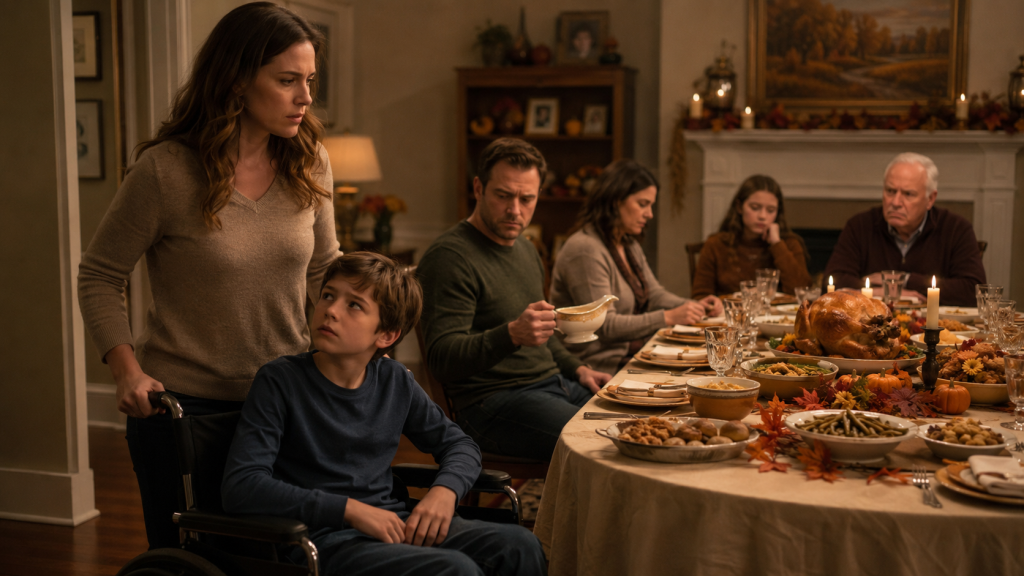
I looked at the house behind him, where his family continued eating as though nothing had happened.
“No, Mark. I think I’ve spent years making things smaller than they are.”
His expression changed.
He knew I wasn’t talking only about Thanksgiving.
Then my phone buzzed.
It was a message from Linda.
Richard has done this before. There’s something you need to know.
I read it twice before looking back at Mark.
“What has your father done before?”
Mark’s face went still.
Not confused.
Not surprised.
Still.
And that told me almost everything.
“You knew?” I whispered.
“Claire, this isn’t the place.”
I gave a short, disbelieving laugh.
“You said that inside too.”
Ethan was watching us through the open van door.
That stopped me from saying everything I wanted to say.
I closed the door gently and walked several feet away.
“Tell me what Linda means.”
Mark rubbed both hands over his face.
“My dad has always been… difficult.”
“Difficult?”
“He says things.”
“He just told our ten-year-old son that his existence makes people uncomfortable.”
“He didn’t say his existence.”
I stared at him.
Mark immediately looked ashamed.
“That came out wrong.”
“No, Mark. It came out exactly the way you’ve been thinking about this. You’re splitting hairs because admitting what your father did would mean admitting what you did.”
“I didn’t do anything.”
“That’s the problem.”
He looked back toward the house.
Through the dining room window I could see shadows moving.
Nobody was coming outside.
Nobody except Mark.
And even Mark had only followed after Ethan and I were already in the driveway.
“Claire,” he said quietly, “Dad grew up differently.”
“So did millions of other people who somehow learned not to humiliate children.”
“You know how he is.”
There it was.
The sentence I had heard for fourteen years.
You know how he is.
Richard forgot birthdays because that was how he was.
Richard criticized my cooking because that was how he was.
Richard mocked Mark’s career decisions because that was how he was.
Richard interrupted Linda and corrected her in front of people because that was how he was.
Richard complained when restaurants seated us somewhere that gave Ethan enough space because that was how he was.
Apparently everyone else was expected to shrink so Richard would never have to grow.
I had tolerated it when the comments were aimed at me.
I had even tolerated more than I should have when they were aimed at Mark.
But Ethan?
No.
I opened the driver’s door.
“Where are you going?” Mark asked.
“Home.”
“You can’t just leave me here.”
“I didn’t.”
He frowned.
“You chose your seat.”
Then I got into the van.
He stood in the driveway as I pulled away.
For the first ten minutes, Ethan said nothing.
The highway stretched ahead of us beneath a gray November sky. Bare trees blurred past the windows. A half-finished holiday playlist played quietly through the speakers until I turned it off.
Eventually Ethan spoke.
“Grandpa doesn’t like me, does he?”
I gripped the steering wheel.
Children have a way of asking questions adults spend years avoiding.
I could have lied.
I could have told him Grandpa loved him in his own way.
I could have protected Richard’s reputation at the cost of Ethan’s understanding.
I had done variations of that before.
Not anymore.
“Grandpa has some wrong ideas,” I said. “And sometimes those wrong ideas make him treat people badly.”
“Because of my chair?”
“Yes.”
Ethan stared out the window.
“That’s stupid.”
Despite everything, I smiled.
“Yes. It is.”
He thought about it.
“Does Dad think that too?”
That question was harder.
“No,” I said carefully. “Your dad loves you.”
“Then why didn’t he say anything?”
I had no answer that would make sense to a ten-year-old.
Honestly, I barely had one that made sense to me.
“I think sometimes people get so used to keeping another person happy that they forget what they’re supposed to protect.”
Ethan nodded slowly.
Then he said something I would remember for the rest of my life.
“Well, I don’t want Dad protecting Grandpa’s feelings from me.”
Neither did I.
Twenty minutes later, instead of continuing home, I took an exit.
“Where are we going?” Ethan asked.
“You hungry?”
He looked at me as if I had asked the dumbest question imaginable.
“I didn’t get pie.”
“Tragedy.”
“Absolute tragedy.”
There was a twenty-four-hour diner near the interstate that we had passed dozens of times.
It had faded red booths, crooked framed photographs, and a handwritten sign promising HOMEMADE PUMPKIN PIE.
The hostess looked at Ethan, then at the narrow path between two tables.
“Give me one second,” she said.
She moved a chair, shifted a small table, and cleared a comfortable space without making a production out of it.
No staring.
No sighing.
No suggestion that Ethan would be more convenient somewhere else.
“Better?” she asked him.
“Perfect,” Ethan said.
That ordinary kindness nearly made me cry.
We ordered turkey sandwiches, fries, hot chocolate, and two enormous slices of pumpkin pie.
Halfway through dessert, Ethan’s mood began to return.
He told me about a science project he wanted to build.
He complained that his teacher still refused to believe Pluto deserved to be a planet.
He announced that the diner’s whipped cream was “scientifically superior” to Grandma Linda’s.
Then my phone began buzzing.
Mark.
Mark again.
Linda.
My sister-in-law Rachel.
Mark.
Richard.
I turned the screen facedown.
Ethan noticed.
“You can answer.”
“Not tonight.”
“Dad might be worried.”
“He knows where we’re going.”
“Home?”
“Eventually.”
He dipped his fork into whipped cream.
“Mom?”
“Yeah?”
“Can we have Thanksgiving here next year?”
I looked around at the cracked vinyl booths and laminated menus.
“Maybe somewhere slightly fancier.”
“No. Here.”
“Why?”
He shrugged.
“Nobody told me to eat in the kitchen.”
That did it.
I excused myself, went into the restroom, locked myself inside a stall, and cried silently for three minutes.
Not because Richard had shocked me.
Because he hadn’t.
If I was being truthful, there had been signs for years.
When Ethan was four and had begun using his first wheelchair, Richard had called it “that contraption.”
When Ethan was six, Richard refused to change restaurants after discovering the one he chose had stairs at the entrance.
“We already made reservations,” he’d complained.
Mark had carried Ethan inside while I folded the chair and followed.
At the time, I had told myself it was practical.
When Ethan was seven, Richard bought all the grandchildren bicycles for Christmas.
Including Ethan.
An ordinary two-wheel bicycle.
I had stared at it in disbelief.
Richard laughed.
“What? Maybe it’ll motivate him.”
Mark had pulled me aside before I could respond.
“He didn’t mean anything by it.”
At eight, Ethan overheard Richard telling a neighbor that raising “a kid like that” must be exhausting.
At nine, Richard complained because Ethan needed extra room at Linda’s birthday dinner.
Every time, I objected.
Every time, Mark smoothed it over.
He never agreed with Richard.
That was what I told myself.
Mark wasn’t cruel.
He simply hated confrontation.
But somewhere along the way, I had begun accepting cowardice as kindness simply because it wore a quieter face.
When Ethan and I finally reached home after nine that evening, Mark’s car wasn’t in the driveway.
I helped Ethan inside, made sure he was comfortable, and found three texts from Mark.
We need to talk.
Dad is furious.
Mom says you misunderstood her message.
The third one made me pause.
I called Linda.
She answered on the first ring.
“Claire?”
“What did you mean?”
Silence.
“Linda.”
“I shouldn’t have texted.”
“But you did.”
“I was upset.”
“Tell me.”
She lowered her voice.
“I don’t want to interfere between you and Mark.”
“You already know Richard told Ethan to eat in another room.”
“Yes.”
“And you said he’s done this before.”
Another pause.
Then she sighed.
“When Mark was little, his cousin Peter used crutches.”
I sat down.
“What happened?”
“Peter had cerebral palsy. Richard’s brother would bring him to family events. Richard always complained about accommodations.”
My stomach tightened.
“One Christmas, Richard told his brother it would be easier if Peter stayed home.”
I closed my eyes.
“Mark knew?”
“He was thirteen.”
“Did he hear it?”
“Yes.”
“What happened?”
“Richard’s brother stopped coming.”
The room seemed suddenly colder.
“Linda, why didn’t you say anything today?”
She began crying softly.
“I don’t know.”
I did.
But I wanted to hear whether she did.
“I spent thirty-seven years telling myself that peace was worth it,” she continued. “Every time Richard said something cruel, I thought correcting him would create a bigger problem. So I cleaned up afterward.”
The words landed heavily.
Because that was exactly what Mark had learned.
Not Richard’s cruelty.
Linda’s accommodation of it.
“You taught Mark to survive his father,” I said quietly.
“I know.”
“And now he’s doing the same thing.”
“I know.”
I pressed my fingers against my forehead.
“Does Richard actually believe Ethan shouldn’t be around people?”
“I think Richard believes anything that makes him uncomfortable should disappear.”
That might have been the most accurate description of my father-in-law I had ever heard.
Before ending the call, Linda said, “Claire?”
“Yes?”
“I’m sorry.”
“For what?”
“For not standing up from that table with you.”
I appreciated the apology.
But apologies after a child is humiliated have limits.
“Thank you for saying that.”
When I walked into Ethan’s room, he was already asleep.
His wheelchair rested beside the bed.
On his desk sat a model rocket we had built together the previous month.
There were books everywhere, a half-finished drawing taped crookedly to the wall, and a basketball signed by a Paralympic athlete Ethan adored.
I sat beside him and brushed his hair back.
This child had worked harder by age ten than many adults worked their entire lives.
He had endured surgeries.
Physical therapy.
Pain.
Stares.
Questions from strangers.
Buildings designed as though people like him did not exist.
And somehow he was still funny.
Still curious.
Still generous.
No one was going to teach him that he should apologize for occupying space.
Not even his grandfather.
Especially not his father.
Mark came home after midnight.
I was sitting at the kitchen table.
He stopped when he saw me.
“Ethan asleep?”
“Yes.”
He removed his coat.
“I’m sorry.”
I waited.
“For what?”
He hesitated.
“For everything.”
“Specifics matter.”
His jaw tightened.
“Claire, I’m exhausted.”
“So am I.”
“I spent three hours getting yelled at by my father.”
“And Ethan spent Thanksgiving wondering whether his dad was ashamed of him.”
That silenced him.
Mark sat across from me.
“I’m not ashamed of Ethan.”
“Then why didn’t you defend him?”
“I froze.”
“You passed the gravy.”
He looked away.
“I didn’t know what to say.”
“You could have said no.”
“I know.”
“You could have stood up.”
“I know.”
“You could have followed us immediately.”
“I know.”
“You stayed.”
“I know!”
His voice rose.
The house went still.
We both glanced toward the hallway.
Mark lowered his voice again.
“I know.”
I studied him.
This man had been my husband for fourteen years.
We met when we were twenty-five.
He was funny, intelligent, dependable.
When Ethan was born and doctors told us something was wrong with his spine, Mark stayed beside me for forty hours straight.
He learned every medication.
Every appointment.
Every transfer technique.
He built ramps.
Modified bathrooms.
Fought insurance companies.
Sat beside hospital beds.
This was not a father who didn’t love his son.
That was what made Thanksgiving worse.
Love had been present.
Courage had not.
“Your mother told me about Peter,” I said.
Mark’s face changed.
For several seconds, he didn’t respond.
Then he whispered, “She shouldn’t have.”
“Why?”
“Because that was years ago.”
“Did your father tell Peter’s parents to leave him home?”
Mark nodded.
“And you knew.”
“I was a kid.”
“You’re not a kid anymore.”
He leaned back.
“I know.”
“You watched your uncle disappear from the family because your father couldn’t tolerate his disabled son.”
“It wasn’t just that.”
“What else was it?”
“There were arguments. Money. Family stuff.”
“But Peter was part of it.”
“Yes.”
“And today your father did the same thing to Ethan.”
Mark’s face crumpled slightly.
“I didn’t realize it until you left.”
That sentence mattered.
Not because it excused him.
Because it revealed how deeply the pattern ran.
“Mark,” I said, “I need you to understand something. I am not taking Ethan back into that house until your father apologizes directly to him and demonstrates that he understands what he did.”
Mark nodded.
“And if he refuses?”
“Then Ethan doesn’t go back.”
“What about me?”
“That’s your decision.”
He stared at the table.
“I can’t cut off my parents.”
“I didn’t ask you to.”
“It sounds like you are.”
“No. I’m asking you to stop requiring Ethan to absorb harm so you don’t have to experience conflict.”
He flinched.
Good.
Some truths are supposed to hurt.
The next morning, Richard called me.
I almost ignored it.
Then I decided I wanted to hear exactly what he had to say.
“Claire,” he began, “this has gotten ridiculous.”
No hello.
No apology.
“What has?”
“You storming out.”
“You told Ethan to eat in the kitchen.”
“I suggested a seating adjustment.”
I laughed.
“A seating adjustment?”
“There were fourteen people at the table.”
“There were sixteen chairs.”
“That wheelchair takes space.”
There it was.
Not even hidden.
“So Ethan should disappear because his wheelchair takes space?”
“You always twist everything.”
“No, Richard. You’ve simply spent years around people who untwist your words after you say them.”
He became quiet.
Then colder.
“I won’t be spoken to this way.”
“Then hang up.”
“I am your elder.”
“And Ethan is your grandson.”
“He needs to learn the world won’t rearrange itself for him.”
I gripped the phone.
“The world already makes him fight for access every day. His family is supposed to be the place where he doesn’t have to.”
“You’re making him soft.”
“No. You’re confusing dignity with weakness.”
Richard scoffed.
“I raised three successful children.”
“And one of them was too scared of you to defend his son yesterday.”
Silence.
Then Richard said, “Mark should control his wife.”
I ended the call.
Not angrily.
Not dramatically.
I simply pressed the red button.
Ten seconds later he called again.
I blocked his number.
That afternoon, Mark found out.
“You blocked my dad?”
“Yes.”
“You can’t just do that.”
“I just did.”
“He’s my father.”
“He can call you.”
“This affects all of us.”
“That’s true.”
“Claire, please.”
I turned toward him.
“No. You don’t get to ask me to make this easier anymore.”
He opened his mouth.
I continued.
“For years, whenever your father insulted someone, we were expected to be mature. Whenever he made a cruel joke, we were expected to have a sense of humor. Whenever he inconvenienced Ethan, we were expected to be flexible. Do you see the pattern?”
Mark didn’t answer.
“The only person nobody ever expects to change is Richard.”
He sat down heavily.
That evening, Mark did something I hadn’t expected.
He called his uncle.
Peter’s father.
His name was David.
I hadn’t seen David Bennett in eleven years.
Mark spoke to him for nearly an hour in his office.
When he came downstairs, his eyes were red.
“What happened?” I asked.
He leaned against the counter.
“Dad told me a different story.”
“About why David stopped coming?”
Mark nodded.
“He said Uncle David became bitter over inheritance money.”
“And?”
“David said the final argument happened after Dad refused to let Peter come to Grandma’s seventieth birthday because the venue wasn’t accessible.”
My stomach turned.
“How old was Peter?”
“Sixteen.”
Mark looked devastated.
“Dad told everyone David chose not to attend.”
There are moments when the story you have told yourself about your family collapses.
I watched that happen to my husband.
“What else did David say?”
“He said Dad used to call Peter a burden.”
I closed my eyes.
“Mark…”
“I remember hearing it once.”
He sat at the table.
“I told myself I remembered wrong.”
There it was again.
The survival technique passed from mother to son.
Reinterpret.
Minimize.
Forget.
Keep dinner peaceful.
“What happened to Peter?” I asked.
Mark smiled faintly.
“He’s thirty-eight now. Married. Two kids. Works in software.”
“Does he talk to Richard?”
“No.”
“Smart man.”
Mark almost smiled.
Then he looked toward Ethan’s room.
“I did exactly what my mother did.”
I didn’t reassure him.
He needed to sit with that.
“I watched Dad hurt someone and convinced myself saying nothing was better than making things worse.”
“Yes.”
“I don’t want Ethan remembering me that way.”
“Then give him something else to remember.”
The next morning, Mark knocked on Ethan’s bedroom door.
I stayed in the hallway.
“Come in,” Ethan called.
Mark entered.
For several minutes, I heard nothing.
Then Mark said, “I owe you an apology.”
Ethan didn’t respond.
“I should have defended you at Grandpa’s house. What he said was wrong. And when I didn’t say anything, I made it look like I agreed with him.”
Still silence.
“I don’t.”
Ethan’s voice came softly.
“Why didn’t you say that there?”
Mark answered honestly.
“Because I was scared of arguing with Grandpa.”
Ethan said, “You’re bigger than him.”
I had to cover my mouth.
Mark laughed once, sadly.
“I know. Being bigger doesn’t always mean you’re braver.”
Another pause.
“Were you scared when Grandma had surgery?” Ethan asked.
“Yes.”
“But you still went.”
“Yes.”
“Were you scared when I had surgery?”
“Terrified.”
“But you stayed.”
“I did.”
“So you can do things scared.”
Mark’s voice broke.
“Yes.”
“Then you could have said something.”
“Yes.”
A minute later, Mark came out crying.
Ethan had forgiven him.
I hadn’t.
Not yet.
Forgiveness between parent and child is different from repair between spouses.
Mark understood that.
The following week, Richard sent a letter.
Not to Ethan.
To Mark.
Two handwritten pages explaining why I was ruining the family.
I was controlling.
Overly sensitive.
Disrespectful.
Manipulative.
Richard claimed I had “weaponized Ethan’s condition” against him.
Mark read the letter twice.
Then he tore it in half.
That surprised me more than any speech would have.
“What are you doing?” I asked.
“Something I should have done years ago.”
He threw it away.
But Richard wasn’t finished.
He called relatives.
He told them I had banned him from seeing his grandson because of a misunderstanding.
He said I was forcing Mark to choose between his wife and parents.
Some believed him.
Some didn’t.
One aunt called me and said, “You know Richard. He’s old-fashioned.”
I replied, “Prejudice doesn’t become charming because it has wrinkles.”
She didn’t call again.
Christmas approached.
Linda asked whether she could visit Ethan.
I hesitated.
Unlike Richard, she had apologized.
But apologies meant little without action.
“Will Richard come?”
“No.”
“Does he know?”
“Yes.”
“And?”
“He’s angry.”
I considered it.
“Come Saturday.”
She arrived carrying no gifts except a pie.
That mattered.
I didn’t want Ethan being bribed into affection.
When Linda entered, she knelt beside his chair.
“I’m sorry I didn’t stand up for you.”
Ethan looked at her.
“You didn’t tell me to go away.”
“No. But I let someone else tell you, and I stayed seated.”
He thought about that.
Then he asked, “Why?”
Linda’s eyes filled.
“Because I got used to being afraid of making Grandpa angry.”
Ethan glanced toward Mark.
“You too?”
Mark nodded.
Ethan looked between them.
“Grandpa sounds exhausting.”
Linda laughed through her tears.
“He is.”
Something changed that afternoon.
Not everything.
But something.
Linda began telling stories.
Real stories.
She talked about Richard controlling family holidays.
About David.
About years of walking on eggshells.
Mark listened like someone hearing the biography of his own childhood for the first time.
Eventually Linda said, “I should have left the table.”
I replied, “Yes.”
She nodded.
No excuses.
No defensiveness.
Just yes.
That was when I began believing she might actually change.
Richard did not.
On December twentieth, he appeared at our house without warning.
I opened the door but didn’t invite him inside.
“We need to settle this before Christmas,” he said.
“There’s nothing to settle.”
“I’m prepared to move past it.”
I almost laughed.
“How generous.”
“I’m serious.”
“So am I.”
He looked over my shoulder.
“Where’s Ethan?”
“In the house.”
“I brought him something.”
He held up a large wrapped box.
“What?”
“A gift.”
“That wasn’t my question.”
His jaw tightened.
“A new tablet.”
Ethan already had a tablet.
Richard knew that.
This was not a gift.
It was a payment.
“No.”
“You won’t even let me give my grandson a Christmas present?”
“You haven’t apologized.”
“I’m not apologizing for suggesting a practical solution.”
“Then you’re not seeing him.”
His face hardened.
“This is my son’s house too.”
“Correct.”
As if summoned, Mark appeared behind me.
Richard looked relieved.
“Mark. Tell her this is ridiculous.”
Mark stood beside me.
Not behind.
Beside.
“Dad, you need to leave.”
Richard blinked.
“What?”
“You heard me.”
“After everything your mother and I did for you?”
“This isn’t about that.”
“It’s because of her.”
Mark shook his head.
“No. That’s what I kept telling myself. Claire was the difficult one because that let me avoid admitting you were.”
Richard’s face turned red.
“You’re choosing her over your family.”
Mark said something I still remember word for word.
“She is my family. Ethan is my family. You’re asking me to choose your comfort over my son’s dignity. I already did that once. I’m not doing it again.”
Richard stared at him.
Then at me.
Then back at Mark.
“Fine.”
He shoved the gift against Mark’s chest.
“When he grows up spoiled, remember this.”
Mark set the box on the porch.
“Take it.”
Richard left it anyway.
We donated the tablet to a children’s rehabilitation center.
Christmas was smaller that year.
Linda came.
My sister and her family came.
David and Peter joined us through a video call.
For the first time, Mark spoke to Peter as an adult.
Their conversation lasted nearly two hours.
At one point Ethan rolled into view.
Peter smiled.
“Nice wheels.”
Ethan grinned.
“Thanks.”
Peter tilted the camera downward and showed his own mobility scooter.
“Mine’s faster.”
“Doubt it.”
The two of them spent twenty minutes debating specifications.
After the call, Ethan said, “He’s cool.”
Mark looked emotional.
“Yeah. He is.”
In January, Mark started therapy.
He didn’t announce it dramatically.
One Tuesday he simply said, “I made an appointment.”
“For what?”
“Therapy.”
I raised my eyebrows.
“I think I need to understand why I’m still thirteen whenever my dad is angry.”
That was the beginning of real change.
Not the apology.
Not the confrontation.
The work afterward.
For years, Mark had mistaken avoidance for patience.
Therapy gave him language for what he had grown up around.
Emotional intimidation.
Control.
Conditioned appeasement.
A family system built around keeping one volatile person calm.
He came home from one session and said, “My therapist asked what happened when Dad got angry when I was a kid.”
“What did you say?”
“I told her Mom made everyone quiet.”
That sentence explained generations.
Linda began therapy too.
Richard called it brainwashing.
By February, Linda had moved into the guest room.
By March, she moved out.
That shocked everyone.
After thirty-seven years of marriage, she rented a small apartment fifteen minutes from us.
Richard told relatives I had broken his family.
Linda corrected them.
“No,” she said. “Claire stopped pretending it wasn’t already broken.”
I didn’t tell Linda to leave him.
Mark didn’t either.
That decision belonged to her.
She later told me Thanksgiving had forced her to see something she had avoided for decades.
“When Richard said Ethan should eat in the kitchen,” she explained, “I looked at you waiting for you to do what I always did.”
“What?”
“Smile. Adjust. Keep everyone comfortable.”
She wiped her eyes.
“Then you stood up.”
I reached for her hand.
“I wish I’d done it years earlier.”
“So do I.”
There was grief in that.
Not just for Thanksgiving.
For Peter.
For David.
For Mark.
For Linda herself.
Richard’s consequences didn’t arrive dramatically.
There was no courtroom.
No public humiliation.
No giant confrontation where everyone applauded.
They arrived quietly.
People stopped coming.
Linda left.
Mark stopped answering abusive calls.
Rachel, Mark’s sister, began limiting contact after Richard insulted her husband.
David refused reconciliation without accountability.
For the first time in his life, Richard discovered that being tolerated was not the same as being loved.
In April, Ethan had a school presentation.
His class had been assigned a project called “Someone Who Changed My Life.”
I assumed he would choose an athlete.
Or a scientist.
Maybe one of his doctors.
He chose Mark.
I didn’t know until we arrived.
Parents filled the classroom.
Students took turns presenting poster boards covered with photographs.
When Ethan rolled to the front, he positioned himself behind a small podium.
His poster said:
MY DAD LEARNED HOW TO BE BRAVE.
I glanced at Mark.
He looked stunned.
Ethan began.
“My dad has always helped me with things. He learned how to fix my wheelchair and helped me build ramps and stayed with me in hospitals.”
Mark lowered his eyes.
“But sometimes helping people do things isn’t the same as standing up for them.”
The room became very quiet.
“My dad used to be scared to argue with my grandpa. On Thanksgiving, my grandpa said I should eat somewhere else because of my wheelchair.”
A few parents exchanged looks.
“My dad didn’t say anything.”
Mark’s eyes filled.
“But later he apologized. And he didn’t just say sorry. He changed.”
Ethan turned toward us.
“My mom says apologies are promises about what you do next.”
I had said that once.
I didn’t know he remembered.
“So my dad started doing the next part.”
Ethan smiled.
“He learned you can be scared and still do something.”
When the class applauded, Mark cried openly.
Afterward, he hugged Ethan.
“Thank you.”
Ethan shrugged.
“You still owe me twenty bucks.”
“For what?”
“The science fair bet.”
Mark laughed.
“Extortionist.”
Their relationship wasn’t magically healed because of one presentation.
But it was stronger.
Honesty had done what silence never could.
That summer, Richard had a health scare.
Nothing life-threatening.
But enough to frighten him.
He called Mark from the hospital.
Mark went.
I didn’t object.
Boundaries are not revenge.
Mark was allowed to love his father.
He simply wasn’t allowed to offer Ethan as the price of that relationship.
Richard asked about Ethan.
Mark said he was doing well.
Then Richard reportedly said, “Are you ever going to let this go?”
Mark replied, “When you apologize.”
“I already said I was sorry everyone got upset.”
“That’s not an apology.”
“What do you want from me?”
“I want you to understand what you did.”
Richard stared at him.
“Why does everyone suddenly need feelings explained?”
Mark stood.
“Because ignoring them cost you your family.”
He left.
Months passed.
Then, almost a year after that Thanksgiving, an envelope arrived addressed to Ethan.
I recognized Richard’s handwriting.
I did not open it.
I gave it to Mark.
“What do we do?”
He looked at the envelope.
“Ask Ethan.”
That was progress too.
Not deciding around him.
Including him.
Ethan inspected the letter.
“Is it from Grandpa?”
“Yes.”
“Do I have to read it?”
“No.”
“Can you read it first?”
“Yes.”
Mark opened it.
The letter was short.
Ethan,
Last Thanksgiving I said something cruel and wrong. I treated your wheelchair like it was a problem and made you feel as though you did not belong at our table.
You did belong.
I was the one who behaved badly.
Your father has asked me for months to apologize, but I kept thinking an apology meant losing an argument.
I understand now that I had already lost something more important.
I missed your birthday.
I missed your school presentation.
I missed seeing you this summer.
Those were consequences of my choices, not your mother’s.
I am sorry.
You do not owe me forgiveness.
Grandpa Richard
Mark stopped reading.
The room stayed silent.
Ethan looked at me.
“Do you think he means it?”
“I don’t know.”
“Dad?”
Mark folded the letter.
“I think he might.”
Ethan considered that.
“Can I write back?”
“Of course.”
He took a sheet of paper from his desk.
His response was even shorter.
Grandpa,
Thank you for apologizing.
You hurt my feelings.
I’m not ready to come to your house yet.
Maybe you can come to one of my basketball games sometime if Mom and Dad say yes.
Ethan
That was the first step.
Not reconciliation.
A step.
Richard came to a game three weeks later.
Adaptive basketball was one of Ethan’s favorite things in the world.
Richard sat at the end of the bleachers.
He didn’t complain about the crowded gym.
He didn’t make comments about the chairs.
He didn’t offer advice.
He simply watched.
Ethan scored six points.
Afterward, Richard approached us.
“Good game,” he said.
“Thanks.”
Then nothing.
It was awkward.
Good.
Some things should be awkward before they become better.
Richard looked at Ethan’s chair.
For one terrible second, I worried he would say something foolish.
Instead he said, “That thing moves fast.”
Ethan grinned.
“Told you.”
Richard smiled.
It was small.
But real.
Over the next year, contact resumed slowly.
Always on Ethan’s terms.
Always with boundaries.
Richard came to public events.
Then lunches.
Then eventually our home.
We did not return to his house for a long time.
Not because kitchens were dangerous.
Because memories are.
Linda never moved back.
She and Richard eventually divorced.
People assumed she would regret leaving at sixty-three.
She didn’t.
She joined a gardening club.
Traveled with her sister.
Bought bright yellow furniture Richard would have hated.
She became louder.
Not rude.
Just present.
One afternoon she told me, “I spent most of my adult life thinking a successful marriage meant no one left.”
“What do you think now?”
“That sometimes leaving is the first honest thing anybody does.”
Richard changed too.
Not completely.
People rarely become different overnight.
He was still stubborn.
Still blunt.
Still capable of saying things that made Mark close his eyes and count to five.
But now people corrected him.
And, more importantly, they stopped rescuing him from the consequences.
If he insulted someone, the conversation ended.
If he ignored a boundary, the visit ended.
If he complained, nobody rushed to soothe him.
Slowly, behavior that had survived for decades because everyone accommodated it stopped working.
Two Thanksgivings after the one that changed everything, we hosted dinner.
Not Richard.
Us.
Twenty people came.
David and Peter drove from Michigan.
It was the first time Mark had seen Peter in person since they were teenagers.
When Peter entered our house, Mark hugged him for nearly a minute.
“I’m sorry,” Mark whispered.
Peter squeezed his shoulder.
“You were a kid.”
“I still believed Dad’s version for too long.”
“We all believe whatever helps us survive our families.”
Ethan rolled over.
“Race you to dessert.”
Peter pointed at him.
“You’re on.”
The house was chaotic.
Children running.
Adults laughing.
Linda arguing cheerfully with my sister about stuffing.
Rachel opening wine.
Mark burning rolls.
Someone dropped cranberry sauce.
Nobody cared.
Then the doorbell rang.
Richard.
He stood outside holding a pie.
For a moment, everything inside me traveled backward.
The dining room.
The gravy boat.
Ethan’s voice.
Did I do something wrong?
Richard looked nervous.
I had never seen Richard Bennett nervous before.
“Come in,” I said.
He entered.
His eyes landed on Peter.
The room became quieter.
Peter didn’t move.
Richard approached him.
“Peter.”
“Uncle Richard.”
Richard swallowed.
“I owe you an apology too.”
Peter raised an eyebrow.
“About thirty years late.”
“Yes.”
Nobody rescued Richard from the discomfort.
Nobody told Peter to be nice.
Nobody changed the subject.
Richard stood there and took it.
“I said things about you that were cruel. I treated your disability as an inconvenience. I pushed your family away and then blamed your father.”
Peter stared at him.
“Yes, you did.”
“I’m sorry.”
Peter nodded.
“I appreciate you saying it.”
That was all.
No dramatic hug.
No instant forgiveness.
Just truth.
Sometimes that is enough for the first day.
When dinner was ready, everyone began finding seats.
Our dining table had been extended into the living room.
We had rearranged furniture so both Ethan and Peter could move easily.
Richard watched Mark slide one chair aside to create additional room.
Then he quietly moved another without being asked.
Ethan rolled beside him.
“Grandpa.”
“Yes?”
“You’re in my spot.”
Richard immediately stepped aside.
“Sorry.”
Ethan laughed.
“I’m kidding.”
Everyone laughed.
Even Richard.
Especially Richard.
Dinner started.
Halfway through, Mark picked up the gravy boat.
I watched him.
He noticed.
For a second, neither of us said anything.
Then he smiled faintly.
“Gravy?”
The memory hit both of us at once.
I smiled back.
“Sure.”
He passed it to me.
This time it meant something different.
After dinner, Ethan wanted to make a toast.
He tapped his spoon against his glass.
“Attention.”
Everyone quieted.
He had recently turned twelve and had discovered the joy of commanding rooms.
“I have an announcement.”
Mark whispered, “This feels dangerous.”
Ethan ignored him.
“I just want to say this Thanksgiving is better than the bad one.”
Richard looked down.
Ethan continued.
“Not because nobody made mistakes.”
He glanced around the table.
“But because now people actually talk about them.”
Linda smiled.
Peter nodded.
“And because Mom said if anyone tells me to eat in the kitchen, she’ll make them eat in the garage.”
Everyone burst out laughing.
“I did not say garage,” I protested.
“You implied garage.”
“I absolutely did not.”
Mark raised his glass.
“I heard garage.”
Traitor.
Even Richard laughed.
Then Ethan became serious.
“I used to think Grandpa didn’t want me around because something was wrong with me.”
Richard’s smile disappeared.
“But Mom told me other people’s behavior isn’t proof about your worth.”
I felt tears burn behind my eyes.
“So I think everybody should remember that.”
He lifted his glass of sparkling cider.
“And I still think Pluto is a planet.”
The table erupted.
“To Pluto!” someone shouted.
“To Pluto!”
Later that night, after everyone left, I found Mark standing alone in the kitchen.
He was loading plates into the dishwasher.
I leaned against the doorway.
“Need help?”
“I’ve got it.”
I watched him for a moment.
“Two years.”
He nodded.
“I know.”
“Feels longer.”
“Feels like another lifetime.”
He shut the dishwasher.
“I still think about that day.”
“So do I.”
“I hate remembering myself sitting there.”
“You should.”
He looked at me.
I smiled gently.
“Not forever. But enough to remember why you changed.”
He nodded.
“I thought being a good husband meant keeping everyone happy.”
“You were terrible at it.”
He laughed.
“Apparently.”
Then he became serious.
“I almost lost you.”
“Yes.”
“And Ethan.”
“Possibly.”
He took my hand.
“Thank you for standing up when I didn’t.”
I squeezed his fingers.
“I wasn’t trying to save our marriage.”
“I know.”
“I was protecting Ethan.”
“I know.”
“That distinction matters.”
“I know.”
He leaned against the counter.
“Maybe that’s why it saved us.”
He was right.
If I had stayed seated that Thanksgiving, our marriage might have looked peaceful.
We would have eaten turkey.
Passed gravy.
Cut pie.
Driven home.
Mark would have apologized quietly in the car.
Richard would have forgotten the comment by morning.
And Ethan would have remembered forever that nobody moved when he was told he didn’t belong.
That kind of peace has a cost.
For years, I thought keeping a family together meant preventing explosions.
Now I know families can be damaged just as deeply by silence.
Sometimes love looks like patience.
Sometimes love looks like forgiveness.
And sometimes love looks like pushing your chair back from the table and saying, “No.”
No, my child will not be hidden.
No, cruelty will not be called tradition.
No, cowardice will not be confused with keeping the peace.
No, age does not excuse prejudice.
No, blood does not guarantee access to someone you repeatedly hurt.
And no, we will not teach our children to make themselves smaller so adults can remain comfortable.
Ethan is fourteen now.
He barely remembers the exact words Richard used that Thanksgiving.
I do.
I probably always will.
But what Ethan remembers more clearly is what happened afterward.
He remembers the diner.
The giant slice of pumpkin pie.
His father’s apology.
His grandmother changing her life.
Meeting Peter.
Playing basketball with Grandpa watching from the bleachers.
He remembers that the adults around him eventually became braver.
Last month, Ethan had to give a speech at school about belonging.
I sat in the auditorium beside Mark.
Near the end, Ethan said something that made me cry.
“Belonging isn’t when people let you stay as long as you don’t inconvenience them. Belonging is when nobody questions whether there should be space for you in the first place.”
Mark reached for my hand.
Across the aisle, Richard sat beside Linda.
They were divorced.
They would never become close friends.
But they could now attend their grandson’s events without turning every room into a battlefield.
Richard heard Ethan’s words.
His eyes filled.
After the speech, he approached him.
“You taught me that,” Richard said.
Ethan grinned.
“That’ll be five dollars.”
Richard laughed.
“Inflation?”
“Knowledge is expensive.”
Watching them, I thought about the question Ethan had whispered years earlier.
Mom… did I do something wrong?
At the time, I had answered no.
Today I would answer more.
No, sweetheart.
You did nothing wrong.
You were never the problem.
Your chair was never the problem.
Your need for space was never the problem.
The problem was that too many adults had confused convenience with respect.
The problem was that silence had been handed down through generations and labeled peace.
The problem was that everyone had learned to protect the feelings of the person causing harm instead of protecting the person being harmed.
And the solution began with one chair scraping backward from one Thanksgiving table.
People sometimes ask whether I regret walking out.
Never.
I regret that I didn’t walk out sooner.
I regret the restaurant stairs.
The bicycle.
The jokes.
Every little moment I convinced myself wasn’t serious enough to fight about.
Because children notice what adults tolerate.
They learn where they rank by watching what we defend.
They learn whether their pain matters by seeing whether inconvenience stops us from acting.
That Thanksgiving, Ethan watched me stand.
Then, eventually, he watched his father stand too.
Then Linda.
Then others.
And surprisingly, even Richard eventually learned that accountability wasn’t exile.
It was the only road back.
Our family did change forever that day.
Just not in the way Richard predicted.
I didn’t destroy it.
I stopped helping it pretend.
And once the pretending ended, the people willing to change found one another again.
The people willing to apologize rebuilt trust.
The people who needed boundaries received them.
The people who had been pushed aside were invited back.
And my son never again had to wonder whether he belonged at our table.
Because now, whenever we set it, we make room for everyone before anyone sits down.
💬THE END! THANK YOU FOR READING!