

The prison gates opened beneath a cold gray sky, and I stepped outside carrying everything I owned in one small canvas bag.
For a moment, I simply stood there.
Twenty-three months.
That was how long it had been since I had walked through a door without someone checking my name, counting my belongings, or telling me when I could leave.
The air smelled like rain.
Cars moved along the distant highway.
Somewhere beyond the fence, a dog barked.
Ordinary sounds.
I had forgotten how powerful ordinary things could feel.
Rachel Kim stood beside a black sedan parked near the curb.
She wore a charcoal coat and held an umbrella over one shoulder, but she wasn’t alone.
A silver-haired man stood beside her.
I recognized him immediately.
Samuel Whitmore.
For nearly fifteen years, Samuel had served as outside counsel for Mercer Development.
He had been there when Daniel and I signed our first serious investor agreement.
He had reviewed acquisitions.
He had advised us during refinancing negotiations.
And, more importantly, he had helped me draft several of the corporate protections Daniel had once mocked as “Eleanor’s paranoia clauses.”
Samuel lifted a leather briefcase.
“Welcome back,” he said.
I stopped.
Rachel gave me a small smile.
“Eleanor,” Samuel continued, “Daniel triggered the clause.”
For the first time since the prison doors closed behind me nearly two years earlier, I laughed.
It wasn’t loud.
It wasn’t joyful.
But it was real.
“What exactly did he do?” I asked.
Samuel opened the rear door of the sedan.
“Get in.”
We drove for almost forty minutes before anyone explained.
Samuel had rented a conference suite in a hotel near the river.
No press.
No Mercer Development employees.
No one connected to Daniel.
Just the three of us and several banker’s boxes filled with records.
When Samuel began laying documents across the table, I realized immediately how much Daniel had underestimated me.
Years earlier, after Mercer Development secured its first major institutional investment, I had insisted that neither Daniel nor I could unilaterally seize full control of the company if the other became legally incapacitated, accused of financial misconduct, or removed through circumstances that involved undisclosed conflicts of interest.
Daniel had hated the provision.
He said it was unnecessary.
I told him unnecessary protections were often the only reason companies survived necessary disasters.
Eventually, he signed.
The clause created an independent voting trust containing a block of protected shares.
Under normal circumstances, neither Daniel nor I could control them.
But if one founder attempted a major transfer of company assets while the other founder’s legal status was under active challenge, the shares automatically entered review.
Daniel had forgotten.
Or perhaps he had never understood what he signed.
While I was incarcerated, he had behaved as if my conviction erased every agreement that came before it.
He removed my photograph from the company website.
He altered the executive history on marketing materials.
He described himself publicly as the sole visionary behind Mercer Development.
Then, three weeks before my release, Daniel attempted to sell thirty-two percent of the company to Arden Capital, an aggressive private equity firm based in New York.
The deal would have made him enormously wealthy.
More importantly, it would have permanently diluted any ownership interest I might recover if my conviction were overturned.
That sale triggered the protection clause.
Which triggered an independent audit.
Which revealed transfers.
Millions of dollars.
Some routed through consulting firms.
Some hidden inside development fees.
Some disguised as vendor payments.
Several eventually reached shell companies connected to Vanessa Cole’s older brother, Marcus.
Rachel slid a spreadsheet toward me.
I examined it carefully.
“Daniel approved these?”
“Most of them,” Samuel said.
“Not all.”
I looked up.
“Who approved the rest?”
Samuel hesitated.
“Your digital signature.”
My stomach tightened.
“I didn’t sign these.”
“We know.”
The signatures occurred during periods when I had been traveling or hospitalized.
Rachel leaned forward.
“That matters because we also found something else.”
She opened the gray folder I remembered from the prison visiting room.
The original security archive.
The evidence Daniel believed would never surface.
“We finally reconstructed the full camera sequence,” Rachel said.
She turned a laptop toward me.
My pulse quickened.
I had imagined this moment for nearly two years.
Sometimes during sleepless nights, I wondered whether memory had failed me.
Whether there was some detail I had overlooked.
Whether I had somehow been closer to Vanessa’s accident than I remembered.
Rachel clicked play.
The footage began.
The lobby camera showed me entering Daniel’s office building at 2:11 p.m.
I remembered that afternoon.
I had gone there because one of our financial managers had anonymously emailed me copies of unusual transfers and asked to meet privately.
The meeting never happened.
The manager disappeared before I arrived.
Daniel later claimed I had gone to confront Vanessa.
The footage showed me entering the elevator.
Then another camera captured me leaving on the twelfth floor.
At 2:18 p.m., I entered a conference room.
At 2:32 p.m., I exited.
At 2:35, I left the building through the side lobby.
Vanessa did not fall until 2:51.
Sixteen minutes after I was already gone.
The prosecution had never been given that camera angle.
Instead, Daniel’s attorneys provided a partial archive showing my entrance but not my exit.
I stared at the screen.
My hands began trembling.
Not because I was surprised.
Because after twenty-three months of being told what everyone thought I had done, I was finally looking at proof that reality had never changed.
I had left the building.
I had been gone.
I had never confronted Vanessa.
Rachel let the video continue.
At 2:39, Vanessa appeared near the executive staircase.
Daniel was with her.
I leaned closer.
They were arguing.
There was no audio.
Vanessa pointed toward Daniel’s office.
Daniel shook his head.
She followed him.
At 2:46, they reappeared.
Vanessa looked furious.
Daniel reached for her arm.
She pulled away.
Then she stepped backward.
One heel caught against the edge of the marble stair.
Daniel lunged forward.
He didn’t push her.
He didn’t cause the fall intentionally.
But he had been there.
He saw everything.
And he let me go to prison anyway.
The footage ended with employees rushing toward Vanessa while Daniel stood frozen at the top of the stairs.
My throat closed.
“He watched it happen,” I whispered.
Rachel nodded.
“And then he lied.”
Samuel opened another file.
“There’s more.”
Of course there was.
With Daniel, there was always more.
The original server logs showed that someone from the executive administrator account had accessed the security archive the evening after Vanessa’s accident.
Footage had been copied.
Several files were deleted from the local server.
The administrator credentials belonged to Daniel.
Rachel had also obtained metadata from the fabricated messages used during my trial.
The messages supposedly showed me threatening Vanessa in the weeks before her fall.
Experts now believed they had been exported from a secondary device and altered.
One of the devices linked back to a tablet registered to Mercer Development.
A tablet regularly used by Vanessa.
I looked at Rachel.
“So both of them were involved.”
“We believe so.”
“Believe?”
“We need admissions or stronger corroboration before I’ll say it in court.”
Samuel tapped the financial records.
“That’s where the audit becomes useful.”
The fake contracts and shell companies had created an entirely separate trail.
Daniel and Vanessa had not merely framed me after an accident.
They had also been stealing from the company.
And because Daniel thought I had disappeared permanently, he had become careless.
Exactly as I predicted.
I stood and walked toward the hotel window.
Far below, traffic moved across wet streets.
“What happens if we file everything today?” I asked.
Rachel answered first.
“Emergency motion to vacate your conviction.”
“And Daniel?”
“His lawyers will know within hours.”
“He’ll freeze what he can. Destroy whatever remains. Blame Vanessa. Blame employees. Claim the financial irregularities happened while I still had authority.”
Rachel didn’t disagree.
Samuel studied me.
“You have something else in mind.”
I turned.
“When is the wedding?”
Rachel frowned.
“Saturday.”
Three days away.
“And the Arden sale?”
“Scheduled to close Monday morning.”
I smiled.
“Perfect.”
Rachel already knew that expression.
“No.”
“You don’t know what I’m going to say.”
“I know enough.”
“I want the audit to continue quietly.”
“It already is.”
“I want every account preserved.”
Samuel nodded.
“That can be arranged.”
“I want copies of Daniel’s most recent investor representations.”
“Already requested.”
“And I want to know which directors knew about the sale structure.”
Rachel crossed her arms.
“Eleanor.”
I looked at her.
“I’m not going to crash his wedding with a camera crew.”
“That’s exactly the sort of sentence people say before crashing a wedding with a camera crew.”
Despite everything, I smiled.
“I want him relaxed.”
Samuel understood immediately.
“You want him to sign something.”
“Exactly.”
Daniel was scheduled to execute final representations related to the Arden transaction on Friday night.
Those documents required him to certify that there were no undisclosed investigations, ownership disputes, fraudulent transfers, or material liabilities affecting Mercer Development.
If he signed while knowing my appeal evidence existed, he might claim uncertainty.
But if he signed before learning we had the archive?
Then his own certification could become evidence.
Rachel slowly sat down.
“You really have spent twenty-three months planning this.”
“No.”
I looked at Daniel’s signatures on the table.
“I spent twenty-three months remembering who I married.”
By Friday, I was living in a furnished apartment under Rachel’s name.
Not because I was hiding forever.
Just because I wanted forty-eight more hours without Daniel knowing exactly where I was.
My sister, Grace, was the first person from my old life I saw.
She entered the apartment carrying groceries and burst into tears before the door closed.
For nearly two years, she had visited whenever prison rules allowed.
But glass had always been between us.
Now she wrapped both arms around me.
I froze.
Then I held her.
We stood in the kitchen for almost a minute without speaking.
Finally, Grace pulled away.
“You’re too thin.”
I laughed.
“That’s your first sentence?”
“I had twenty-three months to plan my first sentence.”
“You wasted them.”
She cried harder.
Then we both laughed.
It felt strange.
Good.
Painful.
Human.
Grace had kept records too.
Newspaper articles.
Company announcements.
Social media photographs.
Public filings.
Anything connected to Daniel.
She spread several across the kitchen table.
“Tomorrow’s wedding is ridiculous,” she said.
“Define ridiculous.”
“Four hundred guests. Historic hotel. Imported flowers. Twelve-piece orchestra. Three-day celebration.”
“Daniel always liked expensive proof that he was happy.”
Grace glanced at me carefully.
“Are you sure you want to go anywhere near it?”
“I’m not going to the ceremony.”
“Good.”
“I’m going to the hotel.”
Her face fell.
“Eleanor.”
“I need one meeting.”
“With who?”
“Arden Capital.”
Samuel had arranged it.
The private equity group believed they were meeting with an unidentified stakeholder regarding a potential ownership conflict.
They did not know the stakeholder was me.
At ten Saturday morning, while Vanessa was preparing for a wedding ceremony scheduled to begin at four, I walked into a private conference room three floors below the ballroom.
Three Arden executives were waiting.
Their attorney stood near the window.
Samuel sat beside me.
The lead partner, a woman named Celeste Warren, stared when I entered.
“Eleanor Mercer.”
“Technically still Mercer,” I said. “For the moment.”
Celeste’s expression changed immediately.
Everyone in that room knew my conviction.
Everyone knew what newspapers had said about me.
Samuel placed the original security findings, trust agreement, and preliminary audit summary on the table.
“We believe the seller has failed to disclose material ownership and legal issues,” he said.
Celeste looked at me.
“Your conviction stands.”
“For the next few days, perhaps.”
She examined the footage.
Then the altered digital records.
Then the share clause.
Her attorney requested a private discussion.
They left for fifteen minutes.
When they returned, Celeste looked furious.
Not with me.
With Daniel.
“We’re suspending the transaction.”
“Don’t,” I said.
She stared.
Samuel nearly smiled.
“I’m sorry?”
“Don’t tell him you’re suspending it.”
“You expect us to close?”
“No. I expect you to continue appearing prepared to close.”
Celeste looked at her attorney.
He looked fascinated.
“What exactly are you asking for?”
“I’m asking you not to interrupt someone while he is documenting his own misconduct.”
There was silence.
Then Celeste leaned back.
“I think I’m beginning to understand why Daniel Mercer never discussed you in negotiations.”
By noon, everything was in place.
Daniel had signed the final representation packet the previous evening.
He certified that there were no undisclosed ownership disputes.
No pending challenges.
No material investigations.
No fraudulent transfers.
Every sentence was false.
At 1:17 p.m., Rachel filed the emergency motion to vacate my conviction.
At 1:32, the prosecutor’s office received the original surveillance archive.
At 1:46, the judge’s clerk confirmed receipt.
At 2:05, Samuel delivered the audit evidence to federal investigators examining potential financial misconduct connected to Mercer Development.
At 2:21, Arden Capital’s attorneys formally postponed the closing internally.
Daniel still knew nothing.
At 3:40, wedding guests began filling the hotel lobby.
Grace and I watched from an upstairs suite.
Daniel looked exactly as he did in every article.
Tailored tuxedo.
Perfect posture.
Perfect smile.
He greeted investors.
Politicians.
Developers.
Journalists.
People who had stopped returning my calls after my arrest.
People who had publicly expressed sympathy for him.
People who told newspapers that Daniel Mercer had survived an unimaginable betrayal.
I thought seeing them would make me angry.
Instead, I felt strangely calm.
They had believed the easiest story.
That was all.
Daniel had provided a villain.
Vanessa provided a tragedy.
And I had been too stunned to fight the performance effectively.
Now facts were arriving.
Facts did not need applause.
At 3:55, Vanessa crossed the lobby toward the ballroom.
She wore a silk robe with the word BRIDE embroidered across the back.
Three bridesmaids surrounded her.
She looked happy.
For one brief second, I wondered whether she ever thought about the prison cell where I slept.
Whether she remembered testifying.
Whether she remembered looking at the jury and saying, “I just wanted her to leave me alone.”
Then she turned.
Her eyes found mine.
Everything stopped.
Vanessa froze in the middle of the lobby.
The smile disappeared.
One bridesmaid nearly walked into her.
I didn’t move.
Vanessa stared at me as though she were seeing a ghost.
Then she whispered something.
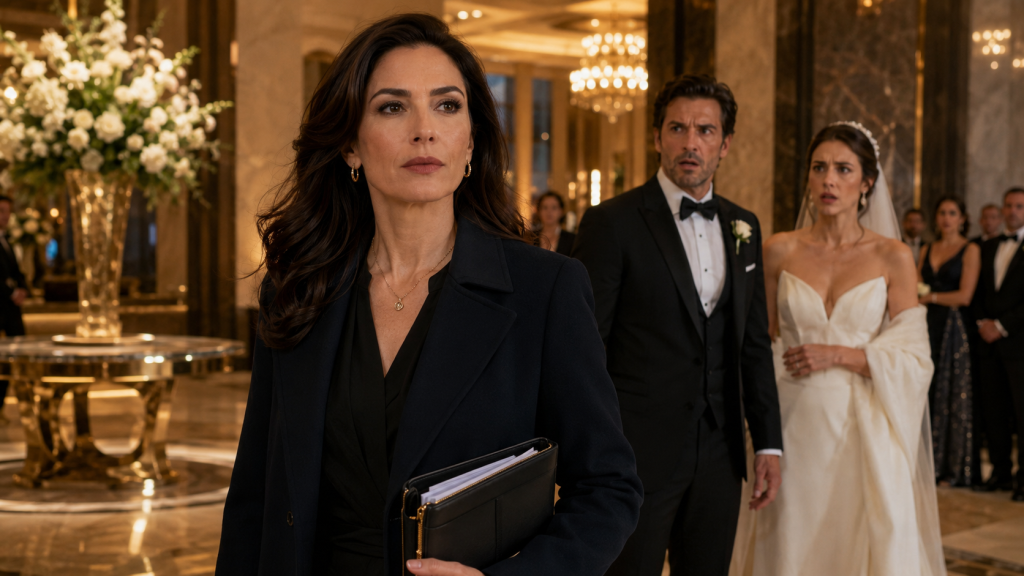
One of the women followed her gaze.
Within seconds, three people were staring.
Then six.
Then ten.
Grace stepped beside me.
“So much for staying unnoticed.”
“I never said unnoticed.”
Vanessa moved toward us quickly.
“What are you doing here?”
Her voice trembled.
I looked at her.
“Hello, Vanessa.”
“You’re not supposed to be here.”
“Interesting choice of words.”
“I mean—”
“I know what you mean.”
She glanced around.
“You need to leave.”
“Why?”
“This is my wedding.”
“I’m aware.”
“You can’t just appear here after everything you did.”
Grace stepped forward.
I touched her arm.
“No.”
Vanessa saw the gesture.
Perhaps she interpreted restraint as weakness.
That had always been her mistake.
She moved closer.
“Daniel told me you’d probably try something after your release.”
“Did he?”
“He said you were obsessed with us.”
“I’ve been busy.”
Her eyes narrowed.
“With what?”
I smiled.
“You’ll find out.”
She went pale.
Then Daniel appeared.
He came out of the ballroom surrounded by two groomsmen and a hotel manager.
When he saw me, he stopped so abruptly that one of the men behind him collided with his shoulder.
Twenty-three months.
Not one visit.
Not one letter.
Not one apology.
And now he was looking at me for the first time since the sentencing hearing.
“Eleanor.”
My name sounded strange in his voice.
“Daniel.”
Guests had begun slowing down around us.
Phones appeared.
Of course they did.
Daniel noticed immediately.
His expression changed.
Public Daniel returned.
Controlled.
Concerned.
Gentle.
“Why are you here?”
“I had a business meeting.”
“At my wedding hotel?”
“It’s also a hotel.”
Vanessa reached for his arm.
Daniel ignored her.
“You shouldn’t be here.”
“You’ve both said that.”
“I’m serious.”
“So am I.”
He lowered his voice.
“Do not ruin this day.”
Something inside me almost laughed.
He had watched me receive a prison sentence for something he knew I had not done.
And he was worried I might ruin his wedding.
“Daniel,” I said quietly, “your day is not my responsibility.”
He stared at me.
Then he noticed Samuel entering the lobby behind us.
His expression changed.
Just slightly.
But I saw it.
“Samuel?”
Samuel approached calmly.
“Daniel.”
“What are you doing here?”
“Representing a shareholder.”
Daniel looked back at me.
That was the moment confidence cracked.
Not shattered.
Not yet.
But cracked.
“What shareholder?”
Samuel didn’t answer.
Daniel understood anyway.
“That’s impossible.”
I smiled.
“You should have read the agreements.”
His jaw tightened.
Vanessa looked between us.
“What is she talking about?”
Daniel ignored her.
“Eleanor, whatever game you think you’re playing—”
“I don’t play games anymore.”
His phone rang.
He looked at the screen.
Declined the call.
It rang again.
Then Vanessa’s phone vibrated.
Then Samuel’s.
Then Daniel’s again.
The lobby suddenly felt smaller.
Daniel answered.
“Mercer.”
He listened.
His face lost color.
“What motion?”
Another pause.
“No. That footage was reviewed.”
He looked at me.
I said nothing.
His eyes widened.
“Original archive?”
Vanessa grabbed his sleeve.
“What footage?”
Daniel turned away.
“How did they get it?”
Rachel entered through the revolving doors.
I watched Daniel see her.
His shoulders dropped half an inch.
That was when he knew.
Not everything.
But enough.
Rachel approached us.
“Mr. Mercer.”
Daniel ended the call.
“You.”
“Yes.”
“You found the server.”
Rachel didn’t answer.
Vanessa’s breathing became shallow.
“Daniel?”
He looked at her.
For the first time, neither of them knew which lie the other might tell.
It was almost beautiful.
Rachel faced me.
“The prosecutor has agreed to support immediate review.”
Daniel stepped closer.
“You planned this.”
“For months,” I said.
Vanessa shook her head.
“No. No, whatever you found, she’s manipulating it.”
Rachel turned toward her.
“The original footage shows Eleanor leaving the building sixteen minutes before your fall.”
Vanessa went still.
Several guests gasped.
Daniel looked around.
“Everyone needs to leave.”
No one moved.
The hotel manager looked as though he wished the floor would open.
Vanessa pointed at me.
“She confronted me earlier.”
“No,” Rachel said. “She didn’t.”
“You don’t know that.”
“We have footage covering Eleanor’s entire visit.”
Vanessa looked at Daniel.
“Tell them.”
He said nothing.
Her face changed.
“Daniel.”
Still nothing.
“Tell them she threatened me.”
Daniel stared at the carpet.
That silence was louder than any confession.
Vanessa whispered, “You said the deleted cameras were gone.”
Everyone near us heard it.
Daniel’s head snapped toward her.
Rachel’s eyes sharpened.
Samuel slowly removed his phone from his pocket.
Vanessa realized what she had said.
Her hand flew to her mouth.
Daniel grabbed her elbow.
“Stop talking.”
She pulled away.
“You told me they were gone.”
“Vanessa.”
“You said the server had been replaced.”
“Stop.”
“You said nobody could prove anything.”
Daniel looked around.
Dozens of people were watching.
Several were recording.
His carefully built world was collapsing in the middle of the lobby where he had expected to celebrate his victory.
Vanessa began crying.
Not the controlled tears she had used during testimony.
Real panic.
“You told me Eleanor would only get probation.”
Daniel stared at her.
“You testified.”
“Because you said—”
“Enough!”
The word echoed through the lobby.
Rachel stepped between them.
“You should both stop talking.”
Vanessa laughed hysterically.
“Oh, now someone says that?”
Hotel security approached.
Then two men in dark suits entered from the side doors.
They did not look like wedding guests.
Daniel saw them.
“What is this?”
Samuel answered.
“Your company is also under review.”
Daniel turned toward him.
“For what?”
“The transfer audit.”
Silence.
Then Daniel looked at me.
“You had no access.”
“I didn’t need access.”
“That audit is confidential.”
“So are shell companies until someone opens them.”
Vanessa stopped crying.
Daniel’s expression hardened.
“What did you find?”
I didn’t answer.
He stepped forward.
“What did you find?”
“Enough.”
Vanessa looked frightened now for an entirely different reason.
Daniel saw it.
Then he understood.
“Marcus.”
She shook her head quickly.
“No.”
“Your brother.”
“Daniel, don’t.”
“You told me those accounts were clean.”
Her mouth opened.
He turned on her in front of everyone.
“You said the payments couldn’t be traced.”
Rachel quietly said, “Thank you.”
Daniel froze.
He had done it too.
One careless sentence.
The mistake I waited twenty-three months for.
Arrogance had finally finished what truth began.
Daniel stared at Rachel.
Then at me.
Then at the phones around us.
The hotel lobby had become a courtroom without a judge.
A room full of witnesses.
Vanessa collapsed into a chair.
“I’m not marrying you.”
Daniel looked at her as if she had spoken another language.
“What?”
“I’m not marrying you.”
“You think this is my fault?”
She laughed bitterly.
“You let me testify.”
“You agreed.”
“You created the messages.”
“You used them too.”
“You told me she would never get the server.”
“And you told investigators she attacked you.”
“She didn’t.”
Those two words changed everything.
Even Daniel stopped moving.
Rachel stepped closer.
“Say that again.”
Vanessa looked at her.
Tears ran down her face.
“She didn’t attack me.”
Someone behind us whispered.
Vanessa continued.
“I fell.”
Daniel said her name sharply.
She ignored him.
“We argued.”
Rachel asked, “You and Daniel?”
Vanessa nodded.
“I wanted him to tell Eleanor about us. He kept saying he needed more time because of the company. I told him I was pregnant and I wasn’t going to hide anymore. We argued near the stairs.”
My chest tightened.
Vanessa looked at me.
“You were gone.”
I felt Grace’s hand close around mine.
Vanessa kept talking.
“I knew you were gone.”
Daniel stepped toward her.
“Don’t do this.”
“You let me lose everything and then made me lie.”
“You chose to lie.”
“You told me if the board learned why we were arguing, they would investigate the accounts.”
Rachel glanced at Samuel.
There it was.
The bridge between the accident and the financial scheme.
Daniel’s face turned hard.
“You’re destroying yourself.”
Vanessa laughed through tears.
“You already did.”
The two men in dark suits approached Daniel.
One showed identification.
He was not being arrested.
Not yet.
But he was instructed to preserve records and surrender certain company devices under an emergency order connected to the investigation.
Daniel looked at me while the man spoke.
“You did this.”
I met his eyes.
“No.”
My voice was steady.
“You did.”
The wedding never happened.
By evening, every major local news outlet had footage from the hotel lobby.
By midnight, national business publications were reporting that Arden Capital had suspended its proposed investment in Mercer Development.
By Sunday morning, three members of the board had requested Daniel’s immediate leave of absence.
By Monday, he was removed as chief executive pending investigation.
And on Tuesday afternoon, I walked into court.
The same courthouse.
The same marble walls.
The same security checkpoint.
But this time, I wore my own clothes.
Rachel sat beside me.
Grace sat behind us.
Samuel had come too.
Daniel was not present.
Vanessa had retained separate counsel and had begun cooperating.
The prosecutor stood.
“Your Honor, the state no longer has confidence in the integrity of the conviction.”
I closed my eyes.
For twenty-three months, I had imagined hearing those words.
I thought I would cry.
I didn’t.
The judge reviewed the newly recovered footage.
The altered messages.
The undisclosed security data.
Vanessa’s sworn recantation.
Then he looked at me.
“Ms. Mercer, this court cannot restore the time taken from you.”
No.
It could not.
Nothing could.
Twenty-three months were gone.
Birthdays.
Holidays.
Ordinary mornings.
The last year of my grandmother’s life.
The funeral I was not allowed to attend.
The version of myself that believed justice automatically followed truth.
All gone.
The judge continued.
“But this court can correct the legal record.”
He vacated the conviction.
Effective immediately.
Rachel gripped my hand.
Grace began sobbing behind me.
I stared straight ahead.
Then the judge said the words I needed most.
“Ms. Mercer, you are exonerated.”
Outside the courthouse, cameras filled the steps.
Reporters shouted questions.
“How do you feel?”
“Will you sue Daniel Mercer?”
“Are you returning to the company?”
“Do you forgive Vanessa Cole?”
I stopped at the microphones.
For years, Daniel had been the public voice.
I had always preferred contracts to cameras.
But not anymore.
“My name is Eleanor Mercer,” I said.
The crowd quieted.
“Twenty-three months ago, I entered prison for an act I did not commit. The evidence that proved my innocence existed from the beginning. It was hidden.”
Cameras clicked.
“I cannot recover the time I lost. But I can decide what I do with the truth now.”
Someone shouted, “Are you seeking revenge?”
I looked toward the reporter.
“No.”
That answer surprised them.
“Revenge would mean making my life about Daniel. I’ve already given him twelve years of marriage and twenty-three months of prison. He doesn’t get another day.”
That quote appeared everywhere.
Daniel saw it too.
I knew because he called me that night.
I almost didn’t answer.
Then I did.
“Eleanor.”
His voice sounded older.
“Daniel.”
Silence.
“I need to see you.”
“No.”
“Please.”
“No.”
“There are things you don’t understand.”
I looked around my apartment.
A lamp glowed beside the window.
Grace had left flowers on the table.
For the first time in years, the room belonged only to me.
“I understand enough.”
“It wasn’t supposed to happen like this.”
“What part?”
He was silent.
“My conviction?”
“Eleanor.”
“The forged messages?”
“I never thought you would actually go to prison.”
I laughed.
“You testified against me.”
“My attorney said—”
“No.”
He stopped.
“You do not get to blame an attorney for words you spoke under oath.”
“I was trying to protect the company.”
“You were protecting yourself.”
“The accounts were complicated.”
“They were theft.”
“Not all of them.”
“That’s your defense?”
Another silence.
Then his voice broke.
“I loved you once.”
I closed my eyes.
There it was.
The sentence people use when they want past affection to soften present cruelty.
“I know.”
“You don’t believe me.”
“I believe you loved the version of me that made your life easier.”
“That’s not fair.”
“Fair?”
I almost smiled.
“You watched me receive a prison sentence for something you knew I didn’t do.”
He breathed heavily.
“I panicked.”
“For twenty-three months?”
Nothing.
I continued.
“You sold our house.”
“I thought—”
“You erased me from company history.”
“The board wanted distance.”
“You never visited.”
“I didn’t know what to say.”
“You knew exactly what to say.”
My voice softened.
“The truth.”
Daniel began crying.
Once, that would have destroyed me.
Now it only made me tired.
“I lost everything,” he whispered.
“No.”
I looked out the window.
“You lost what you tried to steal.”
Then I ended the call.
The investigations lasted nine months.
Longer than the public expected.
Shorter than Daniel wanted.
Vanessa cooperated fully.
She admitted helping create the false messages.
She admitted lying about confronting me.
She admitted that Daniel convinced her the financial transfers had to remain hidden because discovery would destroy both their careers.
In exchange for cooperation, prosecutors recommended leniency.
I was asked whether I objected.
I didn’t.
People online criticized me for that.
Some said Vanessa deserved the harshest possible punishment.
Maybe she did.
But I had learned something in prison.
Punishment does not automatically create healing.
Vanessa had lied.
Her lies cost me nearly two years.
I would never forget that.
But I didn’t want the rest of my life measured by how much suffering I could cause in return.
Daniel’s case was different.
He had orchestrated the deletion of evidence.
Approved fabricated records.
Misrepresented company finances.
Committed fraud in connection with the Arden transaction.
And repeatedly lied under oath.
He eventually accepted a plea agreement covering obstruction, fraud, and related financial offenses.
The day he was sentenced, I did not attend.
That surprised everyone.
Rachel asked if I was sure.
“Yes.”
“People may expect you there.”
“I spent years being present for Daniel’s important moments.”
I smiled.
“He can have this one without me.”
Mercer Development nearly collapsed.
Clients panicked.
Banks reconsidered credit lines.
Three executives resigned.
Two board members faced investigations of their own.
Employees who had nothing to do with Daniel’s actions suddenly feared losing jobs.
That mattered to me.
The company wasn’t just Daniel.
It wasn’t just me.
Hundreds of people had mortgages, children, parents, plans.
So when the independent board asked whether I would return temporarily, I agreed under one condition.
The company would change its name.
Daniel had made Mercer synonymous with himself.
I wanted the future built around something larger than either of us.
Six months later, Mercer Development became Northbridge Urban Partners.
My title was not chief executive.
I refused it.
Instead, I became executive chair for a one-year restructuring period.
We hired an outside CEO.
Installed stronger compliance controls.
Created whistleblower protections that bypassed senior leadership.
And published a corrected company history.
Not a flattering one.
A factual one.
The original website photograph returned.
Daniel and me in that tiny apartment.
Two folding chairs.
A borrowed desk.
Blueprints taped to the wall.
The caption read:
“Founded by Eleanor Mercer and Daniel Mercer.”
Nothing more.
Nothing less.
I didn’t erase him.
Erasure was his method.
Truth was mine.
One afternoon, nearly a year after my release, Vanessa requested a meeting.
I almost declined.
Then curiosity won.
We met in a quiet café across town.
She arrived without makeup, without designer clothing, without the polished confidence I remembered.
She sat across from me.
“Thank you for coming.”
“I haven’t decided whether I’m glad I did.”
“That’s fair.”
We both sat quietly.
Finally, Vanessa looked down.
“I rehearsed an apology.”
“Don’t.”
She looked up.
“I don’t want a rehearsed apology.”
Her eyes filled.
“I knew you were innocent.”
“I know.”
“I knew from the beginning.”
“I know.”
“I kept telling myself Daniel was right. That if the financial investigation happened, the company would collapse. That people would lose jobs. That everything would be ruined.”
“And prison was acceptable?”
“No.”
Her voice cracked.
“No. It wasn’t.”
I waited.
“I was afraid,” she said.
“So was I.”
“I loved him.”
“So did I.”
She closed her eyes.
That answer hurt more than accusation could have.
Maybe because it reminded us that betrayal rarely begins between strangers.
Vanessa wiped her face.
“I don’t expect forgiveness.”
“Good.”
She nodded.
“I just wanted you to know I’m sorry.”
“I believe you’re sorry.”
She looked hopeful.
Then I continued.
“But regret and forgiveness are different things.”
Her shoulders fell.
“I understand.”
“I hope you do someday.”
We left separately.
I never saw her again.
Another year passed.
Northbridge stabilized.
We restored investor confidence.
Employees who had feared layoffs received retention bonuses funded partly through recovered assets from Daniel’s fraudulent transfers.
My civil case resulted in substantial compensation.
I used some of it to create the Whitmore Justice Fund, named after Samuel, who protested violently until I told him the paperwork had already been filed.
The fund supported legal appeals for people whose convictions involved suppressed digital evidence.
Rachel joined the advisory board.
Grace called it the only reasonable thing I had ever done with Daniel’s money.
I told her technically it had been mine too.
She said that made it worse.
I moved into a small house near the coast.
Not a mansion.
No marble staircase.
No glass walls.
No magazine-worthy kitchen.
Just a quiet home with blue shutters, a garden, and a porch facing the water.
The first night I slept there, rain tapped against the windows.
I woke at three in the morning.
For a moment, I didn’t know where I was.
My body expected fluorescent hallway lights.
Metal doors.
Footsteps.
Counts.
Then I heard waves.
I walked downstairs.
Made tea.
Opened the porch door.
And stood barefoot in the cool air.
Freedom does not arrive all at once.
People imagine prison ending at the gate.
It doesn’t.
For months, I kept asking permission before leaving rooms.
I woke before dawn automatically.
Crowded spaces made me uncomfortable.
Locked doors made my chest tighten.
I kept documents obsessively.
Receipts.
Emails.
Contracts.
Proof.
Everything needed proof now.
Rachel told me healing could be slow.
I told her I hated slow processes.
She said that explained why I had become impossible to represent.
Then one spring morning, almost three years after my exoneration, Samuel called.
“I have something strange.”
“That usually means expensive.”
“Daniel wrote to you.”
I went quiet.
Daniel had been incarcerated for more than two years.
He had sent several letters early on.
I returned them unopened.
“What does he want?”
“I didn’t read it.”
“Samuel, you absolutely read it.”
He sighed.
“I skimmed.”
“What does he want?”
“To apologize.”
“No.”
“He also says he has something that belongs to you.”
That got my attention.
“What?”
“A notebook.”
My notebook.
The blue leather one.
The one I used during Mercer Development’s first five years.
Business plans.
Early sketches.
Investor notes.
And personal pages I wrote during nights Daniel and I were too exhausted to sleep.
I thought it had been lost when Daniel sold our house.
“How does he have it?”
“He apparently kept a box of your belongings.”
I laughed softly.
“He erased me publicly and stored me privately.”
Samuel didn’t answer.
“Send the notebook.”
“And the letter?”
I hesitated.
Then I said, “Fine.”
It arrived two days later.
The notebook smelled faintly of old paper and dust.
My handwriting filled the pages.
Plans.
Dreams.
Fear.
A younger version of me who believed hard work could solve anything.
Daniel’s letter was folded inside the back cover.
I read it once.
He did not ask forgiveness.
That surprised me.
He wrote that prison had forced him to confront silence.
No assistants.
No publicists.
No board.
No Vanessa.
No applause.
He admitted that after the accident, he became convinced the truth would destroy everything.
Our marriage was already ending.
The hidden accounts would be exposed.
His reputation would collapse.
He told himself that allowing suspicion to fall on me temporarily would buy time.
Then temporary became testimony.
Testimony became conviction.
And once the machine started moving, he was too cowardly to stop it.
He wrote:
I kept believing there would be a moment when I could fix it without losing everything. That moment never came because every day I waited, fixing it required losing more.
I stopped reading.
That sentence stayed with me.
Not because it excused him.
Because it explained something larger.
People imagine terrible choices appearing all at once.
Sometimes they do.
But sometimes ruin arrives through smaller decisions.
One lie to protect another.
One silence to avoid embarrassment.
One erased video.
One false statement.
One day of waiting.
Then another.
Until the person you once were becomes impossible to find beneath everything you chose.
Daniel ended the letter with:
You were always stronger than I understood. I used to think strength was being the loudest person in the room. You built things quietly. I took credit loudly. I know there is nothing I can give back that equals what I took. The notebook belongs to you. So does the truth.
I folded the letter.
Then I burned it.
Not dramatically.
No tears.
No audience.
I lit the corner over the kitchen sink, watched the pages curl inward, and washed the ash away.
I kept the notebook.
That summer, Northbridge opened a community housing project outside Baltimore.
It was the largest development we had completed since the restructuring.
At the opening ceremony, the new CEO asked me to speak.
I almost declined.
Then I saw families waiting near the front.
Children running between folding chairs.
Older couples smiling beside new apartment keys.
Employees who had survived the scandal standing together.
So I walked to the microphone.
Years earlier, Daniel would have stood there.
He would have spoken about vision.
Legacy.
Leadership.
I looked at the crowd.
“Buildings are strange things,” I began.
“They look permanent.”
People quieted.
“Stone. Steel. Concrete. Glass. We imagine strength means refusing to move.”
I looked toward the finished homes behind us.
“But anyone who has ever built something knows strength comes from something else.”
I paused.
“Foundations are designed to carry weight. Sometimes unexpected weight.”
Rachel stood near the side of the stage.
Grace waved.
Samuel pretended not to be emotional.
I smiled.
“People are like that too.”
For the first time, I told part of my story publicly without mentioning Daniel’s name.
I spoke about losing control of my life.
About surviving an identity someone else created for me.
About learning that reputation and truth are not the same thing.
Reputation is what people believe when they don’t know everything.
Truth remains after belief changes.
When I finished, the applause felt different from the applause Daniel used to chase.
I didn’t need it.
But I accepted it.
That evening, Grace and I sat on my porch watching the sun fall over the water.
She held two glasses of lemonade.
“No champagne?” I asked.
“You become unbearable after champagne.”
“That happened once.”
“It happened at my wedding.”
“You married a man who gave a forty-minute toast.”
“He was nervous.”
“He described meeting your parents in chronological detail.”
Grace laughed.
Then we grew quiet.
After a while she asked, “Do you ever think about what your life would have been if none of this happened?”
“Yes.”
“Do you miss it?”
I watched the horizon.
Sometimes I missed the house.
Not the house Daniel sold.
The earlier one.
The apartment where we built the company.
I missed laughing with him over takeout cartons at midnight.
I missed believing we were on the same side.
I missed the woman I was before suspicion became instinct.
But missing something did not mean wanting it back.
“No,” I said.
Grace looked at me.
“I miss some moments.”
“That’s different.”
“Yes.”
She leaned against the chair.
“You’re happy.”
It wasn’t a question.
I considered it carefully.
Happiness used to mean success to me.
A growing company.
A marriage people admired.
A beautiful house.
Certainty.
Now happiness looked smaller.
Coffee before sunrise.
Work that mattered.
Phone calls from Grace.
A house where nobody lied to me.
A bedroom door I could lock or leave open.
A name that belonged to me again.
“Yes,” I said.
“I am.”
The final legal matter ended that autumn.
My divorce.
It had taken far longer than expected because Daniel’s assets were tangled in restitution proceedings.
I sat in Samuel’s office when the signed decree arrived.
He handed it across the desk.
“Eleanor Bennett.”
My maiden name.
I stared at it.
For twelve years, I had been Eleanor Mercer.
For nearly two of those years, that name had appeared beside the word convicted.
For years after, it became associated with scandal, exoneration, corporate reform.
Now the document said Eleanor Bennett.
I signed.
Samuel smiled.
“How does it feel?”
“Quiet.”
“That’s all?”
I thought about it.
“No.”
I looked at my signature.
“It feels like mine.”
On the anniversary of my release, I returned to the prison.
Not inside.
Just the road outside.
Rachel came with me.
We parked across from the gates.
Neither of us spoke for a while.
Finally she asked, “Why did you want to come?”
“I don’t know.”
“That’s a terrible answer from a lawyer’s favorite client.”
“I was never your favorite client.”
“You were absolutely not.”
I laughed.
A woman emerged from the gate carrying a plastic bag.
Someone waited for her near the curb.
They embraced.
I looked away.
Rachel noticed.
“You okay?”
“Yes.”
And I was.
That surprised me.
I had thought the prison would always have power over me.
But sitting there, I understood something.
The place had been real.
What happened there was real.
The injustice was real.
But it was no longer happening.
Memory had been confusing past and present.
That morning, for the first time, they separated.
I was not going back through those gates.
I was on the other side.
Rachel started the car.
“Where to?”
I smiled.
“Home.”
Years later, people still occasionally recognized me.
Sometimes they remembered the scandal first.
Sometimes the exoneration.
Occasionally someone asked whether I regretted waiting to reveal the security footage.
That question always made me pause.
Could I have acted sooner once Rachel found the archive?
Yes.
Would Daniel have tried to destroy more evidence?
Almost certainly.
Would the outcome have changed?
Perhaps.
But regret is a dangerous historian.
It rewrites choices using information you only gained afterward.
So I stopped asking whether every decision had been perfect.
Perfect had never saved me.
Prepared did.
Patient did.
Truth did.
Most importantly, I stopped thinking of Daniel as the person who defined the worst chapter of my life.
He was in it.
He caused much of it.
But he did not own it.
I did.
My story was not about the husband who betrayed me.
It was about what remained when betrayal failed to destroy me.
It was about learning that being believed and being truthful are not always the same thing.
It was about discovering that justice can arrive late without becoming meaningless.
And it was about understanding that rebuilding does not mean restoring everything exactly as it was.
Sometimes rebuilding means deciding certain things should never be rebuilt.
One evening, long after the last reporter stopped calling, I opened the old blue notebook.
Near the front was a page written during Mercer Development’s first year.
I had forgotten it existed.
Daniel and I had been broke then.
Three clients had rejected us in one week.
Our electricity was almost disconnected.
I had written one sentence across the top:
Build something that can survive the people who built it.
I laughed when I read it.
Twenty years younger, exhausted, terrified Eleanor had no idea what she was predicting.
Below that sentence were early company plans.
I turned to a blank page near the end.
For several minutes, I held the pen without writing.
Then I added one final line.
And build yourself so you can survive what cannot.
I closed the notebook.
Outside, the ocean moved beneath a moonlit sky.
No courtroom.
No cameras.
No company crisis.
No Daniel.
Just quiet.
The kind of quiet I once thought prison had stolen from me forever.
I stepped onto the porch and breathed deeply.
For years, Daniel believed he had won because I was behind bars and he was free.
He thought freedom was money.
Reputation.
Control.
A company.
A new marriage.
The ability to make people believe whatever version of the truth benefited him.
He learned too late that none of those things were freedom.
They were only things he could lose.
Real freedom was standing in a life nobody else controlled.
It was waking without fear.
Speaking without permission.
Remembering without being trapped.
And finally understanding that the worst thing someone did to you did not have to become the most important thing about you.
Daniel had tried to bury the truth.
Instead, he buried himself beneath the lies required to keep it hidden.
I had lost twenty-three months.
I would never pretend otherwise.
But he had lost something far larger.
He had lost the ability to decide who I was.
And once I understood that, there was nothing left for me to prove.
I went inside.
Closed the door.
And for the first time in a very long time, I didn’t look back.
💬THE END! THANK YOU FOR READING!