

The officer held the photograph closer to the porch light and pointed toward the lower corner.
“There,” he said.
At first, I didn’t understand what I was looking at.
Then I saw it.
A reflection in the glass door behind my husband and the unknown woman.
Someone had been standing across the street when the picture was taken.
Someone holding a camera.
Watching them.
My stomach tightened.
“That wasn’t a casual photograph,” the officer said quietly. “Someone was following your husband.”
I looked down at my daughter.
She was sleeping peacefully against my chest, wrapped in the pale yellow blanket the hospital had given us.
Three days old.
Completely unaware that the world she had entered was already filled with secrets.
The officer introduced himself properly then.
Detective Marcus Hale.
He had originally arrived because of the vandalism complaint, but the photograph had changed everything.
“This could be connected to your husband’s accident,” he said.
The sentence made my entire body go cold.
“My husband died because a truck crossed the median.”
“That’s what the preliminary report says.”
“Preliminary?”
Detective Hale hesitated.
“There were questions about the scene.”
No one had told me that.
I stared at him.
“What questions?”
“The investigating officers couldn’t explain why your husband was driving on that road.”
I knew exactly what he meant.
The accident happened forty miles north of our house.
When the state trooper came to my door, I had assumed Daniel had been traveling for work.
Daniel owned a small commercial construction company and frequently drove between job sites.
But after the funeral, I learned there had been no scheduled project anywhere near the place where he died.
I had pushed the thought away.
Grief had made almost everything feel impossible to examine closely.
“Was someone with him?” I asked.
“No.”
“Was he meeting someone?”
“We don’t know.”
Detective Hale looked toward the photograph again.
“But this woman may know.”
My eyes returned to her face.
She looked to be around forty.
Dark hair.
Gray coat.
Serious expression.
She wasn’t standing close enough to Daniel to appear romantic.
There was no touching.
No smile.
Nothing suggesting intimacy.
But they clearly knew one another.
Daniel was looking directly at her.
And he was holding the black folder.
The missing folder.
For years, that folder had lived in the bottom drawer of Daniel’s desk.
Whenever I teased him about being overly protective of paperwork, he would smile and tell me it contained “boring company documents.”
I had never questioned it.
Marriage teaches you which mysteries matter and which ones don’t.
At least, I thought it did.
Detective Hale asked me to stay with a neighbor while officers searched the property.
My closest neighbor, Margaret, immediately opened her home to us.
Margaret was sixty-eight and had lived across the street for almost thirty years.
She had watched Daniel repair our porch.
She had attended our baby shower.
She had brought soup to my house every Thursday after Daniel died, never staying long enough to make me feel obligated to entertain her.
Now she stood in her kitchen holding my daughter while I tried to understand how my life had become a police investigation.
“Who would paint a widow’s house black?” Margaret whispered.
“I don’t know.”
She shook her head.
“Daniel wouldn’t have wanted you frightened.”
Hearing his name almost broke something inside me.
I looked away.
Detective Hale returned twenty minutes later.
“We found footprints near the bedroom window and another set beside the detached garage.”
“Did they get inside?”
“We don’t think so.”
He sat across from me at Margaret’s kitchen table.
“Do you have somewhere else you can stay tonight?”
“My mother lives thirty minutes away.”
“Go there.”
I immediately thought of the message written on the photograph.
The address.
Eight o’clock tonight.
“What about the address?”
“We’ll handle it.”
“I want to know what’s there.”
“And you will.”
“That message was left for me.”
“Exactly. Which is why you shouldn’t walk into whatever is waiting there.”
His tone was gentle but firm.
I hated that he was right.
I gave the officers permission to remain at my property.
Then I packed the few hospital bags still sitting in my car and drove to my mother’s house.
Mom cried when she saw the black paint covering my home.
She had followed behind me in her car and witnessed it before we left.
By the time we reached her house, she had shifted from grief into anger.
“This is sick,” she said while warming a bottle. “Completely sick.”
I sat on the sofa, exhausted.
“I don’t understand any of it.”
“You don’t need to understand tonight.”
But I did.
I needed to understand more than I needed sleep.
Daniel had been my husband for six years.
I knew how he took his coffee.
I knew he hated cilantro.
I knew he always forgot where he put his sunglasses.
I knew he called his older brother every Sunday evening.
I knew he touched the back of my neck whenever he walked behind my chair.
I knew the sound of his footsteps.
I knew the little crease between his eyebrows when he was worried.
But apparently, I had not known why he was forty miles away from home the afternoon he died.
I had not known about the woman.
I had not known why someone was photographing him.
And I had not known why the black folder he guarded so carefully disappeared after his death.
At 8:17 that evening, Detective Hale called.
The address from the photograph belonged to an abandoned storage facility.
The police had searched it.
Inside one unit, they found a folding chair, an empty coffee cup, and a prepaid mobile phone.
Nothing else.
The phone contained only one saved number.
Daniel’s.
My heart began pounding.
“Did anyone call him from it?”
“Several times.”
“When?”
“The final call was made the morning he died.”
I closed my eyes.
“What did they talk about?”
“We don’t know yet.”
The next morning, Detective Hale came to my mother’s house.
He carried Daniel’s accident file.
What he told me changed everything.
A witness had seen Daniel’s vehicle parked at a roadside diner approximately an hour before the crash.
Daniel had been sitting with a woman matching the one in the photograph.
According to the waitress, they appeared tense.
Not romantic.
Not friendly.
The woman had handed Daniel something.
Daniel had placed it inside the black folder.
Then another man entered the diner.
Daniel immediately stood.
The woman left through the back exit.
Daniel left several minutes later.
The unidentified man followed him.
Twenty-three minutes afterward, Daniel’s SUV crossed into the path of an oncoming truck.
The official assumption had been that Daniel lost control.
But there were no skid marks.
No mechanical failure.
And toxicology showed nothing unusual.
“Could someone have forced him off the road?” I asked.
“It’s possible.”
I felt physically sick.
“Why didn’t anyone tell me?”
“Because until yesterday, there wasn’t enough evidence to suggest his death was anything other than an accident.”
“And now?”
“Now there are questions.”
Detective Hale placed a printed photograph on the table.
It showed the unidentified man entering the diner.
The image was grainy.
But I knew him immediately.
“Oh my God.”
“You recognize him?”
I couldn’t speak for several seconds.
His name was Victor Lang.
Daniel’s business partner.
They had founded the company together nine years earlier.
Victor had stood beside me at Daniel’s funeral.
He had carried the casket.
He had hugged me afterward and promised that I would “never have to worry about anything.”
He had even offered to buy Daniel’s shares in the company so I wouldn’t need to deal with business matters while raising a newborn.
I had almost signed the papers.
Almost.
“Victor.”
Detective Hale’s expression changed.
“You’re certain?”
“Yes.”
I told him everything I knew.
Daniel and Victor had met while working for another construction company.
They became friends.
Eventually they borrowed money, bought two trucks, and started their own business.
The company struggled for years before winning several major contracts.
Recently, though, Daniel had seemed restless.
He checked his phone constantly.
He worked late.
Twice, I woke up around two in the morning and found him sitting alone in the kitchen.
When I asked what was wrong, he blamed stress.
One night, about a month before he died, he said something strange.
“If anything ever happens to me, don’t trust paperwork just because someone says I signed it.”
At the time, I laughed nervously.
“What kind of thing is that to say?”
Daniel immediately smiled.
“Nothing. Forget I said it.”
I had.
Until now.
Detective Hale wrote down every word.
Then he asked the question I had been avoiding.
“Did your husband have life insurance?”
“Yes.”
“How much?”
“Two million dollars.”
“Beneficiary?”
“Me.”
“And his ownership stake in the company?”
“I inherited it.”
That meant I now owned forty-nine percent of Lang & Mercer Development.
Victor owned fifty-one.
Suddenly his eagerness to buy my shares felt very different.
That afternoon, police questioned Victor.
He admitted being at the diner.
He claimed Daniel had asked to meet him regarding an internal business dispute.
He said Daniel left angry.
Victor insisted he drove in the opposite direction afterward.
Traffic cameras partially supported his story.
Partially.
His vehicle appeared at an intersection twelve miles from the accident scene forty minutes later.
That gave him enough time to have followed Daniel.
But there was no proof.
Victor also denied knowing the woman.
When Detective Hale showed him the photograph, he said he had never seen her before.
I didn’t believe him.
Two days passed.
Then three.
The black paint remained on my house because investigators wanted to preserve evidence.
I stayed with my mother.
Neighbors brought diapers, meals, flowers, and cards.
Everyone knew about the vandalism.
No one knew about the investigation into Daniel’s death.
I spent most nights feeding my daughter and staring into darkness.
We had named her Lily.
Daniel had loved the name.
During our baby-name argument on the final night of his life, I had wanted Amelia.
He wanted Lily.
“If she looks like you, she’ll be a Lily,” he had said.
“And if she looks like you?”
“Then we apologize to her.”
I had laughed so hard I spilled tea on the couch.
That memory hurt now.
Because Lily did look like him.
Especially around the eyes.
On the fifth night at my mother’s house, I received a message from an unknown number.
STOP ASKING QUESTIONS.
I immediately showed Detective Hale.
The phone was prepaid.
Untraceable.
Twenty minutes later, another message arrived.
DANIEL SHOULD HAVE LISTENED.
I nearly dropped the phone.
Detective Hale placed patrol officers outside my mother’s house.
He also told me something he had not previously mentioned.
Daniel had contacted the police six weeks before his death.
Not formally.
He had called a detective he knew from a construction project and asked hypothetical questions about corporate fraud, bid manipulation, and money laundering.
He never filed a report.
But the detective remembered the conversation.
Daniel had sounded frightened.
That night, I finally opened Daniel’s laptop.
I had avoided it since his death.
There was something intimate about touching the computer he had used every morning.
His fingerprints were probably still on the keys.
His browser history still contained ordinary pieces of his life.
Weather searches.
Construction suppliers.
A video about installing a nursery ceiling fan.
A restaurant reservation he never lived long enough to use.
Then I found a folder titled TAX 2019.
Daniel was terrible at organizing files.
There was no reason he would keep seven-year-old tax documents on his desktop.
I opened it.
Inside were dozens of scanned contracts.
Invoices.
Bank transfers.
Property records.
Emails.
Most meant nothing to me.
But several names repeated constantly.
Lang & Mercer Development.
Stonebridge Consulting.
Northlake Holdings.
Cedar Creek Municipal Partners.
I called Daniel’s accountant, Rebecca Cho.
Rebecca had handled our personal taxes for years.
When I showed her the files, her expression slowly changed.
“These numbers don’t make sense.”
“How?”
She pointed toward several payments.
“Your husband’s company paid Stonebridge Consulting nearly four million dollars over three years.”
“For what?”
“I don’t know.”
She searched public records.
Stonebridge Consulting had no employees.
No real office.
Its registered address belonged to a mailbox service.
Rebecca continued searching.
Then she stopped.
“Oh.”
“What?”
She turned the laptop toward me.
Stonebridge Consulting was registered to a holding company.
The holding company was controlled by Victor Lang’s brother-in-law.
My hands went cold.
Rebecca looked through more documents.
“Daniel was collecting evidence.”
“Evidence of what?”
“Someone was moving money through fake subcontractors.”
“Victor?”
“Possibly.”
Then Rebecca opened another spreadsheet.
“This is worse.”
Several municipal construction contracts appeared to include inflated bids.
Payments were then routed through shell companies.
Millions of dollars.
I immediately called Detective Hale.
Within two hours, financial crimes investigators were sitting around my mother’s dining room table.
Daniel had uncovered something enormous.
According to their preliminary analysis, Victor may have been paying kickbacks to secure public construction contracts.
Daniel apparently discovered the scheme and began quietly copying records.
That explained the black folder.
It probably contained physical evidence.
But it still didn’t explain the woman.
Three days later, we learned her identity.
Her name was Elena Ruiz.
She had worked as an accounting manager for Stonebridge Consulting.
Two months before Daniel died, she disappeared from her apartment.
Not officially missing.
She had resigned from her job, closed several accounts, and vanished.
Police eventually located her sister in Arizona.
Her sister said Elena had been terrified.
She believed her employer was using her identity to authorize fraudulent transactions.
She told her sister she had found documents proving everything.
Then she stopped answering calls.
Detective Hale showed Elena’s sister the photograph.
She confirmed it was Elena.
That meant Daniel had met with a frightened insider only an hour before his death.
And someone had photographed them.
The mystery was beginning to form a terrifying shape.
But the black paint still made no sense.
Until Margaret called me.
“I remembered something,” she said.
Her voice trembled.
“The night your house was painted.”
I sat upright.
“What?”
“I woke up around three because my dog was barking.”
“Did you see someone?”
“A van.”
“What kind?”
“White. Utility van.”
“Could you see the driver?”
“No. But there was writing on the side.”
My pulse quickened.
“What writing?”
“I couldn’t read all of it.”
She paused.
“But there was a red triangle.”
I knew that logo.
One of Lang & Mercer’s subcontractors used a red triangle.
Redline Industrial Coatings.
They painted warehouses, parking structures, and commercial buildings.
Including black industrial sealant.
Detective Hale obtained a warrant.
Redline’s records showed that one company van had been checked out the night my house was vandalized.
The employee responsible claimed someone had stolen the keys from his locker.
Security footage told a different story.
At 2:06 a.m., a man wearing a baseball cap entered the company yard using a valid access code.
He took the van.
At 5:41 a.m., he returned it.
The camera never captured his face clearly.
But investigators noticed something distinctive.
He limped slightly on his left leg.
Victor Lang had injured his left knee in a motorcycle accident years earlier.
He walked with the exact same limp.
The police still didn’t arrest him.
They wanted more.
So did I.
Then something happened that none of us expected.
Elena Ruiz contacted me.
Not the police.
Me.
The call came from another unknown number.
I almost ignored it.
“Is this Claire Mercer?” a woman asked.
“Yes.”
“My name is Elena.”
I stopped breathing.
“Where are you?”
“I can’t tell you.”
“The police are looking for you.”
“I know.”
“You met my husband.”
Silence.
Then she whispered, “Daniel was trying to protect you.”
Tears filled my eyes.
“Protect me from what?”
“Victor.”
The name landed like a stone.
Elena explained everything.
She had worked for Stonebridge for four years.
At first, she thought the company was legitimate.
Gradually, she realized invoices were being fabricated.
Some projects didn’t exist.
Others were real projects with fake subcontractors attached.
Money flowed through several accounts before returning to people connected to Victor.
Daniel discovered irregularities after a city auditor questioned one invoice.
He confronted Victor privately.
Victor denied everything.
Daniel began investigating on his own.
Eventually he found Elena.
She agreed to provide records.
The black folder contained signed authorization forms, account numbers, and copies of emails linking Victor directly to the scheme.
“Why didn’t Daniel go straight to the police?” I asked.
“Because Victor threatened you.”
My blood turned cold.
“What?”
“Daniel told me Victor knew you were pregnant. Victor told him that if he destroyed the company, he would destroy his family too.”
I gripped the phone.
“Did Victor kill him?”
“I don’t know.”
“You were there.”
“I left before they did.”
“Why did you disappear?”
“Because someone broke into my apartment that night.”
She began crying.
“They didn’t steal anything. They just placed a photograph of my daughter on my bed.”
I understood immediately.
It was a warning.
Just like my black house.
Just like Lily’s name on the envelope.
“Did you paint my house?” I asked.
“No.”
“Did you leave the envelope?”
“No.”
That shocked me.
“Then who did?”
“I think Daniel did.”
I almost laughed from disbelief.
“My husband had been dead for two months.”
“Not personally.”
“What are you saying?”
“Daniel created a backup plan.”
Before I could ask another question, Elena hung up.
Detective Hale traced nothing.
But her final words stayed with me.
A backup plan.
I went through every memory of Daniel’s final weeks.
Every strange comment.
Every late night.
Every unexplained errand.
Then I remembered something.
Two weeks before he died, Daniel changed our home security system.
He installed a new camera above the garage.
He told me the old one had stopped working.
After the accident, the camera app disappeared from my phone when I changed devices.
I had forgotten about it.
Detective Hale contacted the security company.
The account still existed.
And Daniel had purchased cloud storage.
The footage from the night our house was painted was still there.
We watched it together.
At 2:34 a.m., the white Redline van arrived.
A man stepped out.
Cap.
Dark jacket.
Limp.
He began painting the house.
But then something bizarre happened.
At 3:02 a.m., another vehicle stopped across the street.
A woman stepped out.
The painter didn’t notice her.
She walked toward the mailbox.
Placed the envelope inside.
Then drove away.
Detective Hale froze the frame.
It wasn’t Elena.
It was a woman I recognized.
Daniel’s attorney.
Laura Bennett.
I called her immediately.
She refused to speak on the phone.
Thirty minutes later, she arrived at my mother’s house carrying a locked metal case.
The moment she entered, she looked exhausted.
“I promised Daniel I wouldn’t do this unless certain conditions occurred.”
“What conditions?”
“If he died unexpectedly.”
My knees nearly gave out.
Laura placed the case on the table.
“Daniel came to my office three weeks before his death.”
She explained that he believed Victor had discovered his investigation.
Daniel feared the evidence could disappear if something happened to him.
So he created instructions.
If Daniel died suddenly, Laura was supposed to wait until Lily was born.
Then she was to place an envelope at our house containing the photograph and meeting information.
The address was intended to lead me to a secure storage location Daniel had arranged.
But Victor apparently discovered part of the plan.
“The police found nothing at the storage unit,” I said.
Laura nodded grimly.
“Because I moved the evidence before leaving the envelope.”
She opened the metal case.
Inside was the black folder.
I burst into tears.
For weeks, that folder had represented everything Daniel never told me.
Now it sat inches away.
Laura pushed it toward Detective Hale.
Inside were bank documents, recordings, photographs, and signed statements.
Daniel had documented everything.
Including Victor’s threats.
One recording made my stomach turn.
Victor’s voice was unmistakable.
“You think you’re protecting your family by playing hero?”
Daniel answered, “Leave Claire out of this.”
Victor laughed.
“She’s already part of it.”
Another recording captured Daniel saying, “If anything happens to me, everything goes to the police.”
Victor replied, “Then you’d better hope nothing happens.”
That was enough to transform the investigation.
But it still wasn’t enough to prove murder.
Then investigators examined Daniel’s SUV again.
This time they knew what to look for.
The brake line had been tampered with.
Not completely severed.
Damaged enough that pressure would gradually fail.
Daniel probably discovered the problem moments before the crash.
Phone records showed he attempted to call 911 seventeen seconds before impact.
The fatal accident had not been an accident.
Daniel had been murdered.
The police arrested Victor two days later.
He denied everything.
His attorneys claimed Daniel had fabricated records because of a business feud.
They claimed the brake damage happened during the crash.
They claimed someone else took the Redline van.
They claimed the recordings were misleading.
For a while, I feared he might actually escape accountability.
Then Elena came forward.
She entered the police station with her attorney and a suitcase full of documents.
She had been hiding copies of Stonebridge records for months.
More importantly, she had something no one expected.
A recording from the diner.
Daniel had secretly activated his phone before Victor entered.
The audio captured almost the entire confrontation.
Victor demanded the black folder.
Daniel refused.
Victor threatened him.
Daniel said he had already made copies.
Then Victor said seven words that ended his freedom.
“You won’t make it home with them.”
The prosecution charged Victor with murder, fraud, conspiracy, intimidation, money laundering, and several additional offenses.
Two other executives were arrested.
A city procurement official resigned and was later charged.
Stonebridge collapsed almost overnight.
News vans appeared outside my mother’s house.
Reporters called constantly.
Every headline seemed to contain Daniel’s name.
CORPORATE WHISTLEBLOWER KILLED BEFORE EXPOSING FRAUD.
I hated that phrase.
Whistleblower.
Victim.
Key witness.
Daniel had become a headline.
To me, he was still the man who sang badly while assembling Lily’s crib.
The man who left coffee cups everywhere.
The man whose toothbrush remained beside mine because I still hadn’t been able to throw it away.
The black paint was eventually removed from my house.
Contractors spent nearly two weeks restoring the porch.
When they stripped the black coating from the white columns, I stood across the street holding Lily.
Margaret stood beside me.
“They look like Daniel’s columns again,” she said.
I smiled through tears.
“Yes.”
The trial began eleven months later.
Victor looked smaller in court than he had at the funeral.
For years, I had seen him as Daniel’s confident business partner.
Now he sat behind the defense table avoiding my eyes.
Elena testified for nearly six hours.
Laura testified.
Financial investigators explained the shell companies.
Forensic specialists explained the brake line.
Then the prosecution played the diner recording.
The courtroom became completely silent.
“You won’t make it home with them.”
Victor’s own voice filled the room.
I closed my eyes.
For months, I had imagined Daniel’s final hour.
Now I knew.
He had been frightened.
But he had refused to surrender the evidence.
Not because he cared about the company.
Because he believed Victor would continue hurting people if no one stopped him.
The most difficult evidence came last.
Daniel had recorded a video for me.
Laura found it on an encrypted drive inside the metal case.
The prosecution didn’t need it for the case.
But Laura gave me a copy.
I waited until after Lily was asleep before watching it.
Daniel appeared on the screen sitting in his office.
He looked tired.
He looked scared.
And painfully alive.
“Claire,” he began, “if you’re watching this, then something happened before I could explain everything myself.”
I covered my mouth.
He took a breath.
“I know you’ll be angry that I kept this from you. You have every right to be.”
Tears blurred the screen.
“I thought silence would protect you. Maybe that was wrong.”
He looked down for a moment.
Then back at the camera.
“Victor has been stealing money and paying people for contracts. I found out accidentally. When I confronted him, he threatened you and the baby.”
Daniel’s voice cracked.
“I should have gone to the police immediately.”
He paused.
“But I was afraid.”
That sentence shattered me more than anything else.
Daniel had always seemed fearless.
Hearing him admit fear made the danger real.
“I started collecting evidence because I wanted to make sure that if I spoke, he couldn’t bury it.”
Then he smiled faintly.
“And because you once told me that if I ever became a mysterious secret agent, I’d be terrible at it.”
A laugh escaped through my tears.
I had said that.
Years earlier.
During some ridiculous spy movie.
Daniel continued.
“If I don’t get the chance to tell you this in person, I need you to understand one thing.”
He leaned closer to the camera.
“None of this happened because of you.”
He swallowed.
“And none of it happened because of our daughter.”
My chest tightened.
“You were the reason I kept trying to fix it.”
Then came the words I replayed hundreds of times afterward.
“Tell Lily her dad loved her before he ever met her.”
I broke completely.
I cried harder than I had at the funeral.
Harder than I had when the trooper came to my door.
Harder than I had when I saw the house painted black.
Because for the first time since Daniel died, I wasn’t grieving the mystery around his death.
I was grieving him.
Just him.
My husband.
Lily’s father.
The man who should have been sitting beside me.
Three weeks later, the jury returned its verdict.
Guilty.
Victor showed almost no reaction.
I did.
I closed my eyes and exhaled a breath I felt I had been holding for more than a year.
Outside the courthouse, reporters gathered around.
I gave only one statement.
“Daniel Mercer was more than the circumstances of his death. He was a husband, a father, a son, a brother, and a man who tried to do the right thing even when he was afraid. I hope that is what people remember.”
Then I went home.
Not to my mother’s house.
To mine.
The columns were white again.
The front door was blue.
I had chosen the color myself.
Daniel had always wanted blue.
I used to prefer red.
Some arguments don’t need winners.
Lily was almost one by then.
She had Daniel’s eyes.
Daniel’s stubborn expression.
And, unfortunately, Daniel’s habit of waking before sunrise.
One morning, shortly before her first birthday, I carried her onto the porch.
The neighborhood was quiet.
Margaret’s sprinklers clicked across her lawn.
Somewhere down the street, a dog barked.
Lily reached toward one of the porch columns.
I smiled.
“Your daddy fixed that,” I told her.
She slapped her tiny palm against the wood.
I laughed.
There were still moments when grief appeared unexpectedly.
A song in the grocery store.
A jacket hanging in the closet.
An old voicemail.
The smell of sawdust.
But grief had changed.
In the beginning, it felt like drowning.
Later, it became something I carried.
Heavy sometimes.
Quiet other times.
Always present.
But no longer stronger than everything else.
The company was eventually dissolved.
My ownership stake, along with recovered assets from the fraud investigation, left Lily and me financially secure.
I donated part of Daniel’s share to establish a legal fund for employees who report corporate misconduct.
We called it the Mercer Integrity Fund.
Elena helped create it.
She and I became unlikely friends.
For months, I had looked at that photograph and wondered whether she represented a hidden life Daniel had kept from me.
Instead, she had been part of his attempt to expose the truth.
One afternoon, years later, Elena visited our house.
Lily was five.
She was sitting on the porch steps drawing with sidewalk chalk.
Elena watched her for a moment.
“She looks like him.”
“Everyone says that.”
“She has your smile.”
“I’ll take whatever credit I can get.”
We laughed.
Then Elena looked at the restored columns.
“Do you ever think about painting the house?”
I knew what she meant.
Not black.
Something entirely different.
Starting over.
I looked at the siding.
The porch.
The blue door.
“No.”
She seemed surprised.
“Why?”
“Because someone tried to turn this house into a warning.”
I watched Lily draw a huge yellow sun across the sidewalk.
“I decided I wanted it to become something else.”
“What?”
“Home.”
That night, after Elena left, Lily asked me about Daniel.
She had begun asking more questions as she grew older.
“What was Daddy’s favorite food?”
“Anything with too much cheese.”
“Favorite animal?”
“Dogs.”
“Favorite color?”
“Blue.”
She pointed toward the front door.
“That blue?”
“Exactly that blue.”
Then she asked the question I had known would eventually come.
“How did Daddy die?”
I had rehearsed answers.
I had imagined telling her when she was older.
I had worried about saying too much.
Instead, I kept it simple.
“Someone made a very bad choice because Daddy tried to tell the truth.”
Lily thought about that.
“Was Daddy scared?”
I remembered the video.
Daniel’s voice.
I was afraid.
“Yes,” I said.
She looked surprised.
“But Daddy was brave?”
I kissed the top of her head.
“Being brave doesn’t mean you’re never scared.”
“What does it mean?”
“It means you try to do what’s right even when you are.”
She accepted that answer with the uncomplicated wisdom children sometimes possess.
Then she ran upstairs because she had forgotten to bring her stuffed rabbit to bed.
I remained in the hallway.
On the wall beside me hung a photograph.
Daniel and me at the beach.
My hair blowing across my face.
His arm around my shoulders.
Both of us laughing.
For years, I had believed the worst moment of my life was the afternoon a state trooper came to my door.
Then I believed it was returning from the hospital and finding my home covered in black paint.
Then the envelope arrived.
The photograph.
The black folder.
The threats.
The truth.
But eventually I understood something.
The darkest part of my story wasn’t the paint.
It wasn’t Victor.
It wasn’t even discovering that Daniel had been murdered.
It was believing, for those first terrible months, that death had taken everything we had planned.
It hadn’t.
Daniel never held Lily.
He never heard her laugh.
He never watched her take her first step.
He never saw her start school.
But pieces of him survived in ways I hadn’t expected.
In her eyes.
In the blue door.
In the repaired porch columns.
In the fund bearing his name.
In the people who came forward because his story made them less afraid.
And in the truth he had worked so hard to protect.
Several years after Victor’s conviction, I received one final envelope.
For a moment, seeing it in my mailbox made my heart jump back to that terrible day.
But this envelope had a stamp.
A return address.
And ordinary handwriting.
Inside was a letter from a woman in Ohio.
Her husband worked for a company where executives had been stealing from employee retirement accounts.
He had discovered it.
He had been terrified to report them.
Then he read about Daniel.
He contacted an attorney.
The investigation recovered millions of dollars.
The woman wrote one sentence I will never forget.
“Your husband’s courage reached people he never knew.”
I sat on the porch and cried.
Not because I was sad.
Not entirely.
Because Daniel had once believed his choices might destroy our family.
Instead, the truth he left behind had become larger than any of us.
Lily came outside carrying two glasses of lemonade.
She was nine then.
She handed one to me.
“Why are you crying?”
I passed her the letter.
She read it slowly.
When she finished, she smiled.
“Daddy helped them?”
“Yes.”
“Even though he’s gone?”
“Yes.”
She looked toward the blue door.
Then at the white columns.
For several seconds, neither of us spoke.
Finally, she leaned against my shoulder.
“I think he’d like that.”
I wrapped my arm around her.
“So do I.”
The afternoon sun stretched across the porch.
Children rode bicycles down the street.
Margaret, now well into her seventies, waved from her garden.
The house looked ordinary.
No black paint.
No police cars.
No frightened neighbors.
Just home.
Sometimes people ask whether I ever wished I had ignored the envelope.
Whether knowing the truth made losing Daniel harder.
The answer is no.
The truth hurt.
It changed almost everything I believed about his final weeks.
But lies would have hurt longer.
Victor wanted fear to silence Daniel.
When Daniel died, Victor tried to transfer that fear to me.
The black paint was supposed to tell me something.
Be afraid.
Stay quiet.
Don’t look deeper.
For a short time, it worked.
Then I opened the envelope.
And everything Victor had tried to bury began coming back into the light.
Years later, I still keep that original photograph locked away.
Daniel standing beside Elena.
The black folder in his hand.
The reflection of the person secretly watching them.
For a long time, I hated that photograph.
Now I see it differently.
It captured Daniel during one of the bravest periods of his life.
Not because he wasn’t afraid.
Because he was.
And he continued anyway.
On Lily’s eighteenth birthday, I finally showed her the entire video Daniel recorded.
We watched it together in the living room.
The same room where Daniel and I had argued playfully about baby names the night before he died.
The furniture had changed.
The walls had been repainted.
The old couch was gone.
But I could still remember exactly where he had been sitting.
Lily cried quietly through most of the recording.
When Daniel said her name, she covered her mouth.
When he said, “Tell Lily her dad loved her before he ever met her,” she reached for my hand.
After the video ended, we remained silent.
Then Lily whispered, “He knew my name.”
I nodded.
“You told everyone you decided after I was born.”
“I did.”
“But Dad wanted Lily.”
I smiled.
“He did.”
She wiped her cheeks.
“So technically he won.”
“Absolutely not.”
She laughed.
And suddenly, in that room where so much grief had once lived, I heard the same sound I had heard the last night Daniel was alive.
Laughter.
It felt like a circle closing.
Not perfectly.
Nothing about loss is perfect.
But enough.
That evening, Lily and I walked outside.
The porch light illuminated the white columns.
She touched one gently.
“Mom?”
“Yes?”
“Promise me something.”
“What?”
“If I ever become as stubborn as Dad, tell me.”
I looked at her.
“You’re about sixteen years too late.”
She laughed again.
Then she hugged me.
I looked over her shoulder at the house.
For a second, I remembered arriving from the hospital with my newborn daughter in my arms.
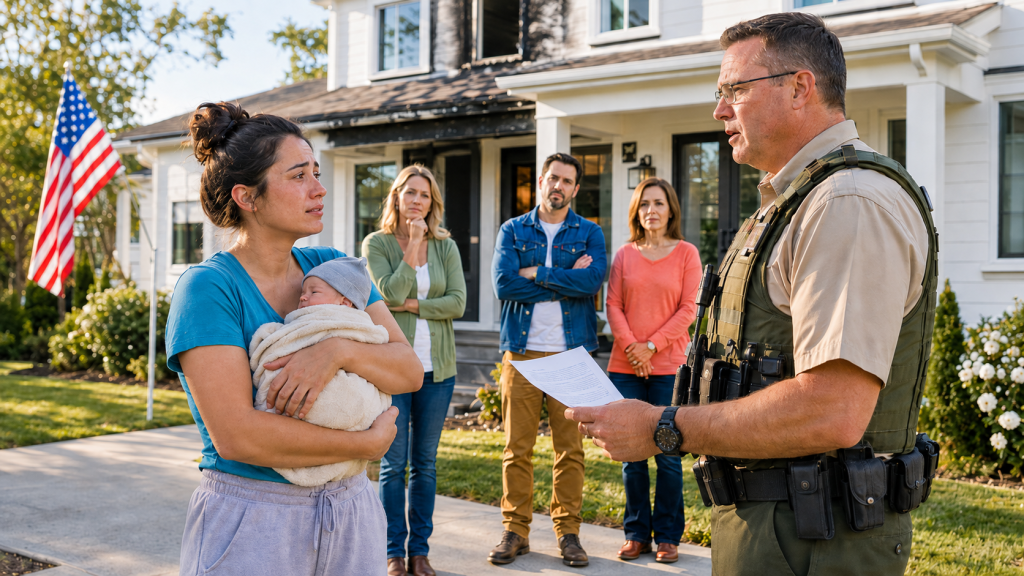
Neighbors standing silently.
Black paint covering everything.
The envelope waiting in the mailbox.
Back then, I thought someone had destroyed the home Daniel and I built.
I was wrong.
Paint can be removed.
Wood can be restored.
Secrets can be uncovered.
Fear can lose its power.
And families can survive even after being changed forever.
The house had never been the thing holding our memories.
We were.
Lily and me.
And somewhere within all the years between grief and healing, Daniel’s story stopped being only about how he died.
It became about what he left behind.
The truth.
His courage.
His daughter.
And a life that continued growing long after someone tried to paint everything black.
💬THE END! THANK YOU FOR READING!