

The moment my mother told me I was “dead to the family” over a $2,500 BMW repair bill, something inside me finally snapped.
Not loudly.
Not dramatically.
I didn’t scream.
I didn’t cry.
I didn’t beg them to reconsider.
I simply looked at my parents, looked at my sister, and realized that after years of being treated like the family’s personal emergency fund, I was finally done.
And what happened after I walked out that door changed my life in a way none of them could have imagined.
It started at Sunday dinner.
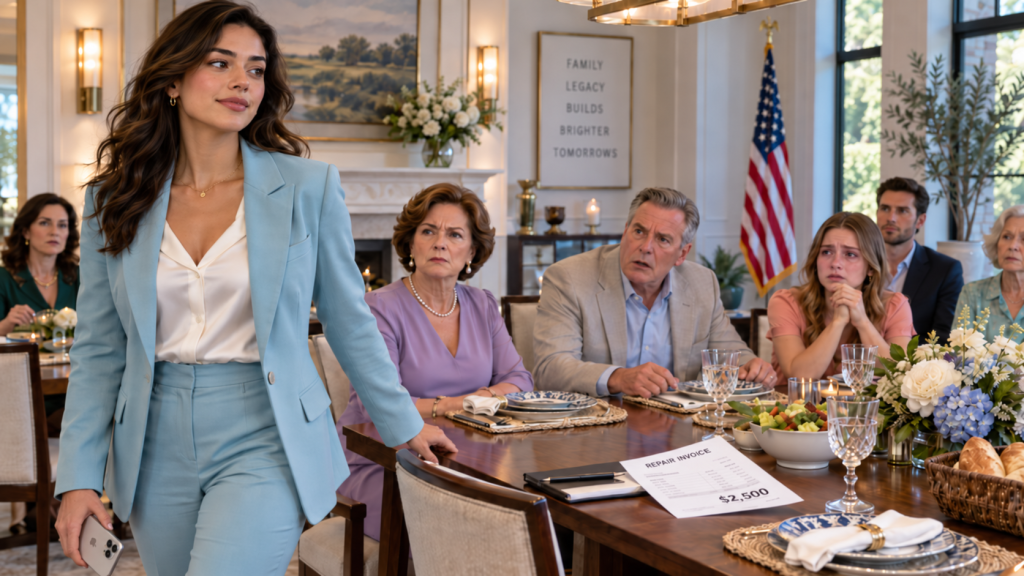
The dining room table had always been the center of our family gatherings, but that night it felt more like a courtroom.
Everyone was sitting around the polished wooden table when my mother suddenly slammed her palm down so hard that the silverware jumped beside the porcelain plates.
The sharp crack silenced the room.
In the center of the table sat a single sheet of paper.
A repair invoice.
At the bottom, printed in bold numbers, was the total.
$2,500.
It was for a transmission repair on my twenty-two-year-old sister Chloe’s BMW.
Chloe sat directly across from me, her cheeks wet with tears.
Her mascara had begun running slightly beneath her eyes, and she had perfected the expression she always used when something went wrong.
Helpless.
Afraid.
Wounded.
Anyone who didn’t know her would have thought something terrible had happened.
I knew better.
My father leaned forward.
“You are going to pay this bill, Maya,” he announced.
His voice filled the room with the same authoritarian tone he had used on me since childhood.
“And that’s the end of it.”
I stared at him.
For a moment, I honestly thought I had misunderstood.
Then he continued.
“Your sister needs her car for her internship. You’re earning a comfortable corporate tech salary while she has practically nothing. It’s your responsibility to this family.”
Responsibility.
That word almost made me laugh.
Almost.
Instead, I kept my voice calm.
“My responsibility?”
My father’s jaw tightened.
I looked at Chloe.
“Chloe spent her entire paycheck on a luxury weekend in Miami last week.”
Chloe immediately looked away.
“She knew her car payment was due,” I continued. “She knew the BMW had problems. Instead of saving anything, she went to Miami.”
“Maya—” my mother warned.
But I wasn’t finished.
“This isn’t even the first time I’ve had to rescue her.”
Nobody spoke.
“This is the third time this year.”
Chloe wiped her eyes.
“I didn’t know the transmission was going to break!”
“That’s not the point.”
“Oh, of course it’s easy for you to say!” she snapped. “You have money!”
There it was.
The sentence I had heard in one form or another for years.
You have money.
Which apparently meant everyone else was entitled to it.
I had worked hard for my corporate technology job.
I had put in long nights, accepted projects nobody wanted, studied while other people were partying, saved carefully, and sacrificed things I wanted because I had goals for my future.
But whenever Chloe made another irresponsible decision, my savings somehow became the family solution.
Her first rescue that year had been $1,800 for rent after she used her paycheck on concert tickets.
The second had been $3,200 after she backed into a concrete column in a parking garage and discovered her insurance deductible was much higher than she remembered.
Before that there had been tuition shortfalls, overdraft fees, vacations, clothes for job interviews, emergency credit-card payments, and the $4,000 security deposit on the apartment she absolutely had to have because the cheaper building was “depressing.”
And it wasn’t just Chloe.
My parents had borrowed $12,000 from me when Dad’s small consulting business had a bad quarter.
They never repaid it.
Mom had needed dental work.
I paid.
The roof had leaked.
I paid.
My uncle needed help after a divorce.
My mother volunteered me before she even asked.
For years, every family emergency somehow ended with my bank account opening.
Yet every time I talked about saving for a home of my own, my mother called me obsessed with money.
Whenever I declined an expensive family trip, my father said I had forgotten where I came from.
Whenever I bought something nice for myself, Chloe joked that it must be nice to be the rich sister.
I wasn’t rich.
I was disciplined.
There was a difference.
My mother gasped dramatically and pressed one hand against the pearls around her neck.
“How dare you speak to us that way?”
I stared at her.
“After everything we sacrificed for you?” she continued.
I knew what was coming.
Guilt.
It was the weapon my parents used whenever reason stopped working.
My mother leaned closer.
“This is your final choice, Maya.”
The room became completely still.
Even the relatives sitting around the table stopped moving.
“You transfer the two thousand five hundred dollars into Chloe’s account immediately,” my mother said, “or you pack your things, walk through that front door, and consider yourself completely disowned.”
My stomach tightened.
Then she delivered the final blow.
“You are dead to this family.”
Absolute silence followed.
Everyone stared at me.
And suddenly I understood what they expected.
They expected me to break.
They expected tears.
An apology.
A trembling hand reaching for my phone.
Because that was what I had always done.
Maybe not exactly like this, but close enough.
Every time they accused me of being selfish, I gave in.
Every time Chloe needed rescuing, I helped.
Every time my parents reminded me that “family comes first,” what they really meant was that I came last.
They were confident their ultimatum would work because they believed I still needed their approval.
Their affection.
Their acceptance.
But something strange happened.
Instead of panic, I felt peace.
For the first time in years, everything became incredibly clear.
I looked at Chloe.
Then my mother.
Then my father.
And finally every relative sitting silently around that table.
I slowly pushed my chair backward.
The legs scraped against the floor.
My mother blinked.
“What are you doing?”
I stood.
My father frowned.
“Maya.”
I didn’t answer.
My heart was pounding, but my hands were steady.
I looked directly at my parents.
“Then I’m out.”
My mother’s expression changed instantly.
“What?”
“I said I’m out.”
My father stood abruptly.
“Don’t be ridiculous. Sit down.”
“No.”
His expression darkened.
“You walk out that door, don’t expect to come crawling back.”
I nodded.
“Okay.”
That seemed to shock him more than anything else.
Chloe stared at me with her mouth slightly open.
For once, nobody had a comeback.
I turned away from the table.
Behind me, my mother began talking rapidly.
“You’re being selfish!”
I kept walking.
“You’re abandoning your sister!”
I reached the hallway.
“You’re going to regret this, Maya!”
Maybe I would.
But I knew one thing.
If I stayed, I would regret that more.
I took my coat from the rack beside the front door.
My fingers wrapped around the handle.
For half a second, I hesitated.
Behind me was everything familiar.
My childhood.
My parents.
My sister.
My family.
In front of me was absolutely nothing certain.
Then I opened the door.
Cool night air hit my face.
I stepped outside.
And I never looked back.
Minutes later, I was driving away from the house with my hands gripping the steering wheel and my family’s voices still echoing inside my head.
You’re selfish.
You’ll regret this.
You’re dead to this family.
Streetlights flashed across my windshield.
I had just lost my family over $2,500.
Or maybe I had finally escaped them because of it.
I didn’t know yet.
All I knew was that I needed somewhere to sleep.
For the previous eight months, I had been temporarily living in my parents’ guest suite while waiting for the lease on a new apartment development to begin.
Naturally, they had acted as if allowing me to stay there made me indebted to them for life, even though I paid them monthly rent and covered half the groceries.
Most of my belongings were still there.
But I had my laptop, work bag, wallet, phone, and a small overnight bag in my car from a business trip two days earlier.
I was thinking about hotels, friends, apartments—anything—when my phone suddenly vibrated beside me.
A notification appeared.
At first, I almost ignored it.
Then I noticed the name of the app.
My breath caught.
It was a banking app.
One I hadn’t opened in so long that I had almost completely forgotten the account existed.
I pulled into the parking lot of a closed pharmacy.
My heart began beating faster.
Something about that notification didn’t make sense.
I picked up my phone.
Unlocked the screen.
Opened the app.
And when the account balance appeared in front of me, I froze.
$186,420.17.
For several seconds I thought I was looking at the wrong account.
Then I read the title.
MAYA REYNOLDS EDUCATION TRUST.
I felt the blood drain from my face.
I had never opened an education trust.
I tapped the account.
A transfer had been made three days earlier.
FINAL DISTRIBUTION — ELIZABETH CARTER ESTATE.
Elizabeth Carter.
My grandmother.
My mother’s mother.
Grandma Elizabeth had died when I was seventeen.
I had been told she left almost nothing behind.
My mother had said Grandma’s medical bills consumed most of her savings and that whatever little remained had been divided among relatives.
Yet here was nearly two hundred thousand dollars in an account carrying my name.
My hands began trembling.
I clicked through the transaction history.
There were records going back years.
Tuition payments.
Investment distributions.
Administrative fees.
Statements.
Then something made my stomach twist.
The mailing address attached to the account was my parents’ house.
The same house I had just been thrown out of.
I opened the statement history.
Every annual statement for more than a decade had been sent there.
I stared at the screen in disbelief.
Had my parents known?
Before I could process the question, my phone rang.
Unknown number.
I almost let it go to voicemail.
Then I answered.
“Hello?”
“May I speak with Maya Reynolds?”
“This is Maya.”
There was a brief pause.
“My name is Anna Whitaker. I’m an attorney with Whitaker, Sloan and Mercer. Our firm handled portions of your grandmother Elizabeth Carter’s estate.”
I sat completely still.
“I think,” I whispered, “I just received money from it.”
“Yes. That is why I’m calling.”
My throat tightened.
“I didn’t know there was an estate account.”
Another pause.
Then she said something I would remember for the rest of my life.
“Maya, your grandmother left instructions.”
I leaned back against the seat.
“What instructions?”
“I would rather explain in person. There are documents you should see.”
I looked at the dark pharmacy windows in front of me.
“Did my parents know about this?”
Anna was quiet just long enough for the answer to become obvious.
“Yes.”
One word.
That was all it took.
Something inside my chest went cold.
“How much did they know?”
“I think we should meet tomorrow.”
“No.”
My voice came out sharper than I intended.
“I just got told I’m dead to my family because I refused to pay my sister’s car repair. If my parents have been hiding money that belongs to me, I need to know.”
Anna exhaled softly.
“The money in the account belongs to you. Your grandmother created the trust when you were twelve. It was intended primarily for education, but any unused principal was to become fully yours once you turned thirty.”
I had turned thirty three days earlier.
The same day as the transfer.
I closed my eyes.
“What else?”
“Your grandmother instructed the trustee to send annual notices to your legal address. Until you were eighteen, that was naturally your parents’ residence. After that, our firm repeatedly requested updated contact information.”
My fingers tightened around the phone.
“And?”
“We were told you preferred all estate correspondence to continue going through your parents.”
“I never said that.”
“I suspected you might say that.”
My heart thudded.
Anna continued carefully.
“There is more, Maya. The trust paid a significant portion of your university expenses.”
My eyes opened.
“What?”
“Your tuition.”
“No. My parents paid my tuition.”
At least that was what I had been told.
My parents had reminded me of it constantly.
Dad had used it during arguments.
Mom had mentioned it whenever she needed money.
We paid for your education.
Do you know what we sacrificed for you?
I had spent more than a decade believing I owed them for college.
Anna’s voice remained calm.
“The trust paid approximately eighty-seven percent of the tuition and mandatory fees listed in our records.”
The silence inside my car became deafening.
My parents had made me repay them for part of college.
For six years after graduation, I had sent them $700 every month because Dad said they had borrowed against their retirement savings to give me a future.
Forty-two thousand dollars.
I felt sick.
“Anna,” I whispered, “were they allowed to take money from the trust?”
“Not directly. Payments were made to approved educational institutions or documented expenses.”
“Then why did they tell me they paid for everything?”
“That is a question I cannot answer.”
But I could.
Because if I believed they had sacrificed everything for me, I would spend the rest of my life paying them back.
And I had.
I booked a hotel room that night.
At 9:00 the next morning, I walked into Anna Whitaker’s office carrying coffee I barely touched.
She was in her early sixties with silver hair and a calm expression that reminded me strangely of my grandmother.
On the conference table sat a thick folder.
Anna pushed it toward me.
“These are copies.”
I opened it.
The first document was dated eighteen years earlier.
The signature at the bottom belonged to my grandmother.
Elizabeth Carter.
My eyes blurred unexpectedly.
Grandma had been the only person in my childhood who never compared Chloe and me.
She never called me difficult because I asked questions.
She never told me to make myself smaller so Chloe wouldn’t feel insecure.
When I won a scholarship at sixteen and my parents spent most of the celebration reassuring Chloe that she was “special in different ways,” Grandma had quietly taken me for ice cream afterward.
“You are allowed to be proud of something you earned,” she told me.
I had forgotten that sentence.
Now it came back with painful clarity.
Anna showed me the trust agreement.
Grandma had put $95,000 into it originally.
Through investment growth and after educational expenses, the remainder had become the $186,420 sitting in my account.
Then Anna handed me a sealed envelope.
Across the front, in Grandma’s handwriting, were two words.
For Maya.
My throat closed.
“She asked that this be given to you upon final distribution,” Anna said.
I opened it carefully.
Inside was a letter.
My dearest Maya,
If you are reading this, you are older than the girl I knew and, I hope, strong enough to understand something I learned too late in life.
Love is not measured by how much suffering you are willing to accept.
Family should not require you to become smaller so others may remain comfortable.
You have always been responsible. That is a strength. But I worry the people around you may turn that strength into an obligation.
I have created this trust because I want some portion of your future to belong only to you.
Not to your mother.
Not to your father.
Not to your sister.
To you.
Use it to learn, to build, to leave, to begin again, or simply to breathe.
And if anyone tells you that protecting your own future makes you selfish, remember that generosity without boundaries becomes permission for others to consume you.
I hope I am wrong about many things.
But if I am not, I hope this money gives you the freedom to choose yourself.
Love always,
Grandma Elizabeth.
I read the final line twice.
Then I covered my mouth and cried.
Not because of the money.
Because someone had seen what was happening long before I did.
Grandma had understood the pattern when I was still a teenager.
She had tried to leave me an exit.
My parents had spent years making sure I never knew it existed.
Anna slid a box of tissues toward me.
“There is one more matter.”
I looked up.
She opened another file.
“Your grandmother also owned a small duplex in Arlington.”
I stared at her.
“I remember that house.”
Grandma used to call it the yellow house.
She rented the upstairs unit and occasionally stayed downstairs.
My mother told us it had been sold after Grandma died.
“It was not sold,” Anna said. “Ownership was transferred to a separate trust.”
I stopped breathing for a second.
“For whom?”
“You.”
I actually laughed because the alternative was screaming.
“You’re telling me I own a house?”
“Technically, the trust owned it until your thirtieth birthday. Final title transfer is now in progress.”
“What is it worth?”
“Current assessment is approximately six hundred and forty thousand dollars.”
I stared at her.
The room seemed to tilt.
Nearly $200,000 in cash.
A $640,000 property.
And all morning I had been worried about finding an apartment.
“Rental income has covered taxes, insurance, repairs, and management. Excess income remained within the property account.”
“How much?”
Anna turned another page.
“Approximately seventy-eight thousand dollars.”
I stopped trying to speak.
My grandmother had left me close to nine hundred thousand dollars in combined assets.
My parents had known enough about the trust to intercept correspondence.
And less than twelve hours earlier, they had declared me dead to them over a $2,500 repair bill.
I thought that was the worst discovery.
It wasn’t.
Anna showed me several letters from the previous six years.
Each requested updated contact information.
Each had been answered by someone using my mother’s email address.
Maya is extremely busy. Please continue corresponding through us.
Maya does not wish to deal with estate matters personally.
Maya has authorized her father to retain documents.
I had authorized no such thing.
“Is that illegal?” I asked.
Anna chose her words carefully.
“Potentially. We are reviewing the communications. Your parents did not control the assets, so there was no transfer of trust principal to them. But misrepresenting your wishes could still create serious issues depending on what was signed and how.”
I sat back.
Then another memory hit me.
“Wait.”
Anna looked at me.
“After college, my parents told me I owed them forty-two thousand dollars for tuition.”
Her expression changed.
“I paid it.”
“How?”
“Monthly transfers. For six years.”
“Do you have records?”
“Yes.”
“Save them.”
The two words came out calmly.
But something had changed inside me.
I wasn’t interested in revenge.
I wanted facts.
For the first time in my life, I wanted every number written down.
Every transfer.
Every lie.
Every supposed sacrifice.
That afternoon, I requested seven years of bank statements.
The totals stunned me.
It wasn’t just the $42,000 in supposed tuition repayment.
Over eight years, I had transferred or directly paid $96,730 for my parents and sister.
Almost one hundred thousand dollars.
Some had been genuine emergencies.
Most had not.
I had paid Mom’s kitchen renovation because she said the old cabinets were hurting the home’s value.
I had covered Chloe’s semester abroad because my parents said they couldn’t bear for her to “miss a life-changing experience.”
I had financed Dad’s business expenses.
Covered insurance deductibles.
Paid property taxes one year.
Bought airline tickets.
Cleared credit-card balances.
Paid Chloe’s rent.
Paid Chloe’s phone.
Paid Chloe’s moving expenses twice.
And every single time, they framed it as temporary.
Or necessary.
Or something I owed them.
I created a spreadsheet.
Date.
Amount.
Reason.
Recipient.
Whether repayment had been promised.
Whether repayment occurred.
The last column was almost entirely empty.
That evening, my mother called.
I watched the phone ring.
Then again.
Then Dad called.
Then Chloe.
By midnight I had thirty-one missed calls.
I didn’t respond.
The next morning my mother sent a text.
You have made your point. Come home and apologize and we can discuss this calmly.
An hour later Dad sent one.
Your mother is devastated. Stop acting like a child.
Then Chloe.
I can’t believe you would destroy this family over $2,500.
I stared at that one for a long time.
Then I laughed.
Not because it was funny.
Because it was so perfectly backward.
I hadn’t destroyed anything.
I had simply stopped paying for it.
I muted the family group chat.
Then I went to see the yellow house.
It stood on a quiet tree-lined street twenty minutes from my office.
The paint was no longer yellow.
A property manager had renovated the exterior several years earlier, replacing the old siding with warm white panels and dark shutters.
But I recognized the maple tree in the front yard.
I recognized the stone walkway.
I recognized the little brass knocker Grandma used to polish every spring.
The downstairs unit was vacant.
When the property manager unlocked the door, I stepped inside and almost cried again.
The kitchen had been updated.
The floors refinished.
The furniture was gone.
But sunlight still came through the same bay window where Grandma used to sit with tea.
I walked into the small bedroom at the back.
I remembered sleeping there when I was fourteen after one terrible fight at home.
Chloe had broken my school laptop and my mother had blamed me for “leaving it where she could reach it.”
I had cried in Grandma’s kitchen.
Grandma listened without interrupting.
Then she told me something I hadn’t understood at the time.
“Some people will keep moving the fence until your entire life belongs to them. You have to decide where your property begins.”
Back then, I thought she meant the laptop.
Standing in that house sixteen years later, I finally understood.
I moved in the following weekend.
I didn’t buy expensive furniture.
I didn’t celebrate with champagne.
I bought a mattress, a kitchen table, two lamps, and a ridiculous blue armchair because I loved it.
For the first time in years, I purchased something without imagining my mother’s judgment.
Too expensive.
Too impractical.
You could have helped Chloe with that money.
I sat in that blue chair the first evening and realized nobody knew where I was.
The silence felt strange.
Then it felt wonderful.
My parents discovered the truth about the trust two weeks later.
I still don’t know exactly how.
Maybe one of the old letters arrived.
Maybe someone from the estate office contacted them while verifying records.
Maybe my mother opened one piece of mail too many.
What I know is that Dad called me seventeen times between 8:14 and 9:03 one Tuesday morning.
Then he left a voicemail.
“Maya, call me immediately. There seems to be some confusion about your grandmother’s estate.”
Confusion.
That word told me everything.
Not surprise.
Not congratulations.
Confusion.
I called Anna.
“Do I have to talk to them?”
“No.”
“Good.”
That afternoon, Chloe appeared at my office.
Security called upstairs.
“There’s a woman named Chloe Reynolds insisting she’s your sister.”
I almost told them to send her away.
Then I changed my mind.
“Have her wait in the lobby.”
When I came downstairs, Chloe was pacing near the elevators.
The second she saw me, she rushed forward.
“You inherited almost a million dollars?”
People turned.
I stared at her.
“Hello to you too.”
Her eyes widened.
“Mom says Grandma left you a house and some huge account.”
“Why are you here?”
“Because this is insane!”
“What part?”
“All of it! Grandma had two granddaughters.”
There it was.
Not Are you okay?
Not I’m sorry.
Not I can’t believe Mom and Dad knew.
Her first concern was whether she had been left out.
“Take it up with Grandma,” I said.
“She’s dead!”
“Then I guess that’s going to be difficult.”
Chloe’s face flushed.
“You think this is funny?”
“No.”
“You got everything!”
“No, Chloe. I received what Grandma chose to leave me.”
“She loved me too.”
“I never said she didn’t.”
“Then why would she leave you that much?”
I looked at my sister.
For years, I had seen Chloe as irresponsible, spoiled, manipulative.
But standing there, I saw something else too.
She was a product of the same family system.
The difference was that while I had been trained to provide, Chloe had been trained to receive.
Neither role was healthy.
But only one had been expensive.
“Did you know about the trust?” I asked.
She stopped.
“What?”
“Before this week.”
“No.”
I watched her carefully.
For once, I believed her.
“Did Mom and Dad ever tell you they used trust money to pay my tuition?”
Chloe frowned.
“What trust money?”
I nodded slowly.
“They told me they emptied savings for my education. Then they had me repay them for six years.”
Her expression changed.
“They made you repay college?”
“Forty-two thousand dollars.”
“I thought Dad paid.”
“So did I.”
For the first time, Chloe looked genuinely unsettled.
Then she shook her head.
“That doesn’t change Grandma leaving you everything.”
“She didn’t leave me everything. She left me specific assets.”
“Same difference.”
“No, it isn’t.”
She crossed her arms.
“Mom says you’re planning to sue them.”
“I haven’t decided anything.”
“You can’t sue Mom and Dad.”
“Why?”
“Because they’re our parents!”
I almost smiled.
There was that word again.
Family.
The universal key they expected to unlock every door.
“Chloe, they lied to me for more than a decade.”
“They raised you.”
“And?”
She blinked.
“You can’t erase everything they did because of one mistake.”
“One mistake?”
I pulled out my phone.
I had saved the spreadsheet.
I turned it toward her.
She scrolled.
Her face slowly changed.
$1,800.
$3,200.
$4,000.
$6,500.
$12,000.
$42,000.
Line after line.
“You kept track?”
“No. I created this after I left. These are bank records.”
She continued scrolling.
Then she saw her own name.
Again.
Again.
Again.
She handed the phone back.
“I didn’t know it was that much.”
“I know.”
Her voice became smaller.
“Mom always said you had plenty.”
“I know.”
“She said you liked helping.”
“I did. Sometimes.”
Chloe looked toward the glass entrance doors.
“What happens now?”
“That depends on Mom and Dad.”
She looked back.
“What do you want?”
It was the first useful question anyone in my family had asked me.
“I want them to stop pretending they did nothing wrong.”
Three days later, my father showed up at the yellow house.
I had no idea how he found the address until I remembered the property record had recently transferred into my name.
He stood on the porch wearing the same navy jacket he used for church and business meetings.
I opened the door but didn’t invite him in.
His eyes moved past me.
“So it’s true.”
“What?”
“You own this place.”
“Yes.”
He gave a bitter laugh.
“Your grandmother always did enjoy creating division.”
I stared at him.
“That’s why you came?”
“I came to fix this.”
“Then start with the truth.”
His mouth tightened.
“We never stole from you.”
“I didn’t say you did.”
“You’re talking to attorneys.”
“I spoke to the attorney who managed my trust.”
His jaw flexed.
“We raised you. We fed you. We gave you every opportunity.”
“You also told me you paid my tuition.”
“We did pay expenses.”
“Thirteen percent of tuition-related costs, according to the records.”
He looked away.
“And then you collected forty-two thousand dollars from me.”
“That money went to the household.”
“You told me it was reimbursement for college.”
“It was all family money.”
“No.”
My voice stayed quiet.
“That is exactly the problem. You think every dollar I earn becomes family money, but nothing belonging to the family ever becomes mine.”
“That is unfair.”
“Is it?”
He took a step closer.
“Your mother is barely sleeping. Chloe is distraught. Your aunt says you’ve blocked everyone.”
“I muted the group chat.”
“Same thing.”
“No, Dad. It isn’t.”
He exhaled sharply.
“What do you want us to do? Get on our knees?”
“I want you to admit you lied.”
His expression hardened.
“We did what was necessary.”
“For what?”
“To keep this family together.”
I almost laughed.
“You hid information about money Grandma left me so the family could stay together?”
“You were young.”
“I was thirty three weeks ago.”
“You didn’t need that money.”
There it was.
The real answer.
I didn’t need it.
Therefore, in his mind, I didn’t deserve to know about it.
“What if I had needed it?” I asked.
“You had a good job.”
“What if I wanted to buy a home?”
“You could save.”
“I did save. Then all of you kept asking for it.”
His face reddened.
“Nobody held a gun to your head.”
That sentence ended something in me.
Because he was right.
They hadn’t forced me.
They had only trained me.
Guilted me.
Punished me emotionally when I said no.
Threatened rejection.
And finally carried out the threat.
But I had still handed over the money.
Which meant I also had the power to stop.
“You’re right,” I said.
My father looked surprised.
“Nobody forced me.”
He relaxed slightly, as though he thought I was surrendering.
“So we can put this behind us.”
“No. I mean you’re right that I participated.”
His expression changed.
“And I’m not participating anymore.”
“Maya—”
“You told me if I walked out, not to come back.”
“You were angry.”
“So was I.”
“Families say things.”
“And choices have consequences.”
He stared at me.
Then his eyes narrowed.
“You’ve changed.”
“No. I finally stopped negotiating against myself.”
He left without another word.
My mother waited four days before coming.
Unlike Dad, she cried before I even opened the door completely.
“Maya.”
I stayed behind the threshold.
She looked smaller than I remembered.
For a moment, the old instinct kicked in.
Comfort her.
Fix it.
Make everything okay.
I resisted.
“I brought your things.”
Dad’s SUV was parked by the curb.
Several boxes sat inside.
“Thank you.”
Her eyes filled.
“Can I come in?”
I hesitated.
Then I let her.
She entered the living room and looked around.
Her gaze stopped on Grandma’s old bay window.
“I hated this house,” she said.
That surprised me.
“Why?”
“Because my mother always made me feel judged here.”
I studied her.
“Grandma loved you.”
“She loved correcting me.”
I didn’t answer.
Mom sat on the edge of my sofa.
“You think she was some saint because she left you money.”
“No.”
“She wasn’t.”
“I know.”
“She was controlling. She always thought she knew best.”
“That sounds familiar.”
Her eyes flashed.
Then she looked down.
“Maya, I didn’t come here to fight.”
“Why did you come?”
“To ask how we fix this.”
I sat across from her.
“Tell me why you hid the trust.”
She looked at her hands.
“We didn’t hide it.”
I said nothing.
She lasted eleven seconds.
Then her shoulders dropped.
“Fine.”
The word came out tired.
“We didn’t tell you.”
“Why?”
“Because your grandmother made that trust after an argument with me.”
“What argument?”
“She said I depended on you too much.”
I felt a chill.
“I was twelve.”
“Not financially then. Emotionally.”
Mom rubbed her palms together.
“She said whenever Chloe was upset, I expected you to accommodate her. She said I treated you like another adult in the house instead of a child.”
I remembered being twelve and packing Chloe’s lunch because Mom was tired.
Helping Chloe with homework.
Giving Chloe my birthday gift because she cried.
Staying home from a school trip because Chloe had the flu and Mom said she needed help.
Grandma had noticed.
“What happened when Grandma died?”
“Your father and I knew about the education trust. We assumed it would be used for college and disappear.”
“But it didn’t.”
“No.”
“And the house?”
She looked toward the window.
“I knew she had placed it in a trust. I did not know the final amount of money in the account.”
“But you knew the house would eventually become mine.”
“Yes.”
I swallowed.
“Why did you tell me it was sold?”
She didn’t answer.
“Mom.”
“Because I was angry.”
“At me?”
“At her.”
“So you lied to me to punish a dead woman?”
Her face tightened.
“When you say it like that—”
“How else should I say it?”
She began crying again.
“I made mistakes.”
“That isn’t enough.”
“What do you want from me?”
“The truth.”
“I’m telling you the truth!”
“Then tell me about the college payments.”
She froze.
That was all the answer I needed.
“You knew.”
She covered her face.
“Your father’s business was struggling.”
I stared at her.
“You knew I was repaying money you never spent.”
“We spent money on you your entire life!”
I stood.
She immediately stopped crying.
“No,” I said quietly. “Do not do that.”
“What?”
“Do not turn basic parenting into an invoice.”
Her mouth opened.
I continued.
“You chose to have children. Feeding me, housing me, buying clothes, driving me to school—those were not loans.”
“I never said they were.”
“You say it every time you tell me I owe you for raising me.”
She looked away.
I took a breath.
“How much of the forty-two thousand went to Dad’s business?”
“Most of it.”
There it was.
Finally.
The truth.
Not elegant.
Not dramatic.
Just ugly and ordinary.
My parents had convinced themselves that because I was doing well, redirecting my money toward their needs was harmless.
They hadn’t called it stealing.
They had called it family.
“Did Dad know?”
“Yes.”
“Did Chloe?”
“No.”
I nodded.
“Okay.”
Mom wiped her face.
“Okay what?”
“Okay. Now I know.”
“What are you going to do?”
“I want the forty-two thousand returned.”
She stared at me.
“We don’t have forty-two thousand dollars lying around.”
“I didn’t ask for it tomorrow.”
“This is your family.”
“I know.”
“You’re going to charge your own parents?”
“I’m asking you to repay money you obtained by lying.”
She stood.
“Your grandmother gave you almost a million dollars!”
“And somehow that means you shouldn’t repay me?”
“You don’t need it!”
I almost laughed.
Exactly what Dad had said.
“I’m not asking because I need it.”
“Then why?”
“Because I need you to understand that what happened mattered.”
She stared at me as if she had never seen me before.
Then she picked up her purse.
“I don’t know who you are anymore.”
I opened the front door.
“That makes two of us.”
The family exploded after that.
Aunt Denise called me greedy.
Uncle Robert said suing one’s parents was morally disgusting, even though I had not sued anyone.
A cousin sent me a three-paragraph message explaining that “money comes and goes but blood is forever.”
I replied with one sentence.
Then you pay Chloe’s repair bill.
He never answered.
Meanwhile, something fascinating happened.
Once I stopped paying, the entire family system began wobbling.
Chloe sold the BMW.
That was the first surprise.
She bought a used Toyota with the proceeds and took the bus for a week while arranging everything.
She also canceled a planned trip to Cabo.
My parents stopped paying for her apartment.
She found a roommate.
Dad downsized his office.
Mom postponed remodeling the upstairs bathroom.
Nobody starved.
Nobody became homeless.
Nobody’s life ended.
They simply began making the kinds of financial decisions I had been making for years.
The world did not collapse because Maya stopped writing checks.
Three months passed.
I furnished the yellow house slowly.
I kept the upstairs tenant.
I invested most of the cash distribution.
I hired an independent financial adviser.
For once, my future had structure.
I also started therapy.
That turned out to matter more than the inheritance.
I learned words like parentification.
Enmeshment.
Financial coercion.
Conditional affection.
I learned that boundaries were not punishments.
I learned that saying no did not require a courtroom defense.
I learned that another person’s disappointment could exist without becoming my emergency.
Most importantly, I learned that freedom was not the same thing as isolation.
I began reconnecting with friends I had neglected because family crises always came first.
I traveled.
Not to prove anything.
I took a quiet four-day trip to Vancouver and spent an entire afternoon reading beside the harbor.
Nobody called asking for money.
Nobody ruined it.
I came home feeling more rested than I had in years.
Then one evening, six months after Sunday dinner, Chloe knocked on my door.
She was holding a grocery-store pie.
I looked at it.
“What’s that?”
“I wasn’t sure what adults bring when they’re trying to apologize.”
Despite myself, I smiled.
“Usually flowers.”
“I thought pie had more utility.”
I let her in.
She sat in the blue chair.
“I like this.”
“Mom hates it.”
“Then I love it.”
We both laughed.
It was the first easy moment we had shared in years.
Then she became serious.
“I owe you an apology.”
I waited.
She twisted her fingers together.
“I kept thinking about that spreadsheet.”
I said nothing.
“I really didn’t know how much you paid for me.”
“I believe you.”
“I should have known.”
“That’s different.”
She nodded.
“I sold the BMW.”
“I heard.”
“Dad called the Toyota an appliance.”
“Cars are appliances.”
“Don’t become unbearable just because you’re right.”
I smiled.
Then she looked at me.
“I thought money just appeared when things went wrong.”
I understood exactly what she meant.
“Mom and Dad always said you were better with money. So I figured you had so much because you were naturally good at it.”
“No one is naturally good at paying other people’s bills.”
“I know that now.”
She took a breath.
“I got a second job.”
I raised an eyebrow.
“At the campus library.”
“That sounds suspiciously responsible.”
“Don’t tell anyone.”
We laughed again.
Then she pulled an envelope from her purse.
Inside was a check.
$500.
I stared at it.
“What’s this?”
“The beginning.”
“Of what?”
“Paying you back.”
“You don’t owe me everything on that spreadsheet.”
“I know. Some of it was gifts. Some you offered. But the BMW deductible, the rent rescue, the credit card thing… those weren’t gifts.”
“Chloe—”
“I need to do this.”
I looked at her.
For the first time, she wasn’t crying.
Wasn’t manipulating.
Wasn’t asking.
She looked nervous but determined.
So I accepted it.
“Thank you.”
Her shoulders relaxed.
Then she said quietly, “Mom and Dad are paying you too.”
I blinked.
“What?”
“Dad sold his old motorcycle.”
I stared at her.
“He loved that motorcycle.”
“Apparently he loves complaining about selling it even more.”
I laughed.
Two days later, $5,000 appeared in my account.
The memo said:
Tuition repayment — installment 1.
No apology.
No message.
Just the money.
I didn’t need the $5,000.
But I cried when I saw it anyway.
Because it was the first concrete acknowledgment that the debt had been real.
Over the next year, my relationship with my family changed.
Not magically.
Not perfectly.
My mother and I went nearly four months without speaking at one point after she told a relative I had “abandoned everyone after inheriting money.”
When I confronted her, she denied saying it.
Then Aunt Denise produced screenshots.
Mom eventually apologized.
A real apology.
No “but.”
No “if you were hurt.”
No mention of how difficult I had been.
Just:
“I said it because I was embarrassed about my own behavior, and blaming you felt easier. I’m sorry.”
It was probably the hardest sentence she had ever spoken.
Dad changed more slowly.
He hated therapy.
He hated talking about feelings.
He hated admitting mistakes.
But he kept making payments.
$2,000.
$1,500.
$3,000.
Sometimes nothing for months.
Then another transfer.
Twenty months after I left, the final tuition repayment arrived.
$42,000 returned in total.
I called him.
He answered after one ring.
“You got it?”
“Yes.”
A pause.
Then I said, “Thank you.”
Another pause.
“I shouldn’t have taken it.”
My eyes closed.
Those six words mattered more than the entire amount.
“No,” I said softly. “You shouldn’t have.”
“I thought I was doing what I had to do.”
“I know.”
“That doesn’t make it right.”
“No.”
Silence again.
Then he asked, “How’s the house?”
It was not an emotional reconciliation.
My father was still my father.
“The maple tree needs trimming.”
“I know a guy.”
Of course he did.
“Send me his number.”
And that was how we started again.
Not by pretending nothing happened.
By refusing to pretend.
Chloe eventually finished her internship and was offered a full-time position.
A year later, she bought a car.
Not a BMW.
A four-year-old Honda she paid for mostly in cash.
She sent me a photograph from the dealership.
Look. No emergency fund required.
I replied:
Grandma would be shocked.
She wrote back:
Grandma would probably ask why I need heated seats.
She was right.
As for the original $2,500 transmission bill, I never paid a cent.
Chloe negotiated with the repair shop, sold the BMW as-is to a buyer who specialized in European cars, and used the difference toward her Toyota.
The crisis that had supposedly required my immediate rescue solved itself within nine days.
That taught me something I wish I had understood years earlier.
Sometimes helping people too quickly prevents them from discovering that they are capable of helping themselves.
I had thought I was rescuing my sister.
In reality, I was helping keep her dependent.
And my parents had done the same thing to both of us in different ways.
They made Chloe believe someone would always catch her.
They made me believe I always had to be the one doing the catching.
Neither belief was love.
The yellow house became more than a home.
Two years after I inherited it, the upstairs tenant moved away to get married.
Instead of renting the unit again, I renovated it into a small office and meeting space.
Then I did something Grandma probably would have loved.
I started a nonprofit financial-literacy program for young women leaving difficult family situations.
Nothing huge.
Nothing glamorous.
Weekend workshops.
Budgeting.
Credit.
Emergency funds.
Rental contracts.
Employment negotiations.
Basic investing.
And one lesson I insisted on teaching personally.
Your income is not proof that you owe everyone access to you.
One Saturday after a workshop, a nineteen-year-old woman stayed behind.
Her family expected her to send nearly every paycheck home.
She wanted to move out but felt guilty.
“What if they say I don’t love them?” she asked.
For a moment, I heard my mother’s voice from years earlier.
Family comes first.
After everything we sacrificed.
You’re selfish.
You’re dead to us.
Then I remembered Grandma’s letter.
“Someone being angry about your boundary doesn’t automatically mean your boundary is wrong,” I told her.
She nodded slowly.
After she left, I went downstairs and opened the small fireproof box where I kept Grandma’s original letter.
The paper had softened along the folds from being read so many times.
I reread my favorite line.
Generosity without boundaries becomes permission for others to consume you.
Grandma had written it nearly two decades earlier.
I wondered what she would think if she could see me now.
The answer arrived in an unexpected way.
My mother came over that afternoon.
We were having coffee in the kitchen when she noticed the letter on the counter.
Her face changed.
“She wrote to you?”
“Yes.”
“Can I read it?”
I hesitated.
Then I handed it over.
Mom read slowly.
When she reached the end, she sat in silence.
I expected defensiveness.
Anger.
Maybe criticism.
Instead, tears filled her eyes.
“She knew.”
“Yes.”
“I hated her for thinking I was a bad mother.”
I said nothing.
“She told me once that I was turning you into a second parent for Chloe.”
“I know.”
“She told you?”
“No. You just told me.”
Mom wiped her cheek.
“I was overwhelmed when you girls were little. Your father worked constantly. Chloe was difficult. You were so capable.”
There was the old explanation.
You were capable.
The compliment that became a job description.
“I know you were overwhelmed.”
“I leaned on you.”
“Yes.”
“Too much.”
“Yes.”
Her eyes dropped to the letter.
“I’m sorry.”
I believed her.
Not because she cried.
Not because she was my mother.
Because she had changed her behavior.
She no longer volunteered my time.
She no longer told relatives about my finances.
She stopped asking how much I earned.
When Chloe complained about money, Mom told her to make a budget instead of calling me.
Apologies mattered.
Changed behavior mattered more.
I reached across the table and took her hand.
For years, I thought forgiveness meant returning to the way things were.
I had been wrong.
Sometimes forgiveness means building something entirely different.
Something with locks on the doors.
Something where people knock.
Something where love is welcome but entitlement is not.
My family never returned to what it had been.
Thank God.
Sunday dinners changed.
They became smaller.
Less formal.
Sometimes at my house.
Sometimes at Chloe’s.
Nobody slammed invoices onto tables anymore.
Nobody issued financial ultimatums.
If someone needed help, they asked.
And “no” became a complete answer.
Not a betrayal.
Not an attack.
Just an answer.
A few years after everything happened, we were having dinner at my house when Chloe arrived late.
She dropped into a chair and groaned.
“My car needs new brakes.”
Dad immediately said, “How much?”
“Eight hundred.”
Mom looked at me automatically.
It was only for half a second.
An old reflex.
We all noticed.
The room went silent.
Then Mom covered her face.
“Oh my God.”
Chloe started laughing.
Dad laughed.
I laughed too.
Mom peeked through her fingers.
“I swear I wasn’t going to say it.”
“Yes, you were,” I said.
“I caught myself.”
“That’s progress.”
Chloe pointed her fork at me.
“For the record, I already have the money.”
“Who are you and what have you done with my sister?”
She threw a napkin at me.
And just like that, the moment passed.
No guilt.
No resentment.
No rescue.
After dinner, I stood on the porch while everyone left.
Chloe hugged me before walking to her car.
Dad reminded me about the maple tree again.
Mom kissed my cheek.
Then they drove away.
I remained outside for a while.
The neighborhood was quiet.
Warm light spilled through the windows of the yellow house that was no longer yellow.
I thought about the woman I had been on that Sunday night.
Sitting at a table surrounded by people who believed they could determine my value by what I was willing to pay.
Terrified of disappointing them.
Terrified of being called selfish.
Terrified that losing their approval meant losing everything.
Then I thought about the moment my mother said:
You are dead to this family.
At the time, those words felt like a door slamming shut.
Now I understood they had actually opened one.
If she had asked more gently, I probably would have paid the $2,500.
If Dad had framed it as a temporary loan, I might have agreed.
If Chloe had apologized first, I almost certainly would have rescued her again.
And I would have kept going.
Another year.
Maybe ten.
Maybe until my retirement account became someone else’s emergency fund.
Their ultimatum forced me to see the transaction underneath our relationship.
Give us what we want, or lose us.
So I chose to lose them.
For a while.
And in doing so, I finally found myself.
The inheritance helped.
Of course it did.
Money gives options.
Grandma understood that.
But the greatest thing she left me was not the trust.
Not the house.
Not the rental income.
It was permission.
Permission to build a life that did not require everyone else’s approval.
Permission to say no.
Permission to stop confusing sacrifice with love.
Permission to believe that being useful was not the same thing as being worthy.
Years later, the original repair invoice is still in my desk.
Chloe gave it to me as a joke after she found it in one of Mom’s old folders.
Across the top, in red marker, she wrote:
THE MOST EXPENSIVE $2,500 BILL MAYA NEVER PAID.
She wasn’t wrong.
That invoice cost me the version of my family I had believed in.
It exposed lies that had lasted more than a decade.
It forced my parents to confront what they had done.
It forced Chloe to grow up.
It forced me to stop living as everyone’s emergency plan.
And somehow, after all of that, it gave us the opportunity to become something healthier.
Not perfect.
Never perfect.
But honest.
Sometimes people ask whether I regret walking out that night.
I don’t.
I regret waiting so long.
I regret every time I said yes while secretly wanting to say no.
I regret confusing guilt with obligation.
I regret believing that love had to be earned through usefulness.
But I do not regret opening that door.
I do not regret stepping into the cold.
And I definitely do not regret refusing to pay for that BMW.
Because my mother had been wrong about one thing.
Walking away did not make me dead to the family.
It was the first moment in years when I truly began living my own life.
And if Grandma Elizabeth had been sitting beside me that night, I think she would have smiled, taken my hand, and said the words I had needed someone to say for a very long time.
You are allowed to choose yourself.
This time, I finally did.
💬THE END! THANK YOU FOR READING!