

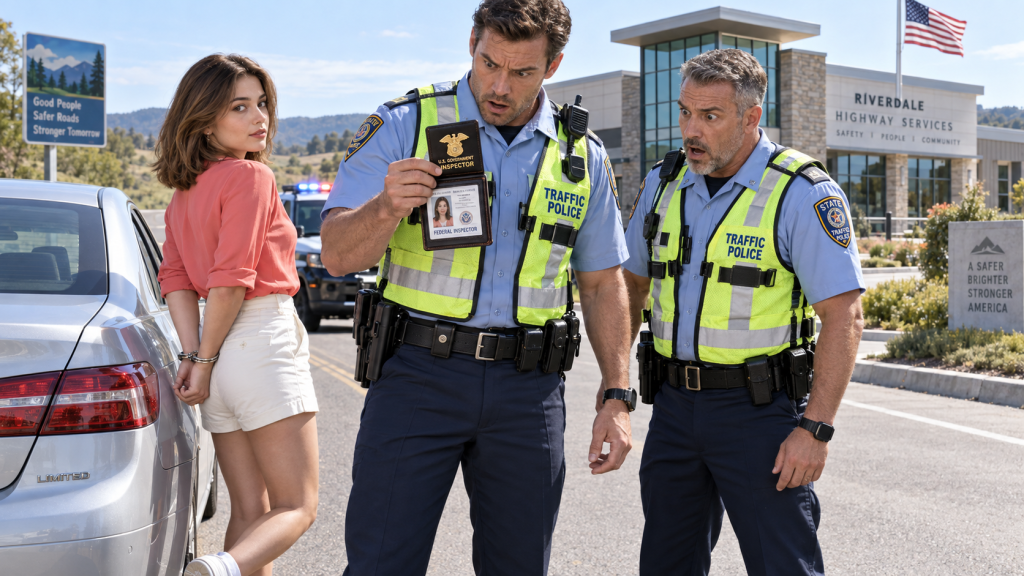
The first inspector’s smug expression vanished the moment he looked at what he had pulled from Victoria’s pocket.
It was not money.
It was not a weapon.
It was not anything illegal.
It was a small black leather identification case with a silver government emblem stamped across the front.
For several seconds, the inspector simply stared at it.
The second officer moved closer.
“Well?” he asked. “What is it?”
The first man slowly opened the case.
His face changed instantly.
The second officer leaned over his shoulder and read the card inside.
The smile disappeared from his face too.
Victoria remained beside her car with both hands cuffed behind her back.
Her shoulder still pressed against the driver’s door.
Her hair had fallen across one side of her face when they had dragged her from the seat, but she made no effort to move it.
She simply watched the two men.
The card showed Victoria’s photograph, her full legal name, and the words:
VICTORIA HALE
SPECIAL INVESTIGATIONS DIVISION
STATE OFFICE OF PROFESSIONAL STANDARDS
Officer Grant looked at her.
Then back at the identification.
Then at her again.
His mouth opened, but nothing came out.
Officer Miller whispered, “Take the cuffs off.”
Victoria’s answer was immediate.
“No.”
Both officers stared at her.
Grant frowned.
“What?”
“I said leave them on.”
Miller suddenly became nervous.
“Ma’am, there has clearly been a misunderstanding.”
Victoria looked directly at him.
“A misunderstanding?”
“Yes.”
“You opened my car door.”
Neither man answered.
“You grabbed my arm.”
Silence.
“You forced me against my vehicle.”
Grant looked away.
“You handcuffed me because I asked why I had been stopped.”
Victoria tilted her head.
“Which part was the misunderstanding?”
Miller swallowed.
“We thought you were refusing to cooperate.”
“I gave you my license.”
“Yes.”
“My registration.”
“Yes.”
“I stayed inside the car.”
He said nothing.
“I asked you to identify yourselves and explain why I had been stopped.”
Grant muttered, “You were argumentative.”
Victoria almost smiled.
“Questions are not arguments.”
The officers exchanged a worried glance.
Then Grant tried to sound confident again.
“Look, this can still be handled calmly.”
“It was calm,” Victoria replied. “Until you decided my questions offended you.”
Grant’s face tightened.
Before he could respond, a dark gray SUV appeared behind the patrol car.
Victoria saw it in the reflection of her car window.
The officers turned.
The SUV slowed and pulled onto the shoulder.
A woman in her late forties stepped out of the passenger side.
She wore a navy suit, low heels, and a badge clipped to her belt.
A man carrying a small black case exited the driver’s side.
The woman looked first at the patrol car.
Then at Victoria.
Then at the handcuffs.
Her expression became hard.
“Victoria?”
The first officer immediately straightened.
“Ma’am, we can explain.”
The woman ignored him.
She walked directly toward Victoria.
“What happened?”
Victoria spoke without raising her voice.
“I was stopped without being given a reason. I provided my license and registration. I asked the officers to identify themselves. They refused. I asked why I had been stopped. They said it was a check. I reached for my phone to record the interaction. Officer Miller opened my door and grabbed my arm. Officer Grant removed me from the vehicle and placed me against the car. I was handcuffed without being told I was under arrest or what offense I had committed.”
The woman looked at both officers.
“My name is Deputy Director Elaine Morris.”
Officer Grant’s face went pale.
Elaine continued.
“I oversee field investigations for the State Office of Professional Standards.”
Nobody moved.
For several seconds, the only sound was traffic passing on the highway.
Elaine looked at the cuffs.
“Who applied those?”
Miller pointed toward Grant.
Grant shot him a furious look.
Victoria corrected him.
“Officer Miller held my arms while Officer Grant applied the cuffs.”
Elaine looked at Grant.
“Remove them.”
Victoria interrupted.
“Not yet.”
Elaine paused.
Grant stared at her.
Victoria turned toward the man who had arrived with Elaine.
“Daniel, photograph the cuffs first.”
Daniel nodded.
He took out a camera.
Grant said, “Is that really necessary?”
Victoria looked at him.
“You thought the cuffs were necessary five minutes ago.”
Grant said nothing.
Daniel photographed Victoria’s wrists, the position of the cuffs, the marks on her skin, the driver’s door, the patrol vehicle, and the location of her documents on the roof of the car.
Only after the photographs were finished did Victoria allow Grant to remove the handcuffs.
The metal came away from her wrists.
Red pressure marks were clearly visible.
Elaine saw them.
So did both officers.
Grant suddenly started talking faster.
“We didn’t know who she was.”
Victoria slowly turned toward him.
“That sentence is exactly why this matters.”
Grant blinked.
She stepped closer.
“You did not know who I was.”
“No.”
“So if I had been a waitress, this would have been acceptable?”
Grant said nothing.
“A teacher?”
Silence.
“A college student?”
Nothing.
“A grandmother?”
He looked away.
Victoria continued.
“You treated me differently only after learning my job.”
Miller interrupted.
“That isn’t what he meant.”
Victoria looked at him.
“Then explain what he meant.”
Miller hesitated.
Elaine folded her arms.
Nobody answered.
Victoria rubbed one wrist.
“My profession should not determine whether you respect my rights.”
Grant’s jaw tightened.
“We were doing our jobs.”
Victoria looked toward the patrol car.
“No. You were testing whether I would obey you without asking questions.”
Elaine turned toward Daniel.
“Check the patrol vehicle.”
Daniel walked toward the windshield.
“There’s a dash camera.”
Grant immediately said, “It has been having technical problems.”
Daniel leaned closer.
“The recording indicator is active.”
Miller glanced nervously at Grant.
Elaine noticed.
“Do not touch anything in that vehicle.”
Grant raised his hands.
“I wasn’t going to.”
Elaine took out her phone.
“I’m calling Internal Affairs.”
Grant stepped forward.
“Come on. This isn’t necessary.”
Elaine looked at him.
“You handcuffed one of my investigators during an unjustified stop.”
“We didn’t know she was an investigator.”
Victoria quietly said, “There it is again.”
Grant closed his mouth.
Elaine made the call.
Within twenty-five minutes, another vehicle arrived.
Two investigators stepped out.
The senior investigator introduced himself as Marcus Reed.
He was a calm, gray-haired man who rarely raised his voice.
The second was a digital evidence specialist named Leah Ortiz.
Marcus first approached Victoria.
“Are you injured?”
“My wrists are sore.”
“Anything else?”
“No.”
“Do you need medical care?”
“Not urgently.”
He nodded.
“We’ll document it.”
Then he turned toward Grant and Miller.
“Step away from the patrol vehicle.”
Grant frowned.
“Why?”
“Evidence preservation.”
“We didn’t do anything criminal.”
Marcus remained expressionless.
“I didn’t say you did.”
“You’re treating us like suspects.”
“I’m treating this like an investigation.”
Grant’s face turned red.
Marcus continued.
“Do not access the vehicle computer, your body cameras, the dash system, radio records, or your phones until instructed.”
Miller quietly obeyed.
Grant did not.
“This is ridiculous.”
Marcus looked at him.
“Officer Grant.”
Grant stared back.
“Step away from the vehicle.”
This time, he obeyed.
Leah entered the patrol car.
She began securing digital records.
Then Marcus asked for both officers’ body cameras.
Miller removed his and handed it over.
Grant touched the center of his uniform.
The mounting clip was empty.
Marcus noticed immediately.
“Where is your camera?”
Grant shrugged.
“It wasn’t working.”
“When did it stop working?”
“This morning.”
“Did you report it?”
Grant hesitated.
“I was going to.”
“What time did your shift start?”
“Seven.”
Marcus checked his watch.
“It is almost three-thirty.”
Grant looked away.
Marcus wrote something down.
Miller suddenly said, “Mine was on.”
Grant turned toward him sharply.
Miller avoided his eyes.
Leah inserted the camera into an evidence reader.
A few minutes later, she looked up.
“We have video.”
The entire stop had been captured from Miller’s chest.
Grant said nothing.
Victoria watched his expression.
For the first time, he looked genuinely afraid.
The roadside investigation lasted nearly two hours.
Victoria gave an initial statement.
The officers were separated.
The patrol vehicle was taken out of service while recordings were copied.
Grant and Miller were ordered back to headquarters separately.
Victoria left with Elaine.
Daniel followed behind.
During the drive, Elaine glanced toward Victoria.
“You all right?”
Victoria nodded.
“Angry.”
“I know.”
“I thought they would back off when I mentioned procedure.”
Elaine sighed.
“People who misuse authority often hear knowledge as disrespect.”
Victoria looked through the window.
That morning, she had been interviewing a woman named Margaret Ellis.
Margaret was sixty-eight years old and recently retired after four decades as a nurse.
Two months earlier, she had filed a complaint against Officer Grant.
She said he stopped her on the same country road.
He claimed her license plate was difficult to read.
Margaret had asked what was wrong with it.
Grant became irritated.
He kept her on the roadside for forty minutes.
He repeatedly asked whether she had medication inside the car.
When she refused permission to search, he accused her of being uncooperative.
Margaret had eventually filed a complaint.
The complaint had been closed without discipline.
Victoria had been assigned to review it.
She had spent two hours that morning listening to Margaret describe the stop.
Margaret had apologized several times.
“I probably asked too many questions,” she had said.
Victoria had told her, “Asking why you were stopped is not misconduct.”
Margaret looked uncertain.
“Officer Grant made me feel like I had done something wrong.”
Victoria remembered those words now.
Only a few hours later, Grant had tried to do the same thing to her.
At headquarters, Victoria gave a complete recorded statement.
She described the first moment she saw the patrol car.
The emergency lights.
The stop.
The demand for documents.
Grant refusing to introduce himself.
Miller telling her not to be “too smart.”
Her attempt to record.
The car door opening.
The grip on her arm.
Grant pulling her out.
The cuffs.
Marcus listened carefully.
Then Leah entered with the body-camera file.
They watched it together.
The video showed Victoria sitting calmly in the driver’s seat.
Grant stood at the window.
“Documents.”
Victoria handed them over.
The footage recorded her asking, “Why did you stop me?”
Grant answered, “A check.”
“What exactly is the check?”
Grant stared at her.
“You ask too many questions.”
Victoria said, “I’m asking you to identify yourself and state the reason for the stop.”
Then Miller’s voice was heard.
“Are you too smart? Sit quietly.”
Victoria remained calm.
“I’m speaking calmly.”
Then she reached for her phone.
Miller opened the door.
Victoria said, “Don’t touch me.”
Grant pulled her from the vehicle.
She did not strike either officer.
She did not attempt to flee.
She did not threaten them.
She did not resist.
Then Grant turned her toward the car.
Miller held her wrists.
The cuffs were applied.
Marcus paused the recording.
Everyone remained silent.
Victoria stared at the frozen image.
Seeing it from outside herself affected her differently.
For the first time that day, she felt a deep chill.
She whispered, “They knew there were cameras.”
Marcus looked at her.
Victoria continued.
“If they were willing to do that while being recorded…”
Elaine finished the sentence.
“What did they do when they believed nobody would see?”
That question changed the entire investigation.
Marcus requested eighteen months of traffic-stop records involving Grant and Miller.
Complaint files were reopened.
Dash-camera recordings were collected.
Body-camera compliance was reviewed.
Supervisors were interviewed.
Driver names were cross-referenced.
Patterns emerged within days.
Grant conducted far more discretionary roadside checks than other officers in the unit.
Many involved people driving alone.
Many ended without citations.
Some lasted unusually long.
Miller frequently described drivers as “hostile,” “argumentative,” or “uncooperative.”
Yet recordings showed something different.
Several drivers were calm.
Some were frightened.
Most simply asked questions.
Margaret Ellis’s case was reopened first.
Her dash-camera footage still existed.
Grant had claimed her rear plate was partially obscured.
The video showed the plate clearly.
His report also stated Margaret behaved suspiciously when asked about medication.
The body-camera audio revealed her actual response.
“I’m a retired nurse. I have blood pressure medication in my handbag.”
Grant had then asked to search the car.
Margaret said no.
He kept her there for forty-three minutes.
No citation was issued.
The next case belonged to a university student named Jasmine Brooks.
Jasmine was twenty-one.
She drove a sedan registered to her father.
Miller stopped her and questioned whether the vehicle was stolen.
Jasmine tried to call her father.
Miller ordered her to put the phone away.
She began crying.
The report described her as “emotionally unstable and resistant.”
The video showed no resistance.
Jasmine had never filed a complaint.
When investigators contacted her, she was hesitant.
“I don’t want trouble.”
Victoria spoke with her personally.
“You aren’t in trouble.”
Jasmine looked down.
“I thought nobody would believe me.”
Victoria said, “I believe what the evidence shows.”
Jasmine eventually agreed to give a statement.
Then came Thomas Reed.
Thomas drove a delivery van.
Grant stopped him for an alleged lane violation.
Grant repeatedly suggested he might be carrying stolen merchandise.
Thomas denied it.
Grant asked to search the van.
Thomas initially refused.
Grant threatened to tow the vehicle pending investigation.
Afraid he would lose his job, Thomas agreed.
Nothing illegal was found.
The stop lasted nearly two hours.
Thomas lost a full afternoon of wages.
Another driver, a single mother named Rebecca Sloan, described being stopped at night.
Grant repeatedly asked where she was going and why she was driving alone.
She told him she was returning from work.
He ordered her out because he claimed she seemed nervous.
She later said, “Of course I was nervous. I was alone on a dark road with two officers questioning me like I was a criminal.”
No violation was documented.
Then another pattern appeared.
A phrase.
“Why are you making this difficult?”
Grant used it repeatedly.
Miller used similar language.
It appeared in stop after stop.
Questions were treated as defiance.
Nervousness was treated as suspicion.
Refusing a voluntary search was treated as guilt.
Marcus shook his head after reviewing several recordings.
“This is not enforcement.”
Elaine asked, “What is it?”
“Control.”
The investigation widened.
Supervisors had received complaints.
Why had nothing happened?
The traffic-unit commander, Captain Harold Price, was interviewed.
He was fifty-nine and had worked in law enforcement for more than thirty years.
He entered the room confidently.
“I run a good unit.”
Marcus placed several complaint files on the table.
“These were sent to you.”
Price glanced at them.
“I get complaints all the time.”
“One concerns Grant keeping a retired nurse roadside for forty minutes.”
“She refused cooperation.”
“She refused a voluntary search.”
Price leaned back.
“Same difference when you’re trying to keep roads safe.”
Marcus stared at him.
“No. It is not the same difference.”
Price said nothing.
Another investigator produced an email.
A lieutenant had written six months earlier:
“Grant continues generating citizen complaints. Recommend counseling and body-camera review.”
Price’s reply had been three words.
“He gets results.”
Marcus asked, “What did you mean?”
Price shifted in his chair.
“Productivity.”
“What kind?”
“Stops. Citations. searches.”
“Lawful searches?”
Price frowned.
“Of course.”
Marcus slid another chart forward.
“Grant’s search rate is triple the unit average.”
Price glanced at it.
Marcus continued.
“His success rate is lower than average.”
Price remained silent.
“Meaning he searched more people and found less.”
Price rubbed his forehead.
“I didn’t know that.”
“You praised the numbers.”
“I trusted my officers.”
Marcus leaned forward.
“Supervision is not trust without verification.”
Price’s confidence disappeared.
A younger officer named Ben Carter contacted Internal Affairs privately.
Ben had worked with Grant for nine months.
He looked terrified when he entered the interview room.
“I don’t want to ruin anyone.”
Marcus replied, “Tell the truth.”
Ben nodded.
“Grant calls them attitude checks.”
Victoria, watching from behind a one-way glass window, leaned forward.
Marcus asked, “What is an attitude check?”
Ben swallowed.
“He stops someone for something minor. Sometimes nothing clear. Then he sees how they react.”
“And if they question him?”
“He keeps them longer.”
“Why?”
Ben looked down.
“To teach them respect.”
Marcus was silent for several seconds.
“Is that written policy?”
“No.”
“Is it legal?”
“No.”
“Does Miller participate?”
Ben nodded.
“Yes.”
“Anyone else?”
Ben hesitated.
Then he gave two more names.
Those officers were investigated separately.
One had participated in questionable stops but had not used force.
The other admitted witnessing Grant’s behavior and failing to report it.
The department now faced a broader problem.
It was no longer about two officers.
It was about a culture that rewarded numbers while ignoring methods.
Three weeks after Victoria’s stop, Grant and Miller were placed on administrative leave.
Captain Price was temporarily reassigned.
Grant was furious.
He hired an attorney.
Miller did too.
Grant claimed Victoria had intentionally provoked him.
That claim lasted until investigators played the video.
Then he changed his explanation.
He said he had been worried Victoria might be reaching for a weapon.
But the footage showed her saying, “I’m recording this.”
Miller had responded, “Put the phone away.”
There had been no mention of a weapon.
No request to show her hands.
No warning.
Grant’s account kept changing.
Miller’s began changing in the opposite direction.
At first, he defended Grant.
Later, after watching the body-camera recording, he admitted they had escalated unnecessarily.
“I thought we were showing her who was in control.”
Marcus looked at him.
“And now?”
Miller lowered his eyes.
“Now I think that was the problem.”
Miller began cooperating.
He revealed that Grant sometimes intentionally failed to activate his body camera.
He also said Captain Price rarely reviewed footage unless there was a serious complaint.
“Grant knew that.”
Victoria asked, “Did you?”
Miller looked ashamed.
“Yes.”
“Then why participate?”
Miller took a long time to answer.
“Because it became normal.”
That sentence disturbed Victoria more than she expected.
Because it became normal.
Abuse of authority rarely began with one dramatic act.
Sometimes it began with small things people stopped questioning.
A rude comment.
An unnecessary delay.
A search justified by pressure.
A complaint quietly closed.
A camera conveniently off.
Then the next act became easier.
And the next.
One evening, six weeks after the incident, Victoria sat at her kitchen table surrounded by files.
Her father called.
Richard Hale was seventy-two, retired, and incapable of pretending not to worry.
“You sound exhausted.”
“I am.”
“Still working?”
“Yes.”
“On that traffic case?”
“Yes.”
There was a pause.
“Is that the same case connected to what happened to you?”
Victoria hesitated.
“Yes.”
Richard became quiet.
Then he asked softly, “Were you scared?”
Victoria looked at the fading marks on her wrists.
“A little.”
“Only a little?”
She smiled.
“Fine. More than a little.”
“I knew it.”
“Dad.”
“You always act like nothing scares you.”
“That is not true.”
“It absolutely is.”
Victoria laughed.
Then Richard became serious.
“What happens to those men?”
“We finish the investigation.”
“And then?”
“The evidence goes to the disciplinary board.”
“I know what I would do.”
Victoria smiled.
“You would fire them before breakfast.”
“Correct.”
“That is why you were a school principal and not an investigator.”
“I suspended children for less.”
“Dad.”
“I am exaggerating.”
“Obviously.”
They both laughed.
Then Richard said something that silenced her.
“Victoria, the important thing is not that they changed when they discovered who you were.”
She looked down.
“The important thing is what they believed they were allowed to do when they thought you were nobody important.”
Victoria stopped smiling.
Richard asked, “You hear me?”
“Yes.”
“A person should not need a government badge in her pocket to deserve basic respect.”
Victoria closed her eyes briefly.
“I know.”
After the call, she wrote his words on a yellow note.
The next morning, she placed it beside her computer.
Elaine saw it.
“Your father?”
Victoria nodded.
“He should work here.”
“Please don’t encourage him.”
Elaine laughed.
Two months after the stop, the final investigative report was completed.
It was more than four hundred pages.
The report found that Grant repeatedly violated policies governing traffic stops, searches, body cameras, detention procedures, documentation, and professional conduct.
It found Miller had participated in several improper stops and failed to challenge misconduct.
It also found serious supervisory failures.
Captain Price ignored repeated warnings.
Complaint reviews were incomplete.
Body-camera violations went unaddressed.
The disciplinary hearings began soon afterward.
Grant’s attorney attempted to shift responsibility toward Victoria.
“Ms. Hale, you are an experienced investigator?”
“Yes.”
“You understand traffic stops can be dangerous?”
“Yes.”
“You understand officers must control roadside situations?”
“They must maintain safety.”
“Control and safety are often the same thing.”
Victoria looked at him.
“No. They are not.”
The attorney paused.
“You questioned Officer Grant repeatedly.”
“I asked why I had been stopped.”
“You demanded his identity.”
“I asked him to identify himself.”
“You reached for a phone.”
“Yes.”
“Without permission.”
Victoria remained calm.
“I did not require his permission to record from inside my vehicle.”
The attorney looked down at his notes.
“Would you agree that your behavior increased tension?”
Victoria considered the question.
“No.”
“You don’t believe questioning an officer can increase tension?”
“I believe a professional officer should be able to answer a lawful question without becoming physically aggressive.”
The room fell silent.
The lawyer changed direction.
“You did not immediately identify yourself as a state investigator.”
“No.”
“Why not?”
“Because my profession was irrelevant.”
“Irrelevant?”
“I was a driver stopped on a public road.”
Victoria looked directly toward Grant.
“My job should not determine whether I am treated lawfully.”
Grant stared at the table.
Miller’s attorney approached more carefully.
“Ms. Hale, Officer Miller has expressed regret.”
“I know.”
“He acknowledges mistakes.”
Victoria nodded.
“He should.”
“Would an apology matter?”
“Yes.”
Miller looked toward her.
Victoria continued.
“But an apology does not erase accountability.”
Three days later, the disciplinary board announced its findings.
Officer Grant was terminated.
Officer Miller was also terminated, though his cooperation was noted.
Captain Price was demoted.
He retired shortly afterward.
Other supervisors received formal discipline.
The department adopted new policies.
Random body-camera audits became mandatory.
Traffic stops ending without citations or warnings were flagged for review.
Supervisors had to document why complaint investigations were closed.
Repeated complaints against one officer automatically triggered outside review.
But the most important changes happened in public.
The department held a community meeting.
The room was packed.
Victoria sat near the front.
Margaret Ellis walked slowly toward the microphone.
Her hands trembled slightly.
“I am sixty-eight years old,” she began. “I worked as a nurse for forty years. I raised three children in this county. Before Officer Grant stopped me, I believed flashing lights behind me meant someone was doing a job.”
She paused.
“After that stop, every patrol car made me nervous.”
The room remained silent.
“I spent weeks asking myself what I had done wrong.”
She looked toward the police chief.
“Now I understand that asking that question was part of the problem. I had been made to feel guilty for wanting an explanation.”
Next came Jasmine Brooks.
She carried a folded page.
“I never filed a complaint.”
Her voice shook.
“I thought nobody would believe me.”
Her father sat behind her.
Jasmine looked toward Victoria.
“When investigators called me, I almost refused to talk.”
She wiped one eye.
“I kept thinking, it’s my word against theirs.”
Then she took a breath.
“But it wasn’t only my word. There were videos. There were other people. There was a pattern.”
Thomas Reed spoke too.
“My van was searched because I got scared.”
He shook his head.
“I told myself, if I’m innocent, I have nothing to hide.”
He looked around the room.
“But innocence should not require surrendering every right because someone threatens to make your life harder.”
The police chief listened to every speaker.
At the end, he stood.
“I cannot undo what happened.”
Nobody reacted.
“I cannot ask you to trust us simply because I say things will change.”
He paused.
“We will have to earn that.”
The reforms continued for a year.
Training changed.
New officers received instruction on lawful detention, communication, and de-escalation.
Supervisors watched random body-camera recordings.
Complaints were tracked electronically.
Drivers could request records online.
The department began publishing quarterly statistics.
Nothing became perfect overnight.
There were still complaints.
There were still mistakes.
But patterns were harder to hide.
Almost fourteen months after her roadside detention, Victoria stopped at a small café near the highway.
She ordered coffee and sat by the window.
An older man at the next table kept looking at her.
Eventually, he approached.
“Excuse me.”
Victoria looked up.
“Yes?”
“Are you Victoria Hale?”
She hesitated.
“Yes.”
The man smiled.
“My name is Thomas Reed.”
Victoria recognized him immediately.
“The delivery driver.”
He nodded.
“I wanted to thank you.”
“You don’t owe me anything.”
“I think I do.”
He sat across from her.
“That stop cost me almost a whole day’s wages.”
Victoria nodded.
“I read your statement.”
“I was angry for months.”
“At Grant?”
Thomas shook his head.
“At myself.”
“Why?”
“Because I agreed to the search.”
Victoria frowned.
“You were pressured.”
“I know that now.”
Thomas stared at his coffee.
“But at the time, I thought, if I say no, they’ll think I’m guilty.”
He looked up.
“That fear is powerful.”
Victoria nodded.
“It is.”
Thomas smiled.
“Things are different now.”
“Better?”
“Better.”
“That matters.”
He stood.
“Thank you anyway.”
Victoria watched him leave.
Outside, cars traveled along the highway.
Ordinary people.
Workers.
Parents.
Students.
Retirees.
People going home.
None of them should need a government credential hidden in a pocket to be treated with dignity.
Several months later, Elaine called Victoria into her office.
“I have something.”
She handed her the new annual complaint report.
Victoria scanned the page.
Traffic-unit complaints had fallen sharply.
Body-camera compliance was above ninety-eight percent.
Unexplained detentions had dropped.
Use-of-force complaints during routine traffic stops had fallen too.
Victoria looked up.
“Better.”
Elaine nodded.
“Not perfect.”
“It never will be.”
“No.”
“But better.”
Victoria closed the folder.
Elaine smiled.
“Do you ever think about how unbelievable the whole thing was?”
“What?”
“You were investigating Grant, and then Grant stopped you.”
Victoria laughed softly.
“I wasn’t investigating him personally yet.”
“Still.”
“Bad coincidence.”
Elaine shook her head.
“Bad luck for him.”
Victoria thought about Margaret.
Jasmine.
Thomas.
Rebecca.
Ben.
“No.”
Elaine looked at her.
Victoria said, “Good luck for everyone else.”
A year later, the state created a training video using anonymized footage from several improper traffic stops.
Victoria allowed part of her own recording to be included.
Her face was blurred.
Her name was removed.
Her voice remained.
“Why did you stop me?”
Then Grant’s voice.
“A check.”
“What exactly is the check?”
The video paused.
An instructor appeared.
“A citizen asking for clarification is not automatically hostile, resistant, or suspicious.”
The footage continued.
Miller opened the door.
Victoria said, “Don’t touch me.”
The video stopped again.
The instructor explained proper procedure.
Then the handcuffing scene appeared.
“Physical control must be based on objective safety needs, lawful detention, or resistance. It cannot be used to punish questions or enforce personal obedience.”
Victoria watched the completed training video from the back of a classroom filled with new recruits.
None of them knew she was the driver.
When the video ended, the instructor asked, “What went wrong?”
Several hands rose.
One recruit answered, “The officers took questions personally.”
Another said, “They confused compliance with submission.”
A third said, “They escalated because their authority was challenged emotionally, not legally.”
Then a young man near the back raised his hand.
“They forgot authority is not the same thing as control.”
Victoria smiled.
The instructor nodded.
“Exactly.”
After class, he approached her.
“You didn’t tell them?”
“No.”
“Why?”
“I wanted to hear what they understood.”
“And?”
Victoria looked toward the recruits leaving the room.
“They understood.”
Years later, Victoria still occasionally received messages from people who knew the story.
Some thanked her.
Others described their own experiences.
Many asked what they should do during a traffic stop.
Victoria always gave careful advice.
Stay calm.
Keep your hands visible.
Follow lawful safety instructions.
Do not physically resist.
Ask clear questions.
Record if legally permitted.
Remember names, times, locations, and details.
Challenge misconduct afterward through proper channels.
She never encouraged people to fight with officers on the roadside.
She understood the risks too well.
But she also refused to tell people that silence was the price of safety.
Respect had to work in both directions.
One autumn evening, Victoria drove the same country road again.
The weather looked almost identical to the day she had been stopped.
Clear sky.
Light traffic.
Long open fields.
A patrol car appeared behind her.
For one second, her stomach tightened.
Then the emergency lights came on.
Victoria signaled and pulled safely onto the shoulder.
She lowered the window.
A uniformed officer approached.
“Good evening, ma’am.”
“Good evening.”
“My name is Officer Carter.”
Victoria glanced at his badge.
Carter.
She looked at his face.
Ben Carter.
The young officer who had testified.
He was older now.
More confident.
He did not recognize her immediately.
“The reason I stopped you is your left brake light appears to be out.”
Victoria nodded.
“Thank you for telling me.”
“May I see your license and registration?”
“Of course.”
She handed them over.
Ben looked at the license.
Then his eyes widened.
He looked at her.
She smiled.
“Hello, Ben.”
His jaw dropped.
Then he laughed.
“Wow.”
Victoria laughed too.
“I promise I wasn’t testing you.”
“I’m glad.”
He handed back the documents.
“You really do have a brake light out.”
“I believe you.”
“I’ll give you a written warning so you have a record.”
“That’s fine.”
He prepared the warning.
Then he returned.
Before walking away, he paused.
“Ms. Hale?”
“Yes?”
“I wanted to thank you.”
“For what?”
“For what happened after the investigation.”
Victoria shook her head.
“You testified.”
“So did others.”
“That is how change happens.”
Ben nodded.
“Things are different now.”
Victoria looked at him.
“Better?”
“Better.”
She smiled.
“That’s enough.”
Ben returned to his patrol car.
Victoria waited until it was safe.
Then she merged back onto the highway.
As she drove, she thought about how strangely everything had come full circle.
The same road.
Another stop.
Another officer.
But this time there had been a reason.
An introduction.
An explanation.
Professional behavior.
No intimidation.
No ego.
No unnecessary fear.
Some people thought accountability only meant punishment.
Victoria had learned something different.
Consequences mattered.
Grant deserved to lose a position he had abused.
Miller had to answer for participating.
Supervisors had to answer for ignoring warnings.
But the greater purpose of accountability was prevention.
To make the next encounter better than the last one.
To protect the next driver.
To correct the next officer before arrogance became abuse.
To remind institutions that power without oversight eventually becomes dangerous.
Victoria arrived home after sunset.
She turned off the engine.
For a moment, she remained inside the car.
The road was quiet.
Her porch light glowed ahead.
She looked into the rearview mirror.
She remembered herself standing beside the car years earlier.
Hands cuffed.
Grant laughing.
Miller telling her to be quiet.
She remembered the exact moment Grant reached into her pocket.
His expression when he opened the identification case.
He had believed that card changed everything.
He had been wrong.
The card changed nothing about what had already happened.
Victoria had deserved lawful treatment before he knew her occupation.
Margaret had deserved it.
Jasmine had deserved it.
Thomas had deserved it.
Rebecca had deserved it.
Every unknown driver on that road deserved it.
The badge merely forced two officers to confront the possibility that the person they were mistreating had enough power to make people listen.
That was what disturbed Victoria most.
How many people had they treated that way because they believed nobody important would care?
Her father’s words returned.
The important thing was not what they did when they learned who she was.
The important thing was what they thought they were allowed to do when they believed she was nobody important.
Victoria smiled faintly.
A few days later, she visited Richard.
He sat on the porch with a newspaper and a cup of coffee.
“There she is.”
Victoria sat beside him.
“You heard about my traffic stop?”
His eyes widened.
“Again?”
“My brake light was out.”
“Who stopped you?”
“Ben Carter.”
Richard remembered the name.
“The officer who testified?”
“Yes.”
“How did he behave?”
“Perfectly.”
Richard smiled.
“Then maybe all this did some good.”
Victoria leaned back.
“A lot of people did good.”
“You included.”
She shook her head.
“Dad.”
“I’m allowed to be proud.”
“I know.”
Richard folded the newspaper.
“You still carrying that identification case?”
Victoria laughed.
“Yes.”
“Keep it.”
“Why?”
“Because apparently it scares bad officers.”
Victoria gave him a look.
“That is not the lesson.”
“I know.”
He laughed.
Then he became quiet.
“You know what is?”
Victoria looked at him.
Richard said, “Doing the right thing when you don’t know who is watching.”
Victoria nodded slowly.
“That’s closer.”
“Closer?”
“Much closer.”
They sat together as the afternoon light softened.
A breeze moved through the trees.
Richard eventually said, “Your mother would have been proud of you.”
Victoria looked down.
“She hated bullies.”
“She did.”
“She would have yelled at Grant.”
Richard laughed.
“She would have frightened him more than your badge.”
Victoria smiled.
“That I believe.”
For a moment, sadness and warmth mixed inside her.
Then Richard placed a hand over hers.
“You know, people will probably tell this story for years.”
“I hope they don’t make it sound heroic.”
“Why not?”
“Because I wasn’t trying to be a hero.”
“What were you trying to be?”
Victoria thought about it.
“Someone who asked a reasonable question.”
Richard nodded.
“Sometimes that is enough.”
Months passed.
The case gradually disappeared from public attention.
Other news replaced it.
New officers joined.
Older officers retired.
Policies became routine.
The reforms that once caused arguments became normal procedure.
That was exactly what Victoria wanted.
Good systems should not depend on one dramatic story forever.
They should become habits.
Years later, Elaine retired.
At her farewell dinner, she gave a short speech.
She thanked colleagues.
She told stories.
Then she looked toward Victoria.
“There was a day many years ago when one of my investigators got stopped on a rural highway.”
Everyone laughed.
Victoria covered her face.
Elaine continued.
“She managed to turn a traffic stop into a four-hundred-page investigation.”
More laughter.
Victoria called out, “That was not intentional.”
Elaine smiled.
“No, it wasn’t.”
Then her tone became serious.
“But that case taught me something.”
The room quieted.
“We often imagine misconduct reveals itself dramatically.”
Elaine looked around.
“It usually doesn’t.”
“It begins small.”
“A complaint ignored.”
“A camera not checked.”
“A person dismissed.”
“A supervisor too busy to ask why.”
“An officer whose results look good on paper.”
Elaine glanced toward Victoria.
“And then one day, someone reaches into the wrong pocket.”
The room laughed again.
Elaine smiled.
“But the real lesson was never about Victoria’s identification.”
Her expression softened.
“The lesson was that nobody should need one.”
Victoria felt her throat tighten.
Elaine raised her glass.
“To everyone who asks reasonable questions.”
Glasses lifted around the room.
Victoria raised hers too.
Years after that, Victoria became Deputy Director herself.
Her office was larger than Elaine’s old one.
She hated that.
She preferred fieldwork.
But she accepted the responsibility.
On her desk sat one framed object.
Not her credentials.
Not an award.
Not a photograph from a ceremony.
A yellow note.
The handwriting had faded slightly.
A person should not need a government badge in her pocket to deserve basic respect.
Her father had died two years earlier.
Victoria kept the note where she could see it every morning.
One day, a young investigator named Rachel entered her office.
Rachel looked nervous.
“I need advice.”
Victoria gestured toward the chair.
“Sit.”
Rachel explained that she had reviewed a complaint against an experienced officer.
The evidence was not dramatic.
No one had been hurt.
But something felt wrong.
The officer repeatedly delayed people who questioned him.
His reports used the same phrases.
“Uncooperative.”
“Suspicious.”
“Argumentative.”
Rachel worried she might be overreacting.
“He has twenty years on the job.”
Victoria listened.
Rachel continued.
“His commander says he’s one of their best.”
Victoria looked at the yellow note.
Then back at Rachel.
“Have you reviewed the recordings?”
“Yes.”
“What do they show?”
“People asking questions.”
“Anything more?”
“No.”
“Any threats?”
“No.”
“Resistance?”
“No.”
“Then what does the evidence tell you?”
Rachel hesitated.
“That the reports exaggerate what happened.”
Victoria nodded.
“So follow the evidence.”
Rachel looked worried.
“What if people think I’m attacking him?”
Victoria leaned back.
“Your job is not to protect his reputation.”
Rachel waited.
“It is also not to destroy it.”
Victoria continued.
“Your job is to find the truth.”
Rachel nodded slowly.
Before leaving, she glanced at the note.
“Your father?”
Victoria smiled.
“How did you know?”
“It sounds like something a father would say.”
“He was very proud of that sentence.”
Rachel smiled.
“He should have been.”
After she left, Victoria looked out the window.
Traffic moved along the highway far below.
Somewhere out there, lights would flash behind a driver.
An officer would walk toward a window.
A conversation would begin.
Most of those conversations would be ordinary.
Professional.
Uneventful.
That was good.
People often remembered dramatic justice.
The fired officer.
The investigation.
The hearing.
The shocking badge in the pocket.
Victoria remembered something quieter.
Officer Carter saying:
“The reason I stopped you is your left brake light appears to be out.”
Simple.
Clear.
Respectful.
That was the real victory.
Not that two men had frozen in shock when they saw her identification.
Not that careers ended.
Not that a case became famous.
The victory was that years later, another officer on the same road knew exactly how a lawful stop should begin.
Victoria picked up the old identification case from her drawer.
The leather had become soft at the corners.
She opened it.
Her photograph was outdated now.
She smiled.
Then she closed it and placed it back.
She no longer thought of it as the object that saved her.
It had not saved her.
Evidence had mattered.
Witnesses had mattered.
Courage had mattered.
People willing to speak had mattered.
The identification had only exposed the truth faster.
Victoria stood and turned off her office light.
Before leaving, she glanced once more at the yellow note.
Nobody important.
That phrase stayed with her.
There should be no such thing.
Not when dignity was involved.
Not when authority was involved.
Not when power was involved.
Every citizen mattered before anyone knew their name.
Every person deserved an explanation before someone demanded obedience.
Every officer deserved clear training and fair supervision.
And every institution needed people willing to ask uncomfortable questions before bad habits became accepted culture.
Victoria locked her office.
Outside, the evening air was cool.
She walked toward her car.
In the distance, a patrol vehicle moved slowly along the road.
Victoria watched it pass.
Then she smiled.
She had once believed the most important moment of the entire story was when Grant opened that leather case and froze.
She understood now that it wasn’t.
The most important moment came much earlier.
It was when she asked one simple question.
“Why did you stop me?”
Everything that followed began there.
Because accountability often begins with a question.
And justice sometimes begins when someone refuses to believe that asking for respect is the same thing as causing trouble.
Victoria opened her car door.
She sat behind the wheel.
She checked the mirrors.
She smiled when she remembered the brake light.
Then she started the engine and drove home.
The road ahead was quiet.
The sky was clear.
And for the first time in years, that stretch of highway felt ordinary again.
That was exactly how she wanted it.
💬THE END! THANK YOU FOR READING!