

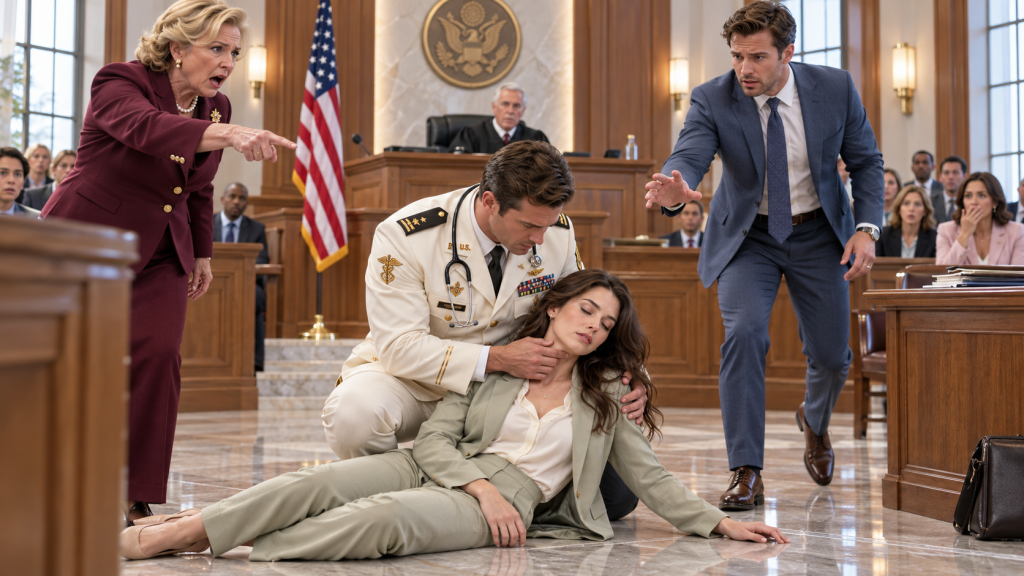
My mother-in-law pointed at me from the front row of the courtroom and said, “She’s faking it.”
Her voice cut through the silence so sharply that even the court reporter looked up.
My husband, Daniel Whitaker, sat beside his attorney with one arm resting across the back of his chair. He gave a small, knowing smirk.
“She does this every time she doesn’t get her way.”
I was standing near the witness box with one hand wrapped around the wooden railing.
The room had become unbearably bright.
The fluorescent lights above me buzzed like insects.
Every tiny sound seemed amplified.
A pen clicking.
Paper sliding across a desk.
Someone coughing behind me.
The squeak of a chair leg against the polished floor.
Judge Richard Hanley lowered his glasses slightly.
“Mrs. Whitaker, are you able to continue?”
I opened my mouth.
Nothing came out.
My tongue felt thick.
My vision narrowed around the edges.
The custody hearing had already been going badly.
For three hours, Daniel’s lawyer had described me as unstable, unreliable, dramatic, emotionally fragile, and manipulative.
My medical history had been displayed on a large screen as though it proved I was an unfit mother.
Emergency room visits.
Episodes of dizziness.
Two fainting spells.
Unexplained headaches.
Temporary numbness in my fingers.
One incident when I forgot where I had parked my car.
Daniel’s attorney presented every symptom as evidence that I could not safely care for our seven-year-old daughter, Lily.
Daniel claimed the symptoms became worse whenever he challenged me.
He said I “weaponized illness.”
His mother, Patricia Whitaker, supported every word.
Patricia sat in the front row wearing a pale blue suit, a pearl necklace, and the expression of a woman attending a charity luncheon.
Whenever Daniel’s attorney asked whether she had witnessed my “episodes,” Patricia would sigh sadly before answering.
“Yes. Many times.”
“Would you describe them as unpredictable?”
“Conveniently unpredictable.”
That answer had earned a few uncomfortable smiles from people sitting near her.
I wanted to scream.
Instead, I tried to remain calm.
I had come to court without an attorney because my previous lawyer had withdrawn two weeks earlier.
Daniel had emptied our joint savings account.
The money I had set aside for legal fees disappeared overnight.
He insisted it had been used to cover business debts.
I knew better.
But knowing something and proving it in court were two different things.
So I stood there alone, trying to explain why Lily cried every Sunday evening before she had to spend the night at Daniel’s house.
I tried to explain the nightmares.
The stomachaches.
The way Lily sometimes begged me to lock the door when Patricia’s car entered our street.
I explained that Lily had started wetting the bed again after almost four years without an accident.
Daniel’s attorney responded with one sentence.
“Children often reflect the anxiety of the parent they spend the most time with.”
Patricia nodded.
Daniel looked satisfied.
Everything I said became evidence against me.
If I defended myself, I was aggressive.
If I cried, I was unstable.
If I hesitated, I was confused.
If I became tired, I was medically incapable.
The harder I tried to speak clearly, the more frightened I became.
Then the floor seemed to shift.
I tightened my grip on the rail.
“Your Honor,” I whispered, “I need a minute.”
Daniel laughed softly.
“See?”
Patricia shook her head.
“Drama.”
Judge Hanley’s expression hardened.
“Mrs. Whitaker, this court has already allowed several pauses this morning.”
“I know.”
My voice barely worked.
“I just feel…”
The room tilted.
Daniel leaned toward his attorney.
I heard him whisper, “Here we go.”
Then my legs gave out.
The wooden railing slipped from my fingers.
My shoulder struck the floor first.
A second later, the side of my head hit the carpet.
For several seconds, everything disappeared.
Then sounds slowly returned.
Voices.
Movement.
Someone gasping.
A chair scraping backward.
Through blurred vision, I saw a man rushing from the benches near the rear of the courtroom.
He wore a dark green military uniform.
He was tall, probably in his late fifties, with closely cropped gray hair.
He dropped to his knees beside me.
“Ma’am, can you hear me?”
I tried to answer.
Only a weak sound escaped.
He placed two fingers against my neck.
Daniel stood several feet away.
“She’s fine.”
The uniformed man looked up.
Daniel folded his arms.
“She does this.”
The man’s expression changed.
“I’m Colonel Aaron Carter. United States Army Medical Corps.”
Then he turned toward Judge Hanley.
“Your Honor, she needs immediate medical attention.”
Patricia scoffed.
“You don’t know her.”
Colonel Carter ignored her.
He leaned close to me.
“Can you smile for me?”
I tried.
One side of my mouth barely moved.
He lifted my wrist.
“Grip my fingers.”
My right hand responded.
My left hand felt distant.
Carter’s expression became serious.
“Call 911.”
The courtroom seemed frozen.
Then Patricia said, “This is ridiculous.”
Carter’s head snapped toward the bailiff.
“CALL 911!”
The command thundered through the room.
The bailiff immediately reached for the phone.
Carter carefully positioned my head and checked my pupils.
Daniel stepped closer.
“You’re making this worse. She gets attention from this.”
Carter looked at him.
“Sir, step back.”
“I’m her husband.”
“Then act concerned.”
The words struck harder than a slap.
Daniel’s face reddened.
His attorney touched his arm and quietly told him to sit down.
Judge Hanley rose.
“Everyone remain quiet.”
Carter checked my pulse again.
“Mrs. Whitaker, have you had headaches recently?”
I nodded weakly.
“How long?”
“Months.”
“Dizziness?”
“Yes.”
“Blackouts?”
“Sometimes.”
“Numbness?”
“Yes.”
“Difficulty speaking?”
I swallowed.
“Sometimes.”
Daniel interrupted.
“Every doctor told her nothing was wrong.”
I turned my eyes toward him.
That was not true.
Several doctors had recommended further tests.
A neurologist had asked me to schedule an MRI.
Daniel convinced me not to go.
He said the test would cost thousands.
He said the neurologist was trying to scare me.
Another doctor recommended heart monitoring.
Daniel told me the insurance company had denied it.
Later, I learned he had canceled the appointment himself.
At the time, I trusted him.
Why wouldn’t I?
He was my husband.
He handled our insurance.
He handled our bills.
He handled most appointments because my headaches had become so severe that even concentrating on paperwork felt difficult.
Carter looked at Daniel.
“You knew she was experiencing neurological symptoms?”
Daniel hesitated.
“They weren’t real neurological symptoms.”
“And how did you determine that?”
Daniel did not answer.
Sirens sounded outside.
Two paramedics entered with equipment.
They moved quickly.
One placed a blood-pressure cuff around my arm.
The other attached monitors.
“Pressure’s low.”
“How low?”
The paramedic gave the number.
Colonel Carter frowned.
The second paramedic asked, “Any medications?”
“My list is in my purse.”
“Where?”
I pointed weakly toward the witness stand.
Colonel Carter stood to retrieve it.
Daniel moved immediately.
“Don’t touch that.”
The room became completely silent.
Judge Hanley turned toward him.
“Mr. Whitaker?”
Daniel glanced around.
“I just mean it contains personal things.”
The judge stared at him.
“It belongs to your wife.”
“I’ll get it.”
“No.”
Judge Hanley looked at the bailiff.
“Please bring Mrs. Whitaker’s purse.”
The bailiff retrieved it.
My hands were shaking too badly to open the zipper.
Carter crouched beside me.
“May I?”
I nodded.
He opened the purse.
Inside were my wallet, keys, tissues, Lily’s hair tie, a small notebook, and several receipts.
Then Carter opened a zipped interior pocket.
He stopped.
His hand came out holding a small amber prescription bottle.
I stared at it.
I had never seen it inside my purse.
Carter read the label.
His expression changed.
He passed it to the paramedic.
The paramedic looked at the name.
“Daniel Whitaker.”
Every person in the courtroom seemed to turn toward Daniel.
Daniel stood abruptly.
“That’s mine.”
Judge Hanley’s voice was cold.
“Why is your medication in your wife’s purse?”
“I don’t know.”
The paramedic examined the bottle.
“How often do you take this?”
Daniel’s attorney stepped forward.
“My client will not answer further questions.”
The paramedic ignored him and looked at me.
“Mrs. Whitaker, have you taken this medication?”
“No.”
“Ever?”
“No.”
The paramedic exchanged a look with Carter.
“This medication can cause sedation, confusion, low blood pressure, coordination problems, memory problems, and fainting.”
My stomach tightened.
Daniel shook his head.
“It probably fell into her purse.”
Carter looked directly at him.
“A bottle fell into a zipped interior compartment?”
Daniel’s jaw tightened.
His lawyer whispered something.
The paramedics placed me onto a stretcher.
As they wheeled me toward the courtroom doors, I looked back.
For the first time that morning, Daniel was not smiling.
Neither was Patricia.
They looked frightened.
Not frightened for me.
Frightened of what had just been discovered.
At the hospital, everything moved quickly.
Blood tests.
CT scans.
Neurological examinations.
Cardiac monitoring.
I drifted in and out of awareness.
Several hours later, I woke in a private room.
Colonel Carter was sitting near the window.
I blinked at him.
“You’re still here?”
He stood.
“I wanted to make sure you were stabilized.”
“You didn’t have to stay.”
“No.”
He paused.
“But somebody should.”
The words nearly made me cry.
A neurologist entered shortly afterward.
She introduced herself as Dr. Melissa Grant.
She pulled a chair beside my bed.
“Mrs. Whitaker, we found something concerning.”
My heart began racing.
She explained that my blood contained a significant amount of a sedating prescription medication.
The same drug prescribed to Daniel.
“I didn’t take it.”
“I believe you.”
Three simple words.
I believe you.
I had forgotten what those words felt like.
Dr. Grant continued.
“We also found evidence of a vascular abnormality that may explain some of your headaches and numbness.”
“Is it dangerous?”
“It can be managed. But combined with certain medications, dehydration, stress, and low blood pressure, it can become much more serious.”
I stared at the ceiling.
For almost a year, Daniel had told me my symptoms were imaginary.
Patricia told me I loved attention.
Daniel once recorded me struggling to speak during a dizzy spell.
Later, he showed the video to his sister and laughed.
“See what I deal with?”
I had been humiliated.
Eventually, I stopped talking about my symptoms.
I stopped trusting myself.
Dr. Grant touched my wrist gently.
“You were not imagining this.”
Tears rolled down my cheeks.
Colonel Carter quietly stepped outside.
Later that evening, a police detective entered.
Her name was Elena Ruiz.
A hospital security officer stood behind her.
Detective Ruiz placed Daniel’s prescription bottle into an evidence bag.
“Mrs. Whitaker, do you know how this medication entered your system?”
“No.”
“Has your husband prepared food or drinks for you recently?”
I almost answered no.
Then memories began surfacing.
Daniel and I had been separated for four months, but because of Lily, he still came to the house regularly.
Sometimes he brought coffee.
Sometimes dinner.
Sometimes smoothies.
He had become strangely helpful after we separated.
I thought he was trying to repair our relationship.
There was one Sunday when he arrived with iced coffee.
Twenty minutes after drinking it, I became dizzy.
Daniel drove Lily home with him because he said I was “too unstable.”
Another time Patricia made tea during a discussion about custody.
I woke nearly five hours later on the couch.
Patricia said I had fallen asleep halfway through a conversation.
Then I remembered mediation.
Daniel bought me coffee before the meeting.
Halfway through, I became confused.
I could not remember what the mediator had just asked.
Daniel later told the mediator, “This happens constantly.”
Detective Ruiz watched my face.
“What are you remembering?”
I told her.
Everything.
When I finished, she asked, “Is there anything in your home your husband regularly gives you? Supplements? Drinks? Medication?”
A plastic container flashed through my mind.
Daniel had brought it two months earlier.
A powdered hydration drink.
He insisted I use it because he said my dizziness came from dehydration.
The container sat in my kitchen cabinet.
He often mixed it for me.
“Yes.”
Ruiz leaned forward.
“What?”
I described it.
She immediately made a phone call.
Police obtained authorization to secure my home.
They collected the powdered drink mix.
Several mugs.
An old travel cup.
A bottle of supplements Daniel had purchased.
And medications from a bathroom drawer he still used.
The custody hearing was suspended.
Lily temporarily stayed with my older sister, Rachel.
Daniel was ordered not to contact me.
Patricia was also told to stay away.
The first night in the hospital, I slept for almost eleven hours.
No phone calls.
No accusations.
No Daniel telling me I was crazy.
No Patricia telling me I was dramatic.
When I woke, Rachel was sitting beside my bed.
She looked furious.
Not at me.
At herself.
“I should have known something was wrong.”
“You couldn’t have.”
“I kept thinking he was just cruel.”
“So did I.”
Rachel reached for my hand.
“You’re not going back to him.”
“No.”
It was the first time I said it without uncertainty.
“No, I’m not.”
Three days later, Detective Ruiz returned.
She closed the door before sitting down.
“The preliminary laboratory results came back.”
My heart began pounding.
“The drink powder?”
She nodded.
“It contains traces of a prescription medication that is not listed among the ingredients.”
I already knew what she was going to say.
“Daniel’s?”
“Yes.”
My hands went cold.
Ruiz continued.
“Investigators also obtained access to Mr. Whitaker’s phone and cloud backups pursuant to a warrant.”
She opened a folder.
“We found deleted text messages.”
“Between Daniel and who?”
“His mother.”
She placed several printed pages on my blanket.
The first message was from Patricia.
She’s getting suspicious. Use less.
Daniel replied:
I know what I’m doing.
Another message:
She almost passed out yesterday.
Daniel:
Good. Rachel saw it.
Patricia:
Perfect. More witnesses that she’s unstable.
My hands began shaking.
I read another exchange.
Patricia:
Make sure she misses the neurologist appointment.
Daniel:
Already canceled it. Told her insurance denied it.
Patricia:
Good. Don’t let some doctor ruin everything now.
Then another.
Daniel:
Mediation went perfectly. She couldn’t even finish a sentence.
Patricia:
How much did you give her?
Daniel:
Enough.
I stopped reading.
I could not breathe.
Detective Ruiz moved the papers away.
“There are more.”
“Why?”
My voice cracked.
“Why would they do this?”
Ruiz hesitated.
“Financial investigators believe money was a significant motive.”
My father had died four years earlier.
He left me a trust worth approximately eight hundred and forty thousand dollars.
Daniel had always resented the restrictions.
The trust was mine.
He could not withdraw money.
He could not use it as collateral.
When our marriage began deteriorating, I told him the trust would support Lily if necessary.
Apparently, Daniel and Patricia began researching guardianship law.
If Daniel could convince a court that I was mentally incapable of managing my finances, he believed he might gain control.
Custody was part of the plan too.
If I looked unstable enough to lose Lily, it would strengthen his claims elsewhere.
My illness was not an inconvenience to Daniel.
It was evidence he had manufactured.
I felt sick.
“They weren’t trying to kill me?”
Ruiz was careful.
“We don’t yet know what level of harm they intended.”
“But…”
She understood.
“The messages suggest their primary goal was to impair you.”
Confuse me.
Exhaust me.
Make me forgetful.
Make me collapse.
Then call me unstable.
It was horrifying because it explained everything.
Why Daniel always seemed calm when I became sick.
Why he had his phone ready to record.
Why Patricia frequently appeared shortly afterward.
Why they told family members stories about my “episodes” before I even understood what happened.
Why Lily had begun looking terrified whenever Daniel prepared my drinks.
Lily.
I sat upright.
“What about my daughter?”
Ruiz immediately understood.
“We have no evidence she was given anything.”
“No evidence?”
“We’re arranging testing and a forensic interview.”
I started crying.
“If they touched her—”
“Mrs. Whitaker, listen to me. We have no indication that Lily was drugged.”
Rachel brought Lily to the hospital later that afternoon.
She ran through the doorway.
“Mommy!”
I held her so tightly she squealed.
“Mom, you’re crushing me.”
“Sorry.”
She climbed onto the edge of the bed.
“Are you going to die?”
“No.”
“Promise?”
“I promise.”
She studied my face.
“Daddy said you were sick because you worry too much.”
I swallowed.
“Daddy was wrong.”
She nodded.
Then she said something that changed the investigation completely.
“Grandma said your drinks have medicine.”
The room seemed to stop.
Rachel looked at me.
“What did you say?”
Lily shrugged.
“Grandma said I shouldn’t drink Mommy’s drinks because they have grown-up medicine.”
“When did she say that?”
“A lot.”
Rachel immediately called Detective Ruiz.
Lily was later interviewed by a child specialist.
Her memories were simple.
But devastating.
She remembered Daniel crushing tablets with the back of a spoon.
He told her they were vitamins.
She remembered Patricia bringing small packets and telling Daniel, “Don’t use too much.”
Lily did not understand what that meant.
Once, she tried drinking from my cup.
Patricia grabbed it away so quickly that it spilled.
“Never drink Mommy’s drinks.”
At the time, Lily thought I took special medicine.
Daniel was arrested two days later.
Patricia was arrested shortly afterward.
When I saw their booking photographs on television, I expected satisfaction.
Instead, I felt hollow.
The people who had done this to me were people I had trusted.
Daniel had slept beside me for eleven years.
He held my hand when Lily was born.
He attended my father’s funeral.
He knew my passwords.
He knew my fears.
He knew exactly how much medication would make me look impaired without immediately sending me to the hospital.
Patricia had once called me the daughter she never had.
Now police were reading messages where she joked about me collapsing.
My recovery took weeks.
The vascular problem was treated.
The medication slowly left my system.
Then something strange happened.
My mind became clearer.
I could read without losing my place.
I stopped forgetting words halfway through sentences.
My hands stopped trembling.
The constant exhaustion disappeared.
The headaches became less frequent.
Every improvement brought relief.
And anger.
I realized how carefully Daniel had dismantled my confidence.
He convinced me to stop driving because I was “unsafe.”
He took control of bills because I was “forgetful.”
He handled my appointments because I was “too overwhelmed.”
He encouraged me to stop seeing friends because crowds “triggered” me.
One decision at a time, he made my world smaller.
Then he pointed at the small world he created and said it proved I could not function.
Rachel helped me hire a new attorney.
Her name was Maya Ellis.
She was calm, sharp, and completely unimpressed by Daniel’s reputation.
The first time we met, she placed both hands on the table and said, “I want you to understand something.”
I waited.
“You are not going into that courtroom to prove you are perfect.”
I nodded.
“You are going there to prove your daughter deserves safety.”
That changed everything.
Six weeks after my collapse, I returned to Judge Hanley’s courtroom.
My stomach tightened the moment I entered.
The same lights.
The same wooden railing.
The same benches.
But everything else was different.
Rachel sat behind me.
Maya sat beside me.
Colonel Carter had agreed to testify.
Dr. Grant was present.
Detective Ruiz waited outside.
Daniel entered under strict conditions from his criminal case.
Patricia sat beside her attorney.
Neither looked at me.
Judge Hanley entered.
We stood.
After taking his seat, he removed his glasses.
“Mrs. Whitaker.”
“Yes, Your Honor?”
“Before we proceed, I need to address what occurred during the previous hearing.”
The courtroom became silent.
“I failed to respond appropriately to your medical distress.”
I stared at him.
“The court relied too heavily upon characterizations presented by opposing parties.”
He glanced toward Daniel.
“Those characterizations are now themselves part of a criminal investigation.”
He looked back at me.
“I apologize.”
I had never expected an apology.
“Thank you, Your Honor.”
The hearing began.
Colonel Carter testified first.
Daniel’s attorney tried to minimize what had happened.
“Colonel Carter, you are not Mrs. Whitaker’s treating physician, correct?”
“Correct.”
“You had never met her before that morning?”
“Correct.”
“So you had no knowledge of her history.”
“Only what I observed.”
“Stress can cause fainting, can’t it?”
“Yes.”
“Anxiety can cause difficulty speaking?”
“Yes.”
“Therefore her collapse could have been psychological.”
Carter remained completely calm.
“Counsel, stress can cause many things. It does not explain prescription medication in a person’s bloodstream when that medication was not prescribed to her.”
The attorney shifted.
“But you didn’t know that when she collapsed.”
“No.”
“So your assessment was incomplete.”
“My assessment was that she needed emergency medical care.”
“And you were certain?”
Carter leaned slightly forward.
“I did not need to know why a person was collapsing in order to recognize that laughing at her was not appropriate treatment.”
Nobody spoke.
Daniel stared at the table.
Dr. Grant testified next.
She explained the toxicology.
She explained my vascular condition.
She explained how Daniel’s medication could worsen confusion, memory problems, low blood pressure, and neurological symptoms.
Maya asked one question.
“Doctor, in your professional opinion, was Mrs. Whitaker faking the symptoms you observed?”
“No.”
“Could she have voluntarily produced the toxicology findings?”
“Not without ingesting the medication.”
“Did she have a prescription for it?”
“No.”
“Who did?”
“Her husband.”
Then Detective Ruiz testified.
She read the messages.
Not all of them.
Enough.
Every sentence seemed to shrink Daniel in his chair.
When she read Patricia’s message—Once Lily is with us, she can fall apart all she wants—I heard Rachel begin crying behind me.
Patricia stared straight ahead.
Then came Lily’s forensic interview.
The judge reviewed the recording privately.
When he returned, his expression was different.
Colder.
He denied Daniel unsupervised contact with Lily.
Then he ordered that any future contact would require evaluation and court approval.
Patricia was prohibited from contacting Lily entirely until further review.
Daniel’s attorney stood.
“Your Honor—”
Judge Hanley raised his hand.
“I have heard enough.”
For months, I dreamed about winning custody.
In my imagination, I always felt victorious.
The real moment felt completely different.
It felt quiet.
Like setting down something impossibly heavy.
Outside the courthouse, reporters waited.
Maya told me not to speak publicly because the criminal investigation was ongoing.
As we walked toward the parking lot, someone called my name.
“Mrs. Whitaker.”
I turned.
Colonel Carter stood near the courthouse steps.
I walked toward him.
“I don’t know how to thank you.”
“You don’t need to.”
“You were the first person who believed me.”
He shook his head.
“I didn’t know you well enough to believe or disbelieve your whole story.”
I smiled slightly.
“That sounds very clinical.”
“It is.”
Then he softened.
“I simply looked at the person on the floor instead of listening to the people telling me what I was supposed to see.”
That sentence stayed with me.
The criminal cases took almost a year.
Daniel eventually pleaded guilty after prosecutors presented the messages, laboratory evidence, financial records, and testimony.
Patricia accepted a plea agreement as well.
Their attorneys claimed neither intended permanent physical harm.
That argument angered me.
As though destroying someone slowly was somehow kinder.
As though making a mother question her own mind was less serious because no weapon was visible.
Daniel received a prison sentence.
Patricia received a shorter one because of her age, limited criminal history, and cooperation near the end.
I attended Daniel’s sentencing.
Not because I wanted revenge.
Because I wanted him to see me standing.
His attorney spoke about his career.
His reputation.
His childhood.
His stress.
His regret.
Then Daniel addressed the court.
He said, “I never meant for things to go this far.”
For the first time in months, I almost laughed.
That sentence sounded exactly like him.
Nothing was ever his decision.
Everything simply “went too far.”
When I was permitted to speak, I stood.
My hands trembled.
But I did not look away.
“You keep saying you never meant for things to go this far.”
Daniel stared at me.
“But you crushed medication.”
“You hid it.”
“You canceled medical appointments.”
“You lied to doctors.”
“You recorded me when I was sick.”
“You told our daughter I was unstable.”
“You tried to take my money.”
“You tried to take my child.”
“You did not make one mistake.”
“You made hundreds of decisions.”
Daniel lowered his eyes.
I continued.
“The worst thing you did was not putting medication in my drink.”
His head lifted.
“The worst thing you did was teaching me not to trust myself.”
The courtroom was silent.
“For months, I thought I was losing my mind.”
I looked at the judge.
“But I am not standing here because he destroyed me.”
Then I looked at Daniel.
“I’m standing here because he failed.”
I sat down.
That was the last time I spoke to him face-to-face for years.
Lily and I moved to another neighborhood.
Our new house was smaller.
The kitchen needed work.
The backyard fence leaned slightly.
The upstairs bathroom had ugly green tiles.
Lily loved it instantly.
She chose a yellow front door.
“Why yellow?” I asked.
“Because nobody sad has a yellow door.”
I laughed.
“That is definitely not scientifically proven.”
“It should be.”
So we painted it yellow.
Our new life was not magically perfect.
Healing was complicated.
I could not accept coffee from someone unless I watched them prepare it.
If I became dizzy, I panicked.
For months, I checked the labels on every bottle in my kitchen.
Sometimes I woke at three in the morning convinced I had heard Daniel’s key in the lock.
Lily struggled too.
She developed nightmares.
She asked whether her father loved her.
That question broke my heart.
I never told her he did not.
Instead I said, “Sometimes people love others and still make terrible, selfish choices. Love doesn’t excuse what they do.”
She started counseling.
So did I.
At first, I hated therapy because Daniel had spent years using the idea of therapy against me.
He called every disagreement a symptom.
He told people I needed “professional help.”
But my therapist, Dr. Warren, never treated me like I was broken.
She taught me the difference between being damaged and being injured.
One afternoon she asked, “When did you stop trusting your judgment?”
I thought about it.
“There wasn’t one moment.”
“That’s usually how it works.”
Daniel had not destroyed my confidence all at once.
It happened in tiny pieces.
You forgot that.
You’re too emotional.
That’s not what happened.
You always exaggerate.
You’re imagining things.
You embarrass yourself.
Let me handle it.
Eventually, his voice became louder than mine inside my own head.
Therapy taught me to lower it.
A year after his sentencing, I received a letter from Daniel.
I recognized his handwriting immediately.
I left it unopened on the kitchen counter for two days.
Then curiosity won.
He apologized.
Sort of.
He said prison gave him time to think.
He said Patricia influenced him.
He said he became obsessed with money.
He said he never intended to permanently harm me.
Then he wrote:
I only wanted control of the situation.
I stared at that sentence.
Control.
That was exactly what he wanted.
Control of my money.
My health.
My daughter.
My memories.
My identity.
My future.
I folded the letter.
Then I burned it in the fireplace.
Not angrily.
Not dramatically.
I simply watched the paper disappear.
Two years after my collapse, I returned to the courthouse.
This time, Rachel was getting married.
She wanted a small civil ceremony.
The moment I walked through the lobby, my body remembered.
My chest tightened.
My breathing changed.
Then Lily reached for my hand.
She was nine now.
“Mom?”
“I’m okay.”
She looked toward the hallway.
“Is that where you fell?”
“Yes.”
“And Colonel Carter helped you?”
“He did.”
She squeezed my fingers.
“Did he save you?”
I thought about the question.
“He helped save me.”
“And me?”
I looked at her.
“He helped open the door.”
“What does that mean?”
“It means sometimes one person notices something wrong. Then other people help.”
She considered that.
“So lots of people saved us?”
“Yes.”
She smiled.
“Cool.”
Then she dragged me toward Rachel’s ceremony because she was terrified of missing the cake.
That day was wonderfully ordinary.
Rachel cried.
Her new husband forgot half his vows.
Lily scattered flowers even though nobody told her to.
Someone’s baby screamed halfway through the ceremony.
Everyone laughed.
There were no accusations.
No lawyers fighting.
No fear.
Just family.
Safe family.
A few months later, a local hospital invited me to speak at a support program for women recovering from coercive relationships.
My first answer was no.
Then I remembered myself standing in court while everyone seemed ready to believe Daniel.
So I changed my answer.
Nineteen women attended.
Some had experienced physical violence.
Some had not.
Some had been financially controlled.
Some had been isolated.
Some had been told for years that their memories were wrong.
I stood behind the podium.
“I used to think abuse always looked obvious.”
The room became silent.
“I thought there had to be bruises. Broken furniture. Police visits.”
Several women nodded.
“My husband rarely raised his voice.”
I paused.
“He didn’t need to.”
I told them about the canceled appointments.
The medication.
The recordings.
The money.
The courtroom.
Then I said the lesson that had taken me years to understand.
“When someone constantly tells you that your pain is fake, your memory is wrong, your fear is irrational, and your instincts cannot be trusted, the goal may not be to convince everyone around you.”
I looked across the room.
“Sometimes the goal is to convince you.”
A woman in the second row started crying.
Afterward, she stayed behind.
She was around fifty.
“My husband keeps telling me I’m becoming forgetful.”
I listened.
“He handles my medications.”
My stomach tightened.
“Do you see your doctor alone?”
“No.”
“He always comes.”
I gave her the number of an advocate.
“Make one appointment without him.”
Three months later, she emailed me.
She was safe.
Her situation was not identical to mine.
But something had been wrong.
That message meant more to me than any courtroom verdict.
Years passed.
Lily grew taller.
She became stubborn, hilarious, compassionate, and incapable of getting ready for school on time.
She tried violin.
Quit violin.
Joined soccer.
Quit soccer.
Joined the art club.
Stayed.
She loved drawing houses.
Every house she drew had enormous windows.
One afternoon, when she was twelve, she showed me a picture.
A blue house surrounded by trees.
“That’s our future house.”
“Our house?”
“When I’m rich.”
“You’re buying me a house?”
“Obviously.”
“That’s generous.”
“You can live upstairs.”
“Only upstairs?”
“The downstairs is my art studio.”
I laughed.
For years, I believed justice would feel like Daniel being arrested.
Then I thought justice would be winning custody.
Then his conviction.
I was wrong.
Justice looked like that.
Lily sitting at the kitchen table drawing imaginary houses.
My mind clear.
My body healthier.
No fear in the hallway.
No hidden medication.
No one telling me what I remembered.
Colonel Carter and I exchanged Christmas cards for several years.
He retired from the Army.
The last time I saw him in person was at a patient advocacy fundraiser.
He sat near the back.
After my speech, I found him drinking coffee.
“You always sit in the back.”
“Better view.”
I hugged him.
“You look well,” he said.
“I am.”
“And Lily?”
“Better than well.”
He smiled.
I said, “I still think about that courtroom.”
“So do I.”
“I really thought I was losing my mind.”
Carter’s expression softened.
“That’s what people like Daniel depended on.”
“You believed me before I believed myself.”
He shook his head.
“Being believed helped.”
Then he pointed gently toward me.
“But learning to believe yourself is what saved your life.”
He was right.
For years, I thought the defining moment of my story was my collapse.
It was dramatic.
A courtroom.
A military doctor.
An ambulance.
A hidden medication bottle.
Arrests.
Trials.
But the true turning point happened quietly.
One morning shortly after leaving the hospital, I stood in front of my bathroom mirror.
My face looked exhausted.
My hair was messy.
I had dark circles beneath my eyes.
Daniel’s words still lived inside my head.
Unstable.
Weak.
Dramatic.
Forgetful.
Difficult.
Crazy.
I stared at my reflection.
Then I whispered, “I believe you.”
I was talking to myself.
“I believe you.”
I believed the headaches.
I believed the dizziness.
I believed the fear.
I believed my instincts about Lily.
I believed my own memories.
I believed the woman Daniel had spent months trying to erase.
Once I did that, his voice became quieter.
Patricia’s too.
Eventually they became nothing more than echoes from a life I had survived.
Today, Lily is seventeen.
She is applying to colleges.
She wants to study medicine.
When I asked why, she shrugged.
“Doctors are supposed to notice things other people miss.”
I smiled.
“I know one who did.”
On her desk is a photograph from Rachel’s courthouse wedding.
Lily is holding flowers.
I am beside her.
We are smiling.
Behind us is the hallway leading toward the courtroom where I once collapsed while two people who were supposed to love me laughed.
Sometimes the place where you nearly lose everything becomes the place that reminds you how much you survived.
Last week, Lily walked into the kitchen holding her laptop.
“Mom?”
“Yes?”
“Read my college essay.”
“What’s it about?”
She looked suddenly nervous.
“You.”
“That sounds dangerous.”
“Mom.”
I laughed.
“Give it here.”
I sat at the kitchen table.
Her essay began:
When my mother collapsed in a courtroom, everyone thought she was weak. I was only seven, but years later I understood that falling was not the moment she became weak. It was the moment people finally saw what she had been surviving.
I stopped reading.
Lily looked alarmed.
“Why are you crying?”
“I’m not.”
“You absolutely are.”
“I have allergies.”
“It’s December.”
“Winter allergies.”
She rolled her eyes.
Then she hugged me from behind.
I looked around our kitchen.
Sunlight streamed through the windows.
Dirty dishes sat beside the sink.
Her backpack was lying in the middle of the floor.
A grocery list was attached to the refrigerator with a ridiculous strawberry magnet.
Nothing about the room looked extraordinary.
That was exactly why it felt beautiful.
Peace had once seemed boring to me.
Now I understood how valuable boring could be.
No secret medication.
No courtroom accusations.
No checking whether my memory matched someone else’s story.
No wondering whether the person sleeping beside me wanted to protect me or control me.
Just life.
Mine.
Lily’s.
Safe.
Years ago, Daniel thought taking control of my mind would give him control of everything else.
He almost succeeded.
But he made one mistake.
He assumed that if enough people called me weak, I would remain weak forever.
He was wrong.
I fell in that courtroom.
I fell in front of everyone.
I could not stand.
I could barely speak.
And yet, looking back now, I know something Daniel never understood.
Falling was never my failure.
Staying down would have been.
I stood again.
I protected my daughter.
I reclaimed my health.
I rebuilt my life.
And eventually I learned the lesson I wish I had understood from the beginning.
When someone constantly tells you your pain is fake, do not automatically ask yourself why you are so weak.
Sometimes you need to ask why they are so desperate for you not to trust what you feel.
Because the truth can be inconvenient to people who benefit from your silence.
And sometimes the first step toward saving your life is as simple as believing yourself when everyone else says you shouldn’t.
Daniel took years from me.
He did not get the rest.
Patricia took my trust.
She did not get my future.
And the woman they called unstable?
She raised a brave daughter.
She rebuilt a peaceful home.
She learned to laugh again.
She learned to trust again.
Most importantly, she learned to trust herself.
That was the one thing Daniel could never take from me again.
And that, more than his sentence, more than the custody ruling, more than every apology or guilty plea, became my real justice.
💬THE END! THANK YOU FOR READING!