

My family laughed when I arrived at my sister’s wedding without a date.
My father made sure nearly four hundred guests heard him say, “Look who finally showed up. Emma couldn’t even find someone to bring.”
Minutes later, his idea of a harmless joke left me standing waist-deep in a freezing fountain while guests clapped, laughed, and lifted their phones to record me.
When the applause finally faded, I looked straight at my father and said quietly, “Remember this moment.”
He laughed again.
He had no idea that the secret I had protected from my family for three years was already walking toward the ballroom doors.
My name is Emma Hale, and for most of my thirty-two years, I had been the daughter my family considered difficult.
Not bad.
Not unsuccessful.
Just difficult.
That was the word my mother used when she wanted to soften what my father really meant.
Too serious.
Too independent.
Too quiet.
Too stubborn.
Too sensitive.
My younger sister, Lily, was everything I supposedly was not.
She was beautiful in the way people noticed immediately.
She had bright blond hair, an easy laugh, and the kind of personality that filled a room before she had even crossed it.
People loved Lily.
My father worshiped her.
When we were children, he called her his sunshine.
I was “the little professor.”
At first, I thought it was affectionate.
Then I got old enough to notice that every compliment he gave Lily somehow contained an insult toward me.
“Look at Lily smiling for the camera, Emma. Why can’t you relax like your sister?”
“Lily has such a natural sense of style. Maybe she can help you.”
“Lily knows how to make friends. You could learn something from her.”
Whenever I complained, my father would laugh.
“Learn to take a joke.”
My mother would pull me aside afterward.
“You know your father doesn’t mean anything by it.”
Those words followed me through childhood.
He doesn’t mean anything by it.
When I was sixteen, I failed to make the school cheerleading team. Dad announced it during Thanksgiving dinner and joked that the judges had “saved the crowd from watching Emma attempt a cartwheel.”
Everyone laughed.
He didn’t mean anything by it.
At twenty-one, I brought my college boyfriend home.
Dad spent dinner telling him embarrassing childhood stories about me.
When my boyfriend went to the bathroom, Dad leaned across the table and said, “That boy is too handsome for you. Don’t get attached.”
He didn’t mean anything by it.
At twenty-six, I gained fifteen pounds after working seventy-hour weeks on a major project.
Dad bought me a gym membership for Christmas.
Everyone laughed when I opened the envelope.
He didn’t mean anything by it.
By thirty, I had learned how to survive my family.
Smile.
Don’t react.
Leave early.
Never tell them anything important.
And above all, never give my father anything he could turn into entertainment.
That was why they knew almost nothing about Alexander.
They knew I had dated someone several years earlier.
Then I stopped discussing him.
Lily assumed we had broken up.
Dad once said, “I knew that mystery man wouldn’t last.”
I didn’t correct him.
The truth was that Alexander and I had married three years earlier in a quiet ceremony with only twenty-two guests.
My family had not been invited.
At the time, I told myself I would explain eventually.
But each family gathering made me postpone that conversation.
I wanted one beautiful thing in my life untouched by my father’s jokes and Lily’s comparisons.
Alexander understood.
He never pressured me.
“If you want them to know,” he once told me, “we tell them. If you don’t, we don’t.”
That was one of the reasons I loved him.
He never tried to own my decisions.
He simply stood beside me while I made them.
Lily’s wedding was supposed to be the social event of the year for our family.
Dad had spent eighteen months planning almost as intensely as Lily.
The ceremony and reception were booked at the Rosemont Grand Resort, a luxury property outside the city famous for its landscaped gardens, enormous crystal ballroom, private lake, and ridiculous prices.
Dad talked about the wedding constantly.
He told everyone what the flowers cost.
He mentioned the imported champagne.
He bragged about the orchestra.
He discussed the guest list like he was preparing for a royal summit.
Nearly four hundred people were attending.
Business owners.
Local officials.
Clients.
Friends.
Friends of friends.
And many people Dad barely knew but wanted to impress.
The morning of the wedding, I almost didn’t go.
Alexander had been in Chicago for meetings and was flying home that afternoon.
“Come with me,” I had said two weeks earlier.
He smiled.
“You want me there?”
“I want you everywhere.”
“That wasn’t the question.”
I sighed.
“My family will turn it into a circus.”
“Then maybe today isn’t the day.”
“That’s what I was thinking.”
He kissed my forehead.
“I’ll be home if you need me.”
So I attended alone.
When I arrived at Lily’s bridal suite, she was surrounded by bridesmaids, makeup artists, hair stylists, photographers, and enough flowers to fill a greenhouse.
She looked stunning.
I meant that sincerely.
Despite our complicated relationship, seeing my little sister in her wedding dress stirred something soft inside me.
For a moment, I remembered the girl who used to crawl into my bed during thunderstorms.
The girl whose hair I braided before school.
The girl who cried when I left for college.
I walked toward her holding a small velvet box.
“You look beautiful.”
She smiled at her reflection.
“I know. Isn’t the dress perfect?”
“It is.”
I handed her the box.
“This is for you.”
She opened it.
Inside were antique-style pearl earrings with tiny diamonds.
I had spent months searching for them because they resembled a pair our grandmother had worn in her own wedding photographs.
Our grandmother had died when Lily was twelve.
I expected Lily to understand immediately.
Instead she studied them and said, “They’re nice.”
Nice.
I swallowed my disappointment.
“They look like Grandma’s wedding earrings.”
“Oh.”
For half a second, her expression softened.
Then one bridesmaid held up a pair of large diamond earrings.
“Lily, remember your mother-in-law gave you these.”
Lily looked between the two pairs.
“I think I’ll wear the diamonds.”
“Of course.”
She handed my gift to a bridesmaid.
“Put these somewhere safe.”
I turned to leave.
“Wait.”
I looked back.
Lily glanced behind me.
“Where is your date?”
“I came alone.”
Her eyebrows rose.
“You’re kidding.”
“No.”
“Emma.”
“What?”
“You know Dad is going to say something.”
“Dad always says something.”
One bridesmaid laughed.
Lily gave me a pitying look.
“I just thought maybe you’d finally bring somebody.”
I almost told her.
The words reached the back of my throat.
I’m married.
My husband’s name is Alexander.
You have actually mentioned him at dinner without realizing he is part of my life.
But I didn’t.
Not because I was ashamed.
Because the moment didn’t feel safe.
Instead I smiled.
“Today is about you.”
“That’s true.”
She turned back to the mirror.
I walked out.
The ceremony was beautiful.
Nathan, Lily’s fiancé, cried when she walked down the aisle.
Even Dad looked emotional.
For nearly an hour, we were simply a family watching one of our own get married.
I almost believed the evening might be peaceful.
Then came the reception.
My assigned seat was at a family table near the front.
Mom sat beside me.
Dad was across the room greeting guests like a politician.
Lily and Nathan entered to thunderous applause.
Dinner began.
Champagne flowed.
People danced.
And after dessert, Dad picked up the microphone.
My stomach tightened immediately.
Richard Hale with a microphone was never a safe combination.
He started normally.
He welcomed the guests.
He complimented Nathan.
He talked about the first time Lily brought him home.
He told everyone how proud he was.
Then he began telling childhood stories.
Most were harmless.
Everyone laughed.
Lily laughed louder than anyone.
I relaxed slightly.
Then Dad looked directly at me.
“And of course,” he said, “we can’t forget Lily’s older sister.”
My mother shifted beside me.
I stared at my plate.
Dad grinned.
“Emma, stand up so everyone can see you.”
I stayed seated.
People turned.
He laughed.
“She’s shy tonight.”
A few guests chuckled.
Then he said, “Look at her. All by herself again.”
More laughter.
I felt heat climb my neck.
Dad continued.
“I asked Emma if she was bringing anyone tonight, and apparently she couldn’t even find somebody willing to attend a free wedding dinner.”
The room erupted.
I heard someone nearby say, “Oh my God.”
Dad loved the reaction.
“I offered to hire an actor for her, but apparently they were all booked.”
Louder laughter.
I looked at Lily.
She was covering her mouth, laughing.
My mother whispered, “Richard, enough.”
But she didn’t stand.
She didn’t take the microphone.
She didn’t tell him to stop.
I pushed back my chair.
Dad noticed.
“Oh, don’t leave, Emma. I’m just warming up.”
That earned another laugh.
I walked out of the ballroom.
I didn’t run.
I refused to give anyone that satisfaction.
The terrace outside was cooler and quieter.
A large circular fountain stood in the center surrounded by white roses and tiny lights.
I walked toward it.
My hands were shaking.
I closed my eyes and listened to the water.
Thirty-two years old.
Successful career.
A husband who loved me.
A home I adored.
Good friends.
A life I had built carefully.
And somehow my father could make me feel sixteen again with three sentences and a microphone.
I heard the ballroom doors open.
“Emma.”
Of course.
I turned.
Dad walked toward me, microphone still in his hand.
“You walked out in the middle of my speech.”
“I needed air.”
“You made it awkward.”
I stared at him.
“I made it awkward?”
“Don’t start.”
“You publicly humiliated me.”
He rolled his eyes.
“Oh, for heaven’s sake. It was a joke.”
“It wasn’t funny.”
“Four hundred people seemed to disagree.”
“That doesn’t make it funny.”
Dad sighed dramatically.
“Everything is an emotional crisis with you.”
“No. I’ve spent most of my life pretending your behavior doesn’t bother me.”
“Here we go again.”
“I’m going home.”
His expression hardened.
“No.”
“Yes.”
“It’s your sister’s wedding.”
“And you used it as another excuse to embarrass me.”
“Stop making this about yourself.”
For a moment, I couldn’t believe what I had heard.
“You just spent five minutes making me the punchline of your speech.”
“Because you’re so easy to tease.”
“That’s not a compliment.”
“Emma, grow up.”
I stepped away.
“I am leaving.”
He grabbed my shoulders.
Not violently.
Not enough to look threatening from a distance.
It was the same casual physical dominance he had used when we were children.
Turn around.
Go sit down.
Stop embarrassing me.
“Stop sulking,” he said. “You’re ruining the aesthetic.”
I pulled away.
Then he gave me a shove.
I still don’t know whether he intended for me to fall.
Maybe he expected me to stumble and everyone to laugh.
Maybe he thought I would catch myself.
Maybe he genuinely believed nothing bad could happen because nothing ever happened to him.
But my heel landed on the wet stone surrounding the fountain.
My ankle twisted.
I lost my balance.
For one suspended second, I saw Dad’s surprised face.
Then I fell backward.
The water was freezing.
It swallowed me completely.
My head went under.
My shoulder struck the side.
When I surfaced, gasping, my hair was plastered across my face.
My pale green dress floated around me.
One shoe was gone.
And people were laughing.
Guests had followed Dad onto the terrace.
Some clapped.
Someone whistled.
Several people held up phones.
Dad, recovering from his surprise, raised the microphone.
“Well, at least Emma finally made a splash tonight!”
The applause exploded.
That sound changed me.
Not the water.
Not the humiliation.
The applause.
I looked at faces I recognized.
Relatives.
Family friends.
People who had watched me grow up.
Some looked horrified.
Some laughed because everyone else was laughing.
Some looked away.
Nobody helped me.
My mother stood near the doors with both hands over her mouth.
Lily was beside her.
Even Lily was smiling.
Something inside me became completely still.
For years, I had mistaken endurance for strength.
I believed I was stronger because I didn’t fight.
I told myself I was mature because I refused to respond.
I thought silence meant dignity.
Standing in that fountain, I finally understood that silence had taught my family one lesson.
Emma will take it.
Emma will forgive.
Emma will come back.
Emma will never make us uncomfortable.
I stood.
Water poured from my dress.
I pushed my hair from my face.
Dad was still smiling.
I looked straight at him.
“Remember this moment.”
He laughed uncertainly.
“Oh, come on.”
“Remember exactly what you did.”
My voice was low enough that the people nearest us stopped talking.
“Because I will.”
His smile disappeared.
I climbed out of the fountain.
Someone offered me a napkin.
I walked past them.
Nobody laughed anymore.
I crossed the ballroom.
Hundreds of eyes followed me.
I heard whispers.
“What happened?”
“Did he actually push her?”
“That’s his daughter.”
“Is she okay?”
I didn’t answer anyone.
I went into the restroom and locked myself in a stall.
Only then did I begin shaking.
My phone was wet.
The screen flickered.
I wiped it on a towel.
It worked.
Barely.
There was one person I wanted.
One person who had never laughed when I was hurting.
I opened our messages.
My last message from him had arrived an hour earlier.
Landed. Call if you want me.
I typed two words.
Come now.
Three dots appeared almost immediately.
Where are you?
Rosemont. Side entrance.
His reply came seconds later.
Ten minutes.
I stared at those words.
Then I stood.
I refused to let my father’s joke determine how the rest of my night would look.
I kept an emergency garment bag in my car because my job often involved unexpected meetings and client dinners.
Inside was a black cocktail dress.
Simple.
Elegant.
I changed in a private dressing room near the spa.
I dried my hair as best I could.
I cleaned the mascara beneath my eyes.
I reapplied makeup.
Then I opened my purse and found a tube of red lipstick.
Normally, I wore pale colors.
That night, I chose red.
When I looked in the mirror, I didn’t see the embarrassed woman from the fountain.
I saw someone tired of disappearing.
There was a knock.
“Emma?”
Mom.
I opened the door.
Diane stood outside holding a cream shawl.
Her face looked miserable.
“Oh, sweetheart.”
I said nothing.
She stepped inside.
“I brought this for you.”
“Thank you.”
She draped it over a chair.
“Your father feels terrible.”
I laughed once.
“No, he doesn’t.”
“He didn’t mean for you to fall.”
“Mom.”
“He thought—”
“Stop.”
She froze.
“Do not explain what Dad meant.”
Her eyes filled.
“I’m only saying—”
“You have spent my entire life explaining what he meant.”
“I know he can be thoughtless.”
“No. Thoughtless is forgetting someone’s birthday. Dad enjoys humiliating me.”
“That’s not fair.”
“Isn’t it?”
She looked away.
“Did you laugh?”
Her head snapped back.
“What?”
“When I was in the fountain. Did you laugh?”
“No.”
“You smiled.”
“I was shocked.”
“You smiled because that is what everyone does when Dad makes me the joke. You smile because challenging him is uncomfortable.”
Tears filled her eyes.
“I’m sorry.”
“I know.”
My phone buzzed.
Outside.
Mom noticed the change in my expression.
“Is someone coming?”
“Yes.”
“Who?”
There was no reason to hide anymore.
“My husband.”
Mom stared.
“Your what?”
“My husband.”
She actually took a step backward.
“You’re married?”
“Yes.”
“For how long?”
“Three years.”
Her mouth opened.
Nothing came out.
Then she whispered, “Emma, why didn’t you tell us?”
I looked at her.
“Look at what happened tonight and ask me again.”
She lowered her eyes.
The ballroom music suddenly stopped.
A ripple of voices moved through the hallway.
I knew Alexander had arrived.
I walked out.
Mom followed.
At the far end of the corridor stood a tall man in a dark navy suit.
Rain glistened on his shoulders.
Alexander Grant was forty, broad-shouldered, dark-haired, and naturally calm.
He didn’t look like someone who needed attention.
Attention simply found him.
Two senior hotel executives were walking beside him.
One was the Rosemont’s general manager.
The other was the regional director.
That alone attracted attention.
Then people recognized Alexander.
My father recognized him immediately.
Richard had spent his career studying powerful people.
He knew which executives controlled which companies.
He knew investors.
Developers.
Politicians.
And Alexander was difficult not to know in our city.
His company, Grant Hospitality and Development, owned or operated dozens of luxury properties and commercial developments.
More importantly, Grant had quietly purchased a controlling interest in the Rosemont six months earlier.
Dad had mentioned the acquisition repeatedly.
He once said at dinner, “If I could get ten minutes with Alexander Grant, I could triple my company’s contracts.”
Now Alexander was walking straight toward me.
He saw my damp hair.
His eyes moved to my shoes.
Then to my face.
“What happened?”
“I’m okay.”
He took my hands.
“Emma.”
That tone meant don’t protect everybody else.
I swallowed.
“My father pushed me into the fountain.”
Alexander went completely still.
Behind me, I heard someone gasp.
He lifted one hand and touched my cheek.
“Are you hurt?”
“My shoulder is sore. That’s all.”
Then he leaned down and kissed my forehead.
Nearly the entire ballroom seemed to stop breathing.
Dad approached.
“Mr. Grant.”
Alexander turned.
Dad extended his hand.
“I’m Richard Hale.”
Alexander looked at the hand.
He did not take it.
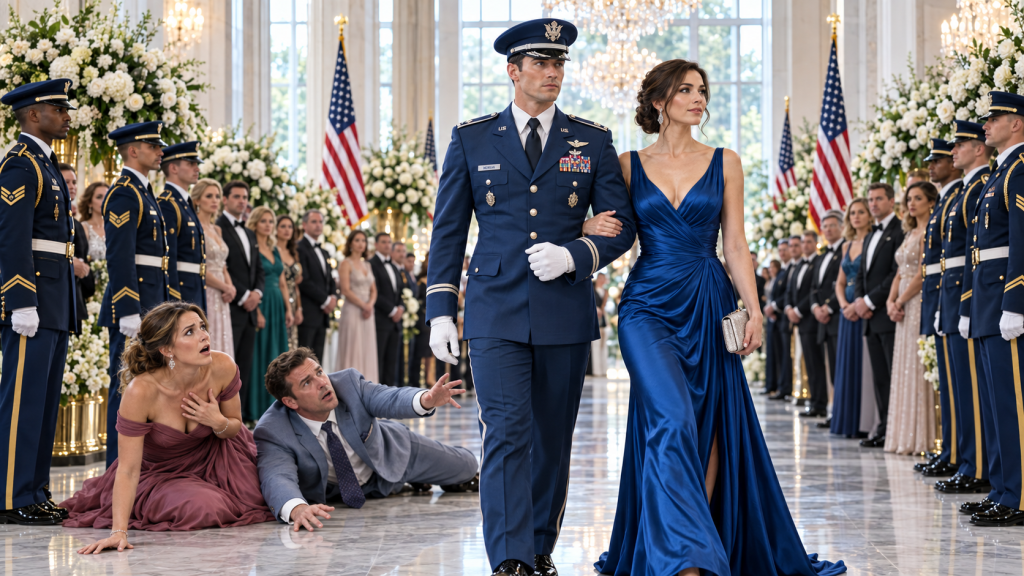
“I know.”
Dad’s smile tightened.
“I’ve followed your company for years.”
“I know that too.”
Lily came closer.
“Emma?”
I looked at her.
She stared at Alexander’s hand holding mine.
“Why is he here?”
I almost laughed.
“Because I asked him to come.”
“But why is he holding your hand?”
Alexander looked at me.
I answered.
“He’s my husband.”
Silence.
Real silence.
Then voices erupted everywhere.
Mom covered her mouth.
Lily stared.
Nathan’s eyebrows rose.
Dad looked as if someone had struck him.
Lily laughed nervously.
“You’re joking.”
“No.”
Alexander raised his left hand.
His wedding ring caught the light.
I reached beneath the neckline of my dress and pulled out a thin chain.
My wedding ring hung from it.
I wore it around my neck at family gatherings because I had been tired of inventing explanations.
Dad stared.
“You married Alexander Grant?”
“Yes.”
“When?”
“Three years ago.”
“And you told none of us?”
“No.”
“Why?”
I looked around the room.
“Do you really need me to answer that tonight?”
He looked embarrassed.
Then angry.
His default emotion whenever embarrassment threatened his pride.
“This is absurd. Families don’t hide marriages.”
“Families also don’t push daughters into fountains for entertainment.”
“That was an accident.”
Alexander spoke for the first time.
“The terrace cameras disagree.”
Dad’s face changed.
“What cameras?”
“The Rosemont records all common outdoor areas.”
Alexander’s voice remained calm.
“The general manager reviewed the footage before I came upstairs.”
Dad looked toward the manager.
The man nodded once.
Richard immediately began defending himself.
“It was a joke. Emma knows that.”
I said, “Stop telling people what I know.”
Dad looked at me.
“I would never intentionally hurt you.”
“You intentionally embarrassed me.”
“That is not the same thing.”
“No. It’s just the part you’re comfortable admitting.”
Lily stepped forward.
“Can we please not do this here? Everyone is watching.”
I looked at her.
“They were watching when I was in the fountain too.”
Her cheeks reddened.
“This is my wedding.”
“And I wanted it to be beautiful for you.”
“Then why are you making a scene?”
That sentence hit harder than I expected.
I stared at my sister.
“I’m making a scene?”
“You disappeared, changed clothes, and brought Alexander Grant into the middle of my reception.”
“I called my husband because our father pushed me into freezing water while you laughed.”
Lily looked away.
Nathan spoke quietly.
“Lily.”
She turned.
“What?”
“Maybe stop.”
Her eyes widened.
“You’re taking her side?”
“I’m saying she fell into a fountain and nobody helped her.”
For once, Lily had nothing to say.
Dad stepped forward.
“Emma, let’s discuss this privately.”
“No.”
“Please.”
“No. You humiliated me publicly. You don’t get privacy now because the truth embarrasses you.”
Several guests shifted uncomfortably.
Dad lowered his voice.
“I said I’m sorry.”
“No, you didn’t.”
His mouth tightened.
“Fine. I’m sorry you fell.”
I nodded slowly.
“That is exactly the kind of apology you have given me my entire life.”
“What do you want from me?”
“Nothing.”
That surprised him.
“I stopped wanting things from you a long time ago.”
Mom began crying.
“Emma.”
I looked at her.
“I love you, Mom. But loving you doesn’t mean pretending this family is healthy.”
Dad shook his head.
“Oh, now we’re unhealthy because of one joke?”
“No. We’re unhealthy because I can list thirty years of jokes and you’ll defend every one of them.”
He scoffed.
“You’ve always been dramatic.”
Alexander’s grip tightened around my hand.
I looked at him.
He understood what I wanted without asking.
I had spent years trying to win arguments with my father.
Not tonight.
Tonight, I wanted facts.
“Mr. Dawson,” I said to the hotel manager, “is the conference room available?”
“Yes, Mrs. Grant.”
Mrs. Grant.
My father visibly flinched.
Lily’s eyes widened again.
Dad looked between us.
“What is this?”
“There’s something else we need to discuss.”
“If this is about the wedding bill—”
“It isn’t.”
I turned toward him.
“It’s about Hale Architectural Supply.”
Dad’s expression changed immediately.
His company was his pride.
He had built it from a small regional supplier into a major contractor.
At least, that was how he told the story.
What he didn’t know was that Grant Hospitality had quietly become one of his company’s largest sources of revenue.
Several hotels.
Three office developments.
Two mixed-use projects.
Dad believed his sales team had won those contracts through aggressive bidding.
The truth was more complicated.
I had recommended Hale.
Three years earlier, after Alexander and I married, I had reviewed a construction proposal and noticed my father’s company could provide several materials Grant needed.
I said nothing about our relationship.
I only told Alexander the business had good employees and competitive logistics.
Hale received a small contract.
Then another.
Then larger agreements.
The company grew.
Dad bought a lake house.
A second luxury vehicle.
A membership at a private club.
He bragged constantly about his business instincts.
I never corrected him.
I didn’t want credit.
The employees benefited.
Their families benefited.
That was enough.
But six months earlier, something changed.
Grant’s audit department found discrepancies.
Invoices didn’t match delivery quantities.
Material costs were being inflated.
Certain subcontractor charges appeared twice.
At first, I assumed it was an accounting mistake.
I asked Alexander to allow Hale time to explain.
Then more irregularities appeared.
The audit expanded.
Seven weeks before Lily’s wedding, Grant’s compliance team concluded someone inside Hale’s executive office had approved the inflated billing.
Dad still didn’t know.
I had convinced the board to delay suspension until the investigation was complete.
Standing in the ballroom, I realized how absurd that was.
I had been protecting my father’s company while he made me his favorite target.
I looked at him.
“Grant Hospitality is suspending all new purchasing orders from Hale Architectural Supply tomorrow morning pending final audit.”
Dad’s face went white.
“What?”
“We found billing irregularities.”
“That’s impossible.”
“It isn’t.”
“You don’t know anything about my company.”
“I know exactly how much Grant pays your company every quarter.”
He stared.
“How?”
Alexander answered.
“Because Emma is the reason Hale became an approved supplier in the first place.”
Dad looked at me.
“No.”
“Yes.”
“You?”
“I recommended you.”
He looked almost offended.
“I won those contracts.”
“Your staff fulfilled them well. That’s why they expanded.”
His breathing became shallow.
“Why didn’t you tell me?”
“Because I knew you would turn my marriage into a business opportunity.”
“That’s insulting.”
“Is it?”
He looked at Alexander.
Then immediately shifted his tone.
“Mr. Grant, whatever accounting issue you found, I’m sure it can be resolved.”
Alexander said nothing.
Dad continued.
“I’ve worked with your company successfully for years.”
Alexander finally replied.
“You worked successfully because Emma repeatedly argued that your employees should not suffer for executive mistakes.”
Dad looked at me.
“What does that mean?”
“It means the audit found evidence the overbilling was approved above the accounting department.”
“That’s a lie.”
“Then the investigation will clear you.”
He stared.
“Are you doing this because of tonight?”
“No.”
“Of course you are.”
“The audit started seven weeks ago.”
That stopped him.
I continued.
“I asked them not to suspend you immediately.”
“Why?”
“Because more than two hundred people work for you, and none of them deserve to lose their jobs because I’m angry at my father.”
For the first time that evening, Dad looked ashamed.
Not enough.
But something.
Lily stepped between us.
“Please. Not tonight.”
I turned to her.
“You’re right.”
She exhaled.
“Thank you.”
“This isn’t the place for a business discussion.”
Her shoulders relaxed.
“So I’m leaving.”
Her relief vanished.
“Emma.”
“I hope you enjoy the rest of your wedding.”
“You can’t leave like this.”
“Yes, I can.”
“What will everyone say?”
There it was.
The sentence that explained our family better than anything else.
What will everyone say?
Not are you okay?
Not can we fix this?
Not I’m sorry.
I looked at her.
“For once, Lily, let them say whatever they want.”
Alexander and I started toward the exit.
Mom hurried after us.
“Emma.”
I stopped.
She stood in front of me, crying.
“I’m sorry.”
I waited.
She continued.
“I should have stopped him.”
“Yes.”
“I should have stopped him years ago.”
“Yes.”
She nodded.
“I don’t expect you to forgive me tonight.”
“Thank you.”
Her face crumpled.
“Do you hate me?”
“No.”
I took her hands.
“I love you. That’s what makes this harder.”
She hugged me.
I hugged her back.
When I pulled away, Dad stood several feet behind her.
He looked smaller than he had an hour earlier.
“Emma.”
I waited.
“Can I say something?”
“If you want.”
He glanced toward the guests.
Then at Alexander.
“If I had known…”
He stopped.
My stomach tightened.
“If you had known what?”
“That you were married.”
“To Alexander?”
“Yes.”
“You would have treated me differently?”
He realized too late where his sentence had led.
“That’s not what I meant.”
“It is.”
“No.”
“Yes, Dad.”
I stepped closer.
“You respected him before he walked through those doors because of his name, his money, and his company.”
Dad said nothing.
“You should have respected me because I was your daughter.”
His eyes dropped.
I turned away.
Alexander and I left.
Outside, the rain had stopped.
Our driver opened the car door.
I sat in the back seat beside Alexander.
For three blocks, I said nothing.
Then I started crying.
Not quietly.
Not gracefully.
I cried the way people cry when thirty years of swallowed pain finally finds an exit.
Alexander didn’t tell me to calm down.
He didn’t tell me everything would be okay.
He just held me.
After several minutes, I whispered, “I thought standing up to them would feel better.”
“It will.”
“When?”
“I don’t know.”
I laughed weakly.
“That’s a terrible answer.”
“I promised never to lie to you.”
He pulled a folded handkerchief from his pocket.
Despite myself, I laughed.
“You still carry those?”
“My grandfather taught me.”
“You’re forty going on eighty.”
“Eighty-year-old men are prepared.”
I wiped my face.
Then I leaned against him.
“I should have told them about you.”
“Why?”
“Maybe things would have been different.”
“They would have treated you differently because of me.”
I knew he was right.
“That’s what hurts.”
He kissed the top of my head.
“You never needed my name to be worthy of respect.”
“I know.”
“Do you?”
I looked at him.
“I’m learning.”
Alexander and I had met six years earlier during a winter storm.
At the time, I volunteered twice a month at a shelter downtown.
One freezing night, every bed filled.
An elderly veteran named George Mercer arrived after losing access to his temporary housing.
The shelter director called several hotels.
Nobody had space at the nonprofit rate.
I drove George to the nearest luxury hotel anyway.
I marched to the desk and asked for a room.
The manager explained there were procedures.
I argued.
A man standing nearby joined the conversation.
He was dressed casually.
I assumed he was another employee.
“We need identification for the room,” he said.
“This man served his country.”
“I understand.”
“He’s seventy-six years old and it’s below freezing.”
“I’m not refusing him.”
“You’re quoting policy.”
“We still need identification.”
I looked at him and said, “You sound like a heartless hotel prince.”
His eyebrows went up.
The manager nearly choked.
Ten minutes later, George was in the presidential suite.
The “hotel prince” paid personally.
The following morning, he donated enough money to expand the shelter’s winter program.
Only then did I discover he owned the hotel.
Two weeks later, Alexander asked me to dinner.
I said no.
He asked again.
I said no.
The third time, he arrived at the shelter in jeans at six in the morning and helped serve breakfast.
I said yes.
Two years later, we married.
George attended the ceremony.
My family didn’t.
The morning after Lily’s wedding, my phone contained eighty-seven missed calls.
Twenty-one were from Dad.
Twelve were from Lily.
The rest came from relatives and guests.
I turned it off.
Alexander and I spent the morning at home.
Around noon, Mom emailed me.
I am not asking you to forgive us. I only want you to know that I finally understand how many times I chose comfort over protecting you. I am sorry.
I read it three times.
Then I closed the laptop.
Monday morning, the Hale audit became official.
The findings were worse than expected.
The overbilling was systematic.
Dad had approved inflated invoices to cover cash shortages.
Those shortages existed partly because he had been taking excessive distributions from the business.
The lake house.
The cars.
Private club fees.
Expensive trips.
He had gambled that future contracts would cover current excess.
When cash tightened, the invoices grew.
Grant Hospitality could have terminated every agreement and sued immediately.
That would likely have destroyed Hale Architectural Supply.
I asked for one thing.
Protect the employees.
Alexander agreed.
Grant’s legal team negotiated a restructuring.
Dad was required to step down as chief executive.
An independent management company took control.
Several personal assets were sold to help reimburse disputed charges.
The employees kept their jobs.
Dad lost control of the company he had built.
For the first time in my life, I didn’t rescue him from the consequences.
For several weeks, he sent messages.
Some angry.
Some apologetic.
Some both.
One read:
You have destroyed everything I spent my life building.
I stared at it for a long time.
Then I replied:
No. Your choices did that. I only stopped protecting you from them.
He didn’t answer.
Lily was angry too.
At first, her messages focused entirely on the wedding.
Everyone left early because of you.
People are talking about Dad.
My wedding video is ruined.
You could have waited one day.
I didn’t respond.
Then, three weeks later, her tone changed.
Mom told me about the audit.
Then:
Nathan thinks Dad has treated you badly for years.
Then:
I watched one of the videos from the fountain.
Finally:
I didn’t realize how awful it looked until I saw myself laughing.
I still didn’t respond.
Two months passed.
Then she sent one more message.
Can I see you? I’m not going to yell. I need to apologize.
I agreed to meet at a small café.
Lily arrived alone.
No dramatic makeup.
No designer outfit.
Just jeans and a sweater.
For a minute, we sat in silence.
Then she said, “I watched every video.”
I stirred my coffee.
“There was more than one?”
“Seven that I found.”
“That’s wonderful.”
“I’m sorry.”
I looked at her.
She continued.
“I watched Dad push you.”
I said nothing.
“I watched you fall.”
Her eyes filled.
“And then I watched myself laugh.”
My throat tightened.
“I didn’t even think.”
“That was always the problem.”
“What do you mean?”
“Dad decided who the joke was. Everyone else followed.”
She looked down.
“I was horrible to you.”
“Sometimes.”
“A lot.”
“Yes.”
She gave a sad laugh.
“You could lie.”
“I spent thirty years doing that.”
“Fair.”
She wiped her eyes.
“I thought you hated me.”
“I resented you.”
“Why?”
“Because Dad used you to prove I wasn’t good enough.”
She nodded slowly.
“He did the opposite to me.”
I frowned.
“What?”
“He told me you were jealous of me.”
“I wasn’t.”
“I know that now.”
She looked out the window.
“When I was fifteen, he told me you hated that I was prettier.”
I stared at her.
“At eighteen, he told me you hated that I had more friends.”
“That isn’t true.”
“I know.”
Her voice broke.
“He made me feel like beating you meant I was winning.”
For years, I had viewed Lily only as my father’s favorite.
Now I saw something I had never considered.
He had shaped her too.
Different wounds.
Same source.
“You were a kid,” I said.
“So were you.”
That sentence changed something between us.
We didn’t repair everything that afternoon.
Real life doesn’t work that way.
There was no dramatic hug that erased decades.
But we began again.
Carefully.
Mom started therapy.
That surprised me more than anything.
One evening, she asked to meet.
She told me, “I spent thirty-five years calling silence peace.”
I listened.
“I thought keeping your father calm protected the family.”
“It protected him.”
“I know.”
She cried.
“And every time I asked you to be the bigger person, I was really asking the person who was hurt to make things easier for everyone else.”
For the first time, I felt understood by my mother.
Not defended.
Not explained.
Understood.
Dad changed more slowly.
For almost six months, I didn’t see him.
Then one Saturday afternoon, he appeared at the community center where I volunteered.
He wore jeans and a blue jacket.
No expensive watch.
No polished shoes.
He held a cardboard box.
“What are you doing here?”
He lifted the box.
“Books.”
The center had posted online asking for donations.
“You could have mailed them.”
“I know.”
“What do you want?”
“To talk.”
“I’m working.”
“I’ll wait.”
Old Richard would never have waited.
He sat in a plastic chair for forty-five minutes.
When my shift ended, I walked outside.
He followed.
We sat on a bench.
For several minutes, he stared at his hands.
Then he said, “I’m sorry.”
I waited.
He looked at me.
“I know that isn’t enough.”
“No.”
“I know I’ve said sorry before without changing anything.”
“Yes.”
“I’m trying not to do that again.”
That was new.
He inhaled slowly.
“I liked making people laugh.”
“I know.”
“I think I needed it.”
“That wasn’t my responsibility.”
“I know.”
He looked toward the parking lot.
“When I walked into a room and everyone laughed at my stories, I felt important.”
“So you used me as material.”
“Yes.”
Hearing him admit it hurt more than hearing him deny it.
“Why me?”
He looked at me.
“You challenged me.”
“I was your daughter.”
“You asked questions.”
“I was curious.”
“You noticed when I was wrong.”
“I didn’t know children were supposed to pretend their parents were perfect.”
A weak smile touched his face and disappeared.
“Lily admired me.”
“And I didn’t?”
“You loved me. But you didn’t worship me.”
The honesty stunned me.
“So you punished me.”
His eyes filled.
“Yes.”
I looked away.
“I hated you sometimes.”
“I know.”
“No, Dad. I don’t think you understand.”
I faced him.
“I used to sit in my car before family dinners and practice smiling.”
His face crumpled.
“I would choose clothes based on whether you might joke about my body.”
He closed his eyes.
“I stopped bringing boyfriends around because I knew you would embarrass me.”
“I’m sorry.”
“I got married without you because I didn’t trust you with the happiest day of my life.”
Tears rolled down his cheeks.
“I know.”
“You weren’t supposed to know. You were supposed to be there.”
“I know.”
For the first time, I watched my father cry because of something he had done rather than something that had happened to him.
“I lost that,” he whispered.
“Yes.”
“I deserved to.”
I didn’t comfort him.
That wasn’t my job.
After a while, he said, “I don’t expect you to forgive me.”
“Good.”
He almost smiled.
“You’re still difficult.”
I stared at him.
Panic crossed his face.
“That was a joke. A terrible one. I’m sorry.”
I started laughing.
Not because it was funny.
Because for once, he recognized the wound before defending the knife.
He laughed too.
“Still learning,” he said.
“Very slowly.”
“I’m old.”
“You’re sixty-four.”
“Ancient.”
“That joke I’ll allow.”
We talked for almost an hour.
I did not forgive him that day.
Forgiveness was not a button.
It was a process.
But something opened.
A year after Lily’s wedding, Alexander and I hosted Thanksgiving.
Only twelve people came.
Mom.
Dad.
Lily.
Nathan.
Alexander’s sister.
Two close friends.
George from the shelter.
A few others.
No ballroom.
No microphone.
No audience.
Just food.
During dessert, Dad stood.
Everyone froze.
He raised both hands.
“No microphone.”
Lily groaned.
“Dad.”
“I only want to say one thing.”
He looked at me.
A year earlier, that would have filled me with dread.
Now I waited.
“I spent most of my life believing that being the loudest man in the room made me the strongest.”
He paused.
“I was wrong.”
Mom reached for his hand.
He looked at me.
“The strongest person in our family was often the one saying the least.”
My throat tightened.
“And I mistook her patience for weakness.”
Nobody moved.
“I hurt my daughter for laughs.”
His voice shook.
“I taught other people that laughing at her was acceptable.”
He swallowed.
“I cannot undo that.”
He looked directly at me.
“But I can say publicly what I should have said publicly decades ago.”
His eyes filled.
“Emma, I am proud of you.”
No punchline came.
No insult followed.
Just those words.
I squeezed Alexander’s hand beneath the table.
“Thank you, Dad.”
He sat down.
That was enough.
Not complete forgiveness.
Not a magical ending.
Enough.
Later that night, Alexander and I stood on the porch.
Light snow was falling.
He wrapped a blanket around my shoulders.
“You okay?”
“Yes.”
“Really?”
I looked through the window.
Dad was helping Mom with dishes.
Lily and Nathan were laughing with George.
For once, nobody was competing.
Nobody was performing.
Nobody was the joke.
“Really.”
A few weeks later, Lily came over for coffee.
She noticed a black cocktail dress hanging near the laundry room.
“You kept that?”
I smiled.
“The dress from your wedding?”
“Yes.”
“Why?”
I touched the fabric.
“Because it reminds me of what happened after the fountain.”
She looked guilty.
“I still hate thinking about that night.”
“I don’t.”
She looked surprised.
“I hated it for a while.”
“And now?”
“Now I think it was the night I stopped waiting for you all to decide I mattered.”
She was quiet.
Then she asked, “Can I ask something?”
“Sure.”
“If Alexander weren’t rich, would you still have called him?”
I laughed softly.
“Of course.”
“I didn’t mean it badly.”
“I know.”
“Everyone remembers this powerful billionaire walking in and terrifying Dad.”
“That wasn’t the important part.”
“What was?”
I looked at her.
“I called Alexander because he was the only person I knew would see me soaked, embarrassed, crying, and never make me feel smaller for it.”
Lily nodded.
“That makes sense.”
“The money didn’t save me.”
“I know.”
“His name didn’t save me.”
She waited.
“I saved myself before he walked through those doors.”
“How?”
I thought about the fountain.
The freezing water.
The laughter.
Dad’s microphone.
My mother’s silence.
Lily smiling because everyone else was smiling.
Then I remembered my own voice.
Remember this moment.
“I finally believed I deserved better.”
That was the real turning point.
Not Alexander entering the ballroom.
Not the audit.
Not Dad losing control of his company.
Not Lily apologizing.
Not Mom going to therapy.
Not even Dad admitting what he had done.
The change happened while I was standing alone in that fountain.
For thirty-two years, I had waited for my father to respect me.
I waited for my mother to defend me.
I waited for my sister to understand me.
I thought that if I became successful enough, patient enough, kind enough, thin enough, quiet enough, useful enough, eventually they would treat me differently.
But respect that must be earned through suffering is not respect.
Love that requires silence is not healthy love.
And being related to someone does not give them unlimited permission to hurt you.
Family can make mistakes.
Family can say foolish things.
Family can hurt each other.
But when cruelty becomes a pattern and the injured person is always expected to forgive without change, that is not peace.
That is permission.
I had spent my life giving permission without realizing it.
The night of Lily’s wedding, I withdrew it.
I stopped being the easy target.
I stopped being the daughter who smiled through humiliation.
I stopped trying to prove that I was not jealous, difficult, oversensitive, or bitter.
I stopped defending myself against labels created by people who benefited from keeping me insecure.
And something extraordinary happened.
Once I stopped accepting the role they had assigned me, everyone else had to change their own role too.
Lily could no longer be the favored daughter competing against someone who refused to compete.
Mom could no longer call silence peace when I refused to stay silent.
Dad could no longer call cruelty humor when nobody agreed to be his punchline.
And I could finally be something much simpler.
Emma.
A wife.
A sister.
A daughter.
A friend.
A woman who knew exactly what she deserved.
My relationship with my family is not perfect now.
Dad still occasionally starts a joke and catches himself.
Mom still worries too much about everyone getting along.
Lily still loves attention.
I still need distance sometimes.
But the difference is that we talk about things.
When something hurts, I say so.
When someone crosses a line, I don’t smile and pretend.
And when I need to leave, I leave.
I no longer confuse boundaries with cruelty.
One afternoon, almost two years after the wedding, Dad and I walked past the Rosemont while attending a charity event nearby.
The fountain was visible through the gardens.
He stopped.
For a moment, neither of us spoke.
Then he said, “I hate that fountain.”
I smiled.
“I don’t.”
He looked at me.
“Why?”
“Because that’s where I stopped being afraid of disappointing you.”
His expression softened.
“I wish I had never pushed you.”
“I know.”
“I wish I could change it.”
“I know.”
“You really don’t hate that place?”
“No.”
I looked at the water sparkling in the afternoon sunlight.
“It reminds me that sometimes the worst moment of your life can become the moment you finally make a better decision.”
Dad nodded slowly.
Then he said, “I’m glad you called Alexander.”
I smiled.
“So am I.”
“He scared the life out of me.”
“I know.”
“I thought he was going to have me thrown out of the hotel.”
“He considered it.”
Dad looked horrified.
I laughed.
“That part was a joke.”
He stared at me.
Then he laughed too.
It was one of the first times humor between us felt safe.
That evening, Alexander asked what Dad and I had talked about.
“The fountain.”
He frowned.
“You okay?”
“Yes.”
I leaned against him.
“I think I finally understand something.”
“What?”
“For years I thought you rescued me that night.”
Alexander shook his head immediately.
“I didn’t.”
“I know.”
He smiled.
“You had already rescued yourself.”
“Yes.”
He kissed my forehead.
“Good.”
That was Alexander.
No speech.
No need to claim credit.
Just good.
Sometimes people who heard the story later focused on the dramatic details.
The billionaire husband.
The luxury wedding.
The secret marriage.
The audit.
The company.
The powerful entrance.
But those are not the parts I remember most.
I remember cold water.
I remember people laughing.
I remember my father’s expression when I stopped looking ashamed.
I remember changing into a black dress with shaking hands.
I remember telling my mother the truth.
I remember walking out of that ballroom without apologizing.
And I remember realizing something every person who has spent years being the family joke needs to hear.
You do not have to wait until everyone agrees that they hurt you before you are allowed to protect yourself.
You do not need unanimous approval to set a boundary.
You do not need the person who disrespected you to understand your pain before that pain becomes real.
You do not have to keep sacrificing your dignity just because someone shares your last name.
And sometimes, walking away is not abandoning your family.
Sometimes it is the first honest invitation you have ever given them to change.
My father eventually accepted that invitation.
My mother did too.
So did Lily.
But even if they had not, I would still have been okay.
Because my life no longer depended on their approval.
I had Alexander.
I had friends.
I had work I loved.
I had people who knew me without needing me to be smaller.
Most importantly, I had myself.
The version of me who climbed out of that fountain never went back in.
Not literally.
Not emotionally.
That woman finally understood that she could love her family without handing them control over her self-respect.
I used to believe strength meant enduring everything without reacting.
Now I know better.
Sometimes strength is saying, “Enough.”
Sometimes strength is walking away.
Sometimes strength is refusing to laugh when the joke is your own humiliation.
And sometimes strength is looking directly at the person who expects you to remain silent and saying, “Remember this moment.”
My father remembers.
So do I.
But now, when I remember that night, I do not see myself standing humiliated in freezing water.
I see myself climbing out.
And that has made all the difference.
💬THE END! THANK YOU FOR READING!