

Fifteen years after my dad threw me out, I saw him again at my sister’s wedding.
Dad sneered, “If it wasn’t for pity, no one would’ve invited you.”
I took a sip of wine and smiled.
Then the bride took the microphone, saluted me, and said, “To Major General Evelyn…”
The entire room turned toward me.
The first insult came before dinner.
My father found me beside the cocktail tables with a glass of Pinot Noir in my hand and fifteen years of silence standing between us.
Gerald Ulette looked older than I remembered, but no gentler.
The same silver hair.
The same expensive suit.
The same expression that said every room belonged to him if he stood in it long enough.
For most of my childhood, people described my father as commanding.
Successful.
Disciplined.
Traditional.
No one ever used the word controlling.
At least, not where he could hear them.
“I didn’t realize Clare’s guest list included charity cases,” he said.
Margaret, his second wife, appeared beside him in a red dress and pearls, smiling as if she had been waiting all evening to see whether my face would break.
I kept my voice steady.
“Hello, Dad.”
His eyes moved over my navy dress, paused at the silver earrings I had bought myself in Germany twelve years earlier, then drifted toward the ballroom where two hundred and fifty guests were drinking champagne beneath crystal chandeliers.
“If you embarrass this family tonight,” he said, “I’ll make sure Clare regrets inviting you.”
There it was.
The threat.
Smooth enough to pass as concern.
That was the thing about my father.
Money was never just money.
It was a leash.
Clare’s apartment.
Her car.
Half the wedding.
Her trust account.
Even the down payment he had promised for her first house.
Everything Gerald paid for became something he could tighten whenever he wanted control.
He could turn generosity into obedience before breakfast.
Fifteen years earlier, I had stood on the front porch of his house with one suitcase after telling him I was joining the Air Force instead of entering the family insurance business.
I still remembered the autumn wind cutting through my sweatshirt.
I remembered the porch light humming overhead.
I remembered Clare peering through the curtains upstairs.
I remembered my father standing in the doorway and telling me I had humiliated him.
“You made your choice,” he said.
I had been twenty-two.
Just graduated.
Terrified.
Excited.
And completely unprepared for the fact that disagreeing with my father could cost me my entire family.
I thought he would cool down.
He didn’t.
By the end of that week, the locks had been changed.
My health insurance was gone.
My phone plan had been canceled.
My bank access had disappeared.
The car he had given me for graduation was reported as belonging to the company and collected from my apartment.
Every photograph of me started disappearing from the house.
Clare was fifteen.
She called me from a friend’s phone because Gerald had checked her messages.
She cried so hard I could barely understand her.
“I’m sorry,” she kept saying.
“You didn’t do anything.”
“He says I’m not supposed to talk to you.”
I closed my eyes.
“Then don’t get yourself in trouble.”
“But you’re my sister.”
“I know.”
“I don’t want you to disappear.”
That sentence stayed with me longer than anything my father had said.
Because Gerald didn’t just kick me out.
He erased me.
At Christmas, my stocking was gone.
On family holiday cards, people were told I had “moved away.”
At reunions, relatives whispered that I was unstable.
Ungrateful.
Difficult.
One aunt told me years later that Gerald claimed I had abandoned everyone because I “couldn’t tolerate responsibility.”
It almost would have been funny if it hadn’t cost me so much.
I was the one who chose responsibility.
Just not his version of it.
My father wanted me in a corner office with Ulette Assurance Group stamped on the glass.
I wanted something else.
I wanted to fly.
I wanted to serve.
I wanted to know whether I could build a life that belonged to me rather than inherit one that came with invisible chains.
I had no idea where that decision would lead.
No idea that I would one day command people.
No idea I would spend nights staring at weather radar while lives depended on choices I made in seconds.
No idea I would become the kind of woman the twenty-two-year-old version of me desperately needed.
But on that porch, I was just a daughter hearing her father say, “If you walk away from this family, don’t ever expect to come back.”
I looked at him and said, “I’m not walking away from my family. I’m choosing my life.”
He closed the door.
Fifteen years later, Clare was the bride.
She had sent the invitation herself.
Handwritten.
No return address.
One line beneath the printed card made me drive three hours to Greenfield Country Club.
Please come. I need you there.
I almost didn’t.
I sat in my car outside the venue for thirteen minutes with both hands around the steering wheel.
I had faced emergency landings with less anxiety.
The country club was exactly the sort of place Gerald loved.
White columns.
Stone fountains.
Valet parking.
Manicured hedges cut into perfect geometric lines.
A place where everyone seemed to know which fork to use and how much not to say.
I had barely made it inside when Clare saw me.
She was standing near the bridal suite in her wedding dress with three bridesmaids around her.
The second our eyes met, her mouth opened.
Then she ran.
Actually ran.
In a Vera Wang gown.
Across polished marble.
One bridesmaid squealed because Clare nearly stepped on her own train.
She didn’t care.
She wrapped both arms around me so tightly the beading on her bodice pressed into my shoulder.
“You came.”
Her voice broke.
I hugged her back.
“Of course I came.”
She pulled away only enough to look at my face.
For a second, she was fifteen again.
The braces were gone.
The frightened eyes weren’t.
“Dad doesn’t know I sent it,” she whispered.
“Clare…”
“Margaret tried to stop it.”
I glanced down the corridor.
“Then maybe I should leave after the ceremony.”
“No.”
“Your wedding is not the place to start a war.”
“I’m not starting one.”
“Your father won’t see it that way.”
“My father sees disagreement as war.”
That stopped me.
Clare squeezed my hands.
“No matter what Dad says tonight, please stay.”
There was something different in her voice.
Something firm.
I knew that tone.
I had heard it in briefing rooms.
In command centers.
In the voices of people who had finally made a decision and accepted the consequences.
I looked into her eyes and saw resolve.
So I stayed.
Even when the welcome sign near the entrance read:
THE ULETTE FAMILY
ESTABLISHED 1988
That was the year I was born.
Yet the framed photographs beneath it showed Gerald, Margaret, Clare, family vacations, charity galas, graduations, ski trips, and holiday portraits.
Not one included me.
I stood there longer than I should have.
A teenage hostess walked over.
“Ma’am, can I help you find something?”
I smiled.
“No. I found it.”
My absence.
Perfectly curated.
Inside the ballroom, a place card waited for me at table twenty-two beside the kitchen doors.
It did not say Evelyn Ulette.
It said:
GUEST OF THE BRIDE.
For some reason, that hurt more than the sign.
Not because I needed the name.
I had built a career without it.
I had served under it without shame.
I had even learned to pronounce it on official introductions without hearing my father’s voice inside my head.
What hurt was realizing someone had intentionally removed it.
Later, I learned Margaret had personally changed my card.
At the time, I just sat down.
The people at my table were mostly distant cousins, vendors, and two older women from David’s church.
They were kind enough.
One introduced herself as Rosa and asked how I knew the bride.
“I’m her sister.”
Rosa blinked.
“You’re Evelyn?”
Before I could answer, Margaret appeared behind me.
“This is Gerald’s older daughter,” she said brightly.
The women smiled politely.
Margaret placed one hand on the back of my chair.
“She left the family years ago to do something with planes.”
“I’m in the Air Force,” I said.
Margaret tilted her head.
“Right.”
Then she smiled.
“Still just you and the uniform?”
The woman across from me looked uncomfortable.
I understood the question.
No husband.
No children.
No traditional markers Margaret could count.
“I’ve been busy.”
“With work?”
“With life.”
Margaret gave a tiny laugh.
“Well, Gerald always said you were independent.”
Independent.
In my father’s vocabulary, that word meant disobedient.
Margaret moved on.
She introduced me to three more people that evening using some variation of the same line.
“She left.”
“She went military.”
“She preferred that life.”
Every sentence was built to make my absence sound like abandonment.
I stopped correcting her.
Not because she was right.
Because I had learned years ago that some people do not misunderstand you.
They understand perfectly.
They just prefer the version that benefits them.
Dinner began at seven.
My father made sure his version of the family history reached the microphone before anyone else’s.
He stood near table one, lifted his Bordeaux, and spoke about loyalty.
About legacy.
About children who understood sacrifice.
About how a family succeeded when everyone remembered where they came from.
Then his gaze drifted toward table twenty-two.
Toward me.
Only for a second.
Long enough.
A few guests followed his eyes.
I took a sip of wine.
Fifteen years ago, that speech would have shattered me.
I would have gone to the restroom.
Locked myself in a stall.
Cried into a hand towel.
Then hated myself for still wanting the approval of a man who had made love conditional.
But I was not twenty-two anymore.
I had flown through sandstorms.
Landed in zero visibility.
Spent thirty hours awake during emergency evacuations.
Sat beside airmen who were afraid they had failed.
Called families after accidents.
Walked into rooms where everyone turned toward me because someone had to decide what happened next.
My father still believed I was the daughter who ran.
He had no idea how many people I had brought home.
After dinner, Margaret’s brother Richard found me.
Richard Hail.
My father’s business partner.
Thick-necked.
Expensive watch.
Voice always half a volume louder than necessary.
“Military, huh?” he said.
“Still.”
“What do you fly?”
“These days, mostly a desk.”
He laughed.
“Well, that happens.”
I smiled politely.
“I’ve flown several airframes.”
“Combat?”
“Yes.”
He looked surprised.
Then dismissive.
“Good for you. Somebody has to do it.”
He took a sip of scotch.
“I just prefer people who actually build something, not simply follow orders.”
The table went quiet.
Rosa lowered her fork.
A man beside her stared into his plate.
Then my father arrived.
As if the conversation had been rehearsed.
Soon the three of them stood around me.
Gerald on my left.
Margaret behind me.
Richard across from me.
A small tribunal dressed in formalwear.
Gerald leaned close enough for his cologne to crowd the air.
“You see all these people?”
“Yes.”
“Every one of them knows you’re the daughter who abandoned her family.”
I looked at him.
He smiled.
“You’re still searching for something you’ll never get.”
“What’s that?”
“My approval.”
There it was.
The old wound.
Named out loud.
Displayed between the wine glasses.
He expected something from me.
Tears.
Anger.
A raised voice.
Proof that underneath the medals and titles and years away, I was still his difficult daughter.
I gave him silence.
It unsettled him.
He straightened.
Raised his voice just enough for nearby tables to hear.
“If it wasn’t for pity, no one would have invited you.”
Silverware stopped.
A waiter froze with a bread basket in both hands.
Margaret touched Gerald’s arm.
Not to stop him.
To make the scene look civilized.
I lifted my wine glass.
Took one slow sip.
And smiled.
“Funny thing about pity,” I said quietly. “The people who offer it usually need it the most.”
My father stared at me.
For the first time in fifteen years, he had no answer.
Then a chair scraped across the ballroom.
Across the room, Clare rose from the head table.
David leaned toward her.
He whispered something.
She nodded.
Then he stood and helped gather her train.
The band softened.
Conversation faded.
Clare walked toward the microphone carrying a kraft paper envelope.
Her face was pale.
Her shoulders were square.
My father leaned back in his chair.
He seemed to expect a tribute.
Margaret smiled.
Richard finished his drink.
Clare reached the microphone.
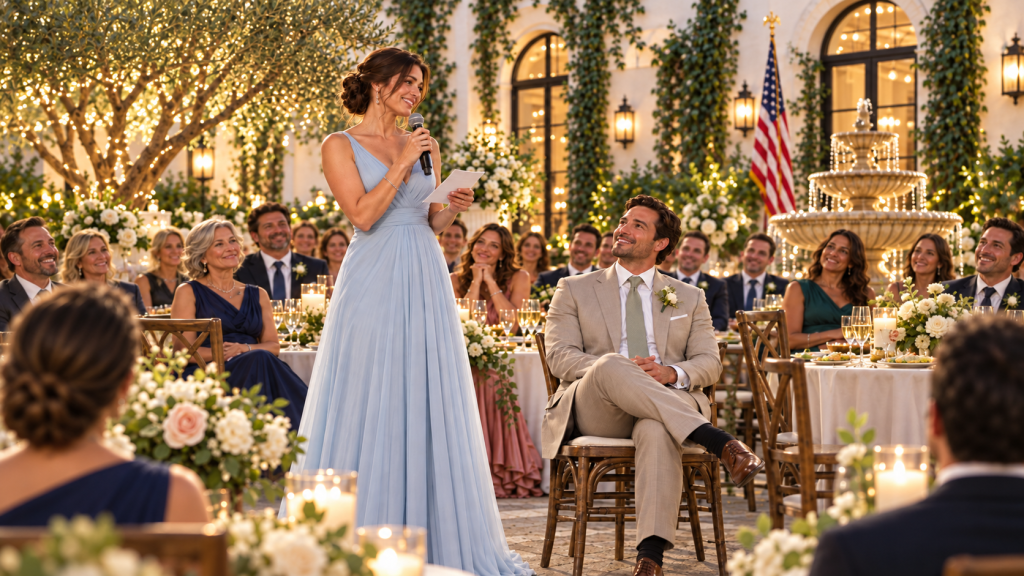
She adjusted it with one hand.
“I need to honor someone tonight.”
Her voice trembled slightly through the speakers.
“Someone this family tried to erase.”
A murmur rolled across the ballroom.
Gerald’s smile disappeared.
Clare lifted the envelope.
I recognized the seal immediately.
Department of the Air Force.
My fingers tightened around the stem of my wine glass.
Clare looked at me.
Then unfolded the paper.
“Fifteen years ago,” she began, “my sister left this family because she chose service over comfort.”
Gerald pushed his chair back slightly.
“Clare.”
She kept reading.
“We were told she was selfish.”
Silence.
“We were told she disappeared.”
My throat tightened.
“We were told she abandoned us.”
Now people were looking toward my father.
Clare’s voice steadied.
“None of that was true.”
Gerald stood.
“Clare, enough.”
David rose beside him.
He didn’t touch Gerald.
He simply stood between my father and the aisle.
Clare continued.
“My sister joined the United States Air Force at twenty-two years old. She served overseas. She flew rescue and transport missions. She led evacuation operations during disasters and combat deployments.”
Someone at table six whispered, “Wait.”
Clare looked directly at me.
“She became an officer.”
Another pause.
“A commander.”
My eyes burned.
“A brigadier general.”
Then Clare smiled.
“And this spring, she was confirmed for promotion to major general.”
The room changed.
I don’t know how else to describe it.
Not louder.
Still.
The way a room becomes still when everyone suddenly realizes the person they thought they understood is someone else entirely.
Clare folded the letter.
“Major General Evelyn Ulette has spent fifteen years doing exactly what our father said she would never do.”
Gerald’s face reddened.
Clare’s voice cracked.
“She built something.”
Richard stopped moving.
“She built a life.”
Margaret’s mouth tightened.
“She built a career.”
Clare looked at me.
“And more importantly, she built herself after this family tried to convince her she was nothing without us.”
I stared at my sister.
She raised her right hand.
Her fingers touched her brow.
The salute wasn’t technically necessary.
She wasn’t military.
It wasn’t formal.
But it was hers.
“To Major General Evelyn Ulette,” she said. “My sister. My hero. And the bravest person in this room.”
Then something happened I did not expect.
A man near table eight stood.
Then another.
Then a woman near the dance floor.
Then an older gentleman with gray hair and a cane.
Retired military.
Current service.
Veterans.
People Clare and David knew through work, church, friends, family.
One by one, they rose.
Some saluted.
Others simply stood.
David’s father raised his glass.
Rosa began clapping.
The applause spread.
I have stood in rooms where my name was announced before hundreds of people.
I have received decorations.
Promotions.
Commendations.
I have walked across stages while cameras flashed.
None of it felt like that.
Because those moments recognized what I had achieved.
Clare was recognizing what it had cost.
My father remained standing.
Not applauding.
Margaret sat rigidly beside him.
Richard looked as if someone had removed the floor beneath his chair.
I started to rise.
My legs felt strangely weak.
Clare lowered the microphone.
“I’m not finished.”
The applause faded.
She looked at our father.
“Dad, you told Evelyn that nobody here would have invited her without pity.”
Gerald’s jaw tightened.
“Do not do this.”
Clare reached into the envelope and removed a second document.
“This wedding is mine.”
“Clare.”
“And I invited her because she is my sister.”
She unfolded the second paper.
“And because I’m done letting you use money to decide who I’m allowed to love.”
My father laughed once.
It was sharp.
“You’re being emotional.”
“No.”
“You have no idea what you’re saying.”
“I know exactly what I’m saying.”
He stepped toward the stage.
David moved into the aisle.
“Gerald,” he said quietly, “stay where you are.”
That alone stunned the room.
Very few people spoke to my father like that.
Clare held up the document.
“This is confirmation from the bank that David and I closed on our own house yesterday.”
Gerald stopped.
Margaret blinked.
“You what?”
“We bought a house.”
My father stared.
“You have the condo.”
“The condo you own.”
“I gave it to you.”
“No. You let me live there.”
Clare’s voice remained calm.
“Every time I disagreed with you, you reminded me the lease was in your company’s name. Every time you wanted something, you mentioned the car payment. When I said I wanted Evelyn at my wedding, you threatened to cancel the venue deposit.”
Several heads turned.
Gerald looked around.
“Private family matters.”
Clare nodded.
“They were private until you humiliated my sister in front of two hundred and fifty people.”
Margaret stood.
“This is grotesque.”
Clare looked at her.
“You changed Evelyn’s place card.”
Margaret froze.
“You removed her name.”
“That is ridiculous.”
“The planner told me.”
A woman near the back of the ballroom looked down.
Clare continued.
“You also removed her from the family slideshow.”
Margaret’s cheeks flushed.
“I was protecting Gerald.”
“From what?”
No answer.
“Having two daughters?”
The silence that followed was brutal.
Gerald stepped forward.
“I paid for this wedding.”
Clare nodded.
“Some of it.”
“You wouldn’t be standing here without me.”
Clare looked toward David.
Then back at our father.
“Actually, that’s the other thing.”
She handed the microphone to David.
He took it.
“Three months ago,” he said, “Clare and I refinanced our plans.”
My father’s face hardened.
“We returned the unused portion of your wedding contribution this morning.”
Gerald stared at him.
David continued.
“The venue, catering, and remaining invoices are paid by us.”
“You can’t afford this.”
“We can.”
My father laughed.
“No, you can’t.”
David smiled faintly.
“We adjusted our honeymoon.”
Clare added, “And we would rather spend three days at a cabin we paid for ourselves than two weeks in Italy owned by your approval.”
A few people actually clapped.
My father turned toward me.
His eyes narrowed.
“You did this.”
I shook my head.
“I didn’t even know.”
“You poisoned her.”
“I haven’t spoken to Clare regularly in fifteen years because you made sure I couldn’t.”
“That was your choice.”
“No.”
My voice remained calm.
“That was yours.”
People were watching us now.
Not the general and the businessman.
A father and daughter.
Finally standing in the same room with nowhere for the story to hide.
Gerald pointed at me.
“You wanted to humiliate me.”
I looked around.
“At your daughter’s wedding?”
“You’ve always resented me.”
I almost laughed.
“Dad, I spent years resenting you.”
He seemed almost satisfied.
Then I continued.
“And then I got busy living.”
His expression changed.
“I stopped needing you to understand me a long time ago.”
“That’s not true.”
“It is.”
“You came here.”
“For Clare.”
“You wore the family name.”
“It’s my name too.”
His mouth opened.
Closed.
For once, there was no weapon available that I hadn’t already survived.
Then Richard spoke.
“Gerald, maybe we should go outside.”
My father snapped toward him.
“Stay out of it.”
Richard went silent.
Clare stepped down from the stage.
Her dress brushed across the floor as she walked straight toward me.
People shifted aside.
She stopped at my table.
“I’m sorry.”
I stood.
“For what?”
“For not finding you sooner.”
I looked at her face.
At the tears in her eyes.
“You were a kid.”
“So were you.”
That broke something open in me.
All those years, I had thought of myself as the adult.
Twenty-two.
Graduated.
Independent.
But Clare was right.
I had been young too.
Young enough to still believe parents could define your worth.
Young enough to confuse punishment with truth.
Young enough to carry shame that never belonged to me.
I put my arms around my sister.
She buried her face against my shoulder.
The ballroom disappeared.
There was only the girl at the upstairs window.
And the woman in the wedding dress.
“I missed you,” she whispered.
“I missed you too.”
“I’m sorry.”
“Stop apologizing.”
“You promise?”
“I promise.”
The applause started again.
Softly this time.
Not for rank.
Not for spectacle.
For us.
My father walked out before dessert.
Margaret followed.
Richard hesitated for a moment, then went after them.
The doors closed.
I expected the atmosphere to collapse.
Instead, the room exhaled.
Music returned.
People started talking.
Someone brought me another glass of wine.
David’s mother hugged me.
Rosa squeezed my hand.
A retired colonel introduced himself and told me he had heard my name years earlier during a humanitarian evacuation operation.
A young airman stationed nearby asked whether I really remembered every person under my command.
“I try.”
“Why?”
“Because they remember whether you remember them.”
He nodded like he was storing the sentence.
For the first time that evening, I relaxed.
Then something unexpected happened.
The DJ called for the bride’s family dance.
Clare stood in the center of the dance floor.
Her father was gone.
David touched her elbow.
“You okay?”
She nodded.
Then she looked at me.
“Dance with me.”
I laughed.
“I don’t think that’s how this works.”
“It is tonight.”
She held out her hand.
I stared at it.
Then took it.
The song was one we both knew.
A song our mother used to play on Sunday mornings before she died.
Clare was eleven when we lost her.
I was eighteen.
Gerald remarried less than two years later.
Our mother became another subject we were not supposed to discuss.
As the first notes filled the ballroom, Clare’s face crumpled.
“Oh no.”
“What?”
“I forgot this song was on the list.”
I smiled.
“No, you didn’t.”
She laughed through tears.
“No.”
We moved awkwardly.
Neither of us could dance properly.
Her train kept getting under my shoes.
At one point she nearly knocked into a waiter.
We laughed until both of us cried.
People formed a circle.
David eventually joined us.
Then his parents.
Then half the bridal party.
It turned into something less formal and more honest than anything else that night.
For the first time, the Ulette family looked nothing like the portrait my father had curated.
And I loved it.
Near midnight, Clare and I slipped outside.
The country club terrace overlooked a dark golf course.
Small lights lined the stone railing.
Inside, music shook the windows.
Clare had removed her shoes.
She sat on the edge of a bench with her gown pooled around her.
“I thought I was going to throw up when I took the microphone.”
“You looked calm.”
“I was dying.”
“That’s the secret.”
“What?”
“Everyone is terrified. Some people just keep moving.”
She smiled.
“Is that general advice?”
“Mostly sister advice.”
For a while, neither of us spoke.
Then she looked toward the lawn.
“Dad told me you never contacted me.”
I went still.
“He said you didn’t want to.”
I turned toward her.
“What?”
“He said you could have called anytime.”
I let out a slow breath.
“I called.”
Her face changed.
“For years.”
“How often?”
“Every birthday at first.”
Clare stared.
“I never got anything.”
“Christmas too.”
She looked away.
“I sent letters.”
She covered her mouth.
“I sent you a card when you graduated high school.”
Nothing.
“When you finished college.”
Nothing.
“When Mom’s sister told me you got engaged.”
Clare began crying.
“I thought you hated me.”
I moved closer.
“I never hated you.”
“He told me you said I chose him.”
“No.”
“He said you wanted nothing to do with anyone connected to the family.”
“That’s not true.”
Her shoulders shook.
I put an arm around her.
For a long moment, she said nothing.
Then she whispered, “He stole fifteen years.”
That sentence hurt because it was true.
But not completely.
I looked toward the ballroom.
“No.”
She frowned.
“He tried.”
“What’s the difference?”
“The difference is we’re here.”
She looked at me.
“He doesn’t get the next fifteen.”
Clare wiped her face.
“No.”
“He doesn’t get tomorrow either unless you want him there.”
She nodded.
“I don’t.”
The next morning, my father called me.
I watched his name appear on my phone while sitting in the hotel lobby with coffee.
For fifteen years, he had never called.
Not once.
I let it ring.
Then it rang again.
And again.
On the fourth call, I answered.
“Hello?”
“You humiliated me.”
No greeting.
No question.
Just accusation.
I looked through the window at the parking lot.
“No.”
“Don’t play games.”
“You humiliated yourself.”
His breathing sharpened.
“That little stunt cost me.”
There it was.
Not Clare.
Not us.
Not fifteen years.
Cost.
“What did it cost you?”
“Richard is reconsidering the merger structure.”
I almost smiled.
So that was why Richard had looked shaken.
Apparently, insulting a major general in front of several government contractors and military veterans had made some people question Gerald’s judgment.
I had no intention of interfering with his business.
I didn’t need to.
Consequences do not always require revenge.
Sometimes people simply watch you long enough.
“You’re calling me because Richard is upset?”
“I’m calling because you need to correct the impression Clare created.”
“What impression?”
“That I somehow prevented you from succeeding.”
I stared at my coffee.
“I don’t think anyone left with that impression.”
Silence.
Then:
“You always were smug.”
I laughed softly.
“No, Dad.”
“What?”
“I was scared of you.”
He said nothing.
“For years.”
“You had no reason to be.”
“I was twenty-two when you cut off my insurance, took my car, changed the locks, blocked me from my sister, and told relatives I abandoned you.”
“You chose against the family.”
“I chose a career.”
“You chose me last.”
“That’s not what happened.”
“It is to me.”
And there it was.
The truth underneath everything.
To Gerald, love was ranking.
Agreement meant loyalty.
Independence meant rejection.
A child becoming separate felt like betrayal.
I could finally see the machinery.
For years, I had thought there must have been something wrong with me to make him react so violently.
There wasn’t.
He simply could not tolerate a daughter he could not control.
“I’m not going to correct anything,” I said.
“You owe me.”
“No.”
His voice hardened.
“I’m still your father.”
“Yes.”
That surprised him.
I continued.
“And you are responsible for what you did as my father.”
“Watch your tone.”
I almost smiled.
“I’m forty years old, Dad.”
He went quiet.
“You don’t get to order me anymore.”
“You think those stars make you important?”
“No.”
“Then what?”
“They remind me that trust has to be earned every day.”
Silence.
“I wish you had taught me that.”
He hung up.
I sat there for several minutes.
My hands did not shake.
That surprised me.
For years, I had imagined conversations with my father.
In some, he apologized.
In others, I screamed.
In a few, I said something so brilliant and devastating he finally understood everything.
Reality was smaller.
He blamed.
I answered.
He hung up.
And the world kept moving.
Clare came down twenty minutes later wearing sweatpants beneath a white bridal jacket.
She sat beside me.
“Was that him?”
“Yes.”
“What did he want?”
“Control.”
She nodded.
“Did he get it?”
“No.”
“Good.”
She stole half my coffee.
I looked at her.
“You have your own.”
“Yours tastes better.”
“You’re still annoying.”
“You missed me.”
“I did.”
She smiled.
“So, what now?”
It was the right question.
Not what about Dad.
Not what about Margaret.
Not what do we do with the past.
What now?
We started small.
Breakfast.
Phone numbers.
A shared photo album.
Weekly calls.
Clare visited me on base months later.
I showed her the aircraft.
The operations center.
The office where people apparently expected a major general to own something more decorative than three coffee mugs and a plant that was barely alive.
She laughed at the plant for five full minutes.
“This is what national defense depends on?”
“Apparently.”
I attended Thanksgiving at her house.
Not Gerald’s house.
Hers.
David cooked the turkey badly.
We ordered pizza at nine.
It was one of the best holidays of my life.
My father did not speak to me for nearly a year.
Then he sent a letter.
Actual paper.
No apology.
Not exactly.
He wrote that perhaps “mistakes were made.”
Passive voice.
The refuge of people still afraid of responsibility.
I read it twice.
Then put it in a drawer.
I did not respond.
Six months later, another letter arrived.
This one was shorter.
“I was angry when you left. I believed if I made returning difficult, you would come back sooner. When you didn’t, I doubled down. By the time I realized I had gone too far, admitting it felt impossible.”
I sat with that sentence.
Not because it excused him.
It didn’t.
But because it was the closest he had ever come to telling the truth.
There was one more line.
“I do not know how to be your father now.”
I wrote back.
For the first time in sixteen years.
“You don’t have to know. You only have to stop trying to own the relationship.”
I signed it:
Evelyn.
Not daughter.
Not Major General.
Just me.
Our reconciliation, if that is what you want to call it, was not dramatic.
There was no tearful reunion.
No embrace in an airport.
No movie ending.
We met for coffee eight months later.
Neutral territory.
A small café halfway between our cities.
He arrived early.
Of course he did.
He looked smaller without a boardroom or ballroom around him.
Older too.
He stood when I approached.
“Evelyn.”
“Dad.”
Neither of us hugged.
We sat.
For ten minutes, we discussed weather.
Then coffee.
Then Clare.
Finally, he looked at his hands.
“I watched your promotion ceremony online.”
I said nothing.
“I didn’t know.”
“I know.”
“I should have.”
“Yes.”
He nodded.
That was new.
No argument.
No excuse.
“I was proud.”
The old version of me might have lived on that sentence for years.
The current version simply received it.
“Thank you.”
His eyes lifted.
“I suppose that doesn’t mean much.”
“It means something.”
“Not enough.”
“No.”
He nodded again.
Then he said the words I had stopped waiting for years earlier.
“I’m sorry.”
I did not rescue him from the discomfort.
I let the silence remain.
He swallowed.
“I’m sorry for throwing you out.”
Another pause.
“For cutting you off.”
His voice dropped.
“For keeping Clare from you.”
My eyes burned.
“That was the worst one.”
“I know.”
“No. I don’t think you do.”
He looked at me.
“You didn’t just punish me. You punished her.”
His face tightened.
“I know that now.”
“Good.”
We sat quietly.
Finally, he said, “Can you forgive me?”
I thought carefully.
“I can stop carrying anger.”
His face shifted.
“But?”
“That is not the same as pretending it didn’t happen.”
“I understand.”
“I don’t trust you yet.”
He looked down.
“I understand.”
“You don’t get access just because you apologized.”
“I know.”
That mattered.
Maybe more than the apology.
Because for the first time, he accepted a boundary without punishing me for having one.
We finished our coffee.
When we stood, he hesitated.
Then held out his hand.
I looked at it.
And hugged him.
Briefly.
Not because everything was fixed.
Because I wanted to.
When I stepped back, his eyes were wet.
He looked embarrassed.
I pretended not to notice.
Some dignity should be given freely.
The years after that were not perfect.
People do not transform because of one wedding.
Gerald still slipped into old habits.
He offered Clare money with strings attached.
She declined.
He tried to criticize David’s career.
David changed the subject.
He once told me I was “too rigid” about boundaries.
I reminded him boundaries had kept us speaking.
He grumbled.
Then apologized.
Margaret never did.
She remained cold.
Eventually, she and Gerald divorced.
Richard left the business partnership two years after Clare’s wedding.
Ulette Assurance survived.
Smaller.
Quieter.
Less powerful.
My father retired.
Clare had a daughter.
She named her Elise after our mother.
The first time I held that baby, Clare stood beside the hospital bed and said, “She is never going to wonder whether love can be taken away because she disagrees with us.”
I looked down at my niece.
“No.”
“She’s never going to earn belonging.”
“No.”
“She just gets it.”
I smiled.
“That’s how it’s supposed to work.”
Years later, when I retired from the Air Force, there was a ceremony.
Nothing extravagant.
Flags.
Speeches.
Old colleagues.
Friends.
People from different chapters of my life.
Clare sat in the front row with David and Elise.
My father sat beside them.
He walked with a cane by then.
His hair was almost completely white.
After the ceremony, Clare found me.
She handed me a glass of wine.
Pinot Noir.
I laughed.
“Seriously?”
“You know what this is.”
“I do.”
She raised her glass.
“To the charity case.”
I nearly choked.
My father, standing nearby, actually laughed.
Then Clare grew serious.
“To my sister.”
David lifted his drink.
“To Evelyn.”
My father looked at me.
There was a long pause.
Then he raised his glass too.
“To the woman who built her own life.”
I met his eyes.
For once, there was no demand behind the words.
No ownership.
No attempt to claim credit.
Just recognition.
I lifted my glass.
And smiled.
Because fifteen years earlier, my father had stood on a porch and told me that choosing myself meant losing my family.
For a long time, I believed him.
But he was wrong.
I had not lost my family by leaving.
I had learned who was willing to love me without controlling me.
I had learned that blood can connect people, but it cannot force respect.
That forgiveness does not require surrender.
That success is not revenge.
That sometimes the strongest answer to someone who wants to shrink you is simply to keep growing.
I had spent years thinking the most important moment of my life was the day my father threw me out.
It wasn’t.
It was the day I finally understood that the door closing behind me had not been the end of my family.
It had been the beginning of my freedom.
And years later, when my sister stood beneath a chandelier in a wedding dress, raised her hand in a salute, and told a room full of people exactly who I was, I realized something else.
I had never needed my father’s permission to belong.
I had never needed his money to have value.
I had never needed his approval to become someone worth respecting.
I just needed enough courage to walk through the first door that opened after he closed his.
And once I did, there was an entire sky waiting on the other side.
💬THE END! THANK YOU FOR READING!