

I married a stranger from a hospital waiting room so he wouldn’t die alone — after our one-week marriage, his lawyer handed me his backpack, saying, “He wanted you to know the truth.”
I was twenty-nine and still trying to find my way through the grief of losing my mother.
People like to describe grief as something you move through.
A tunnel.
A storm.
A season.
Something with an ending.
Mine didn’t feel like that.
It felt like waking up every morning in the same house, only someone had quietly removed one of the walls during the night.
Everything was technically still there.
My bed.
My coffee cup.
My job.
My phone.
My bills.
My routines.
But nothing felt protected anymore.
Nothing felt permanent.
My mother, Evelyn, had died eleven months earlier after a sudden stroke.
She was sixty-three.
Healthy enough that none of us had ever discussed death seriously.
Healthy enough that I still had unopened birthday gifts for her in my closet when it happened.
Healthy enough that the Friday before she died, she called me at work just to remind me to take an umbrella because rain was coming.
I remember rolling my eyes.
“Mom, I’m twenty-nine.”
“And twenty-nine-year-olds don’t get wet?”
“I own an umbrella.”
“You also lose umbrellas.”
“That happened once.”
“Three times.”
“Twice.”
“Sarah.”
“Fine. I’ll bring the umbrella.”
That was the last normal conversation we ever had.
The next morning, my aunt Joanne called.
My mother had collapsed in her kitchen.
By the time I reached the hospital, she was unconscious.
Doctors used careful words.
Swelling.
Bleeding.
Damage.
Uncertain recovery.
Possible complications.
Then, after two days, the language changed.
Severe.
Irreversible.
Comfort.
Family decision.
I held her hand when she died.
Her hand was warm.
That detail stayed with me longer than anything else.
Warm.
She was still warm when the monitor went silent.
Afterward, everyone seemed to expect grief to follow an understandable schedule.
The funeral happened.
Relatives flew home.
Flowers wilted.
People stopped bringing casseroles.
My coworkers stopped asking how I was doing every day.
The world became normal again.
Except mine hadn’t.
I couldn’t stand the silence in my apartment.
I couldn’t sit on my couch without imagining her calling.
I couldn’t walk past the grocery store bakery without remembering the ridiculous lemon cake she bought every year even though nobody except her liked it.
So I started volunteering at St. Matthew’s Medical Center.
At first, I signed up because I needed somewhere to be on Saturday mornings.
Anywhere except home.
I helped at the information desk.
Delivered flowers.
Walked elderly visitors to elevators.
Carried blankets.
Collected abandoned wheelchairs.
Then one evening, a nurse named Denise found me sitting alone in the volunteer lounge.
She was in her fifties, blunt, warm, and impossible to lie to.
“You hate the front desk,” she said.
I looked up.
“I do not.”
“You alphabetized the pen cup.”
“It was bothering me.”
“You need people.”
“I work with people.”
“You point them toward radiology.”
“That still counts.”
Denise sat across from me.
“There’s a volunteer companion program.”
I frowned.
“What does that mean?”
“Some patients don’t have family nearby. Some don’t have family at all. Volunteers sit with them.”
“For how long?”
“As long as needed.”
“Doing what?”
“Talking. Reading. Listening. Sometimes nothing.”
I knew what she wasn’t saying.
“Are they dying?”
“Sometimes.”
The answer hit me strangely.
I looked toward the hallway.
“Why would anyone volunteer for that?”
Denise shrugged.
“Why did you?”
I didn’t answer.
Because I knew.
Three days later, I joined.
The first patient I sat with was an eighty-one-year-old woman named Margaret who had spent forty-seven years teaching fourth grade.
She complained about hospital pudding for an hour and then asked me to read Psalms until she fell asleep.
Another was a former bus driver named Raymond who insisted I memorize the names of all six of his grandchildren even though none of them lived nearby.
One man barely spoke.
One woman asked me to paint her nails.
Another asked me to tell her stories about my mother.
That surprised me.
I had expected being around death to make my grief worse.
Instead, it gave the pain somewhere to go.
I could not save these people.
I could not change what was happening.
But I could sit beside them.
I could make sure somebody heard the last joke they ever told.
I could hold a cup of water.
I could straighten a blanket.
I could make a room feel less empty.
That became enough.
Then I met Thomas.
He was seventy-two.
Thin.
Gray-haired.
Sharp-eyed.
And dying from advanced heart failure.
The first time I saw him, he was sitting in a wheelchair near the large window at the end of the cardiac floor.
A green backpack rested between his feet.
Rain streaked the glass behind him.
I was carrying three crossword books and a plastic cup of coffee when he said, “If you’re going to pretend you aren’t lost, stop looking at the room numbers.”
I turned.
He was watching me.
“I’m not lost.”
“Then you’re worried.”
“Excuse me?”
“You’ve checked that coffee lid four times.”
I glanced down.
I had.
“That doesn’t mean I’m worried.”
“It means either that or you’ve been traumatized by hot beverages.”
Despite myself, I laughed.
He smiled.
It was a tired smile.
But genuine.
“You’re Thomas?”
“That depends. Are you from billing?”
“No.”
“Then yes.”
I walked over.
“My name is Sarah. I’m a volunteer companion.”
He looked at the blue vest I was wearing.
“I gathered that.”
“Denise said you might want company.”
“Denise says many things.”
“She also said you’re difficult.”
“That’s defamatory.”
“So you don’t want company?”
He looked toward the rain again.
“I didn’t say that.”
I sat.
We talked for forty minutes.
Mostly about nothing.
The weather.
Hospital food.
Whether crossword puzzles were secretly designed to humiliate people over fifty.
He asked what I did for work.
I told him I worked in accounts payable for a shipping company.
“That sounds thrilling.”
“It isn’t.”
“Good. I worried you might be lying.”
I asked what he had done before retirement.
“Business.”
“What kind?”
“Several kinds.”
“That’s vague.”
“It’s meant to be.”
I raised an eyebrow.
He raised one back.
That became the rhythm between us.
I returned the next afternoon.
Then the next.
By the fourth day, I knew Thomas hated weak coffee, hospital television, lavender soap, and anyone who used the phrase “everything happens for a reason.”
“That one particularly annoys me,” he said.
“Why?”
“Because sometimes things happen because somebody was careless, selfish, frightened, cruel, unlucky, or simply human.”
He shifted against his pillow.
“Reason is often something we invent afterward so we can sleep.”
I looked at him.
“That’s cheerful.”
“I’m dying. I’ve earned the right to be unpleasantly philosophical.”
I smiled.
“You seem unusually calm about dying.”
“I’m not calm.”
“You look calm.”
“That isn’t the same thing.”
He turned toward the window.
“I’m afraid of pain.”
He paused.
“And I’m afraid of being forgotten before I’m even gone.”
That sentence stayed with me.
Thomas had no visitors.
No children.
No wife.
No siblings.
At least none he mentioned.
Whenever hospital staff asked about next of kin, he said, “None living.”
Once, I asked if there was anyone he wanted me to call.
He shook his head.
“Everyone I loved is either dead or better off without me.”
“That sounds dramatic.”
“It probably is.”
“Do you believe it?”
His face changed.
“Yes.”
He refused to explain further.
On my fifth visit, I brought him coffee from a café across the street.
He took one sip and nearly coughed.
“Sarah.”
“What?”
“This could dissolve metal.”
“You said hospital coffee was weak.”
“There are options between weak and industrial solvent.”
“Drink it.”
He drank it.
By the sixth day, his condition worsened.
He could no longer walk without help.
The doctors moved him into a private room.
That afternoon, rain tapped softly against the window.
Thomas had been unusually quiet.
I sat beside him reading a mystery novel aloud.
Halfway through a chapter, he reached for my hand.
“Sarah.”
I stopped reading.
“Yes?”
“Marry me.”
For several seconds, I thought I had misunderstood.
“What?”
“Marry me.”
I stared at him.
“Thomas.”
“Yes?”
“You’re very sick.”
“I’ve noticed.”
“This isn’t funny.”
“I’m not joking.”
My heart started pounding.
“We barely know each other.”
“We know more than many people know before they marry.”
“That is absolutely not true.”
“It was worth trying.”
I pulled my hand back.
“Why would you ask me that?”
His expression became serious.
“I don’t want the hospital making every final decision because there is nobody listed as family.”
“You can sign documents.”
“I have.”
“Then you don’t need a wife.”
“No.”
That answer surprised me.
“At least you admit it.”
Thomas looked down.
“I don’t want to die as a nameless file.”
“You aren’t nameless.”
“That isn’t what I mean.”
He took a slow breath.
“I’ve spent most of my adult life alone.”
“By choice?”
“Eventually.”
His fingers tightened around the blanket.
“I thought I deserved it.”
There it was again.
That strange shadow in everything he said.
I leaned closer.
“Thomas, what did you do?”
He looked at me for a long moment.
Then shook his head.
“Not today.”
“That’s not reassuring.”
“I know.”
“Then why should I marry you?”
“Because when you walk into this room, I stop feeling like I’ve already disappeared.”
My throat tightened.
He continued quietly.
“I’m not asking you to pretend this is some great romance.”
“Good.”
“I’m asking for seven days.”
“You don’t know you have seven days.”
“No.”
“Could be seven weeks.”
He smiled faintly.
“That would make this awkward.”
I laughed despite myself.
Then immediately felt guilty for laughing.
Thomas squeezed my hand.
“I want my last days to belong to something other than illness.”
I went home that night and stared at my ceiling until three in the morning.
I made lists.
Reasons not to do it.
Legal complications.
Emotional manipulation.
Impulsiveness.
Grief.
Possible regret.
Then I wrote one reason to do it.
No one should die believing they mattered to nobody.
The next morning, I returned.
Thomas was asleep.
I sat beside him until he woke.
“I have conditions.”
His eyes opened slowly.
“Good morning to you too.”
“No money.”
He blinked.
“What?”
“If you have money, property, insurance, investments, anything—I don’t want it.”
“Sarah—”
“I mean it.”
“You don’t even know if I have money.”
“Exactly.”
He studied me.
“I already have an attorney.”
“Then call him.”
Thomas sighed.
“You’re serious.”
“Yes.”
“All right.”
“And if you change your mind at any point, we stop.”
“I won’t.”
“You don’t know that.”
“I do.”
“And no lying to me.”
The moment I said it, something flickered across his face.
So fast I almost missed it.
“Thomas?”
“I understand.”
I should have pressed him.
I didn’t.
Two days later, a hospital chaplain married us.
Denise was my witness.
An orderly named Marcus stood beside Thomas.
I wore a yellow sweater because my mother used to say yellow made people look braver than they felt.
Thomas wore a clean white shirt beneath his hospital gown.
There were no flowers.
No music.
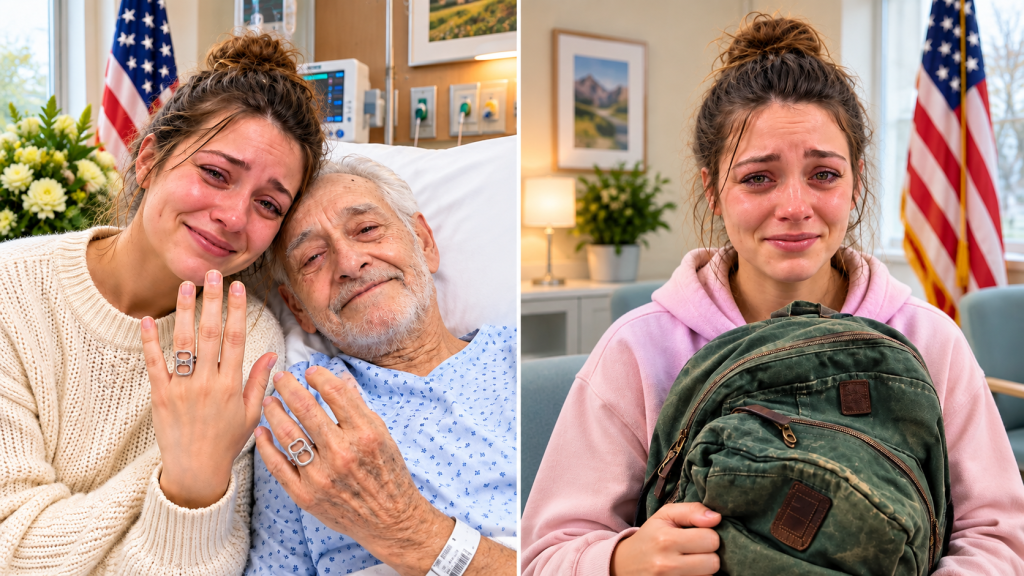
No rings.
When the chaplain asked whether we wanted to exchange rings, Thomas looked around the room.
Then his eyes landed on an unopened soda can.
“Marcus.”
Marcus looked confused.
“Yes?”
“Hand me that.”
Thomas pulled the metal tab from the top.
He held it between two fingers.
Denise started laughing.
“You cannot be serious.”
“It’s stainless-looking.”
“It’s aluminum.”
“Even better.”
He slipped the tab onto my finger.
It was too large.
I curled my hand so it wouldn’t fall.
“There,” he whispered. “Now it’s respectable.”
I laughed.
Then I cried.
Thomas looked startled.
“Did I do something wrong?”
“No.”
“Are you sure?”
“Yes.”
I wiped my face.
“You’re ridiculous.”
“That sounds dangerously affectionate, wife.”
“Don’t get used to it.”
He grinned.
For the next seven days, I barely left the hospital.
I took emergency leave from work.
I slept in the reclining chair beside his bed.
I read novels aloud.
I argued with him about old films.
I smuggled in decent soup.
He complained about everything.
The pillows.
The lighting.
My taste in music.
My coffee.
Especially my coffee.
On the third night of our marriage, he woke from a nightmare.
He grabbed my wrist.
“Don’t leave.”
“I’m not leaving.”
“Promise.”
“I promise.”
His breathing slowly settled.
In the morning, he pretended it hadn’t happened.
I let him.
On the fourth day, Thomas asked about my mother.
I had mentioned her before, but never in detail.
“What was she like?” he asked.
I smiled.
“Stubborn.”
“That sounds genetic.”
“She was generous.”
“Also genetic.”
“Stop interrupting.”
“Continue.”
I told him about her terrible lemon cake.
Her habit of sending birthday cards three weeks early.
Her love of crossword puzzles.
Her inability to throw away reusable containers.
Her belief that every problem could be improved by feeding someone.
Thomas listened with unusual intensity.
At one point, his eyes filled with tears.
“Are you okay?”
He turned his face away.
“Just tired.”
I believed him.
On the fifth day, he gave me the green backpack.
“Put this somewhere safe.”
I lifted it.
It was heavier than I expected.
“What is in here?”
“My sins.”
I looked at him.
He smiled.
I assumed it was a joke.
I put the backpack in the cabinet.
That evening, I noticed Thomas staring at it.
“Do you want something from the bag?”
“No.”
“You sure?”
“Yes.”
He looked at me.
“Sarah?”
“What?”
“If you discovered something terrible about someone after they died, would you hate them forever?”
The question unsettled me.
“That depends.”
“On what?”
“What they did.”
“Suppose they were sorry.”
“That doesn’t undo it.”
“No.”
“Suppose they tried to make up for it.”
“Still doesn’t undo it.”
He nodded.
“What if they became a better person?”
I thought about my mother.
She used to say that an apology mattered most when nobody was watching what you did afterward.
“I guess becoming better matters.”
“Enough?”
“Enough for what?”
“Forgiveness.”
I looked at him.
“Thomas, what are you trying to tell me?”
He closed his eyes.
“That I am a coward.”
“About what?”
But he refused to answer.
The next morning, his doctors told me his heart was failing quickly.
His kidneys were worsening.
His blood pressure was dropping.
They spoke gently.
Hours, perhaps a day.
Thomas seemed to understand before I said anything.
He looked at my face.
“That bad?”
I sat beside him.
“Yes.”
He nodded.
“Well.”
“That’s all you have to say?”
“I’ve used most of my dramatic lines already.”
I cried.
He reached for my hand.
The soda tab was still around my finger.
“You kept it.”
“Of course.”
“It’s ugly.”
“It’s my wedding ring.”
His mouth trembled.
“I’m sorry.”
“For the ring?”
“For more than that.”
I leaned closer.
“Tell me.”
He looked toward the green backpack.
Then back at me.
“I should have told you sooner.”
“Told me what?”
But exhaustion overtook him.
He slept for several hours.
That night, the room became very quiet.
The nurses dimmed the lights.
Machines hummed softly.
I sat beside Thomas with my hand around his.
Shortly before midnight, he opened his eyes.
“Sarah.”
“I’m here.”
“Your mother would be proud of you.”
Everything inside me stopped.
“What?”
He swallowed.
“Evelyn would be proud.”
My blood went cold.
I had never told him my mother’s first name.
Not once.
“Thomas.”
His eyes closed.
“How do you know my mother’s name?”
His breathing slowed.
“Thomas?”
I pressed the call button.
A nurse hurried in.
Thomas squeezed my hand one last time.
Then his grip relaxed.
One breath.
Then another.
Then silence.
He died seven days after we married.
I sat beside him long after the nurse left.
I kept staring at his face.
Then at the backpack.
Then at the soda tab on my finger.
His final words repeated in my head.
Evelyn would be proud.
I told myself there had to be an explanation.
Maybe Denise had mentioned my mother.
Maybe Thomas overheard something.
Maybe I had said her name without remembering.
Grief does strange things to memory.
That was what I told myself.
Then the door opened.
An elderly man in a navy suit stepped inside.
He was tall, slightly stooped, with silver hair and a leather briefcase.
He carried Thomas’s green backpack.
“Sarah?”
“Yes.”
“My name is Harold Hale.”
He extended his hand.
“I’m your husband’s attorney.”
The word husband sounded strange.
Too formal.
Too permanent.
“He asked me to meet you after his death.”
Mr. Hale placed the backpack on the chair.
“He left this for you.”
I looked at it.
“He gave it to me yesterday.”
“Yes. Then he asked a nurse to give it to me this morning.”
“Why?”
“So I could make sure you received it after he died.”
My stomach tightened.
Mr. Hale studied me carefully.
Then lowered his voice.
“Thomas wasn’t who you thought he was, Sarah.”
I went cold.
“What does that mean?”
“He wanted you to know the truth.”
For several seconds, neither of us spoke.
Then I sat.
“Did he hurt someone?”
Mr. Hale’s face changed.
“In a way.”
“Did he commit a crime?”
“Yes.”
My heart started pounding.
“What kind of crime?”
“Open the backpack.”
I didn’t want to.
But I did.
Inside were folded clothes.
A wallet.
Two old notebooks.
Several envelopes.
A bundle of letters tied with blue string.
A brass key taped to a white envelope.
A cassette tape.
And a yellowed newspaper clipping.
I pulled out the clipping first.
The photograph showed four people standing outside a brick building.
One of them was Thomas.
Much younger.
Maybe thirty-five.
Beside him stood a woman in her twenties.
I knew that face.
I had seen it in old photographs.
Same dark eyes.
Same smile.
Same tiny scar near her eyebrow.
My mother.
I stopped breathing.
“No.”
Mr. Hale said nothing.
I looked at the date.
Thirty-eight years earlier.
The headline read:
LOCAL CHARITY DIRECTORS INVESTIGATED OVER MISSING FUNDS.
Thomas’s name appeared beneath the photograph.
But not Thomas Reed.
Thomas Whitmore.
I looked at the lawyer.
“Who was he?”
“His legal name was Thomas Andrew Whitmore.”
“Why did he tell me Reed?”
“His mother’s maiden name.”
“What does my mother have to do with this?”
Mr. Hale pointed toward the envelope with my name.
I opened it.
Thomas’s handwriting was shaky.
Sarah,
If you are reading this, then I am gone.
I wish I had been brave enough to tell you while I was alive.
I was not.
That failure belongs to me.
You deserve the truth.
I knew who you were before you knew me.
I stopped reading.
My hands went numb.
“He knew?”
Mr. Hale nodded.
“When?”
“The first time you introduced yourself.”
“How?”
“Your last name. Your face. He had seen photographs of your mother.”
I looked back at the letter.
Your mother, Evelyn Carter, worked for me when she was twenty-five.
I was thirty-four.
I founded the Whitmore Community Foundation.
We raised money for families facing medical emergencies.
In the beginning, everything was legitimate.
Then I made a series of financial mistakes.
I borrowed money from restricted accounts.
I moved funds to cover debts.
I falsified records.
I told myself I would repay everything before anyone discovered what I had done.
I did not.
Your mother found the discrepancies.
She confronted me.
She told me to tell the board.
I refused.
Instead, when the investigation began, I let suspicion fall on her.
I stopped reading.
The room seemed to narrow.
“What does that mean?”
Mr. Hale removed his glasses.
“Your mother signed several transfer documents because Thomas instructed her to.”
“So?”
“When investigators reviewed the records, those signatures made her look responsible.”
“No.”
“She wasn’t.”
“No.”
“Sarah—”
“My mother was not a thief.”
“I know.”
I stood.
“My mother was not a criminal.”
“She wasn’t.”
“Did he accuse her?”
“Not directly.”
I stared at him.
“What does that mean?”
“He stayed silent while others did.”
My stomach turned.
I picked up the letter again.
I never testified that Evelyn stole the money.
I did something worse.
I knew she had not.
And I said nothing while everyone assumed she had.
She lost her job.
She lost friends.
She left the city.
A man she planned to marry left her.
I protected myself.
She paid the price.
My vision blurred.
I remembered things from childhood.
Mom refusing to explain why she had moved away from Cleveland.
Mom once turning off a television report about a charity scandal.
Mom keeping old papers in a locked drawer.
Mom telling me, “Your name is yours. Never let anyone make you ashamed of it.”
I had never understood where that came from.
I kept reading.
Years later, an accountant found records proving the financial transfers had been authorized by me.
Your mother was publicly cleared.
By then, most people had moved on.
That is the cruelty of public suspicion.
The accusation travels faster than the correction.
I paid restitution.
The foundation closed.
I faced civil penalties.
I was never imprisoned.
That does not mean I was innocent.
It means the law and justice did not arrive together.
I dropped the letter.
“You knew all this?”
Mr. Hale nodded.
“For decades.”
“And you were his lawyer?”
“I became his lawyer after the investigation.”
“Did you defend him?”
“No.”
“Did you know my mother?”
“Only by reputation.”
I laughed bitterly.
“Apparently everybody knew my mother except me.”
Mr. Hale looked pained.
“I’m sorry.”
“Don’t.”
I turned toward the window.
I felt angry at Thomas.
Angry at my mother.
Angry at everyone who had kept this from me.
Then another thought came.
“He used me.”
Mr. Hale said nothing.
“He knew exactly who I was and let me sit beside him.”
“Yes.”
“He let me care about him.”
“Yes.”
“He asked me to marry him.”
“Yes.”
“Was that part of some plan?”
“No.”
“How do you know?”
“Because he called me the night before he proposed.”
“What did he say?”
Mr. Hale hesitated.
“He said, ‘Harold, I’ve done something unbelievably selfish.’”
Despite myself, I almost laughed.
“And what did you say?”
“I told him that narrowed nothing down.”
I looked away.
Mr. Hale continued.
“He told me he wanted to ask you to marry him.”
“And you told him that was fine?”
“I told him it was a terrible idea.”
“Good.”
“He agreed.”
“Then he did it anyway.”
“Yes.”
“Why?”
“He said he was afraid to die alone.”
“That’s not enough.”
“No.”
I looked back at the letter.
It continued.
Sarah,
I did not ask you to marry me because of Evelyn.
I need you to believe that.
By the time I realized who you were, I had already met you twice.
I considered asking the hospital to send someone else.
I should have.
But I wanted to know you.
That was selfish.
You laughed like her.
You tilt your head the same way when you think someone is lying.
You make terrible coffee.
Your mother also made terrible coffee.
Tears sprang to my eyes.
I hated him for making me laugh.
I wiped my face.
He continued.
I told myself I was only curious.
Then I realized I looked forward to seeing you.
Not because you were Evelyn’s daughter.
Because you were Sarah.
You listened without pity.
You argued with me.
You did not treat me like a dying man.
You treated me like a difficult one.
That was a gift.
When I asked you to marry me, I was afraid.
I wanted to belong to someone when I died.
That is the truth.
But there was another truth.
Part of me wanted, for one week, to belong to the family I had once harmed.
That was selfish too.
If you hate me, you have every right.
I sank into the chair.
“His estate.”
Mr. Hale looked at me.
“What?”
“How much money did he have?”
He was quiet for a moment.
“Approximately fourteen million dollars.”
I laughed.
It came out sharp.
“Of course.”
“Sarah—”
“I told him no money.”
“He knew.”
“I made him promise.”
“He did not leave the estate to you.”
I froze.
“He didn’t?”
“No.”
Relief hit me so suddenly I almost cried again.
“Where does it go?”
“Three nonprofit organizations. Legal aid. Medical debt relief. Whistleblower protection.”
I looked at the backpack.
“So what did he leave me?”
“The backpack.”
“And the key?”
“A safe-deposit box.”
“I don’t want it.”
Mr. Hale smiled sadly.
“Thomas predicted those exact words.”
“Of course he did.”
“He asked me to tell you that the box contains no money.”
“Then what?”
“Answers.”
I went home and placed the backpack on my kitchen table.
For three days, I didn’t touch it.
Every time I walked past, I felt betrayed all over again.
Memories changed when I looked at them.
His questions about my mother.
His tears.
The way he watched my face.
The way he asked about forgiveness.
Everything seemed manipulated now.
I felt stupid.
Stupid for caring.
Stupid for marrying him.
Stupid for keeping the ridiculous soda tab.
On the third night, I took the tab off.
I put it in a drawer.
Then I cried for an hour.
The next morning, I called my aunt Joanne.
She answered on the second ring.
“Sarah?”
“Did Mom ever work for a man named Thomas Whitmore?”
Silence.
That was all I needed.
“You knew.”
“Sarah—”
“You knew.”
“Yes.”
I closed my eyes.
“How long?”
“Since it happened.”
“Why didn’t you tell me?”
“Your mother asked me not to.”
“Why?”
“Because she didn’t want that story becoming yours.”
I laughed.
“Well, that worked.”
My aunt sighed.
“What happened?”
“I married him.”
Silence again.
Then very softly:
“Oh, Sarah.”
“You knew he was alive?”
“Yes.”
“You knew where he was?”
“No.”
“He said you talked to him.”
Another silence.
My anger sharpened.
“Joanne.”
“He called me.”
“When?”
“Five days before he died.”
I stood.
“He called you?”
“Yes.”
“And you didn’t call me?”
“He asked whether he should tell you.”
“What did you say?”
“I told him yes.”
“Then why didn’t he?”
“He was afraid you would leave.”
I gripped the phone.
“So he chose himself.”
“Yes.”
The directness stopped me.
She continued.
“He was a coward, Sarah.”
“Then why do you sound like you feel sorry for him?”
“Because people can be cowardly and still be sorry.”
“That doesn’t fix anything.”
“No.”
“He hurt Mom.”
“Yes.”
“He ruined her life.”
“For a while.”
“For a while?”
“She rebuilt.”
“That doesn’t excuse him.”
“I didn’t say it did.”
I sat back down.
My aunt’s voice softened.
“Your mother eventually stopped letting Thomas Whitmore be the most important thing that had ever happened to her.”
“What happened?”
“She left Cleveland. Started over. Met your father. Had you.”
I swallowed.
“Did Dad know?”
“Yes.”
“Everybody knew.”
“Not everybody.”
“Everyone who mattered.”
“No, Sarah.”
Her voice became firmer.
“You mattered most. That is why she didn’t tell you.”
That hurt more.
“Why?”
“Because when you were born, she made a decision. She said, ‘My daughter will not grow up carrying anger she didn’t choose.’”
I started crying.
Aunt Joanne waited.
After a while, I asked, “Did Mom forgive him?”
“I don’t know.”
“He said she wrote to him.”
“She did.”
“What did she say?”
“She told him that apologies were useless unless they changed how he lived.”
I looked toward the backpack.
“That sounds like her.”
“Yes.”
“Did she ever see him again?”
“No.”
“Did she hate him?”
“At first.”
“And later?”
Aunt Joanne took a long breath.
“Later, she stopped talking about hate.”
Two days later, I called Mr. Hale.
“I’ll open the box.”
We met at a bank downtown.
The safe-deposit box was smaller than I expected.
Inside were no jewels.
No cash.
No property deeds.
Only papers.
Photographs.
A cassette tape.
And a portable cassette player.
I stared at it.
“A cassette?”
Mr. Hale shrugged.
“Thomas distrusted smartphones.”
“He had a smartphone.”
“He distrusted his smartphone.”
Despite everything, I smiled.
Then I saw the envelope.
FOR SARAH — AFTER SHE KNOWS.
Inside was a letter.
Not from Thomas.
From my mother.
I recognized her handwriting instantly.
My hands started shaking.
The letter was twenty-six years old.
Thomas,
I received your apology.
I believe you are sorry.
I also believe sorry is a word people use too easily when they want relief from guilt.
I am not responsible for giving you that relief.
What you did changed my life.
For a long time, I hated you.
Then Sarah was born.
Everything changed.
I realized I could either spend the rest of my life looking backward or raise my daughter without teaching her that bitterness was something she had inherited.
So I will tell you this once.
Do not contact me again.
Do not send money.
Do not ask me to forgive you.
If you are truly sorry, spend the rest of your life becoming someone who would never make the same choice again.
If you can do that, then perhaps something useful can grow from something ugly.
Evelyn.
I pressed the letter against my mouth.
My mother’s voice seemed to fill the room.
Not literally.
But I could hear her anyway.
Her practical tone.
Her refusal to dramatize pain.
Her belief that people revealed themselves through actions more than words.
I sat there crying.
Mr. Hale quietly stepped outside.
When I could breathe again, I put the cassette into the player.
Thomas’s voice crackled from the speaker.
“Sarah, if this machine still works, then Harold has probably complained about it at least twice.”
I laughed through tears.
Thomas paused.
“I thought about making a video, but I decided nobody needs to see me dying in high definition.”
Another small laugh escaped me.
Then his voice changed.
“You know what I did.”
Silence.
“I spent thirty-eight years wishing I had been brave for ten minutes.”
I leaned forward.
“That is all it would have taken.
“Ten minutes.
“Ten minutes to tell the truth.
“Ten minutes to say Evelyn did what I told her to do.
“Ten minutes to accept the consequences.
“Instead, I protected myself.
“She carried the shame.
“That was my worst act.
“Not moving the money.
“Not falsifying the records.
“The worst thing I did was knowing an innocent person was being blamed and choosing silence.”
I closed my eyes.
“Your mother was stronger than I was.
“She told me not to contact her again.
“I obeyed.
“But she also told me what to do with my guilt.
“She told me to change.”
Thomas explained what happened after the foundation collapsed.
He spent years working small jobs.
Then started a medical supply business.
It failed.
He started another.
That failed too.
A third survived.
Eventually, he sold it for millions.
Instead of building a public charity under his name, he began funding organizations anonymously.
Legal aid for whistleblowers.
Medical debt relief.
Emergency housing.
Financial fraud victims.
Scholarships.
“Do not confuse this with repayment,” Thomas said.
“It wasn’t.
“You cannot repay thirty-eight years to the twenty-five-year-old woman who lost her reputation.
“You cannot send money backward through time.
“I did those things because Evelyn told me remorse should be useful.
“I tried to make mine useful.”
The tape hissed.
Then he continued.
“When you walked into my room, I recognized your surname.
“Then I recognized your eyes.
“I nearly asked the nurse to send you away.”
I listened.
“Then you gave me coffee.”
I laughed.
“It tasted like something they use to strip paint.”
I covered my face.
“And suddenly I remembered Evelyn complaining that everyone else made coffee too weak.”
Thomas coughed on the recording.
“You were like her.
“And you were nothing like her.
“That mattered.
“I had spent decades thinking of Evelyn as someone I harmed.
“You made me remember she was also funny.
“Stubborn.
“Impatient.
“Alive.
“You gave me back a version of her that guilt had flattened.”
I wiped my eyes.
“Then I did another selfish thing.
“I let you keep coming.”
My chest tightened.
“I should have told you.
“I know that.
“Every day I almost did.
“Then every day I became more afraid.”
He paused.
“That does not excuse me.
“Fear explains many bad choices.
“It excuses very few.”
I thought about his proposal.
His hand.
His face.
“I did not ask you to marry me because I thought it would fix anything.
“I knew it could not.
“I asked because I was dying and afraid.
“I asked because you made me feel less alone.
“And, yes, because some selfish part of me wanted to belong, briefly, to the family I had once harmed.”
His voice cracked.
“If you hate me for that, I understand.”
The recording went quiet for several seconds.
Then:
“But please do not hate yourself for saying yes.”
I stopped breathing.
“You were kind to me before you knew what I had done.
“That kindness belongs to you.
“Do not turn it into stupidity simply because I was flawed.”
Tears rolled down my face.
“Kindness is not foolish just because the person receiving it is imperfect.”
I whispered, “You weren’t just imperfect.”
As if he had expected the argument, his recorded voice continued.
“And before you argue with me through the cassette player, yes, I know ‘imperfect’ is inadequate.”
I laughed.
Actually laughed.
Then cried harder.
“You gave me seven good days.
“They were not absolution.
“They were not forgiveness.
“They were not payment.
“They were simply seven good days.
“I had not expected even one.”
The recording ended with one final sentence.
“Thank you for looking at me like I was still here.”
The tape clicked.
I sat in the bank room for almost an hour.
When Mr. Hale came back, I asked, “Did he ever forgive himself?”
“No.”
“That seems sad.”
“Yes.”
“Do you think he should have?”
Mr. Hale considered it.
“I think Thomas eventually stopped asking that question.”
“What did he ask instead?”
“What can I do next?”
That answer stayed with me.
Before we left, Mr. Hale showed me one more document.
A list.
Hundreds of names.
Dates.
Amounts.
Anonymous donations.
A woman who needed legal help after being falsely accused of stealing from her employer.
A family whose child needed surgery.
A man who lost his home after exposing fraud.
A teenager whose mother died.
College tuition.
Hospital bills.
Rent.
Legal fees.
Burial expenses.
At the bottom, Thomas had written:
None of this erases Evelyn.
Do not let anyone say it does.
That sentence mattered most.
Because redemption stories are often told badly.
Someone does something terrible.
Then they become generous.
Then everyone acts as though kindness cancels harm.
It doesn’t.
Thomas hurt my mother.
His later good deeds did not unhurt her.
My mother rebuilt her life.
That did not make what happened acceptable.
Both facts had to remain true.
For months, I carried both.
Anger and affection.
Betrayal and grief.
Sometimes I missed Thomas.
Then I felt guilty for missing him.
Sometimes I hated him.
Then I remembered him half-asleep asking whether the hospital pudding was legally classified as food.
Nothing stayed simple.
I stopped volunteering for six weeks.
Every hallway reminded me of him.
Denise called once.
Then twice.
On the third call, I answered.
“You alive?” she asked.
“Yes.”
“You sound unconvinced.”
“I’m fine.”
“Liar.”
I sighed.
“I don’t know if I can go back.”
“That’s okay.”
“I thought you were going to argue.”
“No.”
Silence.
Then she said, “But you know where we are.”
Three weeks later, I returned.
The first patient I sat with was a sixty-nine-year-old retired mechanic named Frank.
He barely spoke.
For two hours, we watched baseball.
Near the end, he said, “My son isn’t coming.”
I looked at him.
“Do you want to talk about it?”
“No.”
So we kept watching baseball.
That was enough.
After my shift, I stood in the hospital lobby.
For the first time, I understood something.
I had not started volunteering because I wanted to save people.
I had started because death had made me feel powerless.
Thomas had not changed that.
People still died.
Truth still came too late.
Forgiveness remained incomplete.
But showing up mattered anyway.
Three months after Thomas died, Mr. Hale called.
“There’s something you should see.”
We met at a legal aid office downtown.
Near the entrance was a brass plaque.
I stopped.
THE EVELYN CARTER JUSTICE FUND.
My mother’s name.
I touched the letters.
“What is this?”
“Thomas established it twelve years ago.”
I looked at Mr. Hale.
“He named something after her?”
“Privately.”
“Why privately?”
“He asked Evelyn’s permission.”
My heart stopped.
“She knew?”
Mr. Hale handed me a letter.
It was from my mother.
Four years earlier.
Thomas,
Joanne tells me your fund helped a young woman keep her job after she was falsely accused of theft.
Perhaps you finally understand.
You may use my name.
But make sure they remember the people being helped, not the person paying.
Evelyn.
I stared at it.
“She was still talking to him?”
“Not directly. Your aunt occasionally passed information between them.”
I called Joanne that night.
“You knew about the fund.”
“Yes.”
“Why didn’t Mom tell me?”
“She didn’t think you needed to carry it.”
“That seems to be her answer to everything.”
My aunt laughed softly.
“She was protective.”
“Did she forgive him?”
Joanne was silent for a long time.
Then she said, “I think eventually she stopped needing to decide.”
I didn’t understand at first.
She explained.
“Forgiveness is not always a courtroom verdict. Sometimes it is just the point where the wound no longer gets to organize your life.”
I wrote that down.
A year passed.
Then two.
I kept volunteering.
Eventually, I left my shipping job and became the coordinator of the hospital’s companion program.
It paid less.
I was happier.
I trained volunteers.
I taught them not to force conversation.
Not to promise everything would be okay.
Not to say “everything happens for a reason.”
That one became a rule.
Whenever someone asked why, I said, “Trust me.”
The soda tab stayed in a drawer for almost a year.
One morning, I took it out.
I cleaned it.
Then threaded it onto a chain.
I started wearing it around my neck.
Not every day.
But often.
Denise noticed.
“You put the ring back on.”
“Sort of.”
“You forgive him?”
I thought about it.
“No.”
She looked surprised.
“No?”
“Not exactly.”
“Then why wear it?”
“Because forgiveness isn’t the only reason to remember someone.”
She nodded.
“That sounds annoyingly wise.”
“I’ve been practicing.”
Years passed.
The Evelyn Carter Justice Fund grew.
Thomas’s estate increased its endowment after his death.
The organization helped hundreds of people.
One was a twenty-three-year-old woman named Maya.
She had worked for a nonprofit and discovered her supervisor was diverting grant money.
She reported it.
Then found herself accused of theft.
When I heard the story, I felt physically ill.
It was too close.
The fund paid her legal expenses.
The records eventually cleared her.
She kept her career.
At a ceremony, Maya approached me.
“Are you Sarah?”
“Yes.”
She glanced toward the photograph of my mother near the podium.
“That’s your mom?”
“Yes.”
“She must have been incredible.”
“She was.”
Maya smiled.
“I almost gave up.”
My throat tightened.
“I thought everyone believed them.”
I looked at my mother’s photograph.
Then at the room full of people whose lives had been changed by a fund created from one man’s remorse and one woman’s refusal to let bitterness become her legacy.
I said, “I’m glad you didn’t give up.”
After the ceremony, I visited my mother’s grave.
I sat in the grass.
For years, I had avoided telling the full story out loud.
That day, I did.
“Mom,” I said, “I married Thomas Whitmore.”
It sounded ridiculous.
I laughed.
Then cried.
“It lasted seven days.”
I told her everything.
The hospital.
The proposal.
The yellow sweater.
The soda tab.
The backpack.
The letters.
The cassette.
The anger.
The fund.
When I finished, I stared at her headstone.
“I hope I didn’t betray you.”
That was the fear beneath everything.
Not money.
Not scandal.
Loyalty.
Had loving Thomas, even briefly, dishonored my mother?
Then I remembered something she told me when I was sixteen.
My best friend had betrayed a secret.
I came home furious.
“I’ll never forgive her,” I said.
Mom was washing dishes.
She didn’t turn around.
“Forgiveness isn’t permission, Sarah.”
“She hurt me.”
“I know.”
“So why forgive?”
“Because sometimes forgiveness is simply deciding the person who hurt you doesn’t get to keep choosing how you feel.”
I had forgotten that until Thomas.
I touched the soda tab around my neck.
“I think I understand now.”
The wind moved through the trees.
Before leaving, I placed another soda tab beside Mom’s headstone.
Not Thomas’s.
Just one from a can I had saved.
It looked ridiculous against the polished stone.
She would have laughed.
Years later, people still asked me about the marriage.
Hospital staff told new volunteers the story.
Sometimes badly.
“This is Sarah. She married a stranger who was dying.”
I always corrected them.
“He wasn’t a stranger when he died.”
That mattered.
Thomas entered my life as a stranger.
Then he became a patient.
A friend.
A husband for seven days.
A betrayal.
A connection to my mother.
A lesson I didn’t ask for.
A person I loved imperfectly.
A person I remained angry with.
A reminder that human beings rarely fit into one clean category.
Good.
Bad.
Victim.
Villain.
Coward.
Redeemed.
Thomas had been cowardly.
He had also changed.
My mother had been hurt.
She had also healed.
I had been deceived.
I had also been given something real.
None of those truths canceled the others.
For a long time, I wanted a simple answer.
Was Thomas a good man who once did something terrible?
Or a bad man who spent decades trying to look good?
Eventually, I stopped asking.
The question was too small.
He was a man who made a cowardly choice.
Then another.
Then many better ones.
He never earned the right to rewrite what happened.
But he did earn the responsibility to decide what he did next.
So do all of us.
On the tenth anniversary of Thomas’s death, I visited the hospital room where we had married.
It had been renovated.
Different paint.
Different furniture.
Same window.
Rain streaked the glass.
I stood there with the soda tab around my neck.
A young nurse walked in.
“Can I help you?”
“No.”
I smiled.
“I’m just remembering someone.”
She glanced at the tab.
“That’s unusual.”
“It was my wedding ring.”
She looked startled.
“That’s a story.”
“Yes.”
“It must have been some wedding.”
“It was.”
I walked to the window.
For a moment, I could see Thomas as clearly as if no time had passed.
Thin.
Stubborn.
Wearing that ridiculous white shirt under a hospital gown.
Smiling as though sliding a soda tab onto my finger was the most normal thing in the world.
I remembered his last week.
Seven days.
Such a small amount of time.
Yet I had spent years understanding what happened inside them.
I used to think relationships were measured in length.
Twenty-year marriages.
Fifty-year friendships.
Lifetimes.
Thomas taught me that time is not the only measurement.
Some people pass through your life quickly and still leave permanent rooms behind.
I never inherited his money.
I never wanted it.
What he left me was heavier.
The truth.
Not a comforting truth.
Not a clean truth.
A truth with sharp edges.
My mother had been harmed.
Thomas had been responsible.
My mother had rebuilt her life.
Thomas had spent decades trying to become different.
He had lied to me because he was afraid.
He had loved my company anyway.
I had every right to be angry.
I also had every right to remember him with tenderness.
Those things could live beside each other.
That became the final lesson.
Years later, I trained a new volunteer named Rachel.
She was twenty-six.
Nervous.
Her first assignment was an elderly man with no family.
Before she entered his room, she stopped me.
“What am I supposed to say?”
“Whatever feels natural.”
“What if I say the wrong thing?”
“You probably will eventually.”
She stared at me.
“That’s not reassuring.”
I smiled.
“Just don’t make the moment about your fear.”
She looked toward the door.
“What if he doesn’t want to talk?”
“Sit.”
“What if he’s angry?”
“Listen.”
“What if he did terrible things?”
That question stopped me.
I touched the soda tab beneath my shirt.
Then I said, “You don’t have to forgive someone to make sure they aren’t alone.”
Rachel nodded.
She went inside.
I watched through the small glass window.
At first, she sat stiffly.
Then the man said something.
She laughed.
He laughed too.
I walked away.
That evening, on my way home, I passed the vending machines.
A soda dropped into the tray.
A teenager pulled the tab free.
For a second, I was back in that hospital room.
Yellow sweater.
Rain.
Thomas smiling.
“There. Now it’s respectable.”
I smiled to myself.
He had been wrong about many things.
But not about everything.
Kindness is not foolish because the person receiving it is flawed.
Forgiveness is not permission.
Remorse is not repayment.
Change does not erase harm.
And love does not always arrive in a form that makes sense.
Sometimes it arrives as a mother refusing to teach her daughter bitterness.
Sometimes it arrives as an old man spending decades trying to become different.
Sometimes it arrives as a volunteer pulling up a chair beside a stranger.
Sometimes it lasts only seven days.
And sometimes the smallest object—a cheap metal tab from a soda can—ends up carrying more history than gold ever could.
I still wear Thomas’s ring around my neck.
Not because he was innocent.
He wasn’t.
Not because my mother forgot.
She didn’t.
Not because everything was forgiven.
Some things never need a perfect ending.
I wear it because Thomas and my mother taught me the same lesson from opposite sides of the same wound.
We cannot choose what has already happened.
We cannot go backward and become braver in the moment when courage mattered most.
We cannot erase the pain we caused.
But as long as we are alive, we can choose what we do next.
My mother chose not to let betrayal define her.
Thomas chose, eventually, to make his remorse useful.
I chose to sit beside people who were afraid to die alone.
And one of those people turned out to be connected to my life in a way I never could have imagined.
Sometimes I wonder what would have happened if Thomas had told me the truth the first day.
I probably would have walked out.
I might never have returned.
Part of me still wishes he had trusted me enough to give me that choice.
Part of me is grateful for those seven days anyway.
I no longer try to resolve that contradiction.
Some truths do not need to be made comfortable.
They simply need to be carried honestly.
Thomas spent thirty-eight years trying to answer for ten minutes of cowardice.
My mother spent those same years refusing to let those ten minutes steal the rest of her life.
And I spent one week believing I was helping a stranger die with dignity.
In the end, they both helped me understand how to live.
💬THE END! THANK YOU FOR READING!