

A Strange Dog Sat At My Son’s Grave Every Day — One Day, I Decided To Follow It
My name is Diane Bennett, and three years ago, I lost my only son.
Caleb was nineteen.
There are sentences a mother can say and somehow still not believe.
“My son died.”
“He was nineteen.”
“It happened three years ago.”
People hear those words and assume time has put some distance between the woman speaking and the moment her life split in two.
It hasn’t.
Sometimes three years feels like thirty.
Sometimes it feels like I saw him yesterday.
Caleb died on a rainy Thursday evening in October.
A delivery truck crossed the center line on Route 16.
The police officer who came to my door told me Caleb probably never knew what happened.
For a long time, people repeated that detail as if it was supposed to comfort me.
“At least he didn’t suffer.”
“At least it was quick.”
“At least…”
I learned to hate those two words.
There is no “at least” that makes burying your nineteen-year-old child easier.
Caleb had left the house that afternoon wearing a gray hoodie, ripped jeans, and the old brown boots I had threatened to throw away a dozen times.
He had kissed my cheek on his way out.
“Love you, Mom.”
I had been standing at the kitchen sink.
I didn’t even turn around.
“Love you too. Drive safe.”
Those were the last words I ever said to him.
For months afterward, I tortured myself over not turning around.
If I had known, I would have looked at his face.
I would have memorized it one last time.
I would have hugged him until he complained that I was crushing him.
Instead, I rinsed a coffee mug while my son walked out the door forever.
After the funeral, the world kept moving in a way that felt almost offensive.
People went grocery shopping.
Children laughed in parks.
My neighbors dragged their trash cans to the curb.
Christmas decorations appeared.
The cashier at the pharmacy asked whether I wanted a receipt.
Everything continued.
Everything except Caleb.
His bedroom stayed untouched for almost a year.
His sneakers remained beside the closet.
A half-empty bottle of orange soda sat on his desk until my sister finally threw it away while I was asleep.
His jacket hung on the back of his chair.
For months, I would wake in the middle of the night convinced I had heard him come through the front door.
Eventually, I learned how to live around the hole he left behind.
I went back to work.
I answered phone calls.
I bought groceries.
I smiled when people told me jokes.
But every Sunday morning, I drove to Greenridge Cemetery.
Rain or shine.
Summer or winter.
I brought fresh flowers when I could afford them.
Sometimes I brought coffee and sat beside Caleb’s grave as though we were still sharing Sunday breakfast.
I told him what happened at work.
I told him when the neighbor’s maple tree finally came down.
I told him about the ridiculous price of groceries.
I told him that his cousin Melanie had gotten married.
And sometimes I said nothing.
Sometimes I just sat there with my hand resting against his headstone.
Then, about five months before everything changed, the dog appeared.
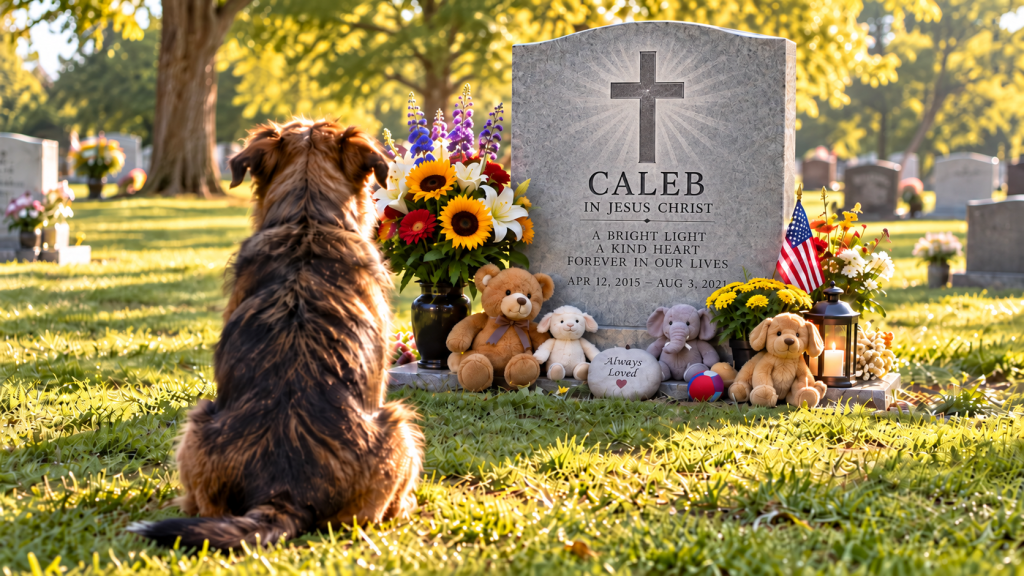
The first time I saw him, he was curled in the grass beside Caleb’s grave.
He was a medium-sized mixed breed, maybe part shepherd, maybe part terrier.
His coat was rough and mostly brown with streaks of black.
One ear stood straight up while the other folded over.
He had white fur around his muzzle that made him look older than he probably was.
There was no collar.
No leash.
No person nearby.
I assumed he belonged to another visitor.
“Hey there,” I said softly.
The dog raised his head.
His eyes were dark and strangely thoughtful.
He watched me place flowers beside Caleb’s headstone.
Then he put his head back down.
I stayed for nearly an hour.
The dog never moved.
When I finally stood to leave, I glanced back.
He was still there.
The following Sunday, he was there again.
And the Sunday after that.
And the one after that.
Sometimes he arrived before me.
Sometimes I saw him crossing the far end of the cemetery while I was parking.
But he always came to Caleb’s grave.
Always.
He never barked.
Never begged.
Never bothered anyone.
He simply lay beside the headstone.
At first, I found it comforting.
Then curiosity began eating at me.
One morning, I brought him a piece of ham.
He sniffed it but didn’t eat until I set it down several feet away.
“You knew him, didn’t you?” I murmured.
The dog looked straight at me.
I laughed at myself.
“Now I’m talking to strange dogs.”
But something about him felt familiar.
Not his appearance.
His manner.
Caleb had always loved animals.
When he was eleven, he rescued a sparrow with a damaged wing and kept it in a laundry basket until a wildlife rehabilitator could take it.
At fourteen, he spent an entire summer walking dogs at the county shelter.
Once, when he was seventeen, he missed dinner because he had stopped on the highway to help a turtle cross the road.
I had no trouble believing Caleb might have known this dog.
What I couldn’t understand was how.
I asked the cemetery groundskeeper, Mr. Watkins.
He leaned on his rake and looked toward the dog.
“That fellow?”
“You’ve seen him?”
“Plenty.”
“Do you know who owns him?”
Mr. Watkins shook his head.
“No collar. Nobody ever comes looking. He shows up a few times a week.”
“A few times?”
“Sometimes more.”
I stared at him.
“I thought he only came Sundays.”
“No, ma’am. Seen him Tuesdays. Thursdays. Once right after sunrise on a Wednesday.”
My skin prickled.
“He always comes to this grave?”
Mr. Watkins looked down at Caleb’s name carved in the stone.
“Yes, ma’am.”
That bothered me all week.
Not in a frightening way.
Just a persistent one.
Who was this dog?
Why Caleb?
Had Caleb secretly adopted him?
Had someone else brought him here?
I searched through Caleb’s old phone, something I had avoided doing for years.
Most of the photographs were exactly what I expected.
Friends.
Cars.
Bad selfies.
Pictures of food.
Screenshots of jokes I didn’t understand.
There were several dogs from the shelter where he volunteered, but none looked exactly like the cemetery dog.
At least, I didn’t think so.
Then I found a blurry photograph taken about four months before Caleb died.
A brown-and-black dog was sitting beside his truck.
Only part of the animal was visible.
One ear upright.
One ear folded.
My heart began pounding.
Under the picture was a text Caleb had sent to someone saved only as “M.”
Found him again. He remembered me.
I stared at those six words for a long time.
There were no later messages.
Caleb had apparently deleted most of that conversation.
I told myself to leave it alone.
Maybe “M” was a friend.
Maybe the dog belonged to someone Caleb knew.
Maybe there was no mystery at all.
But grief creates unfinished rooms inside you.
When even one door appears, you open it.
The following Sunday, I went to the cemetery earlier than usual.
The dog arrived shortly after nine.
He approached Caleb’s grave, circled twice, and lay down.
I sat several yards away.
For the first time, I didn’t speak.
I waited.
Nearly ninety minutes passed.
Eventually, the dog stood.
He stretched his front legs, shook himself, and began walking toward the cemetery gates.
I followed.
I wish I could tell you I had some logical plan.
I didn’t.
I left my car where it was and walked after a strange dog like a woman in a dream.
He never looked back.
He moved with total purpose.
Through the cemetery gate.
Across Hawthorne Avenue.
Behind a closed hardware store.
Past a shuttered gas station.
Down an alley lined with garbage cans.
Then through a neighborhood I barely knew.
The houses grew smaller.
The sidewalks disappeared.
Several homes had peeling paint and sagging porches.
The dog turned onto a dead-end street and stopped in front of a narrow yellow house with a rusted mailbox.
He climbed the porch steps.
Scratched twice at the front door.
Then sat.
The door opened.
And I stopped breathing.
Mara.
Caleb’s girlfriend.
Or former girlfriend.
I wasn’t even sure what word applied when one person died.
I hadn’t seen her since the funeral.
She had been seventeen when she and Caleb started dating.
Quiet.
Dark hair.
Big green eyes.
She used to come to our house after school and sit at the kitchen counter while Caleb made grilled cheese.
They had been together for almost two years.
Then, about six months before Caleb died, he told me they had broken up.
He refused to explain why.
“They just want different things,” his father had said.
Caleb’s father, Michael, and I had divorced when Caleb was ten, but we remained civil.
Mara stopped coming around.
I assumed teenage heartbreak had done what teenage heartbreak does.
At the funeral, she had stood near the back.
She hugged me afterward.
Neither of us said much.
Then she disappeared from my life.
Now she was standing in front of me.
Three years older.
Thinner.
More tired.
Her face went white.
“Mrs. Bennett?”
The dog pushed past her legs and entered the house.
“Mara.”
Her hand tightened around the doorknob.
“What are you doing here?”
“I followed him.”
I pointed toward the dog.
Mara’s expression changed.
Fear.
Shock.
Then something that looked like resignation.
“You followed Scout?”
“Scout?”
She closed her eyes.
“Oh, God.”
My chest tightened.
“You know that dog?”
Mara looked at me for a long moment.
Then tears filled her eyes.
“Yeah.”
“Did Caleb?”
She covered her mouth.
That was enough.
I climbed one porch step.
“Mara, why does that dog visit my son’s grave?”
She didn’t answer.
“Mara.”
“He loved Caleb.”
The words came out broken.
I stared at her.
“Then Caleb knew him.”
“Yes.”
“How?”
She wiped her cheeks.
“Come inside.”
The house smelled faintly of laundry detergent and tomato soup.
Scout immediately walked to a faded blanket in the corner and lay down.
Photos covered one wall.
Mara with her mother.
Mara at graduation.
Scout as a younger dog.
And Caleb.
Dozens of pictures of Caleb.
Caleb smiling in a kitchen I had never seen.
Caleb sitting on these porch steps.
Caleb repairing a bicycle.
Caleb with his arm around Mara.
My throat closed.
“You two were still together.”
Mara didn’t answer immediately.
“After he told me you broke up.”
“We never really broke up.”
I turned toward her.
“What?”
“We were fighting. A lot. But we were still seeing each other.”
“Why would he lie to me?”
Mara stared at the floor.
“Because of my father.”
Before I could ask, a small sound came from the hallway.
A child coughed.
Everything inside me went still.
Mara looked toward a closed bedroom door.
My eyes followed.
On a shelf beside the hallway was a framed photograph.
Caleb was kneeling beside Scout.
In his arms was something wrapped in a blue blanket.
My hands went cold.
“Mara.”
She inhaled sharply.
“Mrs. Bennett—”
“What is that?”
Her mouth opened.
No words came.
I walked toward the picture.
Caleb looked younger.
Alive.
Happy.
Terrified.
The bundle in his arms had a tiny hand sticking out.
A baby.
“Mara.”
My voice sounded like someone else’s.
“What is that picture?”
The bedroom door opened.
A little boy stepped into the hallway.
He had messy brown hair.
Blue pajama pants covered in dinosaurs.
He rubbed one eye with his fist.
Then he looked at me.
My knees nearly gave out.
Caleb’s eyes.
The exact same gray-blue eyes.
The same small crooked eyebrow.
The same dimple in the left cheek.
The child looked from me to Mara.
“Mommy?”
Mara started crying.
I gripped the back of a chair.
“No.”
It came out as a whisper.
“No.”
“Mrs. Bennett…”
“No.”
The boy stepped closer to Mara.
“Who’s that?”
Mara knelt and pulled him against her.
“This is Mrs. Bennett.”
He studied me.
Then he asked the question that shattered what was left of my heart.
“Is she Daddy Caleb’s mommy?”
I collapsed into the chair.
I didn’t faint.
Sometimes I wish I had.
Instead, I remained painfully conscious as three years of grief rearranged itself inside me.
Daddy Caleb.
The little boy knew his name.
Knew who he was.
Mara sat across from me twenty minutes later.
The boy had returned to his room after she gave him cereal and turned on a cartoon.
His name was Noah.
He was three years old.
Three years and four months.
Old enough that the truth became obvious before Mara even said it.
“He’s Caleb’s son,” she whispered.
I stared at her.
“You had my son’s child.”
“Yes.”
“And you never told me.”
Her face crumpled.
“I wanted to.”
“You never told me.”
“I know.”
“Three years.”
“I know.”
“You let me bury my son believing I had lost everything.”
Scout lifted his head from the blanket.
Mara shook violently.
“I’m sorry.”
I stood.
Anger surged through me so suddenly I could barely see.
“Sorry?”
“I know that isn’t enough.”
“You let his child grow up four miles away from me!”
“I was scared!”
“Of what?”
“My father!”
The force of her answer silenced me.
Mara wiped her face.
“You remember my dad.”
I did.
Richard Cole.
Hard man.
Always suspicious of Caleb.
He owned a small towing company and believed everyone wanted something from him.
“He hated Caleb,” Mara continued.
“He thought Caleb was irresponsible because he was nineteen and working at the garage instead of going to college. When I found out I was pregnant, Dad lost his mind.”
My breathing slowed.
“When was this?”
“Seven months before the accident.”
So around the time Caleb claimed they had broken up.
Mara nodded as if reading my thoughts.
“That’s why Caleb told you we broke up.”
“Why?”
“Because my dad threatened him.”
I frowned.
“Threatened him how?”
“He said if Caleb told anyone I was pregnant, he’d report him for things he hadn’t done. He said he had friends who could make Caleb’s life miserable. I was seventeen when I got pregnant. Caleb was eighteen.”
She swallowed.
“Dad wanted me to give the baby up.”
“Did Caleb?”
“No.”
Her answer came instantly.
“Caleb wanted Noah from the first second.”
I covered my mouth.
Mara stood and walked to a cabinet.
She pulled out a small wooden box.
Inside were letters.
Photographs.
Hospital wristbands.
A tiny knitted hat.
Then she handed me an envelope.
My name was written on it.
Mom.
Caleb’s handwriting.
My entire body trembled.
“When did he write this?”
“A week before he died.”
I looked at her.
“You had this all this time?”
Mara nodded miserably.
“He wanted to tell you everything.”
“Then why didn’t he?”
“He was waiting until my eighteenth birthday.”
“Why?”
“Because Dad had told him once I turned eighteen, he couldn’t control me anymore. Caleb had found this house. He was planning to rent it. He had saved almost every dollar he earned.”
I remembered the months before the crash.
Caleb had stopped buying clothes.
Stopped going out with friends.
Started taking extra shifts.
I had assumed he was saving for a truck.
Mara continued.
“He was going to bring me and the baby here. Then we were going to tell you.”
My fingers tightened around the letter.
“Was Noah born before Caleb died?”
“Yes.”
I stared toward the hallway.
“How long did Caleb know him?”
“Six weeks.”
That hurt in an entirely different way.
Six weeks.
My son had been a father for six weeks, and I never knew.
“He came every night after work,” Mara said. “My dad thought Caleb was staying away. But Caleb would park behind the old church and walk to my window.”
A tiny laugh escaped her through tears.
“He was terrible at changing diapers.”
I cried then.
Not gracefully.
Not quietly.
I bent over that unopened letter and sobbed until my ribs hurt.
Mara came closer but did not touch me.
“He loved Noah so much,” she said.
“Why didn’t you come to me after Caleb died?”
Her silence lasted too long.
When I looked up, she appeared ashamed.
“Because my father told me you already knew.”
“What?”
“He said Caleb had told you. He said you wanted nothing to do with us.”
I stared at her.
“That’s a lie.”
“I know that now.”
“Why would he say that?”
“Because he wanted Noah to disappear from Caleb’s family.”
My anger shifted.
“What do you mean?”
Mara sat down.
“My dad was afraid you’d fight for custody. Or that Caleb’s dad would. He said I was young and you had money and lawyers.”
“I’m a receptionist at a dental office.”
“I know.”
“So what happened?”
Mara stared at Scout.
“After Caleb died, I was barely functioning. Noah was six weeks old. Dad took control of everything. He told me Caleb’s family blamed me. He said you thought I had ruined Caleb’s life.”
My stomach twisted.
“I never said that.”
“I know.”
“Why didn’t you check?”
Her eyes filled again.
“Because I was seventeen, terrified, grieving, and stupid.”
I looked away.
I wanted to stay angry.
Anger was easier.
But then Noah laughed at something on television in the next room.
That sound changed everything.
“How does the dog fit into this?”
Mara looked at Scout.
“Caleb found him beside Route 16.”
The same road.
My skin prickled.
“He was hurt,” she continued. “Probably hit by a car. Caleb brought him here because my dad would never let us keep him. We hid Scout in the shed for almost two weeks.”
I remembered the blurry photo.
Found him again. He remembered me.
“Scout kept running away,” Mara said. “No matter where we took him, he came back to Caleb.”
She smiled faintly.
“Eventually my grandmother convinced Dad to let us keep him.”
“And after the accident?”
“Scout disappeared for three days.”
Mara looked at me.
“When he came back, he smelled like wet grass and mud.”
My chest tightened.
“The cemetery.”
“We didn’t know at first. Then one Sunday, I followed him.”
Just as I had.
“He went straight to Caleb’s grave.”
I pressed my palm against my mouth.
“He’s been going ever since?”
“Not every day. But often.”
“Mr. Watkins said several times a week.”
Mara nodded.
“Especially Sundays.”
“Why Sundays?”
Her expression broke my heart.
“Because Caleb used to come see us every Sunday morning before work.”
For several minutes, neither of us spoke.
Then I looked at the envelope again.
“Can I read this?”
“It’s yours.”
My hands trembled as I opened it.
Mom,
I know you’re going to be mad that I didn’t tell you sooner.
But before you get mad, please let me explain.
I have a son.
His name is Noah Caleb Cole.
He has my eyes, according to Mara.
I think he mostly looks like an angry potato right now.
I laughed and cried at the same time.
That was Caleb.
Exactly Caleb.
The letter continued.
I wanted to tell you the day he was born.
Actually, I wanted you there.
But things with Mara’s dad got complicated.
I kept thinking I could fix everything first and then tell you once it was safe.
I know that sounds stupid.
You always say I try to solve problems alone instead of asking for help.
You were right.
I’m trying to do better.
Mara turns eighteen next week.
We found a place.
It’s small, but it has two bedrooms and a porch.
I’ve been saving.
I want you to meet Noah.
I’m scared you’ll think I ruined my life.
But Mom, I swear I didn’t.
When I hold him, nothing feels ruined.
Nothing has ever felt more right.
I hope you’ll love him.
Actually, I know you will.
Because you loved me even when I was a pain in the butt.
I need your help.
Not money.
I just need my mom.
Love,
Caleb.
I read the last line three times.
I just need my mom.
The letter fell from my hands.
For three years, I had replayed every possible version of Caleb’s final months.
Had he been happy?
Afraid?
Lonely?
Was there something he needed to tell me?
Now I knew.
He had needed me.
And because of fear, pride, and one controlling man, he had died before he could ask.
A small hand touched my knee.
I looked down.
Noah stood beside me.
“Why are you crying?”
I couldn’t speak.
He held out a toy truck.
“This is Daddy Caleb’s.”
I stared at it.
It was red.
One wheel was missing.
I recognized it.
Caleb had owned the same truck when he was five.
I thought it had disappeared years ago.
“He gave it to you?”
Noah nodded.
“Mommy says he gave it when I was little.”
Mara corrected him softly.
“When you were a baby.”
Noah climbed into the chair beside me without asking.
Children have a way of ignoring emotional boundaries adults build entire lives around.
He pointed toward the letter.
“Is that Daddy’s writing?”
“Yes.”
“He writes messy.”
A laugh burst out of me.
“Yes. He certainly did.”
Noah grinned.
The dimple appeared.
Caleb’s dimple.
I cried all over again.
That first afternoon lasted nearly five hours.
I learned everything I had missed.
Noah loved strawberries but hated bananas.
He slept with a green blanket.
He was afraid of vacuum cleaners.
He called Scout “Scoot” until he was nearly three.
He knew Caleb from photographs, stories, and videos.
Mara had never allowed her father to erase him completely.
Before I left, I asked the question I had been dreading.
“Does your father still live here?”
“No.”
“Where is he?”
“Florida.”
“Does he know I’m here?”
“No.”
“Are you afraid of him?”
Mara hesitated.
“Not anymore.”
That answer stayed with me.
I drove home after dark.
For the first time in years, I didn’t feel only grief when I walked through my front door.
I felt anger.
Wonder.
Fear.
And something dangerously close to hope.
The next morning, I called my ex-husband.
“Michael.”
“What’s wrong?”
“I need you to sit down.”
“What happened?”
“Caleb had a son.”
Silence.
Then Michael laughed once.
Not because it was funny.
Because sometimes the mind rejects impossible information.
“What?”
“His name is Noah.”
I heard a chair scrape.
“Diane.”
“I met him yesterday.”
“Whose child?”
“Caleb’s.”
“How do you know?”
I closed my eyes.
“Because he has Caleb’s face. Because Mara told me. Because Caleb wrote me a letter.”
Michael drove three hours that afternoon.
When I showed him Caleb’s letter, he cried harder than I had seen him cry at the funeral.
Two days later, with Mara’s permission, we arranged a legal paternity test.
Not because I truly doubted.
But because after everything that had happened, all of us needed certainty.
The results came back at 99.99 percent.
Noah was Caleb’s son.
Our grandson.
Michael stared at the report for several minutes.
Then he said, “Three years.”
I nodded.
“We lost three years.”
Mara was sitting across from us.
“I know.”
Michael looked furious.
I recognized the expression.
It was the same one I had worn.
“You had no right.”
“I know.”
“You should have contacted us.”
“I know.”
“Your father lied to you, but you could have called.”
“I know.”
His voice rose.
“You could have given my son’s mother one reason to keep going!”
“Michael.”
I put my hand on his arm.
He looked at me.
Then at Mara.
She was crying silently.
Finally, Michael sat down.
“I’m sorry.”
“No,” she whispered. “You’re right.”
But the truth was more complicated than right and wrong.
Mara had been a grieving teenager with a newborn and an abusive father controlling every decision.
We had been grieving parents who didn’t know there was someone else to look for.
Caleb had been a young father trying to protect everyone by himself.
Nobody won.
Nobody escaped unchanged.
The only person who had done nothing wrong was Noah.
So that became our focus.
We moved slowly.
I didn’t demand to be called Grandma.
I didn’t ask Mara to pretend the last three years had never happened.
I simply started showing up.
Wednesday afternoons at the park.
Saturday pancakes.
Doctor appointments when Mara had to work.
Trips to the library.
Michael visited twice a month.
Noah accepted us with the easy generosity children sometimes have.
The first time he called me Grandma, he wasn’t even thinking about it.
We were in the grocery store.
He pointed to cereal.
“Grandma, can we get the dinosaur one?”
I froze.
“What?”
He looked confused.
“The dinosaur cereal.”
Behind him, Mara put a hand over her mouth.
I bought three boxes.
That night, I sat in my car and cried for twenty minutes.
Scout became my shadow whenever I visited.
I began taking him to the cemetery myself.
One Sunday, Noah came with us.
Mara hesitated.
“Are you sure?”
“He should know where his father is.”
So the three of us walked through Greenridge Cemetery.
Noah carried yellow flowers.
Scout trotted ahead.
The moment Caleb’s grave came into view, the dog ran forward.
He lay down in his usual place.
Noah approached slowly.
“Is Daddy under there?”
I swallowed.
“Yes.”
“Can he hear me?”
I looked at Mara.
She nodded through tears.
“I like to think so.”
Noah placed the flowers beside the headstone.
Then he sat in the grass.
“Hi, Daddy.”
I nearly broke.
He told Caleb about preschool.
About Scout stealing toast.
About how he could count to twenty except sometimes he forgot fourteen.
Then he leaned against the headstone.
Scout placed his head in Noah’s lap.
That was the moment something inside me changed.
For three years, I had visited that grave to mourn what I had lost.
That Sunday, for the first time, I understood I could also visit it to remember what Caleb had left behind.
But the story wasn’t over.
Three months after I found Mara, Richard Cole came back.
He arrived without warning.
I was at Mara’s house helping Noah build a cardboard castle.
Scout started growling before the knock even came.
Mara looked toward the window.
Her entire body stiffened.
“What?”
She whispered one word.
“Dad.”
Richard entered before she invited him.
He looked older than I remembered.
Heavy.
Gray at the temples.
Angry.
His eyes landed on me.
“So it’s true.”
Mara stepped between him and Noah.
“You need to leave.”
Richard ignored her.
“You found them.”
I stood.
“No. I found you.”
He glared at me.
“You don’t belong here.”
I almost laughed.
“You spent three years making sure I believed that.”
His jaw tightened.
“What did she tell you?”
“The truth.”
“You don’t know the truth.”
“Then tell me why you lied and said I wanted nothing to do with my grandson.”
Richard’s face hardened.
“I was protecting my daughter.”
“From whom?”
“Your son.”
The room became silent.
“Be careful.”
“Caleb was reckless.”
“He was nineteen.”
“He got my seventeen-year-old daughter pregnant.”
“And he stayed.”
Richard said nothing.
“He worked extra shifts,” I continued. “He rented this house. He wrote me a letter asking for help. He planned to raise his child.”
Richard scoffed.
“He would have failed.”
“You didn’t give him the chance.”
His expression changed.
Only slightly.
But I saw it.
Guilt.
Then Mara spoke.
“What really happened the night Caleb died?”
Richard went still.
My heart stopped.
“What does that mean?”
Mara stared at her father.
“I found something.”
Richard turned toward her.
“What?”
“Caleb’s old voicemail.”
The room seemed to contract.
Mara pulled out her phone.
“I restored my old cloud backup.”
Her father’s face went pale.
“Mara.”
She pressed play.
Caleb’s voice filled the room.
Breathless.
Angry.
Mara, your dad followed me from the garage again. I’m pulling over because he keeps flashing his lights. Call me when you get this.
The recording ended.
Nobody moved.
I stared at Richard.
“You followed him?”
Richard backed toward the door.
“It wasn’t like that.”
“You followed my son the night he died?”
“I wanted to talk.”
“What happened?”
He shook his head.
“I didn’t cause the crash.”
“What happened?”
My scream startled Noah.
Mara quickly took him into the bedroom.
Richard sat heavily.
“I told Caleb to stay away.”
My hands were shaking.
“He told me Mara was turning eighteen and I couldn’t control her anymore.”
Richard looked at the floor.
“He said he was taking them.”
“And?”
“I got angry.”
“What did you do?”
“I followed him.”
My knees weakened.
“How far?”
“Several miles.”
“To Route 16?”
“Yes.”
“Were you behind him when the truck crossed the center line?”
Richard’s eyes closed.
“Yes.”
I could barely breathe.
“Did the police know?”
“No.”
“Why?”
“Because I left.”
The words punched through me.
“You left?”
“I saw the truck hit him. I panicked.”
“You left my son there?”
“The truck driver had already called 911.”
“You left him!”
“I couldn’t do anything!”
I moved toward him, but Michael, who had just arrived at the open front door, grabbed my shoulders.
Apparently Mara had texted him when she saw Richard’s car.
Richard looked at us desperately.
“I didn’t hit him.”
“But you chased him,” Mara said from the hallway.
“No.”
“You followed him for miles while angry.”
“I wanted him to stop.”
“And then you lied for three years.”
Richard said nothing.
Mara’s face changed.
Whatever fear she had carried since childhood seemed to disappear.
“Get out.”
“Mara.”
“Get out.”
“I’m your father.”
“No.”
Her voice shook, but she didn’t back down.
“You’re a man who spent years calling control love.”
Richard’s eyes filled.
“I protected you.”
“You isolated me.”
“I raised you.”
“You frightened me.”
He looked toward Noah’s room.
“I love that boy.”
Mara stepped into his path.
“Then prove it by leaving.”
Richard left.
Later, police reviewed the voicemail and reopened parts of the accident investigation.
The truck driver remained legally responsible for crossing the center line.
There was no evidence Richard had physically caused the collision.
But his presence answered questions that had haunted me.
Why Caleb had been driving faster than usual.
Why his phone contained a half-dialed call to Mara.
Why he had taken Route 16 instead of his normal road home.
Richard had been chasing a young man who was desperately trying to build a future.
Knowing that did not give me peace.
For a while, it gave me fresh grief.
But truth, even painful truth, is better than living inside a lie.
Mara eventually cut off contact with her father.
Not because I asked her to.
I never did.
That choice belonged to her.
She went back to school.
With help from me and Michael, she enrolled in a nursing program.
She refused financial help at first.
Then I showed her another line from Caleb’s letter.
Please help Mara finish school if she lets you.
She cried and called him an idiot.
Then she accepted.
Scout grew older.
His muzzle turned white.
His hips stiffened.
But every Sunday, he still walked toward Caleb’s grave.
Eventually he stopped making the trip alone.
One cold November morning, I noticed him struggling to climb the cemetery hill.
I crouched beside him.
“You stubborn old man.”
Scout licked my hand.
Noah, now almost five, took his leash.
“I’ll help him.”
Together we walked the final hundred yards.
Scout reached Caleb’s grave.
He circled once.
Then lay down.
Noah sat beside him.
I placed flowers.
Mara stood on my other side.
Michael had come too.
For a long time, none of us spoke.
Then Noah pulled something from his coat pocket.
The little red truck.
Caleb’s childhood toy.
He placed it beside the headstone.
“I don’t need it anymore,” he said.
Mara crouched.
“Are you sure?”
Noah nodded.
“Daddy can have it.”
My eyes filled.
A breeze moved through the cemetery.
Scout lifted his head.
For one strange second, his tail thumped against the grass.
Once.
Twice.
Three times.
As if someone he loved had just walked toward him.
Two months later, Scout stopped eating.
The vet told us his kidneys were failing.
He was old.
Older than anyone had realized.
Mara brought him home.
We made him comfortable beside the living room window.
On his final morning, Noah lay beside him.
Scout’s breathing was slow.
I sat on the floor stroking his head.
“Thank you,” I whispered.
Mara looked at me.
“For what?”
“For finding me.”
Scout opened his eyes.
I smiled through tears.
“If you hadn’t gone to that cemetery, I never would have followed you.”
He sighed softly.
His tail moved once.
And a few minutes later, he was gone.
We buried Scout beneath a maple tree on the edge of the cemetery with the groundskeeper’s permission, close enough that if dogs understand such things, I liked to think he could still keep watch over Caleb.
Noah insisted on choosing the stone.
It was small.
Simple.
It read:
SCOUT
LOYAL FRIEND
HE ALWAYS KNEW THE WAY HOME.
Years have passed since that Sunday I followed him.
Noah is eight now.
He looks more like Caleb every year.
Same eyes.
Same smile.
Same habit of leaving cabinet doors open.
He loves animals.
Of course he does.
Last month, Mara and I found him sitting in the backyard beside an injured robin.
He had built a little nest out of an old shoebox and towels.
“Grandma,” he said seriously, “we have to help him.”
I almost laughed.
Instead, I sat beside him.
“Yes.”
His brow furrowed.
“What?”
“Nothing.”
“You’re smiling.”
“I was just thinking you remind me of somebody.”
He knew who I meant.
“Daddy?”
“Yes.”
Noah smiled.
“I wish I remembered him.”
That sentence hurt.
But not like it once would have.
I touched his hair.
“You remember him in ways you don’t know.”
“How?”
“The way you care about animals.”
He grinned.
“The cabinet doors?”
I laughed.
“Definitely the cabinet doors.”
Then Noah became quiet.
“Do you think Daddy knew you were going to find me?”
I looked toward the maple tree beyond Mara’s fence.
I thought of Scout crossing town every Sunday.
I thought of a dog lying beside a grave.
I thought of an unopened letter.
A frightened girl.
A little boy with Caleb’s eyes.
“I don’t know,” I said.
And that was the truth.
I don’t believe everything happens for a reason.
I can’t.
There is no reason good enough for my son dying at nineteen.
No explanation that makes that fair.
No lesson worth that price.
But I do believe love leaves trails.
Sometimes they are obvious.
Photographs.
Letters.
Children.
Sometimes they are quieter.
A familiar expression.
A toy truck.
A dimple in a child’s cheek.
And sometimes, apparently, love leaves four muddy paw prints leading through a cemetery gate.
I still visit Caleb every Sunday.
But I don’t always go alone anymore.
Sometimes Noah comes.
Sometimes Mara.
Sometimes Michael.
We sit beneath the maple trees and tell stories.
Not only sad ones.
Especially not only sad ones.
I tell Noah how his father once tried to cook pasta without water.
How Caleb got detention for bringing a frog to school.
How he cried when his childhood dog died and then denied crying for ten straight years.
How he sang badly.
How he danced worse.
How deeply he loved.
Last Sunday, Noah placed his hand on Caleb’s headstone.
“Dad,” he said, “Grandma says you were trouble.”
I raised an eyebrow.
“I said mischievous.”
“That means trouble.”
Mara laughed.
For a second, the cemetery didn’t feel like a place of death.
It felt like a place where our strange, broken family had learned to become whole.
Before leaving, Noah ran over to Scout’s stone.
He brushed leaves away.
Then he looked toward me.
“Grandma?”
“Yes?”
“If Scout hadn’t found Daddy, you wouldn’t have found us.”
I nodded.
“I know.”
“So he saved us.”
I thought about that.
Maybe he did.
Not in the dramatic way people usually mean when they talk about being saved.
Scout didn’t stop the accident.
He didn’t bring Caleb back.
He couldn’t erase three years of grief.
But he carried love between two worlds that had been separated by fear and lies.
Again and again.
Week after week.
He went from Mara and Noah to Caleb.
From Caleb back to Mara and Noah.
Until one grieving mother finally became curious enough to follow.
“Yes,” I told my grandson.
“I think he did.”
Noah smiled.
Then he ran toward the parking lot.
“Come on, Grandma!”
“I’m coming.”
I looked back one last time.
Caleb’s headstone stood beneath the autumn trees.
Scout’s smaller stone rested nearby.
For years, I had believed that grave marked the place where my life ended.
Now I understood something I wish grief had taught me sooner.
A grave marks where a life was laid to rest.
It does not mark where love ends.
Love keeps moving.
Through people.
Through memories.
Through promises.
Through children.
Sometimes even through a scruffy dog who somehow knows exactly where he needs to go.
I touched Caleb’s name.
“I found him,” I whispered.
The wind moved softly through the trees.
“I found your boy.”
Then I walked toward my grandson.
This time, I didn’t look back.
💬THE END! THANK YOU FOR READING!