

I woke up one morning and found a bright red SOLD sign planted in the middle of my front yard.
For a few seconds, I simply stood on the porch staring at it.
The morning was quiet.
Birds were hopping across the grass.
A sprinkler clicked somewhere down the street.
The newspaper lay folded beside my flowerbed.
Everything looked ordinary except for that enormous red sign standing beneath the maple tree Harold had planted thirty-two years earlier.
SOLD.
At first, I thought someone had made a mistake.
Then my son stepped out of the garage carrying a suitcase.
Behind him came his wife, Amber, wearing oversized sunglasses and a cream-colored travel outfit that probably cost more than my monthly pension.
Three enormous pieces of luggage sat beside their car.
Dominic stopped when he saw me.
For half a second, he looked uncomfortable.
Then his expression hardened.
“Mom,” he said, “we need to talk.”
I pointed toward the lawn.
“You sold my house?”
Amber lowered her sunglasses.
Dominic sighed.
“Come inside.”
“No.”
“Mom.”
“You sold my house?”
The words sounded ridiculous even as I said them.
I had lived there for thirty-five years.
My husband, Harold, and I had bought the house when Dominic was four and our daughter, Sarah, was still a baby.
We had painted the bedrooms ourselves because we couldn’t afford contractors.
Harold had installed the kitchen cabinets.
I had planted roses along the fence.
We had watched our children take their first bicycle rides on that driveway.
We had hosted birthdays, graduations, Christmas dinners, anniversaries, neighborhood cookouts, and eventually Harold’s memorial gathering in that house.
Every room contained a memory.
And now there was a SOLD sign in my yard.
Dominic glanced toward the street.
“Can we not do this outside?”
“I think we’re already doing it.”
Amber crossed her arms.
“Vera, this really doesn’t need to become dramatic.”
That was the first moment I felt something inside me change.
Not anger.
Not yet.
Something colder.
I looked at her.
“My house has apparently been sold without my knowledge, and you’re telling me not to be dramatic?”
Dominic rubbed his forehead.
“Please come inside.”
I followed them into the living room because I wanted to understand exactly how far they had gone.
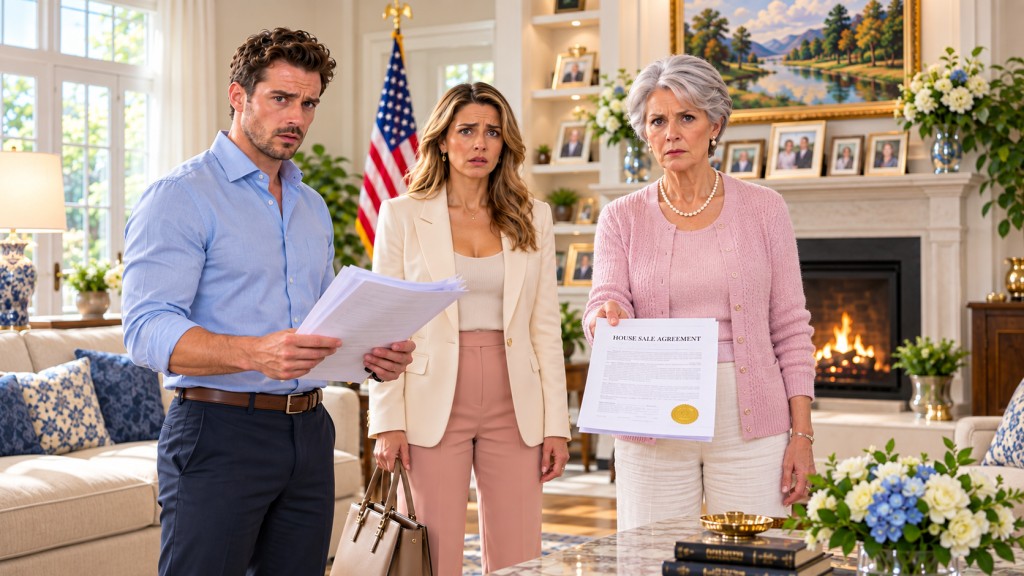
Dominic placed a folder on the coffee table.
Amber remained standing.
She looked impatient.
Almost excited.
“The house sold yesterday,” Dominic said. “Two hundred fifty thousand dollars. Closing is next week.”
I stared at him.
“You cannot sell my house.”
He opened the folder.
“Actually, I can.”
He removed several pages and placed them in front of me.
“Remember the power of attorney you signed when Dad was sick?”
My stomach tightened.
Of course I remembered.
Harold had been diagnosed with pancreatic cancer three years earlier.
During the final six months of his life, our entire world became doctor appointments, hospital stays, insurance calls, medication schedules, and sleepless nights.
Dominic had offered to help.
At the time, I had been grateful.
He said a limited power of attorney would allow him to speak with certain insurance offices, handle paperwork related to Harold’s treatment, and sign a few things if I became too overwhelmed.
I had signed it in our kitchen while Harold slept upstairs.
“That document was for your father’s care,” I said.
Dominic leaned back.
“It covered more than that.”
I picked up the papers.
At first, everything looked official.
Legal language.
Notary stamps.
My signature.
But something bothered me immediately.
The font in one section looked slightly different.
The margins seemed inconsistent.
A paragraph on the second page appeared crowded between two others.
And the signature page looked familiar and unfamiliar at the same time.
I leaned closer.
Before I could study it properly, Amber stepped forward and placed a glossy brochure over the papers.
“We already found somewhere for you.”
I looked down.
Sunset Manor Senior Living.
The cover showed three smiling elderly people sitting beside a fountain.
“You found somewhere for me?”
Amber nodded.
“It’s lovely.”
I looked at her.
“What is it?”
“A residential care facility.”
“A nursing home.”
“It’s not technically called that anymore.”
I turned to Dominic.
“You’re sending me away?”
His face tightened.
“Mom, you’re sixty-two. You live alone. This house is too large.”
“I’m sixty-two, not ninety-two.”
“No one said you were helpless.”
“You’re moving me into a care facility.”
“Only because it’s safer.”
I almost laughed.
“Safer for whom?”
Neither answered.
Amber pushed the brochure toward me.
“They have meals, activities, housekeeping, medication assistance, transportation, everything.”
“I don’t need medication assistance.”
“They have gardens.”
“I have a garden.”
“They have social events.”
“I have friends.”
“They have people your own age.”
I stared at her.
“Exactly what age do you think sixty-two is?”
Amber’s smile disappeared.
Dominic stepped in.
“This isn’t punishment.”
“Then what is it?”
“It’s practical.”
I looked around the room.
Harold’s chair still sat beside the fireplace.
His reading glasses were in the drawer of the little table beside it even though he had been gone for more than two years.
My grandmother’s brass lamp stood near the window.
Family photographs lined the mantel.
I suddenly understood that they had already decided all of this.
The house.
The facility.
My belongings.
My future.
Without asking me.
I looked at Dominic.
“And where are the two of you going?”
Amber’s expression brightened instantly.
“Europe.”
Dominic shot her a warning look.
But she kept talking.
“We leave this afternoon. Paris first, then Switzerland, northern Italy, Florence, Rome, Barcelona, maybe Monaco if we have time.”
“How long?”
“Three months.”
I stared at them.
Then I looked at the paperwork again.
And everything became very clear.
“You’re using the money from my house.”
Dominic shifted.
“It isn’t like that.”
“It looks exactly like that.”
“We’re investing in ourselves.”
Amber nodded enthusiastically.
“I want to start an interior design business.”
“You’ve never worked in interior design.”
“I have an eye for it.”
Dominic continued quickly.
“And I may go back to school.”
“For what?”
He paused.
“We’re still discussing that.”
I looked at him for a long moment.
“You sold your mother’s house so you could take a luxury vacation.”
“It’s not just a vacation.”
“Then why are there five suitcases in the driveway?”
His face reddened.
A horn sounded outside.
Dominic checked his watch.
“That’s your ride.”
I stared at him.
“My ride?”
“To Sunset Manor.”
He said it casually.
As though he had arranged transportation to a dentist appointment.
“We already paid six months.”
My throat tightened.
I had imagined many difficult conversations with my children over the years.
I had imagined illness.
Money problems.
Marriage problems.
Arguments over inheritance after I died.
I had never imagined my son arranging to remove me from my own home while he flew to Europe using money he had taken from it.
“What happens to my belongings?”
Amber shrugged.
“The buyers liked the furnishings.”
I looked toward the front hallway.
One small suitcase sat beside the door.
It was mine.
They had packed it.
One suitcase.
Thirty-five years of marriage.
Motherhood.
Widowhood.
Birthdays.
Family holidays.
Photographs.
Books.
Clothes.
Documents.
Harold’s belongings.
My entire life had apparently been reduced to one suitcase.
I looked at Dominic.
“Does Sarah know?”
His eyes flicked toward Amber.
Only for a second.
But I saw it.
“Sarah has her own life,” he said.
“That wasn’t my question.”
“There was no reason to involve her.”
I knew immediately why.
Sarah would have stopped them.
My daughter lived in California with her husband and two children.
She called me every Tuesday and Sunday.
She worried about me more than I wanted her to.
If she had known Dominic intended to sell my home and place me in a facility, she would have been on the first flight east.
“You lied to her.”
Dominic’s jaw tightened.
“I handled it.”
“No. You hid it.”
“Mom, please.”
I looked at him.
“Your father would be ashamed of you.”
Something crossed his face.
Pain.
For one second, I saw the little boy who used to follow Harold through the garage asking how every tool worked.
Then Amber touched Dominic’s arm.
His expression hardened again.
“We have to go.”
I looked at them both.
Then I picked up the suitcase.
“Enjoy Europe.”
Amber blinked.
Dominic seemed confused.
He had expected screaming.
Begging.
Maybe tears.
Instead, I walked past them.
Outside, a taxi waited at the curb.
The driver put my suitcase in the trunk.
I climbed into the back seat.
As we pulled away, I looked through the rear window.
Dominic and Amber were standing in the driveway beside their luggage.
Behind them, the SOLD sign remained planted in the yard.
Dominic lifted a hand.
I didn’t wave back.
Sunset Manor smelled like disinfectant, boiled vegetables, and resignation.
A cheerful administrator named Claire met me at reception.
She smiled constantly.
“Your son told us you might need time adjusting.”
“I’m sure he did.”
My room was on the third floor.
One narrow bed.
A small dresser.
A television mounted on the wall.
One armchair.
One window overlooking the parking lot.
Claire pointed toward a call button near the bed.
“If you need assistance at any time, press here.”
“I can walk.”
“Of course.”
“I can cook.”
“That’s wonderful.”
“I drive.”
“Excellent.”
“I manage my own finances.”
Her smile became uncertain.
“I understand.”
“Then perhaps you can explain why I’m here.”
She looked uncomfortable.
“Your son said this arrangement was your preference.”
Of course he had.
I sat on the edge of the bed after she left.
For the first time that day, I cried.
Quietly.
Not because I believed I had lost everything.
Because I realized how easily my son had lied.
How calmly he had done it.
That night I barely slept.
Every few minutes, an elevator chimed down the hall.
Someone coughed in another room.
A cart rattled past my door at three in the morning.
I stared at the ceiling.
Dominic probably thought everything was finished.
He had removed me from the house.
He had sold the property.
He had access to the money.
And by morning, he would probably be drinking champagne somewhere over the Atlantic.
There was only one problem.
He had underestimated my memory.
The power of attorney I signed had been limited.
I knew that.
Harold and I had been careful with documents.
We had spent years running a small hardware store together.
We signed contracts.
Loan agreements.
Insurance papers.
Supplier agreements.
I was not unfamiliar with paperwork.
The document Dominic had shown me was not what I remembered signing.
The next morning, I went to breakfast.
That was where I met Dorothy.
She was seventy-four, with silver hair, sharp blue eyes, and a paperback mystery novel beside her oatmeal.
She watched me struggle to open a small container of orange juice.
“Terrible design,” she said.
I smiled weakly.
She handed me a spoon.
“Use the handle.”
It worked.
“Thank you.”
“You’re new.”
“Yesterday.”
“Voluntary or kidnapped?”
I stared at her.
Dorothy smiled.
“That was a joke.”
“Mine might actually be kidnapping.”
That got her attention.
We talked for almost an hour.
I didn’t tell her everything immediately.
But eventually, the whole story came out.
The house.
The power of attorney.
The SOLD sign.
The European trip.
The nursing facility.
When I finished, Dorothy slowly placed her spoon down.
“What did you do for work?”
“My husband and I owned a hardware store.”
“Then you understand signatures.”
“Yes.”
“And contracts?”
“Enough.”
“And you’re certain the document he showed you was different?”
“Yes.”
Dorothy leaned closer.
“I worked as a paralegal for thirty years.”
I stared at her.
She continued.
“If someone altered a power of attorney and used it to sell your house, that is not a family disagreement.”
“What is it?”
“Potential fraud.”
The word landed heavily.
Fraud.
My own son.
“Can I prove it?”
“That depends.”
“On what?”
“How much fight you have left.”
I didn’t hesitate.
“More than he thinks.”
Dorothy smiled.
“Good.”
She gave me the name of an attorney she trusted.
Margaret Peterson.
The following afternoon, Dorothy helped me arrange transportation to Margaret’s office.
Margaret was in her late fifties, with short gray hair, reading glasses, and the expression of someone who had very little patience for nonsense.
I liked her immediately.
She listened without interrupting.
When I finished, she asked for copies of everything I had.
I showed her the document Dominic had left with me.
She studied it silently.
Then she said, “Do you know where the original was prepared?”
“Yes.”
A local attorney had drafted it during Harold’s illness.
Margaret called that office while I sat across from her.
Twenty minutes later, she had confirmation that they still had the original file.
By the next morning, she had obtained a certified copy.
When I returned to her office, the two documents were already spread across her desk.
She pointed to the first page.
“This is the original.”
Then the second.
“This is the copy your son apparently used.”
She placed them side by side.
Even I could see it.
The original authorized Dominic to assist with medical insurance, health-related paperwork, and a limited number of financial transactions connected specifically to Harold’s treatment.
The other version contained additional language.
Broad property authority.
Real-estate authority.
Financial authority.
The power to transfer assets.
Margaret pointed to the altered paragraph.
“This section doesn’t exist in the original.”
My hands began shaking.
“So I remembered correctly.”
“Yes.”
“And my signature?”
“That appears to have been copied from the original signature page and inserted onto another version.”
I stared at the document.
For several seconds, I couldn’t speak.
I kept seeing Dominic standing in the driveway.
His suitcase.
His calm voice.
His certainty.
“He forged it.”
Margaret chose her words carefully.
“It certainly appears the document was altered. We’ll need forensic review and records from the transaction. But based on what I’m seeing, there is substantial reason to investigate fraud.”
“Can I get my house back?”
“We can challenge the transaction. If the buyers acted in good faith, things become more complicated, but there are options. We can also pursue the proceeds and any damages.”
I nodded.
“When does Dominic find out?”
“When formal notices are issued.”
“He’s in Europe.”
Margaret raised an eyebrow.
“For how long?”
“Almost three months.”
“Do you want us to notify him immediately?”
I looked at the papers.
Then I thought about the SOLD sign.
The suitcase.
Amber’s brochure.
The way Dominic had told me that Sarah didn’t need to know.
“No.”
Margaret watched me.
“I don’t want to interfere with anything legally.”
“You won’t.”
“Then do whatever you need to do here.”
“And Dominic?”
I smiled faintly.
“I’d hate to ruin his vacation.”
Margaret almost smiled.
After that, I became busy.
Very busy.
Dominic had made the mistake of believing that because I was quiet, I was helpless.
I contacted my bank.
My accounts were secured.
Passwords changed.
Automatic transfers stopped.
Margaret helped me revoke every authorization Dominic had legitimately possessed.
We redirected my mail.
We notified financial institutions.
We reviewed insurance policies.
We checked property records.
We examined every transaction Dominic had touched during the previous three years.
Then Margaret found something else.
Dominic had not simply used the altered power of attorney to sell the house.
He had opened access to an account connected to the proceeds.
Money was disappearing quickly.
Very quickly.
Meanwhile, Dominic and Amber were posting photographs online.
Paris.
Champagne beneath the Eiffel Tower.
A private dinner overlooking the Seine.
Designer shopping bags.
A luxury hotel suite.
Then Switzerland.
Then Venice.
I watched none of it directly.
Dorothy did.
She would walk into my room every few days holding her tablet.
“You’re not going to believe this one.”
“I probably am.”
“One thousand eight hundred dollars for a handbag.”
“That sounds cheap for Amber.”
Dorothy laughed.
The first postcard arrived two weeks later.
The front showed the Eiffel Tower.
Having the time of our lives. Hope you’re settling in. Love, Dominic.
I placed it in a drawer.
The second came from Venice.
Living like royalty. Incredible food. Five-star hotels. Wish you could see it.
I kept that one too.
Not because I treasured them.
Because Margaret said everything might matter.
By the sixth week, financial records started arriving.
Margaret invited me to her office.
She pushed a stack across the desk.
“They have spent almost one hundred eighty thousand dollars.”
I stared at her.
“You’re joking.”
“I’m not.”
There were luxury hotels.
First-class flights.
Designer stores.
Jewelry.
A twelve-thousand-dollar watch.
Private drivers.
Fine restaurants.
One wine bill was so large that I looked at the figure twice.
“From the house proceeds?”
“A substantial portion appears connected.”
I sat back.
Something inside me hurt.
Not because of the money.
Because every purchase represented a choice.
Dominic had looked at the house his father worked thirty years to pay for and had seen airfare.
Hotel rooms.
Watches.
Wine.
I looked through the receipts.
While Amber bought clothing in Paris, I was sleeping in a narrow bed at Sunset Manor.
While Dominic ate dinner overlooking the Mediterranean, I was eating mashed potatoes from a plastic tray.
“Can we stop them?”
“We already froze what remained under your control. Other funds are being traced.”
“Will they know?”
“Eventually.”
I smiled.
“Good.”
My daughter Sarah called twice each week.
At first, I avoided telling her everything.
I hated lying to her.
So I told partial truths.
“I’m staying somewhere temporarily.”
“Dominic is helping with some paperwork.”
“I’m handling it.”
But Sarah knew me too well.
“Mom, something is wrong.”
“I’m fine.”
“You keep saying that.”
“Because I am.”
“Where exactly are you staying?”
I hesitated.
That silence told her enough.
“Mom?”
Before I could answer, someone entered the hallway outside my room.
I lowered my voice.
“I promise I will explain soon.”
“Does Dominic know?”
“Yes.”
That was my mistake.
Sarah became suspicious.
She called Dominic.
He told her I had voluntarily moved into a retirement community because I was lonely after Harold’s death.
He said selling the house had been my idea.
He said the money was being invested for my future.
He said he and Amber were simply taking a long-delayed vacation.
Sarah almost believed him.
Almost.
Then she called the realtor listed on the online sale record.
The realtor casually mentioned that Dominic had represented himself as my authorized agent.
Sarah called me again.
This time, I told her everything.
There was silence for nearly ten seconds.
Then she whispered, “He did what?”
“Sarah.”
“He sold your house?”
“Yes.”
“And put you in a nursing facility?”
“It’s technically assisted living.”
“Mom!”
“I’m handling it.”
“I’m getting on a plane.”
“No.”
“Mom—”
“Not yet.”
“Why not?”
“Because I need you to trust me.”
She went silent.
“I need you to act normally,” I continued. “Call him if you usually call him. Respond to his photographs. Do nothing that tells him we know.”
Sarah understood immediately.
Her voice changed.
“You’re building a case.”
“Yes.”
Another pause.
Then she said, “Dad would be proud of you.”
I had to close my eyes.
By the ninth week, things began moving quickly.
The buyers had discovered the ownership dispute.
Fortunately, they had not yet fully moved in.
Their attorney contacted Margaret.
Records were reviewed.
The closing process came under scrutiny.
The title company became involved.
Insurance representatives became involved.
A forensic document examiner reviewed the power of attorney.
The conclusion was devastating for Dominic.
The pages did not belong together.
The signature had been reproduced.
The altered section used formatting inconsistent with the original drafting software.
The notarization raised additional questions.
Margaret explained it all to me one afternoon.
“This is very serious now.”
I nodded.
“Good.”
“Vera, I want to prepare you. Once your son realizes what’s happening, he may panic.”
“I’m counting on it.”
The buyers eventually agreed to unwind the transaction under negotiated protections while responsibility for the fraud was pursued separately.
Because sufficient funds had been frozen and title insurance became involved, my home returned to my control far sooner than I had expected.
The day Margaret called me, I was sitting with Dorothy in the Sunset Manor garden.
“You can go home,” Margaret said.
I didn’t speak.
“Vera?”
“I heard you.”
“You can go home.”
I began crying.
Dorothy took my hand.
Three days later, I packed the same suitcase Dominic had packed for me.
Only this time, I was leaving because I chose to.
Dorothy walked me to the lobby.
“You better visit,” she said.
“I will.”
“You’ll forget us the minute you sleep in your own bed.”
“I’m taking you to lunch next week.”
“Somewhere without mashed potatoes.”
“Anywhere without mashed potatoes.”
She hugged me.
“You did good.”
“No.”
I smiled.
“We’re not done yet.”
When I reached the house, I stood outside for several minutes.
The SOLD sign was gone.
The maple tree moved gently in the wind.
Margaret had arranged for my belongings to be returned.
Harold’s chair was back beside the fireplace.
My grandmother’s lamp stood near the window.
The photographs were back on the mantel.
I walked from room to room touching familiar things.
The kitchen counter.
The stair railing.
The doorway where we once marked the children’s heights in pencil.
Dominic at five.
Sarah at three.
Dominic at eight.
Sarah at six.
The marks were still there.
I pressed my fingers against them.
Then I changed every lock.
I installed cameras.
I updated the alarm system.
I changed the garage code.
And with Margaret’s help, I rewrote my estate documents.
That was perhaps the part Dominic would eventually find most painful.
Not because I disinherited him completely.
I didn’t.
Margaret advised me to think carefully before making permanent decisions purely out of anger.
So I did.
I created protections.
Anything Dominic might eventually receive would be tightly controlled.
Sarah would become my primary medical representative.
A professional fiduciary would oversee certain financial matters.
My grandchildren would have protected education funds.
No one would ever again have broad access to my assets because they were family.
Trust had become something earned.
Not inherited.
The day before Dominic returned, Margaret called.
“Everything is ready.”
“When does his flight land?”
“Tomorrow at two twenty.”
I smiled.
“Perfect.”
Dominic and Amber arrived home wearing expensive clothes and exhausted expressions.
They had no idea that during their final week in Spain, legal notices had already begun reaching their attorney, financial institutions, and other involved parties.
They learned the truth shortly after landing.
Dominic called me seventeen times.
I didn’t answer.
Amber called nine.
I didn’t answer her either.
At five thirty that evening, someone began pounding on my front door.
“Mom!”
I was sitting in Harold’s chair reading.
Another round of pounding.
“Mom! Open the door!”
I slowly closed the book.
Walked down the hallway.
And checked the camera.
Dominic stood on the porch holding a thick envelope.
Amber stood behind him.
They looked furious.
I waited ten seconds.
Then opened the door.
Dominic immediately raised the papers.
“What is this?”
I glanced at them.
“Welcome home.”
Amber stared past me.
Her mouth fell open.
“How are you here?”
I raised an eyebrow.
“Where else should I be?”
“You’re supposed to be at Sunset Manor.”
“No, Amber.”
I smiled faintly.
“That’s where you wanted me to be.”
Dominic stepped closer.
“Mom, this says fraud. Financial exploitation. Civil claims. What are you doing?”
“I’m protecting myself.”
“You’re accusing me of a crime.”
“I’m describing what happened.”
“I was trying to help you!”
“By selling my house?”
“You weren’t using all this space!”
“It was still mine.”
Amber stepped forward.
“We had legal authority.”
“No.”
“Yes, we did.”
I stepped aside.
“Come in.”
They entered cautiously.
Amber looked around.
The furniture.
The photographs.
Harold’s chair.
Everything they thought had been taken from me was back where it belonged.
Dominic stared.
“How?”
I walked toward the desk.
Opened the top drawer.
Removed the original power of attorney.
Then handed it to him.
“This is what I signed.”
He unfolded it.
His eyes moved across the page.
Once.
Twice.
A third time.
His face changed.
The anger disappeared.
Amber moved beside him.
“What?”
He didn’t answer.
“What does it say?”
Dominic looked at me.
“Where did you get this?”
“The attorney who prepared it.”
Amber grabbed the page.
She read quickly.
Then looked at Dominic.
“This doesn’t include the house.”
“No,” I said.
“It never did.”
Dominic swallowed.
“Mom, listen.”
“No. You listen.”
My voice remained calm.
“You took a limited document I signed while your father was dying. Someone altered it. You used it to sell my home. You moved me into a facility I did not choose. You hid everything from your sister. Then you took money connected to that sale and spent it across Europe.”
“That’s not exactly what happened.”
“Then explain the twelve-thousand-dollar watch.”
Dominic’s face changed.
Amber looked at him.
“How does she know about that?”
I almost smiled.
Dominic lowered his voice.
“We can fix this.”
“I already did.”
“No. I mean privately.”
There it was.
The word I had expected.
Privately.
Meaning without accountability.
Without records.
Without consequences.
Amber stepped closer.
“Vera, families don’t do this to each other.”
I looked at her.
“You’re right.”
She seemed relieved.
Then I continued.
“Families don’t secretly sell each other’s homes.”
Her face tightened.
A car door slammed outside.
Dominic looked toward the window.
“Who’s here?”
The doorbell rang.
I opened it.
Margaret stood there carrying a thick folder.
But she wasn’t alone.
Sarah stood beside her.
Dominic stepped backward.
“Sarah?”
My daughter walked inside.
She had flown in that morning.
Her eyes were red.
Not from crying.
From anger.
Dominic tried to speak.
She lifted one hand.
“Don’t.”
He stopped.
Sarah looked around the room.
Then at me.
Then back at her brother.
“You told me Mom wanted to move.”
“I was trying to protect you from—”
“You told me she was lonely.”
“She was.”
“No, she wasn’t.”
“You live three thousand miles away. You don’t know what—”
Sarah’s voice rose.
“I called her twice a week!”
Amber crossed her arms.
“Sarah, you weren’t here.”
“And you were?”
“I was helping.”
“You put my mother in a facility so you could go shopping in Paris.”
Amber’s face reddened.
“That is not fair.”
Sarah laughed once.
“No. What happened to Mom wasn’t fair.”
Margaret stepped forward.
“I think everyone should remain calm.”
Dominic stared at her.
“You’re the attorney?”
“Yes.”
He looked at me.
“You brought a lawyer into this family.”
I replied quietly.
“You brought forged paperwork into this family.”
Silence.
Then Margaret opened her folder.
“There is something else.”
Dominic’s face tightened.
“What?”
She removed copies of bank records.
Sarah watched him carefully.
“You told me the money from the house was being placed into investments for Mom.”
Dominic didn’t answer.
Sarah continued.
“I asked Margaret to help review other accounts you had access to during Dad’s illness.”
Dominic went pale.
I looked at Margaret.
This part was new to me.
She had discovered the records only hours earlier.
Margaret placed several statements on the table.
“Approximately eighteen months before Harold died, money began moving from one joint family account into another account controlled primarily by Dominic.”
Dominic immediately shook his head.
“That was for Dad’s expenses.”
“Some of it was.”
Margaret placed another paper down.
“Some of it was not.”
Amber stared at her husband.
“What does that mean?”
Margaret continued.
“Car payments. Credit card balances. A personal loan. Several cash withdrawals.”
I looked at Dominic.
“How much?”
Margaret paused.
“Just over forty-seven thousand dollars.”
The room seemed to tilt.
Dominic raised both hands.
“Mom, Dad knew.”
I stared at him.
“He knew?”
“Yes.”
“Then show me.”
“What?”
“Show me where your father authorized you to take forty-seven thousand dollars.”
Dominic said nothing.
Sarah looked sick.
Amber turned toward her husband.
“You told me your father gave you that money.”
“He did.”
“Then why is she saying there’s no record?”
“There doesn’t have to be a record.”
Margaret spoke calmly.
“There may be explanations for individual transactions. But combined with the altered power of attorney and the home sale, they warrant investigation.”
Dominic looked at me.
“Are you trying to send me to prison?”
His voice cracked.
For the first time, I saw fear.
Real fear.
I looked at my son.
“No.”
He seemed surprised.
“I’m not trying to send you anywhere.”
“Then stop this.”
“I’m trying to find out what you did.”
“Mom.”
“And then you will live with whatever comes from that.”
He stared at me.
“You’re choosing strangers over your own son.”
“No.”
I shook my head.
“I’m choosing the truth over pretending.”
Amber suddenly started crying.
Not quietly.
She covered her mouth.
“We spent everything.”
Dominic turned sharply.
“Amber.”
She ignored him.
“We thought it was legal.”
I looked at her.
“You thought I wanted to live in Sunset Manor while you spent one hundred eighty thousand dollars in Europe?”
She wiped her face.
“Dominic said you didn’t care about the house anymore.”
I looked at my son.
He closed his eyes.
Amber continued.
“He said you wanted to simplify your life.”
“Stop talking,” Dominic said.
“No!”
She turned on him.
“You said she agreed!”
Dominic clenched his jaw.
“You knew what we were doing.”
“You said she agreed!”
The room fell silent.
There it was.
The first crack between them.
Margaret quietly gathered her papers.
“I think this conversation has reached its useful limit.”
Dominic looked at me.
“Mom, please.”
I walked toward the front door.
He didn’t move.
“I said please.”
“So did I.”
He looked confused.
“I asked you not to sell my life without me.”
I opened the door.
“You did it anyway.”
Sarah stepped beside me.
Dominic looked at his sister.
“You’re siding with her?”
Sarah stared at him.
“She’s our mother.”
“So I don’t matter?”
“That isn’t what this is about.”
“You’ve always been her favorite.”
I felt the old family wound immediately.
Dominic had complained about that since childhood.
Sarah shook her head.
“This isn’t about who Mom loves more.”
“It always is.”
I interrupted.
“No.”
Dominic looked at me.
“I loved you when you were born.”
My voice trembled despite everything.
“I loved you when you broke my kitchen window with a baseball and blamed the neighbor’s dog.”
Sarah almost smiled.
“I loved you when you failed algebra.”
Dominic looked away.
“I loved you when your first girlfriend broke your heart.”
His eyes filled.
“I loved you when your father died.”
My voice cracked.
“And I love you now.”
He looked at me.
“Then why are you doing this?”
“Because loving you does not require letting you destroy me.”
No one spoke.
Dominic’s shoulders dropped.
For the first time since he returned, he looked less like an angry man and more like a frightened boy.
But consequences do not disappear simply because someone finally looks sorry.
He and Amber left.
The legal process continued.
It lasted months.
The altered document became the center of everything.
Investigators traced who had created it.
The notary signature had been improperly used.
Electronic records connected the altered file to Dominic’s computer.
Financial records showed the proceeds moving into accounts he controlled.
The earlier withdrawals from Harold’s accounts were examined separately.
Some had legitimate explanations.
Others did not.
Dominic’s attorney eventually advised him to cooperate.
He did.
Not because he suddenly became noble.
Because the evidence left him little choice.
Amber insisted she had believed Dominic possessed legal authority.
Investigators found messages suggesting she knew I had never agreed to the sale, but there was less evidence that she understood exactly how the paperwork had been altered.
Their marriage began falling apart.
Sarah heard about it before I did.
Amber moved out.
Dominic stopped posting online.
The watch disappeared.
The luxury car was sold.
Several expensive purchases were returned where possible.
Money was recovered.
Not all of it.
But enough.
The civil case produced a settlement requiring restitution.
Other legal consequences followed.
I will not pretend I enjoyed watching my son lose things.
I didn’t.
That surprised me.
For months, I had imagined that seeing consequences arrive would feel like justice.
Sometimes it did.
Other times, it felt like grief.
Because no matter what Dominic had done, he was still the boy Harold once carried asleep from the car.
The boy who gave me a macaroni necklace in first grade.
The teenager who cried in our kitchen when he didn’t get into the college he wanted.
People are rarely only the worst thing they have done.
But that does not erase what they have done.
Almost a year after the SOLD sign appeared, Dominic asked if he could see me.
I agreed.
We met at a small coffee shop.
Public.
Neutral.
He looked different.
Thinner.
Tired.
No expensive watch.
No designer clothes.
He sat across from me for several minutes before speaking.
“I’m sorry.”
I said nothing.
“I know that isn’t enough.”
“No.”
He nodded.
“I kept telling myself I was helping.”
“Were you?”
He looked down.
“No.”
“Then why did you do it?”
He took a long time answering.
“Because I wanted the money.”
The honesty hurt more than the excuses had.
He continued.
“I was jealous.”
“Of whom?”
“Sarah.”
I frowned.
“She built this perfect life. Good husband. House. Kids. Career.”
“Sarah’s life isn’t perfect.”
“I know that now.”
He rubbed his hands together.
“I felt like I was falling behind everyone. Amber wanted things. I wanted things. And Dad’s death made me think about how short life was.”
“So you stole mine.”
His eyes filled.
“Yes.”
I looked out the window.
Cars passed.
A mother walked along the sidewalk holding a little boy’s hand.
“You could have asked me for help.”
“I was ashamed.”
“You were not ashamed enough to put me in Sunset Manor.”
He flinched.
“I know.”
“Do you?”
“Yes.”
Silence.
Then he said, “I thought because you were older, the house didn’t matter as much anymore.”
I stared at him.
“That house mattered more after your father died.”
“I understand that now.”
“No.”
I shook my head.
“You understand that there were consequences. That’s different.”
He accepted that.
We sat quietly.
Eventually, he said, “Can you ever forgive me?”
I looked at him.
“I don’t know.”
He nodded.
“That’s fair.”
“I may forgive you someday.”
His eyes lifted.
“But forgiveness will not mean trust.”
“I understand.”
“Trust may take years.”
“I know.”
“And you may never have access to my finances again.”
“I don’t want it.”
“That answer is a beginning.”
He wiped his eyes.
For the first time, I believed some part of his apology.
Not all.
But enough to keep the door open a crack.
Sarah visited more often after that.
She never again allowed more than a few weeks to pass without checking on me in person or by video call.
I told her she worried too much.
She told me I had earned the right to be worried about.
Dorothy and I became close friends.
True to my promise, I took her to lunch the week after I returned home.
We went somewhere expensive.
She ordered mashed potatoes.
I stared at her.
She smiled.
“These are different.”
We laughed until people at the next table turned around.
Eventually, Dorothy moved out of Sunset Manor too.
Her niece found a small apartment near mine.
We began meeting every Thursday for coffee.
Sometimes we talked about books.
Sometimes grandchildren.
Sometimes everything that had happened.
One afternoon, she asked whether I hated Dominic.
I thought about it.
“No.”
“Why not?”
“Because hate would mean he still controls too much of my life.”
Dorothy nodded.
“That sounds expensive.”
“What?”
“Hate.”
I smiled.
“It is.”
I never removed Harold’s chair.
I never removed the height marks from the doorway.
I never removed Dominic’s childhood photographs.
Some people told me I should.
They said I should erase him.
Cut him off completely.
Pretend he was no longer my son.
But that wasn’t what I wanted.
I wanted boundaries.
I wanted truth.
I wanted accountability.
Not erasure.
Two years later, Dominic visited the house again.
This time he rang the bell once.
No pounding.
No shouting.
He stood outside holding a small paper bag.
“What’s that?” I asked.
“Blueberry muffins.”
“Bribery?”
“A peace offering.”
I let him inside.
We sat in the kitchen.
He told me he was working steadily.
Amber had filed for divorce.
He was repaying what remained under the settlement agreement.
He had started therapy.
He didn’t ask me for forgiveness.
That mattered.
He simply told me what he was doing.
Then he looked around.
“I forgot how much I loved this kitchen.”
I followed his eyes toward the doorway.
The pencil marks were still there.
He noticed them.
“You kept those?”
“Of course.”
He walked closer.
His finger touched the mark beside his name.
DOM — AGE 8.
Underneath it was another.
SARAH — AGE 6.
He laughed softly.
“I thought I was taller.”
“You cheated by standing on your toes.”
His eyes filled.
“I remember Dad yelling at me.”
“He didn’t yell.”
“He did.”
“He spoke loudly.”
Dominic laughed.
For a few minutes, we were simply mother and son again.
Not victim and offender.
Not plaintiff and defendant.
Not angry relatives surrounded by attorneys.
Just two people standing in an old kitchen remembering someone we both loved.
That was when I understood something.
The house had never mattered because of its market value.
Not really.
It mattered because it contained proof.
Proof that we had once been a family before grief, greed, fear, and resentment damaged us.
Proof that Harold had existed.
Proof that our children had once been small.
Proof that I had a life before someone tried to decide that my life was finished.
Dominic turned to me.
“I’m sorry, Mom.”
This time, I believed him.
Not because he cried.
Not because he lost money.
Not because the law punished him.
Because he finally understood what he had taken.
I hugged him.
Briefly.
Then I stepped back.
Forgiveness did not restore access to my accounts.
It did not restore power of attorney.
It did not erase legal consequences.
It did not mean everything returned to normal.
Some things should never return to normal.
Instead, we built something new.
Slowly.
Carefully.
Honestly.
Sarah remained my primary representative.
My finances remained protected.
My estate plan stayed exactly as Margaret had prepared it.
Dominic never objected.
Years later, he told me that might have been the clearest proof that he had changed.
The old Dominic would have argued.
The old Dominic would have believed love entitled him to access.
The man sitting across from me understood that love and control were not the same thing.
One spring morning, I stood in the front yard beneath Harold’s maple tree.
It had grown enormous.
Sunlight filtered through the leaves.
For a moment, I remembered that terrible red SOLD sign.
The shock.
The humiliation.
The suitcase.
Sunset Manor.
The postcards from Europe.
Dominic standing in my living room with the real document shaking in his hands.
Then I looked toward the porch.
Sarah’s children were visiting.
My granddaughter was drawing with chalk on the driveway.
My grandson was chasing a ball across the lawn.
Dominic was helping repair a loose step.
Sarah was inside making lemonade.
Dorothy sat beneath the tree complaining that everyone made coffee too weak.
Life had not returned to what it was.
It had become something else.
Something more careful.
Something more honest.
Something I chose.
That was the part Dominic had forgotten when he planted that SOLD sign in my yard.
He thought my age made me powerless.
He thought being my son made him entitled.
He thought silence meant surrender.
He thought one forged document could turn my life into his opportunity.
He thought he could pack thirty-five years into one suitcase and send me away.
He was wrong.
The house was mine.
The money was mine.
The memories were mine.
But most importantly, the decisions were mine.
And from that day forward, no one—not my son, not his wife, not any lawyer, bank, realtor, relative, or stranger—would ever make me forget that again.
Sometimes the greatest revenge is not destruction.
It is not humiliation.
It is not watching someone else suffer.
Sometimes the greatest victory is simply standing in the life someone tried to take from you and realizing that you are still the one holding the keys.
I reached into my pocket.
The house key rested against my palm.
Harold had carried the same old brass key for decades.
I had replaced every lock after Dominic’s betrayal, but I kept that original key anyway.
Not because it opened anything anymore.
Because it reminded me of something.
A key does not matter because of the door it once opened.
Sometimes it matters because of the life behind that door.
And mine was still there.
Waiting for me.
💬THE END! THANK YOU FOR READING!