

For eight years, my parents made me disappear every time my brother’s fiancée and her family came to visit.
Not emotionally.
Not figuratively.
They literally expected me to pack a bag, leave through the back door, and stay somewhere else until the “important people” were gone.
The first time it happened, I was nineteen years old.
My mother stood in my bedroom doorway with one hand wrapped around the brass doorknob and the other folded tightly across her chest.
“They’re respectable people, Anastasia,” she said. “Please don’t make things awkward for us.”
I was sitting cross-legged on my bed with a paperback open in my lap.
“What exactly would I do that would make things awkward?”
Mom sighed.
That sigh became familiar over the years.
It was the sound she made whenever she wanted me to believe I was the difficult person in the conversation.
“You know what I mean.”
“No, I don’t.”
Her eyes drifted toward the prescription bottle beside my lamp.
Then she looked away.
That was when I understood.
Eight months earlier, I had experienced the worst period of my life.
I had been eighteen, exhausted, frightened, and unable to explain why ordinary things suddenly felt impossible.
Sleeping became difficult.
Eating became something I had to remind myself to do.
Crowded rooms made my heart race.
Some mornings, getting out of bed felt like trying to lift a car with my bare hands.
For months, I hid how badly I was struggling because I already knew what my parents thought about mental illness.
Dad called depression “self-indulgence.”
Mom once described a cousin who took anxiety medication as “someone who enjoys being sick.”
So I smiled.
I went to school.
I came home.
I pretended.
Until one night, I couldn’t pretend anymore.
A guidance counselor helped me contact a doctor.
A few days later, after admitting that I was afraid of what might happen if I remained alone, I voluntarily spent a short period receiving psychiatric care.
I stayed less than two weeks.
Those days saved me.
I learned that what was happening to me had a name.
I learned that treatment existed.
I met people who were kind.
I met people who were scared.
I met people who looked completely ordinary and carried pain nobody around them could see.
When I returned home, my parents never asked what I had learned.
Dad only said, “We don’t need the neighbors knowing about this.”
Mom took my discharge paperwork from the kitchen counter and tucked it into a drawer.
“We’ll keep this within the family.”
At the time, I thought she meant privacy.
I didn’t realize she meant erasure.
My older brother, Matthew, had started dating Claire Whitmore shortly before my hospitalization.
Claire came from the sort of family my mother admired from a distance.
Her father, Richard Whitmore, owned commercial properties throughout the state.
Her mother, Patricia, served on charity committees and chaired fundraising galas.
Their family appeared in society pages.
They belonged to a country club.
They traveled internationally.
Claire herself wasn’t particularly flashy from what I could tell, but none of that mattered.
To Mom, the Whitmores represented social proof.
Matthew marrying into that family would mean something.
So when Claire’s parents were invited to our house for the first time, my existence became inconvenient.
“I told them you’re working in Atlanta,” Mom said.
I stared at her.
“I work at Green Haven Nursery fifteen minutes from here.”
“I know where you work.”
“Then why Atlanta?”
“Because it’s simple.”
I laughed once.
I genuinely thought she had made some bizarre joke.
She didn’t laugh.
“Pack enough for Friday and Saturday night.”
I closed my book.
“You’re serious.”
“Anastasia.”
“Where am I supposed to go?”
“Stay with a friend.”
“And if I can’t?”
“Get a motel.”
“With what money?”
Her face hardened.
“You have a job.”
I was nineteen and earning barely above minimum wage watering plants and unloading bags of soil.
Every dollar mattered.
Mom knew that.
She also knew I had only recently returned to work after treatment.
Dad passed my room several minutes later.
I expected him to say the whole thing had gone too far.
Instead, without even stopping, he said, “Just find somewhere else to stay for the weekend.”
That was it.
No discussion.
No apology.
No recognition that they were asking their daughter to evacuate her own bedroom so wealthy strangers would not learn she had once been sick.
So I packed.
My friend Jenna let me sleep on her couch.
On Sunday evening, I came home.
Mom was humming while she arranged leftovers in plastic containers.
“How was your weekend?” she asked.
I looked at her.
She behaved as though I had voluntarily gone on a little vacation.
“Fine.”
“The dinner went wonderfully.”
“Good.”
“Claire’s parents are lovely.”
I nodded.
Then Mom smiled at me.
“Thank you for understanding.”
That phrase stayed with me.
Thank you for understanding.
Understanding what?
That Matthew’s future mattered more than my dignity?
That my illness had transformed me into a family liability?
That love inside our house depended on whether guests were watching?
Still, I stayed.
At nineteen, I believed endurance was maturity.
I told myself this was temporary.
Claire and Matthew might break up.
My parents might realize how cruel the arrangement was.
Maybe one day Mom would apologize.
Instead, the visits became more frequent.
Easter.
Thanksgiving.
Christmas.
Birthdays.
Engagement celebrations.
Graduation weekends.
Whenever Claire’s parents visited, I disappeared.
Sometimes Mom gave me days of notice.
Sometimes hours.
The words eventually became unnecessary.
She would simply appear at my bedroom door and say, “They’re coming tomorrow.”
I would pull the blue duffel bag from my closet.
That bag became a symbol of humiliation.
Two jeans.
Three shirts.
Toiletries.
Medication.
Phone charger.
Book.
Wallet.
Keys.
Leave.
Return when permitted.
I slept at cheap roadside motels with bedspreads that smelled faintly of bleach.
I stayed with coworkers.
After Jenna moved out of state, I lost my easiest escape.
One winter, every affordable hotel in town was booked because of a youth basketball tournament.
I spent most of the night sitting in my car outside a twenty-four-hour diner.
Another weekend, I slept in a bus station because snow made driving dangerous.
Mom knew.
She never said I could come home.
What made it worse was that I was actually getting better.
I worked hard in therapy.
I found the right medication.
I built routines.
I learned how sleep affected my anxiety.
I learned to recognize the difference between a bad day and a crisis.
I stopped treating my mental health as a moral failure.
Green Haven Nursery became the place where I felt most like myself.
At first, I just watered seedlings.
Then I learned propagation.
Soil chemistry.
Pest management.
Pruning.
Tree care.
Customers began requesting me by name.
By twenty-four, I was helping supervise the greenhouse.
By twenty-six, I handled specialty orders and trained new employees.
Plants gave me something people in my family rarely did.
Honesty.
A thirsty plant wilted.
A diseased plant showed symptoms.
Damaged roots affected the leaves.
Nothing pretended everything was perfect while quietly rotting underneath.
At home, however, the lies kept growing.
Mom told me the Whitmores believed I was a successful corporate executive in Atlanta.
Sometimes she added details.
Apparently, fictional Anastasia traveled often.
Fictional Anastasia had a demanding career.
Fictional Anastasia rarely had time to come home.
I hated those stories, but I also found them strangely absurd.
My mother was embarrassed by the daughter who worked with plants, took medication, and lived quietly upstairs.
So she invented a glossy replacement.
I occasionally wondered what would happen if Claire ever met me.
Then, one Tuesday afternoon, she did.
I was rearranging newly arrived dogwoods when someone approached.
“Excuse me?”
I turned.
My hands stopped moving.
Claire Whitmore stood three feet away.
I knew her instantly.
There were framed photographs of her all over our house.
Claire at Matthew’s graduation.
Claire beside Mom at Thanksgiving.
Claire wearing a navy dress at a fundraiser.
Claire holding up her engagement ring.
I had spent years hiding from a woman who had never even seen my face.
Now she stood directly in front of me.
She smiled.
“I was told you’re the tree expert.”
For a second, I couldn’t speak.
Then professional instinct took over.
“What are you looking for?”
“A white dogwood.”
“We have several.”
She followed me down the row.
Her voice was gentle.
She asked intelligent questions.
Nothing about her seemed intimidating.
That surprised me.
For years, my mother had talked about Claire’s family as if they were members of royalty who might faint if forced to occupy the same room as someone with a psychiatric history.
Claire seemed normal.
Warm, even.
“It needs to do well in afternoon sun,” she explained.
“Good drainage?”
“Yes.”
“Clay soil?”
“Unfortunately.”
I showed her several options.
Eventually, she stopped beside a healthy flowering dogwood about seven feet tall.
“This one is beautiful.”
“It’s strong too.”
She touched a leaf carefully.
“It’s for a memorial.”
My stomach tightened.
“I’m sorry.”
“Thank you.”
She looked at the tree.
“My fiancé’s family lost someone very special.”
I thought of Grandpa.
He had died several years earlier.
Maybe the tree was for him.
“Will it be planted on family property?”
“At our church.”
I nodded.
“That should work.”
She read my name tag.
ANASTASIA.
Her expression shifted slightly.
“That’s a beautiful name.”
“Thank you.”
“My fiancé had someone in his family named Anastasia.”
Had.
I should have understood.
But when you have lived inside a lie long enough, your mind becomes skilled at avoiding the obvious.
I assumed Mom must have told Claire about some distant relative.
Claire continued.
“I never met her.”
I looked at her.
For one second, the entire truth was waiting between us.
All I had to say was, “I’m Matthew’s sister.”
I almost did.
Then another customer called from the checkout counter.
The moment broke.
I helped Claire purchase the tree.
I inspected the trunk.
I wrote detailed watering instructions.
I tied the care tag to one of the branches.
Claire thanked me.
“You really love this work.”
“I do.”
She smiled.
“That’s rare.”
Then she left.
I stood watching until her car disappeared.
That evening, I nearly confronted my mother.
I walked downstairs.
Mom was slicing vegetables at the kitchen counter.
“I saw Claire today.”
The words were ready.
I could feel them in my throat.
Then Mom turned.
“Can you grab the salad dressing?”
I stared at her.
Eight years of conditioning won.
I opened the refrigerator.
“Sure.”
I told myself it didn’t matter.
Months later, I learned exactly how much it mattered.
By then, Matthew and Claire had finally begun discussing wedding dates.
Claire had finished graduate school.
Matthew had been promoted.
Both families were gathering more often.
That meant I disappeared more often.
One Thursday evening, Mom entered my room.
“They’re coming tomorrow.”
I looked up.
“How many?”
“What?”
“How many people am I being displaced for this time?”
She frowned.
“Claire’s parents, her aunt, and her uncle.”
“Wonderful.”
“Please don’t start.”
“I didn’t start anything.”
“They’ll be gone Sunday.”
I stared at her.
I was twenty-seven years old.
Eight years had passed since the first time.
Suddenly, I saw the situation from outside myself.
A grown woman was being ordered from her home because her parents were terrified wealthy people might discover she had once needed psychiatric care.
It was insane.
Not my illness.
Their behavior.
Mom waited.
For one moment, I almost refused.
Then exhaustion won.
I grabbed the blue duffel bag.
Mom visibly relaxed.
That expression did something to me.
She wasn’t sad.
She wasn’t conflicted.
She was relieved.
Relieved that I was cooperating with my own disappearance.
“Thank you,” she said.
I didn’t answer.
While packing, I set my medication beside my phone.
Then anger distracted me.
I left without putting it into the bag.
I drove to a motel forty minutes away.
The room had beige walls, a noisy air conditioner, and one lamp that flickered.
I ate crackers for dinner.
Around eleven thirty, I reached for my medication.
Nothing.
I searched the bag twice.
Then remembered seeing the bottle on my nightstand.
For several minutes, I considered skipping it.
But I had worked too hard to treat my health responsibly.
So just after midnight, I drove back.
Several cars were parked outside.
I left mine down the street.
The back door opened quietly.
I entered.
The house smelled like roasted meat and wine.
Light spilled from beneath the dining-room doors.
I could hear distant laughter.
I moved toward the stairs.
Halfway up, I heard voices near my bedroom.
I stopped.
Claire’s mother, Patricia, stood outside my door.
My mother was beside her.
Mom held a tissue.
At first, I thought maybe they were discussing something unrelated.
Then Patricia said, “Would you like me to go inside with you?”
Mom shook her head slowly.
“I still can’t bring myself to.”
I froze.
Mom dabbed her eyes.
“I’ve kept everything exactly the way she left it.”
Patricia touched her arm.
“You’ve been so brave.”
Mom bowed her head.
The performance was extraordinary.
Her shoulders trembled.
Her voice cracked.
Patricia hugged her.
Then she whispered the sentence that destroyed everything I thought I understood.
“Anastasia is watching over all of you.”
My entire body went cold.
Anastasia.
My name.
I pressed one hand against the wall.
Maybe I had misheard.
Maybe they were discussing someone else.
But there was no one else.
Mom whispered, “I hope so.”
I couldn’t breathe normally.
Patricia continued.
“Claire talks about her often. She wishes she could have met her.”
Mom made a soft crying sound.
“So do I.”
So do I.
I nearly stepped into the hallway.
I nearly screamed.
Instead, I remained hidden.
Something instinctive told me I needed to understand the full truth before they knew I was there.
Eventually, they went downstairs.
I waited.
Then I walked to my bedroom.
The door was locked.
My room had never been locked when I was away before.
My hand shook as I used my key.
The door opened.
For several seconds, I simply stared.
Everything looked familiar.
Yet nothing looked lived in.
My laundry basket was gone.
My work shoes had disappeared.
The half-read novel I’d left beside the bed had been removed.
My charger was missing.
The sweater hanging from the chair was gone.
Even the glass of water from that morning had vanished.
In their place were childhood objects.
My stuffed rabbit sat against the pillows.
Old school trophies lined the shelf.
A framed picture of me at sixteen rested on the desk.
My mother had transformed the room.
It didn’t look like a bedroom temporarily vacated by a twenty-seven-year-old woman.
It looked preserved.
I walked slowly inside.
Then I saw the photograph.
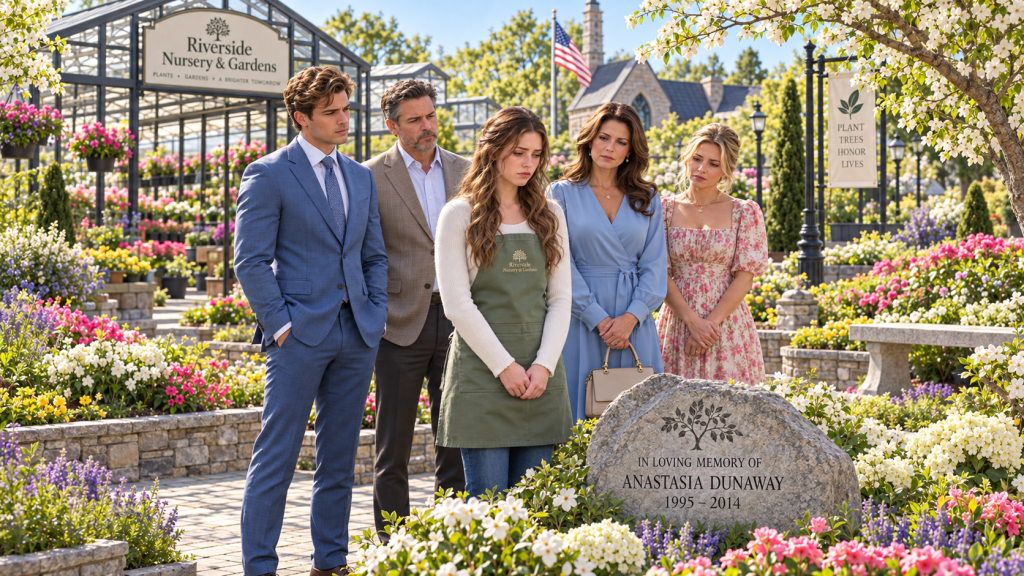
A white dogwood.
My dogwood.
The exact tree Claire had purchased.
I recognized the shape of the lower branches.
The small scar on the trunk.
I had examined it with my own hands.
Beside the photograph sat a black granite plaque.
My feet felt heavy as I approached.
IN LOVING MEMORY OF
ANASTASIA DUNAWAY
1995–2014
I read it once.
Then again.
The year I had been hospitalized.
My parents had not told Claire’s family I was living in Atlanta.
They had told them I was dead.
My mind raced backward through eight years.
Every motel.
Every forced weekend away.
Every holiday.
Every time Mom said she was “protecting my privacy.”
Every time Dad refused to look at me.
Every time Matthew allowed it.
They hadn’t simply hidden my illness.
They had invented my death.
They had taken the year I survived the darkest moment of my life and turned it into the year I supposedly died.
My mother had been accepting sympathy.
My father had been playing the grieving father.
My brother had been pretending he had lost a sister.
Meanwhile, I had been sleeping twenty feet away whenever the Whitmores weren’t visiting.
I looked at the dogwood photograph again.
Then another realization struck.
I had selected my own memorial tree.
I had written the instructions for caring for the tree planted in memory of my fictional death.
I pressed both hands against the desk.
A strange sound came from my throat.
Half laugh.
Half sob.
For years, I had believed I was the one with the embarrassing history.
Standing in that room, I finally saw the truth.
There was nothing shameful about being sick.
What they had done was shameful.
I stopped shaking.
Calm settled over me.
It frightened me how calm I became.
I walked to my closet.
On the top shelf was a small metal box.
Inside were my birth certificate, passport, Social Security card, school records, insurance information, bank documents, and several hundred dollars in emergency savings.
I took everything.
Then I began packing.
Not for a weekend.
For good.
I packed clothes.
Medication.
My laptop.
Two photographs of my grandmother.
A ceramic bird Jenna had given me.
A notebook from therapy containing goals I had written at nineteen.
One of them read:
BUILD A LIFE WHERE I FEEL SAFE.
I stared at that sentence for a long time.
Then I placed the notebook in my bag.
I left the rest.
The trophies.
The furniture.
The stuffed rabbit.
The plaque.
The fake memorial.
Those things belonged to the story my parents had written.
Before leaving, I opened my bedroom door as wide as it would go.
Then I turned on every light.
The desk lamp.
The bedside lamp.
The ceiling fixture.
The small reading lamp beside the window.
Light poured into the hallway.
I wanted Mom to see it in the morning.
I wanted the room she had turned into a tomb to be bright.
Alive.
Disturbed.
I walked downstairs.
Voices came from the dining room.
Mom laughed at something Patricia said.
Matthew was speaking.
Dad poured drinks.
Twenty feet away, my family was entertaining people who believed I had been dead for eight years.
I stood in the kitchen listening.
For a second, I considered walking into the dining room.
I imagined the silence.
Claire recognizing me.
Patricia screaming.
Mom dropping her glass.
Matthew’s face turning white.
I could have destroyed the lie instantly.
Instead, I decided I wanted something else more.
Freedom.
I slipped through the back door.
Nobody noticed.
I drove until dawn.
Around seven, I stopped at a diner nearly two hundred miles away.
My phone had begun vibrating constantly.
Mom.
Dad.
Matthew.
Mom.
Mom.
Matthew.
Dad.
By noon, I had twenty-three missed calls.
Then Matthew sent a message.
WHAT DID YOU DO? CLAIRE’S FAMILY KNOWS.
I stared at it.
Another message arrived.
CALL ME.
Then another.
YOU’VE CAUSED A DISASTER.
I actually laughed.
People at the next table looked over.
I had caused a disaster?
Not the fictional funeral.
Not the eight-year lie.
Not pretending their living daughter was dead.
Me.
I put the phone down.
A voicemail from Mom arrived.
I listened.
“Anastasia, where are you? Please call us. You don’t understand what happened. We can explain.”
I deleted it.
Dad’s voicemail was angrier.
“You need to call immediately. Running away is not how adults handle problems.”
I deleted that one too.
Then Matthew called again.
This time, curiosity made me answer.
“Where are you?” he demanded.
I said nothing.
“Ana?”
“You told her I was dead.”
Silence.
Then, “It’s complicated.”
“No.”
“It got out of control.”
“You told Claire I died.”
“I didn’t mean for it to go this far.”
“How far did you mean for it to go?”
“Ana—”
“Did you know Mom made me leave because of the lie?”
Silence.
That answered everything.
“You knew.”
“I knew some of it.”
“How much?”
“I knew they didn’t want the Whitmores seeing you.”
“Because they thought I was dead.”
He breathed heavily.
“I was going to tell Claire eventually.”
“Eight years wasn’t enough time?”
“That’s not fair.”
I almost couldn’t believe him.
“Not fair?”
He immediately realized his mistake.
“I didn’t mean—”
“No, Matthew. Say it again. Tell your dead sister what’s unfair.”
He began crying.
That surprised me.
“I’m sorry.”
I felt nothing.
Maybe I would later.
At that moment, I was empty.
“What happened this morning?” I asked.
He hesitated.
“Mom went upstairs.”
“And?”
“She saw the room open.”
I waited.
“She started panicking. Patricia was with her.”
Of course.
“Claire heard them arguing.”
“What did she find?”
“A receipt.”
My pharmacy receipt.
Mom must have hidden my medicine and dropped the receipt somewhere.
“It had your name,” Matthew continued. “And the date.”
Two days earlier.
Apparently Claire picked it up.
She asked why a dead woman had filled a prescription two days earlier.
Mom attempted to say there had been a mistake.
Then Claire remembered me.
The nursery.
My face.
My name tag.
The dogwood.
She confronted Matthew.
He confessed.
Not everything.
Just enough.
“You need to come back,” he said.
“No.”
“Claire canceled lunch with her family.”
“Good for Claire.”
“She might end the engagement.”
“That sounds like a problem between you and Claire.”
“You’re my sister.”
I closed my eyes.
“Funny time to remember.”
I hung up.
Ten minutes later, Green Haven called.
Luis, my supervisor, sounded worried.
“You didn’t come in.”
“I know.”
“Are you okay?”
The question nearly made me cry because he actually meant it.
“I’m safe.”
“There’s a woman here looking for you.”
“Claire?”
“Yes.”
I stared through the diner window.
“Tell her I’m sorry.”
“For what?”
“I don’t know.”
Luis paused.
“You want to talk to her?”
“No.”
“Are you coming in tomorrow?”
I looked at the suitcase beside me.
“No.”
“Ana.”
“I’m quitting.”
He was silent.
“You’ve worked here eight years.”
“I know.”
“You don’t have to make that decision today.”
“I already did.”
Luis sighed.
“I’ll keep the position open for a month.”
“You don’t have to.”
“I know.”
I wiped tears from my face.
“Thank you.”
After I hung up, Claire left a voicemail.
Her voice sounded stunned.
“Anastasia, this is Claire. I don’t know if you want to hear from me. I just… I’m sorry.”
She paused.
“I didn’t know.”
Another pause.
“I believed them.”
Her voice broke.
“They told me you died after a long illness. Matthew told me stories about you. Your mother told stories about you. We planted a tree.”
I covered my mouth.
“I met you. I stood in front of you, and you helped me choose your own memorial tree.”
She started crying.
“I am so sorry.”
I listened to the rest.
She didn’t ask me to return.
She didn’t defend Matthew.
She only said, “I hope wherever you are, somebody is treating you like you deserve to exist.”
That sentence finally broke me.
I put my head down on the diner table and cried.
Hours later, I kept driving.
I had no destination.
Only distance.
Three hundred miles from home, exhaustion forced me to stop at a bus station.
I sat near a vending machine.
That was when someone said, “Anastasia?”
I looked up.
Jenna stood there.
For one second, I thought I had imagined her.
She looked different.
Shorter hair.
Wedding ring.
But it was her.
The friend who had allowed me to sleep on her couch during the first years of my parents’ disappearing routine.
“What are you doing here?” she asked.
I tried to answer.
Instead, I started sobbing.
Jenna sat beside me.
She didn’t say, “Calm down.”
She didn’t demand an explanation.
She simply waited.
When I finally told her everything, her expression moved from confusion to disbelief to anger.
“They told people you were dead?”
“Yes.”
“For eight years?”
“Yes.”
“And made you leave the house so nobody found out?”
“Yes.”
She stared at me.
“Ana, come home with me.”
“I don’t want to be anyone’s burden.”
“You’re not.”
“I can get a motel.”
“No.”
“Jenna.”
“I have an apartment over our garage. Nobody uses it.”
“Our?”
“My husband and me.”
She smiled weakly.
“You missed some things after I moved.”
Despite everything, I laughed.
Jenna took me home.
Her husband, Marcus, didn’t ask invasive questions.
He carried my suitcase upstairs and showed me how the heater worked.
The apartment had one bedroom, a tiny kitchen, and windows overlooking the mountains.
“You can stay as long as you need,” Jenna said.
That first night, I slept for eleven hours.
When I woke up, nobody had asked me to leave.
One week became a month.
I found work at a landscaping company.
Later, a botanical garden hired me.
I changed my phone number.
I changed my email.
I opened a new bank account.
Then I mailed one letter to my parents.
I AM ALIVE.
I AM SAFE.
DO NOT LOOK FOR ME.
No return address.
For four years, they respected it.
Or maybe they simply couldn’t find me.
I learned pieces of the aftermath through old friends.
Claire canceled the wedding.
Matthew begged her to reconsider.
She refused.
Apparently, when Mom tried to explain that they had lied because they feared judgment, Claire said, “I’m not judging Anastasia. I’m judging all of you.”
I heard that sentence months later.
It stayed with me.
Claire’s parents were horrified.
Patricia, the woman who had stood outside my bedroom praying for my soul, reportedly refused to speak to my mother for nearly a year.
Richard demanded that a donation made in my memory to a mental-health charity be corrected so it no longer listed me as deceased.
Dad hated that.
Mom hated it more.
For the first time, they had to explain the truth publicly.
They had to tell relatives.
Friends.
Church members.
People who had comforted them.
People who had sent flowers.
There had never been a funeral, thankfully, but my parents had told everyone my death had been private because the family was too devastated for a large service.
They had invented an urn.
They claimed my ashes had been scattered at a lake.
They created an entire mythology around a death that never happened.
Once exposed, the lie collapsed everywhere.
Mom stopped attending church for months.
Dad resigned from a community board.
Matthew’s relationship ended.
At first, hearing those consequences gave me a flicker of satisfaction.
Then even that faded.
I realized I didn’t want my life measured by their punishment.
I wanted something better than revenge.
I wanted a future.
I enrolled in horticulture courses.
I studied landscape restoration.
I learned business management.
I saved money.
Slowly, the frightened woman who had left with a duffel bag became someone capable of making long-term plans.
Three years after leaving, I bought a small house.
Two bedrooms.
A crooked porch.
Ugly kitchen cabinets.
A backyard that had been neglected for years.
I loved it immediately.
I planted lavender.
Rosemary.
Hydrangeas.
And beside the kitchen window, a white dogwood.
Jenna asked whether I was sure.
I knew what she meant.
“Yes.”
“Doesn’t it remind you of…”
“It does.”
“Then why?”
I pressed soil around the roots.
“Because I want one that belongs to me.”
That tree was not planted in memory of anyone.
It was not a symbol of death.
Every spring, when white blossoms appeared, it reminded me that survival deserved monuments too.
Four years after I disappeared, Matthew found me.
It was a Saturday morning.
I opened the door and saw him standing on the porch.
My first instinct was fear.
Then anger.
“How did you find me?”
“Claire.”
I stared at him.
“She knew where I was?”
“Not exactly. She knew someone who still talked to Jenna.”
I folded my arms.
“So she helped you violate the one thing I asked?”
“No. She refused for years.”
“Then why now?”
“Dad had a heart attack.”
I felt something shift.
Not forgiveness.
Not panic.
Something quieter.
“Is he alive?”
“Yes.”
“Then why are you here?”
“Mom wants to see you.”
“No.”
“Ana—”
“No.”
“She’s sorry.”
“She had eight years to be sorry.”
Matthew looked older.
His shoulders had changed.
There was less confidence in him.
“I’m sorry too.”
I laughed softly.
He nodded.
“I know that sounds useless.”
“It is.”
He looked at the porch floor.
“I deserve that.”
“No. Stop doing that.”
“What?”
“Don’t turn this into a performance where you punish yourself and I’m supposed to comfort you.”
He looked up.
“I’m not.”
“Then answer questions.”
He nodded.
“Fine.”
I stepped outside.
“You have five minutes.”
Matthew swallowed.
I asked him the question I had carried for four years.
“Whose idea was it?”
“The first lie?”
“Yes.”
“Mine.”
I expected that answer.
It still hurt.
“Why?”
“Claire asked if I had siblings.”
“And?”
“I said I had a younger sister.”
He rubbed his palms together.
“She asked about you. I mentioned you had been away. She asked where.”
“So you said I died?”
“I panicked.”
“What exactly were you afraid of?”
“I don’t know.”
“Yes, you do.”
He stared at me.
Finally he whispered, “I thought she would think our family was damaged.”
There it was.
“Because I had depression.”
“Yes.”
I nodded.
“Continue.”
“I told her you had died after an illness.”
“Then Mom and Dad found out?”
“Yes.”
“What did they say?”
“Dad was furious at first.”
A bitter laugh escaped me.
“Because lying is wrong?”
“No.”
“Because you might get caught?”
“Yes.”
Of course.
Matthew continued.
“Mom said we should correct it.”
That surprised me.
“For about one day.”
Then Dad apparently decided telling the truth would humiliate the family.
He convinced everyone to maintain the story.
One lie became dozens.
My parents invented dates.
Memories.
Grief.
The reason I was repeatedly removed from the house was simple.
If Claire ever saw me, the entire thing would collapse.
“Did you ever ask them to stop making me leave?”
Matthew looked away.
“No.”
“Did you ever see me leave?”
“Yes.”
“How many times?”
“A lot.”
“How many?”
His eyes filled.
“Almost all of them.”
I felt a sharp pain in my chest.
“You watched me carry that bag out of the house.”
“Yes.”
“You knew I sometimes slept in motels.”
“Yes.”
“You knew I once slept in my car?”
His face changed.
“I didn’t know that.”
“But you knew enough.”
“Yes.”
I breathed slowly.
“Did you love Claire?”
“Yes.”
“Then why didn’t you trust her with the truth?”
He had no answer.
I realized that was why she left.
Not because he had an imperfect family.
Because he had shown her what he was willing to do to preserve an image.
Matthew wiped his eyes.
“She got married last year.”
I said nothing.
“She has a son.”
“Good for her.”
“She asked me to tell you something.”
I waited.
“She never blamed you.”
My throat tightened.
“And the dogwood is still alive.”
I looked toward my own tree.
“Good.”
“She had the memorial plaque removed.”
That mattered more than I expected.
Matthew pulled an envelope from his jacket.
“Mom wrote this.”
I didn’t take it.
“You don’t have to read it.”
“Then I don’t need it.”
He lowered his hand.
“Fair.”
Before leaving, he said, “For what it’s worth, there hasn’t been a day I haven’t regretted it.”
I looked at him.
“That’s yours to carry.”
He nodded.
“I know.”
Three months later, Mom came.
I nearly closed the door.
She had aged dramatically.
Gray hair.
Thinner face.
Hands that shook.
“Anastasia.”
I stared at her.
“Matthew gave you my address.”
“Yes.”
“I told him not to.”
“I know.”
“Then why are you here?”
Her eyes filled.
“Because I needed to say this while I still could.”
I did not invite her inside.
She stood on the porch.
“I buried you while you were alive.”
My breath caught.
For years, I had wanted someone in my family to say exactly what happened without softening it.
Mom continued.
“I let people believe my daughter was dead because I was ashamed to admit she had been ill.”
I watched her.
“I accepted their sympathy.”
“Yes.”
“I made you leave.”
“Yes.”
“I turned your bedroom into a memorial.”
“Yes.”
“I lied to you about what I had told them.”
“Yes.”
She started crying.
I didn’t comfort her.
“I told myself I was protecting Matthew,” she said. “Then I told myself I was protecting you. Then I told myself admitting the truth would destroy the family.”
“It already destroyed the family.”
“I know.”
“No. You protected yourself.”
She closed her eyes.
“Yes.”
That answer startled me.
“You wanted a perfect family.”
“Yes.”
“And I didn’t fit.”
“You were never the problem.”
“Don’t do that.”
Her eyes opened.
“You absolutely believed I was the problem.”
She nodded.
“Yes.”
Silence.
The honesty hurt.
But dishonesty had hurt far more.
“I was ashamed,” Mom whispered.
“Of me.”
“Yes.”
I looked toward the dogwood.
She followed my gaze.
Her face crumpled when she saw it.
“Is that…”
“It’s mine.”
“I know.”
“No. You don’t. That tree is mine. It isn’t a memorial. It isn’t about what happened to you. It doesn’t represent your grief.”
She nodded quickly.
“I understand.”
“It represents the fact that I lived.”
Mom covered her mouth.
For several minutes, neither of us spoke.
Finally she said, “I’m sorry.”
I had imagined hearing those words for years.
In my imagination, they fixed everything.
Reality was quieter.
“I believe you.”
Her face lifted.
“But I’m not coming home.”
“I know.”
“And I’m not forgiving eight years because you drove here once.”
“I know.”
“If we ever have a relationship again, it will happen slowly.”
“Yes.”
“And you will never lie about what happened.”
“I won’t.”
“If someone asks where I was, you tell them I was alive.”
“Yes.”
“If someone asks why I left, you tell them.”
She swallowed.
“Yes.”
“You do not say I was unstable.”
“I won’t.”
“You do not blame medication.”
“I won’t.”
“You do not say I misunderstood.”
“I won’t.”
For the first time in my life, my mother accepted conditions without arguing.
She left twenty minutes later.
I watched her car disappear.
Then I cried.
Not because I wanted her back.
Because I had finally spoken to her as someone who understood she had the right to set boundaries.
Six months later, I agreed to see Dad.
We met in a restaurant halfway between our homes.
He looked frail after the heart attack.
He started crying immediately.
“I’m sorry.”
I waited.
“There’s no excuse.”
That mattered.
Then he admitted the part Mom had avoided.
Maintaining the lie had ultimately been his decision.
Matthew created it.
Dad institutionalized it.
He decided correcting the story would make the family look worse than continuing it.
He coached Mom.
He invented explanations.
He made sure I disappeared.
“I thought I was controlling damage,” he said.
“You were controlling me.”
“Yes.”
That one word carried more accountability than years of excuses ever could.
I did not hug him when we left.
But I agreed to another lunch.
Healing happened like that.
Not dramatically.
Not cleanly.
Mom called occasionally.
Sometimes I answered.
Dad sent birthday cards.
Matthew and I exchanged holiday texts.
Trust returned in fragments.
Some things never returned.
I never gave my parents a key.
I never slept in their house again.
I never allowed them to refer to my hospitalization as a “bad decision” or “that embarrassing time.”
When Mom once started to say, “We all made mistakes,” I stopped her.
“No.”
She looked startled.
“Matthew lied. You and Dad maintained it. I survived it. Those are not equivalent mistakes.”
She nodded.
“You’re right.”
Years earlier, she would have argued.
That difference mattered.
Almost six years after I left, Claire contacted me.
Her message was simple.
Would you meet me at the church?
I knew which church.
The dogwood.
I agreed.
When I arrived, the tree was enormous compared with the one I had sold her.
Branches stretched over a stone bench.
White blossoms filled the canopy.
Claire stood beneath it beside a little boy.
“This is Noah.”
He hid behind her.
I smiled.
“Hi, Noah.”
Claire looked at me.
“I’ve wanted to see you for years.”
“I know.”
“I didn’t want to intrude.”
“Thank you.”
We sat on the bench.
For a while, neither of us mentioned Matthew.
Finally Claire said, “I nearly had the tree removed.”
“Why?”
“Because every time I saw it, I remembered the lie.”
I looked upward.
“What changed?”
“I remembered you chose it.”
I swallowed.
“You didn’t know.”
“No.”
“You weren’t part of it.”
“I still feel horrible.”
“Don’t.”
She looked at me.
“I sold you a tree. You bought one for someone you thought was dead. Neither of us did anything wrong.”
Claire smiled sadly.
“That might be the healthiest thing anyone has said about it.”
I noticed the old black plaque was gone.
In its place stood a small brass marker.
I walked closer.
FOR EVERYONE WHO SURVIVED SOMETHING OTHERS THOUGHT SHOULD DEFINE THEM.
My eyes filled.
Claire stood behind me.
“I hope that was okay.”
“It’s perfect.”
She exhaled.
“I wanted the tree to become something else.”
“It already has.”
We stood beneath the branches.
Petals fell onto the grass.
Claire told me about her life.
She had married a teacher.
She was happy.
She said she had not spoken to Matthew in years, though she hoped he had changed.
Before we parted, she touched the tree.
“I used to think memorials only marked people who died.”
I looked at her.
“Maybe sometimes they can mark versions of us that we outgrew.”
I thought about nineteen-year-old me.
Frightened.
Apologetic.
Believing she needed to leave rooms so everyone else could remain comfortable.
That version of me was gone.
Not dead.
Grown.
Years passed.
I eventually opened my own nursery.
I called it Second Bloom Gardens.
Jenna became my business manager.
Marcus built the checkout counter himself.
Luis drove nearly four hours for the grand opening.
When I saw him, I hugged him so hard he laughed.
“I told you I’d keep that job open thirty days.”
“I needed longer.”
“Apparently.”
My parents attended too.
They stayed near the back.
Mom bought a rosemary plant.
Dad donated money to the mental-health organization we partnered with.
He didn’t announce it.
He didn’t make a speech.
He simply put the envelope into the box.
That mattered.
Before Mom left, she asked, “Can I hug you?”
Asked.
Not assumed.
I nodded.
Matthew came an hour later.
He had remarried.
His wife knew everything before they married.
That had been my only request when he told me he was engaged.
“No lies,” I said.
“There aren’t any.”
He kept that promise.
His daughter, Emily, was seven the first time he brought her to the nursery.
She had dark hair like mine.
I showed her how to repot a fern.
She watched seriously as I loosened the root ball.
“Daddy says you’re really good at making plants come back.”
I glanced at Matthew.
He looked embarrassed.
I smiled.
“Plants usually come back themselves.”
Emily frowned.
“Then what do you do?”
“Give them what they need.”
“What?”
“Good soil. Water. Light. Space.”
She considered that.
Then she said, “People need that too.”
I laughed.
“Yes.”
They do.
People need food.
Shelter.
Medication sometimes.
Therapy sometimes.
Distance sometimes.
Truth always.
For years, my parents thought the worst thing about our family was that their daughter had needed psychiatric care.
They were wrong.
The worst thing was what they were willing to do to hide it.
I had survived depression.
I had survived anxiety.
I had asked for help.
None of those things made me shameful.
They made me human.
The secret almost destroyed me more effectively than the illness ever had.
There is a particular kind of pain that comes from realizing people who claim to love you are more comfortable grieving your fictional death than acknowledging your imperfect life.
For a long time, I carried that pain everywhere.
Eventually, I learned I could put it down.
Not forget.
Not erase.
Put down.
People sometimes ask whether I forgave my family.
I never know how to answer.
Forgiveness sounds too simple.
As though there is a switch.
Off.
On.
Angry.
Forgiven.
My reality was messier.
I stopped wanting to punish them.
I stopped imagining revenge.
I stopped waking up angry.
I allowed them to become people in my life again, but never authorities over it.
Maybe that is forgiveness.
Maybe it isn’t.
I don’t need a name for it.
What matters is that their shame no longer belongs to me.
Every spring, two dogwoods bloom.
One at the church.
One outside my kitchen window.
The church tree once had my fake death carved beneath it.
Now it honors survival.
My tree never had a plaque.
It doesn’t need one.
Sometimes, early in the morning, I sit beneath it with coffee.
White petals drift onto the grass.
I think about the night I returned for my medication.
How easily I might have skipped that trip.
How I could have remained unaware for another year.
Five years.
Maybe forever.
I think about that black granite plaque.
1995–2014.
The strange thing is that something did end in 2014.
But it wasn’t my life.
It was the version of me who believed my family’s approval was the measure of my worth.
That girl began disappearing long before anyone told Claire she was dead.
She disappeared every time she apologized for needing help.
Every time she lowered her voice when saying “therapy.”
Every time she packed the blue duffel bag.
Every time she accepted humiliation because confrontation felt frightening.
Years later, I found that old bag in Jenna’s garage.
I had forgotten it there.
The fabric was faded.
One zipper was broken.
I took it home.
For a while, I considered throwing it away.
Instead, I placed it in a storage box with my old therapy notebook.
Not as a memorial.
As evidence.
Evidence that I once carried everything I thought I needed inside one worn bag because the people who were supposed to protect me convinced me I had no permanent place.
Now I own a home.
A business.
A life.
There is no room in any of them where I am required to disappear.
On the tenth anniversary of the night I left, I closed the nursery early.
Jenna came over.
So did Claire.
Matthew arrived with Emily.
Mom and Dad came separately.
We ate outside beneath the dogwood.
Nobody called it an anniversary.
Nobody made speeches.
We simply had dinner.
At one point, Emily looked around the table.
“Why are we celebrating?”
Everyone became quiet.
Matthew looked at me.
He let me answer.
I smiled at her.
“Because a long time ago, I made a very important decision.”
“What decision?”
“I decided I deserved my own life.”
She nodded as though this made complete sense.
“What did you do?”
“I left somewhere I wasn’t being treated properly.”
“Were you scared?”
“Yes.”
“Did you know what would happen?”
“No.”
Emily thought about this.
“Then how did you know leaving was right?”
I looked at the people around the table.
Some had hurt me.
Some had saved me.
Some had done both in different ways.
“Because staying was teaching me to disappear.”
She seemed satisfied.
Then she returned to her dessert.
Mom looked down at her hands.
Dad stared toward the yard.
Matthew quietly wiped his eyes.
Nobody defended themselves.
Nobody changed the story.
That, more than any apology, showed me how far we had come.
I once believed a happy ending meant my family finally understanding that what they did was wrong.
Later, I thought a happy ending would mean never seeing them again.
Neither idea was completely right.
My happy ending was bigger.
It was having choices.
I could answer Mom’s call or let it ring.
I could invite Matthew to dinner or spend six months without seeing him.
I could talk openly about my mental health without watching people’s faces for signs of judgment.
I could tell my story without lowering my voice.
I could plant white dogwoods without thinking of graves.
I could exist without permission.
That was the freedom I had been searching for.
My parents had spent eight years pretending I was dead because they thought my life made them look imperfect.
In the end, their lie taught me something they never intended.
A person should never have to shrink, hide, leave, lie, apologize, or symbolically die so someone else can maintain a perfect image.
If people love you only when your truth remains invisible, they do not love the whole of you.
They love the version that makes them comfortable.
I no longer live for anyone’s comfort.
I live honestly.
Some days are hard.
I still take medication.
I still see a therapist when I need one.
Sometimes anxiety returns.
Sometimes depression knocks quietly.
But when it does, I don’t hide.
I don’t call myself weak.
I don’t imagine a black plaque with my name.
I remember that asking for help once kept me alive.
And being alive has given me everything that came afterward.
My home.
My work.
My friendships.
My garden.
My second chance with parts of my family.
My freedom.
My voice.
People sometimes stop beneath the dogwood at Second Bloom Gardens and ask why white dogwoods are my favorite.
I usually smile.
“Long story.”
Some customers laugh.
Some ask me to tell it.
Most don’t.
That’s fine.
The tree doesn’t need everyone to know.
Neither do I.
For eight years, my parents ordered me to disappear for a weekend at a time.
Then one night, I finally disappeared completely.
The irony is that leaving was the first time I truly became visible to myself.
I stopped being the daughter hidden upstairs.
The shameful secret.
The imaginary executive in Atlanta.
The dead sister.
The memorial.
I became Anastasia.
A woman who survived.
A woman who left.
A woman who rebuilt.
A woman whose life continued long after other people tried to write its ending.
And every spring, when the white blossoms return, I remember the room glowing at the end of that dark hallway.
The door open.
Every light burning.
The shrine disturbed.
The documents gone.
My mother must have stood there the next morning staring into the room she had spent years pretending belonged to a dead daughter.
For once, the lie could not survive the light.
Neither could the version of me who accepted it.
They told everyone I died in 2014.
They were wrong.
That was the year I learned how desperately I wanted to live.
And years later, when I finally walked away from them, I wasn’t disappearing.
I was coming back.
Back to my own name.
Back to my own life.
Back to the world.
Alive.
Visible.
Unashamed.
And this time, nobody gets to bury me before I’m gone.
💬THE END! THANK YOU FOR READING!