

For twenty-six years, my father pretended I did not exist.
Then he saw me in uniform outside the White House and ordered me to act like we were strangers.
Less than ten minutes later, a four-star general walked past my father’s outstretched hand, stopped in front of me, saluted, and announced that the Secretary of Defense was waiting.
That was the moment my father suddenly remembered he had a daughter.
And I knew exactly why.
My name is Colonel Maya Caldwell.
I was fifty-one years old the morning my father discovered that the child he had spent most of his adult life dismissing had somehow built a life he could no longer ignore.
The invitation in my hand carried the White House seal.
The silver eagles on my shoulders caught the pale Washington morning light.
Around me stood ambassadors, lawmakers, defense executives, military officers, senior government officials, and guests waiting to pass through security for a national defense technology summit.
I had attended more intimidating events.
I had briefed commanders while rockets landed less than a mile away.
I had stood in rooms where people decided whether thousands of soldiers would deploy.
I had once delivered a forty-minute presentation to twelve generals after sleeping for ninety minutes on the floor of an operations center.
But nothing tightened my stomach quite like seeing Victor Caldwell thirty feet ahead of me.
My father.
He had aged well.
Of course he had.
Victor believed aging was another problem money could solve.
His hair, once dark brown, was silver at the temples and carefully trimmed. His tuxedo probably cost more than my first car. A tiny American flag pin rested perfectly on his lapel.
Beside him stood Lorraine, his wife of twenty-four years.
And beside Lorraine stood Blake.
Her son.
The son Victor had spent twenty-six years introducing as his own.
Blake was thirty-six and still possessed the relaxed confidence of a man who had never worried about rent.
He had attempted three businesses.
All three had failed.
Victor had financed every one.
The last had been a company that supposedly developed artificial-intelligence software for warehouse management.
It lasted eleven months.
Blake still called himself an entrepreneur.
He noticed me first.
His eyes traveled from my polished shoes to the ribbons on my chest and finally to the insignia on my shoulders.
He smiled.
Not warmly.
Blake had been fifteen when our parents married.
From our first meeting, he had treated me like an inconvenient relative who should be grateful for occasional invitations.
“Well,” he said loudly enough for the people around him to hear. “This is unexpected.”
Lorraine turned.
Then Victor did.
For half a second, the expression on my father’s face was pure shock.
It disappeared quickly.
Victor Caldwell had spent his entire adult life learning how to control what other people saw.
“Maya?”
I gave him a small nod.
“Good morning, Dad.”
Lorraine’s mouth tightened.
Blake grinned.
“Maya finally made it to the White House.”
His eyes moved over my uniform again.
“What are you doing? Security?”
I said nothing.
He laughed at his own joke.
“Try not to let any senators steal the silverware.”
Lorraine touched his arm.
“Oh, Blake.”
But she was laughing too.
My father was not.
He stared at me with the expression he used to wear when I was seventeen and had embarrassed him by arriving at one of his corporate dinners wearing a thrift-store dress.
“What are you doing here?”
“I was invited.”
“To this event?”
“Yes.”
Victor looked at my uniform again.
He had never bothered to learn enough about my career to understand what the silver eagles meant.
That should have hurt.
Years earlier, it would have.
Now it simply confirmed something I already knew.
“You’re still in the Army?” he asked.
I almost smiled.
“Apparently.”
Lorraine looked between us.
“I thought you were doing administrative work somewhere.”
“Sometimes.”
That answer seemed to satisfy her.
My father stepped closer.
“Maya, come here.”
It was not a request.
I followed him several feet away from Lorraine and Blake.
Victor lowered his voice.
“Today matters to Caldwell Defense Systems.”
“I’m sure it does.”
“We have several very important people here. There are procurement officials, defense committees, representatives from allied governments, people connected to future programs.”
He paused.
“So whatever assignment brought you here, just do your job.”
I stared at him.
Victor glanced over his shoulder to make sure nobody was listening.
“And stay away from us.”
There it was.
Twenty-six years condensed into five words.
Stay away from us.
My father and my mother divorced when I was fourteen.
For two years afterward, Victor still pretended to be my father on alternate weekends.
Then he met Lorraine.
She was elegant, connected, socially ambitious, and recently widowed.
She had one son.
Blake.
Within months, my father stopped calling me every Sunday.
Then he started canceling visits.
Then the birthday checks arrived instead of birthday dinners.
Then the checks stopped too.
When I graduated from high school, Victor promised to attend.
I saved him a seat beside my mother.
The chair remained empty.
He sent flowers the next day.
When I graduated from college, he said a business trip prevented him from attending.
When I completed Officer Candidate School, his assistant mailed me a congratulations card.
The signature inside was printed.
When I deployed for the first time, I called him from the airport.
His secretary said he was unavailable.
I left a message.
He never returned it.
After my mother died, I tried once more.
I called Victor and told him I did not want money.
I did not want explanations.
I simply did not want to lose the only parent I had left.
He was quiet for several seconds.
Then he said, “Maya, you’re an adult now. We have separate lives.”
Separate lives.
That became the foundation of our relationship.
At corporate functions, Blake was introduced as Victor’s son.
Family Christmas photographs appeared in magazines featuring Victor, Lorraine, and Blake.
I was never mentioned.
When Caldwell Defense Systems celebrated its twenty-fifth anniversary, a business publication wrote an article describing the company as a family enterprise Victor hoped to pass to “his son, Blake Caldwell.”
Blake had legally changed his surname three years after Lorraine married my father.
I still had the name I had been born with.
But somehow I became the outsider.
For years, I kept trying.
Birthday cards.
Christmas cards.
Short emails.
One photograph from Afghanistan.
Another from Germany.
Another when I was promoted to lieutenant colonel.
Sometimes his assistant responded.
Usually no one did.
Eventually, I stopped.
Now my father stood outside the White House telling me to pretend I did not know him.
“Today is important,” he repeated.
“I heard you.”
“I don’t want complications.”
I looked at the man I had once spent entire childhood afternoons waiting beside the front window for.
“Don’t worry.”
His shoulders relaxed.
“I won’t embarrass you.”
“That isn’t what I meant.”
“It’s exactly what you meant.”
Victor’s jaw tightened.
“Maya.”
“You asked me to stay away.”
“Yes.”
“So I will.”
I turned toward the security checkpoint.
Then he said the words that made the entire thing almost funny.
“And please don’t tell anyone here that you’re my daughter.”
I looked back at him.
“All right.”
Victor nodded.
Satisfied.
He believed he had solved the problem.
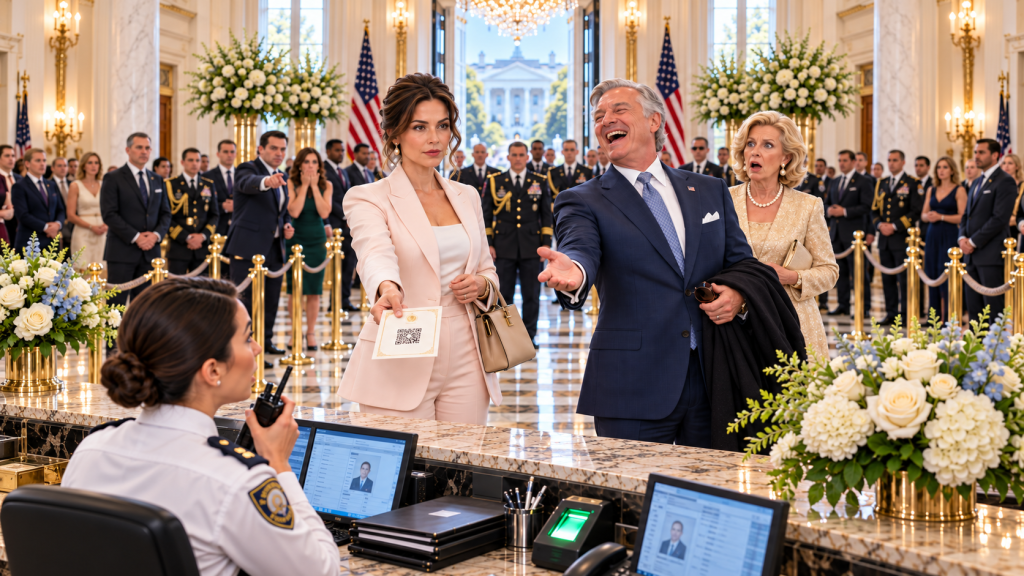
I walked toward the principal security entrance.
An event coordinator in a navy dress checked the document in my hand.
“Military attendees are entering through the south checkpoint, ma’am.”
“This invitation says principal entrance.”
She smiled politely.
“I understand, but most uniformed personnel are being routed through—”
I handed her the card.
She read it.
Her expression changed.
“Colonel Caldwell?”
“Yes.”
She looked at the identification badge clipped inside my jacket.
“One moment.”
She stepped toward a Secret Service officer.
Behind me, I heard Blake chuckle.
“Told you. Wrong door.”
The Secret Service officer approached.
“Colonel, military identification please.”
I handed it over.
She scanned it.
Then she scanned the encrypted code on my invitation.
Her terminal flashed.
The officer stared at the screen.
Her posture changed immediately.
“Please remain here.”
Victor muttered behind me.
“I knew there would be a credential issue.”
The officer touched her earpiece.
“Command, hold inner traffic at East reception.”
Several people glanced toward us.
The event coordinator looked embarrassed now.
The officer spoke quietly into her microphone.
“I need confirmation from General Hale’s office regarding Colonel Maya Caldwell.”
There was a pause.
Then another.
The officer listened.
“Copy.”
She returned my identification and straightened.
“Colonel Caldwell, General Hale is coming to receive you personally.”
The laughter behind me stopped.
Victor stepped closer.
“General Hale?”
I did not answer.
General Marcus Hale was the Chairman’s senior military adviser for advanced defense modernization and one of the most respected officers in the building.
Four stars.
Forty-one years of service.
He had commanded divisions, joint task forces, and multinational operations.
I had worked for him in three different assignments.
The doors opened.
Conversation around us faded.
General Hale walked toward the checkpoint accompanied by two aides.
Every uniformed service member in sight snapped upright.
Victor’s entire expression transformed.
This was his world now.
Influence.
Access.
Opportunity.
He stepped forward immediately.
“General Hale.”
My father extended his hand.
The general walked past it.
He stopped directly in front of me.
Then he saluted.
“Colonel Caldwell.”
I returned it.
“General.”
“The Secretary has been asking where you are.”
Silence.
Not complete silence.
Washington never became completely silent.
But close enough.
Victor slowly lowered his hand.
General Hale continued.
“We moved the Sentinel briefing forward twenty minutes. The Secretary wants your assessment before the principals arrive.”
“Yes, sir.”
“Your field test data came in?”
“At 0430.”
“And?”
“Not good.”
His expression hardened.
“That’s what I was afraid of.”
Only then did he look toward the people behind me.
Victor recovered instantly.
“General Hale, Victor Caldwell. Caldwell Defense Systems.”
Hale gave him a brief nod.
“Mr. Caldwell.”
“We met at the Arlington defense forum three years ago.”
“I meet a lot of people.”
Victor smiled harder.
“Of course.”
Then, unbelievably, he put his hand on my shoulder.
“This is my daughter.”
The same man who had told me six minutes earlier to pretend we were strangers.
General Hale looked at the hand on my shoulder.
Then at me.
His eyebrows lifted slightly.
I said nothing.
Victor continued.
“Maya has always been very independent.”
Independent.
That was one word for abandoned.
The general’s gaze stayed on me.
“Colonel?”
I removed my father’s hand.
“Mr. Caldwell and I haven’t had a relationship in twenty-six years.”
Victor’s face went rigid.
Blake stared at me.
Lorraine looked horrified.
Not by what Victor had done.
By the fact I had said it aloud.
General Hale nodded once.
“Understood.”
Then he turned.
“Colonel, with me.”
I followed.
Behind us, my father called my name.
“Maya.”
I kept walking.
“Maya, wait.”
General Hale glanced sideways.
“Problem?”
“No, sir.”
We passed through the doors.
The last thing I saw was Victor Caldwell standing beside his perfect family with an expression I had never seen before.
Uncertainty.
General Hale waited until we were out of earshot.
“Your father?”
“Biologically.”
“That explains the name.”
“Unfortunately.”
He gave me a sideways look.
“You never mentioned your family owns Caldwell Defense Systems.”
“My father owns it.”
“You own stock?”
“No.”
“Trust?”
“No.”
“Financial interest?”
“None.”
“Expected inheritance?”
I almost laughed.
“Absolutely not.”
Hale nodded.
“I assumed legal had already covered it.”
“They did. Full disclosure six months ago.”
“And you requested recusal on procurement scoring.”
“Yes, sir.”
That detail mattered.
Very much.
Sentinel Shield was one of the largest military modernization programs in development.
The goal was simple to describe and extremely difficult to build: a secure mobile network connecting ground forces, drones, sensors, aircraft, and command posts even when traditional communications were jammed.
Three companies had reached final evaluation.
Caldwell Defense Systems was one.
The potential value of the first phase alone was $8.4 billion.
If Victor’s company won, Caldwell Defense would become one of the largest defense technology firms in the country.
If it lost, the company would survive.
But its future would look very different.
My role was not to select the winning contractor.
Because of my relationship with Victor, I had specifically requested removal from any decision that could financially benefit or harm his company.
But I commanded the operational evaluation team.
That meant my people tested what the companies had built.
We did not care about PowerPoint slides.
We did not care about lobbying.
We did not care which executives knew which senators.
We took prototypes into deserts, mountains, freezing weather, electronic warfare environments, and simulated combat.
Then we measured whether they worked.
Caldwell Defense had a problem.
Actually, it had several.
The company claimed its network node could remain operational for eighteen hours under heavy load.
Our tests averaged eleven.
It claimed automatic failover would restore communication within three seconds.
During two exercises, recovery took more than forty seconds.
Worst of all, the system overheated in enclosed armored vehicles.
At first, those looked like normal engineering failures.
Expensive, but fixable.
Then one of my analysts noticed something strange.
The performance data Caldwell Defense had submitted to the government did not match the raw diagnostic logs embedded in the test equipment.
Numbers had been changed.
Not rounded.
Changed.
We repeated the tests.
The same discrepancies appeared.
That morning at 0430, the final independent laboratory report arrived.
It confirmed deliberate manipulation in multiple test submissions.
That was why the Secretary of Defense wanted me in the room.
Not because I was Victor Caldwell’s daughter.
Because thirty-seven soldiers, engineers, cyber specialists, statisticians, and operational testers had spent eleven months discovering that one of the country’s largest defense contractors might have misrepresented critical performance data.
General Hale and I entered the Roosevelt Room.
Several officials were already seated around the table.
The Secretary stood near the windows reading a briefing folder.
He looked up.
“Colonel.”
“Mr. Secretary.”
“You have confirmation?”
“Yes, sir.”
I placed the report on the table.
“The independent lab reproduced the discrepancies.”
“How many submissions?”
“Seven confirmed. Four more under review.”
“Could this be an instrumentation problem?”
“No, sir.”
“Could your team have mishandled the files?”
“No.”
“You’re certain?”
I had learned something early in my career.
When someone responsible for national decisions asks whether you are certain, confidence is not enough.
You bring evidence.
I opened the binder.
“Original device logs are cryptographically time-stamped. We compared them against the figures submitted by Caldwell Defense. In multiple cases, failure events were removed from the final dataset. Thermal shutdowns were recategorized as operator interruptions. Packet-loss figures were recalculated after excluding periods of degraded performance.”
The Secretary sat down.
“Who signed the certification?”
“Dr. Leonard Pierce, vice president of systems assurance.”
General Hale folded his arms.
“Does Caldwell leadership know?”
“We don’t know.”
That was important too.
My father could be selfish.
He could be arrogant.
He could be cruel.
None of that proved he had ordered anyone to falsify data.
And I would not turn personal history into professional accusation.
The Secretary looked directly at me.
“Colonel, I want to address the obvious issue.”
“Yes, sir.”
“Victor Caldwell is your father.”
“Estranged father.”
“But legally your father.”
“Yes.”
“You filed a conflict disclosure?”
“Six months ago.”
“And requested removal from source selection?”
“Yes.”
The department’s general counsel slid a document across the table.
“She did. Colonel Caldwell has had no access to pricing, competitive ranking, proprietary submissions from other bidders, or selection deliberations.”
The Secretary nodded.
“Good.”
Then he looked at me again.
“How long have you known about the data problem?”
“Initial anomaly was identified seven weeks ago.”
“And when did you learn Caldwell Defense was one of the affected contractors?”
“Immediately.”
“Why didn’t you step away from testing entirely?”
“Because the evaluation protocol was approved before the competitors were identified to my team, sir. I asked ethics counsel whether I should be removed. They advised that replacing the test commander mid-evaluation could create a different integrity problem. So every finding involving Caldwell Defense has been independently replicated and reviewed.”
General Hale added, “I approved that arrangement.”
The Secretary closed the report.
“Then we proceed.”
For the next two hours, nobody mentioned Victor Caldwell as my father.
He was simply the chief executive of a contractor whose submissions had raised serious questions.
That was how it should have been.
When the meeting ended, General Hale caught me outside.
“You all right?”
“Yes, sir.”
“That answer came too fast.”
I looked through a window toward the South Lawn.
“I’m fine professionally.”
“And personally?”
I smiled slightly.
“I’ve had twenty-six years to practice.”
Hale nodded.
“Your father approached me once about getting Blake onto an advisory board.”
That did surprise me.
“When?”
“Two years ago.”
“What did you say?”
“I said advisory boards generally require advisers.”
I laughed.
He almost smiled.
Then his expression became serious.
“Be careful today.”
“I will.”
“If Caldwell learns there’s a problem, he may connect your presence with the program.”
“He will.”
“And?”
“And he’ll decide I can help him.”
Hale looked at me for a long moment.
“You sound certain.”
“I know my father.”
The summit began shortly after nine.
I spent most of the morning in secure sessions.
By noon, rumors had started moving through the building.
They always did.
Nobody knew specifics.
But executives could sense when officials suddenly stopped smiling.
Representatives from Caldwell Defense began checking their phones.
One vice president left a luncheon early.
Victor, according to one of my colleagues, requested an unscheduled conversation with an acquisition official and was politely refused.
At twelve forty-seven, my phone vibrated.
The number was unfamiliar.
I ignored it.
Then a message appeared.
Maya, this is Dad. We need to talk.
I stared at those words.
This is Dad.
For twenty-six years, he had barely earned the right to write either one.
A second message appeared.
I think there has been a misunderstanding about this morning.
Then another.
I’m proud of you. I should have said that.
I locked the screen.
General Hale, sitting beside me during a panel, noticed.
“Started already?”
“Yes.”
“How many?”
“Three.”
“Record everything.”
“I plan to.”
By two o’clock, there were nine messages.
At two fifteen, Blake called.
I declined.
At two seventeen, Lorraine called.
I declined that too.
Then my father sent something different.
Dinner tonight. Just you and me. We should fix this.
I actually stared at the message longer than the others.
There had been a time when twelve-year-old Maya would have traded almost anything for those words.
Just you and me.
Dinner.
Her father wanting to fix things.
That child still existed somewhere inside me.
But she was no longer in charge.
I typed one response.
I am attending in an official capacity. Do not contact me regarding department business.
His answer came almost immediately.
Who said anything about business? I’m talking about family.
I did not reply.
At four, the public portion of the summit concluded with a reception.
I considered leaving through another corridor.
Then I decided I would not alter my movements to accommodate my father.
I entered the reception hall.
Victor found me in less than three minutes.
He had removed his tuxedo jacket.
His tie was loosened slightly.
For the first time all day, he looked less like a magazine photograph and more like a tired seventy-three-year-old man.
“Maya.”
I kept my voice neutral.
“Dad.”
“Can we talk?”
“I have five minutes.”
“Privately.”
“No.”
His eyes narrowed.
“Why not?”
“Because you are the chief executive of a company currently competing for a Defense Department program connected to my command.”
His expression changed.
Only slightly.
But enough.
“So you are involved.”
“I didn’t say that.”
“Maya.”
“Be careful.”
He looked around us.
“You think I’m trying to get classified information?”
“I think you asked me to pretend I wasn’t your daughter this morning and started sending me messages about reconciliation after learning the Secretary of Defense wanted to speak with me.”
His face flushed.
“That’s unfair.”
“Is it?”
“Yes.”
“All right.”
I waited.
Victor seemed unprepared for me not to argue.
“I behaved badly this morning,” he said.
“Yes.”
“I was surprised.”
“You’ve been surprised for twenty-six years?”
His jaw tightened.
“Can we not do this here?”
“You’re the one who approached me.”
He exhaled.
“I made mistakes.”
I said nothing.
“Maya, I was not a good father.”
Still nothing.
“I can admit that.”
“That’s a start.”
“I was building a company. My marriage to your mother had collapsed. Lorraine and Blake came into my life. Everything became complicated.”
“No.”
He blinked.
“No?”
“It became convenient.”
“What does that mean?”
“It means you didn’t lose me in an accident, Dad. You removed me from your life one decision at a time.”
“That is not fair.”
“You missed my graduation.”
“I told you—”
“You were at a golf tournament in Scottsdale. I found the newspaper photograph years later.”
His mouth closed.
“You missed Officer Candidate School.”
“I had meetings.”
“You sent a card signed by your assistant.”
“I didn’t know that.”
“You didn’t know because you didn’t care enough to know.”
People nearby were beginning to notice the tension.
Victor lowered his voice.
“I cannot change twenty-six years.”
“No.”
“But maybe we can change what happens next.”
There it was.
What happens next.
Not what happened before.
I studied him.
“What do you want?”
His face hardened with wounded dignity.
“To have a relationship with my daughter.”
“Why today?”
“I saw you.”
“You’ve known where I was.”
“I didn’t know you had reached this level.”
There was more honesty in that sentence than he realized.
I almost thanked him for it.
He had not regretted losing me.
He regretted underestimating me.
Victor stepped closer.
“You’re obviously important to this program.”
“I did not say that.”
“You walked into a closed meeting with the Secretary and General Hale. I’m not an idiot.”
“No.”
“And Caldwell Defense is suddenly being frozen out of conversations.”
I held his gaze.
“So this is about business.”
“It is about both.”
“No. It became about family when you thought family might be useful.”
His expression sharpened.
“You think very highly of yourself.”
I nearly laughed.
“You spent twenty-six years teaching me not to.”
He looked away.
For a moment, I saw something almost human in him.
Then Victor Caldwell the chief executive returned.
“Look,” he said. “I’m not asking you to violate any rules.”
“Good.”
“I just need to understand whether there is a problem.”
“I cannot discuss that.”
“I’m not asking for details.”
“You’re asking whether there’s a problem.”
“You could simply tell me if there is something we should address.”
“No.”
His voice dropped.
“Maya, thousands of people work for my company.”
“And?”
“They have families.”
“So do the soldiers who use the equipment contractors build.”
He stared at me.
“If something has gone wrong, give us a chance to correct it.”
“Talk to the contracting office.”
“I have.”
“Then follow the process.”
“They won’t tell me anything.”
“Then there is probably a reason.”
His face changed again.
The father disappeared completely.
“Do you have something to do with this?”
There it was.
The accusation.
I felt strangely calm.
“With what?”
“Whatever happened today.”
“I can’t discuss department business.”
“Did you target my company?”
“No.”
“How can I know that?”
“You can’t.”
“Maya.”
I leaned slightly closer.
“But I can tell you something you should have learned long ago.”
“What?”
“Not everything is about you.”
Then I stepped away.
He caught my wrist.
Not hard.
But enough.
I looked down at his hand.
Victor released me immediately.
“You would destroy the company just to punish me?”
People were definitely watching now.
I kept my voice level.
“If your company can be destroyed by someone checking whether its equipment works, your problem is not me.”
Then I walked away.
By six o’clock, I had documented the conversation and sent it to ethics counsel.
I also requested that every future contact from Victor Caldwell be routed through legal channels.
At six thirty, I received a call from General Hale.
“Your father’s angry.”
“How angry?”
“He called the Deputy Secretary’s office.”
“Of course he did.”
“He suggested you might have a personal vendetta.”
I closed my eyes.
“And?”
“The Deputy Secretary asked whether your disclosure paperwork was complete.”
“It is.”
“I know.”
“What happens now?”
“Nothing to you.”
That surprised me.
“Sir?”
“We planned for this. The entire reason legal built independent review around the Caldwell results was because someone eventually might make exactly that accusation.”
I sat on the edge of my hotel bed.
“And the contractor?”
“Formal notice goes tomorrow.”
“What kind?”
“Suspension of evaluation pending investigation.”
That was serious.
Very serious.
“Does my father know?”
“Not officially.”
He would soon.
The official letter went out at eight the next morning.
By eight fifteen, my phone rang.
Victor.
I let it go to voicemail.
It rang again.
Then Blake.
Then Victor.
Then Lorraine.
At eight twenty-three, a voicemail transcription appeared.
How could you do this to me?
Not to the Army.
Not to the company.
To me.
I deleted nothing.
At nine thirty, General Hale asked me to come to his office.
Two investigators were waiting.
One worked for the Defense Criminal Investigative Service.
The other represented the Inspector General.
They asked detailed questions about the testing.
Then one slid a document toward me.
“Have you seen this?”
It was an internal Caldwell Defense email.
I read the top line.
From: Leonard Pierce.
To: Victor Caldwell.
My stomach tightened.
The message was dated four months earlier.
The subject line read:
Sentinel thermal variance.
I read slowly.
Pierce explained that field units were exceeding permitted heat tolerances and that correcting the hardware would likely delay the submission schedule.
Near the bottom was a reply from Victor.
Fix the report. We cannot lose another quarter.
Nothing more.
Four words.
Fix the report.
Ambiguous.
Potentially innocent.
Potentially catastrophic.
The investigator watched my face.
“Do you know what he meant?”
“No.”
“Could ‘fix the report’ mean correct the technical problem?”
“Yes.”
“Could it mean alter the report?”
“Yes.”
“Which do you believe?”
“I don’t know.”
He nodded.
No disappointment.
No pressure.
Just another note on his pad.
That mattered to me.
I was not there to help convict my father.
I was not there to save him.
I was there to tell the truth.
The investigation widened.
For three weeks, my father’s company dominated my phone even though I refused every personal conversation.
Victor’s lawyers issued statements saying Caldwell Defense had complete confidence in its engineering process.
Employees were interviewed.
Internal servers were preserved.
Testing records were collected.
Then someone inside the company came forward.
Her name was Elena Ruiz.
She was a systems engineer.
Forty-two years old.
Mother of two.
Eleven years at Caldwell Defense.
She told investigators that senior management had repeatedly pressured engineers to exclude certain failures from performance summaries.
She had objected.
Her supervisor told her the changes were “presentation adjustments.”
Then she produced copies of the original reports.
The evidence no longer depended on my team.
The company’s own records showed what happened.
Several executives had altered or approved altered data.
Whether my father had directly ordered it remained unclear.
But he had received warnings.
He had ignored them.
A month after the White House event, Victor requested permission through counsel to speak with me.
Not about the investigation.
Personal matters only.
Ethics counsel said the decision was mine.
I nearly refused.
Then I thought about the twelve-year-old girl who had once watched the driveway every Friday evening.
Maybe she deserved one final answer.
We met at a quiet restaurant in Virginia.
Public.
Neutral.
No lawyers.
My father looked ten years older than he had at the White House.
His company’s stock had fallen.
Two board members had resigned.
Blake had disappeared from social media.
Lorraine was reportedly staying at their house in Palm Beach.
Victor stood when I approached.
“Maya.”
“Dad.”
We sat.
For several moments, neither of us spoke.
Finally, he said, “I didn’t ask you here to discuss the investigation.”
“Good.”
“I understand you can’t.”
“Yes.”
He nodded.
“I’ve been thinking.”
I waited.
“About your mother.”
That surprised me.
“What about her?”
“She used to say I would regret the way I treated you.”
I swallowed.
“She was right.”
“Yes.”
He looked down at his hands.
“She said you were the best thing I ever did.”
My eyes burned unexpectedly.
I hated that.
Not the words.
The timing.
My mother had been dead for sixteen years.
She was not here to hear him admit she had been right.
“She tried to defend you,” Victor continued.
“I know.”
“I made her the enemy because she kept reminding me I was failing you.”
I stared at him.
He looked up.
“I told myself you hated me.”
“I didn’t.”
“I know that now.”
“I spent years trying to get your attention.”
He nodded.
“I know.”
“No, you don’t.”
My voice cracked slightly.
I hated that too.
“You don’t know what it feels like to stand at graduation watching every other parent take pictures while the seat you saved stays empty.”
He looked away.
“You don’t know what it feels like to deploy and realize your father might not even notice if you don’t come back.”
“Maya—”
“You don’t know what it feels like to receive a Christmas card from your own father’s office with a printed signature.”
“I’m sorry.”
“That doesn’t give me those years back.”
“No.”
For once, he did not argue.
A waiter approached.
Neither of us ordered food.
Victor asked for coffee.
I asked for water.
After the waiter left, my father said, “I did something terrible.”
“Which thing?”
A faint expression crossed his face.
Not quite a smile.
“I deserved that.”
“Yes.”
He stared toward the window.
“I replaced you.”
The words landed harder than I expected.
“With Blake.”
“Yes.”
“Why?”
Victor was quiet for a long time.
“Because he needed me.”
“So did I.”
“I know.”
“No, Dad. Why?”
He rubbed his forehead.
“Because Blake admired me.”
I said nothing.
“You didn’t.”
“I was a teenager.”
“You questioned everything. You challenged me. You sided with your mother. Blake thought I was brilliant.”
I stared at him.
“So you chose the child who made you feel important.”
“When you say it that way—”
“What other way is there?”
He looked ashamed.
Actually ashamed.
Maybe for the first time.
“I kept telling myself you were difficult.”
“I was sixteen.”
“I know.”
“You were the adult.”
“I know.”
Silence.
Then Victor said, “When I saw General Hale salute you, I realized something.”
I almost laughed bitterly.
“That you had underestimated me?”
“Yes.”
“At least you’re honest.”
“But something else too.”
“What?”
“That all those years, I thought you were the one missing out.”
I looked at him.
“And?”
“I was wrong.”
His eyes filled.
My father did not cry.
At least I had never seen him do it.
He blinked quickly.
“I missed your entire life.”
For a moment, the old longing rose inside me.
Dangerous.
Primitive.
The desire every child carries long after childhood ends.
Tell me you love me.
Tell me you are proud.
Tell me you wish you had come back.
Then I remembered the White House.
Pretend you don’t know us.
I waited.
Victor reached into his jacket.
My entire body tensed.
He removed an envelope.
“Maya, before you assume anything, this has nothing to do with Sentinel.”
He placed it on the table.
“What is it?”
“Open it.”
I did.
Inside was a legal document.
I read the first page.
Then the second.
It was an amendment to Victor’s estate plan.
My name had been added.
Equal share with Blake.
I slowly placed the document down.
“What is this?”
“What it looks like.”
“I don’t want your money.”
“I know.”
“Do you?”
He flinched.
“I’m not trying to buy you.”
“Then why bring this?”
“Because I should have done it years ago.”
I pushed the papers back across the table.
“No.”
“Maya.”
“No.”
“It could be tens of millions.”
“I know.”
“You could retire tomorrow.”
“I don’t want to retire tomorrow.”
“You could give it away.”
“Then give it away yourself.”
His frustration returned.
“You refuse everything I try to do.”
“No.”
I leaned forward.
“I refuse the things you substitute for being my father.”
That silenced him.
“You want to fix this?”
“Yes.”
“Then stop writing checks.”
“What do you want?”
“Nothing.”
He looked confused.
“You asked.”
“I want nothing from you.”
“How am I supposed to make things right?”
“You don’t.”
His face fell.
“You can’t make twenty-six years right.”
“Then what can I do?”
“Be honest.”
“I am.”
“No. Completely honest.”
I held his gaze.
“When you approached me at the White House, did you want your daughter back, or did you want access to the colonel who might help your company?”
Victor looked down.
That was the answer.
“Say it.”
His jaw moved.
“Maya.”
“Say it.”
“At first?”
“Yes.”
He closed his eyes briefly.
“At first, I wanted to know what you knew.”
There it was.
Painful.
Ugly.
True.
“And the messages about being proud of me?”
“I was proud.”
“Before or after you realized my position?”
He swallowed.
“After.”
I nodded.
Victor looked almost desperate.
“But that doesn’t mean it was fake.”
“I know.”
“I saw what you had become.”
“No.”
He frowned.
“You saw what other powerful people thought I had become.”
He started to answer.
I continued.
“If General Hale had walked past me instead of saluting me, you would have gone inside and forgotten I was standing there.”
He said nothing.
“That’s what I needed you to admit.”
He looked toward the document between us.
“I’m ashamed.”
“You should be.”
“I am.”
For the first time in my life, I allowed those words to remain exactly as they were.
I did not comfort him.
I did not tell him everyone makes mistakes.
I did not rescue him from the consequences of his own choices.
Victor finally asked, “Is there any chance for us?”
I thought carefully.
“Maybe.”
His eyes lifted.
“But not the relationship you suddenly want.”
“What does that mean?”
“It means you don’t get to walk into my life and announce you’re my father because you’ve finally decided I’m worth knowing.”
He nodded slowly.
“You start with coffee.”
“Coffee?”
“One hour.”
“How often?”
“When I decide.”
His mouth twitched.
“That sounds like military planning.”
“It is.”
“And the inheritance?”
“No.”
“Maya—”
“No.”
He sighed.
“All right.”
We had our first coffee two weeks later.
Then another a month after that.
Some were awkward.
Some ended early.
Once, he spent twenty minutes complaining that Blake never returned his calls.
I almost choked on my coffee.
“You understand the irony, right?”
Victor stared at me.
Then, unexpectedly, he laughed.
“I suppose I do.”
He began asking questions about my career.
Real questions.
Not who I knew.
Not what contracts were coming.
Where had I deployed?
What had been hardest?
Why had I stayed in the Army?
I told him about soldiers.
About young officers who reminded me of myself.
About friends I had lost.
About the time I had spent Christmas in a plywood operations center while someone played holiday songs through a cracked laptop speaker.
He listened.
Sometimes I caught him realizing how much he had missed.
Those were the moments when regret appeared on his face.
I never made them easier.
Meanwhile, the Caldwell Defense investigation continued.
Three executives were eventually charged with conspiracy and false statements.
Leonard Pierce cooperated.
He testified that Victor had demanded better numbers but never explicitly ordered him to falsify results.
The board forced my father to resign as chief executive.
He was not criminally charged.
But his reputation suffered.
Caldwell Defense withdrew from the Sentinel competition.
Another contractor eventually won the program after additional testing.
My team continued exactly as before.
Measure.
Test.
Verify.
Document.
Months after Victor resigned, he called me.
Not about the company.
Not about Washington.
He sounded strange.
“Maya?”
“Yes?”
“I found something.”
“What?”
“A box.”
“Congratulations.”
“In the attic.”
“Even more impressive.”
He ignored the sarcasm.
“It has your things.”
I stopped.
“What things?”
“School things.”
My chest tightened.
“Your report cards. Photographs. One of your soccer ribbons. Letters.”
I said nothing.
“I thought Lorraine had thrown them away years ago.”
“Why were they in the attic?”
“I put them there.”
Of course.
He had not destroyed me.
He had stored me.
Away from his new life.
“Do you want them?” he asked.
“Yes.”
A week later, a package arrived at my home.
I sat on my living room floor and opened it.
Inside were pieces of a childhood I had almost forgotten.
A photograph of my father holding me on his shoulders at the beach.
A drawing I made in second grade.
My high school debate certificate.
A Father’s Day card.
Best Dad Ever.
I stared at that one for a long time.
At the bottom of the box was an envelope.
It was not old.
Victor had written my name on it.
Inside was a single sheet of paper.
Maya,
I have spent most of my life believing success could excuse everything else I neglected.
It cannot.
I cannot ask you to forgive me because I finally understand the damage I caused.
I cannot ask you to call me a good father because I was not one.
I can only tell you that I am sorry and that I am grateful you became the person you are without the support you should have had from me.
I was proud when General Hale saluted you.
But I understand now that the salute had nothing to do with why I should have been proud.
I should have been proud when you graduated high school.
I should have been proud when you became an officer.
I should have been proud every ordinary day when you were simply my daughter.
I missed those chances.
I will regret that for the rest of my life.
Dad.
I folded the letter.
Then I cried.
Not because everything had been repaired.
It hadn’t.
Not because twenty-six years disappeared.
They didn’t.
I cried because for the first time my father had apologized without asking me to make him feel better afterward.
There was no request.
No inheritance document.
No business problem.
No favor.
Just truth.
A year after the White House summit, I was promoted.
Brigadier general.
The ceremony was held at Fort Myer.
General Hale pinned the first star on my uniform.
My closest friends attended.
Several soldiers I had mentored came from across the country.
And in the third row sat Victor Caldwell.
Alone.
He had asked me two months earlier if he could come.
I told him yes.
Nothing more.
After the ceremony, people lined up to congratulate me.
Victor waited until everyone else had spoken first.
That mattered.
The old Victor would have pushed through the crowd.
He would have introduced himself to generals.
He would have collected names and business cards.
This Victor stood quietly.
When I reached him, he looked at the star on my shoulder.
“General Caldwell.”
I smiled.
“Don’t get carried away.”
His eyes watered.
“I’m proud of you.”
For once, the words did not feel like currency.
“Thank you.”
He hesitated.
Then asked, “Can I hug you?”
Twenty-six years earlier, he would not have asked.
I nodded.
He hugged me.
Not tightly.
Not dramatically.
Just long enough for me to remember another version of us.
A little girl running toward her father after school.
A younger Victor lifting her into the air.
Before divorce.
Before Lorraine.
Before Blake.
Before pride and money and resentment turned years into distance.
When he released me, he wiped his eyes.
“I’m sorry I missed so much.”
“I know.”
“I can’t fix it.”
“No.”
He nodded.
“But you showed up today.”
“Yes.”
“That matters.”
He smiled.
“I almost brought you something.”
“What?”
“A new car.”
I stared at him.
He laughed.
“I didn’t.”
“Good.”
“I remembered what you said about substituting money.”
“Progress.”
“So I brought this instead.”
He reached into his pocket and handed me a small photograph.
It was the beach picture from the box.
I was six years old, sitting on his shoulders.
On the back he had written two dates.
The date the photograph had been taken.
And the date of my promotion.
Underneath, three words.
I showed up.
I looked at him.
“You’re getting sentimental.”
“I’m retired. Apparently that happens.”
“What does Blake think?”
His face changed.
“Blake thinks I ruined his life.”
“Why?”
“I stopped paying his credit cards.”
I burst out laughing.
Victor looked offended for about two seconds.
Then he laughed too.
It was strange.
Good strange.
We were not suddenly a perfect family.
There were still days when I remembered the empty chair at graduation.
There were Christmases I could never recover.
Phone calls that should have happened.
Letters that should have been answered.
My father and I never pretended those things were gone.
That became the difference.
We stopped pretending.
And Victor learned something he had spent most of his life avoiding.
Love could not be negotiated like a contract.
Respect could not be purchased.
Family was not the person you proudly claimed when powerful people were watching.
Family was who you showed up for when nobody important was in the room.
Two years after that morning at the White House, Victor and I were drinking coffee when he brought up the incident again.
“I still think about General Hale walking past me.”
“I know.”
“I had my hand out.”
“I remember.”
“He completely ignored me.”
“Yes.”
“I thought he was incredibly rude.”
I laughed.
“You would.”
Victor stirred his coffee.
“Then he saluted you.”
“Yes.”
“You know what I thought?”
“I’m afraid to ask.”
“I thought, what the hell has Maya been doing?”
“That sounds accurate.”
He smiled.
“Then my second thought was that maybe you could help the company.”
“At least you admit it.”
“I was awful.”
“You were efficient.”
He shook his head.
“I spent twenty-six years acting as though you weren’t important because acknowledging you meant acknowledging what I had done.”
That was new.
I looked at him.
He continued.
“Blake was easy. Lorraine was easy. That life let me tell myself I had built a successful family.”
“And I didn’t fit the picture.”
“No.”
He took a breath.
“You were proof that I had failed at something.”
The admission surprised me.
“So you erased me.”
“I tried.”
He looked at my uniform hanging in a garment bag near the café coat rack.
“Apparently you refused to stay erased.”
I smiled.
“That wasn’t intentional.”
“I know.”
“I wasn’t building my life to prove anything to you.”
“I know that now.”
That may have been the most important thing he ever understood.
I had not become a colonel because my father abandoned me.
I had not become a general to embarrass him.
I had not entered the Army to make Victor Caldwell regret losing me.
For too many years, I had secretly believed success might force him to see me.
Then somewhere along the way, I stopped needing him to.
I built a life that belonged to me.
The Army gave me opportunities, but it also gave me something more valuable.
People who showed up.
Mentors who answered calls.
Friends who remembered birthdays.
Soldiers who trusted me.
Officers who corrected me when I was wrong and stood beside me when I was right.
A family built not from blood but from consistency.
That was why the White House moment had felt so strange.
Victor believed General Hale’s salute changed my value.
It didn’t.
I had the same value before the general walked through those doors.
I had the same value when Victor ignored my graduation.
I had the same value when his assistant mailed the printed card.
I had the same value when I stood at an airport preparing to deploy and my father did not call back.
The only thing that changed outside the White House was that Victor finally saw what everyone else had been seeing for years.
His daughter had never been insignificant.
She had simply stopped waiting for him to notice.
A few months after our coffee conversation, Victor attended a small dinner at my home.
Nothing fancy.
No lawmakers.
No generals except me.
No defense executives.
I made chicken badly.
He brought bread because I had specifically told him not to bring an expensive bottle of wine.
Halfway through dinner, the doorbell rang.
It was one of my former captains, now a lieutenant colonel, who happened to be visiting Washington.
I invited him inside.
When I introduced Victor, I paused.
For years, I had imagined what I might say if that moment ever came.
Victor Caldwell.
Estranged father.
The man who abandoned me.
Instead I said simply, “This is my dad.”
Victor looked at me.
His eyes changed.
He said nothing until the officer left.
Then he stood in my kitchen drying dishes while I washed them.
“You called me your dad.”
“I noticed.”
“I didn’t think you ever would again.”
“Don’t make this weird.”
He laughed.
“All right.”
A minute later he said, “Thank you.”
I handed him another plate.
“Dry.”
“Yes, General.”
“Don’t call me that in my kitchen.”
“Yes, Maya.”
Better.
Much better.
Blake and I never became close.
He blamed me for Victor changing his will, even after I refused the inheritance.
Eventually Victor placed most of his fortune into a charitable foundation supporting military families, engineering scholarships, and technical education programs.
Blake received enough money to live comfortably.
Apparently, comfortably was not enough.
He called me once and accused me of manipulating Victor.
I listened for thirty seconds.
Then I asked, “Do you remember the White House?”
He went quiet.
“You made a joke about me being security.”
“I was kidding.”
“I know.”
“What does that have to do with anything?”
“Nothing.”
I smiled.
“I just wanted to remind you how that day started.”
Then I hung up.
Years later, I still think about that morning whenever someone tells me that respect comes from titles.
It doesn’t.
Titles merely reveal who was waiting for permission to respect you.
My father saw a uniform and assumed I was insignificant.
Then he saw a four-star general salute me and suddenly needed to understand my importance.
But the general’s salute was not the victory.
The Secretary waiting for my briefing was not the victory.
The failed attempt to use me for an $8.4 billion contract was not the victory.
Even my father’s eventual apology was not the victory.
The victory happened long before any of that.
It happened when I stopped leaving empty seats for people who had already decided not to come.
It happened when I stopped measuring my worth by whether Victor Caldwell returned my calls.
It happened when I learned that being unwanted by one person did not make me unworthy of everyone else.
My father eventually earned a place in my life again.
Not because he was rich.
Not because he apologized once.
Not because blood entitled him to it.
He earned it the slow way.
Coffee by coffee.
Phone call by phone call.
Birthday by birthday.
Showing up.
Listening.
Accepting that some wounds would always exist.
And never again asking me to pretend we were strangers.
The last time Victor and I attended an official event together, he was eighty-one.
I was speaking at a military leadership dinner.
He arrived early and sat quietly near the back.
Afterward, an executive approached him.
“You’re Victor Caldwell, aren’t you?”
Victor smiled.
“I used to be.”
The man glanced toward me.
“Do you know General Caldwell?”
My father looked across the room.
For a second, I remembered another morning.
A security line.
A tuxedo.
A cold voice telling me to keep my distance.
Then Victor smiled.
“That’s my daughter.”
No mention of Caldwell Defense.
No mention of contracts.
No mention of himself.
Just pride.
Simple.
Late.
Imperfect.
Real.
I walked over.
Victor introduced me.
And this time, when he said the words “my daughter,” I believed he understood what they meant.
Not ownership.
Not usefulness.
Not reputation.
Responsibility.
History.
Love.
And presence.
Twenty-six years after he erased me from his life, my father finally learned that having a daughter was never about whether she made him look important.
It was about whether he was willing to stand beside her even when she could offer him absolutely nothing.
That was the father I had needed.
He arrived decades late.
But in the years we had left, he kept showing up.
And sometimes, that is the only apology the future can still give you.
💬THE END! THANK YOU FOR READING!