

By ten that morning, my marriage was legally dead.
By eleven-thirty, my former mother-in-law had my suitcases sitting on the sidewalk like garbage.
“Don’t make this embarrassing, Claire,” Margaret Whitmore said from the marble steps of the house where I had lived for seven years.
She wore cream silk and diamonds before noon, because humiliation was apparently a formal occasion.
Behind her, my ex-husband stood with one hand in his pocket, refusing to meet my eyes.
Our divorce had been finalized ninety minutes earlier.
Seven years of marriage, reduced to signatures.
I looked at Ethan.
“You could at least carry one suitcase.”
Margaret laughed.
“Why? So you can pretend you still belong here?”
That finally made Ethan look at me.
“Claire, please. Don’t start.”
I almost smiled.
He had said those words for years whenever Margaret insulted me, controlled our finances, entered our bedroom without knocking, or reminded me that I had married “above my station.”
What neither of them understood was that I had stopped starting fights two years ago.
I had started collecting evidence instead.
I picked up the handle of my suitcase.
Margaret folded her arms.
“And don’t come back tonight.”
“Tonight?”
Her smile widened.
“Oh, Ethan didn’t tell you?”
Ethan’s jaw tightened.
Margaret continued anyway.
“We’re hosting a celebration. Eight hundred thousand dollars. Caterers, orchestra, imported flowers, the governor’s old event planner. Over a hundred guests.”
“For what?”
She savored the answer.
“Ethan and Vanessa.”
Vanessa Hale.
Ethan’s twenty-eight-year-old “marketing consultant.”
The woman whose messages I had found six months earlier.
Margaret leaned closer.
“She’s pregnant.”
For one second, the world went silent.
Then Ethan said quietly, “I was going to tell you after the divorce.”
I stared at him.
Seven years.
Three fertility treatments.
Two miscarriages.
Countless nights of him holding me while I cried.
And now his mistress was pregnant.
Margaret mistook my silence for defeat.
“Tonight, we finally celebrate the future of this family.”
I lifted my suitcase into the taxi.
Then I looked back at the enormous Georgian mansion, the Whitmore family crest above the entrance, and the smug woman standing beneath it.
“You should enjoy every minute,” I said.
Margaret smiled.
“I intend to.”
I climbed into the taxi and shut the door.
Only when we drove away did I take out my phone.
There was one unread message from my attorney.
Everything is filed. They can’t stop it now.
I looked through the rear window at the mansion disappearing behind me.
Margaret thought she had thrown me out of her house.
She still didn’t understand whose house it legally was.
My attorney called before the taxi reached downtown.
“Claire?”
“I’m here.”
Daniel Mercer had represented my family for almost a decade. He was calm to the point of irritation, which was exactly why I trusted him.
“The deed transfer recorded at 10:47 this morning.”
I closed my eyes.
“So it’s final?”
“The property is yours.”
I let out a breath I didn’t realize I had been holding.
“And the Whitmore Holdings documents?”
“Filed.”
“The trust?”
“Activated.”
“The bank notices?”
“Scheduled for four-thirty.”
I looked at the clock on the dashboard.
11:52 a.m.
“What happens then?”
Daniel hesitated.
“Chaos.”
That was the first thing he had said all morning that made me smile.
“Good.”
“Claire.”
His voice changed.
“There’s one more thing.”
I sat straighter.
“What?”
“We received the forensic accounting report.”
My smile disappeared.
“How bad?”
“Worse than we thought.”
I stared out the window.
Cars moved past us.
People stood in line for coffee.
A dog pulled its owner down the sidewalk.
The whole city seemed strangely normal.
Daniel continued.
“Over the last four years, Ethan authorized transfers totaling approximately eleven-point-six million dollars from Whitmore Development operating accounts.”
My fingers tightened around the phone.
“Eleven million?”
“Eleven-point-six.”
“Where did it go?”
“Some to personal expenses. Some to an LLC tied to Vanessa. Some to accounts we’re still tracing.”
I leaned back.
The leather seat suddenly felt cold.
For years, Ethan had complained whenever I spent money on anything he considered unnecessary.
A new laptop for my work.
Dinner with friends.
A weekend trip after my second miscarriage.
Meanwhile, eleven million dollars had been moving quietly through accounts connected to his mistress.
“Does Margaret know?”
“No.”
That answer did not surprise me.
Margaret considered herself the financial genius of the Whitmore family.
In reality, she understood money in the same way people understood expensive art.
She knew how to display it.
She had no idea how it actually worked.
“What about the mansion?”
Daniel asked.
“What about it?”
“Are you sure you want to do this tonight?”
I looked back through the rear window, even though the house was long gone.
“Yes.”
There was silence.
Then Daniel said, “All right. I’ll have everything prepared.”
I checked into a hotel under my maiden name.
The room was small compared with the Whitmore mansion.
I loved it immediately.
No portraits of Ethan’s ancestors.
No silver-framed photographs of Margaret at charity galas.
No housekeeper entering without knocking because Margaret had instructed her to “check whether Claire was awake.”
Just clean white walls, a bed, a desk, and silence.
I opened my suitcase.
For the first time in seven years, everything inside belonged entirely to me.
That mattered more than I expected.
I sat on the edge of the bed and let the morning replay in my mind.
The courthouse.
The judge.
Ethan signing without hesitation.
Margaret waiting outside with her driver.
The suitcases.
Vanessa.
Pregnant.
I should have been devastated.
Part of me was.
But grief has strange timing.
Sometimes the deepest pain doesn’t arrive when someone betrays you.
Sometimes it arrives when you finally accept that the person who betrayed you had been gone long before you noticed.
My phone rang again.
This time it was my younger sister, Rebecca.
“Are you okay?”
“No.”
“Good answer.”
I laughed weakly.
She had always hated Ethan.
Not because he was rich.
Not because his family was powerful.
Because Rebecca noticed things I refused to notice.
The way Ethan interrupted me.
The way he checked his phone whenever I spoke too long.
The way Margaret decided what holidays we attended.
The way I always defended them afterward.
“I heard about tonight,” Rebecca said.
“Who told you?”
“Half the city received invitations.”
Of course they had.
Margaret never celebrated privately.
She required witnesses.
“She’s calling it the Whitmore Legacy Celebration.”
I closed my eyes.
“That sounds like her.”
“Claire, please tell me you’re not going.”
“I’m going.”
Rebecca groaned.
“I knew you were going to say that.”
“I need to.”
“Why?”
I looked at Daniel’s message again.
Because for seven years, I had been treated like a guest inside something I legally owned.
Because Ethan had cheated on me while I was mourning children we never got to have.
Because Margaret believed wealth meant never facing consequences.
But mostly because tonight was bigger than revenge.
Tonight was the only chance to stop them from draining what remained of the company Ethan’s father had spent forty years building.
“There are things you don’t know yet,” I said.
Rebecca went quiet.
“What things?”
“I’ll explain after tonight.”
“Do you want me there?”
“Yes.”
“I’ll wear something expensive.”
I laughed.
“Why?”
“To irritate Margaret.”
“That might be the healthiest reason anyone attends.”
At three o’clock, Daniel arrived at the hotel carrying two black folders and one sealed envelope.
He placed them on the desk.
“This is the property documentation.”
He tapped the first folder.
“This is the trust structure, board authority, and emergency voting rights.”
Then the second.
“And this is the forensic accounting summary.”
I looked at the envelope.
“And that?”
Daniel hesitated.
“The letter from Thomas.”
My throat tightened.
Thomas Whitmore.
Ethan’s father.
The only person in that family who had ever treated me like I mattered.
Three years before his death, Thomas suffered a minor stroke.
During his recovery, I was the person who drove him to therapy.
Margaret considered rehabilitation clinics depressing.
Ethan was too busy expanding the company.
So I drove Thomas.
Three mornings a week.
For eight months.
We talked about everything.
His childhood.
His marriage.
The company.
His regrets.
One afternoon, sitting in the parking lot outside physical therapy, Thomas had asked me a question.
“If this family ever collapses, Claire, will you protect what deserves protecting?”
At the time, I thought he was being dramatic.
Now I understood.
“What does the letter say?” I asked.
“I haven’t opened it.”
“He wrote it to me?”
“To be delivered only if your divorce from Ethan became final.”
I stared at the envelope.
Thomas had been dead for almost two years.
And somehow, he had prepared for this.
“When did you get it?”
“His estate attorney contacted me last month after learning the divorce was near completion.”
“Why didn’t you tell me?”
“Because the instruction was explicit. You could not receive it before the divorce became final.”
I touched the envelope.
My name was written across the front.
Claire.
Not Mrs. Whitmore.
Not Claire Whitmore.
Just Claire.
Thomas’s handwriting.
Daniel looked at his watch.
“Four-thirty is coming.”
I opened the envelope.
Inside was a handwritten letter.
Claire,
If you are reading this, then the marriage ended.
I am sorry.
Not because every marriage should survive.
Some should not.
I am sorry because I suspect my son will have become more like the worst parts of this family than the best.
You once asked me why the house was placed into the Whitmore Legacy Trust instead of being left directly to Margaret.
The answer is simple.
I loved my wife.
But I never trusted her relationship with money.
I loved my son.
But I never trusted his relationship with power.
I trusted you.
That stopped me.
I read the line twice.
I trusted you.
The letter continued.
You may not know this, but during the year after my stroke, you were the only member of this family who never asked me for anything.
Margaret asked about property.
Ethan asked about voting shares.
Advisers asked about contracts.
You asked whether I had eaten breakfast.
That tells a man something.
I set up the trust so that if Ethan’s marriage to you ended under circumstances involving financial misconduct, adultery tied to corporate spending, or an attempt to remove you from the primary residence before settlement, control of the mansion and my protective shares would pass to you.
Do not preserve the Whitmore name.
Preserve the people who worked to build it.
There were more details.
Legal language.
Instructions.
One final paragraph.
If Ethan becomes the man I fear he may become, do not save him from consequences.
A father’s love sometimes means leaving behind one final lesson.
Thomas.
I lowered the letter.
Daniel said nothing.
For several minutes, neither did I.
At exactly four-thirty, my phone began vibrating.
Once.
Twice.
Again.
Messages poured in.
Unknown numbers.
Former company employees.
Board members.
Then Ethan.
CLAIRE WHAT DID YOU DO?
A second message.
CALL ME NOW.
Then Margaret.
You have crossed a line.
I stared at the screen.
Rebecca called.
“Please tell me you’re seeing this.”
“Seeing what?”
“Whitmore Development’s corporate accounts have been temporarily frozen.”
“Not all of them.”
“What?”
“Only discretionary spending accounts.”
Rebecca laughed.
“Oh, that’s somehow better.”
“It protects payroll and active projects.”
“Claire, I have never been prouder of anyone.”
“This isn’t revenge.”
“It can be responsible governance and revenge at the same time.”
At five fifteen, Ethan called.
I answered.
“What have you done?”
No greeting.
No apology.
Just panic.
“I filed documents.”
“You froze company money.”
“No. The bank restricted discretionary funds pending an audit.”
“You had no right.”
“I have forty-one percent voting control under your father’s trust.”
Silence.
Then laughter.
Nervous laughter.
“That’s impossible.”
“No.”
“My father would never give you control.”
“He did.”
“You’re lying.”
“You’ll receive copies.”
“Claire, listen to me.”
His voice softened.
That was worse.
Ethan only became gentle when manipulation stopped working.
“There are a hundred and thirty people coming tonight.”
“I know.”
“Vendors are already at the house.”
“I know.”
“Vanessa’s family flew in.”
“I know.”
“My mother has spent months arranging this.”
I looked at the sealed copies sitting beside me.
“That sounds expensive.”
“Don’t do this.”
“Do what?”
“Humiliate us.”
I almost laughed.
“You mean the way your mother put my belongings on the sidewalk?”
“That wasn’t my decision.”
“You stood there.”
“Claire—”
“You always stood there.”
Silence.
That sentence landed harder than shouting would have.
When Ethan spoke again, the anger was back.
“You’re bitter because Vanessa is pregnant.”
I looked at Thomas’s letter.
“I hope the baby is healthy.”
“You don’t mean that.”
“I do.”
“Then stay away tonight.”
“No.”
His breathing changed.
“Why are you coming?”
“Because there are documents your mother needs to receive personally.”
“What documents?”
“You’ll see.”
He lowered his voice.
“If you show up, I will have security remove you.”
I smiled.
“You may want to check who employs the security company.”
Then I hung up.
At six-thirty, I changed into a dark blue dress I had bought three years earlier and never worn because Margaret said the neckline was “too ordinary for Whitmore events.”
I wore no diamonds.
No designer shoes.
No family jewelry.
Only my mother’s small silver earrings.
Rebecca met me downstairs.
She stared at me.
“You look terrifying.”
“Thank you.”
“I mean elegant terrifying.”
“Better.”
Daniel arrived ten minutes later.
He carried the envelope.
“You don’t have to speak publicly,” he reminded me.
“I know.”
“The notices themselves are sufficient.”
“I know.”
“If Margaret reacts badly—”
“She will.”
“Then don’t engage.”
I looked at him.
“Have you met Margaret?”
Daniel sighed.
“Fair point.”
We left at seven.
The mansion was visible from half a mile away.
Lights covered the front lawn.
White tents stretched across the garden.
Valets rushed between luxury cars.
A string quartet played beside the fountain.
Florists had installed enormous white roses around the entrance.
A banner hung inside the glass conservatory.
THE NEXT GENERATION OF WHITMORE.
Rebecca read it aloud.
“That is aggressively obnoxious.”
I laughed despite myself.
Our car pulled to the front.
The valet opened my door.
He froze when he recognized me.
“Mrs. Whitmore.”
“Claire is fine.”
“Yes, ma’am.”
Inside, the house looked almost unrecognizable.
Gold lights.
Crystal glasses.
Champagne fountains.
Musicians.
Politicians.
Real estate executives.
Old family friends.
People who had attended my wedding seven years earlier now standing beneath flowers celebrating my replacement.
The conversations nearest the entrance slowly stopped.
I saw recognition spread across faces.
Whispers followed.
Claire.
Is that her?
Why is she here?
They divorced today.
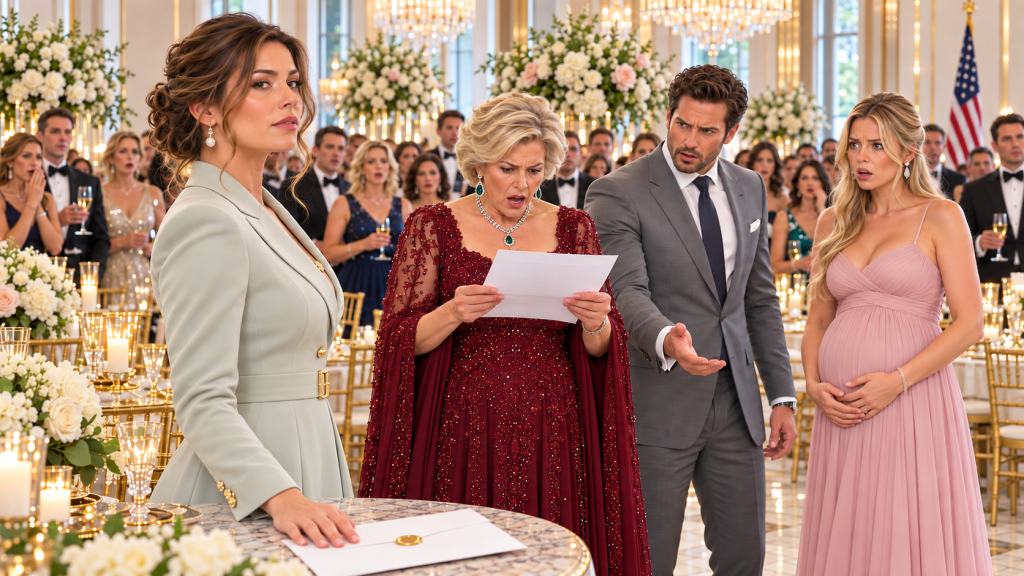
Margaret spotted me from across the ballroom.
Her expression changed instantly.
She crossed the room so quickly that two servers stepped aside.
“What are you doing here?”
“Good evening, Margaret.”
“I told you not to come back.”
“You did.”
“This is a private event.”
“No.”
Her eyes narrowed.
“What?”
“This is private property.”
“It is my home.”
“Not anymore.”
For the first time, uncertainty flickered across her face.
Then it vanished.
“You’re being ridiculous.”
Ethan appeared behind her.
Vanessa stood beside him.
She wore a pale silver gown.
Her hand rested over the small curve of her stomach.
I looked at her.
For months, I had imagined confronting her.
I thought I would hate her.
In person, I mostly felt tired.
Vanessa looked nervous.
Not triumphant.
Ethan stepped closer.
“I told you not to come.”
“And I told you I needed to deliver something.”
Security appeared near the doorway.
Margaret noticed them.
“Remove her.”
No one moved.
Margaret turned.
“I said remove her.”
The head of security looked uncomfortable.
“Mrs. Whitmore, we received updated property authorization this afternoon.”
Margaret stared at him.
“From whom?”
He looked at me.
Her face changed.
Only slightly.
But I saw it.
I walked toward the central table.
More guests had stopped talking.
Even the orchestra faltered.
I placed the sealed envelope beside a tower of champagne glasses.
“This celebration is over.”
Margaret laughed loudly.
“You have always had a flair for melodrama.”
“Open it.”
“I’m not participating in this.”
“Then Ethan can.”
Ethan stepped forward.
“What is it?”
“Open it.”
Margaret snatched the envelope.
She tore it open.
The first page was the recorded deed notice.
Her eyes moved rapidly across the text.
Then stopped.
“That’s impossible.”
Ethan leaned over her shoulder.
I watched the color leave his face.
Margaret flipped to the next page.
Then the next.
“No.”
Her voice was softer now.
“What is this?”
Daniel stepped forward.
“A notice of trust activation, confirmation of controlling interest, and temporary suspension of unauthorized use of Whitmore Development funds.”
A murmur moved through the room.
Ethan stared at me.
“You planned this.”
“No.”
“You planned all of this.”
“I prepared for it.”
He looked at the papers again.
Then he pulled the gold wedding ring from his hand.
Our wedding ring.
He had still been wearing it at the party celebrating another woman.
He stared at it as though he had forgotten it existed.
Then his fingers opened.
The ring struck the marble floor.
The tiny sound seemed louder than the orchestra.
Vanessa looked down.
“You’re still wearing your wedding ring?”
Ethan blinked.
“That isn’t important.”
Her expression hardened.
“You told me you stopped wearing it months ago.”
“Vanessa—”
“You said the marriage was only paperwork.”
Margaret snapped.
“This is not the time.”
Vanessa turned toward her.
“You told me the same thing.”
Guests were openly watching now.
Margaret lowered her voice.
“Claire, whatever childish satisfaction you’re getting from this, you will regret it.”
I looked around the ballroom.
At the flowers.
At the champagne.
At the ice sculptures.
At eight hundred thousand dollars spent celebrating a future financed partly by money taken from a company that had recently delayed bonuses for construction workers.
“This party was paid for with corporate funds,” I said.
Margaret froze.
Ethan’s head snapped toward me.
Daniel removed another document.
“We have invoices.”
I continued.
“Flowers billed as client landscaping.”
The florist near the doors looked horrified.
“Catering billed as executive hospitality.”
Another murmur.
“Music billed as brand development.”
Ethan stepped toward me.
“Stop.”
“And Vanessa’s engagement ring?”
Vanessa looked at him.
“What about my ring?”
I met her eyes.
“It was purchased through an LLC funded from Whitmore Development.”
She slowly looked down at the enormous diamond on her hand.
“No.”
Ethan rubbed his forehead.
“Claire, you’re twisting legitimate expenditures.”
Daniel spoke.
“Eleven-point-six million dollars in questionable transfers are currently under independent review.”
The room went silent.
Margaret turned to Ethan.
“Eleven million?”
He said nothing.
“Ethan.”
“Mom, not here.”
“Eleven million dollars?”
“Some of it was business.”
“Some?”
Vanessa stepped away from him.
“What transfers?”
Ethan looked around.
“This is exactly what Claire wants. She wants everyone fighting.”
I stared at him.
“No. I wanted you to stop stealing.”
His face changed.
“Be careful.”
“Why?”
“You don’t understand the accounts.”
“I understand them better than you thought.”
Margaret grabbed my arm.
“Come upstairs.”
I pulled free.
“No.”
Her face went rigid.
“We are not discussing private family business in front of strangers.”
I looked around.
“These aren’t strangers. Half of them are investors.”
That landed.
Several men near the fireplace exchanged looks.
A woman from the Whitmore board set down her champagne.
Margaret’s confidence started cracking.
“Everyone,” she announced loudly, forcing a smile, “there has clearly been a misunderstanding. Please continue enjoying yourselves while we deal with a personal matter.”
Nobody moved.
Then Vanessa spoke.
“Was my apartment paid for with company money?”
Ethan stared at her.
“Vanessa.”
“My apartment.”
“Not exactly.”
Her face went white.
“What does that mean?”
“The company owns the unit.”
“You told me you bought it.”
“I arranged it.”
“And the car?”
Ethan said nothing.
Vanessa laughed once.
A broken sound.
“Oh my God.”
Margaret stepped between them.
“Enough.”
But it was too late.
Vanessa pulled the ring from her finger.
“Did you even pay for this?”
Ethan reached for her.
She stepped back.
“Don’t touch me.”
“Vanessa, think about the baby.”
Her eyes flashed.
“I am thinking about the baby.”
Margaret looked at me with pure hatred.
“You did this.”
“No, Margaret.”
I shook my head.
“You all did.”
Daniel handed her the final page.
Margaret barely looked at it.
“What now?”
“Formal notice to vacate.”
Her mouth opened.
“What?”
I felt every eye in the room.
But suddenly, I didn’t care.
“You put my suitcases on the sidewalk this morning,” I said.
“So I’m returning the courtesy.”
“You cannot throw me out of my home.”
“I’m not.”
Her face brightened for half a second.
Then I continued.
“You have thirty days under the occupancy agreement created by Thomas’s trust.”
The satisfaction vanished.
“You knew Thomas did this?”
“No.”
“Liar.”
“I learned today.”
Margaret turned toward Daniel.
“You helped him betray me?”
Daniel’s expression stayed neutral.
“Mr. Whitmore established the trust voluntarily.”
“He was sick.”
“He was legally competent.”
“I was his wife.”
“Yes.”
“This house is mine.”
“No,” Daniel said.
“It isn’t.”
Margaret stared at him as though he had struck her.
Then something unexpected happened.
A man near the back of the ballroom began walking forward.
Arthur Dale.
Thomas’s oldest friend.
He had served on the Whitmore board for thirty-two years.
Arthur stopped beside me.
“Margaret.”
She looked at him.
“You knew?”
Arthur nodded.
“Thomas told me.”
Her face collapsed.
“When?”
“Years ago.”
“And you said nothing?”
“It wasn’t mine to tell.”
Margaret looked around the room.
“Did everyone know except me?”
Arthur’s expression softened.
“No. Thomas wanted the documents private unless something triggered the trust.”
Margaret pointed at me.
“She triggered it.”
Arthur shook his head.
“No.”
He looked at Ethan.
“He did.”
Ethan’s face hardened.
“Stay out of this, Arthur.”
Arthur ignored him.
“Your father warned you repeatedly about treating the company like your personal account.”
“You have no idea what you’re talking about.”
“I was present when he amended the trust.”
That silenced Ethan.
Arthur continued.
“Thomas loved you, son. But he was afraid you confused inheritance with entitlement.”
Ethan’s eyes filled with anger.
“You all worship Claire because she played nurse for eight months.”
I felt something inside me finally break.
Not painfully.
Cleanly.
I walked toward him.
“I drove your father to rehabilitation because you said mornings were inconvenient.”
He looked away.
“I sat with him during scans because Margaret hated hospitals.”
Margaret flinched.
“I brought him food after therapy because he couldn’t hold a fork properly.”
“Stop.”
“And while he was learning to walk again, you asked him to sign voting shares over to you.”
“I said stop.”
His voice echoed through the ballroom.
I did.
For once, Ethan had everyone’s attention.
But not the kind he wanted.
He looked around the room.
His life was collapsing publicly.
Exactly the thing he feared most.
Reputation.
Appearance.
Control.
He turned to me.
“What do you want?”
The question surprised me.
“What?”
“Money?”
“No.”
“The company?”
“No.”
“The house?”
“No.”
“Then what?”
I thought about seven years.
The insults.
The quiet betrayals.
The fertility clinics.
The excuses.
The loneliness.
And Thomas’s letter.
“Accountability.”
Ethan laughed bitterly.
“That’s not an answer.”
“It’s the only one you’re getting.”
Vanessa suddenly sat down.
A woman beside her rushed over.
“Are you all right?”
“I’m fine.”
She pressed a hand to her forehead.
“Just dizzy.”
Ethan moved toward her.
Vanessa raised her hand.
“No.”
“Vanessa.”
“Claire.”
Everyone looked at me.
Vanessa swallowed.
“Did you know about me before you filed for divorce?”
“Yes.”
“How long?”
“Six months.”
Her eyes filled.
“He told me you’d been separated for over a year.”
My anger shifted.
Not disappeared.
Shifted.
“What?”
Ethan closed his eyes.
Vanessa looked at him.
“You said you lived in separate bedrooms.”
“We did sometimes.”
“For three years?”
“No.”
“You said she knew about us.”
I stared at Ethan.
He looked trapped.
Vanessa’s voice trembled.
“You told me Claire wanted the divorce.”
I almost laughed.
Not because it was funny.
Because suddenly I saw it.
Vanessa hadn’t walked into the marriage believing she was destroying it.
Ethan had built two realities.
One for each of us.
Margaret stepped in.
“Vanessa, tonight is emotional. You should rest.”
Vanessa turned toward her.
“You knew.”
Margaret didn’t answer.
“You knew Claire didn’t know.”
“Vanessa—”
“You knew.”
Margaret’s silence was enough.
Vanessa stood.
She removed the diamond ring and placed it on the table.
“I’m leaving.”
Ethan grabbed her wrist.
“Don’t.”
She pulled away.
“Do not touch me.”
“Where are you going?”
“Anywhere you aren’t.”
“What about us?”
Vanessa looked at him.
“There is no us until I know what is true.”
She walked toward the door.
Margaret called after her.
“Think carefully about what you’re doing.”
Vanessa stopped.
Turned.
And said something Margaret clearly never expected.
“I am.”
Then she left.
The orchestra had completely stopped playing.
Guests were beginning to leave.
Some quietly.
Some after whispering to one another.
Margaret looked around at the collapsing party.
“No.”
Her voice was barely audible.
“No, no, no.”
She hurried toward the event planner.
“Tell them to keep serving dinner.”
The woman stared at her.
“Mrs. Whitmore…”
“Serve dinner.”
“Most guests are leaving.”
“Then stop them.”
The woman looked helpless.
Margaret spun around.
“Arthur, say something.”
Arthur buttoned his jacket.
“I think the evening is finished.”
Margaret stared at the flowers.
The champagne.
The disappearing crowd.
Eight hundred thousand dollars of performance dissolving in twenty minutes.
Then she looked at me.
“I hope you’re satisfied.”
I thought I would be.
For months, I imagined this moment.
Margaret humiliated.
Ethan exposed.
Everyone seeing what they had done.
But satisfaction wasn’t what I felt.
Relief was.
The difference mattered.
“I’m done,” I said.
I turned toward the door.
Ethan followed me.
“Claire.”
I kept walking.
“Claire.”
Outside, the air was cold.
I reached the steps before he caught up.
“Wait.”
I turned.
For the first time that day, Ethan looked genuinely lost.
Not angry.
Not arrogant.
Lost.
“What happens now?”
I almost couldn’t believe the question.
“You’re asking me?”
“The company.”
“There will be an independent audit.”
“And me?”
“The board decides.”
“You control the board.”
“I control enough votes to require the audit.”
His jaw tightened.
“You could remove me.”
“Yes.”
“Will you?”
“If the evidence supports it.”
He laughed bitterly.
“So this is revenge.”
“No.”
“You’re taking everything.”
“I’m protecting what your father asked me to protect.”
He stared at me.
“My father chose you over me.”
“No.”
I stepped closer.
“Your father gave you dozens of chances.”
That hurt him.
I could see it.
“He never trusted me.”
“He loved you.”
“Same difference.”
“No.”
I shook my head.
“It isn’t.”
For a moment, we were no longer enemies.
Just two people who had once promised forever and failed.
Ethan looked toward the house.
“Did you ever love me?”
The question surprised me more than anything else that night.
“Yes.”
He swallowed.
“Do you still?”
I thought carefully.
“No.”
His eyes closed.
It was cruel only because it was true.
“I don’t know when it ended,” I continued.
“Maybe when I found the messages. Maybe before that. Maybe every time you watched your mother hurt me and asked me not to make a scene.”
He looked down.
“I should have defended you.”
“Yes.”
“I was weak.”
“Yes.”
He almost smiled.
“You don’t have to agree that quickly.”
“I’m done protecting you from accurate descriptions.”
That actually made him laugh.
A small, exhausted laugh.
Then he looked at the wedding ring still visible through the ballroom doors, lying on the marble floor.
“I don’t know why I kept wearing it.”
“I do.”
He looked at me.
“You wanted Vanessa without becoming the man who betrayed his wife.”
His face tightened.
“But taking off the ring would have forced you to admit who you had become.”
He looked away.
Neither of us spoke for several seconds.
Then I walked down the steps.
“Claire.”
I stopped.
“I am sorry.”
I turned.
Maybe he meant it.
Maybe he only meant that consequences had arrived.
Either way, I didn’t need to decide.
“I hope someday you understand what you’re apologizing for.”
Then I left.
The audit began Monday morning.
By Wednesday, Ethan was placed on administrative leave.
By Friday, three independent investigators were reviewing Whitmore Development’s finances.
The eleven-point-six million dollars became fourteen-point-two.
Then sixteen.
Hidden consulting agreements.
Inflated vendor contracts.
Personal travel.
Luxury apartments.
Cars.
Gifts.
Not all of it was illegal.
Enough of it was questionable.
And some of it was very clearly fraudulent.
Margaret called me seventeen times the first week.
I answered once.
“You destroyed this family,” she said.
“No.”
“You poisoned Thomas against us.”
“He created the trust before his final illness.”
“He was manipulated.”
“By whom?”
Silence.
Then she changed tactics.
“You cannot possibly want this house.”
“I don’t.”
“Then give it back.”
“No.”
Her voice rose.
“Why?”
“Because the property is collateral protecting employee pension obligations.”
That silenced her.
Thomas had done more than protect a mansion.
He had tied the property into a structure that prevented Ethan or Margaret from borrowing against it without trustee approval.
They had believed it belonged to them.
In reality, Thomas had used it as a shield.
“What happens to me?” Margaret asked quietly.
“You have thirty days.”
“Where am I supposed to go?”
“You own two apartments.”
“That is not the same.”
“No.”
I looked around my hotel room.
“It isn’t.”
She hung up.
Two weeks later, Vanessa contacted me.
I almost ignored the call.
Then I answered.
“Hello?”
“Claire?”
“Yes.”
“It’s Vanessa.”
“I know.”
She hesitated.
“I wanted to apologize.”
I sat down.
“For what?”
“For believing him.”
“That isn’t something you owe me an apology for.”
“I still should have asked questions.”
“Yes.”
She accepted that without argument.
“I thought your marriage was over.”
“It almost was.”
“He said you refused to leave because you wanted money.”
I laughed softly.
“Of course he did.”
Vanessa was quiet.
“I’m keeping the baby.”
“That’s your choice.”
“I know.”
“And Ethan?”
“I don’t know.”
There was something in her voice.
Fear.
“I found more lies.”
“What kind?”
“He said he opened a savings account for the baby.”
My stomach tightened.
“And?”
“It has my name on paperwork I never signed.”
That was no longer personal.
“Send everything to Daniel.”
“Your lawyer?”
“Yes.”
“Why would you help me?”
I thought about it.
“Because your baby didn’t do anything wrong.”
She began crying.
Quietly.
“I hated you,” she admitted.
“I know.”
“He made you sound horrible.”
“I probably sounded convenient.”
“I’m sorry.”
This time, I accepted it.
“Thank you.”
Vanessa’s documents uncovered another trail.
Ethan had created multiple accounts using authorizations that appeared to contain forged signatures.
The situation moved quickly after that.
The board terminated him.
Several lenders filed claims.
Regulators became involved.
Whitmore Development survived only because Thomas’s trust prevented Ethan from pledging the core assets.
Arthur became interim chairman.
I accepted a temporary trustee role.
Not CEO.
Not president.
I had no desire to run the company.
My condition was simple.
Protect employees.
Sell unnecessary luxury assets.
Repay what could be repaid.
Build independent oversight.
Margaret called that betrayal.
The employees called it Tuesday.
That taught me something.
The wealthy often describe accountability as catastrophe because they rarely experience consequences in ordinary proportions.
For everyone else, it is simply life.
A month after the party, I returned to the mansion.
Margaret’s moving trucks were outside.
She stood in the foyer surrounded by boxes.
For once, she wore no diamonds.
She looked older.
Not weak.
Just human.
“I suppose you came to watch,” she said.
“No.”
“Then why are you here?”
“To collect Thomas’s personal letters.”
She looked toward the library.
“He left everything to you.”
“No.”
“Enough.”
She turned away.
I followed her into the library.
The room smelled exactly as I remembered.
Leather.
Wood.
Old books.
Thomas used to sit beside the window reading financial reports with handwritten notes covering the margins.
Margaret touched the back of his chair.
“He loved this room.”
“Yes.”
For several minutes, neither of us spoke.
Then she said, “I loved him.”
“I know.”
“You think I only cared about money.”
“I think money became the way you measured security.”
She looked at me sharply.
“Don’t analyze me.”
“Then don’t ask what I think.”
To my surprise, she laughed.
A real laugh.
Small and bitter.
“Thomas liked that about you.”
“What?”
“You answered the question people actually asked.”
She sat in his chair.
“I hated that.”
“I know.”
She looked around.
“When Ethan was born, we had almost nothing. People forget that.”
I said nothing.
“Thomas built everything. Then suddenly everyone wanted access to him. Politicians. Investors. Strangers pretending to be friends.”
Her fingers traced the armrest.
“I learned very quickly that if we looked powerful, people treated us differently.”
“And eventually looking powerful became more important than being decent.”
Her eyes lifted.
“That sounds like something Thomas would say.”
“It is.”
That hurt her.
I regretted it immediately.
Not because it was false.
Because some truths are unnecessary weapons.
“I’m sorry,” I said.
She looked surprised.
“For what?”
“That was cruel.”
Margaret stared at me.
Then something changed in her face.
Maybe because I had apologized.
Maybe because no one in that house had done it often enough.
“I was cruel to you,” she said.
I waited.
“For years.”
“Yes.”
“I thought you made Ethan weak.”
“He managed that himself.”
She almost smiled.
Then she looked down.
“I thought if he married someone ambitious enough, polished enough…”
“Rich enough?”
“Yes.”
“At least you’re admitting it.”
“You embarrassed me.”
“How?”
“You didn’t care about the same things.”
“That embarrassed you?”
“You wore department-store dresses to dinners with billionaires.”
“They were comfortable.”
“You drove your own car.”
“I still do.”
“You worked after marrying Ethan.”
“I liked my work.”
“That was the problem.”
I stared at her.
She continued.
“You never needed this family as much as I wanted you to.”
For the first time, I understood Margaret.
Not forgave.
Understood.
“You wanted dependence.”
“I wanted loyalty.”
“You confused them.”
She looked toward the window.
“Yes.”
The admission was so quiet I almost missed it.
Then she asked, “What are you going to do with the house?”
“Sell it.”
Her face changed.
“To whom?”
“I don’t know.”
“You can’t.”
“Why?”
“Because it’s Whitmore House.”
“It’s a building.”
“It is history.”
“It costs almost nine hundred thousand dollars a year to maintain.”
“That’s not the point.”
“It is when the company laid off sixty-three workers last year while Ethan approved renovations to the wine cellar.”
Margaret had no answer.
“The sale proceeds will stabilize the pension reserve.”
“You’re selling my home to pay strangers.”
“Employees.”
“Strangers.”
“People who built your family’s wealth.”
She looked away.
I picked up Thomas’s letters.
At the door, Margaret stopped me.
“Claire.”
I turned.
“If Thomas trusted you so much, why didn’t he simply leave everything to you?”
“Because he wasn’t trying to reward me.”
“What was he doing?”
“Building a brake.”
“A brake?”
“For your family.”
She stared at me.
Then nodded slowly.
“That sounds like him.”
Three months later, Whitmore House was sold to a private foundation.
Not another billionaire.
Not a developer.
A foundation.
They turned part of the property into a conference center and donated the west wing to a regional arts program.
Margaret hated the idea.
Then she discovered they planned to keep Thomas’s library intact.
She stopped complaining.
The sale funded the company pension reserve and paid several overdue contractor claims.
The extravagant ballroom where Margaret had celebrated Ethan’s “new future” became a scholarship fundraising hall.
There was something poetic about that.
Ethan faced civil claims and criminal investigation for the falsified financial documents.
He avoided prison after cooperating, returning assets, and accepting a plea connected to financial misconduct.
His reputation vanished.
His expensive friends vanished faster.
For the first time in his adult life, he lived in a two-bedroom rental apartment.
Vanessa did not marry him.
But she allowed him to be present for the birth of their daughter.
They named her Lily.
I learned that from Rebecca, who learned everything whether I wanted to know it or not.
“Do you want to see a picture?” she asked.
I hesitated.
Then nodded.
Lily had dark hair.
Tiny hands.
A serious little expression.
I felt something I hadn’t expected.
Not jealousy.
Not grief.
Peace.
“She’s beautiful,” I said.
Rebecca watched me carefully.
“You okay?”
“Yes.”
And I was.
My own miscarriages had once felt like locked doors.
For years, I believed motherhood was the room behind them.
Eventually, I learned grief does not disappear when life changes.
It simply stops controlling every hallway.
Six months after the divorce, I moved into a small house near the river.
Three bedrooms.
A porch.
A kitchen that needed renovating.
No ballroom.
No family crest.
No security gate.
I loved every inch of it.
On my first night there, Rebecca arrived carrying pizza and cheap champagne.
She looked around.
“This is aggressively normal.”
“Thank you.”
“No marble.”
“None.”
“No chandeliers?”
“Kitchen light.”
“No room specifically designed for storing wine?”
“Cabinet.”
She raised her glass.
“To poverty.”
“I’m still technically wealthy.”
“To emotionally healthy moderate wealth.”
“Better.”
We laughed.
Later that night, after Rebecca left, I sat alone on the porch.
My phone buzzed.
A message from Ethan.
I’m sorry to bother you. I found something of yours in storage.
A photograph appeared.
My mother’s recipe book.
I had thought it was lost during the move.
I replied.
Please leave it with Daniel.
A few minutes later:
Okay.
Then another message.
Claire?
I waited.
Thank you for not taking everything.
I stared at the words.
He still didn’t understand.
Maybe he never would.
I typed:
I didn’t take anything, Ethan. I stopped you from taking more.
I sent it.
He never replied.
A year after the divorce, Whitmore Development announced its first profitable quarter under new leadership.
Employee retirement contributions were fully restored.
Arthur retired.
I resigned as trustee after the board appointed independent governance.
At the final meeting, Arthur handed me a small wooden box.
“Thomas wanted you to have this if the company survived.”
Inside was an old brass key.
I looked at him.
“What does it open?”
“Nothing anymore.”
I laughed.
“Helpful.”
“It was the original key to Whitmore House.”
I ran my thumb across the metal.
“He kept it?”
“Since 1978.”
“Why give it to me?”
Arthur smiled.
“He said you would understand.”
I didn’t.
Not immediately.
That night, I read Thomas’s letter again.
Preserve the people who worked to build it.
Then I understood.
The key wasn’t about ownership.
It was about stewardship.
Doors.
Access.
Responsibility.
For years, Margaret believed the mansion represented power because she controlled who could enter.
Ethan believed the company represented power because he controlled the accounts.
I had spent years believing marriage meant staying inside a house where I was barely welcome.
All of us had misunderstood something.
Nothing is truly yours simply because your name appears on it.
A home is defined by safety.
A marriage by trust.
A company by the people who build it.
A family by what its members protect when protecting one another becomes inconvenient.
Two years after the night of the party, I received an invitation.
Not from Ethan.
From Vanessa.
Lily was turning two.
I stared at the card for several minutes.
There was a handwritten note inside.
No pressure. She knows your name because someday I want her to understand the truth about the people who protected her future.
I almost didn’t go.
Then I did.
The party was held in a public park.
Folding tables.
Paper decorations.
Cupcakes.
Children running through grass.
The entire event probably cost less than Margaret’s floral arrangements at the mansion.
Vanessa saw me first.
She smiled nervously.
“Hi.”
“Hi.”
Lily was sitting on a blanket wearing a yellow dress.
Ethan stood several yards away talking to another father.
He saw me.
His expression changed.
Then he nodded.
I nodded back.
That was enough.
Margaret sat beneath a tree.
She wore a simple blue dress.
No diamonds.
When she noticed me, her eyebrows rose.
“You came.”
“I was invited.”
“So was I.”
“I assumed.”
She looked toward Lily.
“She has Thomas’s eyes.”
I smiled.
“I never know what people mean when they say babies have someone’s eyes.”
Margaret laughed.
“You still say irritating things.”
“You still invite them.”
She patted the chair beside her.
I sat.
We watched Lily destroy a cupcake.
After a while, Margaret said, “I volunteer now.”
I turned.
“What?”
“At the arts foundation.”
“The one in the mansion?”
She sighed.
“Yes.”
I tried not to smile.
“Don’t.”
“I didn’t say anything.”
“You were about to.”
“What do you do?”
“Fundraising.”
“That makes sense.”
“And tours.”
I stared at her.
“You give tours of your old house?”
“Apparently people find my stories interesting.”
“That must be strange.”
“It was horrible at first.”
She watched Lily.
“Then it wasn’t.”
I nodded.
People can survive losing almost anything except the belief that they cannot survive it.
Margaret had lost the mansion.
Ethan had lost the company.
I had lost the marriage.
Yet there we were.
Alive.
Different.
Less impressive, perhaps.
More real.
Ethan eventually walked over.
“Claire.”
“Ethan.”
He looked healthier.
Not richer.
Healthier.
“I heard you started consulting.”
“I did.”
“That’s good.”
“So I’m told.”
Awkward silence.
Then Lily ran toward us holding a plastic spoon.
“Daddy!”
Ethan bent down.
She climbed into his arms.
Watching him with her, I saw something I hadn’t expected.
He was gentle.
Present.
Maybe consequences had changed him.
Maybe fatherhood had.
Maybe people were complicated enough to be terrible in one chapter and better in another.
That didn’t erase what he had done.
It didn’t need to.
Forgiveness did not require revision.
Lily looked at me.
“Who you?”
Everyone laughed.
I crouched slightly.
“I’m Claire.”
She considered this.
Then handed me the plastic spoon.
“Cake.”
“Thank you.”
She ran away.
Ethan smiled.
“She likes you.”
“She gave me used cutlery.”
“That’s basically trust at two.”
I laughed.
Then Ethan became serious.
“I never thanked you.”
“For what?”
“For protecting the company.”
I looked at him.
“You hated me for it.”
“I did.”
“And now?”
“Now I know what would have happened if you hadn’t.”
I waited.
He swallowed.
“I was out of control.”
“Yes.”
“I thought money made consequences optional.”
“That sounds familiar.”
He glanced toward Margaret.
“She’s heard me say it.”
Margaret pretended not to listen.
Ethan continued.
“I blamed you because admitting you were right meant admitting Dad was right too.”
I nodded.
“I figured.”
“I’m sorry.”
This time, the apology felt different.
Not because I needed it.
Because he finally understood it.
“Thank you.”
He looked surprised.
That was all I said.
Thank you.
No dramatic forgiveness.
No reunion.
No promise that everything was healed.
Some relationships deserve distance even after anger disappears.
I left the party before sunset.
On the drive home, I thought about the morning of the divorce.
My suitcases on the sidewalk.
Margaret’s cream silk.
Ethan refusing to look at me.
The announcement about Vanessa.
The eight-hundred-thousand-dollar celebration.
At the time, it felt like the worst day of my life.
Now I understood that humiliation had been the doorway.
The marriage ending had not ruined me.
It had released me from something I had spent years trying to repair alone.
When I reached my house, I carried groceries inside and opened the windows.
The river smelled like rain.
On a shelf in my office sat Thomas’s old brass key.
Sometimes visitors asked what it opened.
I always gave the same answer.
“Nothing anymore.”
But privately, I knew that wasn’t true.
It opened the last door I had been afraid to walk through.
The door between endurance and freedom.
Between being tolerated and belonging.
Between protecting people who hurt me and protecting myself.
Margaret once believed she could put my suitcases on the sidewalk and erase me.
Ethan once believed signing divorce papers meant he could move forward without ever answering for what came before.
And I once believed losing the Whitmore name meant losing the life I had spent seven years building.
We were all wrong.
The house was never my victory.
The money was never my victory.
Watching Ethan’s empire collapse was never my victory.
My victory was waking up in a home where nobody could tell me I didn’t belong.
It was earning my own money again.
Calling my sister whenever I wanted.
Choosing who entered my front door.
Sleeping without wondering whose messages were lighting up my husband’s phone.
It was realizing that peace is not what remains after you defeat someone.
Peace is what begins when you stop arranging your life around people determined to diminish you.
A few weeks after Lily’s birthday, I received one final envelope.
No return address.
Inside was a photograph.
Thomas, sitting in his library years earlier.
He was smiling.
On the back, in his handwriting, were seven words.
A house means nothing without good people.
I stood there for a long time.
Then I placed the photograph beside the brass key.
That evening, I made dinner.
Opened a bottle of wine.
Turned on music.
And sat on my own porch while the sun disappeared beyond the river.
No orchestra.
No champagne fountain.
No hundred guests.
No diamonds.
No Whitmore crest.
Just quiet.
Freedom.
And a life that finally belonged to me.
I thought about the sealed envelope I had placed on that ballroom table two years earlier.
At the time, I believed I was ending their celebration.
I didn’t realize I was beginning my own.
Not a celebration of revenge.
Not of money.
Not even of winning.
A celebration of choosing myself after years of being told that doing so was selfish.
That was the inheritance Thomas had actually left me.
Not a mansion.
Not voting shares.
Permission to walk away from people who believed love meant surrender.
And once I understood that, I never surrendered myself again.
💬THE END! THANK YOU FOR READING!