

My dad left Hawaii at twenty years old and never went back.
For most of my life, that fact had been little more than a family mystery.
He talked about Hawaii the way some people talk about a first love.
Not constantly.
Not dramatically.
Just often enough that you understood part of him had never really left.
Sometimes I would come downstairs early in the morning and find him sitting at the kitchen table before sunrise, coffee cooling beside his hand, staring at an old photograph.
The picture showed a beach.
Golden sand.
Dark green mountains.
A crooked line of palm trees bending in the wind.
Dad never told me exactly where it was.
Whenever I asked, he’d smile in that quiet way of his.
“The rain is warm there,” he once told me.
I had been thirteen.
I remember sitting across from him eating cereal while he turned the faded photograph over between his fingers.
“What does that even mean?” I laughed.
“It means you don’t run from it,” he said.
“From rain?”
“From Hawaii rain.”
He smiled.
“You let it fall on you.”
Then his expression changed.
Only for a second.
A shadow crossed his face.
“You can smell the ocean before you see it,” he added.
I leaned forward.
“Why don’t we go someday?”
Dad looked toward the hallway.
My mother was upstairs.
His voice dropped.
“Maybe.”
But we never did.
Every few years, I brought it up again.
Every time, the answer was the same.
Someday.
Maybe next summer.
Maybe when work calmed down.
Maybe when Mom felt ready.
Eventually, I stopped asking.
My mother hated conversations about Hawaii.
She never yelled exactly.
Mom wasn’t a yeller.
She had a way of going quiet that somehow felt worse.
If Dad mentioned Honolulu, her fork would stop moving.
If he talked about surfing as a teenager, she would suddenly remember dishes that needed washing.
If someone on television showed a Hawaiian resort commercial, she changed the channel.
Once, when I was sixteen, I finally asked her why.
“Why does it bother you so much when Dad talks about home?”
Mom stared at me for several seconds.
“This is his home.”
“I know. I just mean where he grew up.”
“He chose his life here.”
I remember hearing something wounded in her voice.
I didn’t understand it.
“He misses it,” I said.
Her mouth tightened.
“People can miss places without needing to go backward.”
Dad walked into the room before I could answer.
Mom left.
I turned to him.
“Why does Hawaii upset her?”
He sighed and pulled out the chair beside me.
“Your mother loves deeply.”
“That doesn’t answer my question.”
“No.”
“Then answer it.”
He looked at me for a long time.
“Try to understand your mother, Annie.”
“Understand what?”
He reached over and squeezed my hand.
“If you knew the whole story, you wouldn’t be angry with her.”
That sentence stayed with me for years.
I always assumed there had been another woman.
Some teenage girlfriend Dad had loved before Mom.
Maybe Mom had discovered old letters.
Maybe there had been some dramatic breakup.
Whatever it was, Dad clearly believed silence kept the peace.
And because I adored him, I let him keep the secret.
I was always Daddy’s girl.
I told him everything.
My first crush.
My first heartbreak.
The time I cheated on a chemistry quiz and felt so guilty I confessed before the teacher even noticed.
The night I failed my driver’s test.
The morning I quit a job I hated.
When my college boyfriend proposed and I wasn’t sure whether I loved him enough to say yes, Dad sat with me on the back porch for three hours and never once told me what to do.
He just listened.
That’s what Dad did best.
He made you feel safe enough to tell the truth.
Which made it strange that he kept something so enormous from me.
Two weeks ago, Dad was driving home from work when a pickup truck crossed the center line.
The police officer who came to our door used words like immediate and no suffering.
I hated those words.
People think they’re comforting.
They’re not.
They only make the impossible sound official.
One minute my father existed.
The next minute he didn’t.
There was no hospital bedside.
No final conversation.
No goodbye.
Just a knock at the door.
Mom collapsed against the hallway wall.
I caught her before she hit the floor.
For the next ten days, our house filled with casseroles, sympathy cards, flowers, neighbors, distant cousins, coworkers, and people I didn’t recognize telling me stories about my father.
Everyone knew a version of Daniel Kealoha Bennett.
Only later did I realize none of us knew all of him.
The funeral was on a Saturday.
By Tuesday morning, the flowers had begun to wilt.
Mom barely slept.
Neither did I.
I was standing in the kitchen staring at Dad’s favorite coffee mug when the doorbell rang.
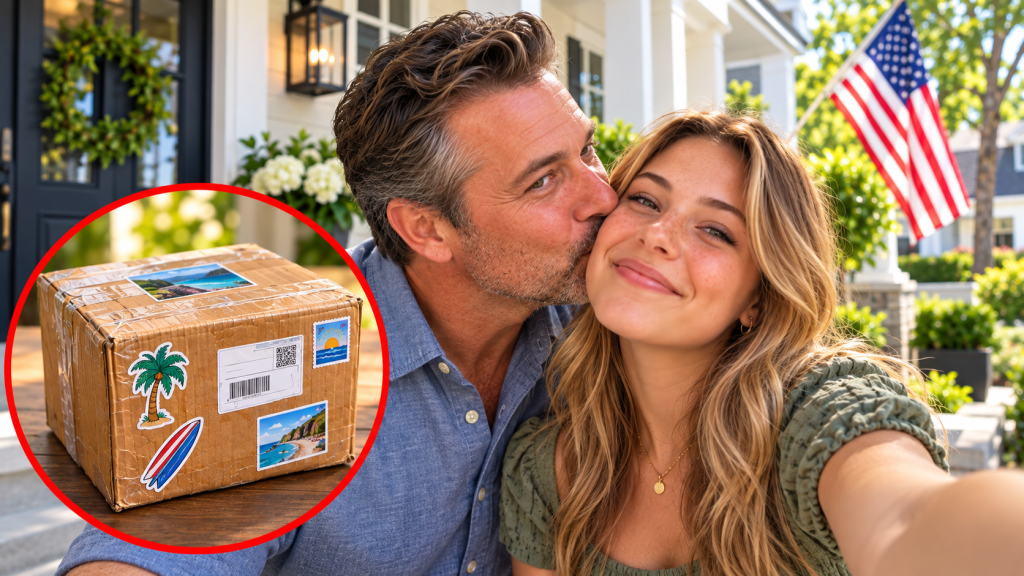
The mail carrier stood outside beside a large cardboard box.
“Package for Daniel Bennett.”
Hearing Dad’s name spoken like he might still walk downstairs made my chest tighten.
“He passed away,” I said.
The carrier’s expression changed immediately.
“I’m so sorry.”
He glanced at the label.
“This was shipped before… before that.”
I signed for it anyway.
The box was heavy.
Much heavier than I expected.
The postmark said Honolulu.
Three days before Dad’s accident.
There was no return address.
I carried it into the kitchen.
Mom was sitting at the table wearing one of Dad’s old sweatshirts.
She looked up.
The moment she saw the box, all the color drained from her face.
Not sadness.
Fear.
Pure fear.
“Where did you get that?”
“It just came.”
“From where?”
“Hawaii.”
Mom stood so fast her chair scraped across the tile.
“Leave it, Annie.”
I stared at her.
“Mom?”
“Please.”
She came toward me and grabbed my wrist.
Her hand was ice cold.
“Throw it away.”
“What?”
“Take it outside. Put it in the trash. Don’t open it.”
I actually laughed because what she was saying made so little sense.
“Mom, it’s addressed to Dad.”
“I can see that.”
“Someone mailed this before he died.”
“I know.”
That answer stopped me.
“You know?”
Her fingers tightened.
“Annie, please. Just this once, don’t ask questions.”
My heartbeat changed.
“Who sent it?”
She looked away.
“Throw it away.”
“No.”
“Please.”
“Mom, somewhere in Hawaii someone might be waiting for Dad to answer them. They might not even know he’s dead.”
Her eyes filled with tears.
“I said leave it alone.”
I pulled free.
“I can’t.”
“Annie.”
“I can’t throw away something meant for him.”
I found a pair of scissors in the drawer.
Mom covered her mouth.
I cut the tape.
She whispered my name once.
I opened the box.
The first thing I saw was a photograph.
Dad was standing barefoot on a beach.
He looked impossibly young.
Maybe nineteen.
Maybe twenty.
His hair was longer than I’d ever seen it.
He was laughing.
Beside him stood a beautiful young woman with dark hair blowing across her face.
She was holding a newborn baby.
Dad had one arm around her shoulders.
His other hand rested protectively over the baby’s blanket.
For several seconds, I couldn’t breathe.
I lifted the photograph.
On the back, someone had written:
For Daniel. She deserves to know you someday.
My eyes moved toward Mom.
“Who is this?”
She didn’t answer.
“Mom.”
Her lips trembled.
“Close the box.”
“Who is this baby?”
“Annie.”
“Who?”
She sank into the chair.
I looked back inside.
Beneath the photograph was a bundle of old letters tied with blue ribbon.
A hand-carved wooden frame.
A small velvet pouch.
I opened the pouch.
Inside was a silver bracelet.
One word had been engraved into it.
Leilani.
My skin prickled.
“Who is Leilani?”
Mom began crying.
Not loudly.
She just folded in on herself.
“Your father promised me this was over.”
“What was over?”
She looked at the photograph.
Then at me.
“Before your father met me, he left someone behind in Hawaii.”
“A girlfriend?”
Her eyes closed.
“No.”
I stared at her.
“What do you mean, no?”
She opened her eyes.
“A family.”
The room tilted.
I actually gripped the counter.
“What?”
“Your father had a daughter.”
The words didn’t make sense.
I heard them.
I understood each one individually.
But together they felt impossible.
“No.”
Mom nodded through tears.
“Yes.”
I looked at the baby in the photograph.
“That baby?”
“Yes.”
“She’s Dad’s?”
“Yes.”
I sat down.
My knees had stopped cooperating.
I stared at the photograph again.
Dad.
The woman.
The baby.
He looked happy.
Not trapped.
Not frightened.
Happy.
“What was her name?”
“Leilani.”
I looked at the bracelet.
“His daughter?”
Mom nodded.
“How old?”
“She’d be…”
Mom swallowed.
“Forty-three now.”
Forty-three.
I was thirty-two.
My father had a daughter eleven years older than me.
A sister.
Somewhere in Hawaii, I had a sister.
“You knew.”
It wasn’t really a question.
Mom lowered her eyes.
“You knew this entire time.”
“I knew before we got married.”
I pushed back from the table.
“How?”
“Your father told me.”
“And you made him abandon her?”
Mom flinched.
“No.”
“Then what happened?”
“It’s complicated.”
“Don’t.”
My voice came out sharper than I intended.
“Please don’t say that. Not today. Not after Dad died without telling me he had another daughter.”
Mom pressed both hands against her face.
“He didn’t abandon her because of me.”
“Then why did he leave?”
She hesitated.
That hesitation told me the truth was worse.
“Mom.”
“He believed she wasn’t his.”
I frowned.
“What?”
“Her mother told him she wasn’t his.”
I looked at the photograph again.
The young woman beside Dad looked maybe eighteen.
“Who was she?”
“Her name was Nalani.”
The name sounded familiar somehow.
Maybe because Dad had once mentioned a childhood friend named Nala and then immediately changed the subject.
Mom continued.
“Your father and Nalani grew up together. Same neighborhood. Same school. Their families knew each other.”
“Were they together?”
“From the time they were seventeen.”
I said nothing.
“She became pregnant when they were nineteen.”
“And Dad thought the baby was his.”
“Yes.”
“Then why would she tell him otherwise?”
Mom looked toward the window.
“Because she wanted him to leave.”
“That makes absolutely no sense.”
“It didn’t make sense to him either.”
Mom’s voice was softer now.
“Daniel had been accepted into a technical apprenticeship program in Oregon. It was everything he had been working toward. He planned to turn it down because Nalani was pregnant.”
I stared at her.
“She didn’t want him to.”
“So she lied?”
“Yes.”
I felt anger rising.
“She told him he’d been cheated on just to make him leave?”
“That’s what your father believed.”
“For how long?”
“Eleven years.”
I froze.
“What happened after eleven years?”
Mom looked at me.
“She wrote to him.”
My stomach tightened.
“What did she say?”
“That Leilani was his daughter.”
I looked at the box.
The letters.
The bracelet.
“You read the letter?”
“Daniel showed me.”
“When?”
“You were a baby.”
The room went silent.
I was suddenly aware of the refrigerator humming.
Rain tapping faintly against the kitchen window.
My father’s empty chair.
“You knew when I was a baby.”
Mom nodded.
“What did Dad do?”
“He wanted to go back.”
There it was.
The thing she’d feared all these years.
Not Hawaii.
Not nostalgia.
He wanted to go back.
“He wanted to meet her,” Mom whispered. “Of course he did.”
“And you stopped him.”
Her expression broke.
“I begged him not to.”
I stood.
“Why?”
“Because I was terrified.”
“Of what?”
“Everything.”
She wiped her cheeks.
“I had just given birth to you. I was exhausted. I wasn’t sleeping. Your father had been working double shifts because we barely had enough money. Then one afternoon, this letter arrived from Hawaii saying he had an eleven-year-old daughter.”
“His daughter.”
“I know.”
“You keep saying it like it was some problem dropped into your marriage.”
“It felt like one then.”
I shook my head.
“That’s horrible.”
“Yes.”
Her answer stopped me.
She didn’t defend herself.
She just said yes.
“I was twenty-seven years old, Annie. I was scared, jealous, and selfish. I imagined him flying back to Hawaii, seeing Nalani, remembering the life he’d had there, and realizing he’d made a mistake marrying me.”
“So you told him not to go.”
“I begged him.”
“And he listened.”
“For a while.”
I turned toward her.
“What does that mean?”
“He wrote to Leilani.”
My anger faltered.
“He did?”
“Every month.”
I looked at the bundle of letters in the box.
“These?”
“No. Those must be different.”
“Did he meet her?”
Mom shook her head.
“Not then.”
“Why?”
“Nalani died.”
I stared.
“When?”
“Less than a year after she contacted him.”
My anger suddenly shifted into something heavier.
“How?”
“Cancer.”
Mom folded her arms around herself.
“She’d been sick for years. Apparently that’s why she finally told him the truth.”
“And Leilani?”
“She went to live with Nalani’s older sister.”
“Did Dad keep writing?”
“Yes.”
“For how long?”
Mom’s face twisted.
“Until Leilani stopped answering.”
“When?”
“When she was fourteen.”
I did the math.
Three years.
My father had discovered he had a daughter, written to her for three years, and then she disappeared from his life.
“Why did she stop?”
“We never knew.”
“You never knew, or Dad never knew?”
Mom’s eyes lifted to mine.
“Your father never knew.”
That distinction mattered.
I walked back toward the box.
Under the bundle of letters was another envelope.
My name was written across it.
Annie.
The handwriting was unfamiliar.
My hands started trembling.
Mom saw it.
“No.”
I picked it up.
“Don’t.”
“It’s addressed to me.”
“Annie, please.”
“For thirty-two years, everybody has decided what I should and shouldn’t know.”
I tore it open.
Inside were four pages.
The first line made my knees weak.
Dear Annie,
If you are reading this, then my father either received the package or someone close to him opened it first.
My father.
I kept reading.
My name is Leilani Makoa.
I believe I am your sister.
I had known that before opening the letter.
Still, seeing the words made it real in a way nothing else had.
I sat down.
Mom remained frozen across from me.
The letter continued.
I have started and stopped writing this more times than I can count.
I don’t know what your father told you about me, if anything.
For most of my childhood, I believed he abandoned my mother before I was born.
That wasn’t true.
My mother lied to him because she believed leaving Hawaii would give him a better life.
She regretted it.
She eventually told him the truth when she became sick.
After she died, your father wrote to me often.
I still have every letter.
I was angry.
I was fourteen.
I blamed him for not being there, even though I now understand he didn’t know.
I stopped answering.
Years passed.
Pride has a way of turning one bad year into ten.
Ten became twenty.
I kept waiting for the perfect moment to contact him again.
Then last year, my aunt died.
Before she passed, she gave me a box of things my mother had saved.
Among them were your father’s letters.
Not just the ones he sent me.
Letters he had written to my mother after he left Hawaii.
He had never stopped loving where he came from.
And he never stopped wondering about me.
I had to stop reading.
My eyes blurred.
Dad had wondered about her.
All these years.
“Did you know she was trying to contact him?”
Mom shook her head.
I continued.
There is something else you deserve to know.
Three months ago, I finally called your father.
My head snapped up.
“What?”
Mom’s face changed.
“What did it say?”
I read the line aloud.
“Three months ago, I finally called your father.”
Mom grabbed the edge of the table.
“No.”
I kept reading.
We spoke for two hours.
He cried.
I cried.
He told me about you.
He said you were stubborn, kind, too curious for your own good, and that you made him proud every single day.
A sob escaped me.
That sounded exactly like Dad.
He told me he wanted to come home.
Not permanently.
Just to visit.
He wanted to stand on the beach where he grew up.
He wanted to meet my children.
He wanted you to come with him.
I covered my mouth.
Dad had been planning to take me to Hawaii.
Three months ago.
Why hadn’t he told me?
Then I remembered.
Two months earlier, Dad had asked whether my passport was current.
I thought he was making conversation.
He’d asked if I could take a week off work sometime before Christmas.
I told him probably.
He smiled.
“Good,” he’d said.
That was it.
I had forgotten completely.
I kept reading.
He wanted to tell your mother first.
He said there were old wounds he needed to handle carefully.
We agreed that I would send him this package containing photographs and letters.
He planned to show everything to you after he spoke with her.
I don’t know whether he has done that.
That was why Mom had gone pale.
She understood the box immediately.
Dad hadn’t forgotten Hawaii.
He hadn’t closed the door.
He had finally opened it again.
There was one more paragraph.
If he is reading this, I hope he knows I forgive him.
If you are reading it, Annie, I hope you understand something I learned too late:
Our father didn’t abandon me.
He was young.
People lied.
People were afraid.
And silence did the rest.
If you ever want to contact me, my phone number is below.
I would like to know my sister.
I lowered the letter.
Neither Mom nor I spoke.
Finally she whispered, “He called her.”
I nodded.
Mom looked crushed.
“He didn’t tell me.”
“He planned to.”
She closed her eyes.
“He was going to leave.”
“No.”
“How do you know?”
“Because the letter says he wanted to visit.”
“He wanted Hawaii.”
“Mom.”
“He always wanted Hawaii.”
“That doesn’t mean he didn’t want us.”
“You don’t understand.”
“No, I think I’m finally beginning to.”
She looked at me sharply.
“For years, you’ve treated Dad missing where he came from like it was an insult to you.”
Her mouth opened.
I continued.
“He couldn’t mention his childhood without you getting upset. He couldn’t talk about the ocean. He couldn’t talk about food. He couldn’t talk about home.”
“This was his home.”
“He had two homes.”
Mom looked away.
“Maybe that’s what scared you.”
She started crying again.
But this time, I didn’t soften.
Not yet.
“Did you ever ask him to stop contacting Leilani?”
The silence answered before she did.
“Mom.”
“Yes.”
My chest tightened.
“After Nalani died?”
“Yes.”
“Why?”
“Because every letter changed him.”
“What does that mean?”
“He would receive one and disappear emotionally for days. He felt guilty. He wanted to fix something that couldn’t be fixed.”
“She was a child.”
“I know.”
“His child.”
“I know.”
“Did you make him choose?”
“No.”
“Did you?”
“I never used those words.”
“That’s not what I asked.”
Mom’s shoulders dropped.
“I told him I didn’t know how our marriage would survive if he kept living half his life in Hawaii.”
I stared at her.
“So yes.”
She covered her face.
“Yes.”
The anger came fast.
“You made him stop writing to his daughter.”
“No. She stopped answering first.”
“And when she did, you were relieved.”
Mom said nothing.
“Say it.”
“I was.”
I turned away because suddenly I couldn’t stand looking at her.
Dad had spent years telling me to understand Mom.
Now I understood why.
Because he knew I’d be furious.
I walked into the living room.
Dad’s funeral flowers covered almost every surface.
His photograph stood on the mantel.
He was smiling.
He looked so ordinary.
So familiar.
How could someone I knew so well have carried an entire lost family inside him?
Mom followed.
“Annie.”
I didn’t turn around.
“Did he resent you?”
The question hurt me to ask.
Mom stopped.
“For asking him to let her go?”
Silence.
“Did he?”
“I don’t know.”
“You were married thirty-four years.”
“I know.”
“You must know.”
Mom began to speak, stopped, then tried again.
“Your father wasn’t cruel.”
“That’s not an answer.”
“He never threw it in my face.”
“That’s definitely not an answer.”
She sank onto the couch.
“There were moments.”
I finally turned.
“What moments?”
“Birthdays.”
“Whose?”
“Leilani’s.”
Of course he remembered.
“Every February, he’d get quiet.”
I sat in the armchair opposite her.
“He knew her birthday.”
“He never forgot.”
Mom looked toward Dad’s photograph.
“Sometimes I’d wake up and find him downstairs writing letters he never mailed.”
My throat tightened.
“Why didn’t he mail them?”
“He didn’t know where she lived.”
“What happened to the letters?”
“I don’t know.”
I suddenly thought of Dad’s office.
We hadn’t cleaned it yet.
After the funeral, I’d closed the door and left everything exactly as he had it.
I stood.
Mom watched me.
“Where are you going?”
“His desk.”
Dad’s office smelled like cedar and coffee.
His reading glasses still lay beside the computer.
A legal pad contained a grocery list.
Bananas.
Light bulbs.
Oil filter.
Nothing prepares you for how ordinary the possessions of a dead person remain.
I opened drawers.
Tax forms.
Pens.
Receipts.
Instruction manuals.
Then I remembered the locked bottom drawer.
Dad always kept important documents there.
I knew where the key was.
Inside an old ceramic mug shaped like a lighthouse.
I unlocked it.
The drawer contained a thick manila folder.
Across the front, Dad had written one word.
Leilani.
I sat on the floor.
Mom appeared in the doorway.
She saw the folder and froze.
Inside were copies of every letter he had sent.
Dozens.
Then hundreds.
Some were typed.
Others handwritten.
The earliest dated back thirty years.
The most recent was from three weeks ago.
He had never stopped writing.
He simply stopped mailing them.
I opened one from when Leilani was fifteen.
Dear Lei,
Today Annie took her first steps.
I wish you could have seen it.
Then guilt punched me because immediately afterward I wondered what your first steps looked like.
I don’t know.
I wasn’t there.
There are so many things about your childhood I will never know, and I am sorry in a way words probably cannot fix.
I hope someday you believe that not knowing about you was not the same as not loving you.
My eyes filled.
Mom sat on the floor beside me.
I opened another.
Leilani was twenty-one.
Dear Lei,
You’d be old enough to order a drink today.
I don’t know whether you drink.
I don’t know whether you went to college.
I don’t know what music you like.
I don’t know whether you’ve fallen in love.
Sometimes I imagine meeting you in a grocery store and not recognizing my own daughter.
That thought destroys me.
Mom made a broken sound.
I opened the most recent letter.
Three weeks before Dad died.
Dear Lei,
After thirty-two years, I finally heard your voice again.
You sound like your mother when you laugh.
I had forgotten how much that would hurt.
I don’t mean bad hurt.
Some pain is proof that love survived.
I know Annie doesn’t know about you yet.
I am going to tell her.
I should have told her years ago.
That failure belongs to me.
Not Susan.
Not Nalani.
Me.
I spent too much of my life believing silence kept people safe.
It didn’t.
It only made the truth heavier.
I think I’m finally ready to carry it into the light.
I stopped reading.
Mom was crying beside me.
Dad had protected her even in the letter.
Not Susan.
He had written.
Not Mom.
He had taken responsibility.
I looked at her.
“He didn’t blame you.”
She shook her head.
“That almost makes it worse.”
For the first time since opening the box, my anger loosened.
Not disappeared.
Just loosened.
Mom touched one of the letters.
“I was afraid all the time.”
“Of losing him?”
“Yes.”
“Did you really think he’d leave you?”
“No.”
She laughed through tears.
“That’s the ridiculous part.”
She wiped her face.
“Your father never gave me any reason to think that.”
“Then why?”
“Because some part of him was homesick in a way I couldn’t fix.”
I waited.
“When we first met, Daniel talked about Hawaii constantly. The mountains. His grandmother’s cooking. Fishing with his cousins. He’d light up.”
Her expression softened.
“I loved that about him.”
“Then what changed?”
“I started thinking if he loved it that much, Oregon would never be enough.”
“Or you.”
She nodded.
“Or me.”
I looked down at the letter.
“Mom, loving one thing doesn’t mean loving something else less.”
“I know that now.”
“Did Dad know you knew that?”
Her face crumpled.
“I don’t know.”
That was the cruelest thing grief does.
It leaves you with questions nobody can answer.
Three days later, I called Leilani.
I stared at the number for almost an hour first.
Mom sat across the kitchen but didn’t speak.
Finally, I pressed call.
It rang twice.
A woman answered.
“Hello?”
My throat closed.
“Is this Leilani?”
Silence.
Then:
“Yes.”
“My name is Annie Bennett.”
Another silence.
Longer.
“Oh my God.”
Her voice broke.
“Oh my God, Annie.”
Neither of us knew what to say.
We started crying almost immediately.
Two strangers.
Two sisters.
Connected by a man who had spent half his life wishing we knew each other.
“I need to tell you something,” I said.
She already knew.
I heard it in the way she inhaled.
“He died, didn’t he?”
I closed my eyes.
“Two weeks ago.”
Leilani began sobbing.
Not politely.
Not quietly.
The sound came through the phone raw and deep.
“I waited too long.”
“No.”
“I had thirty years.”
“You called him.”
“Three months.”
“You had three months.”
“I thought we had more time.”
“So did I.”
That silenced both of us.
Because that was grief in one sentence.
We all thought we had more time.
Leilani told me Dad called every Sunday after their first conversation.
She told me about their plans.
He wanted to fly over in November.
He wanted to see the beach from the old photograph.
He wanted to visit his parents’ graves.
He wanted to eat shave ice from the stand he’d loved as a teenager.
He wanted to meet Leilani’s husband.
And her children.
Dad had grandchildren.
Three of them.
My nieces and nephew.
Malia, seventeen.
Noah, fourteen.
And Daniel, nine.
She’d named her youngest son after our father.
When she told me that, I cried again.
Then Leilani said something unexpected.
“He wanted Susan to come.”
I looked at Mom.
“What?”
“He said eventually, maybe not the first trip, but someday he wanted your mother to come too.”
Mom’s hand flew to her mouth.
“He said that?”
“Yes.”
I put the phone on speaker.
Leilani continued.
“He told me your mother had been afraid of Hawaii for years.”
Mom closed her eyes.
“He said he wanted her to finally see it wasn’t a place trying to steal him back.”
A tear slid down Mom’s face.
“He said it was just part of him.”
Mom whispered, “Daniel.”
Leilani heard.
“Is she there?”
“Yes.”
Another silence.
Mom looked terrified.
More terrified than she’d looked opening the box.
“Hello, Susan,” Leilani said.
Mom couldn’t answer at first.
Then:
“Hello, Leilani.”
No anger came through the phone.
That surprised me.
Mom seemed to expect it too.
“I owe you an apology,” Mom said.
Leilani exhaled slowly.
“Probably.”
Mom almost laughed.
It came out as a sob.
“I was jealous of a child.”
“You were afraid.”
“That doesn’t excuse it.”
“No.”
“I asked your father to close a door he never should have closed.”
Leilani was quiet.
Finally she said, “He told me.”
Mom looked stunned.
“He did?”
“He didn’t hide things from me after we reconnected.”
Mom bowed her head.
“What else did he say?”
“That you loved him.”
That made Mom cry harder.
“He said you were young and scared. He also said he made his own choices.”
“That’s what he always said.”
“Then maybe believe him.”
Mom covered her face.
Leilani continued.
“I spent years blaming him for something my mother started. Then years blaming myself for not answering his letters. If we’re going to do this, I don’t want another generation of women carrying blame that belongs to the past.”
I looked at Mom.
She looked at me.
Something changed in the room.
Not forgiveness exactly.
Not yet.
But space opened.
A little room to breathe.
We talked for almost three hours.
I learned Leilani was a high school guidance counselor.
She lived outside Hilo.
She hated papaya.
Loved old soul music.
Cried during dog food commercials.
Had Dad’s laugh.
The first time she laughed on the phone, I knew immediately what Dad had meant.
It was his.
Exactly.
That startled me more than the photograph.
I asked whether she resembled him.
She texted a picture.
I gasped.
Same eyes.
Same eyebrows.
Same slight tilt of the head.
It felt like seeing Dad alive inside another person.
Over the next week, we spoke every day.
Sometimes for ten minutes.
Sometimes for hours.
Then she asked the question I’d been both hoping for and dreading.
“Will you come?”
I looked at the old beach photograph propped against Dad’s coffee mug.
“When?”
“Whenever you’re ready.”
I looked toward Mom.
She had heard.
Her face tightened automatically.
Then she caught herself.
For thirty-four years, fear had trained her body faster than thought.
Finally she said:
“Go.”
I stared at her.
“What?”
“You should go.”
Her voice shook.
“Your father wanted you to see it.”
Three weeks later, I landed in Honolulu.
The moment the airplane doors opened, warm air wrapped around me.
Dad had been right.
Even in the airport, the air felt different.
Softer.
Heavier.
Alive.
Leilani met me near baggage claim.
I knew her before she waved.
She stood beside a tall man and three children.
When our eyes met, neither of us moved.
Then she smiled.
Dad’s smile.
I dropped my suitcase.
She crossed the distance between us.
We hugged.
I expected awkwardness.
There wasn’t any.
I cried into the shoulder of a sister I’d never met.
She cried into mine.
Her daughter Malia joined us.
Then Noah.
Then little Daniel.
By the time her husband hugged me too, everyone was laughing and crying at once.
“You look like him,” I told Leilani.
“So do you.”
That surprised me.
People always said I looked like Mom.
Leilani touched my cheek.
“You have his expression when you’re trying not to cry.”
I laughed.
“Great. Thanks.”
“There it is.”
“What?”
“His laugh.”
And somehow that undid me all over again.
The next morning, Leilani drove me to the beach from Dad’s photograph.
It wasn’t a famous tourist beach.
No hotels.
No crowds.
Just black volcanic rock, golden sand, palms, and mountains rising green in the distance.
Clouds moved overhead.
Then rain began falling.
Warm rain.
I stood perfectly still.
Leilani watched me.
“My dad told me something about this.”
“What?”
“He said Hawaii rain is warm.”
She smiled.
“Sometimes.”
“He said you don’t run from it.”
Her eyes filled.
“That sounds like him.”
So we stood there.
Two daughters of the same man.
Rain soaking our hair and clothes.
Neither of us moved.
And Dad was right about something else too.
You could smell the ocean before you saw it.
Salt.
Wind.
Flowers.
Wet earth.
It felt less like discovering a place and more like recognizing something I had somehow inherited.
Leilani walked me toward a cluster of trees above the beach.
“There.”
A weathered wooden bench faced the water.
Dad’s name had been carved beneath the seat.
DANIEL KEALOHA.
I stared at it.
“Who did this?”
“My grandfather.”
“His father?”
She nodded.
“After Dad left.”
I ran my fingers over the letters.
“Why?”
“He always believed Daniel would come home.”
My throat tightened.
“He never did.”
“No.”
Leilani looked at the sea.
“But you did.”
That afternoon, we visited the house where Dad grew up.
It belonged to Leilani now.
Her aunt had left it to her.
The paint was newer.
The kitchen had been remodeled.
But the porch was original.
Leilani showed me pencil marks inside a closet where Dad’s height had been measured as a child.
Daniel, age 9.
Daniel, age 12.
Daniel, age 16.
I touched the marks.
For the first time, my father existed as a boy in my mind.
Not Dad.
Daniel.
Someone’s son.
Someone’s brother.
A teenager who ran barefoot down these roads.
Someone who loved a girl named Nalani.
Someone who thought he was going to become a father at twenty.
Someone who had his heart broken so thoroughly that he boarded a plane and never came back.
Leilani brought out another box.
“This was my mother’s.”
Inside were Dad’s letters from Oregon.
I read one written six months after he left.
Nalani,
I don’t know why I’m writing because you told me the baby isn’t mine.
Maybe I’m stupid.
Maybe I’m still trying to make something true that isn’t.
But I keep waking up thinking I hear a baby crying.
I keep wondering whether she has my eyes.
I hope whoever her father is understands how lucky he is.
I couldn’t finish.
“He always suspected,” I whispered.
Leilani nodded.
“My mother knew.”
“Why didn’t she tell him sooner?”
“Guilt.”
Leilani looked toward the window.
“At first she thought she had done the right thing. Dad got the apprenticeship. He built a career. Then years passed.”
“Did she ever plan to contact him?”
“Many times.”
“So everyone waited.”
“Pretty much.”
We looked at each other.
Families could be destroyed by cruelty.
But ours had been damaged mostly by fear.
Fear and good intentions.
Maybe that was harder.
Because there was no villain simple enough to hate.
Nalani lied because she wanted Dad to have opportunities.
Dad stayed away because he thought he wasn’t wanted.
Mom feared losing him.
Dad stayed silent to protect Mom.
Leilani stopped writing because she was angry.
Then pride carried the silence another twenty-eight years.
Everyone believed waiting was safer.
Nobody understood that waiting was making decisions for them.
On my fifth day in Hawaii, Mom called.
“How is it?”
The question sounded difficult for her.
I looked out from Leilani’s porch.
“It’s beautiful.”
Mom was quiet.
“I knew you’d say that.”
“That doesn’t mean Oregon isn’t home.”
“I know.”
I smiled slightly.
“Do you?”
“I’m trying.”
I told her about Dad’s childhood house.
The beach.
The bench.
The letters.
I expected some part of her to retreat.
Instead she asked questions.
“What color was the house?”
“Blue.”
“He always said it was green.”
“Apparently his father repainted it.”
“Did you find the mango tree?”
I paused.
“What mango tree?”
“Behind the house.”
I walked to the kitchen window.
There it was.
Huge.
“How did you know?”
Mom laughed softly.
“Your father drew that stupid tree on every birthday card for twenty years.”
I hadn’t known.
Then Mom said:
“Annie.”
“Yeah?”
“I think I want to come.”
I turned away from the window.
“To Hawaii?”
“Yes.”
I didn’t say anything.
She rushed on.
“Not because I think I’m entitled to anything. I know Leilani may not want me there. I just…”
Her voice broke.
“I spent most of my marriage being afraid of a place I’d never seen.”
I swallowed.
“And now?”
“Now Daniel’s gone.”
Silence.
“I want to meet the part of him I kept pretending didn’t matter.”
I spoke to Leilani.
She thought about it overnight.
Then she said yes.
Mom arrived four days later.
I met her at the airport alone.
She looked terrified walking through the terminal.
Almost immediately, she started crying.
“What?”
I asked.
“The smell.”
“What smell?”
She laughed.
“The flowers.”
Apparently Dad had once told her the first thing he’d noticed when returning from school trips between islands was the smell of flowers in the airport.
I hadn’t known that story.
Mom had.
That’s when I began understanding something important.
I knew Dad deeply.
But I didn’t know every version of him.
Mom knew pieces I didn’t.
Leilani knew pieces I didn’t.
Nalani had known pieces none of us ever would.
Love does not give one person ownership over another person’s whole story.
That evening, Mom and Leilani met.
No dramatic confrontation.
No screaming.
No accusations.
Just two women standing on a porch.
Mom spoke first.
“I’m sorry.”
Leilani nodded.
“I know.”
“I don’t expect forgiveness.”
“I didn’t invite you here because I hate you.”
Mom started crying.
Leilani stepped forward and hugged her.
Mom froze.
Then hugged back.
Later, while the sun went down, they talked without me.
I went walking with Malia along the beach.
When I returned, both women had clearly been crying.
But something between them had softened.
The following morning, we took Dad’s ashes to the beach.
He had never left instructions about what he wanted done with them.
Maybe because he thought he had more time.
We decided to divide them.
Half would stay with Mom in Oregon.
Half would remain in Hawaii.
At sunrise, all of us walked down toward the water.
Leilani carried the urn.
Mom carried the faded photograph.
I carried Dad’s newest letter.
The one he had written after speaking to Leilani.
We stood where Dad had once stood at twenty.
The same mountains were behind us.
The same ocean in front.
Forty-three years had passed.
We opened the urn.
Mom held some of the ashes in her palm.
Her hands shook.
“I’m sorry I kept you away,” she whispered.
Wind moved through her hair.
“You should have come back sooner.”
She released the ashes.
They scattered across the water.
Leilani cried beside her.
Then it was my turn.
I held a small amount.
For several seconds, I couldn’t open my fingers.
This was my father.
The man who taught me to ride a bicycle.
The man who packed my lunches.
The man who waited outside my first apartment while I cried after a breakup.
The man who never missed a birthday.
The man who told me every truth except the one he was most afraid would hurt me.
I looked toward the horizon.
“You were right, Dad.”
Everyone looked at me.
“The rain really is warm.”
Leilani laughed through tears.
Then the rain started.
Barely anything.
Just a mist.
Mom looked upward.
For once, she didn’t retreat from it.
None of us did.
We stayed there until our clothes were damp.
Until the sunrise cleared the clouds.
Until the ocean carried Dad home.
That night, I opened the final item from the original package.
The hand-carved wooden frame.
I had almost forgotten about it.
Inside was another photograph.
This one was recent.
Dad and Leilani.
Together.
I stared at it.
“When was this taken?”
Leilani came over.
“Three months ago.”
I looked at her.
“You met him?”
She nodded.
My shock must have shown.
“He didn’t tell you?”
“No.”
“He flew to Seattle for a work conference.”
I remembered.
Dad had been gone four days.
“He asked me to meet him there.”
My eyes filled.
“He saw you.”
“For one day.”
She smiled sadly.
“We had coffee. Walked by the water. Talked for nine hours.”
I touched Dad’s face in the picture.
“He looks happy.”
“He was.”
“Why didn’t he tell us?”
“He wanted to tell Susan himself first. Then he wanted to tell you properly.”
Leilani took something from her pocket.
“A week after we met, he mailed me this.”
It was a small envelope.
Inside was a handwritten note.
If I lose my nerve, remind me that my daughters deserve the truth more than I deserve comfort.
My daughters.
Plural.
I pressed the paper against my chest.
For so long, I had thought Dad’s secret meant there was some hidden life where we mattered less.
The truth was the opposite.
He had loved too many people and convinced himself silence would prevent them from hurting each other.
It didn’t work.
But love had been there all along.
When Mom and I returned to Oregon, we brought copies of the photographs.
Leilani kept Dad’s old letters.
I kept the most recent one.
Mom framed the picture of Dad and Leilani from Seattle.
She placed it on the mantel beside our family photographs.
The first time I saw it there, I stopped.
“You put this up?”
Mom nodded.
“He shouldn’t have to be divided anymore.”
Those words mattered.
A lot.
Months have passed now.
Leilani and I talk every Sunday.
Apparently Dad had chosen a tradition for us without realizing it.
Malia is applying to colleges in Oregon.
Noah sends me terrible memes.
Little Daniel calls me Aunt Annie and has decided I’m responsible for buying him a surfboard when he turns ten.
Mom sometimes joins our video calls.
It’s still awkward.
But healing usually is.
Last week, I found Mom sitting at the kitchen table.
Dad’s old beach photograph was in her hands.
For a moment, I was thirteen again.
“What are you thinking about?” I asked.
She smiled.
“Your father.”
“Anything specific?”
“How stubborn he was.”
I laughed.
“He’d say you were worse.”
“He’d be right.”
She turned the photograph over.
Then she handed it to me.
On the back was something I’d never noticed before.
Faint writing.
Dad’s handwriting.
Home is not the place where you choose one life over another.
Home is where the people you love finally know the whole truth.
I read it twice.
“Was that always there?”
Mom nodded.
“When did he write it?”
“Years ago.”
“Why didn’t you show me?”
She looked toward Dad’s empty chair.
“I think I was still learning what it meant.”
I placed the picture back on the table.
Outside, Oregon rain streaked the windows.
Cold rain.
Nothing like Hawaii.
Mom looked at me.
“You going back?”
“At Christmas.”
She nodded.
Then, after a moment:
“Save me a seat.”
I smiled.
“I will.”
Dad spent forty-three years believing that part of his life had been lost.
It wasn’t.
It was waiting.
Waiting inside a cardboard box.
Inside old photographs.
Inside letters nobody mailed.
Inside two daughters who didn’t know each other existed.
Inside a wife who had to learn that love wasn’t something you protected by closing doors.
And inside an ocean that had never forgotten him.
Sometimes I still get angry.
At Dad for not telling me sooner.
At Mom for letting fear rule so much of our family.
At Nalani for telling the first lie.
At Leilani for letting pride keep her silent.
At myself for never asking Dad one more question.
But anger isn’t the only thing the truth gave me.
It gave me a sister.
Three children who call me Aunt Annie.
A beach where my father’s ashes became part of the place he never stopped missing.
And a version of Dad that is larger, more complicated, and somehow more human than the man I thought I knew.
I used to believe secrets protected families.
Dad believed that too.
So did Mom.
Now I think secrets are more like rooms with locked doors.
You can live beside them for years.
You can decorate around them.
You can pretend they’re empty.
But whatever is inside doesn’t disappear.
It waits.
And one day, someone finds the key.
In our case, the key arrived in a cardboard box from Honolulu three days after my father died.
I wish he’d been here when I opened it.
I wish I’d heard the story from him.
I wish he could have stood on that beach with both his daughters beside him.
I wish he could have watched Mom finally step into the warm rain without being afraid.
But life doesn’t always give you the ending you wanted.
Sometimes it gives you the truth too late.
And asks you what you’re going to do with it.
We chose not to hide it again.
We chose to call.
To travel.
To apologize.
To forgive.
To keep the photographs on the mantel.
To say Leilani’s name at the dinner table.
To say Hawaii without anyone going quiet.
And sometimes, when rain hits the kitchen windows, I make coffee and sit in Dad’s chair.
I hold the old beach photograph in my hands.
And I can almost hear him.
The rain is warm there.
You can smell the ocean before you see it.
He was right.
About Hawaii.
About Mom.
About how difficult the whole truth would be.
And maybe, in the end, he was right to believe we could survive it too.
Because the package didn’t destroy our family.
It showed us how much of our family had been missing.
💬THE END! THANK YOU FOR READING!